

For many visitors to China, airports may be where Chinese signs are first seen. This chapter will sample some signs that are commonly seen at airports, including those for customs, terminals, departure lounges, boarding gates, baggage reclaims, and transportation options. Most of the airport signs are bilingual with English translations. Therefore, only the character-by-character glosses will be given.
Most of the signs in this chapter are seen at the Pudong International Airport in Shanghai.

Figure 5.1 International arrival
国际港澳台到达 guójì gǎng ào tái dàodá
international Hong Kong Macau Taiwan arrive reach
港澳台 are abbreviations for 香港, 澳门 and 台湾respectively. Note even though Hongkong and Macau have been returned to China, they are still grouped together with Taiwan and foreign countries.

Figure 5.2 Foreigners
外国人 wàiguórén | outside country person
Does ‘foreigner’ sound as bad as ‘alien’ used in some countries?

Figure 5.3 Customs
中国海关 zhōngguó hǎiguān
middle country sea pass

Figure 5.4 To terminal
至 zhì | to
航站楼 hángzhànlóu | navigate station building
至 is classical for到 (note its left component 至).

Figure 5.5 Distance and time to boarding gate
至登机口距离及时间 zhì dēngjīkǒu jùlí jí shíjiān
to board airplane opening distance and time
至 and 及 are classical Chinese for 到 and 和 respectively. 口 ‘opening/mouth’ is used for ‘gate’.

Figure 5.6 Domestic departures
国内出发 guónèi chūfā
country inside out dispatch
内 is classical for 里 ‘inside’. But 国里 is not possible.

Figure 5.7 Self check-in
自助值机 zìzhù zhíjī
self-help duty airplane
(self check-in)
值 seems abbreviated from 值日 ‘be on duty’

Figure 5.8 First-class lounge
69号头等舱候机室
69 hào tóuděngcāng hòujīshì
69 number head class cabin wait airplane room
候 is classical Chinese for 等. But 等机室 is not said. It is also used in 候车室.

Figure 5.9 Baggage check room
行李检查室 xínglǐ jiǎncháshì

Figure 5.10 Baggage claim
领取行李 lǐngqǔ xínglǐ | claim get baggage
国内转机 guónèi zhuǎnjī | country inside transfer airplane

Figure 5.11 Rendezvous point
会合点 huìhé diǎn | meet join point

Figure 5.12 Metro/maglev
地铁 dìtiě | earth iron
磁浮 cífú | magnet float

Figure 5.13 Taxi
出租车 chūzūchē | out rent vehicle
There is also a loanword from English ‘taxi’ 的士. In Taiwan it is also called 计程车 ‘calculate distance vehicle’.

Figure 5.14 Terminal shuttle bus
航站楼摆渡车 hángzhànlóu bǎidùchē
navigate station building ferry vehicle
This is one of the ways to say shuttle bus.

Figure 5.15 Shuttle bus
穿梭巴士 chuānsuō bāshì
巴士 is a loanword from English. The Chinese word is 公共汽车 or 公车 for short. This is another way to say shuttle bus.

Figure 5.16 Local bus
市内巴士 shìnèi bāshì
city in bus
Note 内 is used, not 里.

Figure 5.17 Airport bus tickets
机场巴士售票处 jīchǎng bāshì shòupiàochù
airplane field bus sell ticket place

Figure 5.18 To Downtown
往市区方向 wǎng shìqū fāngxiàng
toward city area direction

Figure 5.19 Parking
停车库 tíngchē kù | stop car garage
This is covered parking, distinct from 停车场 ‘parking lot’.

Figure 5.20 Airport hotel
机场宾馆 jīchǎng bīnguǎn
airplane field guest house

Figure 5.21 Economy cabin
经济舱 jīngjìcāng
United Airlines is 美联航 měi liánháng, which is short for 美国联合航空公司.
Learning Outcomes
a. Gain familiarity with Chinese signs related to air travel.
b. Gain greater awareness of classical Chinese words in public signs.
Suggested Learning Activities
1. Using 机场, 航站楼, 候机, 出发, 登机,行李, and 机场交通, search online for airport signs. You can combine the keywords with specific locations. Type out the signs.
2. Using traditional characters of the keywords, search for signs from regions outside China.
3. What do the classical words 内, 至, 侯, 售, 及, 室, 处mean? Give the non-classical counterparts.
4. Identify the classical Chinese elements 内, 至, 侯, 售, 及, 室, 处 in found signs.
5. If you can, visit an airport in a Chinese-speaking area and take pictures of signs and annotate them.
6. Use the words from signs in this chapter in a written narrative about your arrival or departure from an airport in a Chinese-speaking area.
It is important to bear in mind that hotels and hostels are only infrequently straightforwardly referred to as places of lodging such as 旅馆 or 旅店. They can be misleadingly called 酒店 ‘alcohol shop’ or 饭店 ‘food shop’. In this chapter, only a few hotel and hostel signs will be given. They by no means exhaust all the possible ways in which hotels are named.

Figure 6.1 Wenhai ecology hotel
文海生态旅馆 wénhǎi shēngtài lǚguǎn
This one is called a 旅馆, a plain and unambiguous term to refer to hotels, but it is one of the least commonly used terms.

Figure 6.2 Lake light fashion stylish hotel
潭晖时尚风华旅店 tánhuī shíshàng fēnghuá lǚdiàn
Like 旅馆, 旅店is not misleading, but like 旅馆 it is also not the most commonly used term to refer to hotels. 潭 ‘pond’ refers to the lake日月潭 (Sun Moon Lake), a scenic area in Taiwan.

Figure 6.3 Beiping international youth travel lodge
北平国际青年旅舍 běipíng guójì qīngnián lǚshè
旅舍 is not common either. Note Beijing is spelled in the old way as Peking. A former name of the city 北平 ‘north peace’ is also used.

Figure 6.4 Fast speedy guest house
快捷宾馆 kuàijié bīnguǎn
Despite its haute sounding literal meaning (宾 is used in 贵宾 ‘VIP’) and a somewhat elevated status in mainland China (at least it used to be so), 宾馆 is interpreted rather differently in Taiwan with some hint of seediness.

Figure 6.5 Like home alcohol shop
如家酒店 rújiā jiǔdiàn
As is obvious, this is not a bar, even though it is called 酒店 ‘alcohol shop’. The misleading name, which probably originated in Hong Kong, only started to be used in mainland China in the 1980s to refer to fancier hotels.

Figure 6.6 Purple jade food store
紫玉饭店 zǐyù fàndiàn
As misleading as 酒店 is, the main meaning of 饭店 is hotel and not restaurant. To make it more confusing, while 酒店 cannot be a bar, 饭店 can indeed be a restaurant! Note the right-to-left text orientation, befitting its traditional courtyard setting.

Figure 6.7 Taipei teacher meeting place
台北教师会馆 táiběi jiàoshī huìguǎn
会馆 can also mean gathering place for people from the same place or profession. Or it can refer to exclusive clubs.

Figure 6.8 People dwelling
民宿 mínsù
This is similar to a bed and breakfast.

Figure 6.9 Floral Qinyuan Inn
花筑沁园客栈 huāzhù qìnyuán kèzhàn
The somewhat quaint 客栈 is chosen to suggest old-time charm. This courtyard-style hotel is in Lijiang, a major tourist destination in Southwest China.

Figure 6.10 Rest room
休息房 xiūxi fáng
98 元/三小时 98 yuán/sān xiǎoshí
98 RMB/3 hours
Note this is not a ‘restroom’!
Learning Outcomes
a. Gain familiarity with names of hotels and hostels.
b. Gain awareness of ambiguity in terms referring to hotels and restaurants.
Suggested Learning Activities
1. Use all possible words for hotels and hostels to look up examples online. Type out and translate the signs. Comment on their differences.
2. Use traditional characters to look up examples of hotels and hostels outside mainland China and make comparisons. Type out and translate the signs.
3. Using the terms for hotels and hostels given in this chapter, look them up in a corpus (for example, the BCC corpus http://bcc.blcu.edu.cn/) and compare their frequencies of occurrence. What is the most frequently used term and what is the least frequently used?
4. Which word in this chapter can refer to both restaurants and hotels?
5. Find similarly misleading names of restaurants in Chapter 10.
What are basic services? Apart from the need for food and shelter, getting hydrated (and duly performing ‘bodily function’), getting connected and having access to funds may rank high.
Places for ‘Bodily Function’
Like other languages, there are quite a few terms (including different euphemisms) for toilet in Chinese. The ones sampled here are by no means exhaustive.

Figure 7.1 Public toilet
公共厕所 gōnggòng cèsuǒ
In speech, 公共厕所 may be abbreviated into 公厕 or simply referred to as 厕所.

Figure 7.2 Public toilet
公厕 gōngcè
This is abbreviated from 公共厕所. Note the traditional character for 厕 is slightly different.

Figure 7.3 Wash hand room
洗手间 xǐshǒujiān
This is one of the many euphemisms for ‘toilet’, as is the English translation ‘restroom’.

Figure 7.4 Male hygiene room
男卫生间 nán wèishēng jiān
卫生间 is another euphemism for ‘toilet’.

Figure 7.5 Outhouse
茅房 máofáng | thatched house
Although the term may still be used in rural areas, few if any toilets are actually called 茅房. This is seen at a tourist spot in Taiwan, and it is clearly trying to suggest rustic charm.

Figure 7.6 Hygiene paper
卫生纸 wèishēng zhǐ
This is along the same line as the euphemism for toilet 卫生间.
Getting Hydrated

Figure 7.7 Drinking water
饮用水 yǐnyòng shuǐ | drink use water
Note classical 饮 is used instead of 喝 for ‘to drink’. It is also used in compounds like 饮料 and 饮品. But unlike in Cantonese, it cannot be used by itself for ‘to drink’.

Figure 7.8 Direct drink water
直饮水 zhí yǐn shuǐ
A relatively new thing, water from these fountains can be drunk directly without boiling.
Courtesy Amenities

Figure 7.9 Mother baby room
母婴室 mǔ yīng shì
公园办公室内 gōngyuán bàngōngshì nèi
public garden office inside (inside park office)
母 and 婴 are abbreviated from 母亲 and婴儿respectively. 内 is classical for 里.

Figure 7.10 Baby chair
宝宝椅 bǎobao yǐ
This is a booster chair seen in a Shanghai restaurant.

Figure 7.11 Accessible elevator
无障碍电梯 wú zhàng’ài diàntī
no obstacle electric ladder
无 is classical for 没有.

Figure 7.12 Priority seating
爱心专座 àixīn zhuānzuò
love heart special seat
Note the different ways the same concept is expressed.

Figure 7.13 VIP seat
重点旅客 zhòngdiǎn lǚkè | heavy point travel guest (VIP traveler)
专用座席 zhuānyòng zuòxí | special use seat
Seen on a high-speed train, the juxtaposition of 重点 and 旅客 is somewhat jarring, as 重点 is mostly used for institutions or projects such as 重点中学 ‘key middle school’ and 重点项目 ‘key project’.

Figure 7.14 AC on
空调开放 kōngtiáo kāifàng | air condition open release
欢迎光临 huānyíng guānglín | welcome 请进qǐngjìn | please enter
空调 is the same as 冷气 ‘cold air’ in Hong Kong and Taiwan.

Figure 7.15 Smoking allowed
允许吸烟 yǔnxǔ xīyān
allow inhale smoke
Getting Connected and Charged Up

Figure 7.16 Free Wi-Fi
免费无线上网 miǎnfèi wúxiàn shàngwǎng
Exempt fee no wire go on network

Figure 7.17 Free Wi-Fi
免费网络 miǎnfèi wǎngluò
Exempt fee network

Figure 7.18 Already with Wi-Fi coverage
无线网络已覆盖 wúxiàn wǎngluò yǐ fùgài
No wire network already cover
账号 zhànghào | account number
密码 mìmǎ | secret code
Note the string of 8s for the password! The number 8 bā is an auspicious number due to its sounding like 发 fā ‘get rich’.

Figure 7.19 China mobile
中国移动 zhōngguó yídòng
This is one of the largest cellphone providers in China. 移动 is short for 移动电话 ‘mobile phone’.

Figure 7.20 China Unicom
中国联通 zhōngguó liántōng
China United Communication
联通 is short for 联合通讯 ‘united communication’.

Figure 7.21 Special SIM card vendor
卡号专卖 kǎhào zhuānmài
card number special sell

Figure 7.22 Public telephone
公用电话 gōngyòng diànhuà | public use electric speech

Figure 7.23 Public telephone
公共电话 gōnggòng diànhuà | public share electric speech
Increasingly, these old-style phone booths have been re-purposed. Many have a Wi-Fi sign on them.

Figure 7.24 Charger socket
充电插座 chōngdiàn chāzuò
fill electricity plug base

Figure 7.25 Power outlet
电源插座 diànyuán chāzuò | electricity source plug base
Note the voltage for China is 220v, which is double that of 110v in the United States. Most computer and phone accessories, however, can now accept both 110v and 220v.

Figure 7.26 EV charging station
电动汽车充电站
diàndòng qìchē chōngdiàn zhàn
electric car charging station
Many electric vehicles are now seen on Chinese streets.
Banks and Banking

Figure 7.27 Bank of China
中国银行 zhōngguó yínháng | China silver firm
Note the use of 银 ‘silver’ to refer to money

Figure 7.28 China industry commerce silver firm
中国工商银行 zhōngguó gōngshāng yínháng

Figure 7.29 China construction silver firm
中国建设银行 zhōngguó jiànshè yínháng

Figure 7.30 Communication silver firm
交通银行 jiāotōng yínháng
More than 100 years old, it is the fifth largest bank in China.

Figure 7.31 Shanghai silver firm
上海银行 shànghǎi yínháng

Figure 7.32 Friend benefit silver firm
友利银行 yǒulì yínháng
This is the second largest bank in Korea. It can be found in Chinese cities where Koreans live.

Figure 7.33 Chase bank
大通银行 dàtōng yínháng | big through silver firm
This branch is in Boston’s Chinatown.

Figure 7.34 Non-cash business
非现金业务 fēi xiànjīn yèwù
Note 金 is used for money instead of 钱 in cash 现金.
Also note the use of the classical 非 ‘non’.

Figure 7.35 Exchange
货币兑换 huòbì duìhuàn
currency exchange

Figure 7.36 Self-help banking service
自助银行服务 zìzhù yínháng fúwù

Figure 7.37 Deposit/withdrawal all-in-one machine
存取款一体机 cúnqǔkuǎn yìtǐ jī
deposit withdraw one body machine
Miscellaneous Services

Figure 7.38 Service middle heart
服务中心 fúwù zhōngxīn

Figure 7.39 Food delivery
1小时速达1 xiǎoshí sùdá | 1 hour fast arrive
饿了么 èle me | hungry?
美团外卖 měituán wàimài | Meituan out sell (Meituan take-out)
送啥都快 sòngshá dōukuài | deliver what all fast (all delivery is fast)
仅在饿了么, 美团外卖购物 (饿了么, 美团外卖 purchase only)

Figure 7.40 Fast delivery
快递 kuàidì
无首磅wú shǒu bàng | no head pound
(No first-pound base charge)
无and 首 are classical for 没有, 第一 respectively.

Figure 7.41 Mail drop
邮政信筒 yóuzhèng xìntǒng
postal administration letter cylinder
中国邮政 zhōngguó yóuzhèng
China postal administration
The green cast-iron cylindrical mail collection bin used to be a ubiquitous sight in Chinese cities, but it is no longer very common.

Figure 7.42 High elegant hair salon
高雅发廊 gāoyǎ fàláng
发 is short for 头发. This is a popular hair salon in Boston’s Chinatown.

Figure 7.43 Everyone come shave head shop
大家来剃头店 dàjiā lái tìtóu diàn
剃头 is quite an old-style word for haircut. The more common word is 理发 ‘tidy up hair’. This down-to-earth barbershop is seen in Taiwan.

Figure 7.44 Pleasing housekeeping
悦心家政 yuèxīn jiāzhèng | please heart home admin
Domestic help is very common in China.
Learning Outcomes
a. Gain familiarity with terms of basic amenities and services.
b. Gain greater awareness of the use of euphemisms.
Suggested Learning Activities
1. Using selected key words from this chapter, search online for signs with similar content. Type out the signs and translate them.
2. Using traditional characters to search for signs from regions outside China.
3. Which amenities and services are the most important to you? Which you have not used?
4. What are the most common euphemisms for ‘toilet’ in your area?
This chapter includes some basic signs of location, such as exit and entry, names of cities, and streets of various sizes and styles.
Entry and Exit
Otherwise short and straightforward, they do differ in the use of classical Chinese and in the range of meanings.

Figure 8.1 Entrance
入口 rùkǒu | enter opening

Figure 8.2 Entrance
进口 jìnkǒu | enter opening
These two signs for entrance differ in the first character. One is standard usage, with the classical word 入 for ‘enter’. The other one with 进is not as common, as 进口 can also mean ‘import’.
There is thus an asymmetry: while 进口 may be used for both ‘entrance’ and ‘import’, 入 口cannot be used for ‘import’.

Figure 8.3 Imported food
进口食品 jìnkǒu shípǐn | enter opening food product
Even though 进 and 入 both mean ‘enter’, 入口 cannot mean ‘import’.

Figure 8.4 Exit
出口chūkǒu | out opening
Unlike ‘enter’, there is only one word for ‘go out’
But like 进口, 出口 can also mean ‘to export’.

Figure 8.5 Entrance/Exit
出入口 chūrù kǒu | out enter opening
This sign combines 出口 and 入口. Interestingly, even though 进口 can mean ‘entrance’, 出进口 does not seem possible. Nor is reversing 出入 possible.

Figure 8.6 Pull
拉 lā
Both characters contain the 扌 ‘hand’ radical, which is found in many characters denoting physical action.

Figure 8.7 Push
推 tuī
City Names
There are common elements in the names of cities and regions. One of them is 州 ‘prefecture’. It is used both in China and in other Sino-sphere countries, such as 九州 in Japan (Kyushu) and 新义州 in North Korea (Sinuiju).

Figure 8.8 Four city names
苏州 sūzhōu 常州chángzhōu
无锡 wúxī 扬州 yángzhōu

Figure 8.9 Kowloon and Hong Kong
九龙及香港 jiǔlóng jí xiānggǎng | nine dragon and fragrant harbor
Note classical 及 for 和 ‘and’. The English names are based on the Cantonese pronunciation.
Names of Roads and Streets
There are quite a few words for roads and streets, which vary depending on size, style, and region.

Figure 8.10 Ward Road
华德路 huádé lù
Near the former Jewish refugee area in Shanghai, this road is now called 长阳路. Note the right-to-left text orientation.

Figure 8.11 College Road
大学路西段 dàxué lù xīduàn | college road west section
Note the different romanization system once used in Taiwan.

Figure 8.12 Four roads
金惠路 jīnhuì lù
惠源路 huìyuán lù
锡澄路 xīchéng lù
欣惠路 xīnhuì lù
It is noteworthy that 惠 appears in three of the four road names. It seems the three roads intersect.

Figure 8.13 People’s Avenue pedestrian tunnel
人民大道 rénmín dàdào | people big path
过街地道 guòjiē dìdào | cross street earth path
道 is synonymous with 路. 道路 is a compound word referring to roads. 大道 can also be rendered as ‘boulevard’.

Figure 8.14 Chongqing Street
重庆街 chóngqìng jiē
莺歌镇 yīnggē zhèn | Yingge town
This is a street in the town of Yingge ‘nightingale song’ in Taiwan known for ceramic production.

Figure 8.15 North money string Hutong
北钱串胡同 běi qiánchuàn hútòng
胡同s are narrow residential lanes in Beijing. The word is said to be Mongolian in origin.

Figure 8.16 Dye Cloth Lane
染布巷 rǎnbù xiàng
This is seen in Kunming Yunnan. 巷 is one of the ways to say ‘lane’.

Figure 8.17 Qingyu Road 368 Lane
清峪路368弄 qīngyù lù 368 lòng
弄 has a distinct regional flavor. 弄s are seen everywhere in Shanghai. Note the different word order in the Chinese. The same is true of the format of dates: larger units come first.

Figure 8.18 People’s Square underpass
人民广场地下通道 rénmín guǎngchǎng dìxià tōngdào
people square ground below through path
地下通道 can be abbreviated into 地道.
Learning Outcomes
a. Gain familiarity with common elements in place names.
b. Gain greater awareness of the possibility of multiple meanings of the same word.
Suggested Learning Activities
1. Using 州, search online for names of cities and regions. Type them out and translate.
2. Using 美国 and 州, find out online what 州 means in this context.
3. Using 路, 街, 道, 大道, 弄, 巷, 胡同, search online for road signs. Type them out and translate.
4. Using 出口, search online for examples of both the meanings of ‘exit’ and ‘export’.
5. Find a map of China online and identify some common elements in place names.
6. Find a map of a Chinese city online and identify some common elements in road names.
In China, getting around in and between cities is done mostly by public transportation such as bus, metro, and train. For airport signs, see Chapter 5 ‘Airport and Arrival’.
Trains
The train remains the most popular way for inter-city transportation.

Figure 9.1 Sell ticket machine
售票机 shòupiào jī
信用卡 xìnyòng kǎ | trust use card
金融卡 jīnróng kǎ | finance card
Note 金融卡 for ATM card is quite different in Taiwan from 提款卡 used in Mainland China.

Figure 9.2 Train ticket
检票 jiǎnpiào | check ticket
无锡站 wúxī zhàn | Wuxi station
上海站 shànghǎi zhàn | Shanghai station
二等座 èrděng zuò | second-class seat
This is a cropped image of a train ticket. The name and ID number of the passenger is not shown.

Figure 9.3 Maglev train ticket
上海磁浮列车 shànghǎi cífú lièchē
Shanghai magnet float train
普通票 pǔtōng piào | general ticket
Shanghai’s maglev train was the first in China. Note the non-idiomatic translation of 普通票 as ‘economic class’.

Figure 9.4 Ningbo east station
宁波东站 níngbō dōng zhàn
Very often, 站 is dropped on train timetables.

Figure 9.5 Train to Urumqi
阿拉山口 ālā shānkǒu | Ala mountain pass
乌鲁木齐 wūlǔmùqí | Urumqi
普客pǔ kè | ordinary passenger
This train goes from the China/Kazakhstan border to Urumqi, the capital of Xinjiang Uyghur Autonomous Region. 普客 is short for 普通客车, which is slower than 特快 ‘special fast’.

Figure 9.6 Train to Kunming
开往 kāiwǎng | drive toward 昆明 kūnmíng | Kunming
K9612次 cì | K9612 number 8:38 开 kāi | 8:38 leave
一站台 yī zhàntái | one platform 上车shàngchē | board train
车厢顺序号 chēxiāng shùnxù hào | compartment order number

Figure 9.7 Departure level
出发层 chūfā céng
2F refers to the second floor.

Figure 9.8 Waiting area
候车区 hòuchē qū | wait train zone
候 is the classical word for 等.
But 等车区 is not said.

Figure 9.9 Check in
检票口 jiǎnpiào kǒu | check ticket mouth
(ticket-checking/boarding gate)

Figure 9.10 Train status
车次 chēcì | train number
终到站 zhōngdào zhàn | destination station
开点 kāidiǎn | depart time
检票口 jiǎnpiào kǒu | check ticket gate
状态 zhuàngtài | status
停止检票 tíngzhǐ jiǎnpiào | stop check in
正在检票 zhèngzài jiǎnpiào | checking in
候车 hòuchē | waiting for train
Note all the destinations have 站 omitted.

Figure 9.11 Non-reserved seat
车厢 chēxiāng | train compartment
自由座 zìyóu zuò | free seat
This is on a high-speed train in Taiwan. 自由座 can also be referred to as 自由席.

Figure 9.12 Make up ticket place
补票处 bǔpiào chù
Would there be a penalty for not paying upfront?

Figure 9.13 Exit
出站口 chūzhàn kǒu
out station mouth
Metro/Subway

Figure 9.14 Metro
地铁 dìtiě | ground iron
地铁 is short for 地下铁路 (underground iron road).

Figure 9.15 Shanghai public transportation card
上海公共交通卡 shànghǎi gōnggòng jiāotōng kǎ
The card can be used for all kinds of public transportation.

Figure 9.16 IC card vending/recharging
IC卡售卡/充值 IC kǎ shòukǎ/chōngzhí
IC card sell card/charge value
IC means ‘smart’. 售 is classical for 卖.

Figure 9.17 Metro station
地铁花园桥站 dìtiě huāyuánqiáo zhàn
ground iron flower garden bridge station
6号线 liùhào xiàn | 6 number line

Figure 9.18 Metro station
城站站 chéngzhàn zhàn
Interestingly, the second character in the place name 站 is the same as the word for station. The place may have been named 城站 because there was a station there. So, the station is now called ‘station of town station’.

Figure 9.19 Metro station
微风台北车站 wēifēng táiběi chēzhàn
slight wind Taipei station
This is a stop of the 捷运 ‘speedy transport’ system in Taipei.

Figure 9.20 Entrance/ticket check
进站检票 jìnzhàn jiǎnpiào
enter station check ticket
Even though 入口 is entrance, 入站 does not seem possible here.

Figure 9.21 To Disney
往迪士尼 wǎng díshìní | to Disney
往 can also be 开往 ‘bound for’.

Figure 9.22 Change line
换乘3/9号线 huànchéng 3/9 hào xiàn
change ride 3/9 number line
Note 乘 is used instead of 坐.

Figure 9.23 Metro stop
西藏南路 xīzàng nánlù | South Tibet Road
下一站 xià yī zhàn | down one stop ‘next stop’
鲁班路 lǔbān lù | Luban Road
上一站 shàng yī zhàn | up one stop ‘last stop’
南浦大桥 nánpǔ dàqiáo | South Pu Big Bridge
This is a typical way to indicate the current and adjacent stops.

Figure 9.24 Northwest entrance
西北口 xīběi kǒu | west north mouth
Note the difference between Chinese and English: west north vs. Northwest.
Bus, Taxi


Figure 9.26 Tour bus
大巴士公司 dà bāshì gōngsī | big bus company
香港观光游 xiānggǎng guānguāng yóu | Hong Kong sightsee tour
巴士 is from English ‘bus’.

Figure 9.27 Taxi
的士 díshì
This is from English via Cantonese. Taxi can also be 出租车 ‘rented car’ in mainland and 计程车 ‘metered car’ in Taiwan.

Figure 9.28 Bus stop
25路 lù route 朝阳广场 cháoyáng guǎngchǎng | sun-facing square
(南禅寺 nánchán sì | south zen temple)
首班 shǒubān | first bus 末班 mòbān | last bus
堰桥 yànqiáo | Yan Bridge下站xiàzhàn | next stop: 市民广场: shìmín guǎngchǎng | citizen square
班次间隔 bāncì jiāngé | bus interval 5-15分 fēn | minutes
This is a typical bus stop route map. 首and 末 are classical words for 第一 and 最后respectively.

Figure 9.29 Bus fare
分段计价 fēnduàn jìjià | divide segment calculate price (price by distance)
1元起价 1 yuán qǐjià | 1 yuan start price (starting price 1 yuan)

Figure 9.30 Transportation options
到达层 dàodá céng | arrival level
地铁 dìtiě | metro
公共汽车 gōnggòng qìchē | bus
出租车 chūzūchē | taxi
停车库 tíngchē kù | parking garage
2号航站楼 2 hào hángzhànlóu | terminal 2
售票处 shòupiào chù | ticket office
商业 shāngyè | business
餐饮 cānyǐn | food and drink
This is in the Hongqiao airport in Shanghai.
Driving

Figure 9.31 Driving school
时代驾驶 shídài jiàshǐ | era driving
This is seen in Boston’s Chinatown. 驾驶 is more formal than 开车. 驾驶员 is a driver.

Figure 9.32 Slow
慢 màn
车辆慢行 chēliàng mànxíng | vehicle slow go
辆 is normally a measure word for vehicles, but in 车辆, it makes a generic noun referring to vehicles in general rather than specific ones. Similar generic words formed with measure words are 纸张,书本 etc. 行 is classical for 走.

Figure 9.33 Stop
停 tíng

Figure 9.34 Parking
停车场 tíngchē chǎng | stop vehicle field
空余 kòngyú | empty remain
停车场 tends to be open-air; covered parking garages are 停车库.
Biking


Figure 9.36 Walk person priority
行人优先 xíngrén yōuxiān
Even though the classical 行 is no longer used for ‘walk’ (still used in Cantonese), it is still used in compounds like 行人. This sign is seen in Taiwan.
Learning Outcomes
a. Gain familiarity with means of public transportation.
b. Gain greater awareness of classical Chinese, aliases, and abbreviations in signs for transportation.
Suggested Learning Activities
1. Name different means of public transportation. Include the ones mentioned in Chapter 5.
2. Using 车,高铁,地铁,号线,车站,售票, and 检票, search online for transportation signs. Type them out and translate.
3. Using 中国 and 火车票, search for examples of Chinese train tickets. Extract as much information as possible from one.
4. Using 車票 in traditional characters, search for train tickets from outside China. Are there any differences between them and those in China?
5. Using 地鐵, 高鐵, and 車站 in traditional characters, search for signs from outside China. Are there any differences between them and those in China?
6. Using 沪宁线 and 图, search for route maps containing the aliases 沪 and/or 宁. Which cities are mentioned?
7. What do 侯, 行, 售, 首, 末, 乘, 驾驶 mean? Paraphrase in Chinese.
8. Identify foreign elements in words for transportation.
9. Identify abbreviations of train stations names in sign #10 of this chapter.
10. List the main elements in names of bus stops in sign #28 of this chapter. They are at the end of the names.
This chapter deals with signs to do with eating out. They include:
As is the case with hotels (see Chapter 6), many restaurants have misleading names. For example, 酒家 and 酒楼 (distinct from 酒店 ‘hotel’) are not drinking establishments. In fact, few restaurants are straightforwardly called 饭馆 or 餐馆. 饭店 is used more for hotels than restaurants. The range of names for places to eat includes 饭店, 饭庄, 酒家, 酒楼, 餐厅, 馆, 店, 居, 厨房, 楼, 美食街, and 排档.
To sound fancy and literary, aliases for place names are often used to refer to regional cuisines instead of official full names.

Figure 10.1 Imitate (royal) cuisine
仿膳饭庄 fǎngshàn fànzhuāng | restaurant
This is a well-known old restaurant in Beijing. 饭庄 conveys a sense of grandness.

Figure 10.2 Hunan Chongqing restaurant
湘渝饭店 xiāng yú fàndiàn
This is in Bishkek, Kyrgyzstan. 饭店 is not the most common term for restaurants, as it can also mean ‘hotel’. The Russian word here means ‘café’ in the sense of an eatery.

Figure 10.3 Muslim dining hall
回民餐厅 huímín canting
As a cafeteria on a college campus, the term 餐厅 may convey a sense of modesty. The pinyin spelling even looks like ‘canteen’ in English!

Figure 10.4 Halal BBQ restaurant
清真 qīngzhēn | clear true (Halal)
宝宝烤肉店 bǎobao kǎoròu diàn | baby roast meat store
In the context of eating, the term 店 refers to restaurants. This restaurant is in the Muslim Street of Xi’an.

Figure 10.5 Ma family halal restaurant
马家清真馆 mǎjiā qīngzhēn guǎn
In the context of eating, 馆 refers to an eating or drinking establishment. This restaurant is in San Diego, California.

Figure 10.6 Fragrance full garden
香满园 xiāngmǎnyuán
海鲜菜馆 hǎixiān càiguǎn | seafood dish place
The term 菜馆 seems a bit non-mainstream and may even be regional. This is seen in Boston’s Chinatown.
Wine or Dine?
Instead of 饭 and 菜, many restaurants are called wine house or wine shop, which are misleading terms. While 酒楼 and 酒家 are restaurants, 酒店 is more likely to be a hotel. Interestingly, none of these three can be considered bars, which is 酒吧.

Figure 10.7 Emperor garden restaurant
帝苑酒楼 dìyuàn jiǔlóu
It is important to note that 酒楼 does not mean a bar!
This restaurant is in Boston’s Chinatown.

Figure 10.8 New gold gate seafood wine house
新金门海鲜酒家 xīn jīnmén hǎixiān jiǔjiā
酒家 does not mean bar either! This seems an older term. This restaurant is also in Boston’s Chinatown.

Figure 10.9 Peace wine store
和平酒店 hépíng jiǔdiàn
The use of 酒店 is quite unusual, which usually means hotels. But this is in Kyrgyzstan! To the left and right of the Russian word for peace МИРА are the Russian and Kyrgyz words for café in the sense of an ‘eatery’.
Other Names for Restaurants

Figure 10.10 Beijing flavor building
京味楼 jīngwèi lóu
新品京味菜 xīnpǐn jīngwèi cài | new style Beijing flavor dish
In the context of eating, 楼 often refers to restaurants.

Figure 10.11 No name residence
无名居 wúmíng jū
Despite its name of ‘no name’, this is quite a fancy restaurant in Beijing. In general, 居s seem to be special and traditional.

Figure 10.12 BBQ Kitchen
烧腊厨房 shāolà chúfáng | roast preserve kitchen
烧腊 is not quite a BBQ. It is a Cantonese specialty, featuring marinated meats roasted in the oven.

Figure 10.13 Xi’an snack
西安小吃 xī’ān xiǎochī
小吃 is quite a bit more modest than cuisine as translated!

Figure 10.14 Gourmet food street
老字号美食街 lǎozìhào měishí jiē
old establishment gourmet food street

Figure 10.15 Gourmet stall
美食排档 měishí páidàng
排档, also known as 大排档, is Cantonese in origin. These are informal and tend to be outdoors. Popular offerings are snacks, and local specialties. This is in Boston’s Chinatown.

Figure 10.16 Fire vehicle south station
火车南站 huǒchē nánzhàn
滇味食肆 diānwèi shísì | Yunnan flavor eatery
滇 is the alias for 云南 the province bordering Vietnam. 食肆 is rather a quaint term. This restaurant is on the site of the former train station on the Yunnan-Vietnam line. The French name reflects the colonial history of Vietnam.

Figure 10.17 Wishing-tree coffee house
愿望树咖啡馆 yuànwàng shù kāfēi guǎn
Some Restaurants Specializing in Regional Cuisines
Aliases for place names are frequently found in the names of such restaurants. For more examples of aliases, see Chapter 2 on stylistic traits.

Figure 10.18 Sichuan Hunan cuisine
川湘菜 chuān xiāng cài
川 is an alias for 四川 ‘Sichuan’; 湘stands for 湖南 ‘Hunan’. Sichuan and Hunan food is very spicy. They are two of the eight major cuisines of China.

Figure 10.19 Zuo mother Sichuan food
左妈蜀食 zuǒmā shǔshí
蜀 is another alias for 四川, where 蜀国 the kingdom of Shu was located.

Figure 10.20 Gather Xiang pavilion
聚湘阁 jù xiāng gé
湖南土菜 húnán tǔcài | lake south earth dish (Hunan rustic food)
This sign includes both the alias 湘 and the official name 湖南 for the southern province of Hunan. The shorter alias sounds more elegant, in keeping with the literary ‘pavilion’.

Figure 10.21 Yu flavor
渝味 yú wèi
重庆麻辣烫 chóngqìng málàtàng | Chongqing numbing spicy hotpot
Like the sign above, this sign also includes both the alias 渝 and the official name 重庆.

Figure 10.22 Little Wu Yue
小吴越 xiǎo wúyuè
江浙融合菜 jiāngzhè rónghé cài | Jiangsu Zhejiang fusion food
吴 and 越 refer to the two ancient kingdoms in the present day 江苏(江) and 浙江(浙), two of the eight major cuisines of China.

Figure 10.23 Rendezvous with Anhui cuisine
皖约 wǎn yuē | Anhui date
不一样的徽菜 bù yíyàng de huī cài | not same Anhui cuisine
皖 is the alias for 安徽 province, which can be shortened to 徽. 徽菜 is one of the eight major cuisines of China.

Figure 10.24 South north flavor
南北风味 nánběi fēngwèi
风味 here means ‘style of food’, which can also be风 by itself.

Figure 10.25 Qi family Shaanxi cuisine
齐家陕菜 qíjiā shǎncài
The doubling of ‘a’ in Shaanxi is used to indicate the third tone. Shanxi is 山西 with a first tone.

Figure 10.26 Brimming Min tea
溢闽茶 yì mǐn chá
闽 stands for 福建 a major tea producing province in China. In fact, the word ‘tea’ in several European languages is a loanword from the Min dialect. In the Min dialect, ’tea’ is pronounced as te, which is the origin of the word ’tea/te’ in some European languages.
Some Popular Foods

Figure 10.27 Breakfast foods
小桃园 xiǎo táoyuán | small peach garden
油条 yóutiáo | oil stick (fried dough stick)
豆浆 dòujiāng | bean juice (soy milk)
手工点心 shǒugōng diǎnxīn | hand work dot heart (handmade snack)
面点 miàndiǎn | flour dot heart (wheat-based snack)
Note simplified characters are used for the name of this restaurant in Shanghai, while traditional characters are used for the food items.

Figure 10.28 Sea bottom scoop hotpot
海底捞火锅 hǎidǐ lāo huǒguō
早9点至次晨7点 zǎo 9 diǎn zhì cì chén 7 diǎn
morning 9 o’clock to next morning 7 o’clock
This is one of the most popular hotpot chain restaurants. Note the red chili in the logo Hi, which sounds like 海 in 海底捞. 至 is classical for 到; 次 means ‘next in line’.

Figure 10.29 Home have good skewer
家有好签 jiāyǒu hǎo qiān
8毛钱吃串串8 máoqián chī chuànchuan | 80 cents eat skewer stick
成都比火锅好吃的串串 chéngdū bǐ huǒguō hǎochī de chuànchuan
more delicious skewer than hotpot in Chengdu
Both extremely popular, 火锅 is usually served indoors, while 串 is a quintessential street food.
Ordering, Picking Up, and Taking Out

Figure 10.30 Cellphone order
手机自助点餐 shǒujī zìzhù diǎncān
cellphone self-help order meal
点餐不排队 diǎncān bù páiduì
order meal not line queue
苗圃餐厅 miáopǔ cāntīng
nursery restaurant
扫码点餐 sǎomǎ diǎncān
scan code order meal
看屏取餐 kànpíng qǔcān
watch screen fetch meal

Figure 10.31 (cof)fee fast
啡快 fēi kuài
在线点 zàixiàn diǎn | online order
到店取 dàodiàn qǔ | go store get
新功能上线 xīn gōngnéng shàngxiàn | new function online
Note the pun 啡快, which retains the second syllable of coffee and sounds like 飞快 ‘lightning fast’.

Figure 10.32 Wrap up take away
打包带走 dǎbāo dàizǒu
打包 is also used for taking away leftovers.
Names of Dishes without Cooking Verbs
A dish can be named by just listing the main ingredients, with the most important ingredient given at the end. The shapes of the ingredients can also be mentioned, which include 片 ‘slice’, 块 ‘chunk’, 丝 ‘thread’, and 末 ‘minced’, etc.

Figure 10.33 Minced meat eggplant rice
肉末茄子饭 ròumò qiézi fàn
末 ‘minced’ is the shape of the ingredient 肉 ‘meat’.

Figure 10.34 Black pepper cow meat rice
黑椒牛肉饭 hēijiāo niúròu fàn
进店必点 jìn diàn bì diǎn | enter store must order
套餐包含 tàocān bāohán | set meal include
瓦锅饭 wǎguō fàn | clay pot rice + 酱汁 jiàngzhī | paste sauce
Black pepper is the seasoning while beef rice are the main ingredients.
Names of Dishes with Cooking Verbs
The main verbs of cooking are 炒 chǎo ‘stir-fry’, 烧 shāo ‘braise’, 煎 jiān ‘sautee’, 蒸 zhēng ‘steam’, 炸 zhá ‘deep fry’ and 拌 bàn ‘mix’.

Figure 10.35 Baby most love
宝宝最爱 bǎobao zuìài
红烧狮子头饭 hóngshāo shīzitóu fàn
red braised lion head rice
狮子头 is a large meat ball. The cooking verb is 烧 ‘braise’. 红烧 is ‘braised with soy sauce’.

Figure 10.36 Scallion oil mix oat noodles
葱油拌莜面 cōngyóu bàn yóumiàn
酸菜炒莜面 suāncài chǎo yóumiàn
sour vegetable stir-fry oat noodles
The cooking verbs are 拌 ‘mix’ and 炒 ‘stir-fry’.
(Parts of) Menus

Figure 10.37 Goose
鹅肉 éròu | goose meat
米粉 mǐfěn | rice noodle
冬粉 dōngfěn | bean noodle
面 miàn | noodle
香饭 xiāngfàn | fragrant rice
This is from a night market in Taiwan. 冬粉 is Taiwanese for 粉条/粉丝 ‘vermicelli’.

Figure 10.38 Fruit/melon juice
___汁 zhī | ___juice
___果汁 guǒzhī | ___fruit juice
___瓜汁 guāzhī | ___melon juice
___牛奶 niúnǎi | ___cow’s milk
This is also from a night market in Taiwan. The blanks are different fruits and melons.

Figure 10.39 Western style hamburger
西式汉堡 xīshì hànbǎo
汉堡 hànbǎo | hamburger
热饮 rèyǐn | hot drink
薯条 shǔtiáo | fries
鸡米花 | jī mǐhuā | popcorn chicken
奶茶 nǎichá | milk tea
咖啡 kāfēi | coffee
This menu is from the Muslim cafeteria in Capital Normal University in Beijing. Can you figure out what kinds of burgers and milk teas are on offer?

Figure 10.40 Farmhouse snacks
农家小吃 nóngjiā xiǎochī
早点类 zǎodiǎn lèi | breakfast type
面类 miàn lèi | noodle type
饺子类 jiǎozi lèi | dumpling type
Can you find the four cooking verbs?

Figure 10.41 Fast-food menu
鲔鱼 wěiyú | tuna 可颂 kěsòng | croissant 潜艇堡qiántǐngbǎo | sub 套餐 tàocān | set meal
嫩鸡 nèn jī | tender chicken 附fù | come with 甜品 piánpǐn | dessert 饮料 yǐnliào | beverage
牛肉 niúròu | beef 水果 shuǐguǒ | fruit 总汇zǒnghuì | combo 三明治 sānmíngzhì | sandwich
火腿 huǒtuǐ | ham 蛋 dàn | egg 烤吐司kǎo tǔsī | toast
Measuring words: 片 piàn | slice 个 gè | item 杯bēi | cup
This is a Western fast-food restaurant in Taiwan. Can you match the items with the annotations in simplified characters with those on the menu in traditional characters?
Learning Outcomes
a. Gain familiarity with names of restaurants.
b. Gain awareness of the ambiguity in terms referring to restaurants.
c. Gain awareness of the prevalent use of aliases to refer to types of cuisine.
d. Gain some familiarity with the format of names of dishes in Chinese.
Suggested Learning Activities
1. Using 酒家, 酒楼, 馆, 店, search online for names of restaurants. Type out and translate.
2. Use a corpus (for example, BCC http://bcc.blcu.edu.cn/) to look up terms referring to restaurants and eateries and compare their frequencies of occurrence. What is the most frequent and what is the least frequent?
3. Using 菜系 ‘cuisine system’, search online for the eight major cuisines. Type out the aliases standing for the regions and give the official names of the places.
4. Identify foreign elements.
5. Order both something to eat and drink from the menu 西式汉堡 (sign #39). Total the cost. Type out the items ordered and translate them into English.
6. Find all the cooking verbs in the menu called 农家小吃 (sign #40)
7. For the menu from a Taiwanese fast-food restaurant (sign #41),
a. name the cheapest dish on the menu; type out text and translate into English
b. name the most expensive on the menu; type out the text and translate into English
8. Using cooking verbs such as 红烧, 炒,拌, 蒸, search online for names of dishes.
9. Create two dish names of each of the following two types:
a. ingredient 1+ ingredient 2
b. (ingredient) + cooking verb + ingredient
10. Use signs in a narrative on a related topic (e.g. going to a restaurant).
Included in this chapter are some signs seen in shopping establishments. They mainly include:
Types of Business

Figure 11.1 Kaiyuan mall
开元商城 kāiyuán shāngchéng
Kaiyuan commercial town

Figure 11.2 Year goods big street
年货大街 niánhuò dàjiē
It is a tradition to shop for things needed for the Chinese new year 年货.

Figure 11.3 Family harmony supermarket
家和超级市场 jiāhé chāojí shìchǎng
The abbreviated 超市 is more common in speech.

Figure 11.4 New prosperity food stuff
新荣食品 xīnróng shípǐn
Sun Wing is how 新荣 is pronounced in Cantonese.
This is in Boston’s Chinatown.

Figure 11.5 Miscellaneous merchandise
家电 jiādiàn 纺织 fǎngzhī
百货 bǎihuò 化妆品 huàzhuāngpǐn
百货 ‘miscellaneous merchandise’ is strangely rendered as bazaar, which is really bizarre!

Figure 11.6 Sun up exempt tax firm
日上免税行 rìshàng miǎnshuì háng
This was seen at an airport.

Figure 11.7 Kim Tai jewelry gold firm
金泰珠宝金行 jīntài zhūbǎo jīnháng
It is unclear whether ‘kim’ is an artifact of the romanization system or due to a dialect different from Cantonese, which is more like ‘kam’. This is in Boston’s Chinatown.

Figure 11.8 C-store
喜士多 xǐshìduō | happy people much
便利店 biànlì diàn | convenience store
喜 is transliteration of C; 士多 is from English ‘store’. This is a Taiwanese chain.

Figure 11.9 Hardware
苏北五金 sūběi wǔjīn | Jiangsu north five gold
(North Jiangsu hardware)
苏 is the alias for 江苏. Note hardware is ‘five gold/metal’ (五金).

Figure 11.10 Underwear shop
内衣店 nèiyī diàn | inner clothing shop
This is quite straightforward, a world’s difference from ‘intimate apparel’!

Figure 11.11 Outdoor travel
犟驴 jiànglǘ | stubborn donkey 旅游lǚyóu | travel休闲 xiūxián | leisure 户外hùwài | outdoor
Why is a stubborn donkey associated with travel? Because donkey (lǘ) and travel (lǚ) sound similar, differing only in tone. Travel companions are often jocularly referred to as donkey friends (驴友).
Inside a Business

Figure 11.12 Business hour
营业时间 yíngyè shíjiān | do business time
对公业务 duìgōng yèwù | toward public business
个人业务 gèrén yèwù | individual business
周一至周五 zhōuyī zhì zhōuwǔ | Monday to Friday
周六, 周日 zhōuliù, zhōurì | Saturday, Sunday
节假日 jiéjià rì | festival vacation
周 is used instead of 星期; 至 is used instead of 到.
This is actually in a bank, hence the distinction between corporate banking and personal banking.

Figure 11.13 Welcome
欢迎光临 huānyíng guānglín
welcome illustrious arrive
Carrefour (家乐福) is a French hypermarket chain.

Figure 11.14 Welcome
欢迎莅临 huānyíng lìlín | welcome attend arrive
Seen in Taiwan, this is in traditional characters and more formal than 欢迎光临.

Figure 11.15 Open ticket center
开票中心 kāipiào zhōngxīn
This is often the first step in making a purchase, followed by payment at the till.

Figure 11.16 Cashier
收银台 shōuyín tái | receive silver counter
Note the use of 银 ‘silver’ instead of 钱. 金 ‘gold’ is also used for money, such as 租金 ‘rent money’.

Figure 11.17 Shopping card
购物卡 gòuwù kǎ | purchase stuff card
The classical 购 is used instead of 买 for ‘to buy’ and 物 instead of 东西 for ‘things’.
Payment Methods
In today’s China, the number of non-cash payment options is staggering. They range from bank cards to cellphone apps to even face recognition. In a grocery chain owned by Jack Ma in Ningbo, the author found he had no way of paying, since he had none of the non-cash payment options.

Figure 11.18 Payment methods
可刷卡消费 kěshuākǎ xiāofèi | may swipe card consume
快捷新生活 kuàijié xīn shēnghuó | fast direct new life
银联支付 yínlián zhīfù | Union Pay
支付宝支付 zhīfùbǎo zhīfù | Ali Pay
微信支付wēixìn zhīfù | Wechat Pay
Note 支付 is used instead of 付钱. 宝 in 支付宝 (Ali Pay) is often used to refer to a favorite gadget, such as 充电宝 ‘electric charger’.

Figure 11.19 Scan code
立刻扫码 lìkè sǎomǎ | instant scan code
购咖啡 gòu kāfēi | buy coffee
Note 购 is used instead of 买.

Figure 11.20 Scan once
微信扫一扫 wēixìn sǎoyìsǎo | Wechat scan once
支付宝扫一扫 zhīfùbǎo sǎoyìsǎo | Ali pay scan once
The implied object of 扫 is 码 ‘code’.

Figure 11.21 Swipe face pay
刷脸支付 shuāliǎn zhīfù
靠脸吃饭 kàoliǎn chīfàn | depend face eat food
As 刷 is normally used with 卡, as in swiping cards, its use with 脸 is a bit amusing. Note the attempt at humor 靠脸吃饭.
Sales and Saving

Figure 11.22 Low price
本店同类 běndiàn tónglèi | this shop same type
低价 dījià | low price
among same type low price in this shop

Figure 11.23 Special price
特价 tèjià
特 is short for 特别.

Figure 11.24 Big drop price
大降价 dà jiàngjià
比医院更便宜 bǐ yīyuàn gèng piányi
compare hospital even cheaper

Figure 11.25 Big reduce price
大减价 dà jiǎnjià
减价 is similar to 降价.

Figure 11.26 Instant reduction
满 150元 mǎn 150 yuán | full 150 yuan
(when purchase total reaches 150 yuan)
立减lì jiǎn | instant reduce
The implied object of 减 is 价.

Figure 11.27 Discount
折 zhé | break
In Chinese, the number+折 (×10) refers to the percentage of the full price; but in English the percentage is the amount of discount.

Figure 11.28 Up to 70% off
低至三折 dī zhì sānzhé | low to three break
70% off is 30% of the full price (三折). Therefore, English is ‘up to’, but Chinese is ‘low to’.

Figure 11.29 Everything 90% off
全场1折 quánchǎng 1 zhé | whole lot 1 break
Mind you, it is 90% off, not 10%!

Figure 11.30 Half price day
周三 zhōusān | Wednesday半价日 bànjià rì | half price day
每周四外卖全部6折 měi zhōusì wàimài quánbù 6 zhé
every Thursday takeout everything 40% off

Figure 11.31 Jasmine fresh flower cake
茉莉鲜花饼 mòlì xiānhuā bǐng
买四送二 mǎi sì sòng èr | buy 4 gift 2
单个 dāngè | single one 会员价 huìyuán jià | member price

Figure 11.32 Buy 4 get 1 free
买 4免1 | mǎi 4 miǎn 1 | buy 4 exempt 1
(最便宜的1件免费) zuì piányi de 1 jiàn miǎnfèi | cheapest one free
免 seems less common than 送 in the expression ‘buy N get N free’.

Figure 11.33 Gifting red pouch
送红包 sòng hóngbāo
18元代金券 18 yuán dàijīn quàn
18 yuan cash equivalent voucher

Figure 11.34 Save even more
省更多 shěng gèngduō
Note the Chinese yen sign at the bottom of the character 省.

Figure 11.35 Hot sell
热卖rè mài
Unexpectedly, 热售 with the classical word for ‘sell’ is much less frequent.

Figure 11.36 Clearance sale
清货 qīng huò | clear stock.
5 折 zhé | five break (50% off)
清仓 is more common, where 仓 cāng is warehouse.

Figure 11.37 Best value
最划算 zuì huásuàn
泰式南洋奶茶 tàishì nányáng nǎichá | Thai style south sea milk tea
划算 is rather colloquial, which is quite unusual. This was seen in a Chinese supermarket in San Diego, California.

Figure 11.38 Member price
会员尊享 huìyuán zūn xiǎng
member respect enjoy
非会员价 fēi huìyuán jià
not member price
非 is classical for 不是.
Receipts

Figure 11.39 Fixed amount receipt
上海公共交通卡股份有限公司
shànghǎi gōnggòng jiāotōng kǎ gǔfèn yǒuxiàn gōngsī
Shanghai public transport card limited company
国家税务总局 guójiā shuìwù zǒngjú | state tax general bureau
定额发票 dìng’é fāpiào | fix amount receipt
统一社会信用代码 tǒngyī shèhuì xìnyòng dàimǎ | standard social credit code
人民币 rénmínbì | RMB (Chinese currency)
壹佰元yì bǎi yuán | 100 yuan
This type of fixed amount receipt is often given out by taxi drivers. Note the more formal 壹佰 is used instead of 一百. Numbers 1–10 written this way: 壹贰叁肆伍陆柒捌玖拾.

Figure 11.40 Fruit receipt
- 品名 pǐnmíng
product name
- 数量 shùliàng
quantity
- 单价 dānjià
unit price
- 小计 xiǎojì
sub total
- 消费合计 xiāofèi héjì
consumption total
- 应收 yīngshōu
should receive
- 实收 shíshōu
actually receive
- 找零 zhǎolíng
give change

Figure 11.41 Fruit receipt
- 商品名 shāngpǐn míng
name of merchandise
- 单价 dānjià
unit price
- 数量 shùliàng
quantity
- 金额 jīn’é
amount
- 件数 jiànshù
number of pieces
- 商品总价 shāngpǐn zǒngjià
total price of merchandise
- 订单总金额 dìngdān zǒng jīn’é
total amount order
- 现金支付 xiànjīn zhīfù
cash payment
- 实付金额 shí fù jīn’é
actuall payment amount
Note ‘amount’ is 金额 ‘gold amount’ rather than 钱数.
Learning Outcomes
a. Gain familiarity with the names of commercial establishments.
b. Gain familiarity with ways to indicate discount.
c. Gain familiarity with ways of non-cash payment options.
Suggested Learning Activities
1. How many ways are there to refer to commercial establishments?
2. Using 店,商场,市场, and 购物中心,search for names of shopping establishments. Type them out and translate.
3. Using 价,打折,支付,收银,现金,金额, and 发票,search for signs related to shopping. Type them out and translate.
4. Using traditional characters, repeat the above searches for regions outside China.
5. How many ways are there to indicate discount and price reduction?
6. List all compound words containing 价.
7. How many non-cash payment methods have you not used?
8. Use signs in a narrative on a related topic (e.g. shopping).
This chapter includes signs from various educational institutions in mainland China and Taiwan and a few of school and government offices.
Educational Institutions at Different Levels
It is worth noting that in informal speech, abbreviated forms are used, often affectionately.

Figure 12.1 Communication University
交通大学 jiāotōng dàxué | communication big study
Note that ‘university’ in Chinese is ‘big study’. Traditional characters are used, even though this is in Shanghai. The abbreviation is 交大.

Figure 12.2 Capital Normal University
首都师范大学 shǒudū shīfàn dàxué
head metropolis teacher model big study
Normal universities for training teachers are common in China. The abbreviation is 首师大.

Figure 12.3 Campus directions
首都师范大学 shǒudū shīfàn dàxué
学生公寓 xuéshēng gōngyù
综合楼 zònghé lóu
学生食堂 xuéshēng shítáng
外语学院 wàiyǔ xuéyuàn
The translation of 综合楼 is quite strange. Maybe a multi-purpose building?

Figure 12.4 National Taiwan Normal University
国立台湾师范大学 guólì táiwān shīfàn dàxué
state establish Taiwan teacher model big study
In the center of the logo on the left is the abbreviation 师大.

Figure 12.5 National Open University
国立空中大学台南中心 guólì kōngzhōng dàxué táinán zhōngxīn
成功大学光复校区 chénggōng dàxué guāngfù xiàoqū
Chenggong University Guangfu campus

Figure 12.6 Taipei city Jianguo high school
台北市立建国高级中学 táiběi shìlì jiànguó gāojí zhōngxué.
Taipei city establish build country high grade middle study
建中 in the triangular logo, read from right to left, is the abbreviation of the full name. On closer look, the logo also incorporates the city name台北 (北 above 台).

Figure 12.7 Beipu national elementary school
新竹县 xīnzhú xiàn | new bamboo county
北埔国民小学 běipǔ guómín xiǎoxué
县长 xiànzhǎng | county head 郑永全 zhèng yǒngquán 题tí | inscribe
国民小学 is often abbreviated as 国小 (国民中学 is abbreviated as 国中). 国小 and 国中 are both compulsory in Taiwan.

Figure 12.8 Kindergarten
金囡幼儿园 jīnnān yòu’éryuán
gold child young child garden
囡 is child in the Shanghai dialect.

Figure 12.9 Mandarin training center
国语教学中心 guóyǔ jiàoxué zhōngxīn
national language teaching center
This center is affiliated with Taiwan Normal University, and it is the best-known institution for teaching Chinese in Taiwan. Note the use of 国语 ‘national language’ to refer to Mandarin Chinese. In the center logo, the abbreviation 师大 is seen.

Figure 12.10 Chinese language center
华语中心 huáyǔ zhòngxīn
This center is part of the Chenggong University in Tainan. The choice of 华语 ‘language of ethnic Chinese’ instead of 汉语 ‘language of Han people’ or 国语 ‘national language’ is worth noticing. The term seems to be gaining ground and it is exclusively used in Singapore.

Figure 12.11 Library
图书馆 túshūguǎn | graph book place
The term came from Japanese. This is the main library of Taiwan University.

Figure 12.12 Main library
总图书馆 zǒng túshūguǎn
This plaque is inside the main library of Taiwan University. Note the right to left orientation and the vertical lines on the sides about the alumni donors.

Figure 12.13 Library (room)
图书室 túshūshì | graph book room
This is the one-room library of the Mandarin Training Center of Taiwan Normal University.

Figure 12.14 Computer classroom (2)
电脑教室(二) diànnǎo jiàoshì (èr)

Figure 12.15 Language visual audio classroom
语言视听教室 yǔyán shìtīng jiàoshì

Figure 12.16 Self-study room
自修室zìxiū shì
This is in the Mandarin Training Center of Taiwan Normal University. In mainland China it will be ‘自习室’ where 习 is short for 学习 ‘study’. 修 is also used in 主修 ‘major’ and 辅修 ‘minor’.

Figure 12.17 Student lounge
学生休息室 xuéshēng xiūxi shì | student rest room

Figure 12.18 Office
办公室 bàngōng shì
do business room

Figure 12.19 Bulletin board
校外布告栏 xiàowài bùgào lán
off-campus bulletin board

Figure 12.20 Campus e-card information service station
校园e卡资讯服务站 xiàoyuán e kǎ zīxùn fúwù zhàn

Figure 12.21 Parents pickup area
一(1) 班yī (1) bān | 1st year (1) class
五(1) 班wǔ (1) bān | 5th year (1) class
放学区 fàngxué qū | let out school zone
This is seen at an elementary school in Shanghai.

Figure 12.22 Parent pickup and drop-off zone
家长接送区 jiāzhǎng jiēsòng qū
house head receive send zone
This is seen in Taipei, Taiwan.

Figure 12.23 Cram class
补习班bǔxí bān | mend study class
These after-school classes are extremely numerous.
Offices
Offices at different levels of the governmental hierarchy are 部, 局, 处, 科, 委, and 室.

Figure 12.24 President’s office
院长室 yuànzhǎng shì | college head room
党委书记室 dǎngwěi shūjì shì | party committee secretary room
院 is short for 学院 ‘college’. 党 and 委 are abbreviations of 共产党 ‘communist party’ and 委员会 ‘committee’ respectively. In China, leadership at every level is shared by two nominally equal-ranking people: the communist party head side by side with the administrative head. In this instance, the president and the party secretary are one and the same person. Therefore, the two offices are in the same room.

Figure 12.25 International exchange affairs office
国际交流事务室 guójì jiāoliú shìwù shì
This office takes care of all matters relating to international students, and international exchanges.

Figure 12.26 International affairs/R&D
国际事务处 guójì shìwù chù
研究发展处 yánjiū fāzhǎn chù
This is in a university in Taiwan. 处 is a mid-level administrative unit. 研究发展 is often abbreviated as 研发 (R&D).

Figure 12.27 International cooperation and exchange
国际合作与交流处 guójì hézuò yǔ jiāoliú chù
护证 for room 106 is and abbreviation of 护照 ‘passport’ and 签证 ‘visa’. Note translations for room 101 and 104 are incomplete. 101 is missing the translation for 港澳台 ‘Hong Kong, Macau, Taiwan’ and 104 is missing that of 自费 ‘self-funded’.

Figure 12.28 Floor index
The floor index of this government office building gives a glimpse into the bureaucratic hierarchy. There are four types of units: 部 ‘department’, 局 ‘bureau’, 委 ‘commission’, and 室 ‘office’. It is full of abbreviations, which can be a bit opaque for outsiders. 发改委, located on 4F and 5F, stands for 发展改革委员会 ‘development and reform commission’. A product of Reform and Opening up started in the late 1970s, this is a relatively late comer to the Chinese lexicon. 纪委 on 10F–12F on the other hand has had a longer history. It was established when the PRC was founded in 1949 and re-established during the Reform years. It stands for 纪律检查委员会 ‘disciplinary and oversight commission’. 政研室 on 8F is abbreviated from 政策研究室 ‘policy research office’. 党工委 on 3F is abbreviated from 共产党工作委员会 ‘party work committee’.
Learning Outcomes
a. Gain some familiarity with the terms referring to educational establishments.
b. Gain some familiarity with the terms referring to levels in bureaucracy.
c. Gain greater awareness of the use of abbreviations.
Suggested Learning Activities
1. Using 大学, 中学, and 小学, search online for educational institutions at various levels. Type out the names and translate them.
2. Using 教室, 室, and 班, search online for parts of a school. Type out the text and translate.
3. Using 部, 局, 处, 科, 委, and 室, try to find online an organizational chart of the administrative hierarchy.
4. Using traditional characters to repeat the above searches for regions outside China.
5. Abbreviate the full names of schools in this chapter.
6. Find the abbreviations of government offices in this chapter.
7. Using abbreviations, search online for educational and government institutions.
Museums

Figure 13.1 Capital museum
首都博物馆 shǒudū bówùguǎn
江泽民 jiāng zémín | Zemin Jiang
首都 literally is ‘head metropolis’. Jiang was a former communist party boss. Note the choice of traditional characters.

Figure 13.2 Lijiang old town museum
丽江古城博物院 lìjiāng gǔchéng bówùyuàn
田纪云 tiánjìyún | Jiyun Tian
Tian was a former vice premier.

Figure 13.3 Qi Baishi old residence memorial museum
齐白石旧居纪念馆 qí báishí jiùjū jìniànguǎn
齐白石 (1964–1957) was a famous traditional painter.

Figure 13.4 Deyao Yu Art Museum
余德耀美术馆 yúdéyào měishùguǎn
余德耀 (Budi Tek) is an Indonesian Chinese art collector. The museum is in Shanghai.

Figure 13.5 Chung Yuan University Art Center
中原大学艺术中心 zhōngyuán dàxué yìshù zhōngxīn
This university is in Taiwan.
Historical Sites
Two of the common words are 故 ‘former’ (故址, 故城, 故居) and 址 ‘site’ (遗址 and 旧址).

Figure 13.6 Tang dynasty Huaqing palace royal bath former site
唐华清宫御汤遗址 táng huáqīnggōng yùtāng yízhǐ
This is near Xi’an, the capital of Tang Dynasty.

Figure 13.7 Qin first emperor mausoleum cultural relics display hall
秦始皇帝陵文物陈列厅 Qínshǐhuáng dìlíng wénwù chénliè tīng
The mausoleum is near Xi’an. Note the seal style characters.

Figure 13.8 Genghis Khan’s thirty-fifth generation descendant’s former residence
成吉思汗35代世孙故居 chéngjísīhán 35 dài shìsūn gùjū
This is in Beijing, which was the capital of the Yuan Mongolian dynasty.

Figure 13.9 Jiaohe old town
交河故城 jiāohé gùchéng
This was from over 2,000 years ago. It is in Turpan Xinjiang, on the ancient Silk Road.
Temples
Two common words to refer to temples are 寺 and 庙. In fact, the generic term for temples is 寺庙.

Figure 13.10 Longfu Temple
隆福寺 lóngfú sì
This is the former site of a Buddhist temple in Beijing.

Figure 13.11 Hangzhou Confucius Temple
杭州孔庙 hángzhōu kǒngmiào

Figure 13.12 Tainan Confucius Temple
全台首学 quán tái shǒu xué
whole Taiwan first school
This is the largest Confucius Temple in Taiwan, located in the city of Tainan.

Figure 13.13 Mosque
清净寺 qīngjìng sì | clear clean temple
创建于公元1009年 chuàngjiàn yú gōngyuán 1009 nián | build in AD 1009 year
This mosque is in the coastal city 泉州. 泉州 was a major port during the time of the Marine Silk Road. Along with foreign merchants came many foreign religions. 泉州 thus gained the reputation of being ‘a museum of the world’s religions’.

Figure 13.14 Ohel Moishe Synagogue
摩西会堂旧址 móxī huìtáng jiùzhǐ |Moses meeting hall old site
This synagogue was in the old Jewish settlement in Shanghai.
Books

Figure 13.15 Bao Yugang Library
包玉刚图书馆 bāo yùgāng túshūguǎn
The late 包玉刚 was a Hong Kong shipping magnate and major philanthropist originally from Ningbo China. Libraries bearing his name are found in Hong Kong and mainland China. This one is in Hong Kong and is thus in traditional characters.

Figure 13.16 Five ring book bar
五环书吧 wǔ huán shū bā
无线网络 wúxiàn wǎngluò | no wire net (Wireless internet)
精品图书 jīngpǐn túshū | exquisite object graph book ‘fine books’
五环 seems to refer to the fifth ring road encircling outer Beijing. 吧 bā is originally used only in 酒吧 ‘bar’, but it has been extended to 网吧 ‘internet café’ and 书吧 ‘book café’.
Entertainment

Figure 13.17 Wanda movie town
万达影城 wàndá yǐngchéng
售票 shòupiào | sell ticket
This one is typical of the new style multiplex theatres. 万达 Group is a large conglomerate engaged in many lines of business. Note 售票 cannot be 卖票, even though the meaning is the same.

Figure 13.18 Poly Theater
保利剧院 bǎolì jùyuàn
This is a large performance venue in Beijing.

Figure 13.19 Dream Taiji Theater
梦幻太极剧场 mènghuàn tàijí jùchǎng
This is in a theme park in 横店, the movie studio town in Zhejiang province.

Figure 13.20 Xi’an concert hall
西安音乐厅 xī’ān yīnyuè tīng
Xi’an music hall
Public, Scenic Spaces

Figure 13.21 Freedom square
自由广场 zìyóu guǎngchǎng
This square in Taipei was renamed in 2007 from 大中至正门 which contains the characters 中 and 正, which constitute the alias of the former authoritarian ruler Chiang Kai-shek of ROC.

Figure 13.22 National key scenic and famous site area
国家重点风景名胜区 guójiā zhòngdiǎn fēngjǐng míngshèngqū

Figure 13.23 Nine tribe culture village
九族文化村 jiǔzú wénhuà cūn
This is a theme park in the scenic area of Sun Moon Lake (日月潭) featuring the cultures of the original inhabitants of Taiwan.

Figure 13.24 Cable-car boarding point
缆车搭乘处 lǎnchē dāchéng chù
搭 and 乘 can both mean ‘to ride’.

Figure 13.25 Da’an forest park
大安森林公园 dà’ān sēnlín gōngyuán
This is a park in Taipei, Taiwan.

Figure 13.26 Beijing Zhongtianxing RV club
北京中天行房车俱乐部 běijīng zhōngtiānxíng fángchē jùlèbù
新疆喀纳斯房车营地 xīnjiāng kǎnàsī fángchē yíngdì
Xinjiang Kanasi RV campground
This is in the scenic area of Kanasi, Xinjiang. 俱乐部 is from English ‘club’.
Miscellaneous

Figure 13.27 Street artist
台北县 táiběi xiàn | Taipei county
街头艺人 jiētóu yìrén | street artist
This is seen in the town 淡水, just north of Taipei.

Figure 13.28 China sports lotto
中国体育彩票 zhōngguó tǐyù cǎipiào

Figure 13.29 Free ticket
赠票处 zèngpiào chù
赠 cannot be replaced with the synonymous 送, which is spoken in style.

Figure 13.30 Ticketing information
购票须知 gòupiào xūzhī | buy ticket must know
购卡计费 gòukǎ jìfèi | buy card calculate charge
不予退换 bùyǔ tuìhuàn | not allow refund exchange
This is at a boat dock in Beihai Park in Beijing. 不予 is more formal than 不可以. 须知 is from 必须知道.
Media

Figure 13.31 TV channels
本地 běndì | local
央视 yāngshì | CCTV
卫视 wèishì | satellite TV
广播 guǎngbō | radio
This is part of a TV channel lineup, with channels from cities and provinces. 央视 is abbreviated from 中央电视台 ‘Chinese Central TV (CCTV)’. 卫视 is abbreviated from 卫星电视 ‘satellite TV’.

Figure 13.32 Traditional theatre
戏曲 xìqǔ | theatrical tune
The word seems to be reserved for Chinese traditional opera.

Figure 13.33 Super Hi-Def
超高清 chāo gāoqīng | super high clear
高清 is the abbreviation for 高清晰度 ‘high clarity’.

Figure 13.34 News night club
新闻夜总会 xīnwén yèzǒnghuì
This was a feature of TVBS in Taiwan.

Figure 13.35 Shanghai Radio
上海电台 shànghǎi diàntái

Figure 13.36 National education broadcast station
国立教育广播电台 guólì jiàoyù guǎngbō diàntái
This is in Taipei, Taiwan.
Learning Outcomes
a. Gain familiarity with words related to cultural, scenic, and historical sites, entertainment venues, and media.
b. Gain some familiarity with artistic fonts.
Suggested Learning Activities
1. Using 博物, 纪念馆, 遗址, 故居, 故城, 旧址, search for names of museums and historical sites. Type them out and translate.
2. Using 庙and 寺, search for names of religious sites. Type them out and translate.
3. Using 影院, 剧院, 剧场, search for names of entertainment venues. Type them out and translate.
4. Using 公园 and 广场, search for names of parks and squares. Type them out and translate.
5. Using 频道 and 电台, search for names of TV channels and radio stations. Type them out and translate.
6. Using traditional characters, repeat the above searches for regions outside China.
7. Using the sign on boat rental (sign #30), select a boat and duration for your group and calculate the total cost.
8. Use words from this chapter in a narrative about a related topic (e.g. a weekend outing).
The signs in this chapter range from the strongest warnings to gentler reminders. 禁 (止) ‘forbid’ and 严禁 ‘strictly forbid’ are used for the strongest warning possible. 请勿 ‘please don’t’ may be a tad less strong than 禁止. There are also other verbs of warning such as 莫 ‘don’t’, 不得 ‘must not’ and 不可 ‘may not’. The most common reminders include verbs 当心 ‘beware of’, 小心 ‘be careful about’ and so on.
To convey a sense of seriousness, the language of warnings and reminders tends to be formal, replete with classical Chinese elements. For more examples of classical Chinese elements, see Chapter 2 on stylistic traits.

Figure 14.1 Forbid/Please don’t
禁止摄影 jìnzhǐ shèyǐng | forbid photography
请勿踩踏 qǐngwù cǎità | please don’t step on
禁止饮食 jìnzhǐ yǐnshí | forbid drinking eating
请勿触碰 qǐngwù chùpèng | please don’t touch
This is seen in a museum in Shanghai.
It is Forbidden!

Figure 14.2 No smoking
禁止吸烟 jìnzhǐ xīyān | forbid inhale smoke
投诉电话 tóusù diànhuà | report phone
违者 wéizhě | violator
个人最高罚款 gèrén zuìgāo fákuǎn | individual highest penalty
场所最高罚款 chǎngsuǒ zuìgāo fákuǎn | venue highest penalty
上海市健康促进委员会 Shànghǎi shì jiànkāng cùjìn wěiyuánhuì
Shanghai health promotion commission
吸烟 is used instead of the spoken 抽烟 chōuyān ‘draw smoke’. The classical 者 is used for the ‘or’ in ‘violator’. The attention to smoking in public places has clearly increased, at least in the larger cities. This sign is rather more detailed than usual. The maximum fine for individuals is 200 RMB (about 30 USD) and maximum fine for venues is 30,000 (about 4,300 USD). Although the phone number 12345 to report violators sounds too simple to be real, online commentators have confirmed its validity.

Figure 14.3 Strictly no smoking
严禁吸烟 yánjìn xīyān
strict forbid inhale smoke
This is seen in Taiwan. 禁止 is shortened to 禁. 严 is added for emphasis.

Figure 14.4 No smoking in toilet
文明如厕 wénmíng rúcè | civilized use toilet
严禁吸烟 yánjìn xīyān | strict forbid inhale smoke
Be civilized in using toilet. Strictly forbid smoking.
There are two sentences here without any punctuation.
如厕 is a very fancy way of saying ‘上厕所’.

Figure 14.5 No smoking in terminal
航厦内全面禁烟 hángshà nèi quánmiàn jìnyān
aviation building inside complete forbid smoking
航厦 is used in Taiwan. 航站楼 is used in mainland.

Figure 14.6 No selling tabaco and alcohol to minors
禁止向未成年人出售烟酒商品
jìnzhǐ xiàng wèichéngniánrén chūshòu yānjiǔ shāngpǐn
forbid to not yet become person sell tobacco alcohol product
Selling tobacco and alcoholic products to minors is forbidden
未 in 未成年人 is classical for 没有. 出售 means the same as 售.

Figure 14.7 No eating and drinking
禁止饮食 jìnzhǐ yǐnshí | forbid drink eat
饮 and 食 are classical for 喝 and 吃respectively. They can no longer be used as verbs in speech in modern Mandarin, though still used in Cantonese this way.

Figure 14.8 No playing
禁止玩耍 jìnzhǐ wánshuǎ | forbid play
With the meaning of 玩, 耍 is more restricted in usage. But it is used regularly in southwestern Mandarin.

Figure 14.9 No pushcart
手推车禁止入内 shǒutuī chē jìnzhǐ rùnèi
hand push cart forbid enter in
入内 is classical for 进里边.

Figure 14.10 No vehicle access
禁止车辆通行 jìnzhǐ chēliàng tōngxíng
forbid vehicle through go
The 辆 in 车辆 is normally a measuring word specifically for vehicles, but when it is used after 车, it makes the noun generic to refer to vehicles in general rather than to specific ones. Similar words are 纸张,书本, and so on.
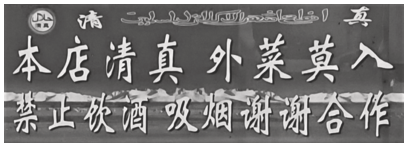
Figure 14.11 No food from outside
本店清真 běn diàn qīngzhēn | this store halal
外菜莫入 wàicài mòrù | outside dish no enter
禁止饮酒吸烟 jìnzhǐ yǐnjiǔ xīyān | forbid drink smoke
谢谢合作 xièxie hézùo | thank cooperation
莫 is used instead of 别, as it goes better with 入.

Figure 14.12 No setting off firework
外环线内禁止燃放烟花爆竹 wàihuánxiàn nèi jìnzhǐ ránfàng yānhuā bàozhú
outer ring line within forbid set off fireworks and firecrackers
洋泾街道平安办 yángjīng jiēdào píng’ānbàn | Yangjing street peace office
洋泾派出所 yángjīng pàichūsǔo | Yangjing police dispatch place
办 in 平安办 stands for 办公室. A 派出所 is like a police precinct in the United States.

Figure 14.13 No firework unit
禁放单位 jìn fàng dānwèi | forbid set off unit
禁放 is short for 禁止燃放. 单位 ‘unit’ is Chinese for workplace. There seem to be units such as museums with cultural relics where firecrackers are not allowed.

Figure 14.14 No drugs, no gambling, no prostitution
民警向您提示 mínjǐng xiàngnín tíshì | civil police to you remind
禁毒 jìndú | forbid drug
禁赌 jìndǔ | forbid gamble
禁止卖淫嫖娼 jìnzhǐ màiyín piáochāng | forbid prostitution
The choice between 禁止 and 禁 seems to depend on the number of resulting syllables, with preference for even numbers. Also note the female radical in the two characters for visiting a prostitute 嫖娼!
Please Don’t!

Figure 14.15 Please don’t look at cellphone when riding escalators
乘坐电梯时请勿看手机 chéngzuò diàntī shí qǐngwù kàn shǒujī
ride sit electric ladder time please not look hand machine
时 is 的时候 in spoken Chinese. 勿 is 别/不要 in spoken Chinese. The author noted more than once that about half of the people riding escalators were looking at their cellphones. Only the prospect of violating the rule prevented him from taking a picture of it.

Figure 14.16 No going in and out of car when light is blinking
门灯闪烁 méndēng shǎnshuò | door light blink
请勿上下车 qǐngwù shàngxiàchē | please don’t go in out car

Figure 14.17 Please don’t play in water
请勿戏水 qǐngwù xìshuǐ
Note the use of 戏 instead of 玩 for ‘play’.

Figure 14.18 Not going down on elevator
注意zhùyì | pay attention
电梯不可下行 diàntī bùkě xiàxíng
For this function, 不可 seems preferred than the longer 不可以.

Figure 14.19 No exceeding load
不得超载 bùdé chāozài
如校巴超载 rú xiàobā chāozài
if school bus exceed load
司机不准违法驾驶 sījī bùzhǔn wéifǎ jiàshǐ
driver not allow against law drive
不得 seems restricted to the formal style.

Figure 14.20 Tourists stop
游客止步 yóukè zhǐbù | tour guest stop step
Even though 止 means 停, for this function only止步 can be used, and 停步 literally means stopping steps.
Be Careful!

Figure 14.21 Friendly reminder
温馨提示 wēnxīn tíshì
请注意防滑qǐng zhùyì fánghuá
please attention prevent slip
请小心台阶 qǐng xiǎoxīn táijiē | please careful steps

Figure 14.22 Careful, floor is slippery
小心地滑 xiǎoxīn dìhuá
small heart ground slippery

Figure 14.23 Mind your head
小心碰头 xiǎoxīn pèngtóu | small heart bump head
限高 xiàngāo | limit high

Figure 14.24 Please carefully take care
请小心保管 qǐng xiǎoxīn bǎoguǎn
您的财物 nín de cáiwù | your valuable
Safety

Figure 14.25 Safety exit
安全出口 ānquán chūkǒu
peace whole out mouth

Figure 14.26 Police
警察 jǐngchá | vigilant observe (Police)
公安 gōngān | public peace (public security)
Public security bureau is 公安局.

Figure 14.27 Security booth
治安亭 zhì’ān tíng | manage peace booth

Figure 14.28 Close door behind you, prevent being tailed
随手关门 suíshǒu guānmén | follow hand close door
谨防尾随 jǐnfáng wěisuí | cautious prevent tail follow

Figure 14.29 Video surveillance
您已进入24小时监控区域 nín yǐ jìnrù 24 xiǎoshí jiānkòng qūyù
you already enter 24 hour monitor control zone
已 is preferred over the full form 已经. 进入 is a mixed compound, with modern 进 and classical 入, both meaning ‘enter’.

Figure 14.30 Dropping off and loading only
临时上下客 línshí shàngxià kè
temporary up down guest

Figure 14.31 Be careful, fire hazard
当心火灾 dāngxīn huǒzāi
careful fire disaster

Figure 14.32 Fire hydrant
消火栓 xiāohuǒ shuān | extinguish fire hydrant
灭火器 mièhuǒ qì | extinguish fire device
火警 huǒjǐng | fire warning
消 and 灭 both mean ‘extinguish’. They can even form a compound 消灭, which means to ‘wipe out (enemy)’. But the choice between 消 and 灭seems fixed. While 消火器 is occasionally seen, *灭火栓 does not seem to exit.

Figure 14.33 Xiushui building fire escape route map
秀水大厦逃生疏散图 xiùshuǐ dàshà táoshēng shūsàn tú
xiushui big building escape life disperse chart
Learning Outcomes
a. Gain familiarity with warning and reminder signs.
b. Gain familiarity with key common elements in warning and reminder signs.
c. Gain greater awareness of the use of written-style words in public signs.
Suggested Learning Activities
1. Using 禁止, 严禁, 禁, 请勿, 不得, 不可, 止步, 小心, and 当心, search for signs online. Type them out and translate.
2. Using traditional characters, repeat the above searches for regions outside China.
3. Identify written-style elements in found signs.
4. Paraphrase written-style signs in spoken style.
5. Analyze mistranslations in bilingual signs and correct them.
6. What is the most forceful way to say ‘not allowed’? What is the least?
7. Use 禁止, 严禁, 禁, 请勿, 不得, 不可, 止步, 小心, and 当心 to create signs.
This chapter includes several public announcements from past pandemics, images of medicine, medical care, and various offices and departments in a neighborhood community clinic in Shanghai.

Figure 15.1 First aid
医疗急救 yīliáo jíjiù
medical urgent rescue
Pandemic-related
The signs below were collected before the COVID pandemic. But they are as applicable today as back then.

Figure 15.2 Today already disinfected
今日已消毒 jīnrì yǐ xiāodú
2011年6月18日 | 2011 year 6 month 18 day
今日is used instead of 今天, 已 instead of 已经. This was seen after the H1N1 pandemic in 2009.

Figure 15.3 This hall is thoroughly disinfected
本大厅 běn dàtīng | this hall
已全面消毒yǐ quánmiàn xiāodú | already all side disinfect
请安心使用 qǐng ānxīn shǐyòng | please peace of mind use
This was seen in Taiwan.

Figure 15.4 All people guard against H1N1
全民防范 H1N1 quánmín fángfàn H1N1
勤洗手 qín xǐshǒu | frequently wash hands
保健康 bǎo jiànkāng | protect health
This was seen in Taiwan.

Figure 15.5 Prevent flu
预防流感 yùfáng liúgǎn
进入馆舍请使用 jìnrù guǎnshě qǐng shǐyòng
enter building please use
干性洗手剂 gānxìng xǐshǒu jì
dry wash hand agent
This was posted in a university library in Taiwan.

Figure 15.6 Treasure life
珍惜生命 zhēnxī shēngmìng
让艾远离 ràng ài yuǎnlí | let AIDS be far
艾滋病的传播途径 àizībìng de chuánbō tújìng | AIDS disease spread channel
The ad hoc abbreviation 艾 is incomprehensible without the accompanying full version 艾滋病. The abbreviation reduces the syllable count to four, to be parallel with the phrase above it. Interestingly, 艾 sounds like 爱 ‘love’ and 爱滋 is another word for AIDS. 珍惜…远离 is a common pattern.

Figure 15.7 Seek 1,000 people
寻找1000名 xúnzhǎo 1000 míng
慢病患者 mànbìng huànzhě | slow illness patient
糖尿病 tángniàobìng | diabetes
高血压 gāo xuěyā | hypertension
高血脂 gāo xuězhī | hyperlipidemia
This is an ad looking for participants for a clinical trial. A mixed compound 寻 (classical) 找(non-classical) is used for ‘seek’.

Figure 15.8 Dentist
晶致牙医 jīngzhì yáyī | crystal ultimate dental doctor
There may be an attempt at puns. 晶 can suggest ‘sparkling’ ; 晶致 sounds the same as 精致, which means meticulous.

Figure 15.9 Ophthalmologist Chen
陈眼科 chén yǎnkē | Chen eye department
耳鼻喉科 ěrbíhóu kē | ear nose throat department
This is seen in Taiwan. Note the vertical, right-to-left format.

Figure 15.10 Siam palace Thai style wellness center
暹罗宫泰式养生馆 xiānluó gōng tàishì yǎngshēng guǎn
预约专线yùyuē zhuānxiàn | reservation special line
Drugstore and Drug


Figure 15.12 Drugstore
药店 yàodiàn | medicine store
This chain drugstore is in Boston’s Chinatown.

Figure 15.13 Tylenol
泰诺 tàinuò
Although this is obviously based on transliteration, the character 泰 does mean ‘peace’. Both 泰 and 诺, along with 康 and 宁, are frequently used in names of medicines.
A Hospital and a Clinic in Shanghai

Figure 15.14 Xuhui district central hospital
徐汇区中心医院
xúhuìqū zhōngxīn yīyuàn
The name of this hospital in Shanghai is written in the vertical format and traditional characters.

Figure 15.15 Yangjing community health service center
洋泾社区卫生服务中心
yángjīng shèqū wèishēng fúwù zhōngxīn
Community clinics like this one are found throughout Chinese cities. They are different from full-scale hospitals in having no in-patient services.

Figure 15.16 Registration/Cashier
挂号 guàhào | hang number
收费 shōufèi | collect fee

Figure 15.17 Infusion/injection room
输液室 shūyè shì | input liquid room
注射室 zhùshè shì | injection room
What is translated as ‘transfusion’ is for IV injection.

Figure 15.18 Radiology
放射科 fàngshè kē
radiology department
B stands for basement.
科 ‘department’ is the basic unit in a hospital.

Figure 15.19 First floor
挂号收费 guàhào shōufèi | registration and cashier
放射科医生办公室 fàngshè kē yīsheng bàngōngshì | radiology doctor office
全科诊室 quánkē zhěnshì | general practice room
眼科yǎnkē | ophthalmology department
皮肤科 pífū kē | dermatology department
家床办公室 jiāchuáng bàngōngshì | home bed office
医患沟通室 yīhuàn gōutōng shì | doctor-patient communication room
输液室 shūyè shì | transfusion room
化验室 huàyàn shì | lab room
西药房 xīyàofáng | western medicine pharmacy
医患 ‘doctor-patient’ is abbreviated from 医生 and 患者.

Figure 15.20 Second floor
收费 shōufèi | cashier
中医内科 zhōngyī nèikē | Chinese internal medicine
中医推拿 zhōngyī tuīná | Chinese massage medicine
中医伤科 zhōngyī shāng kē | Chinese traumatology medicine
中医治未病 zhōngyī zhìwèibìng | Chinese preventive medicine
中药房 zhōng yàofáng | Chinese medicine pharmacy
康复治疗室 kāngfù zhìliáo shì | rehabilitation therapy room
口腔科 kǒuqiāng kē | oral medicine department
妇女保健室 fùnǚ bǎojiàn shì | women wellness room
妇科 fùkē | gynecology department
计划生育指导室 jìhuà shēngyù zhǐdǎo shì | plan birth guidance room
更年期咨询室 gēngniánqī zīxún shì | menopause consultation room

Figure 15.21 Third floor
哮喘门诊 xiàochuǎn ménzhěn | asthma consultation
B超室B chāo shì | ultrasound room
心电图室 xīndiàntú shì | electrocardiogram room
信息科 xìnxī kē | information department
中医针灸 zhōngyī zhēnjiǔ | Chinese acupuncture
会议室 huìyì shì | conference room
全科团队工作室 quánkē tuánduì gōngzuò | general teamwork room
超in B 超 is short for 超声波 ‘ultra sound wave’. B stands for brightness. The bi-script abbreviation is quite unusual!

Figure 15.22 Fourth floor
医务科 yīwù kē | medical department
预防保健科 yùfáng bǎojiàn kē | preventive health care department
护理部 hùlǐ bù | nursing department
院感办公室 yuàngǎn bàngōngshì | hospital infection office
全科团队服务科 quánkē tuánduì fúwù kē | general practice team service department
工会 gōnghuì | union
会议室 huìyì shì | conference room
院感 ‘hospital infection’ is abbreviated from 医院感染.

Figure 15.23 Fifth floor
主任室 zhǔrèn shì | director’s office
书记室 shūjì shì | (party) secretary’s office
副主任室 fù zhǔrèn shì | deputy director’s office
综合办公室 zōnghé bàngōngshì | general office
人事科 rénshì kē | personnel department
财务科 cáiwù kē | financial department
后勤保障科 hòuqín bǎozhàng kē | logistic support department
安全办 ānquán bàn | security office
The 办 in 安全办 is abbreviated from 办公室. Note that top administration occupies the top floor!
Learning Outcomes
a. Gain familiarity with terms related to health and medicine.
b. Gain familiarity with different departments of hospitals and clinics.
c. Gain greater awareness of the use of abbreviations.
Suggested Learning Activities
1. Using 医院, 门诊, 诊所, 牙医, 口腔科, and 卫生所, search online for related signs.
2. Using traditional characters to search for signs from regions outside of China.
3. Identify abbreviations and find out what the full terms are.
4. What do 科 and 室 mean? Find all the 科s and 室s in this chapter and Chapter 12 and translate them.
5. Using Google Translate, translate some Western drugs into Chinese. Which characters are used most often?
6. Use signs relating to hospital in a narrative on a related topic (e.g. seeing the doctor).


