


One spring evening as we were sitting around during a visit with my brother-in-law's family, the phone rang. I heard my teenage niece Corey answer in the other room: “Oh hi. I'm okay. I'll IM you, okay? ‘kay, bye!” It was a boy. My assumption was that Corey didn't want to talk within earshot of all us adults. As it turns out, it wasn't a matter of wanting privacy at all. Corey later explained to me that until she knows someone really well, whether it's a boy or a girl, she's much more comfortable instant messaging on her computer than talking on the telephone. Why? Well, because the phone requires you to maintain a fairly quick conversational rhythm, and pauses are awkward. On the computer, because of the time it takes to type a message, pauses are inevitable. They are a natural part of the medium. They aren't awkward or face-threatening. So, as Corey explained, it's more comfortable to ‘converse’ in writing online because you have the time to come up with things to say, and, moreover, whatever awkward pauses might occur can be attributed to the machine.
When I tell this story to my undergraduate students, they can relate. They say that this is part of their culture.Footnote 1 They hate the phone. Texting and instant messaging are quick, easy, non-intrusive, and allow one to think about what one is about to say before one actually says it. In this sense texting and IM are better than ‘real’ face-to-face communication because you can craft something more clever than what you could produce on the spot. You have the sense that you can ‘edit’ a conversation while it's going on. Moreover, you don't have to respond right away – or at all – if you don't want to. It's about personal control of your communication. It is about what we can call communication by design.Footnote 2
Communication by design involves the use of existing semiotic resources and often a technological medium to conceive, plan, shape, and express meanings for some expressive or communicative purpose – and in the process to produce new semiotic resources for oneself and others. It is a feature of photo, film, and video-editing software that allows you to seamlessly alter images and sequences, without anyone knowing that what they are looking at is a ‘virtual’ product of behind the scenes tinkering. It is a feature of music composition programs that allows you to slow down the tempo in order to play and record parts you couldn't possibly play in real time, or to cut and paste music composed by others into your own, or to use electronic processing to create tones and sounds that you could never produce with just your instrument (or to ‘autotune’ your voice to make it perfectly on pitch). It is a feature of website design that allows you to choose visual design elements from other people's websites and import them, to be modified or left as is, into your own webpage. And it is a feature of writing, whether done with a stylus on wax, pencil on paper, or fingers on a keyboard. In all these particular cases, communication by design involves a reconfiguring of time and space.
On the face of it, there is something that seems slightly disingenuous about all this. Personal deficiencies are masked. Reality is molded and idealized. Creativity is mechanized. Like the technology of writing, which Plato condemned for being a manufactured product that offered only an illusion of truth, today's digital technologies contribute to art in both its positive and its negative senses: the creation of beautiful things, and achievement by deceitful or artificial means.
On the other hand, communication by design can be seen as a matter of technological tools providing the means for people to better realize their full creative potential, by suspending some of the obstacles that might otherwise come between the conception and full execution of their ideas. It can even allow people to outperform their competence by effectively suspending time, providing a space to work out problems, to reformulate their expression, and to collaborate with others and get constructive feedback. And this ‘behind the scenes’ work has of course tremendous educational value in the sense that learners become more consciously aware of, by dint of conscious manipulation, the component processes of self-expression, which, in the parenthesis of a virtual timeframe, can be isolated and focused upon one by one in systematic fashion. Not to mention that if we wish to communicate beyond our own local community, we have no choice but to engage in some form of communication by design. Plato, despite his critique of writing, was, after all, a consummate writer whose lasting influence was achieved only through his writing.
We have lived with communication by design for at least the last five thousand years, so it is certainly nothing new.Footnote 3 What has changed dramatically in the age of digital technologies is the range of possible transformations, the relative ease with which they can be implemented, and how accessible to non-specialists these technologies have become. But perhaps the biggest change has been the increasingly contradictory relationship between individuals and communication technologies. On the one hand, individuals have greater control than ever over the communication technologies they use – they have unprecedented access to the means of textual production and distribution (now literally on a global scale). On the other hand, individuals are increasingly subject to control by those very same technologies. Much of our work, play, and communication now involves computers, and we have little choice but to acquiesce to the computer's particular ways of doing things. By virtue of their symbolic sophistication, digital technologies probably go further than any previous medium in shaping our creative impulses and setting the parameters of what we consider to be our world. And they often do so without our being aware of it.
Of course, one might argue that all communication is by design. After all, by virtue of having intentions, people will shape their discourse according to their personal desires and needs, even in spoken face-to-face conversation. This is very true; design is involved in all forms and manners of meaning making. As we engage in conversation with others, for example, our choices about what to say and how to say it are informed by behind-the-scenes thinking. But often these choices are made somewhat automatically, without conscious reflection. Once external mediation comes into play, whether it is writing, drawing, photographing, or some other form of designing, our meaning-making decisions become more deliberate. This is why we are generally held more responsible for our words when we write than when we speak spontaneously.
The extent to which communication is designed is really a continuum, from heavily designed (i.e., carefully planned, organized, and crafted) to lightly designed (i.e., shaped by more spontaneous decisions in response to here-and-now conditions), and extending perhaps to the ‘undesigned’ (e.g., the verbatim repetition of an utterance, as in a foreign language classroom).
Before delving into the notion of design in greater detail, we should clarify what we mean by communication. We will first consider a traditional, information-transfer model of communication and contrast that with a more dialogic model. We will then consider the particular dynamics of textual communication and consider a third model of communication that takes interactions of material, social, and individual factors into account.
Two models of communication
The information transfer model of communication goes like this. Person A begins with a message, which is encoded and sent via some channel or medium (e.g., speech, writing, or signed gesture) to Person B. Person B receives the coded message as an auditory or visual stimulus, and must decode it to reconstitute the original message. If both the sender and the receiver know the code and if the signal has not been degraded due to some form of interference, the message can be expected to arrive intact. That is to say, Person B now ‘has’ the same message that Person A encoded. Person B may then formulate a response, which may be kept to himself, encoded and sent back to Person A, or passed along to someone else. According to this model, human communication is analogous to sending messages by fax: a page is scanned and encoded into digital strings of zeros and ones, transmitted as electronic impulses through telephone wires to a distant location, then reconverted to the original page image by the receiving fax machine.Footnote 4
This model does have an intuitive appeal – we do, after all, manage to communicate our ideas to others, and the encoding/decoding model proposes an explanation for this. However, the model oversimplifies the complexity of communication in a number of ways. First, by suggesting that meanings have an a priori existence in our minds, no account is taken of the intersubjective ways we adjust what we say (and sometimes even what we think) in response to verbal or bodily feedback from our interlocutor. In conversation as well as in writing, meaning is often not determined in advance, but conceived at the moment of utterance, and sometimes the very process of articulation in speech or writing can bring coherence to formerly inchoate ideas and thoughts. In this sense, communication not only conveys but also generates meaning.
Second, language doesn't encode and transfer meanings as much as it creates frameworks that allow others to predict and reconstruct meaning. Just as we don't wait to make sense of an event until it is completed, we don't wait until the end of a message to form a response to it. We can sometimes predict on the basis of just a few words what our interlocutor will say, which explains why people interrupt each other. We make predictions partly based on our knowledge of language, but also based on our understanding of the situational context, our purpose, our knowledge and beliefs, and our personal experience. Our ability to integrate these various resources is what frees us from the need to use language literally, and to express and interpret indirect, ironic, metaphorical, or allegorical meanings.
The assumptions of the information-transfer model have been widely critiqued in a large body of work in sociology, anthropology, conversation analysis, and interactional sociolinguistics over the last fifty years. This work has shown that meaning is not immanent in language but actually constituted through interaction itself. Meaning is also shaped by the immediate situational context as well as broader social and cultural contexts, and furthermore, by any mediational tools used. In this sense we can talk about acts of communication as ecologies of interaction that integrate linguistic, social, situational, and material dimensions of meaning making.
To illustrate this ecological perspective, let's consider a communicative exchange between two people, offered by cognitive psychologist Christian Brassac (Reference Brassac1997). A young man has just accompanied a young woman to her apartment and he says to her:
You have a phone here.
Brassac argues that although this utterance takes the surface form of an assertion, its pragmatic value cannot be determined without seeing how it is taken up in subsequent interaction. Consider the following four scenarios, which show how meaning is constructed conjointly and in the very process of interaction.
Scenario 1
A: You have a phone here
B: Yeah, it's modern
A: Oh…I wouldn't have imagined
Scenario 2
A: You have a phone here
B: Yeah, my number is 04.83.35.36.09
A: Oh, so I can call you then
Scenario 3
A: You have a phone here
B: Yeah, it's modern
A: (laughs) Well shoot, I was hoping you would give me your number!
Scenario 4
A: You have a phone here
B: Yeah, my number is 04.83.35.36.09
A: Um, okay, but I wasn't asking for your number
A's literal assertion ([I am telling you that] you have a phone here) can be taken non-literally to mean a number of things – that is, it is a meaning potential (Halliday, Reference Halliday1978) but not yet a stabilized meaning. It might be taken as a request for information (I am asking if you have a phone here) or a request for action (I am requesting that you give me your phone number) or an expression of surprise or admiration (Wow, a phone!). We cannot know what A's true intentions were at the moment he formulated his utterance. We also cannot ultimately know how B interpreted A's remark and intentions. She may have thought he was asking for her phone number, but did not want to give it to him, or she may have thought he was expressing surprise that she had a phone. In scenarios 1 and 3, she ostensibly responds to the latter interpretation with mild sarcasm. In scenarios 2 and 4, she responds in a straightforward manner to what she interprets as a request for her number. What is important is that it is not until A responds to B (i.e., in turn 3) that the meaning of A's first utterance is stabilized. In scenario 1, even if A was really asking for B's phone number, A accommodates his reply to B's utterance, tacitly confirming the ‘surprise’ interpretation of his initial utterance and playfully mirroring B's mildly sarcastic tone. In scenario 2, whether or not A had originally intended to ask for B's phone number, he affirms this interpretation by stating an entailment of B's giving him her number. In scenarios 3 and 4, on the other hand, we see ‘corrections’ of B's interpretations of A's utterance (and thereby his perceived intention), which again serves to stabilize the meaning of his original utterance in the context of the interaction.
What the utterance ‘means,’ then, is more accurately described as what meaning or meanings get associated with the utterance as it is taken up in subsequent discourse. In fact, interlocutors may decide to accommodate their original intended meaning to the actualized meaning that develops in an interaction, effectively ‘changing their mind’ about what they really meant. A minimum of three utterances is therefore needed to stabilize a meaning: I say something, then you respond, then I accept or refute or modify your response. Whether the stabilized meaning matches my original intention is not of key importance – what matters is what meanings you and I establish dynamically and dialogically in our discourse. And even when a meaning is stabilized, it is not fixed, because it can always be renegotiated at a later time. In sum, we are far from a situation in which meanings are enclosed in our heads and get transferred from one person to another via language; rather, meanings reside in between interlocutors and are co-produced and modified interactively. In this sense we can understand communication in its etymological sense of making something common or shared.
One implication of this dialogic and relational model is that there is always a degree of uncertainty in communication, and that a large part of our communicative competence is knowing what to do in the face of that uncertainty. Traditional notions of comprehension are based on an information transfer model in which a priori messages get successfully transmitted from person A to person B. However, as we have seen above, it is not realistic to think about comprehension in the sense of really understanding someone else's ‘true’ intentions. From a relational, ecological perspective, what is important is that a meaning emerges from interaction to which both parties (and the environment in which they interact) are co-contributors, and this meaning may in fact be different from what was originally intended by one or both of the participants. Brassac calls this mutual and interactive shaping of meaning intercomprehension to underline its dialogic nature.
How might all this apply to situations of literacy and technology-mediated communication, in which those who are communicating are not usually in one another's presence? In some ways the situations are very similar. For example, one principle we can apply from the Brassac example is that the whole interpretive situation – not language alone – stabilizes meaning in an interpretive act.
An important difference in textual communication, however, is that the interpretive situation is not generated by two face-to-face speakers, but is established in two separate occasions of meaning design: first between writer and text, and later between reader and text. We will thus consider a third model of communication that incorporates the spirit of the dialogic, relational model presented above, but addresses the special conditions of textual communication. Before considering that model, however, we first need to establish how technology relates to language and texts in the twin processes of textualization and recontextualization.
Textualization and recontextualization
Technology allows language to be textualized. The word ‘text’ derives from the Latin textus, designating that which is woven. What is woven together in a text are linguistic, paralinguistic, and non-linguistic signs, and the loom that does the weaving involves some form of material technology. Texts can be visual, audio-recorded, or tactile, as in the case of Braille. They can be as short and simple as a single letter, such as ‘P’ for parking, or a word, such as ‘Exit’ or ‘Stop’, or as long and complex as a novel. As Widdowson (Reference Widdowson2004) puts it, a text is identified “not by its linguistic extent but by its social intent” (p. 8). A key feature of any complex text is the interrelatedness of its elements (i.e., relations of cohesion and coherence) that make the text a unified whole.Footnote 5 Some texts are composed principally of non-linguistic symbols and may only involve language peripherally, such as tables, graphs, spreadsheets, musical scores, and dance notations. Linguistic texts, on the other hand, will always involve more than just language: spatial organization (e.g., layout and paragraphing), the physical medium (e.g., book, scrap of paper, skywriting), and the tools of inscription and how they are used (e.g., pencil, pen, spray paint, computer, handwriting style, typography, color, punctuation) can all be integral to a written text's meaning. In the case of spoken texts, tempo and rhythm, as well as pitch, loudness, and articulation style will play a signifying role, as will framing decisions (i.e., the choice of where to start and end recording).Footnote 6
If reading, viewing, and listening are processes of realizing discourse from text, textualization is the complementary process of transforming discourse into text. Writing is therefore a subset of the broader notion of textualization.Footnote 7
Once created, texts can be recontextualized, that is, cut loose from their original contextual moorings and inserted into new and different contexts, where they may be interpreted in new ways. A famous case is a passerby's personal video recording of the beating of Rodney King by Los Angeles policemen in 1991, which became a text viewed by millions around the world. As it was repeatedly played during the Rodney King trial, this ostensibly objective videotext was used as evidence by defense and prosecution attorneys to argue for both the innocence and the guilt of the policemen involved in the incident.
Recontextualization may also involve transformation of a text as it is redesigned to address new purposes or new audiences. For example, the text might be reformulated (e.g., press releases and newswire feeds rewritten as articles), or translated into another language, or transduced into another sign system (e.g., made into an audio-visual presentation). In all these cases of transformation, the theme, content, or style of one text can reverberate in another, producing the textual network effect that Kristeva (Reference Kristeva and Moi1986) called intertextuality.
To illustrate the processes of textualization and recontextualization, let's consider the photograph shown in Figure 1.1. Taken at a tram stop in Grenoble, it depicts an advertisement for a Nokia mobile phone that has been marked up with graffiti. There are three layers of writing. First is the printed ad itself, which shows an aerial view of a scenic secluded cove on a sunny day with the caption Nokia 6230: 64 mails à envoyer. Je plonge. (Nokia 6230: 64 emails to send. I'm diving.) Second is a scrawled graffiti commentary protesting the marketing message (JETTES TON PORTABLE [Throw away your mobile phone]). Third is a meta-graffiti (written in classic French handwriting style) that corrects the first graffiti by stating an orthographic rule for imperative forms (Sans ‘s’ [Without ‘s’]). These three layers of writing, each with its own voice (the publicist, the protester, the pedagogue), index three distinct discourse worlds (i.e., technology and consumerism, anti-technology activism, schooling). What in speech would have to be separated into a linear time sequence of three separate discourses is here compressed into a single text that shows the three discourses simultaneously, and thereby impels the reader/viewer to relate the three discourses to one another.

Figure 1.1 Layered discourses in a Nokia advertisement
The original unmarked Nokia ad is identifiable as the ‘same’ whether it appears at the Grenoble tram stop, or the back cover of a magazine, or on a computer screen. But when the graffiti is added it is no longer the ‘same’ text. Although it shares commonalities with the original Nokia ad, it has been transformed into a new and unique text that is intertextually related to the original advertisement. Once we have seen the transformed text, we can no longer return to the original Nokia ad without some trace of remembrance of its graffiti-marked cousin. It has changed the way we view the original.
But can we really say that the graffiti-marked text is ‘unique’? After all, it has now been reproduced on the pages of this book. Is the one you see here the ‘same’ text that appeared on the wall of a tram stop in Grenoble? The text has been given borders and abstracted from its original surrounding context. It has been resituated by being reproduced in a radically smaller format, in black and white, in relatively poor resolution – in a book about language, literacy and technology. In short, it has been recontextualized and repurposed. Having seen the text in this book, we can no longer view either the original Nokia ad or the graffiti-marked ad at the Grenoble tram stop in quite the same way – they have both been symbolically transformed.
To sum up what the process of textualization involves, let's consider what Kramsch and Anderson (Reference Kramsch and Anderson1999) propose as five fundamental traits of textualization:
(1) It realigns reality along new axes of space and time.
(2) It stabilizes an event or discourse by making it an artifact, identifiable as ‘the same’ each time it is read or played.
(3) It dissociates the meaning of an event from both the participants’ and the author's intentions.
(4) It extends the importance of an event beyond its original context.
(5) It makes the meaning of the event accessible to multiple foreseen and unforeseen audiences. (p. 34)
Realignment of reality in textualization is done principally by means of framing and editing. Framing is the process by which the designer decides what to include and exclude from view – literally in the case of a camera, and figuratively in the case of writing – as well as where to start and where to stop the text.Footnote 8 Editing allows discourse or scenes to be cut or moved to new locations, creating new sequences that do not correspond to the original lived reality or the original created discourse.
The idea that textualization stabilizes an event or discourse by making it an artifact, identifiable as ‘the same’ over time, should not be taken to mean that the meaning of the text is fixed and unaffected by subsequent recontextualizations. As we saw in the “You have a phone here” and “Nokia” examples, meaning is relational and co-produced. An author will produce and hold to certain intended meanings, and readers will bring their own intentions that shape their interpretations, but neither meanings can be said to be absolute, as new frames can produce new meanings. The dissociation of meaning from authorial intention acknowledges a certain autonomy of the text – especially with regard to its susceptibility to being recontextualized. But this autonomy should not be taken to mean that the meaning (i.e., the interpretation) of a text is autonomous – rather, meaning is always realized in the interaction of the text with its full context of reception, which includes the reader/viewer's expectations.
Symbolic representation is what makes the importance of a textualized rendering of an event exceed the importance of the original event. In late 2010, the slap on the face of a vegetable merchant by a policewoman in a remote part of Tunisia and the vendor's subsequent suicide not only led to revolt in that country but also set off a chain reaction of social uprisings in other Arab countries in 2011. In this case, the event was not video recorded, but started as oral narrative and then became technologized in writing and disseminated on a massive scale through social networking sites, then by news media.Footnote 9 In this technological amplification process, the event was transformed not only into text but also into myth, taking on additional meanings as the story spread around the world. For example, although the street vendor was widely reported to be a college graduate, hence emblematizing the plight of educated workers struggling to find work in Tunisia, it turns out he had not in fact attended college.
By virtue of transforming events into discourse that can be disseminated, interpreted, and reinterpreted by foreseen and unforeseen audiences, textualization is central to what and how we learn about the world, and how we represent those understandings to ourselves. Recontextualization reminds us that our interpretations are relational, and that as we shift interpretational frames, the meanings we construct will also shift. With this backdrop, we will now return to our consideration of models of communication, but now with a focus on the special case of textual communication.
Textual communication
Every time we read we elaborate mental representations that constitute a discourse world (Kern, Reference Kern2000). As we scan the very first words of a text we develop expectations based on the text, its material context, and our prior knowledge and experience. As we continue to read, we generate hypotheses that are sometimes supported by the text and sometimes overthrown when we encounter new information inconsistent with our expectations. We thus continually actualize and transform meanings in a dialogic way as we interpret what has been written. And, just as the meaning of a face-to-face interaction can be renegotiated after the fact, our interpretation of a text can change with re-readings over time. The words of the text don't change, but what we bring to them – the other half of the dialogue – does. In this way, we can see how both the producer of a text and the interpreter of a text are engaged in design of meaning. Finally, the virtual, discourse worlds that we generate through reading can consequently shape how we perceive and interpret things in our everyday ‘real world’ experience. Birkerts (Reference Birkerts1994), for example, describes his experience after having read V. S. Naipaul's A Bend in the River:
I found myself brooding for days on the ways in which cultures and value systems come into collision…I would catch myself monitoring gestures and interchanges between members of different racial and cultural groups. I also read the morning paper differently, looking more closely at reports detailing racial and ethnic frictions. I had absorbed a context which suddenly heightened the “relevance” of this theme.
This layering of ‘actual’ and ‘virtual’ worlds in reading has been taken up by psychologist Herb Clark (Reference Clark1999), who makes a distinction between what he calls ‘embodied’ and ‘disembodied’ language. Whereas embodied language is used in here-and-now communication as in a face-to-face interaction or a phone conversation, disembodied language is “language that is not being produced by an actual speaker at the moment it is being interpreted” (Clark, Reference Clark1999, p. 43).Footnote 10 Disembodied language would thus include recorded speech and most writing (exceptions would presumably be writing on a chalkboard or other surface in the presence of one's addressee and synchronous online chat, though Clark does not discuss such situations). In Clark's model, all use of disembodied language demands the ability to deal with a layering of ‘real’ and ‘virtual’ operations. This is how it works: Person A uses language and some form of technology to create a text. This is what Clark calls layer 1. Person B, reading or listening to the text, generates a virtual, imagined world based on it. This is layer 2, which entails establishing a joint pretense that Person A and Person B are doing something together. So, for example, as I write this chapter, typing words on the screen of my computer, I envision communicating with you, the reader. And you, reading this chapter, have the sense of communicating with me – so we both pretend we are sharing a kind of co-presence and exploring ideas about language, literacy, and technology together. For Clark, then, texts aren't communicative acts in and of themselves, but material props that get readers (or viewers or listeners) to imagine communicative acts between themselves and the ‘virtual agents’ they envision as they read the text.Footnote 11
Clark extends his ‘virtual agent’ idea to our use of computers, drawing on the work of Reeves and Nass (Reference Reeves and Nass1996), which has shown that people do not interact with computers and new media simply as tools, but in fundamentally social ways:
Every operating system and every computer application relies heavily on disembodied language. To understand that language, we users have to collude with its producer in the pretense that we are engaged with a virtual agent in a joint activity, and that we are communicating with that agent in order to carry it out. So whenever we use an operating system or application, we create virtual agents.
For Clark, then, features of computer design are, like texts, “simply the props that support the type of joint pretense in which virtual agents and I work together, often with virtual tools, in order to accomplish real tasks” (ibid., p. 47).
Clark's analysis is illuminating, but problematic in at least two areas. The first problem is the term ‘disembodied’ language. To my way of thinking, language is never disembodied. Technology may allow language to be separated from the moment and context of utterance, but the act of writing or recording always involves some form of human embodied activity and the written/recorded traces themselves have a materially embodied existence, even if it is outside of a human body. Furthermore, the material form of language will itself contribute something to the total meaning produced. Just as there is a pragmatics of speech (involving tone of voice, gestures, eye gaze, facial expressions, postures, body language, proxemics, etc.), there is also a pragmatics of text (involving spatial arrangement, margins, typeface, font size variation, boldface, italic, underline, non-alphabetic characters, upper and lower case letters, etc.). Whether spoken, written, or signed, language can never exist outside of all contexts. For this reason I suggest that disembodied language might be more productively thought of as re-embodied language. This would acknowledge that language can be made into textual artifacts and re-situated, but reminds us that language use is always situated in one way or another. Consider, for example, how the word ‘cafe’ indexes different meanings when written with coffee beans, on a coffee bag, on a Paris awning, on a road sign, and on a billboard (see Figure 1.2).

Figure 1.2 Various written representations of ‘cafe’
A second quibble has to do with Clark's assertion that “Disembodied language is to be taken as a representation of embodied language, and to interpret it, we are intended to imagine the embodied language it represents” (1999, p. 44). Audio-recorded speech may represent embodied speech, but writing generally does much more than that. If writing serves as a prop to help us imagine worlds and relations, it does so in ways that are graphic and spatial as well as linguistic. Certain uses of writing are imagistic, ideographic, or iconic, and not always verbal in nature. Many texts have no spoken equivalent (as just a few examples, consider checks, receipts, signatures, spreadsheets, lists, business cards, contracts, recipes, reports, graffiti, novels, concrete poetry, computer programs). So, instead of viewing texts as representations of embodied language, we should see them more broadly as acts of meaning design that draw on multiple semiotic resources, some linguistic, some not.
We have considered three models of communication. The information-transmission model views communication as a linear sequence that starts with an idea or message in one person's head. That idea or message is then encoded in speech, writing, gesture, or some non-verbal form so it can be perceived and decoded by others. This decoding allows the original idea to be reconstituted in all recipients’ heads, assuming they all know the code. The problem with this model is that it does not adequately account for the complexities of human communication. The dialogic/relational model sees communication as a complex interactive system. This model acknowledges the dialogic and contingent nature of communication and reminds us that meaning is not a property, but a function of signs as they are used in particular ways, in particular settings, and in interaction with particular people. The third model applies the spirit of the dialogic/relational model to the special case of textual communication, in which those communicating are usually not in one another's presence and context is textual as well as situational.
We will now return to the notion of design to show its compatibility with dialogic, relational views of spoken and written communication and to elaborate on the role of material, social, and individual resources.
Design
In 1994, a team of ten scholars from Australia, Great Britain, and the US (including Courtney Cazden, Norman Fairclough, James Gee, Mary Kalantzis, Gunther Kress, and Allan Luke among others) met in New London, New Hampshire, to discuss the state of literacy education. Known as the New London Group, this team proposed a vision of literacy education whose goal was to prepare learners to interpret, express, and negotiate meaning within a variety of contexts. Their initial 1996 manifesto, “A Pedagogy of Multiliteracies: Designing Social Futures,” was followed by a book-length treatment (Cope & Kalantzis, Reference Cope and Kalantzis2000) and a ten-year update (Cope & Kalantzis, Reference Cope and Kalantzis2009).
At the heart of the New London Group's vision is the notion of design of meaning. Design of meaning is about creatively configuring existing resources (what the New London Group calls Available Designs) in relation to purposes, contexts, and prior discourse to produce signs and texts. Through the process of recontextualizing, recombining, and reshaping available designs, people produce what the New London Group refers to as the Redesigned. The redesigned, in turn, provides new resources, new available designs, for future acts of meaning making. Design is therefore an iterative and transformative process of recycling old materials in fresh ways.
It may seem paradoxical that we can only create something new and unique by using resources and practices that have existed long before ourselves. The resolution of the paradox lies in the fact that meanings are not strictly tethered to individual signs but rather arise from relations among signs, and between signs and their contexts of use, as we saw in our discussion above.
Figure 1.3 offers a schematic representation of the design process, whereby various linguistic, cultural, material, and technological resources (available designs) are woven together to produce a new artifact (for our purposes, a sign, utterance, or text). This process is motivated and shaped by two kinds of context: the immediate situation (involving participants’ intentions, identities, resources, and setting) as well as the broader social and historical conditions (such as ideologies, values, and cultural practices). The newly designed artifact feeds back into the system as a new resource, a new available design, for future acts of design.

Figure 1.3 Schematic representation of the design process
What is important about the design process is that it breaks from traditional semiological theories that posit stable, bounded sign systems. As linguist Linda Waugh (Reference Waugh1980) has pointed out, not all signs that people use are part of some a priori system; rather, they are invented in the very act of communication.Footnote 12 This in turn requires a shift in perspective on the status of the meaning maker. According to an information transfer view, competence comes with mastery and internalization of a stable, established sign system. There is no account of individual innovation and broader change in the system. From a design perspective, however, the shared resources we draw upon in making meaning are not fixed and static, but in a continual state of renewal, with individual creativity and innovation having the potential to produce change in socially shared discursive systems.Footnote 13 The transformation of the designed into the redesigned underlines the openness of meaning systems and the important role of creativity in meaning making.
From a design perspective, we are co-collaborators with the material and symbolic resources we use. When we communicate we usually do not have an idea and then look around for a medium with which to express it. Rather, the medium is generally part and parcel with the idea itself. That is why serious consideration of media must be part of any theory and practice of communication, learning, and teaching.
Design involves ongoing monitoring of the meaning-realization process, like field testing, which might lead to a change in the chosen medium, or how it is used, in the process of designing meaning. But unlike an a priori model in which meaning making is tested against an original intention, the design model is also open to the possibility of re-evaluating the goal itself. So, design implies a certain consciousness or self-consciousness about meaning making. And the individual plays an active, agentive role as a potential transformer of semiotic resources (Kress, Reference Kress, Cope and Kalantzis2000a, p. 160).
With regard to this last point about the agency of the individual meaning maker, two caveats need to be made clear. First, although we use signs, language, and texts to design meanings we want to uniquely express as unique individuals, our agency is mitigated by the fact that those signs, languages, and texts we use inevitably resonate with their own histories and contexts of use, expressing sedimented meanings over which we have no control (or in some cases even any awareness, as is often the case among foreign language learners, for example).
Second, our agency may also be mitigated by constraints imposed by the material and technological mediums we have to work with – or by our inadequate knowledge of how best to use them. New media, for example, may foster innovation and creativity in certain respects, but the characteristics of the mediums themselves may also impose important constraints. For instance, Twitter messages are restricted to a maximum length of 140 characters. Facebook profiles are based on a pre-established template. Online search engines are programmed to ‘learn’ what kinds of information we are most interested in, and then to filter future search results accordingly, essentially narrowing our search results to those consistent with our interests, our beliefs, and our points of view.Footnote 14
This is not to say that constraints are bad. Indeed, they can spur us to highly creative thinking and expressiveness. Think of fixed verse forms (e.g., haiku, sonnet, villanelle), or standard musical progressions (e.g., the blues), or the constraints invented by the OULIPO, such as Georges Perec's novel La disparition, which excludes the most common letter in the French language (e). But these are all cases of artists thoroughly understanding and willingly accepting constraints as part of their creative process, rather than being unwittingly stifled by them.
To summarize, although design is involved in all communication, it is particularly salient in writing, recorded speech, music, film, digital storytelling, and other forms of technologically mediated communication. We have seen that design processes do not take place in a void, but in contexts of various scales, ranging from immediate circumstances to broad social, cultural, and historical patterns. Consequently, designing meaning is always a relational process.
We have seen that design draws on existing resources (available designs) to produce signs, utterances, and texts, which then may be used as new resources for subsequent acts of meaning design. Design draws on three primary kinds of resources:
Material/technological resources, such as pens, paper, film, computers, smartphones, recorders, cameras and videocameras, as well as material forms of language use (whether written, spoken, or signed).
Social resources, such as language and other semiotic systems, social practices and conventions, cultural values, ideologies, and norms.
Individual resources, such as creativity, imagination, intuition, emotion, aesthetic sensibility, as well as circumstantial factors such as available time, energy, motivation.
Material, social, and individual resources interact, influencing one another (as indicated by the bidirectional arrows in Figure 1.4).Footnote 15 Material technologies are constituted (i.e., realized as technologies) by human action (individual and social). Social resources are constituted historically, but ultimately by actions of individuals and groups. Social resources are often mediated by technologies, and social values are embedded within technologies. Individuals define themselves in relation to social collectivities and social contexts, and do so by means of, and in relation to, social conventions and material artifacts. Individual resources are largely internalized social resources, but social resources ultimately find their origins in individual creativity.
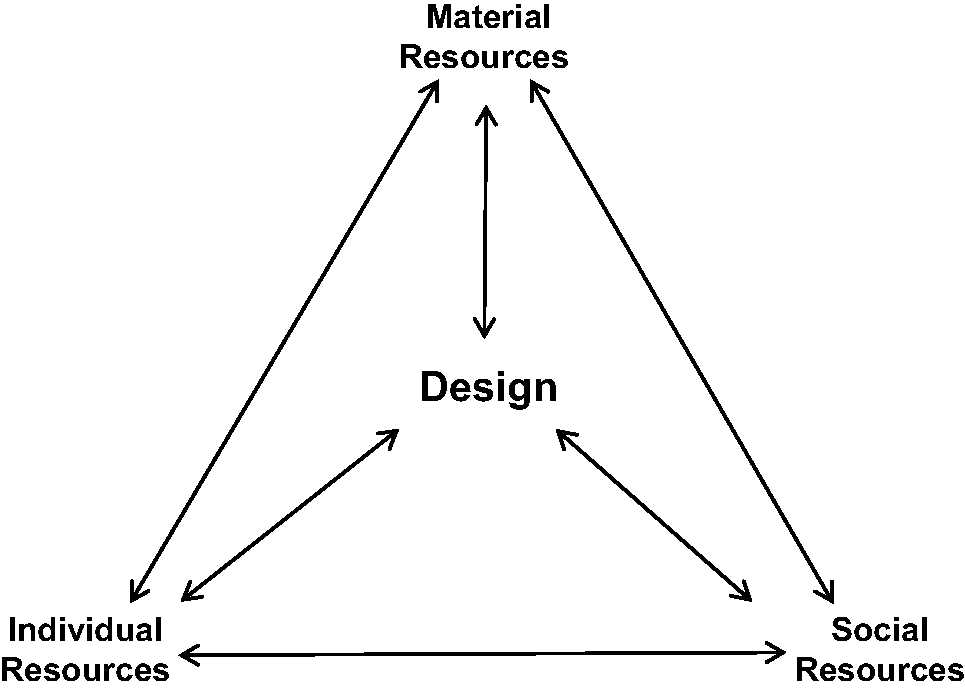
Figure 1.4 Material, social, and individual resources in design
The outward arrows from ‘design’ remind us that design can have an impact on material, social, and individual resources, just as these influence design. Because of this ongoing renewal of resources through design, the three poles of material, social, and individual resources are dynamic, not static. Furthermore, each type of resource is continually defined in relation to the other two.
In order to illustrate these relationships, let's consider two simple examples of technologically mediated communication: one written (sending an email to a colleague), and one spoken (recording an outgoing message on an answering machine). The two texts are as follows:
1. Steve,
Thanks for sending this.
Rick
2. Hi. I'm not here right now. Please leave a message and I'll call you back as soon as I can.
The email message is to thank a colleague for having sent a document as an attachment in a previous message. The act of thanking is based on social convention. But whether it is performed or not depends on the availability of material resources (i.e., access to a means of contacting my colleague) as well as my own individual availability of time, energy, and motivation. In formulating the email, my choice of words, and the form they will take, will be influenced by social factors implicit in questions such as these: How well do Steve and I know each another? (Do I write ‘Steve’ or ‘Professor Jones’? Do I include a closing or not?) Over how much time have we been exchanging messages about this topic? (If it has been a quick series of exchanges and I am writing back right away, writing ‘Dear Steve’ will be strange; if the exchange has been very quick, I don't need to mention his name at all; on the other hand, if he sent the attachment a week ago, ‘Dear Steve’ is an option.) These questions are all tied to social conventions, but are also influenced by individual circumstances.
Related to material resources, how familiar are we with conventions of the medium? (Consider, for example, my use of deixis – Thanks for sending this – which has no textual referent in my message, but Steve and I both understand that it refers to the attachment in Steve's last message; it also indicates that I already have the document, whereas if I were thanking Steve for sending the document by postal mail, I could not say this but would have to write ‘Thanks for sending that.’) Material factors that will influence the form of my message are the device I am using to write, the space it affords me, and my dexterity with the interface. If it is a mobile phone with numerical keypad, I might opt for all lower case letters and perhaps abbreviate ‘Thanks’ as ‘thx’ and ‘Rick’ as ‘r,’ and I might not correct any typos I make. If, on the other hand, it is a smartphone or a computer with a full keyboard I will be less inclined to abbreviate and I will be more likely to correct errors.
However, all the above is influenced by individual circumstantial factors such as how much time I have, how distracted I am, whether I am being jostled on a crowded subway or sitting calmly at my desk, and so on. My decision to write the email or not will also be influenced by how I understand my social role vis-à-vis Steve (a power disparity in either direction will increase the likelihood of my writing), whether I am likely to see Steve in person, or talk to him on the phone soon (in which case there would be less need to write). Table 1.1 summarizes the material, social, and individual resources involved in writing a thank you note by email.
Table 1.1 Summary of material, social, and individual factors in writing an email message
| Communicative action | Material resources | Social resources | Individual resources |
|---|---|---|---|
Email to thank a colleague: Steve, Thanks for sending this. Rick |
Computer with a full-size keyboard vs. tablet vs. mobile phone? Abbreviations? Corrections? |
Language; social role(s) enacted; genre conventions of thanking; genre conventions of email; conventions of social exchange (e.g., how long and quickly have we been writing back and forth will partially determine how long I take to respond). | My understanding of my social role/relationship vis-à-vis Steve (feeds into social resources); how much time and energy I have; my physical circumstances and distractions. |
The second example is a greeting message recorded on a home answering machine: Hi. I'm not here right now. Please leave a message and I'll call you back as soon as I can. My task at the moment I record this message is to prepare a communicative act that will take place repeatedly in the future (for however long I keep the message on my answering machine) automatically, without further intervention on my part. I am textualizing my voice in order to project my virtual presence on those occasions when I am not physically present or not willing to engage with a caller. The text that will create this virtual presence must be prepared for a virtual addressee, actually a wide array of real people, some of whom I know and many of whom I do not know. My language must therefore be appropriate to address both intimates and strangers. My message must be short enough not to make people wait unduly to leave a message, and not so short as to sound abrupt or rude. These are all social considerations, informed both by conventions of interpersonal interaction and by genre-specific knowledge of answering machine messages in a particular culture.
As an individual, however, I am not bound to slavishly follow social conventions. Depending on what kind of representation of myself I want to project, I can invent all kinds of playful variations (e.g., “Hello? Oh no, I forgot, I am not home!” or “Hi. I'm Rick's answering machine and if you want to talk to a machine you can leave a message”). I could speak with a foreign accent or in a language other than English. I can speak slowly, enunciating each word clearly, or speak quickly with a casual tone. If I have a bad cold at the time I might not speak at all and instead play a musical passage, or a recording of Humphrey Bogart saying “Here's lookin’ at you, kid.” But whatever creative stylistic choices I make, they will be made in conscious relation to what I understand to be the social function of leaving an outgoing message on my answering phone, and that is culturally defined.
Material resources come into play as well. I obviously need to have and know how to use a telephone and an answering machine. In particular, I need to know how to start and stop recording. I also need to know how to record my voice, adjusting speaking volume and distance from the microphone to avoid distortion on the one hand and an inaudible signal on the other. I need to take into account the memory limitation on the recording chip, which will impose an absolute limit on my recording time. Once I have recorded the message, I need to know how to play it back in order to evaluate it. These are all technical dimensions. But there are also linguistic understandings that are crucial to recording my message. For example, when I use present tense and say ‘right now’ as I record ‘I'm not here right now’ I am clearly not referring to the moment of my utterance, but rather to the hundreds or thousands of specific future moments when someone will listen to my voice in my absence. And when I say ‘here’ I am not necessarily referring to my physical residence, but to a generalized ‘here’ that has more to do with my availability to the envisioned caller (i.e., here with you on the phone) than to any real location. That is because a) answering machine technology allows me to check messages from wherever in the world I might be (and to record my outgoing message from anywhere in the world), and b) I may in fact be physically present at home when you call, but unable or unwilling to talk to you at that moment. That said, the materiality of a fixed-line telephone at home does make a difference. If the greeting message were recorded on my mobile phone, I would not say ‘I'm not here right now’ because the mobile phone itself has no fixed ‘place’ but is an ‘everywhere’ device. So ‘here’ is not conceptually relevant. My message would instead explicitly address my lack of availability (e.g., “I'm sorry I cannot answer your call at the moment”). These uses of deixis are very different from the norm for face-to-face communication (in which they might only be conceivable in instances of play) and are directly attributable to the technology of telephones and answering machines. This is thus spoken language that involves ‘literate’ sensibilities – as is the case for all uses of textualized language.
Table 1.2 Summary of material, social, and individual factors in recording a voicemail message
| Communicative action | Material resources | Social resources | Individual resources |
|---|---|---|---|
| Message on answering machine: Hi. I'm not here right now; please leave a message and I'll call you back as soon as I can. | Telephone and answering machine, and familiarity with their use. Instructions on starting and stopping recording; memory limitation on recording chip; adjusting speaking distance to microphone; articulating my utterance; pushing button to play it back and listening to my voice. | Language, genre knowledge, social conventions, which help me decide what to say, and how to formulate it (in English), with what tone of voice, and at what pace, anticipating the future moment of listening by a wide range of potential callers – all in terms of my knowledge of how telephones and answering machines are used in society, and my experience of hearing others’ recorded messages. | How much time I have to make the recording; how discerning I want to be about the clarity of the message; whether I have a cold; how creative I want to be; how sensitive I am to the recorded quality of my voice: I may repeat the recording until I am satisfied with both the wording and oral performance in terms of pace, rhythm, intonation, articulation. |
Having seen how material, social, and individual resources interact in two communicative acts, we will conclude by considering how material, social, and individual resources interact in the production of new design resources (i.e., the redesigned).
New from old: the redesigned
The following three vignettes illustrate how one resource (the inventory of ASCII characters on an ‘English’ keyboard) can serve design in multiple ways. These vignettes also show how individual and social dimensions of design interact with technological and material dimensions.
The case of @
In 1971, a computer engineer named Ray Tomlinson was working on a way to send messages from one computer to another (inventing what we now know as email). One problem he confronted in addressing messages was how to separate the user's name (i.e., login) from the host machine name. He decided to use the @ sign since it was a symbol seldom used in computing at the time, and it conveniently meant ‘at,’ which linked user and a host server nicely. Ever since, the @ symbol has been associated with electronic communication and ‘trendiness’ in general (e.g., Brenda Danet's book Cyberpl@y, and businesses like @lanta News & Gifts or @mosphere).
The definitive origins of @ are not clear, but a number of scholars trace it to a medieval abbreviation of the Latin ad (‘to, toward, at’) as early as the sixth century.Footnote 16 Mercantile uses of @ reportedly date to at least the fifteenth century in Spain, where it was appropriated as an abbreviation for ‘arroba’ (a unit of weight derived from Arabic ar-rubʿ ( ), a fourth of a quintal), and to sixteenth-century Italy, where it served as an abbreviation for ‘amphora’ (a ceramic vase used to transport grain, spices and wine, which became a standard unit of volume).Footnote 17 In the Anglophone world, the use of @ to indicate the unit price of a commodity (commonly known as ‘commercial a’) was the symbol's predominant meaning until Tomlinson made it part of email.
But the story does not end there, because @ has since taken on new functions in the digital communications realm. In Spanish and Portuguese emails and forums, for example, one encounters the use of @ to represent the visual simultaneity of ‘o’ and ‘a’ in words that index gender, such as l@s chic@as, instead of the longer string los chicos y las chicas, which by virtue of its linearity inevitably creates an implicit order of precedence. Here @ is used as an iconic image of the letters ‘a’ and ‘o’ rather than as a symbol. It is used as a shorthand device, but it also carries possible ideological overtones.Footnote 18 What is important to note is that this integration of masculine and feminine gender forms is something that can only be handled by the technology of writing (whether as @ or o/a or a/o). Consciously neutralizing the o/a opposition in Spanish speech would leave no trace of either gender form. What languages tend to do instead is to use gender-neutral pronouns, such as on in French and they in English.
In group emails and online forums, messages are assumed to be addressed to the whole readership. But if a particular addressee is intended, the writer needs to mark it accordingly, and @ is commonly used to direct a message to a particular reader: ‘@Rick,’ for instance, would indicate that whatever follows is addressed specifically to Rick, rather than to the whole group. Here @ has a vocative function, serving as a visual signpost marking a change in addressee, much as shift of gaze operates in face-to-face interaction.
In social media applications, @ plays an analogous yet distinct role. Twitter's @Reply feature makes it possible to direct a message to someone by typing @ followed by the person's username, which the computer will interpret as a link to that user.Footnote 19 In Facebook, typing @ activates a drop-down menu of names you can ‘tag’ in a status update. But the @ symbol itself does not actually remain on the screen as a visible part of your update; it is merely the trigger that activates the tagging feature and then disappears. What remains visible on the screen is the full name of the person, page, event or group that was tagged, but now with an underlying link to its page. In this way, @ has now become not just a representational symbol but also a performative symbol, whose use directly translates into some kind of action.Footnote 20
This brief history of @ illustrates how individual, social, and material factors interact in the development, appropriation, and reappropriation of a sign. Some anonymous Roman scribe made an abbreviation of the common preposition ad for material reasons – in order to save time, effort, or space. What started out as an individual creative innovation was shared among other scribes and eventually became conventionalized (and thereby broadly interpretable). But the sign takes on new meanings as it is recontextualized in different times and different cultures – and in relation to different technologies. We see this first in the mercantile uses of @ (where it variously refers to unit weight, volume, and cost) and later in the multiple reappropriations in the computer age. According to Tomlinson, his choice to use @ in emails was essentially random, largely determined by process of elimination. The ASCII keyboard had a limited number of characters, and no character that might appear in a name or in a programming command could be used. Material resource limitations thus narrowed the options significantly. But @ was not truly a random symbol; it brought its meaning of ‘at,’ established over centuries of use in mercantile contexts and added a locative dimension (not to mention a ready-made pronunciation) to Tomlinson's use of the symbol to separate user and computer addresses. In the case of Spanish and Portuguese, the @ sign is motivated, not arbitrary, in the sense that it iconically integrates the letters ‘o’ and ‘a,’ specifically addressing a communicative need. Although there are other graphic ways this could be done, no other options exist within the basic ASCII character set. In the context of online forums, Twitter, and Facebook, the functions of @ are even distinguished syntactically from its use in email addresses: @ is placed before, rather than after, the username. Neither the symbol's historical meaning nor its locative email address meaning seems relevant, although ‘at’ in the sense of talking ‘at’ someone does come to mind as being relevant. In all these cases, the form itself remains unchanged, but it is resignified and transformed to adapt to material, individual, and social needs and resources. In short, it has been redesigned with each new functional context.
Figure 1.5 summarizes the configuration of available designs and the sociotechnological context that contributed to Tomlinson's use of @ in email addresses. It should be noted that available designs can have both positive affordances (i.e., resources) and negative affordances (i.e., constraints that disallow certain choices among those resources). In this case, available designs with positive affordances are the ASCII character inventory and the traditional English language use of @ to signify ‘at.’ Available designs with negative affordances (because they impose constraints on design) are the range of possible login names (which almost always use alphanumeric characters, therefore making these a poor choice to separate a login name from a server name) and programming languages and the symbols they conventionally use to designate various functions (the chosen symbol would not want to overlap with another function). The design process occurs within the sociocultural context of technological change (the new use of networked computers to send messages) and a specific technical need (to clearly separate a user's login name from the host server's name).

Figure 1.5 Available designs in the use of @ in email addresses
While this example focused on an individual sign, design and redesign processes are most often operating at the level of texts and whole systems, as the next two examples illustrate.
Greeklish
When people began using email in Greece in the 1980s, there was a problem. Computer keyboards were not available in the Greek alphabet, and email programs were only compatible with the American Standard Code for Information Interchange (ASCII), which includes the Roman alphabet and Arabic numerals, plus assorted punctuation, diacritics, and symbols – but no Greek alphabet. Consequently, Greeks who wished to write email messages had to transliterate Greek letters into Roman alphabet.Footnote 21 The resulting form of writing, dubbed ‘Greeklish,’ became the default and standard way of writing email messages in Greek. Koutsogiannis and Mitsikopoulou (Reference Koutsogiannis and Mitsikopoulou2003) offer the following example of an email that was sent both in Greek and in Greeklish from the Network Operation Center of their university:Footnote 22
[In Greek:] Αγαπητέ κύριε κουτσογιάννη,
Το µέγεθος του αρχείου στο οποίο αποθηκεύονται τα µηνύµατα
του ηλεκτρονικού σας ταχυδροµείου έχει περάσει το όριο των
30000 Kb. Για την καλύτερη λειτουργία του
γραµµατοκιβωτίου σας, πρέπει να σβήσετε τα µηνύµατα της
θυρίδας σας στον εξυπηρετητή.
[In Greeklish:] Agapite kurie Koutsogianni
To mege8os tou arxeiou sto opoio apo8ikeuontai ta minumata
tou ilektronikou sas taxudromeiou exei perasei to orio twn
30000 Kb. Gia tin kaluteri leitourgia tou
grammatokibwtiou sas, prepei na sbisete ta minumata tis
8uridas sas ston e3upiretiti.
[English translation:] Dear Mister Koutsogiannis, Your mail box size has exceeded the 30000 Kb limit. For the best operation of your mail box, please delete some messages from the mail server.
There are two main strategies for transliterating Greek in Roman script. One is based on phonological patterns so, for example, Αθήνα could be written as Athina. The other strategy is to base the transcription on visual patterns, so that Αθήνα could be represented as A8hva (Tseliga, Reference Tseliga, Danet and Herring2007). It would appear that Koutsogiannis's Greeklish email incorporated both strategies, since theta (θ) is represented by 8 and xi (ξ) is represented by 3 (both following the visual strategy), but nu (ν) is represented by n and eta (η) by i (following the phonetic strategy).Footnote 23 Thus, although a convention had developed to use the Roman script in Greek emails, no single transliteration strategy predominated, and individuals were free to configure the script variously in innovative ways as they communicated.
But the most interesting part of this story is that even when Unicode became more widely implemented on computer platforms, making the full Greek script available for all forms of electronic writing, many Greeks continued to write email messages using ASCII characters instead of the Greek alphabet. And this happened despite strong opposition from various sectors of Greek society.Footnote 24 Thus, what began as an adaptation to a technological constraint became a cultural change in the way that writing was handled in a particular environment, and that change became normalized, persisting long after the technological constraint was removed. A 1999 survey showed that 69 percent of respondents living in Greece and 81 percent of those living abroad said they used Greeklish in more than half their emails (Androutsopoulos, Reference Androutsopoulos, Georgakopoulou and Silk2009). Since then, the extent of Greeklish usage has dropped considerably, but it is still widely used by those who used computers before the advent of Unicode (ibid., p. 242).Footnote 25 Greek websites are virtually always written in Greek script, but in online forums Greek and Roman scripts sometimes coexist, with some entries in Greek script and others in Roman script (though rarely both within a single post). The Roman alphabet is also used online for regional varieties of Greek that have traditionally not been written, affording the means to express cultural solidarity in written contexts.Footnote 26 No longer determined by technological constraints, the choice to use Greeklish is now more influenced by expressive and identity-related reasons, and its use has spread to non-electronic contexts such as advertising, to connote technological sophistication, cosmopolitanism, and future orientation (Androutsopoulos, Reference Androutsopoulos2000).
This story shows first the ingenuity of people to make creative use of available resources, second, how these adaptations, however alien or contrived they might be at the outset, can become naturalized through a particular culture of communication, and third, how these cultural practices can ultimately take on a symbolic importance greater than the original material conditions that led to the practices.
Such adaptations are far from unique to Greek email communication. They can be seen, for instance, in texting abbreviations, such as h8 for ‘hate’ or CU2morrow for ‘see you tomorrow.’ As we will see in Chapter 5, material constraints played an important role in the evolution of cuneiform writing, spelling changes in English and other languages, the use of column format in Chinese and Tibetan writing, the rounded forms used in certain South Asian scripts, and so on. In all these cases, what begins as a material necessity becomes social custom. What starts as technological ends up being perceived as natural. In all these cases, it is a matter of using the resources of a particular medium to do something new, something other than what those resources were originally designed for.
This is the first of many examples we will see of a creative commingling of multiple systems that combines the establishment of social norms with a good measure of individual variation.Footnote 27 The Greeklish story also recalls the never-ending debate between prescriptive and descriptive views about language use. Whatever the technological origins of the newly constituted language forms may be, there will always be those who welcome them because of their effectiveness in a particular context of use, and there will be those who resist change because it seems to threaten the very essence of the language.
Figure 1.6 summarizes the social conditions prompting the development of Greeklish and the resources that were brought together to invent it.
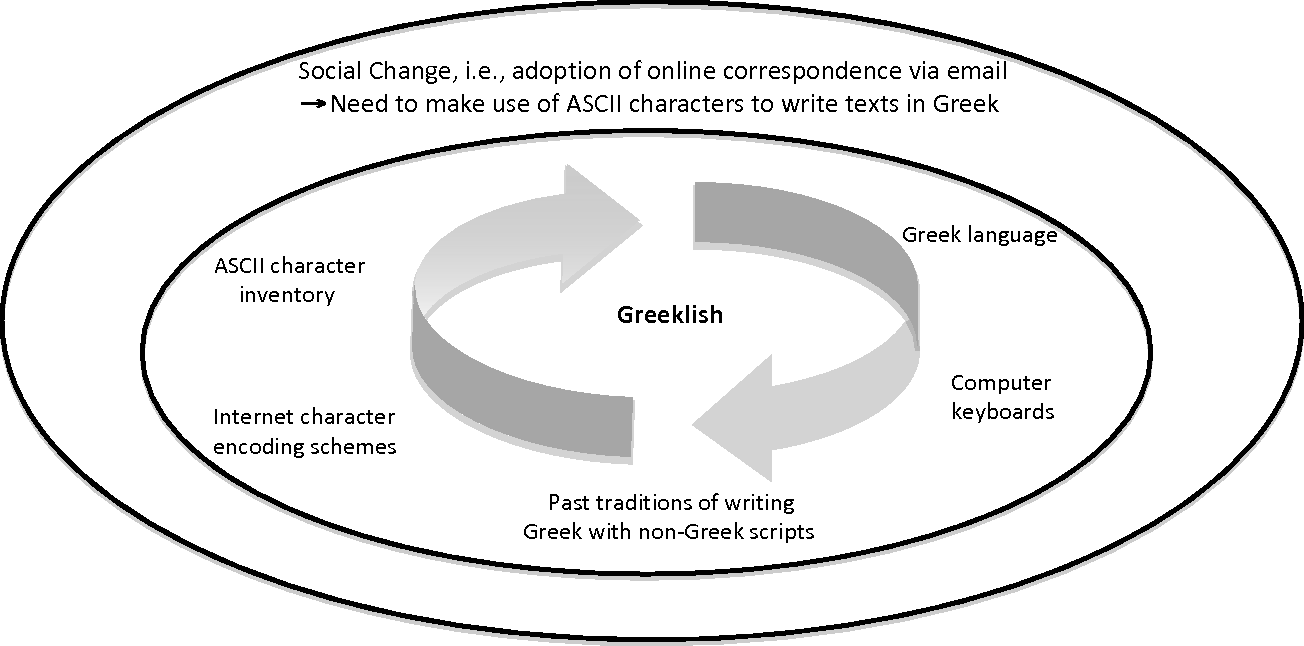
Figure 1.6 Available designs in the development of Greeklish
Emoticons
On September 19, 1982, Scott Fahlman, a young professor at Carnegie Mellon University, posted the following message on an electronic bulletin board, introducing the ‘joke marker’ that was soon to become widely known as the ‘smiley’:
19-Sep-82 11:44    Scott E  Fahlman             :-)
From: Scott E  Fahlman <Fahlman at Cmu-20c>

I propose that the following character sequence for joke markers:

:-)

Read it sideways. Actually, it is probably more economical to
mark things that are NOT jokes, given current trends. For this,
use

:-(
As Fahlman recounts on his website, many bulletin board posts involved sarcastic humor, but there were always a few readers who would fail to get the joke and who would post angry responses. Tongue-in-cheek, Fahlman suggested that adding explicit joke markers might help to let people know not to take some messages seriously. Members of the online community made various proposals for joke markers (one was \__∕ to represent a smile), but Fahlman's ‘smiley’ caught on and spread quickly among computer users. On the other hand, Fahlman's :-( icon did not get taken up in his intended sense, and was instead appropriated as a sign of displeasure, sadness, or anger.
The smiley spawned a host of symbols known as ‘emoticons’ designed to signal various affective states, in the absence of paralinguistic clues such as tone of voice, intonation, gesture, and facial expression in the text-only environments of email, forums, chat rooms, and text messaging. For example, :D indicates being very happy or laughing; :o indicates surprise; ;-) denotes a wink; <3 is a heart for love, and <∕3 is brokenhearted. Emoticons can be intensified by adding extra marks, as in :-)) or :-(( or by lengthening mouth lines, as in the Chinese emoticons -.- (matter of fact), -_- (slightly perplexed), and -_______- (very perplexed).
It is important to note, though, that interpretations of emoticons are quite variable. If one consults the online Urban Dictionary to see what a particular emoticon means, one usually finds a remarkable range of possibilities. The signification of a given emoticon emerges in a specific context, and that meaning may not be transferrable to other contexts. For example, !!! can be taken as either positive or negative comment on prior text. The icon :P (or = P) represents sticking out one's tongue, but it might be in disgust, in gustatory appreciation, or in silliness. The emotion :-( can signal sadness on the part of the writer, but other times it expresses anger or disapproval: The food was ok, but the service was awful :-( and sometimes it indicates sympathy or commiseration, as in:
A: I'm sick today
B: sorry :-(
People sometimes think of emoticons as degraded, simplified forms of language. Emoticons are written communicative devices, but they are paralinguistic, rather than linguistic in nature. Most emoticons occur at the end of messages and serve as directives as to how the message should be read in terms of its illocutionary force. Sometimes they are used as a complete turn in a written exchange, but in this case they are interpreted as a reaction to the preceding message.
Although there is a common core set of basic emoticons in North America and Europe, special emoticons vary across languages to accommodate particular cultural phenomena. For example, French makes a distinction between :-) and :-> (the latter being diabolical, laughing sarcastically or mockingly). Kisses on the cheek are indicated by :-x or :-* or xxx or xox, and drunkenness by :∧) to represent the gesture of a leftward rotation of the fist around one's nose that signifies drunkenness in French culture. In Japanese and Korean, emoticons are not left rotated, but are displayed horizontally (∧_∧ *). In Japanese, raised arms \(∧_∧)∕ makes for a Banzai cheer (hurray!), (>_<") is for ‘ouch,’ (∧∧;) indicates embarrassment (cold sweat running down the cheek), (;_;) is a crying face, and (∧.∧) is a demure ‘girl's smile,’ with a mere dot for the mouth to reflect the politeness norm of women not baring their teeth in a grin. The Japanese wink is rendered as (∧_-), ( = _ = ) indicates boredom, and m(_ _)m iconically represents a figure bowing down either in thanks or apology. Japanese and Korean also use OTL or Orz to represent a ‘side view’ of a stick figure on hand and knees, either kneeling out of disappointment or bowing to show admiration. OZ is the simplified version.
It is interesting to note that Japanese emoticons emphasize the expressiveness of the eyes (∧_∧) (;_;), whereas the Western emoticons emphasize the mouth :-) :-(. Researchers Yuki, Maddux, and Masuda (Reference Yuki, Maddux and Masuda2007) hypothesized that since Japanese tend to mask emotions more than Americans, they would focus on parts of the face that are relatively difficult to control intentionally when they interpreted others’ emotions. As it turns out, the muscles around the eyes are more difficult to control than those around the mouth, and whereas a ‘true’ smile involves contraction of the muscles around the eyes, ‘fake’ smiles do not. Yuki et al. had Japanese and American university students interpret a range of happy and sad emoticons and confirmed that whereas the American students focused primarily on the mouth to determine happiness or sadness, the Japanese focused primarily on the eyes. If people from different cultures read facial cues differently when interpreting emotional expressions, it stands to reason that the emoticons they design will reflect those differences. From a language-learning standpoint, such differences in textual/communicative conventions can provide a starting point for exploring underlying differences between the native and target cultures.
Emoticons were born in the days of ASCII interfaces, when users were faced with making the most of limited resources. In a way, they are a micro-version of ACSII art (Figure 1.7), which developed before the arrival of printers capable of printing graphics, and that incorporated the 95 printing characters of the ASCII code. Unlike ASCII art, however, emoticons are used paralinguistically to guide readers in how to interpret a stretch of language.
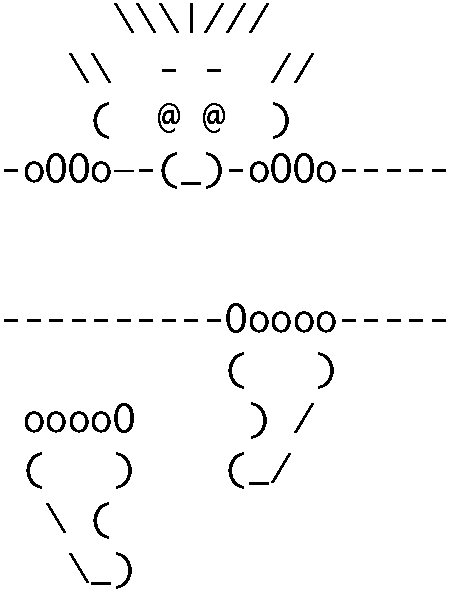
Figure 1.7 Example of ASCII art
Like Greeklish, ASCII-based emoticons continue to be used long after technology has made them obsolete. Despite the availability of far more detailed and extensive graphic-based emoticons in software programs and on the Internet, many people persist in using ASCII emoticons. Again, what began as a material necessity because of a technology's limited resources became an established social practice.
Figure 1.8 summarizes the conditions in which emoticons developed and the available designs that contributed to their make-up.

Figure 1.8 Available designs in the use of emoticons
In the next three chapters we will focus in greater depth on material, social, and individual resources. In Part II, we will consider the dynamic interactions of material, social, and individual resources in the early development of writing, in the spread of literacy that accompanied paper and the printing press, in electronically mediated writing in the digital age, and in the use of multimodal communication technologies. In Part III we will consider educational implications of material, social, and individual contributions to design.


