


The interaction of material, social, and individual dimensions of meaning design is clearly exemplified in the early development of the technology of writing. Writing is thought to have developed roughly 5,000 years ago in four different parts of the world: Mesopotamia, China, the Indus River Valley, and Egypt, with independent development considerably later in Mesoamerica.Footnote 1 Because scholarly documentation is most extensive for early writing in ancient Mesopotamia, this chapter will focus on that region.
Although few statements about the beginnings of writing go uncontested, most scholars agree that writing in Mesopotamia began not as a representation of language at all, but as a way of recording administrative activities in the ancient Near East. At the end of the Neolithic period, social conditions were changing rapidly, with rising wealth, labor specialization, increased circulation of goods, and the emergence of an elite. A more complex political and social infrastructure was essential to manage the expanding economy, and a specific need arose to keep durable records of the production, distribution, and storage of goods. The earliest writing, using an interface of soft clay etched with a pointed stick or reed, was well suited to this need.
But clay etchings and the system that organized them did not spring from nowhere. Archaeological evidence suggests they were likely to have developed over millennia through the invention and use of different systems of administrative record-keeping such as clay tokens, standardized containers, and seals. For example, Schmandt-Besserat (Reference Schmandt-Besserat1996) argues that writing evolved from an accounting system of clay tokens used as early as 8000 bce.Footnote 2 The earliest tokens, appearing with the beginning of agriculture, were basic geometric forms such as cones, disks, spheres, and cylinders, which Schmandt-Besserat calls ‘plain’ tokens (Figure 5.1).Footnote 3 With the rise of cities about four millennia later, ‘complex’ tokens arrived on the scene, complementing the plain tokens with new geometric shapes: bent coils, parabolas, quadrangles, as well as miniature representations of animals, fruits, furniture, vessels, and tools (Figure 5.2).Footnote 4 Whereas the plain tokens had a smooth surface, with no markings, the complex tokens often bore patterns, notches, and punctuations made with a stylus. Both types of token served the same overall function: to organize and store information about goods produced or transacted.
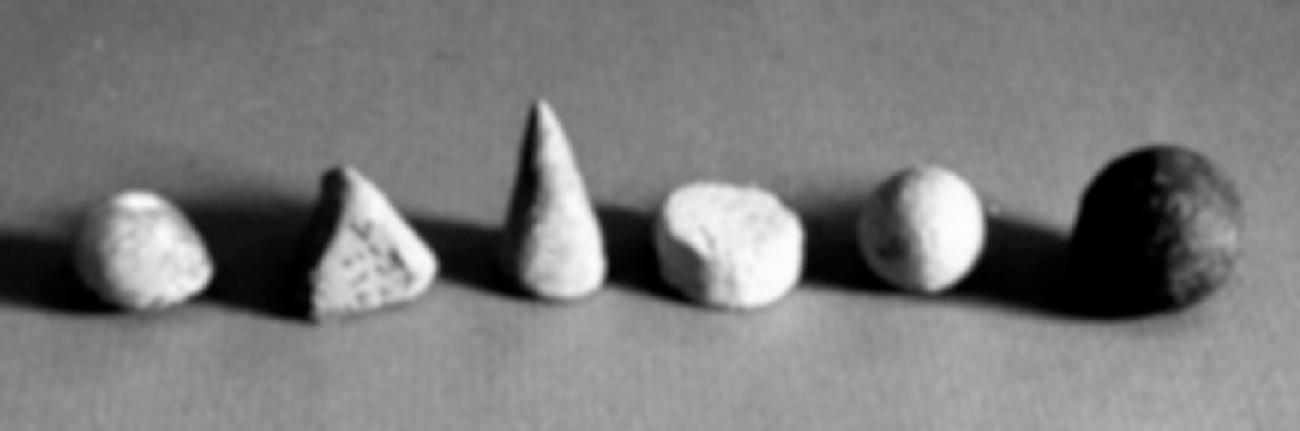
Figure 5.1 Plain tokens from Tepe Gawra, present-day Iraq, c. 4000 bce
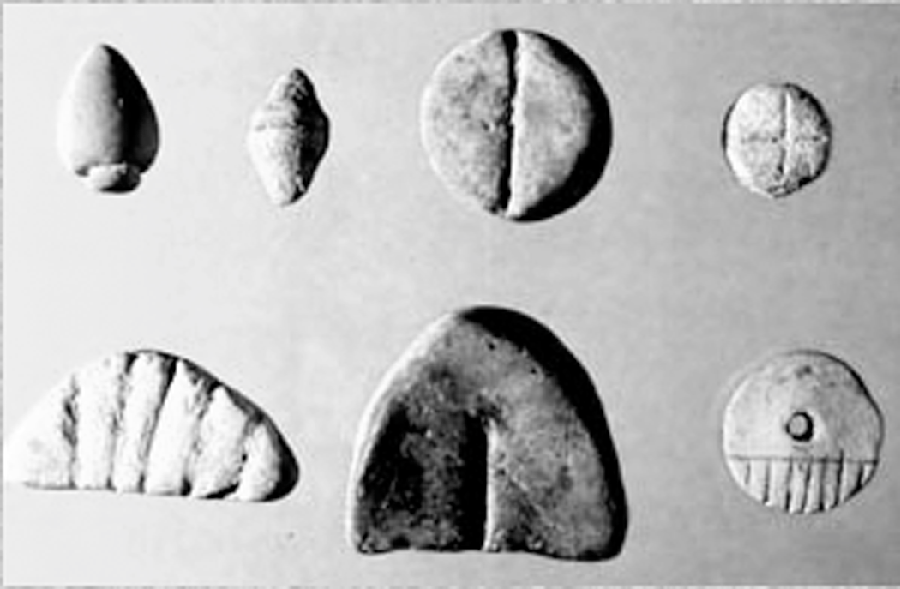
Figure 5.2 Complex tokens from Tello, ancient Girsu, present-day Iraq, c. 3300 bce
As the administrative need arose to archive transaction records, several storage methods were developed. Plain tokens were enclosed in a bulla – a clay envelope the size and shape of a baseball (Figure 5.3), while complex tokens were often strung on a string attached at both ends to an oblong lump of clay impressed with a seal to endorse the authenticity and legitimacy of the record.Footnote 5 Both methods were presumably designed to impede tampering with records – a particularly important safeguard for agreements to be transacted at a later time.

Figure 5.3 Clay ball and tokens
The problem with storing tokens inside clay balls, however, was that once the tokens were enclosed, they were no longer visible or accessible, so the ball had to be broken if one wanted to verify its contents. The solution was to press the tokens into the soft clay exterior of the envelope just before sealing them inside (Figure 5.4). In that way, the contents could be verified without having to break the hardened clay ball. This storage system effectively made the enclosed tokens obsolete, for the impressions alone provided a sufficient record of transacted goods. And if impressions sufficed, it meant that the hollow clay envelope was no longer needed either – a mere flat surface would be adequate. Thus was born the clay tablet (Figure 5.5).Footnote 6

Figure 5.4 Sealed clay ball impressed with tokens similar to those shown to its right
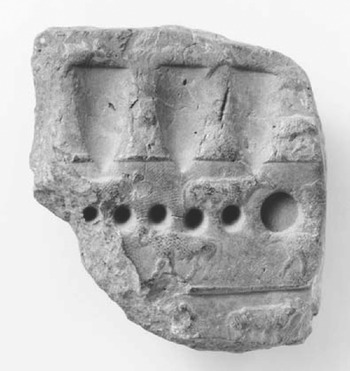
Figure 5.5 Clay tablet from Susa (Iran) showing an enumeration
In terms of the design process, then, a change in social environment (i.e., greater economic and political complexity in Mesopotamian society) was accompanied by the adaptation of existing accounting technologies to develop new practices with the same basic materials (i.e., clay). But how did these social-technological changes relate to linguistic writing?
This is where the story becomes highly controversial. Archaeological evidence from the ancient city of Uruk (in present-day Iraq) dates the beginning of a pictographic writing system known as proto-cuneiform to around 3200 bc.Footnote 7 Proto-cuneiform included icons representing parts of the body, birds, fish, plants, mountains, stars, and so forth (e.g., bird was represented by  , barley by
  ). Schmandt-Besserat (Reference Schmandt-Besserat1996) argues that some of these pictographic signs depicted complex tokens she had inventoried – in other words, they were signs of signs, and thus constituted the essential leap necessary to allow the creation of written language.
Critics argue, however, that Schmandt-Besserat's classification scheme is flawed, that complex tokens are too loosely defined, and that there is no reason to assume that a given token consistently meant the same thing over many millennia and across the vast geographic range where tokens were found (from Egypt to Iran to Anatolia). Archaeologist Paul Zimansky (Reference Zimansky1993) suggests it is more likely that various people at various times used clay tokens to represent whatever they (as individuals) wanted them to represent. Stephen Lieberman (Reference Lieberman1980) adds that because tokens continued to be used alongside written records, we should not think of them as the specific precursor to writing but rather as a parallel system. He takes the fact that the complex tokens were themselves inscribed with marks as further evidence that there well may have existed a sign system that manifested itself both in clay tokens and in clay tablets contemporaneously.
Sumerologist Piotr Michalowski (Reference Michalowski1993) agrees that many tokens likely developed along with or even later than the first inscribed tablets, and proposes a feedback mechanism “whereby certain tokens were made in the shape of written signs, and the proliferation of symbols reflected the experimentation that was taking place in the first writing system” (p. 997). He argues that while tokens and bullae may well have been resources drawn upon in the invention of writing, they were not alone adequate to account for the development of what was really a completely new semiotic form whose genesis he describes as follows:
It is clear…that multiple forms of communication and visual means of social control were prevalent in the Near East in the periods directly preceding and during the time of rapid urbanization. Different social contexts provided the impetus for differing vehicles. Seals, potters’ marks, painting and craft ornamentation, tokens, bullae, numerical tablets, and other designs – these must be seen as parallel systems of communication. The Uruk IV tablets must be placed beside them, not as an evolutionary descendant but as a new member of the extended family. The inventor(s) of proto-cuneiform undoubtedly drew upon many pre-existing elements to create the new vehicle.
Following Michalowski in light of the metaphor of design, we can think of tokens, bullae, seals, numerical tablets, standardized containers, potters’ marks, painting, and craft ornamentation as available designs that operate within their own social contexts. In the new overarching social context of nascent civilization (rapid urbanization, economic exchange on a scale that demanded record-keeping of past, present, and future transactions), proto-cuneiform may not have evolved specifically from tokens but rather emerged from the vortex of available designs operating in parallel semiotic systems, drawing elements from each system (Figure 5.6).Footnote 8

Figure 5.6 Available designs in the development of proto-cuneiform tablets
It is important to point out that language in the sense of connected speech was not explicitly in the mix at this stage, since proto-cuneiform texts apparently bore no relation to spoken language (Damerow, Reference Damerow2006, p. 4). The transition from proto-cuneiform to a full-fledged cuneiform writing system capable of representing speech is poorly documented by archaeological findings, but specialists hypothesize that it was probably at least five centuries after early pictograms before the first connected texts (e.g., legal, religious, commemorative) were written.
What is clear, however, is that two important changes took place between proto-cuneiform and cuneiform writing of the Fara period about 500 years later. One was material, having to do with the technique of writing. The other was functional, having to do with how sounds were linked to graphic signs, first in Sumerian and then other languages.
The language connection: phonetic coding and the rebus principle
Archaeologists believe that the use of true cuneiform writing (as opposed to proto-cuneiform) began during the Early Dynastic I period (c. 2950–2750 bce) in Mesopotamia. Two key changes are considered especially important in this development. The first has to do with the material techniques used in writing, which led to increasingly abstract forms. The second, perhaps enabled by this increased abstraction, is the way written signs came to represent speech sounds.
Because wet clay did not preserve curved lines well, and because it dried quickly in the hot, dry climate, lines drawn with a sharp pointed stylus in proto-cuneiform were replaced by short, straight impressions made with a reed stylus with a triangular tip, explaining the characteristic wedge-shaped marks that give cuneiform its name (see Figure 5.7). With this new wedge-shaped stylus, curved lines became straight strokes (Figure 5.8), circles became squares, and fine details were eliminated, all of which increased writing speed (Gaur, Reference Gaur1984, p. 48). This is the first instance of many that we will encounter of changes in written forms brought about by material factors.
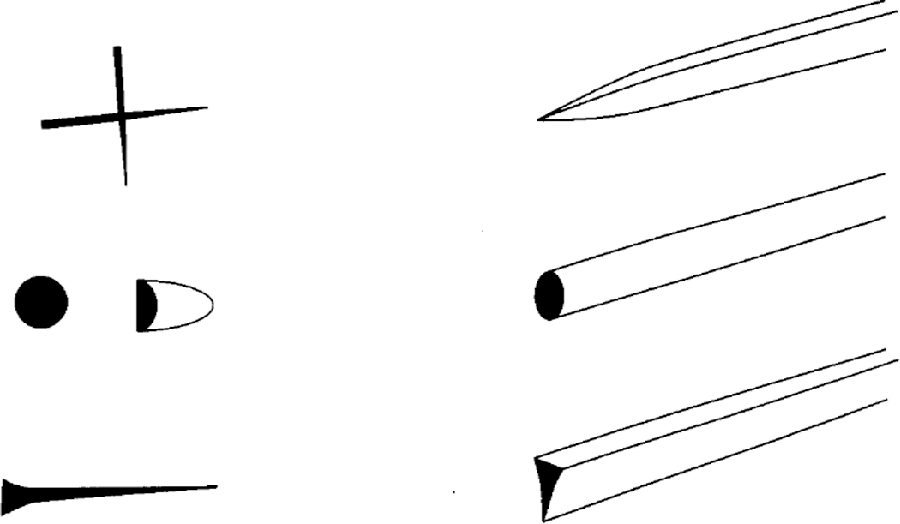
Figure 5.7 Stylus shapes and their respective impressions

Figure 5.8 Breaking up of curved lines with change of stylus
Because early clay tablets were bookkeeping devices, they did not have any discernable syntax and were mostly organized in spatial hierarchies (Damerow, Reference Damerow2006).Footnote 9 For example, names of donors or recipients of a transaction were consistently found below signs indicating the goods transacted, allowing information such as ‘ten sheep (received from) Kurlil’ to be recorded even in the absence of signs to indicate verbs and prepositions (Schmandt-Besserat, Reference Schmandt-Besserat1996, p. 98). While such extreme economy might seem overly ambiguous to the modern reader, it is not entirely unlike today's pared down text messages, tweets, and emoticons. Nissen (Reference Nissen1986) points out that for a long time writing was used “only as a means of producing catchwords for someone who was more or less familiar with the context but needed to be reminded of particular details” (p. 329). Nissen illustrates this point with the example shown in Figure 5.9. While the inscriptions can be interpreted as ‘Two sheep delivered to the temple (or house) of the goddess Inanna,’ they can also be read as ‘Two sheep received from the temple/house of the goddess Inanna.’ Furthermore, because the starlike sign (AN – ‘heaven’) can refer to An, the god of the heavens, or can function as a semantic determinative (marking divinity), it is not clear whether the house or the temple belongs to ‘the goddess Inanna’ or ‘the gods An and Inanna’ (1986, p. 329). Contingency of meaning was thus a feature of written texts right from the start.
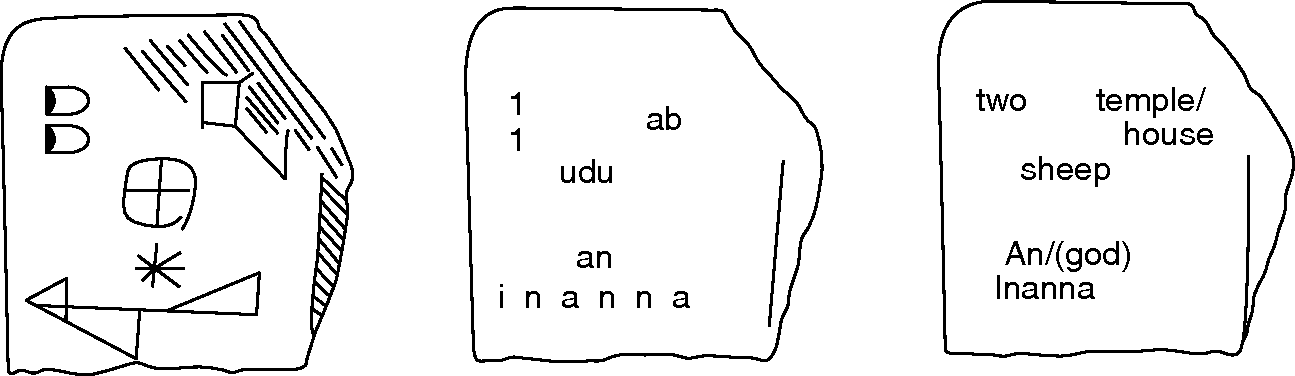
Figure 5.9 The problem of relating signs in a proto-cuneiform text fragment
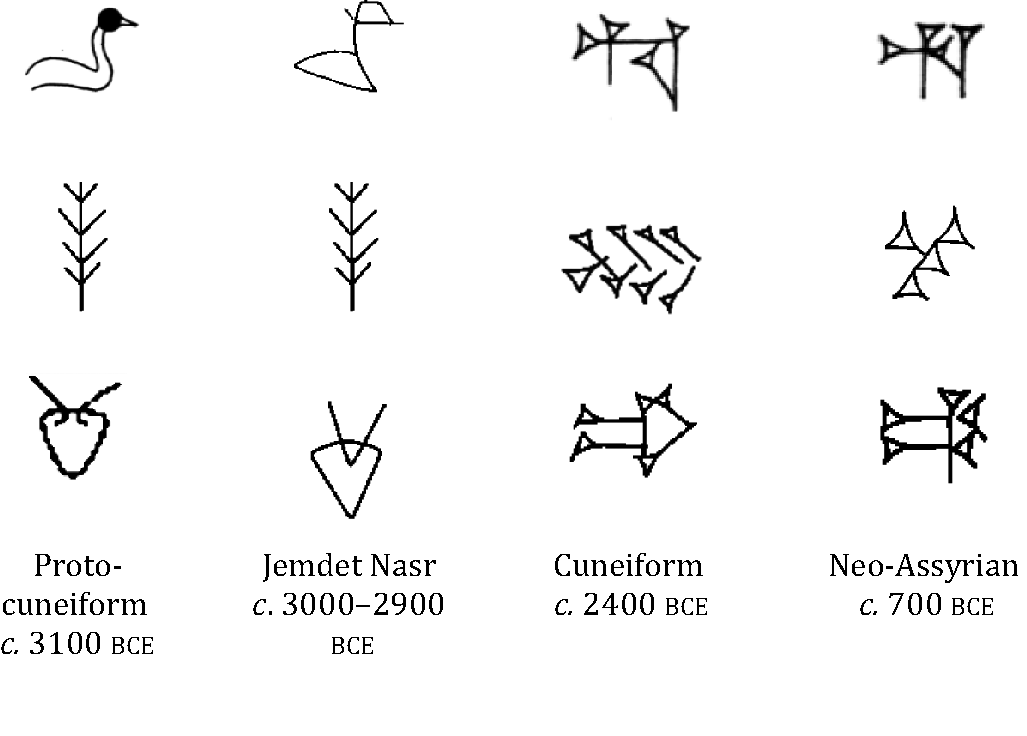
Over a period of centuries, ‘naturalistic’ signs became increasingly abstract, and they continued to change over subsequent millennia as they came to be used not just for Sumerian but also other languages such as Akkadian, Hittite, Elamite, Hurrian, and Urartian. Consider, for example, the transformation of the signs for Sumerian words mušen (‘bird’), še (‘barley’), and gu (‘ox’) from pictograms to cuneiform signs (Figure 5.10). The 90-degree left rotation (shown in the third column of Figure 5.10) occurred sometime during the early third millennium, corresponding to the transition from writing in vertical columns (read from right to left) to writing in rows (read left to right).Footnote 10
The second and crucial change, occurring during the Early Dynastic period (c. 2800 bce), was the linkage of Sumerian writing and speech through phonetic coding. This adaptation changed both the structure and the range of application of proto-cuneiform writing. Although proto-cuneiform was almost entirely logographic, meaning that one graphic sign represented a whole word, the system gradually became more logosyllabic, meaning that signs took on phonetic value through the use of the rebus principle. In a rebus, a picture or symbol is used purely for its sound to represent a spoken word or syllable (see Figure 5.11).

Figure 5.11 Example of a rebus in English. May I see you home, my dear? Escort Card, c. 1865, US
In cuneiform writing, the sign for one word was used to represent another word with the same or similar sound.Footnote 11 For example, the sign for the Sumerian word ti (‘arrow’), written  , was also used to designate the near homophone til (‘life’). Rebuses and homophony not only made it possible to write abstract nouns but also afforded the possibility of writing multisyllabic words and names by representing the sounds of each individual syllable. An analogy in English would be using an icon of the sun not only to represent the words sun or son, or the name Sunn, but also the syllable in sundry, lesson, Anderson, and so on.
But homophony has its limitations as well. Whereas context might clarify meaning in face-to-face speech, in the context-reduced situation of writing, a systematic one-to-one sound–symbol correspondence system could lead to frequent ambiguity. Because some Sumerian words had a large number of homophones, they needed to be distinguished in writing. For example, fourteen homophones of gu were represented by distinct visual signs. The first four are presented below (from Walker, Reference Walker1987, p. 12):

This is similar to how contemporary languages like English and French attribute multiple meanings to the same sound pattern, but differentiate each meaning with a distinct visual sign (e.g., there, their, they're; ver, vers, vert, vair, verre). And this is what allows tongue-in-cheek use of homophony as in the email forwarding tag ‘Sent from my eyePhone.’
To further complicate things, Sumerian was also characterized by homophony's complement, polyphony, meaning that one graphic sign could represent semantically related words that nevertheless had vastly different sounds. For example, the sign for ka‘mouth,’ originally a pictogram of a head with the mouth drawn on it, is also used for words associated with the mouth; for example, gu3 ‘voice’, zu ‘tooth’, du11 ‘speak,’ and inim ‘word’ (Walker, Reference Walker1987). Because of homophony and polyphony, the intended meaning of cuneiform signs could often only be determined by context.
A partial solution to the one-to-many correspondence problem was the development of determinatives – signs placed before or after other signs to specify the relevant semantic domain (e.g., geography, divinity, metal, wood, and so on). Perhaps the most common determinative in Sumerian was an ( ) as seen in the tablet in Figure 5.9 above to designate a deity. Other markers were phonetic, to indicate how a sign should be pronounced (akin to our use of st, nd, rd in 1st, 2nd, 3rd in English). Because they ‘determine’ how a stretch of writing should be read, these particles are vaguely analogous to emoticons in electronic texts today, which are often intended to clarify the tone of an utterance.
An important structural change resulting from cuneiform's new function of representing speech was the standardization of sign order and linearity. Whereas early accounts and administrative records used formats in which written signs were not necessarily placed in the order in which they would be spoken, by the middle of the third millennium bce, the order of signs usually reflected the syntax of spoken discourse (Veldhuis, Reference Veldhuis and Houston2012, p. 6). This happened at the same time that cuneiform was being used for the first time on a large scale to record lengthy prose and poetic compositions.
This story of the origins of writing still poses intriguing puzzles for scholars. We still do not know the extent to which particular threads of the story interact. As we have seen, for example, two important changes occurred between proto-cuneiform and cuneiform writing: material changes in the technique of writing, and functional changes with the beginnings of phonetic representation. Was there a relationship between these two developments? Here are the facts as we currently know them. First, we have seen that the earliest written signs depicted things in the world. When the wedge-shaped reed stylus was introduced, curved lines became straight impressions, fine details were lost, and signs became more stylized and abstract – a trend that continued over centuries and millennia. Signs lost any resemblance they might have originally had to things in the world. Might it have been this increasing abstraction of signs, grounded in the very materiality of writing practices, that facilitated the development of phonetic coding by distancing signs from their original real-world referents and thus making them more suitable for ‘arbitrary’ and multifunctional use? We will never know. But we do know that as cuneiform writing interfaced more fully with the Sumerian language, the degree of multifunctional use of cuneiform signs increased remarkably. Logograms served additionally as phonograms, and homophony and polyphony led to a complex web of relationships between signs, sounds, and meaning. Certain signs were used as semantic determinatives. Sumerian logograms were loosened from the language and came to be used to write Akkadian and other languages as well. Thus a limited inventory of signs was used to accomplish a maximum of communicative work. We can see how this principle still operates today as the Roman alphabet is used to write multiple languages, and when we use letters and numbers to represent words or parts of words, as when we write CU l8r for ‘see you later’ in a text message.
To round out the story, cuneiform became one of the most successful writing systems in human history. Over a period of three millennia, cuneiform writing served multiple needs, purposes, cultures, and languages. Despite its purely administrative origins, cuneiform writing came to preserve and disseminate literature (e.g., the Sumerian/Akkadian Epic of Gilgamesh), law (e.g., the Code of Hammurabi), religion (prayers, hymns, omens, divinations), and scholarship in fields such as astronomy, mathematics, and medicine.
Cuneiform and design
The above description has been somewhat detailed because the specific processes involved in establishing early Mesopotamian writing 5,000 years ago – the use of tokens, seals, tablets, pictograms, and abstract signs that were re-worked in relation to one another – are connected to general processes that have been reiterated throughout the history of literacy, and have direct relevance to our understanding of the relationship of language, literacy, and technology today.
We have seen that writing in Mesopotamia did not begin as a representation of speech but rather was born out of administrative needs in an increasingly complex society, to allow records of transactions to be made and preserved. What thus began as an interface to administrative bureaucracy was subsequently adapted to become a visual interface to language. This sequence is important, as it reminds us that writing is first and foremost a social phenomenon, and that its formal linguistic features follow from its social function as well as material constraints. In previous chapters we have seen this idea play out in diverse examples from handwriting to Greeklish, texting, online chat, and Facebook, and we will see it again in the next chapter when we consider new conventions that developed with the printing press. It will also help us to think about educational issues related to literacy in Part III. In writing classrooms today, for example, it all too often seems that writing is made to be about rules of standard grammar, spelling, and punctuation but without any real exploration of the social and pragmatic underpinnings of those conventions. The case study of cuneiform affirms the importance of conventions, but also highlights their social basis, which is what gives them meaning.
Material dimensions of literacy are also clearly illustrated in the case of cuneiform writing. As we saw in Chapter 2, the physical medium used has important implications for the form of the script, the size of texts, and their relative permanence. The medium of clay and reed stylus lent itself to short, straight impressions rather than round drawn lines. Because most tablets were small enough to fit in a scribe's palm, texts were generally short and required economical use of space. To date, clay has proved to be the most durable of any material used for writing – and its durability was only increased by fires!
Another important point that we can take from the story of cuneiform is that writing co-evolved with Mesopotamia's increasing social, economic, and cultural complexity, but it was not its cause. Technology is often considered an autonomous force that brings about advances in society, but the cases of innovations such as cuneiform writing, the telephone, the printing press, and the computer show us that it is not technology per se, but the interaction of technologies with social life, in the context of particular social conditions, that gives rise to broad social change. As functional needs change, so do material forms of communication, and these changes in turn open up possibilities for new functions, and so on.
The story of cuneiform also reminds us that the repurposing of existing resources depends on the ability to view familiar signs in a new way, drawing on repertoires of symbol manipulation. That ability is facilitated by the abstraction of signs. As users of an alphabet whose origins go back to the Phoenicians, writers of English no more think of an ox head when they write the letter A than they think of a little snake when they write the letter N. And no doubt the Phoenicians didn't either. The letters A and N make meaning when positioned in relation to other letters, but have no intrinsic meaning as letter forms.Footnote 12 The leap made by the Sumerians was to make signs abstract, which was at least partly due to material factors in using clay and stylus. Abstraction allowed signs to designate other signs (e.g., impressions on a bulla of tokens contained within it, which were in turn signs of categories of objects in the world; signs inscribed in clay being used to designate spoken words as well as functions that had no spoken equivalent, such as determinatives). The fact that a sign might refer to a notion of an object in the world, or it might refer to a language sound, or it might be used as a semantic determinative also suggests that extralinguistic context must have played an important role in the Sumerians’ interpretations of texts.
Another significant point illustrated by the case of cuneiform is that technologies of communication don't simply replace one another in a neat succession. Rather, they overlap and inform one another, creating a synergistic panoply of resources for record-keeping, for authenticating, for making and communicating meaning – all operating within a sociocultural ecology (as described in the Introduction and Chapter 3). When writing appeared, it supplanted neither token use nor seals, and it certainly did not supplant the use of speech. Nor did writing likely have just one precursor. As Lieberman, Michalowski and others have argued, writing emerged from a matrix of existing forms (i.e., available designs) coming from different, but interacting, semiotic systems.Footnote 13 Furthermore, the technology of cuneiform was itself an ‘available design’ in the sense that it went on to influence the development of other scripts, such as Ugaritic and Old Persian. Gaur (Reference Gaur2000) likens this (re)invention process to the turning of a kaleidoscope: “at every turn new patterns emerge but the basic components from which these patterns are made remain the same” (p. 6).
Finally, the case of cuneiform furthermore illustrates that writing systems are not static but respond dynamically to the ecologies in which they are used: they are variable in extension and adapt to the needs of the reading culture to which they belong. Thus whereas Old Assyrian merchants needed only about one hundred cuneiform signs, Old Babylonian scholars recording the Sumerian literary tradition used hundreds more, and many of which had several distinct values (Veldhuis, Reference Veldhuis and Houston2012, p. 8). Yet they were working with a system that had a recognizable quality of ‘sameness’ to it.Footnote 14 By virtue of interfacing with fourteen languages other than Sumerian, cuneiform writing also disabused us of the notion that writing systems ‘represent’ languages in any essential way. Rather, they have the potential to interface with multiple languages, and are often adopted for political or cultural reasons rather than for any linguistic reasons.


