

12.1 Introduction
The sound system of English has undergone considerable change in the 1,500 years or so for which documents of the language exist. So great is this change that the earliest forms of the language are not readily comprehensible to speakers of EnglishFootnote 1 today. Major sound changes occurred every few centuries, continuously increasing the distance to earlier stages of the language. Furthermore, different types of phonological change occurred during the history of English and it is the consideration of these types and the research on them which form the core of the present chapter.
Some of the changes were motivated by reanalysis on the part of language learners and some by gradual shifts in pronunciation by adult speakers. Both types of change are connected and form trajectories along which the sound system of English has moved for over a millennium and a half. In the history of the language there are further motivations for language change. Contact with other languages had a lasting influence until at least the late Middle Ages (Hickey Reference Hickey, Nevalainen, Pfenninger and Traugott2012b) after which this influence was largely confined to the lexical area which was fed with items not gained through direct contact with speakers of other languages. From the eighteenth century onwards a further factor comes to the fore in language change: the prescriptivism which arose surrounding language use and education which concerned the rising middle classes in the late modern period.
12.2 Research situation
Phonology was a primary focus when the first works on the history of English began to appear at the end of the nineteenth century. A prominent figure of this period is Henry Sweet (1845–1912) who was educated in the Neogrammarian tradition of language analysis and whose approach to English linguistics was largely philological. Sweet, like scholars working in other Indo-European languages, was concerned with documenting and describing the oldest stage of a language, see his An Anglo-Saxon Reader (1876) followed by The Oldest English Texts (1885) and An Anglo-Saxon Primer (1886). The treatment of sound change in such works was largely within the framework of nineteenth-century historical linguistics: the development in Old English of the sound system of Germanic (and further back, of Indo-European) was traced by examining the regularities of change (the application of sound laws) and comparing developments in related Germanic languages. This comparative philology was complemented by considering internal factors in reconstructing the earliest stages of English. By the beginning of the twentieth century enough knowledge of the historical sound system and grammar of English had been amassed for major synthetical studies to be attempted by ambitious scholars in the field. Two monumental overview works of this period deserve mention, the six volume A Modern English Grammar on Historical Principles (1909) by Otto Jespersen (1860–1943) and the two-volume Historische Grammatik der englischen Sprache, ‘Historical Grammar of English’, (1914–40) by Karl Luick (1865–1935). After the Second World War the historical study of English phonology continued with scholars such as Robert Stockwell, working initially within the tradition of American structuralism. With the advent of generative phonology, following the publication of The Sound Pattern of English (Chomsky and Halle Reference Chomsky and Halle1968) the historical phonology of English received new impetus. Scholars such as Richard Hogg, Charles Jones, and especially Roger Lass, began a renewed investigation of the diachronic sound system of English, often concentrating on providing new interpretations of items of change which had already been considered, see the contributions in Lass (Reference Lass1969) and, somewhat later, Lass and Anderson (Reference Lass and Anderson1975), and Lass (Reference Lass1976). By the mid 1970s classical generative phonology had been revised considerably and different versions of non-linear phonology (Durand Reference Durand1990) were the focus of attention and have remained so since. Overview works for the entire history of English or for key periods were produced, see Jones (Reference Jones1972, Reference Jones1989), Hogg (Reference Hogg1992a), and Lass (Reference Lass, Hogg and Denison2006) as representative publications.
Since the 1960s there has been a close link between linguistic theory and phonological studies and this link led to new research into the history of the sound system of English with the advent of two major theoretical models: the first, lexical phonology (Kaisse and Shaw Reference Kaisse and Shaw1985), from the 1980s and the second, optimality theory (McCarthy Reference McCarthy2002), from the early 1990s. The application of lexical phonology to issues in the history of English is associated in particular with April McMahon and culminated in her monograph McMahon (Reference McMahon2000b) while the application of optimality theory to phonological change in English is ongoing and best represented in the work of Ricardo Bermúdez-Otero, see Bermúdez-Otero (Reference Bermúdez-Otero2015) and Bermúdez-Otero and Trousdale (Reference Bermúdez-Otero, Trousdale, Nevalainen and Traugott2012) as representative examples of this research. Bermúdez-Otero is known for his advocacy of stratal optimality theory which assumes the existence of phonological stratification, as does lexical phonology, and which has different domains of application from the phonological word to the higher ‘prosodic’ units of the phrase and utterance. But there remains the essential difference between lexical phonology, which assumes ordered rules for different levels of language, and optimality theory which works with the notion of constraint ranking, this determining the actual sound outputs in a specific language or language period, depending on how this ranking holds. Many variants of optimality theory are closely linked to early language learning and interpret rankings as emerging from fundamental storage and processing mechanisms in first language acquisition.
Apart from this theoretically oriented work, there is also current research on historical English phonology which is theoretically aware but not bound to a particular model, for instance that by Jeremy J. Smith (Reference Smith2007); see also Chapter 25 by Minkova and Zuraw in this volume.
12.3 Expanding the database
Up to the late twentieth century the data examined in historical phonology studies of English has been very largely from England. The Old English database is clearly circumscribed with most texts from the south or midlands with some from the north. With the advent of the Middle English period the situation becomes more diverse with much regional writing available. Nonetheless, this material has been regarded as part of the mainstream database for the history of English. By the Early Modern period, beginning around 1600, the focus moves to forms of English stemming from the south-east. By the Late Modern period, starting around 1800, forms of English in London and the Home Counties represent the core of data used for studies of the language. In addition, non-localizable, supraregional forms of English are given preference over vernacular varieties, either urban or rural.
This situation has had a number of consequences. Forms of English outside the south-east were seen as the domain of dialectology while varieties of English in Scotland (including Scots) and in Ireland were treated as completely separate from English in the south-east. Most of all, varieties overseas were in the main ignored, perhaps with a nodding reference to American English. This situation changed gradually in the 1980s with publications such as Trudgill (Reference Trudgill1986) and overviews of English accents, such as John Wells's (Reference Wells1982) seminal three-volume work.Footnote 2 With the increasing scholarly interest in varieties of English worldwide (Kortmann and Schneider Reference Kortmann and Schneider2008), new arenas for the development of English came into view for historical phonologists.
In the following sections several instances of phonological change are presented and discussed with a view to documenting the range of change types available in the history of English and their relevance to phonological change as a whole.
12.4 Examining sound change
It is a truism that details of historical phonetic realization are not recoverable via the orthography and hence attempts at accounting for why change took place are fraught with difficulties. Indeed even with present-day primary data the degree of individual variation and the range of sociolinguistic motivation for particular realizations are too great to say with any certainty why a change is taking or has taken place. However, generalizations can be made over repeatedly attested items of sound change, such as intervocalic voicing, palatalization of stops, the rise of front vowels, to allow scholars to posit general principles of phonological change. It is these principles which form the theoretical backbone of the presentation below.
Like other instances of language change, developments in phonology can in principle be assigned to a motivation internal or external to a language. In many cases dual motivation may be posited. The following two sections consider internal and external arguments, the latter stemming from language contact.
12.4.1 Symmetry in the system of fricatives
The contrast between voiceless and voiced fricatives was determined in Old English by environment with intervocalic position triggering voicing, e.g. cnif [kni:f] ‘knife’: cnivas [kni:vɑs] ‘knives’, see the recent discussion in Minkova (Reference Minkova2011). During the Middle English period, with the influx of French words from both Anglo-Norman and later Central French, a voice contrast between fricatives arose which was to become central for English, cf. refuse [ˈrefjus] (noun): refuse [rɪˈfju:z] (verb). In the Early Modern period the sequence /zj/ in words of French origin merged to a single sound [ʒ] (Jespersen Reference Jespersen1909: 341) as in examples (1a) and (1b).
(1a)
vision /vizjon/ → /vɪʒən/
(1b)
pleasure /plezjur/ → /pleʒər/
While this probably resulted from the phonetic elision of /z/ and /j/ the result led to greater symmetry for the system of fricatives in English which now show matching pairs of voiced and voiceless sounds.
(2)
voiceless /f/ /θ/ /s/ /ʃ/ voiced /v/ /ð/ /z/ /ʒ/
12.4.2 Dental fricatives in the history of English
A central part of the Germanic Sound Shift (Harbert Reference Harbert2007: 41–7) is the change of a strongly aspirated /th/ into a dental fricative /θ/ (e.g. thin /θın/ from a much earlier */thin/), in stressed onsets (not preceded by /s/). All the Germanic languages, except Icelandic and English, later lost this fricative (Gothic did not survive long enough to be relevant here; Danish has the dental fricative /ð/ from a different source). Icelandic has changed little over time, so inertia is the major force maintaining dental fricatives there.
English, however, has experienced great phonological change over the centuries, for example, it has lost consonantal length, has acquired phonemic voiced fricatives, and has developed contrastive word stress under Romance influence. So why does a language with so much phonological change still show dental fricatives? Especially given that these are relatively rare cross-linguistically: the friction of dental fricatives is less prominent acoustically than that with /s/, for instance.
A contributory factor could be the existence of dental fricatives in Brythonic (still found in Welsh). Assuming that much of the Old English population consisted of Celts who shifted from Brythonic (Hickey Reference Hickey, Nevalainen and Traugott2012c), dental fricatives would have been natural to them. This helps explain why Welsh, English, and Scots still have dental fricatives.
The ‘marked’ status of dental fricatives is supported by their relative rarity but also by later shifts away from a dental articulation. Consider a related instance of sound-preserving change: a segment-maintaining shift is that of /x/ to /f/ as in cough, rough, laugh. In some cases the shift is not apparent in the standard but is in dialects, compare Northern English duff /dʊf/ ‘boiled pudding’ with dough where the /-x/ was simply deleted. A shift to a less ‘marked’ segment is seen in the move from a dental/interdental to a labio-dental fricative, which is well attested for varieties as far apart as Cockney English and African American English (Wells Reference Wells1982: 328–9).
(3a)
think [fɪŋk], three [fri:]
(3b) brother [brʌvə], bother [bɒvə]
Some scholars, e.g. Jespersen (Reference Jespersen1909: 386), have maintained that the shift arose because of the acoustic similarity of the two types of fricative at the historical source and the present-day realization respectively.
12.4.3 Front rounded vowels
Among the Germanic languages English is unusual today in not having any front rounded vowels. Most Germanic languages have retained the outcome of early umlaut (fronting of stem vowels before an inflection with /i/ or /j/) although the process has been inactive for about a thousand years, cf. German Buch /bu:x/ ‘book’: Bücher /by:xer/ ‘books’, Sohn /zo:n/ ‘son’: Söhne /zø:nə/ ‘sons’. Cases of umlaut in Old English which showed front rounded vowels were unrounded leaving long front vowels which formed the input to the long vowel shift (see section 12.6), e.g. OE lus /lu:s/ ‘louse’: lys /ly:s/ ‘lice’ where /ly:s/ unrounded to /li:s/ which later became /lais/. Front rounded vowels survived in the West Midland dialect into the Middle English period but finally disappeared. Precisely why English lost front rounded vowels is uncertain. One view is that because most speakers of Old English by the seventh/eighth centuries would have been shifters from Brythonic (the precursor of present-day Welsh) they may have transferred their Celtic speech habits into Old English (Lutz Reference Lutz, Filppula and Klemola2009) and these would not have included front rounded vowels. Such developments are known from other scenarios, e.g. with Slavic speakers of German.
Arguments for language contact have become common in recent years (Filppula et al. Reference Filppula, Klemola and Paulasrto2008; Filppula and Klemola Reference Filppula and Klemola2009; Hickey Reference Hickey, Nevalainen, Pfenninger and Traugott2012b, Reference Hickey, Nevalainen and Traugott2012c) as have areal arguments (Hickey Reference Hickey2012a) which consider the presence and absence of features across languages and varieties in geographical contact with each other. Table 12.1 documents the incidence of features among languages of the British Isles and those of the European mainland which are closest to England.
Table 12.1 English and the languages geographically closest to it
| English | Welsh | Scots | Irish | French | Dutch | |
|---|---|---|---|---|---|---|
| Phonemic vowel length | ✓ | ✓ | – | ✓ | – | ✓ |
| Front rounded vowels | – | – | – | – | ✓ | ✓ |
| Nasal vowels | – | – | – | – | ✓ | – |
| Interdental fricatives | ✓ | ✓ | ✓ | – | – | – |
| Voiced sibilants | ✓ | – | ✓ | – | ✓ | ✓ |
| Velar fricative, voiceless | – | ✓ | ✓ | ✓ | – | ✓ |
| Velar fricative, voiced | – | – | – | ✓ | – | ✓ |
| Alveolo-palatal fricative | ✓ | ✓ | ✓ | ✓ | ✓ | – |
| Phonemic affricates | ✓ | – | ✓ | – | – | – |
| 2 or more segment clusters | ✓ | ✓ | ✓ | ✓ | – | ✓ |
12.5 Changes in syllable structure
Since at least the mid 1970s all phonological analyses appeal, to a greater or lesser extent, to syllable structure when explaining synchronic phonology and diachronic developments (see Hooper Reference Hooper1976). Many changes in the history of English can be best accounted for by reference to syllable structure as the following two instances illustrate.
12.5.1 Open syllable lengthening
A metrical foot (F = foot) refers to those syllables which stand between two stressed (S = strong, i.e. stressed) syllables including the first stressed syllable, irrespective of the number of weak, i.e. unstressed (W = weak) syllables after it. In Middle English a foot could not consist of a single light syllable (Minkova Reference Minkova1982: 48). A light syllable is one whose rhyme shows only VC or V (long vowels – V: – do not represent light syllables). If a word has a light (L) stressed syllable and if the second syllable (as a rule /ə/) is lost as part of inflectional attrition in Middle English then compensatory lengthening occurred in the stressed syllable in order to attain a heavy (H) syllable as a foot component.
(4)
2 morae 2 morae S, L W, L ə → Ø S, H | | V → V: | ME eten /etən/ e t ə ɛ:t ‘eat’ ME nose /nozə/ no z ə nɔ:z ‘nose’
The labels S, ‘strong’, and W, ‘weak’, refer to the relative accentuation of the syllable. With the designations L, ‘light’, and H, ‘heavy’, the reference is to the quantity of the syllable. The correlation between strong and heavy on the one hand and weak and light on the other is in Middle English such that when a syllable is the only one in a foot then it must also be ‘heavy’, hence the lengthening of short stressed vowels after the loss of final /ə/. Thus the quantity of words was retained by Open Syllable Lengthening. There are other aspects to this process which cannot be discussed here, such as the lowering of lengthened mid vowels and the preference for the lengthening with mid and low vowels, this latter fact accounting for instances of high vowels, /i/ and /u/ which did not undergo this lengthening.
12.5.2 Coda quantity in Old English
In Old English geminate consonants were found in many intervocalic positions, e.g. sellan ‘sell’, puffan ‘puff’, cyssan ‘kiss’ where the two letters are taken to indicate phonetically long consonants. There was furthermore a complementary distribution of long and short vowels and consonants in stressed syllable rhymes such that the latter either consisted of a long vowel and a short consonant or a short vowel and a long consonant (essentially the quantity distribution rule which still applies in Swedish, cf. vit [vi:t] ‘white’ and vitt [vɪtt] ‘knows’).
The coda quantity rule for the rhymes of syllables was disturbed in the late Old English period due to phonetic lengthening of short vowels before a cluster consisting of a nasal and homorganic stop, e.g. blind /blɪnd/ → /bli:nd/, mind /mɪnd/ → /mi:nd/, leading to so-called ‘superheavy’ syllables. This development meant that later generations of language learners no longer concluded that there was a complementary distribution of length for vowels and consonants and the rule died away.
12.6 Interpreting change: the English long vowel shift
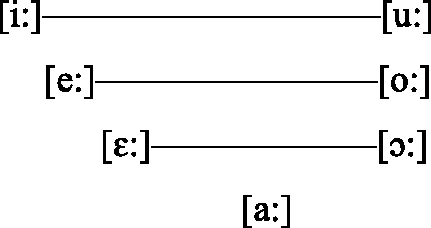
By the Early Middle English period the front vowels of Old English had been unrounded and the retracted /ɑ:/ had largely been replaced by a central variant. Open syllable lengthening (see section 12.5.1) had led to long open mid vowels arising so that the long vowel system looked as follows.

Figure 12.1 Early Middle English long vowels
By the end of the thirteenth century alternative spellings begin to appear in northern England which show e and o as i and u (Wełna Reference Wełna1978: 183–4). This could be seen as the beginning of a series of shifts which represent far-reaching changes in the system of English long vowels.
Both long monophthongs and diphthongs are affected by, and form an outcome of the vowel shift. However, the lexical incidence of long vowels and diphthongs altered radically between late Old English and the beginning of the Early Modern period. The following is a summary of the main movements.

Figure 12.2 Raising of mid vowels; diphthongization of high vowels
There is some disagreement about how the long vowel shift began (Lass Reference Lass1987: 129–31). The view that the mid vowels /e:/ and /o:/ pushed the high vowels towards diphthongization was shared by Karl Luick. Support for this view is forthcoming from the northern dialects of English. Here an unconditioned fronting of /o:/ to a front vowel /ø:/ occurred in the fourteenth century. It is assumed by some scholars, e.g. Roger Lass, that northern ME /u:/ was not diphthongized because /o:/ was not encroaching on its space, having been fronted instead (Lass Reference Lass1987: 226–7).

Figure 12.3 Northern versus Southern Middle English
The notion that the high vowels /i:/ and /u:/ were diphthongized lightly to /ɪi/ and /ʊu/, thus vacating phonological space into which the mid vowels then moved, was supported by Otto Jespersen (Reference Jespersen1909). There has also been dispute about whether the shift occurred for internal structural reasons (an account favoured by Roger Lass) or whether language-external factors, ultimately lying in the social behaviour of speakers, provided the motivation for the shift, see the arguments in Stockwell and Minkova (Reference Stockwell, Minkova, Kastovsky, Bauer and Fisiak1988) contra Lass. These authors also postulate that the lenition of consonants in Old English (Stockwell and Minkova Reference Stockwell, Minkova, Kastovsky, Bauer and Fisiak1988: 356) led to a system of vocalic offglides which provided an impetus for the diphthongization of the long vowel shift.
12.6.1 Problems with mergers and splits
The course of the vowel shift presents problems of phonological interpretation. Various mergers occurred but others did not (see Table 12.2 and discussion above). In particular, the raising of long front vowels has been the subject of discussion. A summary of the movements is given in the following figure.

Figure 12.4 Raising of long front vowels
Table 12.2 Overview of the English long vowel shift
| (1300) | 1400 | 1500 | 1600 | 1700 | 1800 | 1900 | |
|---|---|---|---|---|---|---|---|
| drive | /i:/ | /ɪi/ | /ei/ | /əi/ | /ʌi/ | /ai/ | |
| house | /u:/ | /ʊu/ | /ou/ | /əu/ | /ʌu/ | /au/ | |
| feet | /e:/ | /i:/ | |||||
| fool | /o:/ | /u:/ | |||||
| beat | /ɛ:/ | /e:/ | /i:/ | ||||
| foal | /ɔ:/ | /o:/ | /ou/ | /əu/ | |||
| take | /a:/ | /æ:/ | /ɛ:/ | /e:/ | |||
| sail | /ai/ | /æi/ | /ei/ | /e:/ | /ei/ | ||
| law | /au/ | /ɒu/ | /ɒ:u/ | /ɒ:/ | /ɔ:/ |
In the sixteenth century ME /a:/ (as in made) merged with ME /ai/ (as in maid) in the London area. But although these may have coalesced with ME /ɛ:/ (as in meat), see previous figure, Modern English shows that the vowels cannot have taken the same path because ME /a:/ and ME /e:/ have different present-day reflexes, namely /ei/ (made /meid/) and /i:/ (mead /mi:d/) respectively. One explanation for the non-merger of these vowels is the assumption that the raising of ME /ɛ:/ (to merge with ME /e:/ as in meet) took place before ME /a:/ reached this value. Another is that different varieties showed different stages of the shift and that pronunciations later arose from more than one source.
(5)
(A) (B) (C) meet e: i: i: meat ɛ: e: i: made ɛ: e: e: maid ɛ: e: e:
Samuels (Reference Samuels1972: 147) assumes that the reason for the shift indicated between (B) and (C) was the high functional load of /e:/ due to the homophony of vowels from three sources (meat, made, maid) which was reduced by the shift of /e:/ to /i:/. Evidence for this could be found in traditional dialects of English (Ihalainen Reference Ihalainen and Burchfield1994), e.g. in Scotland and Ireland, in which the vowel in mead has not been raised to /i:/, the last step in the raising of long front vowels.
Some scholars (Labov Reference Labov1994: 349–90, Milroy and Harris Reference Milroy and Harris1980) have pointed out that one may be dealing with near-mergers, or indeed if with mergers, then not perhaps for the entire population speaking a language. There may have been varieties present which did not undergo a merger and which offered a model for the later re-establishment of the distinction between meat and mate after the sixteenth century.
12.7 Change as addition: epenthesis and metathesis
Epenthesis, the addition of sounds (vowels or consonants) to words, has a long history in English. At least from Middle English onwards consonantal epenthesis can be seen in the /-t/ which is added at the ends of words ending in a nasal or fricative as in the following examples (the last two are non-standard forms, Jespersen Reference Jespersen1909: 218ff.).
(6a)
OFr paysan → late ME peasant
(6b)
OFr cormoran → late ME cormorant
(6c)
ME agains → EModE against
(6d)
ME amyddes → EModE amidst
(6e)
EModE onst ∼ ModE once
(6f)
EModE twist ∼ ModE twice
One possible reason for this epenthesis is that the addition of a stop increases the consonantal nature of the syllable coda, thus optimizing the structure of the syllable (Blevins Reference Blevins and Goldsmith1995). Consonant epenthesis can also occur word-internally but with the same apparent motivation, compare English thunder – with /-nd-/ – and German Donner. A further instance of this type of epenthesis is the insertion of a nasal in an unstressed syllable before /ɡ/, i.e. /ˌV.ɡV/ → /ˌVŋ.ɡV/ as in ME nightigale → nightingale; ME messager→ messenger (Jespersen Reference Jespersen1909: 35ff., Dobson Reference Dobson1968: 1004).
Vowel epenthesis involves the insertion of an unstressed schwa vowel to break up a heavy coda, one consisting of more than one sonorant. This type of epenthesis is not found in standard English today but is attested for historical varieties of English and indicated in spellings like alarum ‘alarm’ in Shakespeare.
Metathesis is the reversal of the linear sequences of sounds in a word. It can involve consonants or a consonant and a vowel. For the latter type one usually has a short vowel and /r/, e.g. ME bridde→ bird; ME wreoc∼ weorc ‘work’. For many varieties there is a further condition that the vowel be unstressed, e.g. Irish English modern [ˈmɒdɹən].
In the history of English, metathesis is common and is attested widely for Old English (Campbell Reference Campbell1959: 184–5). There are many instances involving the clusters /sk/ and /sp/.
(7a)
OE fiscas ∼ fixas ‘fish’
(7b)
OE waps ∼ wasp ‘wasp’
Modern English ask goes back to a metathesized form of OE acsian which in its turn derived from ascian. The form with /-ks-/ existed at the time when the palatalization of /sk/ to /ʃ/ removed all instances of /sk/ in southern varieties of Old English, cf. OE disc (< Latin discus) /diʃ/ ‘dish’. In Early Middle English the metathesis of /ks/ reintroduced the /sk/ cluster (c.1200, Onions Reference Onions1966: 54) long after the palatalization rule had ceased to be active and so there was no further shift of /sk/ to /ʃ/ (Jespersen Reference Jespersen1909: 25).
12.8 Change as a loss of distinctions
12.8.1 Rise of centralized vowels
The writing of Old English would seem to imply that unstressed vowels were not reduced to centralized vowels. Indeed there is evidence that the quality of unstressed vowels could have had an effect on the realization of stressed ones (cf. bæþ [bæθ]: baþas [bɑ:ðɑs] with retraction of the stressed vowel under the influence of the back vowel in the inflectional ending). The demise of verbal and nominal inflections in the Middle English period would seem to imply that the phonetic distinctiveness of these endings had been declining for some time. This can be seen in the loss of consonants in inflections and a reduction of inflectional vowels, the latter being replaced by an undifferentiated centralized short vowel which was probably schwa. Certainly, for the language from the Early Modern period, sixteenth and seventeenth centuries onwards, there is orthoepic evidence that unstressed short vowels had been reduced to [ə], either in pre-stress position, e.g. about [əˈbaut] or in post-stress position, e.g. stigma [ˈstɪgmə]. There was furthermore a significant increase in the lexical incidence of schwa in those varieties, such as supraregional southern British English, in which non-prevocalic /r/ was lost, e.g. better /bɛtɚ/ → [bɛtə].
12.8.2 Collapse of short vowel distinctions before /r/
The development of vowels before /r/ is a complex issue in the history of English (Hickey Reference Hickey, Pfenninger, Timofeeva, Gardner, Honkapoja, Hundt and Schreier2014). In summary one can say that in the Early Modern period for southern varieties of English the three-way distinction of vowels in words like bird, term, burn had been reduced to a two-way distinction between front and back vowels and that later this was lost by the centralization of all originally short vowels before tautosyllabic /r/. The /r/ was absorbed into the nucleus of the centralized vowel lengthening it in the process, i.e. one had [bɚ:d], [tɚ:m], and [bɚ:n] for the words just given. The vowel remained centralized for all varieties subsequently, irrespective of whether these came to be non-rhotic (by removing the r-quality of the vowel) or not.
12.9 Long-term processes
Some features of Old English were lost, never to re-occur in any first-language variety of English, e.g. consonant geminates. Other features formed part of a process which has not been concluded yet. The set of word-initial sonorants included the approximant /w/ which could be preceded by /h-/ as in hwic ‘which’ which had a devoicing effect on the approximant. The distinction between /w/ and /hw/ (phonetically [ʍ]) survived longest and was maintained well into the Early Modern period. By the eighteenth century the loss of voicelessness with these segments was clearly advanced. Prescriptivists such as John Walker, author of A Critical Pronouncing Dictionary (1791), commented on this, noting that many speakers did not distinguish between which and witch. The loss of /hw-/ [ʍ] is all but complete for varieties of Present-day English with only vernacular forms of Irish and Scottish English maintaining it, see Hickey (Reference Hickey1984) and Stuart-Smith (Reference Stuart-Smith, Kortmann and Upton2008) respectively.
The voicing of [ʍ] would seem to be linked to the loss of [h] in English: the glottal fricative has been restricted to stressed syllable-initial positions given the loss syllable-final /h/, from an earlier velar fricative, in words like ruh ‘rough’. Today it can be found in words like hat /hæt/ and behave /bɪˈheɪv/ in those varieties which have the glottal fricative. But for virtually all urban varieties in present-day Britain /h-/ does not exist. There is evidence for the early loss of /h/ (Milroy Reference Milroy1992a: 137–45) in phrases like to eat humble pie from umbles ‘entrails’ which shows the hypercorrect insertion of initial /h-/.
The first segment in /hw/ correlates with /h/ word initially, that is, to postulate /h/ + /w/ has additional justification in the fact that initial /h-/ occurs anyway (in all varieties with [ʍ]). Conversely, no variety of English which has /h/-dropping also has [ʍ], that is the lack of /h-/ precludes the cluster /hw-/ [ʍ]. There is a further argument from syllable position. Generally, there is an increase of sonority from edge to centre. Analysing [ʍ] as /hw/ means that one has a fricative /h/, then a glide /w/ (a continuant with open articulation) and a following vowel which is in keeping with the sonority cline for sound segments. Furthermore, English does not have voiceless sonorants or glides, so that to posit /ʍ/ would mean that there would be an unevenness in the distribution of sonority going from syllable edge to centre as can be seen from the following two phonological interpretations of [ʍ].
(8a)
[ʍ] = /hw/ – – – – – – – # (sonority) voiceless # – – – – – – – – – – – – – – – – – – – – – – – – – – – – – – – obstruents # voiced voiced voiced voiced # obstruents sonorants glides vowels [h] [w] Syllable edge – – – – – – – – – – – – – – – – – – – ––> Centre
(8b)
[ʍ] = /ʍ/ – – – – – – – # # – – – – – – # (sonority) voiceless # – – – – – – – – – – – – – – –# # – – – – – – – obstruents # voiced voiced voiceless voiced voiced # obstruents sonorants glides glides vowels [ʍ] Syllable edge – – – – – – – – – – – – – – – – – – – ––> Centre
12.10 Phonotactics
The remarks made in the previous sections have involved sequences of segments in word-initial position, i.e. they concern English phonotactics, the permissible sequences of sounds in words of the language. Sequences in syllable onsets and codas follow fairly strict patterning and generalizations can be made concerning what type of sounds can occur in what slots. The greatest variation is found in single-element onsets which can have any sound of English bar /ŋ/ and /ʒ/ (if one excludes recent French borrowings like genre [ʒɑ̃ɹə]). For double-element codas there are restrictions: the first sound must be an obstruent and the second a sonorant, except with initial /s-/ which can be followed by a stop. Sequences of two fricatives are prohibited and historically have been changed to a stop + fricative, cf. buhsum /-xs-/ → buxom [bʌksəm]. The only exceptions to this are a few words of Greek origin such as sphere with /sf-/. Three-element onsets must consist of /s/ + stop + sonorant/approximant (Lass Reference Lass1987: 92).
(9a)
/s-/ sit, set, sat, suit, sowed
(9b)
/sp-/ spit, /sl-/ slit
(9c)
/spl-/ split, /spr-/ spring, spew /spju:/
The statement just made refers to prototypical phonotactic structures in English. However, there are different sequences attested in loans from other languages. For example, /ʃ/ + sonorant sequences are found in a few German or Yiddish loans, e.g. schnitzel, schmusen, schlock [ʃn-, ʃm-, ʃl-].
Furthermore, certain phonotactic positions are only occupied by words of foreign origin. For instance, /z-/ in initial position only occurs in words which are ultimately of Greek origin, e.g. zoo, zone, zeal, zero, xenophobia, along with a small number of words which have a certain phonoaesthetic value, e.g. zip, zap, ziltch, zombie, and some proper names, mostly of African origin, such as Zulu, Zambia, Zimbabwe. Other sounds do not occur in certain syllable positions at all. The voiced palato-alveolar sibilant /ʒ/ is found word-medially, as in vision, pleasure, fusion, or word-finally as in rouge, prestige, but does not occur word-initially (see remarks above).
Historical changes in phonotactics are documented for English. For instance, the sequence /fn-/ was found in Old English in words like fnēosan ‘sneeze; gasp’, fnær(ett)an ‘snore’ (Lutz Reference Lutz1991: 234) but was later lost either by a shift of /f-/ to /s-/ or due to replacement by another word, e.g. fnēosan ‘gasp’ → Old Norse gasp or Anglo-Norman pant (Lutz Reference Lutz1991: 236).
Simplification of onsets also occurred, e.g. the initial cluster /kn-/ and /gn-/ lost the velar stop, cf. knee and gnaw, both with /n-/ in Modern English (Wełna Reference Wełna1978: 227–8). Foreign words with /kn-/ generally show an epenthetic vowel between the two sounds to break up the cluster, e.g. Knesset (Israeli parliament) [kəˈnesət].
12.10.1 Lenition of /t/
In the history of English the weakening of consonantal segments and their ultimate vocalization is a recurring theme (see the contributions in Minkova Reference Minkova2009). The velar fricatives /ɣ/ and /x/ are instances of this as is intervocalic /v/, often lost and sometimes later reinstated as with over from earlier o'er. In terms of their ‘strength’, i.e. their resistance to weakening, segments can be ordered on a scale which in principle looks like the following:
(10) plosives > fricatives > sonorants > glides > vowels
For recent varieties of English a particularly prominent type of lenition concerns the voiceless alveolar stop /t/. Typical manifestations of this are taps, glottal stops, and apical fricatives.
(11a)
Variety or group Lenited form of stop Example American English Tap water [ˈwɑ:ɾɚ]
(11b)
urban British English Glottal stop water [ˈwɔ:Ɂə]
(11c)
southern Irish English Fricative water [ˈwɑ:ṱɚ]
Glottalization involves the removal of the oral gesture from a segment. The realization of /t/ as a glottal stop [Ɂ] is a long recognized feature of popular London speech but it is also found widely in other parts of Britain (including Scotland and Dublin) as a realization of intervocalic and/or word-final /t/. Tapping can also be classified as lenition as it is a reduction in the duration of a segment. It only occurs with alveolars and only in word-internal, post-stress position. Frication of /t/, where the stop shifts to an alveolar fricative with no change in place of articulation, is a prominent feature of Irish and Liverpool English. The latter also shows lenition of /k/ and less usually of /p/ in weakening positions (word-internally and finally before a pause), see Honeybone (Reference Honeybone, Grant and Grey2007) for details.
12.11 Relative chronology of change
In the present chapter various changes have been discussed which, for a proper understanding of their outcomes and how they affected the lexicon of the language, must be set in order of occurrence. Ordering changes in a specific time sequence relative to one another is known as ‘relative chronology’. A simple example illustrating how this works concerns two major changes in Old English phonology.

Figure 12.5 Palatalization and i-umlaut in Old English
It is obvious that palatalization preceded umlaut; otherwise the pronunciation of the word for ‘king’ would be [tʃin], that is, the process of palatalization would have appeared to have become inactive before i-umlaut set in so that those words which experienced i-umlaut did not go through palatalization.
A further example is provided by the tendency in the history of English for long /u:/ to be shortened, usually before a single-stop coda. This started in the Early Modern period and continues to the present day. The forms affected by this change differ in their realizations today depending on when they experienced the shortening.

Figure 12.6 Vowel shortenings in the history of English
With these changes one can specify the phonetic environment in which they took place. The earliest shortening affected /u:/ before /d/. It took place before the general lowering of /u/ to /ʌ/ in Southern English in the Early Modern period and hence underwent this latter change. After this shortening came that of /u:/ before /k/. This took place after the lowering of /u/ to /ʌ/ had become inactive, hence the pronunciation /bʊk/ for book and not /bʌk/. The shortening before /m/ has not been completed yet as can be seen from words which have variable realizations in British English: room /rʊm/ or /ru:m/.
A third example concerns the long vowel shift which began in the late Middle English period. By this time most of the French loans (Norman and Central French) had already entered the language and thus underwent the shift, e.g. doubt /daut/ from an earlier /du:t/. However, a significant number of loans were not affected and so one must assume that they were borrowed after the shift had been completed.

Figure 12.7 French loans and the long vowel shift
One must also consider the operation of later analogy. There are a few instances where orthographic ou is realized as /au/ for example with route /raut/ in American English whereas British English still has /ru:t/.
Relative chronology is also apparent when dealing with borrowings, for instance, English wine /wain/ is ultimately a Latin loanword, vinum, borrowed in continental Germanic when Latin v was /w/. The word vine /vain/ is a later borrowing of the same word in the Middle English period from Latin via Old French where the pronunciation of v was /v/.

Figure 12.8 Latin /w/ and /v/
12.12 Conclusion
The history of the English sound system offers a good perspective from which to observe, classify, and interpret types of phonological change. The extensive research carried out on the language ensures that the data and its interpretations are well documented and accessible to scholars wishing to advance the insights of this research themselves. Current phonological research appears to involve two main tracks, one which looks at phonological change from the standpoint of present-day theory, above all optimality theory in its various manifestations, not least stratal optimality theory (Bermúdez-Otero forthcoming). Another track sees the sociolinguistic scenarios which prevailed during periods of change as causally involved in this change. This approach is frequently synchronic at the outset and extends findings backwards in time to developments located in history. With regard to methodology, there is also the burgeoning field of sociophonetics which may come to apply its insights into speaker variation (Docherty and Mendoza-Denton Reference Docherty, Mendoza-Denton, Cohn, Fougeron and Huffman2012) to historical situations, such as the long vowel shift, to cast light on the possible motivation and trajectories for such instances of change. Lastly one could point to the increasing interest in the community of phonologists in corpus-based phonology; see the contributions in Durand et al. (Reference Durand, Gut and Kristoffersen2014) as a heuristic for understanding the complexities of phonological change.
13.1 Introduction
Lexical change is a constant feature of living languages in changing societies, and is one of the most noticeable kinds of language change. Over the years, it has attracted attention from both linguists and non-linguists. Nowadays, for example, newspaper editorials and internet message boards are full of discussions of new words, particularly slang terms or expressions which indicate shifting social situations or current cultural phenomena: for example, the British neologism benefit tourism, reflecting concerns about visitors seeking to exploit the welfare state. Interestingly, similar concerns among speakers of other languages may result in similar linguistic innovation, as in German Sozialtourismus with the same meaning.Footnote 1
Changes in lexis can be broadly divided into two related strands: innovation and obsolescence. Innovation in the lexicon takes place when new words become established within or across groups of speakers, or when new senses emerge for existing words. For example, two relatively recent new words in English adopted by some speakers are the noun bromance and the related adjective bromantic, which appear to be found from the 1990s onwards in British and American English. The two terms are blends, or portmanteaus, of the noun bro (short for brother) and romance or romantic, and usually describe close non-sexual relationships between two men; they are often used of films or television programmes which centre on close male friendships. New meanings for existing words are also common. Sick is now used by some speakers to mean ‘fantastic, awesome’, showing a similar semantic development to other adjectives like bad and wicked, which have earlier negative meanings but are now also used in positive senses. According to internet discussions, the new meaning of sick emerged in the 1990s, although it is often difficult to establish precise dates for this kind of innovation in language. Comparable here is Finnish sairaan ‘sickly’, which has followed a similar semantic development, possibly under the influence of English.Footnote 2
As all of these examples illustrate, lexical innovation can initially be restricted to particular groups of speakers, such as young people or people in particular professions, and may or may not become more generally established through time. The same is true of the opposite process, obsolescence, whereby words or word meanings gradually become less common and die out. Again, it can be very difficult to be confident about when this has happened, because of lexical variation across groups of speakers. For example, the noun wireless, meaning ‘radio’, is no longer frequently or commonly used, but can still be found in the lexicons of some older speakers. It seems likely that this use will eventually die out entirely as fewer and fewer speakers are aware of it and the concept of ‘wireless technology’ becomes more widespread. A word which is now completely obsolete, and only known by speakers as a historical form, is the verb wray ‘reveal, betray, accuse’ (see OED, wray v1). This is found in various spellings from the Old English (OE) period until the late sixteenth century; it occurs, for example, in ‘The Miller's Tale’ in Chaucer's Canterbury Tales, in the line ‘if thou wreye me, thou shalt be wood’ (‘if you betray me, you shall be mad’) (Benson 2008: 72, line 3,507). The Oxford English Dictionary (OED) records a very late example in the phrase to wree against a person in a northern dialect glossary from 1781, but the word seems to have fallen out of general use by this time, and is not recorded in modern synchronic dictionaries like the Oxford Dictionary of English and the American Heritage Dictionary of the English Language. Wray is a fairly typical example, since many words found in Old English are obsolete in later varieties.
A final point to note is that not all areas of the lexicon are equally susceptible to change. Lexis is often divided into open and closed class words: open class words are those in the ‘major’ word classes, that is nouns, verbs, adjectives, and adverbs, while the closed class includes ‘grammatical’ words such as pronouns, articles, prepositions, and conjunctions. Although there has been some change in all of these groups across the history of English, the open class has changed much more frequently, and is very much more accepting of innovation. Within the open class, we can make a further contrast between core or basic vocabulary, that is between the ‘everyday’ words that are used frequently across all registers, and less common vocabulary that is more restricted to particular registers, such as the technical vocabularies of science, law, linguistics, etc. The distinction between these two layers is not clear-cut, but it is nevertheless useful to think of core vocabulary as a category structured prototypically, with some uncontroversial members but blurry edges. We can recognize a significant difference between words like water and love, which are found in Old English and survive to the present day with relatively stable basic meanings (albeit with spelling variations in different periods), and words like edamame and unimpeachability, which are relatively new to English, much more restricted in their use, and much less commonly used.
13.2 Lexical change in the history of English
One way of tracking how the lexicon has developed is by examining groups of related words arranged in semantic categories, as in the Historical Thesaurus of the Oxford English Dictionary (HTOED, Kay et al. Reference Kay, Jane, Samuels and Wotherspoon2009). While no two categories follow exactly the same path of development, those for concepts with a long history of lexicalization often reveal a good deal about innovation and change in the vocabulary. The combination of HTOED with the more detailed information about individual words available in the OED makes a powerful tool for lexical analysis, especially when reinforced by the increased availability of historical online corpora large enough to enable lexical research by allowing further scrutiny of contexts (see further Chapter 8 by López-Couso in this volume).
While discussing structuralism and its relationship to the historical-philological tradition in semantics, Geeraerts writes:
If you focus the study of linguistic meaning on individual items, then you will automatically be interested in the different meanings items may have, and in the relations that exist among those meanings. But if you instead concentrate on the relationship between different items in the linguistic system, the centre of attention switches towards the way in which sets of words conceptually carve up the world in a certain way – from a semasiological interest in polysemy to an onomasiological interest in naming.
To some extent, combining the OED and HTOED as sources unites these two approaches. To illustrate this point, we begin by demonstrating what kinds of information can be extracted from words listed in HTOED with the meaning of ‘farmer’, as shown in Figure 13.1. The list consists of a main group of words with the general meaning, followed by subcategories where the meaning is more specific. Within each list, words are arranged in chronological order, starting with Old English, dated simply OE. For later material, the first, and, where relevant, last recorded dates of use are given, as are OED style labels such as (orig. US). Three points should be noted before reading the analysis. First, while ‘word’ is a convenient shorthand term for a lexical unit, it would be more accurate to refer to ‘meaning’ or ‘sense’, since each meaning of a polysemous word appears in the semantically appropriate HTOED category. Second, dates in the print HTOED, from which Figure 13.1 is taken, correspond to those in the second edition of the OED and may differ from those in the online third edition, where revision is underway. Third, the OED as a matter of principle omits all OE words which did not survive into Middle English (ME) while the print HTOED includes them, thus giving a fuller picture of the lexicon overall.
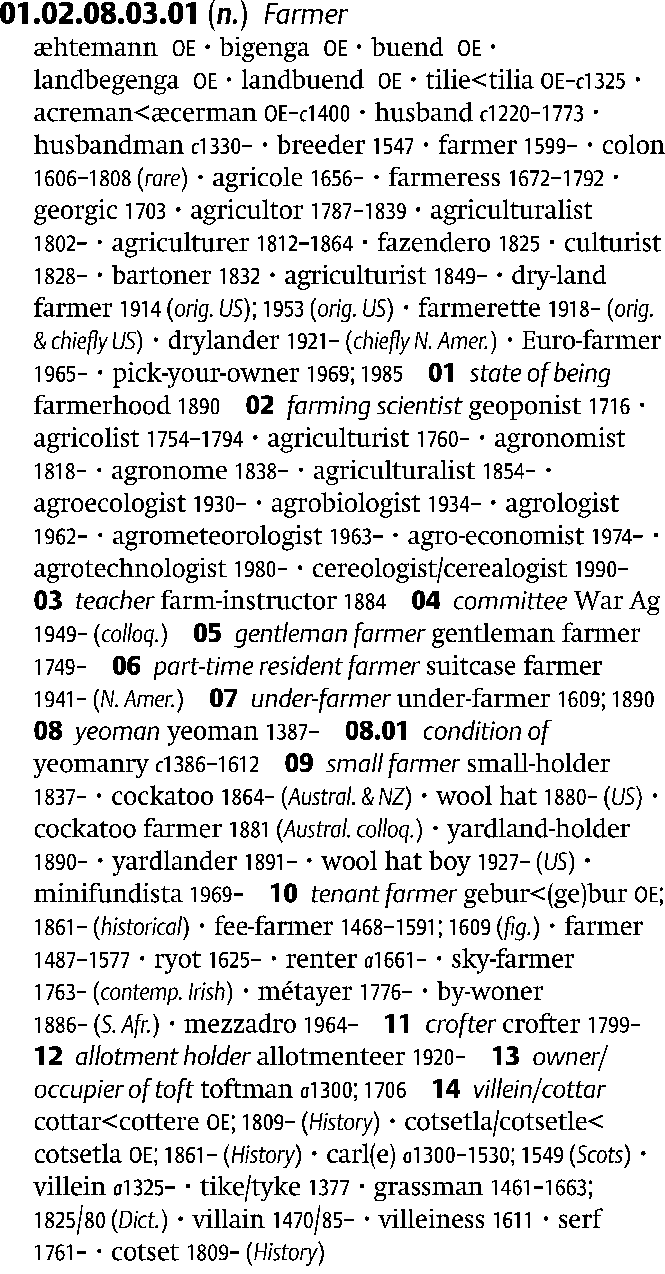
Figure 13.1 HTOED section 01.02.08.03.01 (noun) Farmer.
Lexicalization of the concept of ‘farmer’ dates back to the Anglo-Saxon period, when, from the fifth century ad onwards, settlers from various parts of north-western Europe began to arrive in the British Isles, speaking the Germanic languages which developed into the dialects of Old English. Provision of food for themselves and their families must have been an immediate concern, so it is not surprising that vocabulary in this area is well-attested from an early date, as is vocabulary in related categories such as Hunting and Fishing. It is interesting that the Dictionary of Old English (DOE) glosses both bigenga (see big-genga) and buend as ‘inhabitant…husbandman’, reminding us how the two categories overlapped in early societies, when many inhabitants were presumably also farmers.
During the Anglo-Saxon period, English was influenced by Scandinavian languages as a result of Viking incursions along the coasts. (For further information on English's contact with other languages, see Chapter 19 by Trudgill in this volume.) There is little evidence of Scandinavian influence in the Farmer category except for the rare toftman in subcategory 13, which comes from the Old Norse word for a homestead. Borrowing generally took place during everyday interaction in the spoken language, and many Norse borrowings, such as the better-attested sky and skirt, do not appear in the written record, which was primarily the domain of the educated clerical elite, until Middle English. There is also little evidence here of influence from the indigenous Celtic languages, although a Welsh origin has been suggested for tike/tyke in subcategory 14 (see OED tike/tyke noun 1). Lexical influence from these languages is rare in the recorded OE vocabulary as a whole.
By far the greatest influence on the early vocabulary of English was the Norman Conquest of ad 1066, after which much of the OE lexicon disappeared along with the institutions and cultural practices it described. Only two words from our Farmer group survived this onslaught, neither for very long: OE tilia as ME tilie, and OE æcerman as ME acreman. The words in general use for the concept in Middle English were husband, until the eighteenth century, and its derivative husbandman. Husband was formed in late Old English under Scandinavian influence with the meaning ‘male head of a household’ (OED sense 1) but became polysemous in Middle English through narrowing of meaning to focus on particular functions performed by such a person. It is recorded in c.1220 in the meaning of ‘farmer’ (OED 3a), in c.1290 as a male marriage partner (OED 2a), and from the fifteenth century onwards with reference to various managerial positions such as a housekeeper or steward (OED 4a, 5). Husband can thus be viewed as a network of meanings radiating from a central core, or, in historical terms, as a chain of meanings, each linked to its predecessor by at least one semantic feature. The structure of such a chain may be less clear if intermediate meanings become obsolete in the course of history.Footnote 3
The development of the ‘manager’ meaning of husband may have led to what is sometimes called polysemic clash, when polysemes of close meaning introduce ambiguity into discourse, leading to further semantic development or obsolescence. As the OED citations show, the ‘farmer’ and ‘manager’ meanings were commonly prefaced with adjectives such as good and bad to indicate capability in performing these roles, and it must often have been difficult to know which meaning was intended. Perhaps because of this, neither meaning survives in Present-day English, leaving the field clear for the ‘male marriage partner’ meaning and leading to the introduction of farmer to fill the agricultural gap. The fate of the associated verbs is somewhat different, however, with phrases like ‘husbanding one's resources’ (i.e. managing them well and economically) remaining in use, while ‘husbanding’ or tilling the soil has dropped out and ‘husbanding’ a wife never achieved general currency despite two uses by Shakespeare. The abstract noun husbandry still has some currency, but its use is increasingly restricted to the care of animals, especially in the collocation ‘animal husbandry’ (see, e.g., WebCorp: Synchronic English Web Corpus).
For husbandman, the ‘farmer’ meaning dominates from the outset, although the OED offers a few citations for ‘head of household’ and a single one for ‘marriage partner’. It could have filled the gap left by the obsolescence of husband ‘farmer’, but from the sixteenth century onwards it has gradually been replaced by farmer, the first word from French to appear in our list and now the core member of the group. The obsolescence of husbandman may possibly be attributed to the fact that, in some parts of the country, it referred to a tenant farmer, a person of lower social status than a landowner. A glance at other HTOED terms for agricultural workers, such as tillers and ploughmen, shows a continuing predominance of OE lexis for these lowlier occupations.
Farmer is first recorded in the late fourteenth century in the meaning of ‘tax-collector’ and progresses from there by a series of semantic shifts to mean someone who cultivates land for an owner (OED 4), a tenant farmer (OED 3), and, in 1599, ‘One who “farms” land whether tenant or owner or makes agriculture his occupation’ (OED 5a). It is interesting that the OED definition, written in 1895, puts farm in inverted commas, presumably to identify it as a relative neologism, since the verb in this meaning is not recorded until the eighteenth century, when it is defined as ‘To follow the occupation of a farmer; to till the soil’ (OED verb 2, 5). Till itself would be regarded as an archaism nowadays.
Examining farm and farmer leads to a possible example of homonymic clash, where two words of different origins happen to have the same form and are semantically incompatible. As with polysemic clash, homonymic clash can lead to obsolescence or change of meaning. In Middle English, factors such as loss of OE grammatical endings, lack of standardized spelling, and new words entering from French sometimes combined to create situations where originally distinct forms ended up sharing pronunciation or spelling or both. In the present case OED verb farm1 is the ME descendant of OE feormian, meaning to ‘cleanse, empty, purge’, often with reference to privies. Farmer1 occurs with reference to those who carry out this task (OED noun 1, occurring in the compound gong-farmer, from OE gang ‘privy’). Both of these meanings were apparently obsolete by 1600, apart from a single dialect record of the verb, perhaps because of the developing meanings of OED farm2 and farmer2: one would not wish one's activities as a tax-collector or agriculturalist to be confused with those of an emptier of privies. A further casualty may have been OE feorm, meaning food or a feast, obsolete after the fourteenth century, whose ME spellings also overlapped with those of farm (OED farm noun 1).
Any attempt to identify homonymic clash is speculative, and often requires considerable linguistic and historical research.Footnote 4 As Fischer (Reference Fischer, Christian, Hough and Wotherspoon2004) points out, words meaning ‘toilet’ are affected over the years both by technical developments and by a steady stream of euphemisms intended to divert the mind from the more unpleasant aspects of the topic. In the case of farmer2, a glance at the HTOED category Emptying/cleaning of privies shows the gradual disappearance of several compounds in -farmer, such as jakes-farmer and dung-farmer, and their replacement by the innocuous nightman and euphemistic gold-finder.
To return to Farmer, from the seventeenth century onwards we see more words of Latin origin, such as colon, agricole, and agriculturalist, entering English, sometimes mediated by French. This trend reflects both greater familiarity with the classical languages as a result of the Renaissance, and an increasingly scientific approach to agriculture. It is further reflected in subcategory 02 farming scientist, where the Greek prefix agro- ‘field’ is favoured in the proliferation of later coinages. We also find two words with feminine suffixes, farmeress, which probably meant a farmer's wife, and farmerette, cited from 1918 to 1963 and defined by the OED (in 1972) as ‘A woman or girl who farms land; a farmeress’. Such coinages were common enough in the nineteenth and early twentieth centuries, when women began to enter a range of professions, but are increasingly rejected in more egalitarian times. Throughout the rest of the sample (which contains only the first fourteen of twenty-seven subcategories), we find words for different kinds of farmer, including those from world varieties as English took root around the globe, such as cockatoo and wool hat in 09 small farmer.
Although no single HTOED category can come close to representing all the processes which have influenced the development of the English vocabulary, the Farmer category illustrates many of the tendencies which can be found throughout the lexicon, such as the obsolescence of OE words, innovation in response to cultural change, and the development of new meanings through polysemy. Categories of words with more abstract referents are less prone to fine differentiation of types of the main category than categories like Farmer, but may use other processes like metaphorization to fill gaps or supply a range of synonyms (see further Kay and Wotherspoon Reference Kay and Wotherspoon2005). Figure 13.2, the HTOED section Difficult, provides an example.
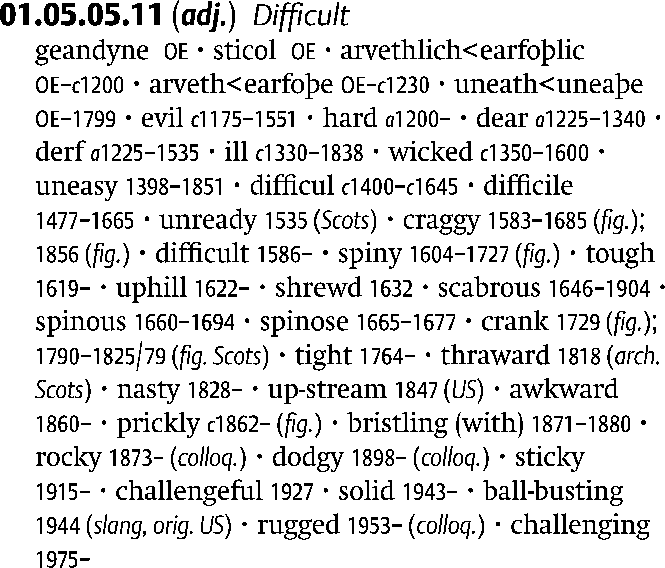
Figure 13.2 HTOED section 01.05.05.11 (adj.) Difficult.
With the single exception of uneath, all the OE adjectives in this category had disappeared by the early thirteenth century. Uneath survives until the eighteenth century, possibly because it is strongly partnered by its antonym eath ‘easy’ in a range of related meanings (OED eath/eith), and had several adverbial uses. In Middle English, the meaning ‘difficult’ is expressed initially by narrowing of OE words with meanings of general badness or opposition, such as evil, hard, and dear, or the Old Norse ill. French appears with uneasy in 1398 (OED 3), which had entered the language earlier in meanings such as ‘uncomfortable, disagreeable, annoying’ (OED 1, 2). Forms of difficult occur shortly thereafter: difficile from French, difficult and difficul either from the same source or possibly back-formations from the noun difficulty, recorded in English before 1400. However, the category as a whole is less notable for borrowed words than for the metaphorical extension of existing words, especially from concrete to abstract hardness, as with hard itself, craggy, tough, uphill, and so on. Uneasy too had a meaning ‘Difficult to traverse on account of ruggedness, steepness, or other obstacles’ attested between 1566 and 1749 (OED 3c); the Middle English Dictionary (MED, accessed via OED3) offers three earlier citations in this meaning, covering c.1390–a1500 (MED 2a). A subcategory of these metaphors suggests a particularly intrusive kind of hardness, as in spiny and its approximate synonyms, prickly, bristling, and rugged. Overall, these examples show the tendency, much discussed in cognitive linguistics, for metaphorical pathways to become established in a language and attract new members.Footnote 5
13.3 New words: borrowing
As section 13.2 shows, the lexicon of English has changed substantially over the years, gaining large numbers of words by a variety of means. One of the major sources of new lexis in English is borrowing, the adoption of words from other languages, often with changes to form, such as spelling or pronunciation, and/or changes in meaning. Present-day English includes words from languages as diverse as French (croissant, garage), Czech (robot, hacek), Japanese (kamikaze, sensai), and Swahili (safari, ultimately from Arabic). Because English has borrowed so widely, semantically related words in Present-day English are often formally unrelated: for example, corresponding to the native Germanic form ear is the borrowed form aural; similar pairs are heart: coronary and mind: mental. Scholars such as Kastovsky (Reference Kastovsky and Hogg1992: 294) describe the lexicon of Present-day English as ‘dissociative’ in this respect.Footnote 6 By contrast, Old English borrowed very little and has an ‘associative’ lexicon, in which a high proportion of semantically related words are also formally related by derivation or compounding, processes discussed further in section 13.4. The adjectives cildisc and cildlic ‘childish’, for example, are clearly related to the noun cild ‘child’, as is cildgeong ‘child-young, youthful’, where modern English might prefer infant or juvenile in some contexts, as both childish and childlike have developed more specialized meanings. Hybrid forms, combining elements from more than one source, also occur, as in lovable (OE stem and French suffix), nobleman (French and OE nouns), and ungracious (OE prefix and French stem).
It is often assumed that more words are borrowed nowadays than in any earlier period; while it is certainly true that English today has loanwords from a wider variety of languages than ever before, it may not be true that borrowing is a more frequent process. From the very earliest records there is evidence that English adopted and adapted words from other languages, and Durkin (Reference Durkin2014: 300) presents data suggesting that, as a proportion of all new words in English, loanwords have shown a steady decline since the end of the seventeenth century and a steeper decline since the end of the nineteenth century. It is, however, difficult to compare the kind of borrowing that can be found in different periods in terms of raw figures. The context in which borrowing takes place, the languages from which English has borrowed, and the motivation for borrowing, have all changed from period to period in interesting and varied ways. Our knowledge of borrowing in earlier periods is necessarily affected by the nature of the available evidence. It often seems to be the case that a word is borrowed into the spoken language and later passes into written use, or it may first have appeared in an unrecorded and possibly restricted context, such as the vocabulary of a particular trade. Any generalizations about spoken language are handicapped by lack of evidence, since it is not until Early Modern English that we find significant amounts of data which approximate to speech, such as personal letters, play-texts, pamphlets, and court proceedings.
As we saw in section 13.2, it is important to consider the external history of English and English speakers when examining how and why borrowing has taken place: such considerations often explain patterns of borrowing and show how cultural change can promote lexical change. The picture is particularly complicated in Middle English, where the three main languages of English, French, and Latin interacted with one another, as shown, for example, in macaronic texts of the period. Rothwell writes:
Two of the constituent elements, English and French, were living vernaculars; the third, Latin, was a dead construct. Two, Latin and French, had been in widespread use as languages of record for centuries. The third, English, was used increasingly for record purposes from the later fourteenth century onwards and eventually absorbed the roles of the other two, thus becoming the sole national language.
He goes on to argue that Middle English speakers would have regarded the use of any or all of these languages in particular contexts as a natural result of the complex political situation after the Norman Conquest, and that ‘assimilation’ is a better term than borrowing for the process by which French words became part of English (1994: 45–67). (See Chapter 24 by Machan in this volume.)
Words which occur in English texts in the early ME period are clearly associated with the functions of French as the language of the ruling elite. They tended to be of relatively high prestige, particularly in comparison to any native alternatives, and many were concentrated in particular semantic fields, such as royalty (royal, royalty, reign, monarch), the nobility (noble, nobility, court, retinue), and literature (poetry, poet, romance, rhyme). Prestige borrowings, as opposed to those motivated by need or at least usefulness, led to the possibility of selecting one term over another for stylistic purposes. Between the Early Modern and Late Modern periods, the fairly elaborate system of register that exists in Present-day English developed, relying on choices in the lexicon between partially synonymous words which are recognizably different in formality and markedness in particular contexts, as in ask, question, interrogate from English, French, and Latin respectively (see further Minkova and Stockwell Reference Minkova and Stockwell2009).
Borrowing can of course take place without face-to-face contact between native speakers of the source and target languages. The major source of loanwords in the OE period is Latin, not primarily because of contact between English and Latin speakers but because some English speakers were bilingual in English and Latin, in that they used Latin as a lingua franca in writing and (to some extent) speech. Following the spread of Christianity through the Anglo-Saxon territories from the sixth and seventh centuries, Latin was the predominant ecclesiastical language; it was also used in England and elsewhere in Europe as a language of permanent record. For both of these reasons, many people encountered and used the language daily in specific situations and for particular purposes, and this led to some borrowing of Latin words, though on a relatively small scale. The HTOED section 03.07.00.18.03.02 Disciple records two OE nouns meaning ‘disciple’: the native leorningcniht and the Latin loanword disciple, which became the most usual term for this concept and is the one commonly used in Present-day English. Other words borrowed in this period relating to religion and religious practices or to writing and records include Pentecosten, the name for the Jewish and Christian religious festival, from Latin pentecoste; biblioþece, meaning both ‘library’ and ‘scriptures, bible’, from Latin bibliotheca; and carte ‘sheet of writing material’, from Latin charta. Latin loanwords tended not to affect more basic OE vocabulary: for example, although it contains many more entries than Disciple, no borrowing from Latin is found in section 01.01.05.05 Sea/ocean.
As we have seen above, Latin remained in use in the Middle English period. A new development, found to some extent in Chaucer (c.1340–1400) and culminating in the work of later poets such as John Lydgate (c.1370–1449/50?) and William Dunbar (1460?–1513×30), was the development of a literary style marked by ‘aureate diction’ in the form of polysyllabic Latinate words such as melodious, saturnine, tenebrous. This diction had two purposes: first, stylistic enhancement, and, second, and more practically, to supply words which fitted iambic metres at a time when English had become increasingly monosyllabic. Larger-scale importation from Latin occurred in Early Modern English, again related to the functions of the two languages, and the ways in which the classical languages were regarded at the time. Latin was still the major language of scholarship around Western Europe, so that major scientific works (in the broadest sense) were written in Latin. There was also huge interest in classical texts, which would have been familiar as part of the education of literate young men. At the same time, borrowing from Latin, sometimes via French, was encouraged by the many contemporary translations into English, and by a widespread feeling among English speakers that their language lacked both elegance and a full vocabulary. Latin terms were commonly used in a naturalized form in translations rather than English equivalents, and were felt to lend prestige to English texts. Some of the earliest printed texts show the popularity of translations: for example, Caxton in the late fifteenth century published versions of Virgil's Aeneid and Ovid's Metamorphoses, as well as translations of French texts. His work shows the influence that translation can have on lexical development, since in choice of both vocabulary and spelling he has a propensity to follow the language of his source (Blake Reference Blake1969: 136–41, 172–3). In non-translations, too, there are large numbers of new English words borrowed from Latin and French. This sudden influx of innovations led to the publication of monolingual dictionaries, the earliest of which specifically recorded and defined ‘hard words’, i.e. mainly Latinate loanwords. Among those first attested in this period are relatively common survivors such as calculate, education, radiate, and sequence, as well as large numbers of rarer or more specialized words such as ingest, oscillate, and quadrilateral.
A fuller account of borrowing patterns in the history of English, which discusses the kinds of morphosyntactic and semantic changes that loanwords undergo, can be found in Durkin (Reference Durkin2014; see also Chapter 23 by Durkin in this volume). Discussions of borrowing in particular periods are available in chapters on vocabulary in the multi-volume Cambridge History of the English Language: for Old English, Kastovsky (Reference Kastovsky and Hogg1992); for Middle English, Burnley (Reference Burnley and Blake1992); for Early Modern English, Nevalainen (Reference Nevalainen and Lass1999a); and for late Modern English, Algeo (Reference Algeo and Romaine1998).
13.4 Processes of word formation
As the examples in section 13.2 show, the alternative to borrowing words from other languages in order to add new forms to the lexicon of a language is to coin new words from forms which are already established. Across the history of English, a number of different processes of word formation can be observed.
13.4.1 Derivation
The lexicon of a language can be extended from its internal resources by processes of concatenation, where a new word is formed by combining existing words or morphemes. (For further information on morphology, see Bauer et al. (Reference Bauer, Lieber and Plag2013) and Chapter 14 by Fischer in this volume.) One common way of doing this is through the process of derivation, where forms are created from existing words by the addition or changing of affixes. In English, both prefixes and suffixes can be attached to bases in this way, sometimes resulting in large groups of related words, for example the adjective happy yielding the adjective unhappy, the adverbs happily and unhappily, and the nouns happiness and unhappiness. More recently, the new verb tweet ‘send a message via the online messaging service Twitter’ has led to such formations as retweet ‘send a message again’ and untweetable ‘not able to be tweeted’ (because the content is poor or unsuitable in some way).Footnote 7
The HTOED sections explored in section 13.2 give a sense of how important derivation is in the history of English, as well as how short-lived derived forms can be. The section Farmer shows a high number of words which share morphemes. For example, in the first section the forms agricultor, agriculturalist, agriculturer, and agriculturist have the same prefix, agri-, and the same root, culture, but differ in their suffixes. The similarity in form and meaning of this group creates a situation of competition and potential redundancy, resulting in the loss of two terms: neither agricultor nor agriculturer is attested after the mid-nineteenth century. In the section Difficult, a similar situation seems to have led to the obsolescence of difficul and difficile, with difficult the only form that survives into the present day.
13.4.2 Compounding
A second common process of word formation throughout the history of English is compounding. Rather than being formed from a single base and one or more affixes, compounds involve the joining of two bases, such as the nouns face and book for the recent proper noun Facebook, or the adjective quick and the verb step for the older verb quickstep (also used as a noun). Compounding was a particularly productive process during the OE period, when borrowing was less common than in later periods. The conventions of OE poetry also favoured the coining of new compounds; it was alliterative rather than rhyming, and ‘elegant variation’ through synonymy was highly prized. These requirements led to a stock of poetic words, many of which appear to be fairly rare, perhaps being coined for particular poems in order to alliterate with other words. For example, the compound feorhbold ‘life house, i.e. body’ occurs once in the poem The Dream of the Rood, and alliterates with fæger ‘fair, beautiful’. An exact synonym feorhhus occurs once in another poem.
A significant proportion of the poetic vocabulary of Old English is made up of kennings, exocentric compounds which are creative, often metaphorical, and often highly elliptical. Many of these occur only once or twice in surviving OE texts. The section Sea/ocean in the Thesaurus of Old English clearly shows the restricted nature of OE poetic vocabulary, containing as it does a high proportion of entries marked with the flags ‘p’ for ‘seems to occur only in poetry’ and ‘o’ for ‘very infrequent’: these include many kennings, such as hranrad ‘whale road’, hwælweg ‘whale path’, and seolhbæþ ‘seal bath’, all synonyms for ‘sea, ocean’.Footnote 8
13.4.3 Other processes
A more transparent process of word formation is conversion (also called zero derivation), where a word of one class (or part of speech) is used in the same form but as a different class. Compared to some other languages, English is unusually permissive in allowing conversion, although some types are more common than others: for instance, as Plag (Reference Plag2003: 107–8) notes, there are many examples of noun > verb conversion, as exemplified by the emergence of the verbs husband and farm (see section 13.2), and by more recent verbs including text ‘send an SMS message’ and friend ‘add someone as a contact on Facebook’. Most scholars believe that conversion has become more common through the history of English, and that this phenomenon relates to the decline of the inflectional system. In early Old English, each word class had its own set of inflectional endings added to the stem, which constrained conversion. As this system broke down and each word class became formally less distinctive, conversion between classes became a morphologically simpler process. Kastovsky (Reference Kastovsky and Hogg1992: 382–3) gives a more detailed explanation of this change; Minkova and Stockwell (Reference Minkova and Stockwell2009: 8–9) offer further examples.
There are also some less productive or minor word-formation patterns in modern English. For example, blending has long been found in English, but seems to have increased in frequency in more recent times. It is difficult to be certain about this, however, since little informal writing survives from earlier times, so that there is relatively little evidence on which to base any conclusion about how common a process it might have been. Blending is a process similar to compounding in that it occurs when a new word is created from existing forms, but in many cases the two inputs to a blend sound similar and the resulting word involves the loss of some of this shared material. For example, a recent coining in British English, the noun welderly ‘older people who are active and healthy’, is formed from the adjectives well and elderly, and the slightly more established noun gaydar ‘ability to identify homosexuals’ from gay and radar. Not all words that are generally recognized as blends are formed from elements that share phonological material in this way: brunch ‘mid-morning meal’ is formed from breakfast and lunch, and smog ‘smoky fog, air pollution’ from smoke and fog. Different types of blends are discussed by Plag (Reference Plag2003: 121–6) and Ronneberger-Sibold (Reference Ronneberger-Sibold, Rainer, Dressler, Kastovsky and Luschützky2010: 213).
The process of clipping also involves loss of material, but from the beginning or end of a single word form: uni is a truncated form of university, and phone shows the loss of the first element of telephone. It is common for clipped forms to take slightly different endings, particularly a diminutive ←y/-ie>, as in the form veggie from vegetarian or telly from television. Clipping, too, seems to have become much more common during the history of English (although again a lack of evidence makes this difficult to judge), and it is hard to find examples earlier than the Early Modern period; Durkin's examples include coz for cousin, attested in the OED in 1559, and wig for periwig, attested in 1675 (Reference Durkin2009: 116). Clipped forms are often stylistically less formal than their unclipped originals, and sometimes change semantically: prom ‘school dance’ is a clipped form of promenade, which is very rare in this sense now.
A fuller discussion of minor word formation processes can be found in Bauer (Reference Bauer1983: 232–41).
13.5 Tendencies in semantic change
Semantic change, the process whereby words develop different or additional meanings, is a key factor in the history of English. It is also a focus of interest in cognitive semantics (see Chapter 4 by Trousdale and Chapter 15 by Fitzmaurice in this volume).Footnote 9 Traditionally, however, it has been considered problematic as a subject of study, because, unlike phonological or morphosyntactic change, it tends not to follow regular patterns. For example, in recent times the adjective gay has acquired a new sense, ‘homosexual’, and the earlier sense ‘happy, cheerful’ has fallen out of use for many speakers. Other words with the same earlier meaning have not undergone the same shift: it is not possible to use either happy or cheerful to mean ‘homosexual’, and we thus cannot make any generalization here about a regular change in the linguistic system of English. The reason for this particular instance of semantic change, and for many others, relates to non-linguistic history, and is difficult to pin down and explain. However, semantic change does not appear to be random, and traditionally a number of fairly broad tendencies have been observed. These can be helpful in making sense of individual word histories, and although they sometimes mask the complexity and messiness that can be involved in semantic change, they still provide a useful starting point for describing the ways in which word meaning can shift over time.
Perhaps one of the most common tendencies is the shift to a more or less restricted meaning, changes known as narrowing (or specialization) and widening (or generalization). Widening is the process whereby the meaning of a word (or one of its senses) becomes more general, so that it can be used to refer to a larger, less specific concept. A well-known and often-cited case is the noun bird, the reflex of OE bridd. In Old English, the usual sense of bridd is ‘young bird, young of a bird’; words for the general meaning ‘bird’ include fugel (modern English fowl) and fleogende ‘flying creature’. For modern speakers, bird refers to all feathered vertebrates, and the OE sense has been lost. The opposite, and more common, process, narrowing, occurs when a meaning becomes more restricted over time and is used to refer to only a subset of the concept described in its earlier meaning. OE mete, to take another well-known example, is the ancestor of Present-day English meat, but is roughly the semantic equivalent of modern food, since it could be used to describe any kind of edible substance, not only flesh from animals. The earlier meaning survives marginally in the phrase ‘One man's meat is another man's poison’.
Another pair of tendencies shows the way in which some word meanings change connotatively, so that their senses become more or less positive over time. Amelioration occurs when a word sense shifts from negative or neutral to positive, or from negative to neutral. A classic example is the adjective nice, a loanword from French (ultimately from Latin). In Middle English, when the word is first attested in the OED, it is used to mean ‘foolish, silly’ and can describe unpleasant entities like sin or strife (OED 1); it is also found with other negative meanings including ‘wanton, lascivious’ (OED 2). By the eighteenth century, after further semantic shifts, it is attested with its Present-day English sense ‘agreeable, pleasant, satisfactory’ (OED 14), which has become the dominant sense for most speakers. The opposite tendency, pejoration, appears to be more common in English, though it is difficult to make any definitive statement about the frequency of either shift. A relatively modern example is the noun cowboy, which is found in English from the eighteenth century. In its earliest uses, it has the neutral meaning ‘boy who tends cows’, and this broadens so that it can be used to refer to adult males as well, including the type of men who feature in Hollywood western films. This sense is still central in Present-day English, but by the twentieth century meanings including ‘reckless (motor vehicle) driver’ and ‘dishonest workman’ had also emerged, with clearly negative connotations. Words for certain categories of people are historically prone to pejoration, thus revealing the negative attitudes of a culture, for example words meaning ‘woman’ (Kleparski Reference Kleparski1997) or ‘foreigner’ (Alexander and Struan Reference Alexander, Struan, Farr and Guégan2013).
The final two tendencies that are often recognized in semantic change are of a somewhat different nature, since they describe conceptual relations that trigger changes rather than actual processes of change. Firstly, changes can be triggered by metaphor, the relationship of perceived similarity between two entities or concepts, which involves the mapping of one concept onto the other. A straightforward example is the polysemous noun mouse (OE mus). Its earliest meaning, which still survives as perhaps its most basic, is ‘rodent’, but, since the advent of personal computers, it has also been used with the meaning ‘computer device’. This sense seems to have emerged because of the similarity in shape and size between the animal and the device, and can be explained by the need to name a new object. Equally important as a trigger for semantic change is metonymy, the conceptual relationship between two entities which are associated in experience. This too involves mapping one concept onto another, and can result in an extension of meaning of a word. For example, the noun crown is found in its Latin form corona in Old English with the sense ‘head ornament worn by a monarch’. Since the sixteenth century, it has also been used to refer to the monarch him- or herself, and although this might be regarded as a figurative use, it is highly conventional, and recorded as a sense of crown in modern dictionaries.
It is important to remember that all of these tendencies may affect a single sense of a word rather than its ‘complete’ meaning: most words are polysemous, and have some senses that are stable over long periods of time and others that have changed or developed alongside existing meanings. The word friend, for example, retains its core meaning of ‘a person with whom one has a close relationship’, but has largely lost its meaning of ‘a relative or kinsman’, and, as noted in section 13.4.3, has developed new uses referring to contacts on the social media site Facebook. Particular meanings are not used equally by all speakers. Friend ‘kinsman’ may still be found in the vocabulary of a few speakers of Scots. Friend ‘Facebook contact’ will be familiar to social media users, be in the passive vocabulary of some other speakers, and probably unknown to many more. Semantic change thus tends not to involve a straightforward change from meaning A to meaning B for all speakers at the same time, but is generally gradual, often partial, and typically happens at different rates and to different extents for different speakers of a language.
13.6 Concluding and looking ahead
In this chapter, we have endeavoured to demonstrate, and if possible explain, some of the processes which have affected developments in meaning and form throughout the history of the English lexicon. Interest in this topic, and significant contributions to it, have increased considerably in recent years. One reason for this is the growing availability of online resources, such as the OED, now linked electronically to HTOED and to period dictionaries such as DOE and the MED as well as to modern dictionaries. Allied to this is the development of text corpora of periods or authors which enable standard corpus analysis techniques to be applied to historical data (once issues of variable spelling and polysemy have been sorted out). Hanks (Reference Hanks2013), for example, shows what can be done with such resources in his analysis of the 2,879 occurrences of enthusiasm in the British National Corpus (2013: 148–60), and more specifically its use by Jane Austen at a time when a change from negative to positive connotations seems to have been in progress. For recent English, the web itself has become a corpus. (On corpus analysis, see also Chapter 23 by Durkin in this volume.)
We have also been at pains to stress the interaction of language and culture as an essential component of lexical analysis. An excellent extended example of this approach is Biggam (Reference Biggam2012), which offers a wide-ranging interdisciplinary examination of the semantic field of Colour, including a good deal of historical information about English. One of the key contributions of cognitive linguistics to semantics has been the restoration to respectability of such encyclopaedic knowledge. As Grondelaers et al. (Reference Grondelaers, Speelman, Geeraerts, Geeraerts and Cuyckens2007: 991–2) say, when discussing the contribution of prototype theory:
diachronic semantics has little use for a strict theoretical distinction between the level of senses and the level of encyclopedic knowledge pertaining to the entities that fall within the referential range of such senses. In semantic change, the encyclopedic information is potentially just as important as the purely semantic senses (to the extent, that is, that the distinction is to be maintained at all).
In the light of all the above, we can confidently expect to learn a good deal more in future about the English lexicon and the uses to which it has been put.
14.1 Introduction
This chapter is concerned with the process and analysis of morphosyntactic change, and more specifically the description, analysis, and explanation of these changes in the field of English historical linguistics. Naturally, in order to understand what has happened in cases of change, we will need a thorough philological description of the facts, based on corpus data. However, no proper description is possible without a theoretical model (i.e. such frameworks as described in the individual chapters in Part I of this volume) by means of which we can systematize what has happened, thus enabling us to move beyond mere facts. In this chapter we will concentrate on some changes that have occurred and on the frameworks that have been applied to them to find out how useful they have been in furthering our understanding of morphosyntactic change in English.
Before we start, some preliminaries. In contrast to the study of phonetic/phonological change, where it is possible to compare concrete forms (forms representing ‘sounds’) or ‘cognates’, and deduce clear tendencies or even law-like developments from this comparison, the use of a theoretical model or models is an absolute necessity in the analysis of morphosyntactic change, where we compare underlying patterns rather than concrete forms; in other words, in syntax there are no cognates that can be recognized purely from their surface form (see McMahon Reference McMahon1994: 107–8). Thus, two superficially similar concrete forms may have to be given a different analysis over time, because the analysis of their structure depends on the synchronic system in which they function, which itself may have changed over time.Footnote 1 There exists, however, an almost natural tendency to interpret or analyse an older construction very much from the point of view of the modern system with respect to both its form and its function (see Lightfoot Reference Lightfoot1979: 34ff.). An example of this is provided by the frequent analysis of Middle English infinitival constructions of the type God bad the rede See divide (Gower, CA 5, 1661),Footnote 2 read with the rede See as subject and the infinitive as intransitive (i.e. ‘God commanded the Red Sea to divide’) rather than transitive (‘God commanded to divide the Red Sea’), not taking notice of the fact that in Middle English infinitival objects were still regularly placed before the verb, as they were in Old English (see note 1 and Fischer Reference Fischer2007: 19–22, which offers more instances of such misanalyses). In section 14.5 we will discuss a somewhat different case in more detail, where the analysis has been led astray in another way, namely by the assumptions of the theoretical framework that was used to analyse it.
Even though a theoretical framework is essential when analysing morphosyntactic change, we have to be aware at the same time that there is a tendency within linguistic frameworks to concentrate on just one factor, principle, universal, or constraint involved in a change, or a tendency to consider the development of one single construction without taking note of the larger domain of similar constructions in which it functions.Footnote 3 Therefore, in order to achieve more insight in change, the use of one specific theoretical model usually does not suffice. In any case of morphosyntactic change studied in detail, we usually find a multiplicity of factors that has caused the change in question – see the articles in De Smet et al. (Reference De Smet2013). The studies collected in this volume show that there is good reason for historical linguists to be eclectic in their use of theoretical models. Theoretical models used in historical linguistic research (such as e.g. generative grammar or grammaticalization) tend to give priority to some factors and not to others in their efforts to clean up the facts so as to make them more manageable, to provide, as it were, laboratory conditions (see Fischer Reference Fischer2007: chs. 2 and 3). Quite often internal, typological, or universal linguistic factors, being of more interest from the point of view of the model and its theoretical development, are given more weight than external ones. This does not mean, however, that they are therefore more important or more crucial.
Finally, in order to discover historical changes, we have to study the language used in any particular period, that is, first and foremost, the written evidence. It is crucial, however, to keep in mind that it is not the language itself that causes the change but the language users, who, after all, interpret and produce the utterances and are thus in some way responsible for the changes. Quite clearly, since we are dealing with history, these speakers are no longer there. We may assume, however, that people's brains and the way they process language will not have altered much in the course of time (following the ‘uniformitarian principle’, cf., e.g., Labov Reference Labov1972: 161, 274–5). In our search for explanation, it would help, therefore, to take into account how people learn language (since the principles or mechanisms used in language acquisition very likely also play a role in change), and we may also consider ongoing cases of change, where introspection is to some extent possible.
In the following sections, I will first discuss the nature of internal and external factors, how they are usually interlinked in actual cases of change in English, and the difficulty of keeping them clearly separate theoretically (section 14.2). In section 14.3, we will look at the various processes/mechanisms (and the models in which these are distinguished) that may be said to play a role in English morphosyntactic change. Section 14.4 will give a brief overview of the main areas of morphosyntactic change in the history of English, and pay special attention to the relation between the loss of inflections and changes in word order. And finally, in section 14.5, a case of change involving the emergence of the semi-modal HAVE-to will be considered in some detail. It concerns a development that has been studied quite extensively and from different viewpoints in the (recent) past.
14.2 Internal and external factors in morphosyntactic change
A first point that needs to be raised is: to what extent can we make a distinction between internal (i.e. language-systemic) and external (sociohistorical) factors, (i) in theory and (ii) in any individual case of change? It is clear that from a theoretical viewpoint such a dichotomy may be useful because the linguist is first and foremost interested in the linguistic factors that cause a change. In order to understand the internal factors involved, we have to link the changes that we find in language use to the system of grammar that helps generate our language utterances. The problem is, however, that this system of grammar constitutes itself a point of debate. Are we born with a universal (innate) grammar, which together with the PLD (primary linguistic data) shapes our grammar system, or do we deduce our grammar system from current language use with the help of general cognitive abilities that are used for learning of all kinds (see, e.g., Lightfoot Reference Lightfoot1979, Reference Lightfoot1991, Reference Lightfoot1999, Reference Lightfoot and Hickey2003 vs. Pullum and Scholz Reference Pullum and Scholz2002, Gentner Reference Gentner2010)? Whatever the case may be, it is clear that synchronic and diachronic linguists need to work together: an understanding of change and what causes it will help to find the contours of the system of grammar and the way it is acquired in childhood, while theories developed to describe the latter should contribute towards our understanding of change. This was already an accepted idea among some of the Neogrammarians, notably Hermann Paul (Reference Paul1909), and it has been widely followed by linguists in more recent times after Kiparsky's (Reference Kiparsky, Bach and Harms1968: 174) famous statement that change ‘provides a window on the form of linguistic competence’. The danger, however, is that this ‘window’ may be blurred by the ideas (principles, constraints) already present in the particular grammatical model a linguist works in, for which evidence is then sought in change.
Because of the above differences in viewpoint, diachronic linguists differ in what they consider important factors in change. A concentration on the system of grammar, as we see in the formal generative approach, puts the emphasis on internal factors, on grammar change, which mostly involves parameter shifts and rule change. It considers the ways in which the language learner systematizes the variants found in an ongoing change, which may lead to a shift in his grammar compared to that of the previous generation. In contrast, historical linguists working within a usage-based approach, such as grammaticalization theory or construction grammar, which concentrate on language in use, look at the gradual way in which an innovation may spread through the language and its speakers. Here, pragmatic and social (i.e. non-systemic) factors, especially those having to do with the communicational context in the widest possible sense, are considered as important as internal systemic ones, or sometimes even more important. The principle of analogy, which through cognitive science, has regained a position in functional approaches, should also be considered an internal factor. It was ignored in generative studies mainly because it could not be captured in general rules or constraints (see Lightfoot Reference Lightfoot1979: 361–73).
A clear example of a system-based approach is, for instance, the explanation for the development of the category of modal auxiliaries in sixteenth-century English provided in Lightfoot's (e.g. Reference Lightfoot and Hickey2003) and Roberts's (e.g. Reference Roberts2007) work, which is seen as a ‘catastrophic’ change caused by a parameter shift. This involves the loss of the so-called V to I rule, which took away the possibility for finite verbs to move to a position before the subject, as was the rule in Old and Middle English (as in What saw thow there?, [Le Morte Arthur, 3462], cf. the impossibility in Modern English: *What saw you there?). Since modal verbs, such as can, may, must, etc. continued to occur in this position (cf. ‘What could you see there?’, they came to be interpreted as instances of a new category, namely Aux.Footnote 4
An example of a usage-based approach, where a construction enters the grammar gradually, via ‘intermediate’ steps, is De Smet's (Reference De Smet2012) study on the development of English all but, from a quantifier loosely followed by a prepositional phrase (in sentences such as Go, my boy, and immitate [sic] him in all but his misfortunes, 1766), to an adverbial element. According to De Smet, this happened via its position before a predicative adjective (as in amidst perils from which escape was all but miraculous, 1838); next, affecting positions before attributive adjectives > passive verbs > active perfective verbs > active past tense verbs, and finally reaching a position before a verb in the present tense: We all but apprehend, we dimly forebode the truth (1841). He shows how this takes place by means of small, almost imperceptible analogical steps, with each one neatly and non-saliently paving the way for the next one: all but occurring each time in a position that shares a syntactic feature with the earlier, original position. Thus the original position before NPs shares a feature with predicative adjectives because nouns as well as predicative adjectives may occur as complements after copula verbs (as in She is sick/She is a coward), and in a similar way it spreads from adjectives to adjectival verbs such as passive participles (as in She was sick/She was knocked over by…), perfect participles, etc.
It is evident that in an approach where attention is paid both to the innovation and the spread of a new construction, to its form as well as its communicational function, and where the theoretical framework consists of layers of constructional schemata rather than across-the-board rules, a multiplicity of factors is more likely to emerge in the explanation of a change. In contrast, in a framework that works with rules, principles, and constraints that apply throughout, it is much more likely that the explanation will concentrate on the way the speaker's system of grammar ultimately deals with the variant constructions found, in other words on how the language learner reacts in face of the increased weight and direction exercised by the variants. The two approaches in fact highlight different aspects and different stages of the change. Both are valuable, however, and we need both to acquire a full understanding of why the change happened.
When it comes to making a distinction between external and internal factors in any case of change it is worthwhile to quote the last of the seven general principles drawn up by Weinreich et al. (Reference Weinreich, Labov, Herzog, Lehmann and Malkiel1968: 188) in their ‘Empirical foundations for a theory of language change’:
Linguistic and social factors are closely interrelated in the development of language change. Explanations which are confined to one or the other aspect, no matter how well constructed, will fail to account for the rich body of regularities that can be observed in empirical studies of language behavior.
It is therefore important for the historical linguist (representing one side of the linguistic partnership), who wants to describe as well as understand the beginning and the endpoint of the change, to analyse the data as much as possible with a mind open to all frameworks relevant for linguistic processing.
Before closing off this brief discussion about the importance of considering both internal and external factors in cases of change, I would like to draw attention to some further aspects that are relevant here. A first point concerns frequency. It is hard to say whether the factor of frequency should be considered internal or external in nature (it is probably both), but what is clear is that it has come to be seen as more and more crucial in our field. Whereas it is mentioned only in passing in Hopper and Traugott's first (Reference Hopper and Traugott1993) edition of Grammaticalization, it has acquired a separate section in the second (2003: 126ff., cf. Pustet Reference Pustet, Frajzyngier, Hodges and Rood2005: 146). Similarly, in generative work on diachronic syntax, frequency has become much more relevant since the 1980s (contrast e.g. Lightfoot Reference Lightfoot1979 with 1999, and the articles edited by Pintzuk et al. Reference Pintzuk, Tsoulas and Warner2000a and Lightfoot Reference Lightfoot2002). In recent years, we have also witnessed the appearance of many studies related to frequency and the effects it has on language processing (e.g. Bybee and Hopper Reference Bybee and Hopper2001, Pustet Reference Pustet, Frajzyngier, Hodges and Rood2005, Bybee Reference Bybee2007), or volumes devoted to (methods of) quantification (e.g. Köhler Reference Köhler2012) and probabilistic linguistics, in which categorial gradience, frequency, and distributional criteria are central (e.g. Bod et al. Reference Bod, Hay and Jannedy2003). These developments are clearly the result of the use of corpora in linguistic research (and of more and more powerful computers to deal with large amounts of data), which began in the 1960s and took off seriously in the 1980s with the availability of bigger and bigger corpora, synchronic as well as diachronic.
A second feature I would like to draw attention to is the fact that speaker-innovations (which may or may not lead to change) are more often linguistically (i.e. internally) rather than socially motivated in the area of morphosyntactic change compared to that of sound change or lexical change. Internal systemic factors are more crucial here because propagation depends more on an increase in frequency through multiple speaker-innovations and on analogies between the new variant and already existent constructions within the language(-system) than on social needs or attitudes. Thus, a new construction may spread paradigmatically from verb to verb-class (by formal and semantic analogy) or from verb-class to another semantically or formally similar verb-class. For instance, Fischer (Reference Fischer1989) shows how the similarity between physical perception verbs (see, hear) and mental perception verbs (see, hear, perceive, understand, etc.) helps to account for the spread of the so-called accusative and infinitive [a.c.i.] construction in English (in Old English occurring only after physical perception verbs: þurh wundor þe he seah Sebastianum [ACC] don ‘through miracles that he saw Sebastian perform’, Mart5 (Kotzor) 855), so that mental perception verbs could begin to occur with an infinitival complement in late Middle English (where in Old English only a þæt-clause was possible): but they wepte to see and vnderstande soo yonge a knyght to Ieoparde hym self for their righte ‘but they wept when they saw and perceived so young a knight to put himself in danger for their rights’ (Malory 281).Footnote 5 A structure may also ‘worm’ its way in by an extension of the type of arguments that it may take. This is how the BE + going to > gonna expression spread from animate subject agents to inanimate subjects, while the nature of the to-infinitive changed from concrete to more abstract. Thus the earliest instances are still ambiguous between ‘movement’ and ‘intention’: we be Frenchmen, pylgrymes, & are goying to offer at ye holy sepulcre (1534, Danchev and Kytö Reference Danchev, Kytö and Kastovsky1994: 62), while constructions with inanimate subjects or abstract infinitives are quite late. The same new construction may also be ‘helped’ by the occurrence of formally and/or semantically similar constructions formed with other future auxiliaries, such as shall/will, thus enabling going to to develop into an auxiliary that looks like other modal auxiliaries (note that the later form gonna indeed takes a bare infinitive). In Bybee (Reference Bybee, Joseph and Janda2003), it is shown in detail how a similar extension caused the use of can to spread in the history of English, turning the Old English lexical verb cunnan/cann ‘to know’ into a modal auxiliary expressing ability. Again this happened on the basis of formal and semantic analogies with other, already existing, verbal patterns.
For similar reasons, morphosyntactic constructions are also far less likely, compared to for instance lexical items, to be borrowed wholesale from another language. Not all linguists agree on this; there are clearly different schools of thought about morphosyntactic change and the likelihood of ‘borrowing’. These are often closely linked to the theoretical framework used. Generative historical linguists on the whole tend to ignore borrowing even though they do not deny that it occurs (see Lightfoot Reference Lightfoot1979: 374, 381–4). Historical linguists with a more sociolinguistic background believe that, given enough intensity and/or length of contact, anything may be borrowed, including syntactic structures (see Thomason and Kaufman Reference Thomason and Kaufman1988: 14, Harris and Campbell Reference Harris and Campbell1995: 149). Most historical linguists, however, believe that the idea that virtually anything can ultimately be borrowed, puts far too much emphasis on the mere force of social pressures and neglects the interaction with internal developments (e.g. Sankoff Reference Sankoff, Chambers, Trudgill and Schilling-Estes2002). Evidence suggests that only those structures are easily borrowed which fit fairly comfortably into the grammatical system of the borrowing language. Thus Latin a.c.i. constructions such as in…yf it soo be the kynge wylle Iuge her to be brente ‘if it is the case that the king will judge her to be burned’ (Malory 807) easily entered English from the fourteenth century onwards because by then (due to the fact that the general clause pattern had become SVO overall) any NP before a verbal, (non-)finite form (i.e. her before to be brente) could be interpreted as subject of that verbal form rather than object (see Fischer Reference Fischer, Gerritsen and Stein1992a, and the brief discussion in sections 14.1 and 14.4), whereas another Latin-type construction, the so-called parasitic gap construction as illustrated in, A man whom if you know i you must love j (1788 Cowper Letters III 215), is found only in Latinate writers since the Renaissance (see van der Wurff Reference Wurff1989). The reason why this latter construction did not enter the grammar of English is that it is difficult to interpret; firstly because the object man has moved from its base position after love (leaving a gap j), via another gap i (which is thus said to be parasitic on the earlier gap j) to the front position making the relation between object and verb hard to spot, and secondly because patterns like this were not found anywhere else in English, which could otherwise have assisted interpretation (as was the case with the a.c.i. construction).
Finally, there is another, rather elusive ‘external’ factor relevant here, which concerns the effect that the development of a written standard language may have on the linguistic models used to analyse the language or indeed on the way we see the language developing as a whole. The written language is often seen as a yardstick for grammaticality judgements in linguistic theories. An example of too much reliance on the written standard within the functional grammaticalization model is provided by Tagliamonte (Reference Tagliamonte, Fischer, Rosenbach and Stein2000) and Miller (Reference Miller, Fischer, Norde and Perridon2004), who show that the HAVE-perfect in standard English, which is supposed to be the neat unidirectional end point of a grammaticalization chain (with a full lexical verb developing into a perfect marker), is only the rule in standard written English. In non-standard and spoken varieties of English, many different forms, often representing stages on the grammaticalization chain, are (still) very much in use, such as an older word-order type (I have a letter written), or the continuing use of the simple past, the perfect with BE (I'm forgot all these things), or one without any auxiliary (She been married), or what Miller calls the ‘reverse cleft’ construction (That's you finished ‘You have finished’). In other words, the process is made to seem more perfectly unidirectional by concentrating only on the written standard. Grammaticalization is often more messy than that, developing different pathways or not developing at all. These aspects are now paid more attention to. A similar example involving the generative framework is the way the so-called that-trace phenomenon (as in Who do you think that will be buying or selling a house in the coming year) is discussed for English. This phenomenon is linked to pro-drop languages, and hence is said to be absent in English, which is not pro-drop.Footnote 6 However, in present-day spoken English it is quite common and it is indeed also found in older written texts, which were often closer to the oral channel (see Fischer Reference Fischer2007: 41–2).
The presence of a written standard may also more directly influence the way a language develops. Feilke et al. (Reference Feilke, Kappest and Knobloch2001) and others (see Schaefer Reference Schaefer, Bergs and Brinton2012) have shown that languages which develop such a standard may undergo a ‘Verschriftlichung der Sprache’, i.e. the spoken language may get ‘moulded’ by the forms of the written standard (a development greatly assisted in the last century by general education). Changes that occur in a language due to this are less directly related to the historical chronological development of the spoken language; they are the result of a channel-shift, of the idea that the written language is primary rather than the spoken variety. The influence of Verschriftlichung is especially strong on syntax and the organization of text. It is notable in this respect that early English texts, written before the present standard developed in the Renaissance period, were often closer to the spoken language than written texts nowadays, so that constructions prevalent in these older texts, and missing in later ones, need not be evidence of any change having taken place in the language overall (see Schaefer Reference Schaefer, Bergs and Brinton2012: 1277–8).Footnote 7
14.3 Processes at work in morphosyntactic change
In this section we will briefly review the different mechanisms, principles, parameters, constraints, and, ultimately, explanations that have been put forward for English morphosyntactic change within both the functional (usage-based grammar, grammaticalization, construction grammar) and formal (generative) models. It is clear, as already hinted at in section 14.2, that there is a wide divide between the two approaches in terms of the weight they give to the various factors at work in morphosyntactic change.
In functional models the locus of change is found in language use; there is no innate grammar, no fixed grammatical principles or constraints in the grammar system steering the change, and categories are fuzzy rather than fixed. Instead, the emphasis is on semantic-pragmatic forces at work in communication, on the role played by economy and expressivity in both speakers and hearers, on problem-solving as a way to understand why variation occurs. The grammar consists of an inventory of ‘constructions’ acquired in the course of language acquisition, which range from concrete collocations to more and more abstract schemata deduced from these. Changes are seen as typically gradual, spreading slowly through the language community and in the individual speaker's grammar, often riding ‘piggyback’ on lexical items before they take on a firmer hold. Two brief examples of this were given in section 14.2, referring to perception verbs and all but.
In grammaticalization theory, which deals only with a subset of changes taking place in language, the main factors causing change are functional in nature, related to metaphorical and metonymic thinking. These involve language users’ associations, linked to similarity, on the paradigmatic plane and linked to pragmatic inferencing on the syntagmatic plane, respectively. Analogy and reanalysis are seen as formal mechanisms accompanying metaphorical and metonymic thinking, but typically changes in form are said to follow changes in meaning. Reanalysis is considered primary, and analogy secondary, the idea being that a new interpretation of a construction occurs first, after which it may expand by means of analogy (Hopper and Traugott Reference Hopper and Traugott2003, Traugott Reference Traugott, Narrog and Heine2011). An example of this is the treatment of the BE + going to construction mentioned in section 14.2 and below, and the grammaticalization of HAVE-to discussed in section 14.5.
Construction grammar, which has recently developed a diachronic branch (Noël Reference Noël2007, Gisborne and Patten Reference Gisborne, Patten, Narrog and Heine2011, Trousdale Reference Trousdale, Gisborne and Hollmann2012, Hilpert Reference Hilpert2013; see also Chapter 4 by Trousdale in this volume), provides a more general theory for change, also encompassing changes in constructions that do not involve a grammaticalizing lexical element, such as for instance word-order changes (Noël Reference Noël2007: 182). There are many similarities in the tenets accepted in both construction grammar and grammaticalization theory, but where they differ is in the attention paid to formal matters:Footnote 8 constructions in construction grammar are a pairing of form and content, i.e. form and content may and often do change together because they influence one another. In this respect it follows ideas put forward in studies on analogy, such as Itkonen (Reference Itkonen2005) and Wanner (Reference Wanner2006). Not surprisingly, therefore, analogy is here considered to be a much more important factor in change than reanalysis: analogy is not just responsible for what is called ‘host class expansion’ (Himmelmann Reference Himmelmann, Bisang, Himmelmann and Wiemer2004) taking place after reanalysis, but also ‘for the creation of new substantive constructions’ (Noël Reference Noël2007: 183, emphasis added; see also Fischer Reference Fischer2007, De Smet Reference De Smet2012, Fried Reference Fried, Hoffmann and Trousdale2013). For instance, new complex prepositions such as in view of, in terms of need not have arisen by grammaticalization of the core lexical item in the normal way, but may have been formed on analogy of a constructional schema (a Prep–NP–Prep pattern) that itself arose as the result of a grammaticalization process (discussed in Hoffmann Reference Hoffmann, Lindquist and Mair2004a). In addition, the ‘success’ rate of the grammaticalization of a lexical construction may wholly or to a large extent depend on the availability of an already existent, similar grammatical construction making it fit more easily into the language-particular system of grammar as a whole. Thus, I argued in Fischer (Reference Fischer, Narrog and Heine2011) that the success of the BE + going to construction also depended on the frequency of AUX-V constructions already present. It is telling in this respect that to became part of the AUX (going to > gonna) so that the structure resembled other AUX-V constructions – which mostly had a bare infinitive – even more closely.
In the formal, generative model, possible semantic-pragmatic motivations, or phonetic-phonological ones involving the syntactic structures under investigation, are neglected because the syntactic system is deemed to be central and autonomous, and context-free (Schlüter Reference Schlüter2005); the way the forms function in the situational context is thus downgraded. The model constitutes a modular and computational system of grammar, geared towards optimal design, which is closely linked to the LAD (Language Acquisition Device). The principles hypothesized within the model always obtain (unless of course falsified), but there is some room for parametric variation. (This is different from functional models working with heuristic tendencies rather than fixed principles, making falsification difficult.) Parameters will be set on the basis of UG (Universal Grammar) and the PLD that the child is faced with during the period of language acquisition. The resetting of parameters (i.e. reanalysis) forms the basic, major mechanism for change (see the loss of the V to I rule referred to in section 14.2). Next to parameter shifts, there are also minor changes involving recategorization. Lightfoot (Reference Lightfoot1999: 185–97), for instance (quoting Warner Reference Warner1995), discusses the changes the verb BE is undergoing in the late eighteenth century in this way, involving restrictions in the type of ellipsis structures in which it could occur.Footnote 9 Variant forms, which provide the staple diet in grammaticalization and construction grammar, are considered possible ‘triggers’, which may or may not lead to a ‘change’ in the grammar (Lightfoot Reference Lightfoot1999: 66ff.), or, if robust, are accounted for by means of a ‘double grammar’. This latter way of dealing with variant forms was first suggested by Pintzuk (Reference Pintzuk1991) in order to explain robust variation in word order in Old English, thus ‘explaining’ the fact that the finite verb in subordinate clauses could appear both in final position (the normal position in SOV languages with a V2 rule) as well as in second position (which indeed became the stable position in late Middle English). In this model, in other words, attention is paid primarily to the endpoint of a change, when it is seen to affect the rules of the grammar system itself. It goes without saying that the explanation for a change is therefore radically different compared to that used in functional models, where ‘triggers’ and ‘changes’ form a continuum, with both in equal measure contributing towards an explanation. Changes within the formal model are typically radical, they involve reanalysis taking place during the acquisition period. Their explanation follows from the system of grammar itself and therefore heavily depends on what are considered parameters or principles/constraints within the system.
A theoretical model in which form and meaning play equal roles, in which context is not ignored, and in which the development of new constructions is not looked at in isolation but as part of the overall system in which the construction functions, is advantageous for the field of historical linguistics because it provides more in the way of explanation. McMahon (Reference McMahon2000a: 115) indeed raises the question ‘whether linguistic change can be modelled, and explained, in formal theories at all’. She continues (p. 125): ‘Progress in terms of external explanation can only be achieved if functional considerations are incorporated into the [formal] model, or if it is accepted that such considerations are relevant.’ It seems quite clear that in order to explain change we must look at what speakers do, we must look at language as it is processed by both speakers (production) and hearers (comprehension). This means that we must not only take the situational context into account but also the apparatus with which speakers and hearers process language (Berg Reference Berg1998); in other words, both the way in which speakers acquire the conventional system and the way in which it continues to shape their speech, play a role.
I will end this section with a brief illustration of two changes in Middle English to show how the different formal and functional ways of dealing with syntactic change affect the outcome and our understanding of what has happened (and through this, how it also affects the way we envisage the contours of the grammar system). Through this comparison, I hope to show not only that it is more likely that changes spread gradually and by analogy, but also that it pays to base an explanation (in as far as any explanation is possible) on careful philological scrutiny of sufficient corpus data. An explanation within a parameter-shift framework does not achieve a similar, satisfactory result; it concentrates too much on the situation when the change is fully completed, ignoring why and how it started, and it is often not really explanatory outside its own model.
The first example concerns the parameter shift invoked by generative linguists to explain the basic word order change from OV to VO, which took place in Middle English. According to Lightfoot (Reference Lightfoot1991: 42–77) such a shift may start off with gradual haphazard changes leading to a threshold. In such a case one would not expect to find patterned variation at this earlier stage. After the parameter has finally shifted, one would expect VO to be the rule for all speakers with a shifted parameter. It is interesting to observe, therefore, that the ‘shifted’ VO speakers still use OV structures at quite a late stage. And more crucially, that these OV structures were found to be patterned (because certain types of direct objects – containing negative and quantifying phrases – retained the earlier word order (Moerenhout and van der Wurff Reference Moerenhout and Wurff2000, Reference Moerenhout and Wurff2005)). Such patterning is difficult to account for within the ‘parameter shift’ model.
The second case concerns changes in constructions with an indirect object. Lightfoot (Reference Lightfoot1991: 124) links the development of a new indirect passive in Middle English (the type He shal be holpen ‘he must be helped’, Chaucer LGW 1984), which replaced the earlier dative passive (Ac ðæm [DAT] mæg bion swiðe hræde geholpen ‘but to-that-one may be very quickly helped’, CP(Cotton)33.224.22), to the simultaneous development of a number of other new constructions that are all said to be caused (according to a rather ‘broadbrush scenario’, Vincent Reference Vincent, Butt and King2001: 29), by the loss of dative case in Middle English. Allen (Reference Allen, Butt and King2001) shows on the basis of detailed corpus work that the change involving the development of the indirect passive took place in separate steps, and that there is no direct relation between the loss of dative case and the emergence of the new indirect passive, because the data show that dative-fronted passives had died out before the new indirect passives arrived (Allen Reference Allen, Butt and King2001: 54). Allen argues, taking into account other, similar (analogical) structures, that there is a direct relation between the loss of the dative-fronted passive (ðæm mæg bion…geholpen) and the fronted dative in active sentences (as in Him geaf ða se cyngc twa hund gildenra pænega ‘Him gave the king two-hundred gold pennies’, ApT 51, 20). Due to this positional loss (i.e. of the fronted dative), the original dative and accusative NPs came to be used side by side immediately after the finite verb (the king gave him 200 pennies/ gave 200 pennies him). It was when the recipient NP came to be fixed in the first position after the verb, that it became reanalysed as an object. This fixed position is what enabled the indirect passive to occur: because of the reanalysis of NPs like him to object, a subject position in passives became possible. The explanation is thus linked to the increasingly fixed word-order patterns (SVO) that became the rule in Middle English. But this is not the whole story. Especially noteworthy is Allen's use of similar-looking active constructions and her suggestion of a ‘fuzzy’ object: an original dative object looking like a direct object because of its position. Such a scenario would not be possible within a parameters framework since it would not allow two types of object. However, this is typical in a ‘fluid’ analogical way of thinking (Hofstadter Reference Hofstadter1995), as we find for instance in construction grammar.
14.4 Brief overview of the main areas of morphosyntactic change in English
The areas most affected in the morphosyntactic development of English involve the nominal, the verbal, and the adjectival inflectional systems – where inflections were lost causing both the rise of new periphrastic constructions (e.g. perfect, progressive, modal auxiliaries, dummy DO, prop word one) and changes in word order, which became increasingly fixed on both the clausal and the phrasal level in the course of time. In the philological tradition, the inflectional attrition taking place during the Old and Middle English periods was seen as the result of a number of internal and external factors such as (i) the fact that in Germanic the word accent came to fall on the first syllable, leaving the final syllables (the inflectional suffixes) unstressed and subject to steady erosion; (ii) the Viking occupation of north-eastern England in the Danelaw and the later French invasion of the British Isles, causing a stronger and swifter attrition in English as compared to its Germanic sisters; (iii) increasingly fixed word order, which can be seen as a result of both (i) and (ii) together (see Weerman Reference Weerman1993, McWhorter Reference McWhorter2002).
We have already seen in section 14.3 that the change in basic word order has been treated differently in the literature, depending on the depth of the philological investigation, and the theoretical model used. Another suggestion put forward is that the loss of variable word order may be due to a certain amount of simplification. In cases of language mix or heavy language contact, it often happens that the more irregular and infrequent forms get levelled out leaving the koiné arising out of the mix with fewer exceptional features. This is the suggestion made in Kerswill (Reference Kerswill, Chambers, Trudgill and Schilling-Estes2002) and Fischer (Reference Fischer, Schreier and Hundt2013). But here again, different models offer different explanations. Kroch and Taylor (Reference Kroch, Taylor, van Kemenade and Vincent1997), who performed a quantitative study of syntactic patterns found in Early Middle English Northern- compared to Southern-Midland texts, note an important syntactic difference between these texts, which they relate to a difference between two types of V2 movement involving two different positions to which the verb may move: either to CP or to a lower IP position. Southern-Midland texts show the same constraints on V2 as Old English texts (involving the inversion of full NP subjects and finite verbs – pronominal subjects, being clitics, do not invert – with exceptions after light adverbs like þa, þonne ‘then’). In contrast, in the earliest Northern prose text, the Rule of St Benet, the complex conditioning of Verb–Subject inversion found in Old English and Southern-Midland texts is virtually absent. Full NP inversion is found in all cases, even after þa/þonne, with pronoun inversion following closely, occurring between 91 per cent and 100 per cent (somewhat lower after adjectival complements).
What could be concluded from this is that a considerable simplification has taken place in the North in that, in the application of the V2 rule, subject pronouns are now treated in exactly the same way as full subject NPs, while the variation after þa/þonne has also disappeared. However, Kroch and Taylor do not accept this ‘simple’ solution; they see this as representing a ‘typological distinction’ (p. 297ff.) involving a parameter shift because they have other evidence showing that the Old English clitic status of pronouns has been preserved even in the Northern text. There is no space to go into details here (for discussion, see Fischer Reference Fischer, Schreier and Hundt2013), but it is clear that the clitic evidence heavily depends on the theoretical model in which the change has been described, and on a very small number of rather exceptional sentences, involving complex and infrequent syntactic constructions. The koinéization scenario offers a more likely explanation: the simplification has been caused by imperfect learning due to language contact with Scandinavian, whereby the most frequent pattern (full NP inversion), by analogy, replaces the less frequent one (i.e. absence of inversion with pronoun clitics). Interestingly, this case shows remarkable resemblance to one of simplification in Modern Dutch, also involving inversion. Imperfect learners, who do not understand the subtlety of Dutch inversion after adjuncts, tend to treat them all as the same pattern (see Fischer Reference Fischer2007: 290ff.).Footnote 10
The overall loss of verbal, adjectival, and nominal inflections not only led to stricter word order (and stricter word order in turn enabled further losses), but it also set the scene for the development of new periphrastic expressions, new adverbial forms in -ly, and the introduction of the prop word one. In the description of all these cases, we see explanations often firmly tied to theoretical models. We have already seen this in connection with the rise of the modals, and we see it again in the description/explanation of changes in adjectival usage. In Fischer (Reference Fischer, Bermúdez-Otero, Denison, Hogg and McCully2000, Reference Fischer2006, Reference Fischer, Denison, Bermúdez-Otero, McCully and Moore2012), I argued on the basis of extensive corpus evidence, that the loss of the distinction between strong and weak adjectives not only caused the loss of substantive adjectives like se wælhreowa ‘the cruel [man]’ (ÆCHomII, 20 177.89) resulting in the use of the prop word one, but it also had an effect on the development of a new determiner system, it led to a fixed Adjective–Noun order in the NP (postposed adjectives as in OE þin þeowa clæna ‘your servant pure’ (LS (Margaret) 4 23) were gradually lost), and to the consolidation of a new adverbial ending in -ly. A complex of factors having to do with changes elsewhere, and especially with the simplification mentioned above are said to account for these new developments. In contrast, in the discussion of some of these constructions in Haumann (Reference Haumann2003, Reference Haumann2010), who works in a generative framework, developments are seen as the result of more abstract theory-internal elements, such as the loss of pro and the loss of agreement features on the adjective. There is no space to go into the different approaches in any detail, but what is clear is that Haumann's account, even though it throws up interesting questions for other researchers to dig their teeth into, is too schematic and the shift too abrupt, to account for all the data found (see Fischer Reference Fischer, Denison, Bermúdez-Otero, McCully and Moore2012).
Recent research, with investigations going beyond syntax and beginning to include discourse and information structure, has shown that the word order changes in turn affected discourse patterns in English (and vice versa), leading to the increasing frequency of passives overall, to it-clefts and other constructions to express discourse topic and comment (broadly defined as ‘given’ and ‘new’ information), and cohesion (see van Kemenade and Los Reference Kemenade, Los, van Kemenade and Los2006a, Los Reference Los2009, Patten Reference Patten2012, Meurman-Solin et al. Reference Meurman-Solin, López-Couso and Los2012). Briefly speaking, what we see here is that the subject and object positions became increasingly fixed in the clause, losing the ability to express information structure by their variation in position, with the result that the preverbal subject position became restricted to expressing only given information and the post-verbal object only new information (hence the rise of passives and it-clefts to indicate given objects and new subjects respectively). An increase in passive infinitives was also caused by the loss of OV order because constructions in which an NP before the infinitive functioned as its object, as in OE hie gesawan þa deadan men swa þiclice to eorþan beran (‘They saw the dead men so thickly to earth carry’, Orosius 3 10.75.20) clashed with the increasingly common interpretation of any NP before a verb as subject. One way to solve this problem was to make the infinitive passive so that the object NP functioned as subject – compare the above example to its modern version: ‘They saw the dead men be[ing] carried to earth so thickly’ (Fischer Reference Fischer and Kastovsky1991). This change at the same time afforded an opportunity for new, Latin-type a.c.i. constructions to emerge, where the pre-infinitival NP functioned as subject of the infinitive, as in thenne she commaunded the gates to be opened (Malory 642) (Fischer Reference Fischer, Gerritsen and Stein1992a, Los Reference Los2005, De Smet Reference De Smet2013).
What is interesting in all the investigations mentioned here, is that they are the result of a combination of approaches: they rely on studies related to the formal elements of word order, which we owe to generative accounts, on the new interest in discourse patterns arising from functional and grammaticalization models, and on the rise of corpus studies, which was accompanied by the development of increasingly larger corpora and the tools to handle these. The detailed search possible in corpora has also provided us with many more examples, thus making it possible to discover quite subtle differences between constructions (showing the role played by analogy), and it has turned our attention to the important role played by frequency.
14.5 The case of HAVE-to
To show some of the processes discussed above at work, and also the effect that a particular theoretical model may have on the way we view a change, I will briefly discuss one case, involving the grammaticalization/auxiliarization of HAVE-to, where word order, analogical forces, changes in the core-modal system, as well as semantic-pragmatic factors important in grammaticalization can all be seen to play different roles.
In line with similar developments involving a possessive verb like HAVE, where HAVE in combination with an infinitive grammaticalized from a full lexical verb into an auxiliary, it has usually been taken for granted that English HAVE-to represents a regular case of grammaticalization. Thus, van der Gaaf (Reference Gaaf1931), Visser (Reference Visser1969: §1396ff.) – who do not yet use the term – Brinton (Reference Brinton1991) and Łęcki (Reference Brinton, Jucker and Taavitsainen2010) all more or less accept the following three developmental stages for the change from OE ic hæbbe þone mete to etene ‘I have that food to eat’ (Jn (WSCp) 4.32) to modern obligative ‘I have to eat that food’. At the earliest (Old English) stage the construction has the following features: HAVE is used as a full verb, meaning ‘to possess’, the NP (mete) functions as the direct object of HAVE, the to-infinitive is not obligatory serving as an adjunct dependent on the NP, and word order is not relevant – it does not influence meaning. In a subsequent stage of the development, the meaning of HAVE slowly generalizes and acquires obligative colouring in combination with the to-infinitive, which itself becomes obligatory, the infinitive now no longer functioning as an adjunct to the NP but as an object complement of the matrix verb HAVE, and the original object of HAVE (mete) becoming an argument of the infinitive. In the final stage, in which we see the appearance of inanimate subjects (possessive HAVE + to-infinitive had animate subjects), and of intransitive infinitives (i.e. the original ‘possessed’ object can now be dropped altogether), HAVE-to becomes truly an auxiliary. Reanalysis or rebracketing from [I [have [that food [to eat]]]] to [I [have to eat [that food]]] takes place at this stage.
It is made clear in this sketch of the putative development of HAVE-to that the grammaticalization proceeds along a path of pragmatic-semantic change – bleaching of possession first, the development of obligative colouring later – and that the syntactic changes – the word-order change and the rebracketing – are subordinate to it, following hard on the heels of the semantic change. The development is seen as gradual and the various stages are extremely difficult to disentangle. The late and sudden shift in word order is difficult to explain satisfactorily within this account.
For this reason I paid more attention to formal aspects in my discussion of the change (Fischer Reference Fischer1994a), combining a generative sense for the importance of word order with a (then recent) interest in corpora. I considered all the instances in which HAVE is combined with a to-infinitive in the Helsinki Corpus (covering the Old, Middle, and Early Modern periods) distinguishing a number of different syntactic types depending on the presence and the position of the object(s) governed by HAVE and/or the to-infinitive. I came to the conclusion that there is no evidence for a gradual semantic change in HAVE from ‘possess’ via a more general meaning to an obligative sense as envisaged in the grammaticalization account, noting that a bleached HAVE already existed in the earliest recorded period, and that the infinitive could have modal colouring from the beginning (but not necessarily one of obligation; it could also express possibility, likelihood, etc. depending on context). Moreover, this modal sense was only possible in constructions where HAVE and the infinitive syntactically and thematically ‘shared’ an object, as in Ic hæbbe mete to etene, which therefore turned out to be a crucial construction.Footnote 11
I also found that the more firm syntactic evidence for the change (the appearance of inanimate subjects, of intransitive infinitives, clear absence of an object of have, double use of have, etc.) is quite late, occurring only from the Modern period onwards (see also Krug Reference Krug2000: 59, 80). Earlier instances of HAVE-to which Brinton (Reference Brinton1991) considered to be periphrastic – led as she was by the tenets of the grammaticalization scenario and, through it, by a too superficial interpretation of the morphosyntactic forms – were found to be interpreted too much with a ‘modern’ eye. It was not noted that the old, non-obligative interpretation was still fully available for these examples and sometimes the only possible one. New examples put forward by Łęcki (Reference Łęcki2010) as evidence that intransitive infinitives and inanimate objects do occur already in Old English, can also be shown to be highly problematic (see Fischer 2015).
In a nutshell, my argument was that it was due to the SOV > SVO word-order change that the order in the ‘shared object’ construction (where the object occurred between HAVE and the to-infinitive) was fixed to HAVE + to-infinitive + NP because other language patterns no longer tolerated an object before the verb with which it had a thematic/syntactic relation. In other words, the SOV > SVO change caused a regular adjacency of HAVE and the to-infinitive, which ultimately led to the auxiliarization of HAVE-to.
With the advent of larger corpora, and the new interest in analogical processes (not only in historical linguistics but also in language acquisition studies) in both construction and usage-based grammar, I decided to look at this case again, since I was no longer such a firm believer in this simple mono-causal explanation. The question that was not really answered in my 1994a article was: why did it take so long for HAVE-to to develop into an auxiliary (according to Krug Reference Krug2000, it became only truly frequent in the nineteenth century), and why did it develop an obligatory and not some other modal sense. In Fischer (Reference Fischer, Fabienne and Brian2015) I used the much larger online Corpus of Middle English Prose and Verse in the hope to find out more by looking at data from the crucial period.
The evidence suggests a very strong role played by analogy, of both an (i) abstract and a (ii) concrete kind. Concerning (i), it is quite clear that the ‘shared object’ syntactic pattern (the only pattern where obligative meaning was possible) was in strong competition with the pattern with two objects and the pattern with an object thematically tied only to HAVE, where this new obligative sense did not occur. These opposing patterns, as it were, slowed down the development to an auxiliary. Only cases where the shared object was preposed – due to wh-movement or topicalization (as in (a) a prevy case that I have to seye to the ‘a private matter that I have to say to thee’, Gesta Romanorum) and (b) Ye shal my ioly body haue to wedde ‘you shall have my beautiful body to marry’, Chaucer, ShT 1613) – were able to provide an analogical pattern for auxiliarization because here HAVE and the to-infinitive were already consecutive and in some of these cases a modal sense could be pragmatically inferred (e.g. in (a) above but not in (b)). This preposed construction became indeed frequent in Middle English. Concerning (ii), a concrete construction where HAVE combined with the infinitive to do without any objects being involved may have created a formal analogical pattern because this HAVE and infinitive were almost always consecutive, thus enabling them to be seen as bonded. But here only the form could have influenced the development, since the meaning of this construction (e.g. I. wil nowht haue to done of suche Matier ‘I will have no dealings with this matter’, Chaucer ShT 4441) had nothing to do with obligation. What also came out of the data, however, was the very frequent occurrence of HAVE followed by the noun nede and a to-infinitive dependent on nede, as well as the construction mo[s]t[e] nede + infinitive, which both expressed obligation. These two patterns, together showing some formal similarity with HAVE-to, are likely to have aided the semantic development towards obligation.
No doubt further factors were involved, such as developments taking place in the core modal system allowing HAVE-to to begin to function as a gap filler for must, and the fact that to-infinitival complements were becoming more frequent overall, thus enabling the former NP adjunct to be interpreted as a complement of the matrix verb HAVE instead.
What this case teaches us is that new ways of looking at the same morphosyntactic change afforded by new theoretical models may help us gradually gain more insight into the how and why of a particular morphosyntactic change, and through it of change in general.
14.6 Concluding remarks
I hope to have shown that we have come a long way in the explanation of morphosyntactic change. In the early days of English historical linguistics, the emphasis was on a proper description of the morphosyntactic facts with the help of traditional grammar and traditional philological methods. It was only in the early 1970s of the last century that the methodology of synchronic linguistics and the then current theoretical frameworks (especially the ones connected to structural and generative models) came to be applied to English historical linguistics, with the aim of finding more general explanations for change that could be tied to models of language learning. More or less simultaneously, a new and again more philological tradition – because it kept an eye on the data and on the functional aspects of language (unlike the generative model) – began to gain ground, helped also by the development of large diachronic language corpora. The latter, accompanied by the emergence of usage-based models both in language learning and language change and the rise of cognitive science, subsequently led to a new interest in the power of analogy. It is this combination of approaches, where each has furthered and developed our knowledge of morphosyntactic developments in English, that has proved to be quite successful in providing deeper insight into the causes and mechanisms of morphosyntactic change.
15.1 Introduction
The study of meaning in the history of the English language requires the work of semantic reconstruction, which, ‘at its most delicate…ultimately means reconstructing past societies with all their cultural and social ramifications’ (Nevalainen Reference Nevalainen and Lass1999a: 435). As Keller (Reference Keller and Ballmer1985: 234) argues, language is an ‘object of sociocultural evolution’. Accordingly, the English language has changed its semantic range and its communicative functions over time, and it has done so as people adapt to changing external conditions and to understanding and communicating within a changing world. The perception that semantic change is sporadic and unpredictable in its effects, that the sensitive semantic changes that affect individual lexical items are idiosyncratic and fundamentally dependent on historical context, has meant that the systematic study of semantic change has been a major challenge in linguistics. Indeed, until the middle of the twentieth century, the treatment of semantic change tended to be reduced to a taxonomy of mechanisms, including pairs of opposites: specialization – generalization; metaphor – metonymy; amelioration – pejoration. In view of the fact that it was difficult to examine change in terms of notions such as regularity and frequency in the absence of techniques to collect and interrogate large quantities of data before the advent of the electronic corpus, scholars had to rely upon dictionaries for lexical data and on their reading in order to secure corroboration for their findings. The availability of large diachronic corpora and the attendant development of sophisticated search software and quantitative techniques for analysing data for semantic study have changed the field, and so both the objects and the methods of study have changed.
Although the principal object of the study of meaning and meaning change has traditionally been vocabulary (the lexical items of a language), scholars have also examined the role of meaning change in the history of structural items, and more recently, grammatical constructions. In the case of the English language, structural items include modal auxiliary verbs (e.g. must and will), which develop out of Old English preterite present verbs in the course of the Middle English period, and morphosyntactic constructions such as the future construction be going to, which emerges with future reference towards the end of the fifteenth century in English. Section 15.2 reviews some critical assumptions underlying current studies of semantic and pragmatic change in English. Section 15.3 concerns the role of meaning change in grammaticalization – the history of constructional and grammatical meaning – and situates important recent research in terms of the processes and mechanisms that account for those changes. Section 15.4 examines the fields of diachronic cognitive semantics, diachronic corpus pragmatics, and the approach to semantic change from a sociolinguistic perspective. Throughout this treatment, we note the impact of corpus linguistics on advancing the field of historical semantics. Section 15.5 concludes with the discussion of future research areas in the light of major new research trends in this area.
15.2 Assumptions
The first assumption underpinning the study of meaning change in the history of English is the distinction between two kinds of meaning.Footnote 1 For our purposes, ‘speaker meaning’ is the full meaning that speakers negotiate as they use words or expressions in a particular context (Grice Reference Grice1989). Meaning created through the use of words and sentences in a specific context is variable and flexible; it is negotiated in the course of interaction among language users. In contrast, word or sentence meaning is the meaning a word or sentence evokes in recurrent situations or indeed regardless of context. This kind of meaning is conceptual, denotative, or referential; the relationship of the linguistic expression to its meaning is conventional and arbitrary, and does not require a context of use for interpretation. Meaning is, therefore, both communicative and cognitive in nature.Footnote 2 Clark (Reference Clark1996: 126) argues that words and sentences are ‘types of signals, linguistic units abstracted away from any occasion on which they might be used, stripped of all relation to particular speakers, listeners, times, and places’.Footnote 3 The distinction between the conventional meaning of an expression and the meaning an expression has by virtue of its use in the context of utterance reflects the distinction between two approaches to meaning that have been represented in the fields of semantics and pragmatics respectively.Footnote 4 We understand semantics as ‘meaning’ and pragmatics as ‘use’.
The second key assumption is that polysemy, which occurs when an expression has more than one distinct but related meaning that is conventionally associated with it, is a basic condition of language. For example, the intransitive verb fly in each of the following quotations drawn from a particular period in the history of English has a distinct yet related meaning:
(1a) Birds fly above the trees (OED s.v. fly I.1.a) [self-propelled aerodynamic activity]
(1b) The wild birds fly (as the bird-catchers term it)… during the month of October. (1768 T. Pennant Brit. Zool. (new ed.) II. 330. OED s.v. fly I.1.e) [migrate –travel on a journey by means of self-propelled aerodynamic activity]
(1c) The faster a given aeroplane flies, the less is the power required to produce its lift. (1959 Chambers's Encycl. I. 112/1 OED s.v. fly I.1.h) [capacity for aerodynamic motion]
(1d) The disorder follows loyalist protests at a decision to reduce the number of days the Union Flag flies above Belfast City Hall. 2013 Evening Standard, 8 January/6. (OED s.v. fly 6.a) [suspension of lightweight object]
(1e) The week flies by, but by Friday I have an inkling of how gruelling it would be to raise children on my own. (2013 Sunday Times, 31 March/11) (OED s.v. fly 7.b)
(1f) Adaptive Mobile, a security firm backed by Enterprise Ireland, Doughty Hanson and Intel Capital, prefers to fly below the radar, fighting international gangs who target mobile phone users with spam and fraud attempts. (2013 Sunday Times, 31 March/6)
Speakers have access to polysemies composed of some or all of these meanings. In examples 1a through f above, fly is used as an intransitive verb with a range of subjects. In 1a and b, the subject birds means that fly may be construed as denoting self-propelled aerodynamic activity, though the linguistic context in 1b requires the reader to adapt the reading so that the verb fly is a kind of shorthand for migration, a periodic journey by flight. In contrast, in 1c, the subject aeroplane renders the verb fly as referring to its subject's capacity for aerodynamic motion. In 1d, the verb refers to the property of suspending a lightweight object, namely a flag. The final two examples, 1e and f, are metaphorical uses of the verb fly; in 1e, rapid movement is attributed to a week, a period of time. This is now a highly conventional figurative use of the verb (cf. time flies). In 1f, the expression fly below the radar, which in this context describes the avoidance of public scrutiny on the part of a mobile phone security company, is adapted from a phrase used to describe the action taken by the pilots of military aircraft to avoid enemy detection by radio waves in the course of World War II. In summary, the fact that the subject of each instantiation of fly has distinct characteristics ensures that the reader has little difficulty in identifying which is the most relevant meaning of the verb required to make sense of the sentence. Polysemy is also a condition of semantic change. The sporadic and non-linear nature of change entails that an expression consists of a family of related meanings whose relationship may alter over time. Over time, one or other of these meanings may become more regularly connected with the expression while others might disappear. Semantic change thus results from the conventionalization of a specific meaning of an expression in consequence of speakers’ persistent use of the expression with that meaning in a range of contexts. However, that change does not prevent polysemy – the continued co-existence of meanings that arise in the context of use. As Ullmann (Reference Ullmann1962: 195) comments: ‘there is nothing final about a semantic change: a word may acquire a new sense or scores of new senses’, giving rise to new polysemies.
The study of semantic change can focus on changes in the function of an expression or on the changing realizations of a particular function. In the case of the first kind of focus, the study of the changes of meaning that a particular lexical expression or construction undergoes over time, the form of the expression remains constant as polysemies develop. The focus on the mapping of form to function over time is labelled semasiological change. The majority of the historical semantics research conducted over the past several decades is semasiological, as exemplified by landmark studies of English cultural keywords such as wit (Barber Reference Barber1976, Nevalainen Reference Nevalainen and Lass1999a). In the second kind of focus, on the ways in which a set of meanings is represented over time by a particular expression or class of expressions, the forms vary while the particular domain of meaning appears constant. This study of the mapping of function to form, for example the development of the coded expression of a particular domain such as true, intellect, or conditional, is labelled onomasiological change (Traugott and Dasher Reference Traugott and Dasher2002: 25).
15.2.1 The pragmatic basis of semantic change
Foundational work on semantic change in the last two centuries established a set of mechanisms of semantic change which were regarded as psychological mechanisms motivated by the communicative needs of the language user. Accordingly, the classification and explanation of types of semantic change have been extensively theorized and exemplified in the literature (Paul Reference Paul1920 [1880], Meillet Reference Meillet1958 [1905–6], Ullmann Reference Ullmann1962, Bréal Reference Bréal and Cust1964 [1900], Lyons Reference Lyons1977). However, despite being acknowledged as rooted in the communicative needs and practices of speakers, meaning change was not explicitly connected to the processes and principles of pragmatic change (change of meaning in context) until much more recently (e.g. Traugott Reference Traugott1989, Sweetser Reference Sweetser1990, Jucker Reference Jucker1995, Brinton Reference Brinton, van Kemenade and Bettelou2006). Therefore, a key assumption is that pragmatic change (shifts in the meaning of an expression as it is used in the context of utterance) is the necessary basis of semantic change (that is, change in the coded meaning of an expression regardless of its context of use).
This assumption of the pragmatic basis of semantic change provides a way of accounting for the roles of speaker intention, expressiveness, emotion, and evaluation in generating highly context-based innovative uses of language that may be taken up by members of a speech community and subsequently result in change. Ullmann (Reference Ullmann1962) notes how meaning changes produce new meanings with emotive overtones; often negative meanings (pejorative connotations) as well as positive (ameliorative) meanings. It is important to track the relationship of the individual's expressive, emotive use of language on a particular occasion in a specific context to the possible generalization of that use into practice in contexts that are different from the context of first use. Understanding this relationship makes it possible to investigate the process whereby the emotive associations of an expression in a particular context of use begin to adhere to an expression regardless of the context.
The relationship of pragmatic and semantic domains of meaning has been formalized in the invited inference theory of semantic change put forward by Traugott and her collaborators (e.g. Traugott and König Reference Traugott, König, Traugott and Heine1991, Schwenter and Traugott Reference Schwenter and Traugott2000, Traugott and Dasher Reference Traugott and Dasher2002, Traugott Reference Traugott and Hickey2003). This theory draws principally upon neo-Gricean pragmatics, which focuses on information and belief (Grice Reference Grice1989, Levinson Reference Levinson2000). Change is constructed as an outcome of pragmatic innovation in the stream of speech, producing meaning that has the potential to catch on and, becoming conventionalized, is analysed as the meaning of an expression regardless of the context in which it occurs. In other words, the speaker uses a coded meaning in a specific context in such a way that the hearer may attach interpretations that are allowed but not explicitly intended by the speaker. As a literal sentence meaning yields additional information via pragmatic inferencing, so one or other word in the sentence can be ascribed a new coded meaning. Fundamentally then, semantic change involves the conventionalization of pragmatic meanings and their reanalysis as semantic meanings. This framework has been adopted specifically for the study of semasiological change in the history of lexical words in English (e.g. Robinson Reference Robinson, Allan and Robinson2012) and of grammatical expressions in English, including modal auxiliaries (e.g. Traugott and Dasher Reference Traugott and Dasher2002), evidentials and adverbial clauses (e.g. Killie and Swan Reference Killie and Swan2009), and discourse markers (Traugott and Dasher Reference Traugott and Dasher2002, Defour Reference Defour, Davidse, Vandelanotte and Cuyckens2010).
15.3 The regularity of semantic change
Historical semantics has tended to focus on the type of meaning changes or mechanisms that affect particular lexical expressions. The major mechanisms that generate changes in the meaning of a word, namely, specialization, generalization, metonymy, and metaphor, form what Geeraerts (Reference Geeraerts2010) calls the ‘classic quartet’ of meaning changes. These mechanisms have traditionally been treated as opposites: for example, specialization – generalization, amelioration – pejoration, and metaphor – metonymy. For instance, in traditional accounts of semantic change, specialization and generalization are treated as ‘two socially conditioned tendencies working in opposite directions’ (Ullmann Reference Ullmann1962: 200). They have also tended to be treated in isolation for their roles in individual word histories; accordingly, the changes in the meaning of the lexical noun pilot in English since the fifteenth century can be accounted for by mechanisms of generalization (a pilot is now the navigator, not only of a ship but of any kind of travelling craft) and metaphor (from the sixteenth century a moral or spiritual guide could be called a pilot). Although these mechanisms have traditionally been considered to be central in accounting for the idiosyncratic, historically context-sensitive semantic changes that affect individual lexical items, they were, until quite recently, not understood to function as pairs within an overarching process of semantic change. Traugott and Dasher (Reference Traugott and Dasher2002: 60) make this clear, noting that ‘[f]aced with pairs of changes that seemed to cancel each other out, even if one member of each pair is predominant, and with examples taken out of context, many linguists have tended to see semantic change as essentially unstructured’.
However, work within historical linguistics on the grammaticalization of lexical expressions (following Meillet 1958 [1905–6], Benveniste Reference Benveniste and Meek1966) generated the investigation in English historical linguistics of the emergence of modal auxiliary verbs, intensifiers, discourse markers, and subordinators (e.g. Traugott 1989, Reference Traugott, Adamson, Law, Vincent and Wright1990, Hopper and Traugott Reference Hopper and Traugott1993). This research yielded the important finding that the semantic changes accompanying the syntactic changes involved were regular and frequently unidirectional in nature. For example, the relationship of DEONTIC > EPISTEMIC meaning, as evidenced by the history of the English modal auxiliary verbs, was argued to be a unidirectional derivational one. For example, must ‘I conclude that’ derives from must ‘be obligated to’, not vice versa (Traugott Reference Traugott1989, Traugott and Dasher Reference Traugott and Dasher2002: 120–37). The impact of Traugott's work on meaning change in the history of grammatical categories has provoked considerable debate among scholars working on grammaticalization, particularly around the status of what has been called the ‘unidirectional hypothesis’ as an inherent feature of grammaticalization or as an empirical generalization (Lass Reference Lass, Fischer, Rosenbach and Stein2000b, Campbell Reference Campbell2001: 127, Janda Reference Janda2001: 289ff., Eckardt Reference Eckardt2006: 26, Norde Reference Norde2009: 49–52, 91–2).
15.3.1 Subjectification and intersubjectificationFootnote 5
Traugott (Reference Traugott, Lehmann and Malkiel1982) established that linguistic expressions exhibit particular semantic-pragmatic tendencies in the course of grammaticalization. Specifically, as they appear to lose lexical specificity, so they also develop polysemies in domains that have to do with the act of speaking/writing (textual) and with the attitude of the speaker towards what is being said (expressive). For example, connectives like and and but have textual functions in terms of linking propositions but they also have expressive functions as they may be recruited to convey the attitude of the speaker towards the relationship of the propositions being linked. Lyons (Reference Lyons, Jarvella and Klein1982: 102) characterizes ‘subjectivity’, this particular sense of the extent to which a speaker's perspective is encoded in language, as ‘the way in which natural languages, in their structure and their normal manner of operation, provide for the locutionary agent's expression of himself and his own attitudes and beliefs’. Following Lyons (Reference Lyons, Jarvella and Klein1982), Traugott formalized the notion of expressivity as subjectivity, hypothesizing a diachronic process of subjectification, a pragmatic-semantic process whereby ‘meanings become increasingly based in the speaker's subjective belief state/attitude toward the proposition’ (Traugott Reference Traugott1989: 35).
The study of subjectification as part of a set of regular and unidirectional changes has been exemplified and debated in relation to a range of features in the history of English, specifically in Early Modern English. These include the modals must and shall, concessive while, the scalar particle even, stance adverbs like actually and generally (Traugott Reference Traugott, Stein and Wright1995a), the perfect (Carey Reference Carey, Stein and Wright1995), the progressive (Wright Reference Wright, Stein and Wright1995, Kranich Reference Kranich2007), as well as constructions such as inversions (Stein Reference Stein, Stein and Wright1995) and adjectives in pre-modifier positions in NPs (Adamson Reference Adamson, Fischer, Rosenbach and Stein2000, González-Díaz Reference González-Díaz2009) and discourse styles, like the empathetic narrative in Early Modern English (Adamson Reference Adamson, Stein and Wright1995). These studies explore the intricacies of subjectification as a mechanism of change from the perspectives of historical pragmatics and cognitive linguistics. The study of subjectification, examined both as a type of change affecting vocabulary and constructions over time and as a regular semantic change in grammaticalization, has grown.
If subjectivity focuses on the way in which language conveys the speaker's attitude towards what is said, intersubjectivity involves the way in which the language enables the speaker to express his or her awareness of the addressee's attitudes and beliefs, most especially their ‘face’ or ‘self-image’ (Traugott Reference Traugott and Hickey2003). Intersubjective expressions include expletives and insults, language that indexes the speaker's assessment of the perspective of the hearer. Intersubjectification, then, involves the development of a newly coded meaning that centres on the addressee.Footnote 6
A classic case of the development of intersubjective meaning is exemplified by some uses of the discourse marker well, which originates as an epistemic adverbial meaning ‘certainly, definitely’ in Old English. In Middle English, well begins to serve as a discourse marker, as a ‘frame-maker and text-sequencing device’ (Jucker Reference Jucker1997: 99) with an interpersonal function at the beginning of a turn in a conversation, to mean something like ‘if this is so, okay then’ (Jucker Reference Jucker1997: 99). Parenthetical reformulation expressions such as I mean and discourse markers like you know acquire intersubjective pragmatic functions over time as they are routinely used by speakers to negotiate meaning with their addressees (Brinton Reference Brinton, Fitzmaurice and Taavitsainen2007, Fitzmaurice Reference Fitzmaurice2004). Lenker's (Reference Lenker, Fitzmaurice and Taavitsainen2007) onomasiological study of ‘truth-intensifying’ adverbials explores the shift from referential to metatextual pragmatic function within this domain of epistemic modal adverbial expressions from Old English to the present day. Lenker finds that these adverbs follow a unidirectional cline of change over time, for example, as trewely acquires epistemic and pragmatic functions in the course of Middle English, so the older adverb soþlice dies out and forsooth survives, but with a highly restricted intersubjective function with strongly negative connotations (2007: 98). Lenker's findings support the argument that adverbs with discourse marker functions exhibit regular semantic-pragmatic tendencies to shift from subjective to intersubjective meanings over time.
15.3.2 Meaning change in grammaticalization
Researchers have focused on meaning change within the process of grammaticalization in terms of three mechanisms: bleaching, metaphor, and metonymy. Bleaching is a term used by Bréal (Reference Bréal and Cust1964 [1900]) to refer to the loss of semantic content in the history of expressions like awfully ‘in a way inspiring awe’ > ‘very’; probably ‘provably’ > ‘possibly’ (Harris and Campbell Reference Harris and Campbell1995: 92, Traugott and Dasher Reference Traugott and Dasher2002: 59). It has been adopted to refer to the gradual loss of lexical specificity of an expression as it is reanalysed as a grammatical item; for example, the development of modal auxiliary verb may (< magan the Old English preterite present verb) involves the loss of the lexical sense related to power (might) and the acquisition of a more general, abstract ability sense. However, although ‘bleaching’ captures the loss of lexical content, its use obscures the fact that this loss may be accompanied by the addition of pragmatic meaning (Sweetser Reference Sweetser1990). In consequence, ‘bleaching’ has given way to the use of ‘pragmatic strengthening’ in much work, in part because the meaning change involved is not merely the paling or bleaching of specific lexical referential meaning; it also consists of an increase in communicated expressive force (see Eckardt Reference Eckardt2006: 32–4).
It has generally been accepted that the key semantic mechanisms in grammaticalization are metaphor and metonymy, concepts that originate in rhetoric and both processes that are cognitive in nature. Metaphor is fundamental to human linguistic communication (Lakoff and Johnson Reference Lakoff and Johnson1980) and central to the understanding of semantic structure and semantic innovation (Ullmann Reference Ullmann1962: 212, Geeraerts Reference Geeraerts2010). Metaphor is based on a perception of a functional resemblance, a relationship of similarity between two objects. In considering metaphor as a ‘major structuring force in semantic change’, Sweetser (Reference Sweetser1990: 18) notes that ‘metaphor operates between domains’. Indeed, she shows that metaphor ‘operates so pervasively that speakers find an inter-domain connection between knowledge and vision, or between time and space’. Sweetser's (cross-linguistic) research shows how verbs of seeing and grasping can be metaphorized as verbs of understanding. In the history of English, verbs denoting physical grasping, such as latch, grasp, grip, seize, and apprehend have all come to denote understanding over time. The regularity with which the domain of physical appropriation of an object maps onto the domain of mental comprehension indicates the force of metaphorization as a mechanism of semantic change.
Whereas diachronic semantics within cognitive linguistics has accorded a central place to metaphor (Györi Reference Györi2002, Eckardt Reference Eckardt2006), grammaticalization studies have shifted focus onto metonymy as a predominant mechanism of change. Metonymy is a relation of similarity derived from the contiguity of two terms. For instance, the development of the auxiliary be going to, which conveys future time, is rooted in the combination of a directional verb (go) with a purposive infinitive (e.g. to travel), which combination invites the inference that the subject of go arrives at the destination at a later time. It is this contiguity that licenses the incorporation of the future of intention, plan, schedule into the verb go (to) itself in Early Modern English (Fischer and Rosenbach Reference Fischer, Rosenbach, Fischer, Rosenbach and Stein2000: 17). According to Hopper and Traugott (Reference Hopper and Traugott1993: 82), metaphor is semantic transfer through a similarity of sense perceptions, and is analogical and iconic, while metonymy is semantic transfer through contiguity and ‘indexical’. Metonymy in this case operates across interdependent (morpho) syntactic constituents (go + to). The emergence of the coded meaning of be going to then consists of the demotion of directionality and the promotion of imminent future. Metonymization (or metonymic meaning shift), namely, metonymy as a mechanism of semantic pragmatic change, is considered a conceptual phenomenon ‘by which invited inferences in the associative, continuous stream of speech/writing come to be semanticised over time’ (Traugott and Dasher, Reference Traugott and Dasher2002: 29).
Of course, metaphorization and metonymization apply more generally to processes of semantic change; they are not restricted to cases of grammaticalization.Footnote 7 Paradis's corpus-based study (Reference Paradis2008) illuminates the manner in which metonymization figures in the foregrounding of degree meanings in gradable adjectives such as absolute, complete, perfect, total, utter, awful, dreadful, horrible, terrible, and extreme as they develop into degree modifiers of nominals in the history of English. She argues that these adjectives develop new degree meanings through ‘metonymisation of the boundedness and scale configurations at the expense of content proper, e.g. absolute bliss, a complete bitch, a perfect idiot, total crap, utter nonsense, extreme pleasure, an awful mess, a dreadful coward, a horrible muddle, a terrible bore’ (Paradis Reference Paradis2008: 334–5). Paradis (Reference Paradis2008: 334) claims that metonymization is involved in the novel use of form–meaning pairings and as such is prior to conventionalization. For example, she notes that absolute came to be used with the meaning of ‘complete degree’ in Early Modern English, through implication (as indicated in her example 4, presented here as 2c). The expression originates as a participle with the sense of ‘disengaged from’ (Paradis Reference Paradis2008: 335, example 2, presented here as 2a) or ‘free from perfection’ (Paradis Reference Paradis2008: 335, example 3, presented here as 2b):
(2a) Men sen it vtterly fre and absolut from alle necessite. (1374, Chaucer, Boeth. 175; OED s.v. absolute a.I.1) ‘disengaged from’ (Paradis Reference Paradis2008: 335)
(2b) A young man so absolute, as yat nothing may be added to his further perfection. (179, Lyly, Euphues 123; OED s.v. absolute a.II.4) ‘free from imperfection’ (Paradis Reference Paradis2008: 335)
(2c) Which yet is an Absolute Impossibility. (1678, Cudworth, Intell. Syst. 897; OED s.v. absolute a.II.5.a) (Paradis Reference Paradis2008: 335)
In 2c, absolute serves to delimit the boundary of ‘impossibility’ (Paradis Reference Paradis2008: 445).
15.4 Corpus linguistics and research in historical semantics and pragmatics
The availability of corpora for investigating words and their semantic fields has also meant that it is possible for scholars to conduct diachronic onomasiological studies (for electronic resources, see Chapter 8 by López-Couso in this volume). A recent corpus-based onomasiological study of the domain of ‘anger’ takes as its starting point an earlier claim by Hans-Jürgen Diller (Reference Diller, Fernández, Fuster Márquez and Calvo1994) regarding the history of English anger. Geeraerts et al. (Reference Geeraerts, Gevaert, Speelman, Allan and Robinson2012) analyse the competition in the Middle English period among the lexemes anger, ire, and wrath, applying modern statistical techniques to assess Diller's claim. Thus they demonstrate how contemporary corpus techniques can be used to trace and account for semantic change.
The increasing sophistication of corpus linguistic techniques on the one hand and the development of very large corpora on the other have also prompted the revision of theoretical assumptions regarding the linearity of semantic-pragmatic change. For example, the semantic development of discourse markers such as I mean or well has recently been shown not to be linear. Brinton (Reference Brinton, Fitzmaurice and Taavitsainen2007: 58) illustrates the extent to which apparently distinct categories of meaning or functions can overlap or interact in speakers’ use at the same time. Brinton argues that the semantic development of I mean shows that whereas the expression has a metalinguistic function in all periods, its precise nature differs subtly from period to period. For instance, she argues that the metalinguistic meaning (‘I'm making the previous discourse more precise’) identified in the following Middle English example also has an intersubjective quality to the extent that the speaker attends to the hearer's need for greater explicitness or for illustration (Brinton Reference Brinton, Fitzmaurice and Taavitsainen2007: 47, example 9c, presented here as 3):
(3) The claper of his distouned bell…I mene his fals tunge)1450 [?1422] Lydgate, Life of our Lady [Dur-U Cosin V.2.16] 2.922; MED).
‘the clapper of his distoned bell…I mean his false tongue’.
In this instance, the writer replaces a metaphorical expression (his distouned bell) with a literal one (his fals tunge) to clarify his meaning. Brinton argues that the pragmatic marker I mean is largely a product of the process of idiomaticization, in which semantic compositionality is lost as the expression gains in opacity as it ‘ceases to express a cognitive state of the speaker’ (2007: 67). Brinton concludes that this process is part of the larger processes of grammaticalization and lexicalization, complementary unidirectional processes that involve freezing, the loss of structural compositionality and what she calls the ‘holistic’ accessing of complex forms (2007: 69). Defour and Simon Vandenbergen (Reference Defour and Simon Vandenbergen2010) also challenge earlier assumptions of the linear semantic–pragmatic development of discourse markers in their corpus-based investigation of the history of well in Middle and Early Modern English. They argue that well, which they term a pragmatic marker, undergoes a more complex development than Jucker (Reference Jucker1997) proposes, exhibiting early interpersonal functions.
15.4.1 Diachronic cognitive semantics
The mechanisms of metaphor and metonymy are key in recent research on meaning change conducted within the framework of cognitive semantics. Geeraerts (Reference Geeraerts2010: 235–50) examines how cognitive semantics, specifically metaphor research, deals with the sociohistorical situatedness of meaning. This approach is exemplified in Nevalainen and Tissari's (Reference Nevalainen, Tissari and Hickey2010) use of conceptual metaphor theory in order to better understand the uses of the politeness lexicon among different social ranks of eighteenth-century English society. Geeraerts's discussion of the anger is heat metaphor provides an extended diachronic example of the importance of cultural and historical specificities in the analysis of metaphor as experiential (Reference Geeraerts2010: 250–1). His argument that a number of terms to describe emotion in English (and other languages) are lexical relics of the theory of humours, a highly influential doctrine that dominated medicine in western Europe (2010: 251) finds support in Taavitsainen's (Reference Taavitsainen, Taavitsainen and Pahta2011) semasiological study of humour and its collocates in the corpus of Early Modern English Medical Texts (1500–1700). Taavitsainen finds that the semantic meanings of humour dominate professional writings where ‘concrete meanings relating to physiology prevail’, whereas in lay texts, particularly in correspondence, the ‘meanings are connected with mood’ (2011: 113). Geeraerts concludes that the traces of humoral theory are left on ‘our emotional vocabulary’; and the ‘heat of a fluid in a container metaphor’ is ‘part of the historical (but reinterpreted) legacy of the humoral theory’ rather than being directly motivated by the physiological effects of anger (2010: 252).
Nerlich and Clarke (Reference Nerlich and Clarke2001) explore the role of metonymy in the history of lexical meaning. Specifically, they argue that what they call ‘diachronic metonymic chains’ ought to be considered by cognitive linguists because, as ‘the sedimental residue of discursive metonymy and of synchronic metonymic polysemies’ (2001: 248), they might be indicative of the extent to which metonymic structures are entrenched cognitively. They offer interesting examples, for instance, of the semantic changes in the history of the word shambles (Nerlich and Clarke Reference Nerlich and Clarke2001: 246, Nerlich Reference Nerlich, Jucker and Taavitsainen2010: 205):
Shambles: Stools for sitting on – to display wares on – to display meat on – meat market – slaughterhouse – bloodshed – bloodshed, scene of carnage – mess
Only the last member of the chain is available to speakers of Present-day English, for instance in the exclamation, ‘what a shambles!’ They observe that this chain includes synecdoche (specialization and generalization) and hyperbole. They argue that the metonymic use of a word sets the word to shift its centre of semantic gravity, so that metonymy ‘slides along well entrenched chains of associations inside one domain and, in some cases, across to adjacent domains’ (2001: 254). The effect is to ‘shorten conceptual distances’ (2001: 256). Curzan (Reference Curzan2003) examines the diachronic association of particular gender values with words over time, for example, the late Middle English pairing of boy and girl as male–female counterparts (2003: 134). Her study of gender in the history of English draws upon the insights of cognitive linguistics and the importance accorded to metaphor as a conceptual and grammatical structuring system as well as a ‘chaining mechanism’ by which words can acquire new meanings (‘metaphorical extension’) (Curzan Reference Curzan2003: 136).
15.4.2 Diachronic corpus pragmatics
Work on historical pragmatics utilizing corpora in order to access enough data to be able to explore meaning change in use across time has increased in recent years, giving rise to what Jucker and Taavitsainen (Reference Taavitsainen, Jucker and Tuominen2014) coin ‘diachronic corpus pragmatics’. This involves corpus-based studies of diachronic developments of pragmatic elements, such as degree modifiers (e.g. pretty, a bit) and parentheticals, and of speech acts like compliments and insults. Early contributions in this vein are Jucker and Taavitsainen (Reference Jucker and Taavitsainen2000), Taavitsainen and Jucker (2007), and Kohnen (2007b, 2012), whose work on the histories of speech acts represents the attempt to assess change in the pragmatic practices of speakers over time. Jucker and Taavitsainen (Reference Jucker and Taavitsainen2000) use the speech act verbs located in a particular semantic space (such as verbal aggression) as clues to the changes in speech acts like insults within a particular pragmatic space. They note how text-types or genre may impose particular constraints on the realization of speech acts. Kohnen's (Reference Kohnen, Pahta, Taavitsainen, Nevalainen, Tyrkkö, Fitzmaurice and Taavitsainen2007b) investigation of directives in sermons from the Old English period to the present day rests on the prior classification of linguistic expressions such as performatives, imperatives, and modals as having directive functions within the subcorpora. Kohnen (Reference Kohnen, Pahta, Taavitsainen, Nevalainen, Tyrkkö, Busse and Hübler2012) compares the performative and non-performative use of directive speech act verbs in Old and Middle English, examining the frequency and specificity of performative uses in Anglo-Saxon oral culture compared with Middle English genres. In so doing, he argues that changes in the metacommunicative lexicon reflect the ‘differing speech-act conventions and cultural patterns of communication typical of Old and Modern English’ (Kohnen Reference Kohnen, Pahta, Taavitsainen, Nevalainen, Tyrkkö, Busse and Hübler2012: 220).
Metacommunicative expression analysis (or the analysis of metalanguage) as demonstrated by Jucker and Taavitsainen (Reference Taavitsainen, Jucker and Tuominen2014) using very large corpora like COHA (Corpus of Historical American English), allows the systematic study of specific speech acts (e.g. compliments) over time. This method facilitates the investigation of the linguistic realization of particular speech acts over time and offers potential for the study of other pragmatic changes. (For further discussion of historical pragmatics, see Chapter 3 by Mazzon in this volume.)
15.4.3 Sociohistorical semantics
Increasingly, linguists studying semantic–pragmatic change by mining large corpora of historical texts are also interested in examining the variation and change of meanings across social categories. Diachronic corpora with social metadata (such as the Corpus of Early English Correspondence (CEEC)) or with sociopragmatic annotation and social status classification of the texts (such as the Sociopragmatic Corpus (1640–1760)) are major research tools for the study of the social dimensions of meaning change. Nevalainen and Tissari (Reference Nevalainen, Tissari and Hickey2010) draw upon conceptual metaphor theory as they examine the ways in which the politeness lexicon (e.g. civility, courtesy, politeness) changes in its use and functions by eighteenth-century English people of different ranks. They find that women appear more preoccupied with matters of civility than men, and that the ranks below the gentry and the professions were not occupied by the much newer lexis associated with politeness (2010: 143–4). The work of Culpeper and Kytö (Reference Culpeper and Kytö2010) on early English dialogues represents the diachronic study of pragmatic acts that is grounded in the social history of the texts investigated.
These studies utilize corpora in order to track changes in context over time, as do Lutzky and Demmen (Reference Lutzky and Demmen2013), who make use of the sociopragmatically annotated Drama Corpus in their study of the use of pray in Early Modern English. They explicitly interrogate the social variation and diachronic development of pray forms in the process of grammaticalizing (Akimoto Reference Akimoto, Fischer, Rosenbach and Stein2000). Robinson (Reference Robinson, Allan and Robinson2012) uses a framework of cognitive semantics and argues for the use of the apparent-time construct for tracking semantic change in a variationist study of community meaning across generations. She demonstrates the utility of experimentally elicited data from speakers of different social groups as well as corpus and dictionary data in tracing changes in meaning of the lexeme skinny. This study provides compelling evidence that semantic variation and change are structured socio-demographically.
15.5 Conclusions
Nevalainen and Traugott (Reference Nevalainen and Traugott2012) insist that we consider familiar concepts and processes of language change afresh, in the light of new evidence, theories, and methods of analysis. There are two recent developments in English historical linguistics in particular that promise to advance the study of semantic and pragmatic change. The first is the development of a range of statistical and visualization techniques for allowing the researcher to apply a ‘bottom-up’ approach to the analysis of linguistic data on the basis of relative frequencies of patterns on the one hand and on the nature of the contexts of the target expressions on the other.Footnote 8 For instance, Hilpert (Reference Hilpert, Allan and Robinson2012a) demonstrates the utility of collostructional analysis in identifying collocations that occur in statistically significant frequencies in different periods and how variation in the relative frequency of particular collocates can suggest semantic change. Hilpert's ‘bottom-up’ data-driven approach allows the data to reveal points at which there are important changes in collocational patterns, so determining how the data determines its historical organization into periods. This work indicates the potential for understanding better the points at which coded meanings can be distinguished from pragmatic functions in the change of meaning.
The second development is a shift in the interpretation of the nature of the boundedness of grammatical categories (particularly in constructional grammar approaches to meaning). For instance, Colleman and De Clerck (Reference Colleman and Clerck2011) explore the demise of double object constructions with verbs of banishment and verbs of manner of speaking, as in their examples 5 and 14a, repeated here as 4a and 4b:
(4a) And a man that could in so little a space, first love me, then hate, then banish me his house [i.e. banish me from his house]. (Richardson 1740) (Colleman and De Clerck Reference Colleman and Clerck2011: 192)
(4b) At her departure she took occasion to whisper me her opinion of the widow, whom she called a pretty idiot. (Fielding 1751) (Colleman and De Clerck Reference Colleman and Clerck2011: 198)
They note that understanding the nature of this grammatical change depends on interrogating the interaction of the semantics of the verbs and the grammatical relations of their arguments. Their study anticipates Broccias's (Reference Broccias, Nevalainen and Traugott2012) argument that the treatment of the relationship of syntax to the lexicon as continuous rather than categorical enables us to examine the possible scope of processes of semantic change (such as specialization) as extending beyond the word to whole predicates. Also, studies such as Hilpert (Reference Hilpert2013) enact the extent to which constructional change incorporates the study of semantic change.
The routine utilization of big corpora, increasingly sophisticated techniques for mining them and capturing changes through frequency in a bottom-up approach, together with theoretical advances in semantics and pragmatics augur well for the development of the field.
16.1 Introduction
The history of English is composed of the histories of its registers and genres (Diller Reference Diller, Diller and Görlach2001: 3), each with its own dynamics and diachronic developments. From this angle, language history is still a somewhat neglected and understudied area of English linguistics, although the importance of genres is well acknowledged and the view that all language use and every text is framed within genres has gained ground. Texts vary a great deal in their linguistic realizations and change in time when sociocultural factors change. There is a great deal of scholarly activity in the field, and the future looks bright. Outlines are already beginning to emerge in various domains of writing, but a great deal remains to be done in the future. The most important result so far is perhaps the insight that instead of one major line of development, there are several, and the picture is more diversified than depicted in language histories and early articles on the lines of development. Diversification begins much earlier than generally assumed, as late medieval texts already show a great deal of variation.
The chapter opens with a short discussion about the revival of genre studies, and an account of various approaches to genres (sections 16.2 and 16.3). Central notions in the field are defined in various ways (section 16.4) and, in addition to literature and philology, historical genre research is informed by modern linguistics (section 16.5). Genre dynamics and genre change are treated from the methodological point of view (section 16.6). The advent of corpus linguistics with large-scale multidimensional studies on historical corpora has opened up a new research paradigm based on solid empirical evidence (section 16.7). Short accounts of various registers of writing follow with focus on what studies on genre dynamics have revealed so far (section 16.8). In the conclusions (section 16.9), I shall discuss the potentials of contextualizing variation and genres as loci of change in the history of English.
16.2 The revival of genre studies and the interface between language and literature
Genres have proved helpful operational tools for classifying language use, but their revival in literary and linguistic research is fairly recent. Genre as a theoretical notion goes back to Aristotelian Poetics and was first recovered in literary theory by scholars paying attention to genre dynamics (e.g. Fowler Reference Fowler1982, Bakhtin Reference Bakhtin1986 [1953], Todorov Reference Todorov1990). Genre studies has been a vibrant field in literary scholarship for some decades now, and it has become one of the most important areas where literature and linguistics interact. An interest in genres in linguistics was prompted by the above-mentioned literary genre revival in the last decades of the twentieth century, and genre studies soon developed to accommodate non-literary texts, especially as ‘each type of discourse usually labeled literary has nonliterary “relatives”’ (Todorov Reference Todorov1990: 11).
But how do genres work in communication and why do genre conventions change? By analysing the sociohistorical and cultural factors, we can relate and perhaps explain the reasons for the linguistic realizations of genres and their changes in a larger frame, taking both parties of communication into account. The relationship between genre and language is one of the fundamental issues in genre studies. In literary studies both text-internal and text-external features are considered, and the same views are shared by some linguistic schools and scholars. Recent large-scale empirical studies on genres without preconceived notions of their linguistic patterns suggest, however, that the issue is even more complex than previously thought. We have come to a new phase from abstract theoretical considerations and qualitative studies of fewer texts to empirically based evidence of genres and their developments based on electronic corpora, as will be demonstrated below (see also Kytö and Smitterberg Reference Kytö, Smitterberg, Biber and Reppen2015).
16.3 Approaches to genre classification
In addition to different definitions, researchers have developed various approaches to how genres are related to each other and how the whole genre map should be viewed. Genres are seen as abstractions in which texts are grouped to form ‘classes’, ‘kinds’, or ‘families’. These metaphorical notions reveal the underlying approaches, whether strict groupings with clear boundaries or loose entities based on resemblances. The basic question is whether genres are rigid and clear-cut categories with obligatory components, or whether they constitute fuzzy sets with overlaps and flexible memberships. Aristotelian classificatory principles distinguished three main ‘kinds’ of literature, expressed with the epithets poetic, dramatic, and fictional; in addition, satire was recognized, and so were essay, biography, dialogue, and history (Fowler Reference Fowler1982: 5). Genres were distinguished on the basis of the object of study, the manner of presentation, the structure of the text, and the effect on the audience (Paltridge Reference Paltridge1997: 18–19). An important aspect of classical genre theory was the tenet that the kinds require certain forms and styles, and thus genres and the language patterns manifested in them were not separated. This guideline for text production served for a long time and can be seen e.g. in medieval literature where descriptions of noble people in aristocratic settings required an elevated style, very different from the more robust language use of rural settings and lower social classes (see 16.4.2). The stylistic requirements held true until modern times e.g. in rules of letter writing (see Palander-Collin Reference Palander-Collin, Jucker and Taavitsainen2010).
The above-mentioned metaphorical terminology of classes, kinds, and families, used for the description of genres reveals how the boundaries between categories are perceived. The view that Fowler (Reference Fowler1982) introduced in Kinds of Literature was quite radical, as he was the first to point out the advantages of the prototype approach to genre studies. According to Fowler (Reference Fowler1982: 3) ‘[l]iterature should not be regarded as a class at all, but as an aggregate’, and the connections between texts should be perceived as ‘family resemblances’ to use Wittgenstein's terminology (see Rosch and Mervis Reference Rosch and Mervis1975). This approach emphasizes blurred edges and fuzzy boundaries. The texts in a genre may exhibit genre features to different extents, so that all features need not be shared, for it is the family resemblance that counts, and multiple membership in more than one family is also possible. In non-literary genres, an early adaptation of the family resemblance approach was carried out in a study on medieval prognostications in the vernacular, where the purpose, e.g. whether defining appropriate times for actions or making forecasts, and the point of departure, whether the phases of the moon or a thunderstorm, served to justify the groupings of texts into subgenres within the larger frame of prognostications that could be found in various forms, either in verse or prose (see Taavitsainen Reference Taavitsainen1988). The same approach was used in a study on herbals (Mäkinen Reference Mäkinen2006), where some of the texts overlapped with recipes, some with health guides as well as exhibiting features in common to various extents.
Another approach to genres takes labels like ‘recipe’, ‘letter’, and ‘will’ as guidelines for genre classification. Görlach (Reference Görlach2004: 24–8) collected some 2,000 such labels that record various text functions, but noted that all are not equally salient.Footnote 1 These labels serve to indicate the dynamics of writing inherent in the diachrony as some labels are entirely new, some are new applications, and some are old. He points out various processes for English: earlier genres could continue to be written but the components may change over time (this is the case in encyclopaedias), features can be transferred from an existing type to a new type (as in the subgenres of legal writing), and borrowings of genre features from other languages and cultures are common in literature (as seen in Chaucer's work) and religious writing (see section 16.8).
A more recent view considers genre labels from a metacommunicative point of view and states that these lexical determinants reveal aspects of the communicative modes that they encapsulate (Hübler and Busse Reference Hübler, Busse, Busse and Hübler2012: 6).Footnote 2 The names of genres employed by contemporary speakers in past periods give us an ethnographic view and can be used as a basis of genre inventories of historical periods. This classification gives an interesting overview of social practices as it emphasizes that genres are cultural products and reflects how people understood them. A diachronic outline of the developments emerges when different synchronic surveys of genre labels are compared.
16.4 Definitions of genre, text type, and register, and the frame model
There is a great deal of terminological variation in the research on genres between individual researchers, scholars, and schools in present-day linguistics. Functional criteria for defining genres are predominant in most recent scholarship, whereas conventional genre definitions emphasize formal criteria, structure, and style. The functional approach to genres emphasizes the link between forms of communication, their users, and the sociocultural contexts that gave rise to them. Users are highlighted in the most recent pragmatic genre considerations (Hübler and Busse Reference Harris2012: 6), and the discursive turn of linguistics can be seen in genre studies as well, as genres, like for instance politeness, are not linked to specific forms but discursively constructed (see Jucker and Taavitsainen 2013: 9). Both genres and text types are abstractions made on the basis of individual texts, and it has proved useful to keep genres and text types apart in historical studies so that genre refers to text-external classification and text type to text-internal linguistic features (Biber 1988: 170; Taavitsainen Reference Taavitsainen, Rissanen, Kytö and Heikkonen1997: 187–90, Reference Taavitsainen2001a). In other words, genres are related to the speaker's or writer's purpose of communication rather than the form. Biber and Conrad (Reference Biber and Conrad2009: 16) emphasize that whole texts are needed for studying genres that can be defined as ‘culturally expected ways of constructing texts belonging to the variety’. In contrast, text types can be defined as groupings according to the linguistic form, irrespective of genre. Language users have an idea of the most salient genres, and their conventionalized features including e.g. the opening lines (see below and 4.2). This calls for another definition of genres as mental frames in people's minds that can be triggered by various conventionalized prompts; these frames become realized in texts for a certain purpose in certain cultural contexts (Taavitsainen Reference Taavitsainen2001a: 140). This is very much related to the schema theory which claims that much of our experience is stored as schemata or scripts that trigger expectations of how various situations develop and help in the meaning-making process (McIntyre and Busse Reference Busse, Busse, Jucker and Taavitsainen2010: 113).
Private letters, for instance, conform to the culturally expected ways of interpersonal communication by appropriate formulaic greetings, taking the recipient into account with polite enquiries about health, and well-wishing at the end. These conventions change in the course of time, and there is a considerable difference between the salutations of early private letters and their equivalents in modern e-mails. Recipes provide another example. Their prototypical opening ‘Take’, or R [for recipe] in Middle English, is enough to trigger expectations of a text belonging to a genre whose function is to instruct in preparing something, be it a culinary dish, medicine, or some other utility like ink. Text type features include imperative forms of verbs, measurements, and an optional efficacy part that may be realized in various ways, with the set phrase probatum est, a vernacular evaluative note like ‘good for headache’, or even a case report to convince the reader (see Taavitsainen Reference Taavitsainen2001b). The advantage of this two-tier model of genres and text types is that it brings out genre dynamics and genre changes.
Register is yet another important term defined as situational language use: language is used in different ways in different fields of writing, and the register perspective characterizes the typical linguistic features of text variation and shows similarities on a more general level than text type; thus it is a superordinate term (Biber and Conrad Reference Biber and Conrad2009: 16, Claridge Reference Claridge, Bergs and Brinton2012: 239). Text type features are distributed throughout the text, and therefore text extracts can be used instead of whole texts, but an extract may not fully represent the linguistic make-up of the whole, as the example below (in section 16.4.1) shows.
16.4.1 Demonstration of the two-tier model: genres and text types
Genres provide an analytical grid for corpus linguistic studies as they indicate the larger context in which changes in language use are located. In the following, I shall first elaborate on the two-tier model of genre and text type by way of a practical demonstration of how it works for a synchronic analysis. By combining several synchronic descriptions of texts of the same genre from different periods, a diachronic outline emerges and it is possible to detect aspects of the mechanisms of change. For instance, we could take sermons from different times based on the same biblical passage and compare them. It would be interesting to see how the instruction and arguments are developed and whether the rhetorical figures change.
The model also gives us an analytical tool to probe into the way genres function. Werlich's (Reference Werlich1982: 28–9) sentence patterns provide useful guidelines for the identification of basic text types: descriptive, narrative, expository, argumentative, and instructive. Texts seldom exhibit these text types in a pure form, but combine several. The model works well as can be demonstrated with a sermon by John Donne (1621) that proves a mosaic of different text types that work together and contribute to the overall function of the genre which is more than the sum of its parts (Jucker and Taavitsainen 2013: 148–51). The text opens with an expository metadiscursive passage explaining the structure of the sermon: ‘three objects, three subjects; first, a secular mariage in Paradise; secondly, a spirituall mariage in the Church; and thirdly, an eternall mariage in heaven…’ (pp. 241–2). Next comes a narrative passage with past tense verb forms and God in the third person as the subject: ‘When God had made Adam and Eve in Paradise…God did not place Adam in a Monastery on one side, and Eve in a nunnery on the other, and so a River between them…’ (p. 242). A descriptive passage follows giving the most important qualities of the people involved in the ceremony: ‘The Persons are He and She, man and woman; they must be so much; he must be a man, she must be a woman…’ (p. 243). Instructive passages giving advice are directly linked with the overall purpose of the sermon, which is to give religious edification and at the same time strengthen the congregation's religious commitment and lead them to devotion. Donne uses a metaphysical metaphor for this purpose: ‘In medicinam, but as his Physick, yet make her his cordiall Physick, take her to his heart, and fill his heart with her, let her dwell there, and dwell there alone, and so they will be mutuall Antidotes and Preservatives to one another’ (p. 244). The above example shows how the model that keeps genre and text type apart gives us tools to probe deeper into the linguistic realization of genres by different text types, and it is the joint effect of various text types that counts.
16.4.2 Demonstration of the frame model: ‘horizons of expectation’
The receptionist view of genres is closely related to the frame model and the late medieval period can demonstrate how genres work in practice. According to this view readers’ or listeners’ earlier experience of literature creates ‘horizons of expectation’ (Jauss Reference Jauss1979: 182, Emmott Reference Emmott1997) that are then fulfilled or transformed in various ways. Genres are perceived as manifestations of perception leading to interpretation; they are historical phenomena, sets of conventions that shift and reform themselves in dynamic systems that evolve constantly as new genres come into being and old ones fade away (Burrow Reference Burrow1982: 56–7). The receptionist view fits well within e.g. Chaucer studies, where the prompts of various genres are clear and guide the audiences to expect the unfolding text. The Knight's Tale opens with ‘Hwilom, as olde stories tellen us,/Ther was a duc…’ (KnT I (A) 859–60) and the story is set in classical surroundings among noble people in the distant past. The same genre pattern is exploited for humorous effect by reversing its default value in The Miller's Tale ‘Ther was Hwilom dwellinge at Oxenford/A riche gnof…’ (MiT I (A) 3187–8).Footnote 3 The genre of fabliaux unfolds thereafter with carnivalistic values that reverse the elevated mode of romance and the accepted societal norms.Footnote 4 The importance of genres to both the production and the reception of texts is a point of common agreement. Further empirical evidence for the medieval conventions and perceptions of genres can easily be gleaned e.g. in the electronic Middle English Compendium, where a simple search of the opening word Hwilom ‘once upon a time’, a powerful trigger of genre expectations, is encountered 461 times in 31 records in romances, saints’ lives, and chronicles. These genres have a great deal in common as they deal with the distant past romanticizing it and mixing fact and fiction. Historically such generic codes may survive for centuries. Even today, opening phrases like ‘Once upon a time’ or ‘Have you heard the one about …?’ create expectations of a fairy tale and a joke, respectively.
16.5 Genre and useful insights in English linguistics, shared by historical linguists
Historical genre studies are also informed by modern linguistics as various ‘schools’ have developed their own ways of dealing with genres. Systemic-functional linguistics focuses on the regularities of unfolding discourse, and the linguistic realization patterns are considered part of the generic description. Genre is defined as a ‘staged, goal-oriented social process’ (Martin and Rose Reference Martin and Rose2003: 7), and the list of examples includes ‘greetings, service encounters, casual conversations, arguments, telephone enquiries, instructions, lectures, debates, plays, jokes, games, and so on’ (ibid.).Footnote 5 Attention has been directed to present-day genres and the ways in which they unfold (Eggins and Martin Reference Eggins, Martin and van Dijk1997), but genre change or genre dynamics are not really discussed, though this approach could shed additional light to historical genre development. A pioneer historical study was made by Halliday where he defines scientific English as a ‘semiotic space within which there is a great deal of variability at any one time, as well as continuing diachronic evolution’ (1988: 162), but he does not specify different genres within this space. He takes physical science to illustrate the evolution of scientific writing in a long diachronic perspective with very broad brush strokes. The data from the early periods is restricted to Chaucer's Astrolabe, a handbook for a 10-year-old ‘Little Lewis’, as the only representative of the late medieval period. Since then, early scientific writing has proved much more diversified and dynamic (see section 16.8).
Another modern approach that can enrich historical studies is Critical Discourse Analysis which regards genres as important social practices. Fairclough (Reference Fairclough1995: 13–14) makes a primary distinction between actual texts and the conventions that people draw upon in producing and interpreting them: he sees genre as an ideal type and text types as configurations that have developed and become conventionalized for particular types of social situations. Thus his applications of the terms are different from their present use, but likewise he emphasizes the abstract nature of genres and the fact that some individual texts can vary a great deal within loose genre constraints. Genre dynamics is not central in this line of research either, but applications to earlier periods reveal the potentials, e.g. for studying manipulative styles (McEnery Reference McEnery2006) or newspaper language representations of parties in political conflicts (Prentice and Hardie Reference Prentice and Hardie2009). The modern polarization of ‘us’ and ‘them’ is already present in seventeenth-century texts and the article shows how the approach can shed further light on implicit textual meanings in historical texts.
Applied linguistics has made a great impact on both modern and historical genre studies as many of the notions developed within this field have gained common acceptance. The term ‘discourse community’ (Swales Reference Swales1990) is a case in point. It is widely used in historical studies with some adaptations to the sociohistorical circumstances of the period under scrutiny. In historical pragmatics, for instance, discourse communities and their practices have become central with the insight that authors of past periods adapted their language according to their target audiences as they do now (see Chapter 3 by Mazzon in this volume). Another important contribution to the overall frame is the notion of ‘networks of genres’ in which hierarchies in terms of prestige, chains with chronological sequence, and sets with individual text positions are taken into account (Swales Reference Swales2004: 2, 23). This approach has proved useful for studying genre dynamics in the religious domain (see section 16.8), and there is potential for applying it even more widely.
Rhetorics of science has paid a great deal of attention to genres as communicative units that are important for meaning-making practices. Texts are viewed as dynamic causal entities as discourse communities actively structure and maintain their interests through texts that organize our perceptions of the world (Bazerman and Paradis Reference Bazerman and Paradis1991: 3; see also Gross et al. 2002). Historical studies have paid attention to the creation of new genre conventions and changes of genre features over time in response to changing discourse communities. Authors communicate their ideas to various audiences for various purposes in various ways, and this insight has come to play an important role in generic studies. This is what Bazerman and Paradis (Reference Bazerman and Paradis1991: 8) call the operational mode where the expertise of a discourse community is transformed into ‘socially operative texts that guide human actions’.
16.6 Applying theories of genre change to historical data
In diachronic genre analysis, a central position is occupied by the creation of genre conventions with their developments and mutations, and changes of genre features over time in response to the needs of their users. Inventories of genres at various points of time indicate synchronic stages of genre development, and when such descriptions are compared to one another along the time axis, an outline of developments may be detected (see section 16.4.1). But here as in any diachronic comparisons we have to be sure that the entities we compare are really comparable. Thus the requirement of tertium comparationis, something that remains constant, is methodologically important and applies here as well as in diachronic speech act studies (see Jucker and Taavitsainen Reference Jucker and Taavitsainen2000, Taavitsainen and Jucker Reference Taavitsainen, Jucker, Jucker and Taavitsainen2008: 7). The function of a genre lends itself easily as a reliable point of departure and guarantees that we are comparing like with like, and that our research questions are sensible. Genres show different realizations in different periods, but more prototypical features may remain constant in a long diachronic perspective, and genres differ in their rates of change. Examples of both stable and unstable, short-lived and long-life genres can be found in various domains of both literary and non-literary writing. The seventeenth-century genre of ‘Characters’ was popular for a short period and achieved a polished and conventionalized form, but soon went out of use (Taavitsainen Reference Taavitsainen, Sell and Verdonk1994). A contrary example is provided by autobiography/diary/blog writing as first-person narratives that express a person's inner feelings. Manifestations of the same function range from medieval mystical experiences in Margery Kempe's dictated texts to early modern precursors of the modern diary form, and even modern blogs that reveal a person's emotional states have several features in common with the above-mentioned predecessors. The function of these genres is much the same, to vent private feelings whether intended to be read by others or not. Such texts reflect the fuzzy border between literary and non-literary writing, and the dichotomy of private and public that makes the recent manifestations of self-expression so very different.Footnote 6
The prototype approach is particularly well suited to the study of the mechanisms of change in historical genres, as everything need not (and does not) change. Stable features can guarantee membership in a genre, but genre mutations are common, and we can give credit to literary studies for pioneering work in the theories of genre change, as Fowler (Reference Fowler1982) was also the first scholar to deal with the dynamics of genres. He discussed the mechanisms of change from a novel angle, and various models for diachronic studies on genre dynamics have been created since. Other literary scholars have broadened the underlying influences to cultural issues like fashions and prestige and noted that, when styles created for culturally learned audiences spread to less cultured layers of society, the reception of the features changed and what used to be refined conventions became an object of mockery (Margolies Reference Margolies1985: 14–16). In stylistics the mechanisms of change have received attention, and the advantage is that modern methods of corpus linguistics and extensive electronic databases have brought empirical studies on linguistic change in various genres to a completely new level as it is possible to quantify the changing proportions of linguistic features. The level of the text itself is a reliable point of departure, and researchers have learned to rely on qualitative examples to demonstrate what their quantitative findings indicate in concrete terms.
16.7 Large-scale multidimensional studies on genre change
According to the variationist view, language is a continuously developing and changing entity (see, e.g., Milroy Reference Milroy1992a). In genre studies we are dealing with macro structures of language, but we can assume that the same underlying theory applies at least to some extent to both the genre repertoire and the linguistic make-up of genres as to the more micro-level changes of phonological, morphological, and syntactic changes. With corpus linguistic methods we have achieved solid empirical evidence of the development of genres and text types and their dynamics in a long diachronic perspective.
Perhaps the most influential corpus linguistic study of the past decades has been Biber's (1988) Variation across Speech and Writing which pioneered in assessing the styles of contemporary English with an innovative, multidimensional methodology. This study was purely synchronic. The aim was to verify the co-occurrences of 67 linguistic features (whose functions had been identified in previous studies) in data that comprised over 481 text extracts in 23 different genres. The frequency counts of these features across the data were assessed with factor analysis that identified their co-occurrence patterns as underlying dimensions of variation. These patterns were then interpreted according to their communicative functions. The multidimensional method has also been applied to diachronic studies with different research questions.Footnote 7 Several continuous scales of variation have been identified, but no single dimension alone is sufficient to account for the whole range of linguistic variation. Fiction, essays, and letters are a fairly coherent group, and a ‘drift’ towards a more oral direction was verified in all, but the rates of change were different (Biber and Finegan Reference Biber and Finegan1989). Drama and medical research writing represent contrary extremes in their situational characteristics, and a long-term diachronic study showed how they developed to different directions, indicating that the patterns of change are not convergent in all domains of writing (Biber and Finegan Reference Biber, Finegan, Nevalainen and Kahlas-Tarkka1997). Further evidence for stylistic developments in opposite directions include newspaper language versus the language of science: the former is becoming increasingly colloquial while the latter has moved towards more specialized, more economical expressions with phrasal noun modifiers (see Biber and Gray Reference Biber, Gray, Nevalainen and Traugott2012). Another statistical computer method, cluster analysis, was used to define linguistically based text types according to linguistic features that cluster together, with core texts of a genre showing a high concentration of particular linguistic features, while more peripheral texts had lower densities of these features (Biber Reference Biber1992b).
16.8 Genre stability versus genre dynamics in different registers of writing
In addition to the genre drifts verified by multidimensional studies, genre changes in various domains of writing have been discussed in the literature. There are several projects that aim at revealing genre dynamics within different registers of writing in the history of English. Common to them all is the fact that they are based on empirical evidence and corpus compilation is part of the project work.Footnote 8 A great deal of research activity is going on in various fronts, as the following survey will demonstrate.
Religion is one of the most important domains of language use with a wide influence. Early genre classifications deal with Middle English religious prose in general (Blake Reference Blake and Rowland1974) and as presented in the Helsinki Corpus (Taavitsainen Reference Taavitsainen, Rissanen, Kytö and Palander-Collin1993). A much larger corpus of religious writing is under way at the University of Cologne, and its compilers have already used it for their studies. Kohnen (Reference Kohnen, Pahta, Taavitsainen, Nevalainen, Tyrkkö, Jucker and Taavitsainen2010: 527) provides a frame for further assessments based on the direction of communication, God addressing the Christian community (the Bible) or vice versa (prayer), or members of the community addressing each other (theological discussion and religious instruction). Major genres show fairly static features and do not change much in the history of English, although an assessment of sermons from Old English to the late twentieth century revealed a tendency towards more polite and less rigorous directives reflecting sociohistorical changes, with strengthening of the common ground, secularization, and freedom of thought (Kohnen Reference Kohnen, Pahta, Taavitsainen, Nevalainen, Tyrkkö, Fitzmaurice and Taavitsainen2007b). Rütten (Reference Rütten2011: 219–20) highlights genre dynamics in the religious domain paying attention to the functional profiles and coordination of genres that share an overall discourse function. The network perspective (see section 16.5) shows large-scale shifts in and across genres, and a dynamic picture arises (see below). Changes occurred in the early modern period as the Reformation altered the genre repertoire with vernacular catechisms. The introduction of English to where Latin had prevailed changed the functional profiles of sermons and treatises (Rütten Reference Rütten2011: 220). Further changes in the genre map can be verified e.g. as saints’ lives were replaced by another type of biography.
Legal writing provides another authoritative register where genre developments can be traced in a long diachronic perspective. Lehto (Reference Lehto2010 and Reference Lehto, Jucker, Landert, Seiler and Studer-Joho2013) discusses the formation of genre conventions in Early Modern English in regard to complexity, clausal coordination, textual structure, and formulaic uses of multinominals of three legislative genres (parliamentary acts, royal statutes, and orders by the Privy Council) and proclamations. Clausal coordination is most frequent before 1550, while phrasal coordination is more numerous in the seventeenth century. Lehto's study provides evidence that many of the conventions of modern writing became established in the early sixteenth century with printing and other sociohistorical developments accelerating the changes (Lehto Reference Lehto2015). Earlier studies on legal writing include Hiltunen's diachronic survey from Anglo-Saxon law to the present day (Reference Hiltunen1990), Bhatia's (Reference Bhatia1993) studies on genre and register features, and Biber's (Reference Biber1992a) complexity study. An area of more recent attention is courtroom language use and trial records, which has attracted a great deal of attention in historical pragmatics with new considerations on the authenticity of recorded language (see Doty Reference Doty, Jucker and Taavitsainen2010; Kytö et al. Reference Kytö, Grund and Walker2011b). Another line of research assesses genres as loci of linguistic change. Kilpiö's (Reference Kilpiö, Nevalainen and Kahlas-Tarkka1997) assessment of participial adjectives is a good example of such studies using the Helsinki Corpus as its material. After a meagre beginning in Old English, the frequencies of participial adjectives increased considerably in legal writing, documents, and official letters. A more specific study focuses on the role of the genre of statutory writing in the standardization process of written English in the late medieval and early modern periods (Rissanen 2000). This line of research has great potential for future studies.
Scientific and medical writing is a third prestige register and it has received more attention than any other in the history of English (see Pahta and Taavitsainen 2010). The late medieval period was important for establishing genre conventions, as the register was new and genres had to be created. Early manifestations show a great deal of fluctuation as translators had difficulties in expressing abstract notions, and it took time before learned genres became fully established in English (Voigts Reference Voigts and Edwards1984, Reference Voigts, Griffiths and Pearsall1989; Pahta Reference Pahta2001; Taavitsainen Reference Taavitsainen, Taavitsainen and Pahta2004, Reference Taavitsainen, Alberni, Badia, Cifuentes and Fidora2012a). These processes continued for centuries, as English was used alongside Latin and gained predominance only in c.1700. Vernacularization broadened the genre repertoire, and various multilingual strategies can be detected in late medieval and early modern texts (Voigts Reference Voigts1996; Pahta Reference Pahta, Taavitsainen and Pahta2004, Reference Pahta, Taavitsainen and Pahta2011). In addition to the diachronic changes, there is synchronic variation even in the earliest periods. Texts were adapted to the capacities of their target groups, authors had different educational backgrounds, and styles of writing vary accordingly. The availability of new electronic corpora has inspired a boom of linguistic studies on early modern medical writing focusing on e.g. formulaic language and the development of phrasal constructions (see e.g. Hiltunen Reference Hiltunen2012; Kopaczyk Reference Kopaczyk, Jucker, Landert, Seiler and Studer-Joho2013; Tyrkkö Reference Tyrkkö, Jucker, Landert, Seiler and Studer-Joho2013a, Reference Tyrkkö, Taavitsainen, Jucker and Tuominen2014). The new spearhead genres of the Royal Society (1662–) have been much discussed in the literature as experimental reports were a novel genre created for the new discourse community and published in the first scientific periodical the Philosophical Transactions (Bazerman Reference Bazerman1988; Gotti Reference Gotti2001, Reference Gotti and Brownlees2006, Reference Gotti2008; Moessner Reference Moessner, Dury, Gotti and Marina2008, Reference Moessner2009; Valle Reference Valle1999, Reference Valle and Brownlees2006). At the same time, the old scholastic style continued in the majority of writings, and there were texts for lay readers in the old remedy book tradition. A bird's-eye view reveals a dynamic movement in the styles of writing as features of earlier spearhead genres find their way to writings targeted at heterogeneous audiences and become downgraded; a vacuum at the top is filled in by a new genre and a new way of writing. Some genres persist for centuries with fairly stable and conventionalized genre features, whereas some others, mainly recording cutting-edge science, change more rapidly (Taavitsainen Reference Taavitsainen, Jucker, Schreier and Hundt2009, Reference Taavitsainen, Taavitsainen and Pahta2010). The late modern period is still fairly uncharted, but the situation has improved lately. Moskowich and Crespo (Reference Moskowich and Crespo2012) contains several articles on the scientific English of the eighteenth and nineteenth centuries dealing with both micro-level features and macro-level stylistic developments, inspired by the release of a new electronic corpus. In the specialized discourse perspective, the creation of Present-day English conventions is of special interest. The modern spearhead genre of research articles presenting new knowledge exhibits highly conventionalized patterns with large units of tightly packed noun phrases and the reduction of the role of verbs (see Halliday and Martin Reference Halliday and Martin1996; Gross et al. Reference Gross, Harmon and Reidy2002), but different fields of scientific writing have different traditions with their own developments (see Hiltunen Reference Hiltunen2010). The long diachronic line should also include English as the lingua franca of science, used and developed by non-native speakers for communicative purposes for global discourse communities. These most recent phases have received increasing attention e.g. by Jenkins (Reference Jenkins2007, Reference Jenkins2013), Seidlhofer (Reference Seidlhofer2011) and Mauranen (Reference Mauranen2012), and both written and oral practices have been researched.
News discourse can be traced to the early modern period. Before newspapers, pamphlets provided a medium for news distribution to wide and heterogeneous audiences of topical and polemical issues like witchcraft (Suhr Reference Suhr2011) and tobacco (Ratia Reference Ratia2011). The first real newspaper in England, the Oxford Gazette, was published in 1665 (Claridge Reference Claridge, Jucker and Taavitsainen2010: 600). Letters from foreign correspondents provided much of the material, but other genres such as crimes and accidents, ship news, and advertisements were soon added. Some of them have been studied in a diachronic perspective (see, e.g., Facchinetti et al. 2012). This register shows the influence of technology and sociohistorical developments like improvements in literacy more clearly than perhaps any other domain. The target audience of newspapers widened in the nineteenth century and we can talk about mass communication. At first communication was mostly one way with letters to the editor as an exception, but more interactive modes have been developed recently with the internet, and there is also a change in the editorial side from single to multiple authorship. The broad definition of mass media extends the scope beyond the traditional areas to the linguistic landscape of billboards and signs opening up new genres for study (Jucker Reference Jucker and Jucker2009: 2). How all these novel aspects and rapid developments influence genre dynamics within the register provides a challenge for future studies.
16.9 Conclusions
Genre studies fall into the interface between language and literature to a large extent. The emphasis on the functions of genres and how the co-occurrence patterns of linguistic features contribute to the overall aim of the genre can add to our understanding in many respects, e.g. we can analyse more precisely what triggers reactions in the audience and how genre expectations are created. The aim of several studies has been to identify repertoires of genres and their features in the history of English and, more ambitiously, to probe into the dynamics of genres both between adjacent genres and in the larger overall picture. Different models of analysis have been developed to account both for synchronic variation and diachronic change. Research on the linguistic features of texts in various genres and registers of writing has revealed interesting patterns, but work in the interface could continue with assessments of genres as loci of change (as in section 16.8), or as context for humorous effects and irony (as in section 16.4.2; see also note 4). Electronic corpora have gained an important position in Present-day English linguistics, and material on a wide variety of writings, both historical and present day, is readily available. The multidimensional method has been particularly fruitful in revealing genre variation and change, but qualitative methods and micro-level analyses of linguistic features are also needed to complement the macro-level assessments and anchor them in their wider sociohistorical and cultural context.
The advantage of the two-tier model of keeping genres and text types apart is obvious, as we can achieve a more analytical grid for tracing the developments of genres in a historical perspective. This model can reveal aspects of the composition of texts that belong to the same genre at different times. Texts may differ in their linguistic features and the mechanisms of change and the dynamics of genres can be revealed in a new way by tracing variation in their encoding. For example, assessing the changing proportions of narration, instruction, and argumentation can bring us closer to the variationist methods traditionally applied to micro units of language (see section 16.7), and provide a new way of assessing discourse and genre dynamics at the macro level. What we need is concrete evidence for theoretical claims about the mechanisms of change. This is not an easy task, but research in this field is actively striving for this goal.
17.1 Introduction
In their 1968 study of language in its social context, Weinreich et al. defined the aspects central to the study of the process of change. According to their classification, language change needs to be defined in relation to its timing, its transition from one form to another, its embedding in the prevalent linguistic and social structures, and to its social evaluation. In the last few decades it has been shown that these aspects are not only of importance for studies in present-day sociolinguistics and -pragmatics, but also in historical language studies. Theory is of central concern in the reconstruction of language change. According to Labov (Reference Labov, Lehmann and Malkiel1982: 20), the ways in which we use the past to explain the present and the present to explain the past are based on particular underlying notions. The uniformitarian principle argues that language worked on the same principles in the past as it does now (see, e.g., Romaine Reference Romaine1982: 122). Or, as Lass (1997: 26) puts it in his General Uniformity Principle, ‘nothing that is now impossible in principle was ever the case in the past’ (emphasis original).
Historical sociolinguistics, or sociohistorical linguistics as Romaine's pioneering book from 1982 calls it, is the study of the reproduction and transformation of the relationship between the linguistic and social structure of a language over time (Romaine Reference Romaine, Ammon, Dittmar, Mattheier and Trudgill1988: 1452; see also Chapter 1 by Romaine in this volume). Similar to sociolinguistics which studies present-day language use and its users, it is based on the notion that language variation and change is a social phenomenon, and that its primary goal is to understand language use over time (see, e.g., J. Milroy Reference Milroy1992a: 221; Chambers Reference Chambers1995: 11). If language and society are to be considered inseparable, research in sociolinguistic aspects of earlier stages of language – similar to studies in synchronic sociolinguistics – must include a rich view of the society in which changes occur (also Labov Reference Labov2001: 326–7). Nevalainen and Raumolin-Brunberg (Reference Nevalainen and Raumolin-Brunberg2003: 9–11) also stress the importance of wide knowledge of historical texts of the time covered by the linguistic study itself. In their opinion, reliable reconstructions of how language change works in society are possible only when the social, empirical, and historical requirements for the study are fulfilled.
Historical sociolinguistics could also be said to be the starting point to other historical research on human interaction, namely, historical pragmatics (see Chapter 3 by Mazzon in this volume). In the first article which properly tackles the definition, Stein (Reference Stein1985b: 347–8) identifies two overlapping approaches to historical sociolinguistics. The first studies how the social and stylistic meanings of individual linguistic items affect linguistic change, whereas the other studies the ways in which changes in the outside world influence changes in individual language structure. Historical pragmatics falls under this second type of sociohistorical linguistics and, as Stein (1985b: 348) notes, in its wider sense, comprise such cognitive-related research topics as, for example, the use of address.
Jacobs and Jucker (Reference Jacobs, Jucker and Jucker1995: 11) call those approaches of historical pragmatics which study the describing and understanding of language conventions pragmaphilological. They concentrate on the contextual analysis of historical texts, including the writer (addresser) and the reader (addressee) and the social and interpersonal aspects of their relationship, the overall method and setting of text production and reception, as well as the way in which texts are used to achieve a particular goal. Diachronic pragmatics, in contrast, focuses on different historical stages of the same language and attempts to give pragmatic explanations for either change in language in general or for development of smaller pragmatic units like speech acts and discourse markers, as well as politeness phenomena.
As stated earlier, in historical sociolinguistics and -pragmatics interdisciplinary research efforts include relying, for example, on social history. Both the correlational and the interactional branches of linguistic research can make use of this successfully. The correlational approach concerns the dependence of linguistic phenomena on extralinguistic factors which are traditionally looked for in sociolinguistics, such as social status, gender, and age. The interactional approach, on the other hand, is more concerned with communicative situations and speaker–hearer interaction. Since Romaine's seminal study on historical sociolinguistics, the focus has increasingly been on language-external factors, and historical sociopragmatics has further introduced contextual factors into the analysis of language variation and change.
This chapter will focus on some of these most prominent and well-studied processes of sociolinguistic change in the history of English, such as social embedding and the influence of social networks. It will also concentrate on such issues as social status and hierarchy, as well as social mobility. In studies on the history of English, social hierarchy emerges as one of the most central factors on the basis of sociohistorical (e.g. Wrightson Reference Wrightson2002) and linguistic research. Historical sociolinguists focusing on patterns of language variation and change, for example, have made extensive use of macro-social categories. Nevalainen and Raumolin-Brunberg (Reference Nevalainen and Raumolin-Brunberg2003), who study the diffusion of morphosyntactic features in Early Modern English correspondence, show, for example, that the changes studied can be driven either by status or mobility or both. Network studies as such provide a way of combining structure and agency in language use and ideally allow the researcher to analyse how linguistic innovations spread in a network and how the nature of ties between network members and their varying roles affect linguistic choices (J. Milroy Reference Milroy1992a, Milroy and Milroy Reference Milroy, Milroy, Coupland and Jaworski1997).
The focus will also be on similar, and partly overlapping, processes of sociopragmatic change in English, like the construction of social roles and identities. The social network analysis (SNA) approach has been extended and developed for studies of the way in which not only language innovations spread, but also in which the strength of ties between network members and their different roles vary and change. Diachronic change in the available linguistic and societal resources and the ways in which language, society and individual are connected is an intriguing topic, and research into identities, roles and networks increases our understanding of language as part of social life and opens new ways in which language history could interact with disciplines like sociology and social history (Bucholtz and Hall Reference Bucholtz and Hall2005; Omoniyi and White Reference Omoniyi and White2006).
Because of their social, societal, and interactional basis, both sociolinguistic and -pragmatic processes have been studied in material which involves dialogic communication, such as personal correspondence, drama, and trial proceedings. Both historical sociolinguists and -pragmaticists have widely discussed the validity of such research material. Labov, for one, emphasized the role in historical linguistics of ‘the art of making the best use of bad data’ (1994: 11). This means that not only is the survival of historical texts random, these texts are only indirectly comparable to the spoken idiom. For this reason, the topic of validity also concerns the availability of data. Whereas literary texts have been more easily retrievable, those representing ‘authentic’, non-fictional language have been difficult to find and use. This kind of data is mostly accessible for later periods of the history of English, from late Middle English onwards, and therefore the current chapter will introduce studies which have used texts from the late medieval to the late modern period (1400–1800) as their primary data.
The chapter is organized as follows. It will, first, introduce more general processes of sociolinguistic and -pragmatic change, and then move onto a more detailed discussion of research in certain linguistic phenomena which have been widely studied in the history of English during the past years. Since the sociolinguistic and sociopragmatic approaches often overlap, the chapter will concentrate more on those issues which have been studied from both aspects of diachronic change. These case studies will include address pronouns and modal verbs and expressions, the examples ranging from those adopting a more sociolinguistic approach (e.g. Nevala Reference Nevala, Taavitsainen and Jucker2003) to those with a more distinctively sociopragmatic approach to language change (e.g. Fitzmaurice Reference Fitzmaurice2000).
17.2 Sociolinguistic and -pragmatic processes
In social sciences, any social process can be seen to work on different levels, each of them pertaining to the particular scope of the process. Sztompka (Reference Sztompka1993), for one, proposes the presence of three separate sociocultural process levels: macro processes (i.e. global, national, regional), mezzo processes (i.e. large groups, communities, associations, political parties, etc.), and micro processes (i.e. small groups, families, schools, occupational settings, friendship circles). Language use can also be seen as occurring at varying levels, and within linguistics, sociolinguistic and -pragmatic variation and change are often discussed in terms of macro- and micro-level phenomena. Sociolinguistic processes include, for example, accommodation or standardization, whereas sociopragmatic ones involve identification and identity construction, as well as negotiation of speaker and participant roles (for a more detailed discussion on historical variationist research, see Chapter 1 by Romaine in this volume, and on historical pragmatics, see Chapter 3 by Mazzon in this volume). Both types of processes heavily relate to the concept of power, whether concerning the power relations between people of different social status or those of different social role. The linguistic processes discussed in this chapter will concentrate on the influence of social embedding and social networks in changing the English language, focusing further on social status and mobility as well as on social roles and networks.
17.2.1 Early English social embedding: status and mobility
English society from medieval to modern can be seen as a hierarchy of layers. The notion of social stratification is associated with the set of ideals or principles regarded as important by the society or some social group within it. Stratification can be built on various social factors, such as, for example, wealth, gender, political status, and religion. It also concerns variation in the speech of an individual speaker, particularly conditioned by the speaker's perception of the situation in which (s)he is speaking. For example, accent has been considered one of the most central features showing hierarchical differences: it can be seen to work both as a social symbol (certain accents, like RP in Britain, carry more prestige in society than others) and as a power symbol (knowing how to accommodate one's speech in a formal situation, for example, equals an increase in power) (see, e.g., Cheshire Reference Cheshire1982; L. Milroy Reference Milroy1987; Eckert Reference Eckert2000).
Like present-day societies, early hierarchical social structures, such as found in medieval and early modern England, offer a range of alternative interpretations, depending on the degree of accuracy in the distinctions we need to make among different social ranks and groups. The social division in the fifteenth and sixteenth centuries, as well as in the early seventeenth century, shows a strong tendency towards hierarchy models which are based on up to eight separate layers. Merchants and professionals were distinguished as social ranks of their own, whereas the gentry and the clergy, although also a part of what could be called the ‘ruling’ group, were separated from the Crown and the aristocracy. From about the middle of the seventeenth century onward, a more simplified social structure became prevalent. Social aspirers could be seen as a group on their own, albeit that socially mobile people often also belonged to middle groups, which have been found, among other things, to have loose network structures in present-day societies (J. Milroy Reference Milroy1992a; Milroy and Milroy Reference Milroy, Milroy, Coupland and Jaworski1997).
Later hierarchy models represented the most simplified type of stratification. By the second half of the seventeenth century, there were at least two contemporary models of social description, the archaic, which was based on a hierarchy in layers between royalty and non-gentry, and the new more informal model, which distinguished people only into ‘the better sort’ and ‘the common sort’. This allowed ‘the plasticity of social identity’ and the terminology of social simplification into sorts of people (Wrightson Reference Wrightson and Corfield1991: 52).
Whichever of the stratification models mentioned is preferred, social status still remains one of the most central overt variables found to correlate with language variation and change in both early and present-day use of English. For example, forms of address have been studied as the most visible feature indicating status hierarchies and any changes within. Diachronic change in title formulae mostly concerned a decrease in the number of modifying adjectives and a simplification in the overall structure. For example, the formula Right singular good Master was common in fifteenth- and sixteenth-century letters, but by the eighteenth century, it was reduced closer to the structure of the title Dear Sir. The form Master itself went through conventionalization after it ceased to be the property of the gentry (for this kind of ‘status inflation’, see Brooks Reference Brooks, Barry and Brooks1994; Nevala Reference Nevala2004).
The influence of social status can also be looked at from the point of view of the spread and diffusion of linguistic innovations. Nevalainen and Raumolin-Brunberg (Reference Nevalainen and Raumolin-Brunberg2003) have found that in early modern England, the upper ranks had a prominent role in the diffusion of certain linguistic elements that later became a part of standard English. If the members of these upper ranks did not adopt and use a certain form, it did not spread in the country. Such was the case at first with third-person singular -s and the relativizer the which. In general, several other linguistic changes have been proved to be socially stratified, including the use of you vs. ye, who vs. which, and that of periphrastic do (Nevalainen and Raumolin-Brunberg Reference Nevalainen and Raumolin-Brunberg1996a; Nurmi Reference Nurmi, Nevalainen and Raumolin-Brunberg1996). The upper ranks were not, of course, the only possible source of new forms. Not everyone wanted to imitate their social superiors, and therefore the covert prestige of the vernacular varieties cannot be denied in the change of English. The language of the upper echelons carried, however, overt prestige, and it was particularly the upwardly mobile professionals, like government officials, officers, and doctors, who imitated the linguistic models of their superiors and this way became central in the diffusion of new variants (Nevalainen and Raumolin-Brunberg Reference Nevalainen and Raumolin-Brunberg2003).
When talking about social stratification, it must be remembered that no model of social hierarchy can be considered fully stable, and that there can be changes not only in the structure of society itself but also in the way in which people move within the hierarchy. Social mobility, either horizontal (i.e. movement between places in and out of a country or between occupations within the same rank) or vertical, is an inherent part of any natural society and its inhabitants. Since, for example, in early modern English society the highest ranks, the royalty and nobility, were rarely accessible for social aspirers, the most common rank for one to enter was the gentry. The most usual way to move upward into the gentry was to become a landowner, which in fact was considered the criterion separating the gentry from the lower ranks (Briggs Reference Briggs1985).
One of the most socially mobile groups was the professionals (Stone Reference Stone1966). For instance, it was particularly common for a merchant to rise up to the gentry by acquiring wealth. In the seventeenth century, merchants could also gain administrative offices, but it was not until the eighteenth century that they began to be increasingly on a par with members of the gentry together with other professionals. Later in the eighteenth century, social mobility offered people of lower status hope of getting into polite society, where they were welcomed despite common attitudes reinforcing social differentiation (Porter Reference Porter2000). Focusing on the behaviour of social aspirers in relation to the upper and lower ranks of early modern England, Nevalainen and Raumolin-Brunberg (Reference Nevalainen and Raumolin-Brunberg2003) have also drawn conclusions about stigmatization in the change of certain linguistic features. One of these concerns the third-person singular inflection -s/-th. Until 1600, social aspirers followed the upper ranks and rarely used -s in writing, as opposed to the lower ranks. However, the stigma of -s seems to have disappeared during the following decades, and by 1620, -s became the majority variant in all ranks.
Address forms provide another good example of the influence of social mobility in the sixteenth-century letters addressed to Cardinal Thomas Wolsey (Nevala Reference Nevala and Renouf1998). After he had moved up to the upper clergy, the terms used to address him helped to construct his new social status. His superiors, royalty, used mixed forms like my own good lord or my own good cardinal; his social equals used more formulaic address forms denoting negative politeness, e.g. my very good singular lord, plain my lord, and your grace. The forms Wolsey's inferiors used in their letters reflected negative politeness to the highest degree: Wolsey's rank, and therefore title, was mentioned in salutational forms like my lord's legate's grace. In some cases, change in the forms of address could even occur within one day after the rise on the social scale.
17.2.2 Early English social identity construction: networks and roles
A person's social identity can be seen as being constructed by both self-concept and membership in a social group or groups. In other words, it involves both how we act as individuals and as parts of a collective (Tajfel Reference Tajfel1974). By way of looking at how a single person behaves and uses language in social interaction with other members of a particular group, we can predict how the group itself behaves and uses language when it interacts with other groups. During the past decade or so, the focus of attention in humanities and social sciences has been on identity construction, maintenance, and variation. Linguistics has been one of those areas of research which have opened a gateway into the study of the relationship between identity and society (de Fina et al. Reference de Fina, Schiffrin and Bamberg2006; Agha Reference Agha2007).
When studying the process of social identity construction within a collective, scholars have found network studies one plausible way of looking into not only how linguistic innovations spread per se but also how the network ties and the relationships within those networks influence linguistic choices. Network studies deal with the roles of different adopter categories, such as innovators, early adopters, early and late majority, and laggards (Rogers Reference Rogers2003). These types with their ideal micro characteristics relate to the social structure at large. In present-day studies, it has been found that the strength of network ties affects the assimilation of linguistic innovations: strong ties tend to correspond to conservativeness of language use, whereas weak intergroup ties are likely to allow external influences, and thus language change (J. Milroy Reference Milroy1992a; L. Milroy Reference Milroy2000). Social networks often promote interaction in which stigmatized forms, or the use of the vernacular, are considered a positive marker of group membership (e.g. Cheshire Reference Cheshire1982; Eckert Reference Eckert2000). So, networks are not dynamic only in relation to their features of interaction, but also in their actor properties of social and regional mobility, for instance.
The influence of networks in language change can be traced back into the history of English. In his study of a fifteenth-century family circle, Bergs (Reference Bergs2005) discusses the influence of networks in morphosyntactic variation in the Paston letters. The data suggests that a person's loose-tie role in the network and the role of a linguistic innovator seem to coincide. Bergs (Reference Bergs2005: 265) describes networks of individual speakers as ‘the hotbeds of linguistic maintenance and change’, in that, in general, they can either hinder or facilitate the speaker's ability to choose certain forms and constructions. At the same time, the situational context of when, how, and why to use innovative forms of language becomes equally important, since, for example, the core members of a social group or network can induce the use of certain forms merely by being present in the interaction.
Historical network studies on the language practices of individual speakers have focused on eighteenth-century English (e.g. Fitzmaurice Reference Fitzmaurice2000; Tieken-Boon van Ostade Reference Tieken-Boon van Ostade2000c, Reference Tieken-Boon van Ostade, Dossena and van Ostade2008c). Sairio (Reference Sairio2009), for example, concentrates on eighteenth-century network reconstruction. Focusing on the network of the Bluestocking hostess Elizabeth Montagu, she draws a comprehensive map of her social connections and evaluates the strength of ties between them on the basis of private correspondence. Other studies on historical networks focus on the language practices and communicative competence of an individual and their influence on changing English as well (see, e.g., Fitzmaurice Reference Fitzmaurice2000; Henstra Reference Henstra2008; Tieken-Boon van Ostade Reference Tieken-Boon van Ostade, Dossena and van Ostade2008c). Tieken-Boon van Ostade (Reference Tieken-Boon van Ostade2000c) shows, for example, that Sarah Fielding's multiform social network had a deep impact on her spelling conventions and made her aware of different styles of writing and the way in which she could alter them according to the relationship with each recipient. Sairio (Reference Sairio, Pahta, Nevala, Nurmi and Palander-Collin2010) has also studied Elizabeth Montagu in relation to her sister Sarah Scott and the social roles they had in their network. She concentrates on the dual spelling systems prevalent in the eighteenth century, finding specifically that the use of such features like contractions and abbreviations is linked with the different social roles and positions that Montagu and her sister had at the time of their correspondence. Scott, because of her lower social standing, appears to have allowed her to apply more linguistic flexibility and informal mode in her letters, compared with Montagu who as a more prominent social figure was bound to a higher level of formality in her overall style and spelling.
Whereas social networks can be seen as a more easily defined context and influence on language change, the notion of social role has, at least recently, been considered passive, fixed, and rigid (Agha Reference Agha2007). Perhaps owing to this less positive, and rather elusive, connotation to the notion itself, only a few studies can be found on social roles in the history of English (see, e.g., Pahta et al. Reference Pahta, Nevala, Nurmi and Palander-Collin2010). In most cases, research has concentrated on the different private and public roles an individual has, builds, and maintains in his/her daily life, and how that social role, on the one hand, reflects the language practices of society at large and, on the other hand, affects and changes the language the speaker uses in interaction with others.
In one of the studies concentrating on individual language users, Nurmi and Pahta (Reference Nurmi, Pahta, Pahta, Nevala, Nurmi and Palander-Collin2010) have studied code-switching in the eighteenth-century writings of Thomas Twining in his various public and private roles. Since Twining did not in fact belong to a bi- or multilingual community, his use of foreign languages had more to do with code-switching as a tool of communication common to those involved in science and education, as well as in the literary and social elites of eighteenth-century England. In Twining's case, different social roles are clearly reflected in his use of code-switching. As a clergyman, he seems to have understood his role as an instructor to his lay congregation which was not able to understand foreign languages, and thus, he does not use them in his sermons. As a member of a scholarly community, on the other hand, Twining is expected, by this discourse community, to show his expertise and mastery of the genre and the topic, and so his code-switching in a number of languages is frequent. In his private roles as a family member and a friend, Twining is more aware of his linguistic repertoires and his relationship to each recipient, and tailors the language of his letters accordingly.
Instead of looking into the varying social roles on an individual level, Culpeper and Kytö (Reference Culpeper, Andreas and Taavitsainen2010) have studied dialogic language use in plays and trial proceedings as a marker of socially stratified social roles, such as masters and servants, and institutional roles of judges, prosecution, and defence counsels, plaintiffs, and defendants. They discuss the different gender roles that women and men have in public and formal as opposed to private and informal discourse in historical data. What they have found is that in the public context women generally speak less than men in mixed-sex interactions, and that higher-status men generally speak more than lower-status men. In private discourse, women tend to either equal or speak more than men, but women's relative status has no relevance to the quantity of talk. So, in this respect as well, language use reflects the societal ideals of the different social roles prevalent at the time.
17.3 Case studies on sociolinguistic and -pragmatic change
Many linguistic aspects in the history of English from spelling systems to morphosyntactic variation have been studied from the perspective of wider social processes and phenomena. In this section, two particular linguistic features are discussed in more detail: address pronouns and modal expressions. As the discussion will show, both features have been the subject of an increasing number of studies in relation to sociolinguistic and -pragmatic variables during the past few decades.
The studies of forms of address and modal expressions have largely concentrated on the period from Middle English to Early and Late Modern English, mainly due to the availability of data. Research questions have varied both according to the material, i.e. written vs. oral, and according to the type of approach. The sociolinguistic studies mostly focus on the extralinguistic factors of social status, as well as on the implications of power in the relationship between the speaker and the hearer. The more sociopragmatic approach comprises research which concentrates on the interactional side of address use, and which goes deeper into the emotive and situational aspects of interaction. In most cases, however, the analysis employs both the sociolinguistic and -pragmatic approach.
17.3.1 Sociolinguistic change: social hierarchy and power
17.3.1.1 Address pronouns
Social hierarchies and power relations are an important factor in language change. Their impact has particularly been studied in the English address term system. The implications of social status and distance have been looked at in authentic and fictive address pronoun use in early English, the material ranging from personal letters to Shakespeare plays (e.g. Calvo Reference Calvo1992; Nevala Reference Nevala, Raumolin-Brunberg, Nurmi, Nevala and Rissanen2002, Reference Nevala, Taavitsainen and Jucker2003; Nevalainen Reference Nevalainen, Fernández, Fuster and Calvo1994; Nevalainen and Raumolin-Brunberg 1995; Tieken-Boon van Ostade Reference Tieken-Boon van Ostade, Tops, Devriendt and Geukens1999; Mazzon Reference Mazzon, Kastovsky and Mettinger2000; Fitzmaurice Reference Fitzmaurice2002b). Social distance has been considered an influential factor in the development of both nominal and pronominal forms of address. In some cases, social constraints and norms have been found to outweigh interpersonal or interactional factors. Such is the case, for example, in relationships or situations which involve social mobility (Nevala Reference Nevala, Raumolin-Brunberg, Nurmi, Nevala and Rissanen2002, Nevalainen and Raumolin-Brunberg Reference Nevalainen, Raumolin-Brunberg and Jucker1995).
In one of the most central theoretical sources for the study of address pronouns, Brown and Gilman (Reference Brown, Gilman and Sebeok1960) look at how closely shifts in power and solidarity of the relationship between the speaker and the hearer are shown in the use of second-person pronominal forms (T[u] and V[ous]). Their analysis is mostly based on the social perspective in that they see the primary reason for the different use of address pronouns being status-related. Respectful V forms are used from an inferior to a superior, while T forms are used either by superiors in return, or between equals. The relationship between interactants is further marked in terms of solidarity, scaling from mutual familiarity to distance. The results have been corroborated by a later study (Brown and Gilman Reference Brown and Gilman1989), which shows that address pronouns in Shakespeare's plays also reflect the social position of the speaker and the addressee. Solidarity affects address usage, which means that the pronoun you is commonly used between equals, such as spouses, adult brothers and sisters, parents and their adult children, and gentle-born friends. The use of thou is, on the other hand, largely restricted to interaction between members of ungentle ranks (see, e.g., Busse Reference Busse2002; Walker Reference Walker2007).
So, the writer's social role and thus the power characteristics seem to affect the use of address forms to a certain degree. Nevala (Reference Nevala, Raumolin-Brunberg, Nurmi, Nevala and Rissanen2002) has also come to similar conclusions when looking at address pronouns: early English letter writers tend to use thou to their inferiors and you to their superiors. The seventeenth century appears to have been decisive in this respect as well, since there seems to have been ‘a breach’ of the power rule. This means that wives, mostly considered having inferior status, begin to address their husbands with thou. Nevala (Reference Nevala, Taavitsainen and Jucker2003) shows an example from a letter of a seventeenth-century wife, Maria Thynne, to her husband using both a term of endearment and the pronoun thou.
(1) Mine own sweet Thomken, I have no longer ago than the last night written such a large volume in praise of thy kindness to me…(CEEC: THYNNE, 1604, 32)
This development may be seen as the result of the increase in the more positive and encouraging attitude towards the expression of intimacy and closeness within friends and family. The use of address pronouns also seems to be influenced to a certain degree by the level of intimacy and affection between members of a family and close friends, albeit the choice between thou and you cannot be fully explained in terms of shifts in politeness strategies or situational context.
17.3.1.2 Modal expressions
In addition to the diachronic change in address systems, modality has been one of the persistent themes in the research of historical sociolinguistics and -pragmatics. This is mainly so because, until recently, there have been no systematic chartings of how social aspects affect the use of modals. Traditional multi-genre corpora have been a gateway to studying sociolinguistic variation in modality between different genres, in the levels of orality and formality (e.g. Kytö Reference Kytö1991; Dury Reference Dury, Gotti, Dossena, Dury, Facchinetti and Lima2002; Dollinger Reference Dollinger2006b). The exact timing of change appears one of the central aims in modality research, and with large language corpora like the older Helsinki Corpus (HC) and the more recent Corpus of Historical American English (COHA) it is possible to get a closer look at when exactly the change in the use of modal expressions occurred and how.
In her various studies on modal auxiliaries, Nurmi (e.g. Reference Nurmi, Granger and Petch-Tyson2003a, Reference Nurmi and Hart2003b, Reference Nurmi, Jucker, Schreier and Hundt2009) has dealt with sociolinguistic processes and variables such as social and regional embedding, gender, and social mobility. One of the main aims in her studies is diachronic variation in general, and pinpointing diachronic change in the use of modal verbs from late Medieval to Late Modern English. For example, analysing data from early modern letters, she has been able to date the change from the use of shall to that of will in the late sixteenth century, more precisely, between c.1560 and 1570 (Nurmi Reference Nurmi, Raumolin-Brunberg, Nurmi, Nevala and Rissanen2002, Reference Nurmi and Hart2003b; see also Gotti et al. Reference Gotti, Dossena, Dury, Facchinetti and Lima2002). In addition to social hierarchy, the influence of socially gendered status seems to have been one of the prominent sociolinguistic variables governing the change: women are the forerunners in the rise of will particularly in informal letters, whereas men tend to prefer shall in formal letters. Since gender has, at least partly, entailed the element of power, these findings regardless of the informal–formal continuum are not surprising.
A similar trend can be seen in the diachronic change in the use of another modal auxiliary, must, in which case men are in the lead in the fifteenth century, but by the end of the seventeenth, women have taken over (Nurmi Reference Nurmi, Granger and Petch-Tyson2003a, see also Nurmi Reference Nurmi, Jucker, Schreier and Hundt2009 for the role of women in the decline in the frequency of may in the eighteenth century). The two meanings of must, ‘personal obligation’ (example (2)) and ‘logical necessity’ (example (3)), appear to have followed a different pattern of development: the former, initially more frequent in men's language, spread rapidly into women's language as well, whereas the spread of the latter appears to have been much slower.
(2) All the hedges and fences must be allso presently made. (CEEC: HOLLES, 1630, III, 404)
(3) I know not with what constancy you could heare the sentence of your Death, but I am certaine there is nothing I could not heare with more, and if your interest in mee bee dearer then your life, it must necessarily follow that tis dearer to mee then any thing in the worlde besides, therfore you may bee sure I will preserve it with all my care. (CEEC: OSBORNE, 1653, 61–2)
As the above-mentioned studies show, the social status people had in the English society of the past can be seen as a combination of different factors. Changes in the language practices of the time cannot, therefore, be seen as solely being driven by, for example, gender or social mobility.
17.3.2 Sociopragmatic change: social identity and stance
17.3.2.1 Address
The choice between different address forms can often be considered a highly conscious one, and therefore different approaches on their use often involve not only the sociolinguistic, but also the sociopragmatic factors concerning the attitudinal and situational background of the interaction (see, e.g., Burnley Reference Burnley and Wiggins2003). This type of approach goes deeply into the contextual level of the text. Here the social status of the writer/speaker is not the primary point of departure; instead, differences in the use of address are seen as momentary shifts which derive from the context of the utterance. For example, fluctuation in the use of address terms is not necessarily triggered by shifts in social status, but caused by variation in register and style, or changes in emotional and affective attitudes of the speaker.
The central matter in analysing address use here is interactional identity, which the speaker establishes in a discourse situation. The social status of the interactants is considered a relatively fixed characteristic, while their social roles and identities are seen as more flexible and dependent on the nature of interpersonal relationships and temporary shifts in power (Jucker Reference Jucker, Dalton-Puffer and Ritt2000, see also the discussion on flexibility in respect to identity and social role in section 17.2.2). The choice between address forms is not governed by rigid conventions, and so situational changes have a strong influence on, for example, which pronoun of address is chosen. In her study of Shakespeare's language, Calvo (1991) sees any shifts between the two pronouns as triggered by speech acts, so that, for example, thou is usually used in insults, apostrophes, promises, and expressions of gratitude. Shifts also seem to correlate with a change of topic, as well as with the beginning and ending of sections in dialogue. In general, changing the pronoun of address can be analysed as a textual marker which indicates that the interaction ‘is taking a new direction’ (Calvo Reference Calvo1991: 17).
Fluctuation in the use of thou and you has mostly been studied in dialogic material, such as court records and plays, which seem better suited for looking at motivations for changes in reciprocal address usage than, for example, fiction and letters. In one such study, Hope (Reference Hope1993: 97) contrasts court records with e.g. Shakespeare's plays, and his results show that by the middle of the sixteenth century, the use of thou and you was already different in speech and writing (see also Mazzon Reference Mazzon, Taavitsainen and Jucker2003b, Bergs Reference Bergs, Rodríguez Alvarez and Alonso Almeida2004). Walker (Reference Walker, Taavitsainen and Jucker2003, Reference Walker2007) makes a similar comparison between drama texts and authentic speech from court records. The following extract is taken from a seventeenth-century courtroom dialogue, in which the power difference between the speaker and the addressee shows in the use of address pronouns. The superior judge uses you throughout to address the inferior witness until the very end of the dialogue, where he switches to thou to express positive emotion, in Walker's (Reference Walker2007: 87) words, to express gratitude for the witness's ‘unexpected honesty’.
(4)
Mr. Just. Wild. Have a care what you say, and mind the Question I ask you, Were you there on the Sunday in that Room where they say Sr. Edmondbury Godfrey's Body was laid? Lee. I cannot say I was in that Room, but I called in at the Door every Day, and I was the last up every Night. Mr. Just. Wild. Ile say that for thee, thou hast spoke with more care then any of them all. (CED: D3TGBH, 1679, 58)
Walker further notes that, in general, thou used in the depositions is heavily marked, mostly to express either emotion or the inferiority of the addressee, whereas you is used as the neutral form. Not surprisingly, she finds that in drama the choice between the two pronouns seems to be based more on artistic considerations than on contemporary usage.
17.3.2.2 Modality
In addition to studies in address term systems, there have also been fine-grained analyses of modality in individuals’ language practices (e.g. Fitzmaurice Reference Fitzmaurice2002a; Dossena Reference Dossena, Pahta, Nevala, Nurmi and Palander-Collin2010). In this kind of research, modal expressions have mainly been discussed from the more sociopragmatic point of view of constructing and negotiating social relationships or, even more so, expressing stance. Much of the research has been done on correspondence, which, in this area of study as well, is easily approachable on all aspects of sociolinguistic and -pragmatic change, mainly because as a genre it represents actual communication between identifiable participants.
The process of change in the grammatical meaning of modals can also contribute to variation in speaker meaning. In her study of modality as a marker of stance in seventeenth-century letters of Margaret Cavendish, Fitzmaurice (Reference Fitzmaurice2000) has found that modal verbs can, may, and will show the syntactic properties of fully-fledged auxiliaries in the data, but that the ongoing change in their grammatical meanings at the time allows the pragmatic inference of a range of speaker meanings. These meanings are then used to display Cavendish's different modal stances or attitudes, such as tentativeness and insistence. For example, when in (5) Cavendish uses will in juxtaposition with shall, there exists what Fitzmaurice calls ‘strengthened subjective modality’ (Reference Fitzmaurice2000: 16). In the extract, the friend's first use of will can be seen as merely predictive, but his second and third uses are much stronger in tentative force. As Fitzmaurice states, they are used as a warning to his addressee, the adulterous husband.
(5) but, said his Friend, if your Wife should come to know you have a Mistress, you will not take much pleasure in her Conversation…for the truth is, said he, your Wife's words will be so Salt, Sharp, and Bitter, as they will Corrode your Mind, Leaven your Thoughts, and make your Life Unpleasant. My Wife, said Sir W.C. shall not know I have a Mistress; his Friend replied, your often Absence will Betray you, or else some other will tell her, for Adultery is like Murder, it seldom escapes finding out. (Fitzmaurice Reference Fitzmaurice1997, Letter XXXV, p. 73)
Relative power has proved a central variable also in studies that have taken a more sociopragmatic approach to modality. It is related to the notion of stance and, as noted in the previous section, has been found influential in change in various uses of address terms as well. Fitzmaurice (Reference Fitzmaurice2002b, see also Reference Fitzmaurice2002a) further discusses the use of modals as a tool for power in the early eighteenth-century correspondence of bookseller Jacob Tonson and such patrons of the Kit Cat Club as Charles Montagu, Earl of Halifax. Her study is a close analysis of how social distance and rank interact to influence contemporary poets’ linguistic choices as they enter the system of literary and political patronage. There appears to be no great variation in the writers’ overall use of modals itself; the more visible differences can be seen in the ways in which the recipients are approached. For example, the letters to Tonson are more modal, with more stance markers of epistemic and deontic modality, than those written to Halifax. The study reveals that it is not the difference in the respect shown to each, but the difference in the manner in which this respect is encoded in the letters that is more crucial in relation to deference shown in the patron–servant relationship. So, once again the attitudinal and situational background of the interaction becomes a more central factor than social status behind language use.
17.4 Concluding remarks
Sociolinguistic change covers a wide range of processes on different levels. But even though such variables as social status, gender, or age, are discussed, the main focus is always on the linguistic behaviour of human beings and language users. An individual speaker is only as influential in language change as the most innovative in his/her group, and our status and role in our own social or language group(s) is constantly strengthened and maintained with the support of other members in it.
Social networks and their role in the spread of innovations or in the death of certain linguistic features have proved to be fruitful ground for both sociolinguistic and -pragmatic research. The historical stages of English are increasingly studied from the point of view of individual variation and change, and the influence of entire networks of people and certain groups or groupings within that offers a much-needed insight into how people in different social roles take on a group identity and how language change as a process works as a tool to convey both diachronic and synchronic shift in how roles and identities are built, maintained, altered, and even discarded. The increasing amount of such qualitative research on historical sociopragmatic processes does not, however, weaken the results gained by quantitative sociolinguistic studies – they complement each other. Quantitative analyses can reveal norms behind particular speaker meanings.
The data suitable for the sociohistorical study of English have been gathered into various electronic corpora in recent years (see Chapter 8 by López-Couso in this volume). These collections of texts have been designed to represent both communicative contexts of genres and registers, such as personal letters, trial proceedings, and fictitious dialogues, and social dimensions, such as those concerning regional, gender, and age variation. As the first historical, multi-genre corpus, the Helsinki Corpus of English Texts (HC), has led the way to various diachronic collections like the Corpora of Early English Correspondence (CEEC-400), which can be used to study not only change in grammatical and lexical features, like -s/-th and you/thou variation (e.g. Nevala Reference Nevala, Raumolin-Brunberg, Nurmi, Nevala and Rissanen2002; Nevalainen and Raumolin-Brunberg Reference Nevalainen and Raumolin-Brunberg2003), but also in pragmatic and discursive patterns, such as reporting and personal reference (e.g. Nevala Reference Nevala, Nurmi, Nevala and Palander-Collin2009; Palander-Collin and Nevala Reference Palander-Collin, Jucker and Taavitsainen2010). Interpersonal communication can also be studied from material that represents speech-based language use as interaction (dialogue) in writing, as in courtroom discourse and play dialogue. For example, the Corpus of English Dialogues 1560–1760 (CED) has been designed to facilitate the study of topics which include politeness phenomena and conversational structure (Culpeper and Kytö Reference Kytö, Jucker and Taavitsainen2010). Regional, as well as register, variation can in turn be explored in historical corpora, such as the Corpus of Scottish Correspondence (CSC) and the more recent Corpus of Oz Early English (COOEE), which both offer data for the studies of linguistic accommodation (Fritz Reference Fritz and Tristram2000) and stylistic literacy (Meurman-Solin and Nurmi Reference Meurman-Solin, Nurmi, Gunnarsson, Bergström, Eklund, Fridell, Hansen, Karstadt, Nordberg, Sundgren and Thelander2004).
Acquiring reliable data will allow further study of both sociolinguistic and -pragmatic historical processes. The situation now is already very different from what it was twenty years ago when building language corpora had only just begun for English historical linguistics; today, we have an increasing amount of material not only to delve into social and societal change in respect to language use, but also to go much deeper into variation and change in individual linguistic repertoires. The answers to questions concerning ‘who’, ‘when’, and ‘where’ will be further supplemented by those relating to the question ‘why’.
18.1 Definitions of standard
Dick Leith defined a standard variety as one which has minimal variation of form and maximal variation of function (Reference Leith1983: 32). However, the word standard has many definitions and connotations, as can be seen from the sheer size of the entry in the OED, where there are three major strands of meaning: a military or naval ensign, e.g. the Royal Standard; an exemplar of measure or weight, e.g. standard deviation; and various senses associated with the verb to stand, e.g. standard lamp. With reference to language, the OED suggests that uses of the word derive from the second strand, with the sub-definition ‘an authoritative or recognized exemplar of correctness, perfection, or some definite degree of any quality’ (s.v. standard n., sense II.10.a). The earliest citation in which standard collocates with language is from 1742:
R. West Let. 4 Apr. in T. Gray Corr. (1971) I. 190 [Racine's] language is the language of the times, and that of the purest sort; so that his French is reckoned a standard.
In attributive use, the OED defines standard with reference to language as ‘applied to that variety of a spoken or written language of a country or other linguistic area which is generally considered the most correct and acceptable form’ (s.v. standard adj., sense I.3.e). Standard thus has connotations of uniformity, correctness, and acceptability. To state that a variety is ‘reckoned’ or ‘generally considered’ to be standard implies a democratic consensus, but, as Jenny Cheshire and James Milroy point out ‘it is those who wield the most power who have most influence in determining the “correct” forms of standard languages’ so that standard varieties are ‘socio-political, as well as linguistic, entities’ (1993: 4).
These definitions relate primarily to the form of a standard variety, which is characterized by uniformity, but standards exist, in language as in weights and measures, to fulfil a function or a set of functions. Cheshire and Milroy use an analogy with objects such as car components to distinguish sub-standard from non-standard uses of language:
The term standardization can be used of phenomena outside language and means the imposition of uniformity upon a class of objects…When such objects are described as ‘sub-standard’, the implication is that they are not of the quality required to perform the function in the most reliable way. When we speak of language as sub-standard, we are, therefore, implying an analogy with factory rejects and suggesting some form of functional inadequacy. When, on the other hand, we speak of items as non-standard, there is no such value judgement.
Cheshire and Milroy are here arguing against the stigmatization of non-standard dialects, pointing out that non-standard dialects of English are able to perform certain functions (such as differentiating singular you from plural yous) which standard English cannot, just as a handmade tool might be more appropriate for a specialist job than a standard one. This argument is convincing to linguists, but the stigma of non-standard varieties persists because standard varieties are associated with élite groups and with modern nation-states.
It is important at the outset to consider where the processes of standardization sit with regard to the mechanisms of linguistic change set out by Labov (Reference Labov1972: 178–81). Labov divides the stages involved in sound change to those involving change from below, i.e. ‘below the level of social awareness’ (1972: 178) and those concerned with change from above ‘a sporadic and irregular correction of the changed forms towards the model of the highest status group, that is the prestige model’ (1972: 179). While specific variants included in the repertoire of a standard language might have their ultimate origin in change from below, standardization itself always involves change from above, since it requires conscious agency. In terms of the traditional division of linguistic changes into internally and externally motivated changes, changes involving standardization are always externally motivated, even though specific features within the standard repertoire may originally have evolved as a result of system-internal factors. It is also important to distinguish between the processes of standardization and those of supralocalization and focusing, both of which, like standardization, involve a reduction in variation of form, but, unlike standardization, can occur as a result of change from below. Nevalainen and Tieken-Boon van Ostade use the word supralocalization as ‘an umbrella term to refer to the geographical diffusion of linguistic features beyond their region of origin’ and note that while this ‘results in dialect levelling, loss of marked and/or rare elements…many processes of supralocalisation in English…have been induced naturally by dialect contacts without any conscious effort towards producing an official standard language’ (2006: 288). Focusing is a term used by Trudgill (1986: 86) to refer to a stage in new dialect formation where there is ‘a high level of agreement in a language community as to what does and does not constitute “the language” at a given time’ (cited in Nevalainen and Tieken-Boon van Ostade Reference Nevalainen, Tieken-Boon van Ostade, Hogg and Denison2006: 287). This involves minimal variation of form, but focusing occurs in the formation of vernacular as well as standard varieties.
Standard varieties of languages arise when certain functions need to be performed by that language, generally the ‘higher’ or more prestigious functions associated with literacy and education, and/or when the language needs to be used as a means of communication between different groups of users. Historically, the process of language standardization is thus tied in with the introduction of literacy and the use of the language in education, government, religion, and other prestigious registers. Unlike tools, which are standardized for purely functional reasons, the standardization of language often has social and/or political motivations. Consequently, in researching processes of standardization in English historical linguistics, scholars have employed methods which have allowed them to find evidence of: (i) uniformity of form among documents from different locations; (ii) the ‘higher’ functions associated with standard varieties; and (iii) the ideological evaluation of these varieties as superior to others. In this chapter, we first consider the highly influential model of standardization provided by Einar Haugen (Reference Haugen1966) and its later modifications by Lesley and James Milroy (Reference Milroy and Milroy1999), further modified by Terttu Nevalainen and Tieken-Boon van Ostade (Reference Nevalainen, Tieken-Boon van Ostade, Hogg and Denison2006), and by Asif Agha (Reference Agha2003). All versions of this model describe standardization as involving several stages, which have some correspondence with successive periods in the history of English, so sections 18.3–18.7 present accounts of research on standardization of English diachronically, from Old English (section 18.3) to the very recent past (section 18.7). Another reason for this diachronic approach is that the evidence for standardization differs considerably both qualitatively and quantitatively from one period to another. This means that both the research questions posed and the methodological approaches to answering them differ in emphasis from one period under study to the next.
18.2 Processes
The foundational model for the process of standardization in language has been that set out by Einar Haugen (Reference Haugen1966). Haugen argues that, in defining terms such as language and dialect, we need to consider two dimensions, that of structure, involving the formal properties of varieties, and that of function, or its social uses. Haugen notes that, while from a purely structural point of view, all varieties of a language are equal, ‘this dimension of functional superiority and inferiority…is an essential part of the sociolinguist's concern’ (1966: 927). If we apply this dichotomy to varieties of English at various historical stages, we can distinguish between the processes of focusing or levelling, whereby varieties become structurally similar but continue to function as vernaculars with no élite functions or social prestige, and those in which structural uniformity is accompanied by prestige and endorsed by authority.
Haugen (Reference Haugen1966: 933) describes the process of standardization as involving four aspects of development: ‘(1) selection of a norm, (2) codification of form, (3) elaboration of function, and (4) acceptance by the community’. He notes that the first two of these processes relate to the form of the standard variety, and the second two to its functions, and that ‘they form a matrix within which it should be possible to discuss all the major problems of language and dialect within the life of a nation’ (Haugen Reference Haugen1966: 933). It is important to note that Haugen implies no chronological ordering by his numbering of these processes and, as Milroy and Milroy (Reference Milroy and Milroy1999 [1985]) point out, some of the processes may overlap and some are ongoing. They develop Haugen's model further by elaborating on the processes involved in the maintenance of a standard variety:
Once it is well established and has defeated its competitors, the standard must then be maintained. Maintenance comes about through various means. As a result of elaboration of function, the standard is perceived by those who are socially mobile to be of more value than other varieties for purely utilitarian ends. It also acquires prestige, as it is noticed that the most successful people use it in writing and, to a great extent, in speech. Thus, the writing system serves as one of the sources of prescriptive norms, and prescription becomes more intense after the language undergoes codification…because speakers then have access to dictionaries and grammar-books, which they regard as authorities.
While Haugen describes the process of standardization in terms of form and function albeit recognizing the importance of prestige with respect to the latter, Milroy and Milroy place more emphasis on the role of ideology in the formation and maintenance of standard varieties. They note that ‘the various stages that are usually involved in the development of a standard language may be described as the consequence of a need for uniformity that is felt by influential portions of society at a given time’ (1999 [1985]: 22). They also consider the processes involved in maintenance of a standard (elaboration of function, codification, and prescription) to be ‘stages of implementation of the standard rather than aspects of standardisation itself’ and state that ‘these additional stages are stages that have been observed to follow from the ideology of standardisation’ (1999 [1985]: 23). Since the ideology of a standard language is still influential, the maintenance of that standard is ongoing.
This ideological approach has been developed further by Asif Agha, who uses the framework of indexicality introduced by Silverstein (Reference Silverstein, Basso and Selby1976) ‘to explain how particular systems of speech valorization come into existence in the first place and, once formed, exist as cultural phenomena over the course of some period for some locatable group of social persons’ (2006: 15–16). Silverstein posits three orders of indexicality whereby linguistic forms are associated with social categories. At the first order of indexicality, there is a correlation between a particular linguistic form and a social category, observable by an outsider such as a linguist, but not noticed by speakers themselves; at the second order, speakers come to rationalize and justify the link between the linguistic form and the social category – they notice that people from a certain place/of a certain social class use the feature. At the third order of indexicality, forms which have been linked with a certain social category become the subject of overt comment. The concept of enregisterment sheds further light on this process. Agha defines this process as involving the identification of a set of linguistic norms as ‘a linguistic repertoire differentiable within a language as a socially recognized register’ which comes to index ‘speaker status linked to a specific scheme of cultural values’ (Agha Reference Agha2003: 231). Within this framework, Agha discusses the establishment of RP as one such ‘linguistic repertoire’ which becomes ‘a socially recognized register’ (2003: 231). I shall return to Agha's account later, but it is worth noting here that, whereas Haugen's and Milroy and Milroy's accounts of standardization refer to written forms of language, and, indeed, Haugen asserts that ‘it is a significant and probably crucial requirement for a standard language that it be written’ (1966: 929), Agha's framework, relying as it does on the association of linguistic features with social characteristics by means of metalinguistic discourse, can be applied to the standardization of spoken varieties, and to any level of language.
In the frameworks provided by Haugen (Reference Haugen1966) and Milroy and Milroy (Reference Milroy and Milroy1999 [1985]), the processes involved in standardization are characterized by the minimization of variation in form, the codification of the forms which emerge as minimally variant, the extension of the standard to a wide range of (prestigious) functions, and the acceptance and subsequent maintenance of this standard. In researching the historical processes of standardization, the research questions which must be asked are: is there uniformity among texts from different locations? Is there evidence of deliberate codification/imposition of norms? Is there metalinguistic evidence that one variety is viewed as superior to others; and is this variety used in prestigious functions? The following sections show how these questions have been approached with regard to different periods in the history of English.
18.3 Old English (c.450–1100)
Whether such a thing as a standard language existed in the Old English period is a matter of debate. If we consider the research questions set out in the previous section, then evidence for such a standard would need to be found in the small number of surviving texts from this period, most of which are written in the West Saxon dialect. This dialect has been given a retrospective and possibly anachronistic status in that, as Richard M. Hogg (Reference Hogg2002: 7) points out, most textbooks use West Saxon as the basis for teaching Old English. Many histories of English take the view expressed by Baugh and Cable that ‘the West Saxon dialect attained something of the position of a literary standard’ but that ‘such a start as it had made towards becoming the standard speech of England was cut short by the Norman conquest which…reduced all dialects to a common level of unimportance’ (2005: 62). While it is the case that, after the Norman Conquest (1066), French took over the functions normally fulfilled by standard varieties, in attributing these functions to West Saxon there is a danger of imposing a modern ideology and, as James Milroy (Reference Milroy2001: 547) suggests, legitimizing the standard language as having an unbroken history as the ‘language of a nation state’.
Research on standardization in Old English has mostly concentrated on evidence from a group of Late West Saxon texts associated with Ælfric in Winchester (963–84). Hogg concedes that these are sufficiently uniform to ‘approach the level of a standard language’ (Reference Hogg2002: 7), but argues that the same could be said about a group of texts in the Mercian dialect written in the Lichfield area from about the beginning of the ninth century. Hogg points out:
This is important because there has been a strong tendency for Late West Saxon to be viewed as a kind of Standard Old English. But Lichfield Mercian has every right to be seen as equal to Late West Saxon, and that rather implies that there was no Standard Old English, but rather at least two varieties which are best described as focussed. That is to say, they were both varieties which speakers tended to favour, rather than fixed standard languages to which speakers were required to adhere, by, for example, prescribed educational standards.
The arguments for Late West Saxon being considered a standard variety rest on the evidence of relative uniformity, i.e. minimal variation in form, dissemination over a relatively wide geographical area, and the élite status of manuscripts emanating from religious houses. Helmut Gneuss (Reference Gneuss1972) found evidence of lexical uniformity in the existence of a set of ‘Winchester words’ found in manuscripts emanating from the scriptorium in Winchester under Æthelwold and Ælfric, and, more recently, Mechthild Gretsch (Reference Gretsch2006) has found evidence of the imposition of uniformity of spelling in the revisions made by Ælfric. Thus, with regard to this group of West Saxon texts, some evidence exists for minimal variation of form and for some kind of codification and/or imposition of norms. There is, however, no evidence that Ælfric's West Saxon had been chosen or accepted as a standard beyond the religious community that produced these texts. As Hogg implies by his use of the term focused, it would be more appropriate to view groups of texts such as those emanating from Winchester and Lichfield as evidence of the shared norms of particular communities of practice, in each of which a repertoire of linguistic forms was enregistered as appropriate for writing sacred and/or literary texts.
Some scholars have applied sociolinguistic methodology to obtain insights into the dynamics of these focused varieties of Old English. Ursula Lenker, applying Lesley Milroy's (Reference Milroy1987) model of social networks to the community in Winchester, concludes that ‘the “Winchester School” emerges as a closeknit, localised network cluster functioning as a mechanism of norm enforcement’ (2000: 236) and that ‘the development of standardized, focused linguistic norms, seems…to be a natural, almost inevitable consequence of a process of cultural focusing’ (2000: 238). Even this much more conservative analysis is hampered by lack of evidence: there is none of the metalinguistic commentary which, in Agha's analysis, would indicate enregisterment. It would appear that, while focused varieties had developed in specific communities, the process of standardization had barely begun by the end of the Old English period.
18.4 Middle English (c.1100–1500)
The Early Middle English period is characterized by the dialectal diversity of such texts in English as survive, and by the lack of even an embryonic standard variety. This is because, despite the fact that writing in English continued in some centres into the twelfth century, English ceased to be the language used for the functions typically associated with standard varieties. Haugen points out that ‘whenever an important segment of the population, an élite, is familiar with the language of another nation, it is tempting to make use of this as the medium of government’ (1966: 928). Although he is here referring specifically to post-colonial situations in twentieth-century Africa and Asia, the point is equally valid in the case of post-conquest England, where the majority of the élite spoke the Norman dialect of French as their first language. It is not until the fourteenth century that English gradually replaces French in various high-status functions.
Research on the dialects of Middle English has been dominated by the projects which eventually produced the Linguistic Atlas of Late Mediaeval English (LALME) and the Linguistic Atlas of Early Middle English (LAEME). The methodology developed by Angus McIntosh and used by McIntosh and M. L. Samuels involved what McIntosh (Reference McIntosh1963: 7) refers to as the ‘fit-technique’. By this method, linguistic variants found in texts of unknown provenance are compared with those which can be placed geographically on external grounds. If a manuscript contains a set of features which have been allocated to a specific dialect area on the basis of other locatable texts, then it can be assigned to the same area on the basis of ‘fit’. Subsequently, other features found in this manuscript can be added to the repertoire of the dialect and used to ‘fit’ other texts, so that a fuller picture of ME dialects accrues. William Kretzschmar and Merja Stenroos suggest that this technique ‘is based on the premise that ME linguistic variation forms a regular continuum, into which any dialectally consistent text may be placed’ and that therefore ‘only “dialectally consistent” texts are included on the map’ (2012: 115–16). However, Samuels noted that the survey of Middle English dialects also provided ‘a frame of reference for isolating and classifying those types of language that are less obviously dialectal, and can thus cast light on the possible sources of the written standard English that appears in the fifteenth century’ (1963: 84). On the basis of ‘minimal variation in form’ between manuscripts from different times and places, Samuels (1963: 88) identified four such ‘types of language’: (i) the language of most of the texts associated with the Lollard preacher John Wycliffe; (ii) that of a group of seven fourteenth-century manuscripts including the Auchinleck manuscript; (iii), which Samuels considers ‘representative of London English of 1400’ and which includes the writings of Chaucer; and (iv), which Samuels calls ‘Chancery Standard’, and which ‘consists of that flood of documents that starts in the years following 1430’. Samuels (Reference Samuels1963: 85) considers type (i) to have been ‘a standard literary language based on the dialects of the Central Midland counties’ and ‘the type that has the most claim to the title “literary standard”’ before 1430. He dismisses types (ii) and (iii) as too heterogeneous to constitute even embryonic standards, but concludes that type (iv), the ‘Chancery Standard’ is ‘the basis of modern written English’ (Samuels Reference Samuels1963: 88).
Samuels's claim for Chancery Standard as the predecessor of modern standard English was echoed and reinforced by John H. Fisher (Reference Fisher1977), but has since been challenged. Michael Benskin (Reference Benskin, Kay, Hough and Wotherspoon2004) questions the idea that the documents of type (iv) were produced in Chancery or in any way enforced by administration, and points out that English played a minor role in Chancery compared to French and Latin. Laura Wright (Reference Wright, Fernández, Fuster and Calvo1994: 113), drawing on Haugen's idea of ‘elaboration of function’, questions whether the ‘diversity of function’ characteristic of modern standard English ‘could have arisen solely from Chancery documents’, which serve a very limited range of functions. In terms of form, the documents of Samuels's type (iv) do exhibit ‘minimal variation’, but they lack both the elaboration of function and the codification involved in Haugen's model of standardization.
From the fourteenth century we begin to find evidence of the kind of metalinguistic commentary which suggests that some varieties were more highly evaluated than others, evidence that was lacking from earlier periods. Rather than any specific variety being enregistered as ‘standard’ or ‘prestigious’, we find comments about varieties which are stigmatized and therefore non-standard. Katie Wales points out the North was ‘constructed’ as ‘alien and barbaric’ from the medieval period onwards (2006: 65). She demonstrates how Northern varieties of English in particular attracted negative metalinguistic comments from the late fourteenth century onwards. A key text here is Trevisa's (1385) updating of Higden's (Reference Higden and Babington1865) [1330] Polychronicon in which Trevisa augments with much more evaluative language the earlier author's comment that the language of the Northumbrians, especially at York, is hard for southerners to understand. Translated into modern English spelling, Trevisa's words, as translated by Caxton (1480) are as follows:
All the language of the Northumbrians, and especially at York, is so sharp, slitting and unshaped, that we Southern men may that language unnethe (= ‘hardly’) understand.
The words ‘sharp, slitting and unshaped’ are derogatory in themselves, but the alliteration adds to the impression that Northern English is harsh-sounding. In metalinguistic comments such as Trevisa's we begin to see the other side of the coin of standardization: the indexing of varieties spoken far from the centre of power as ‘alien’ or barbaric, in other words, non-standard. This evidence was to multiply and intensify in the fifteenth and sixteenth centuries, when evidence for the existence of a standard variety of English is more solid. By the end of the Middle English period, the need had arisen for a standard variety of English to replace French as the élite medium, and, following the appearance of several focused varieties, by the end of the fifteenth century, there is evidence that a standard variety of English had been selected and was increasingly being used in a range of official and literary functions.
18.5 Early Modern English (c.1500–1700)
While it is conventional to mark the beginning of the Early Modern English period neatly at 1500, both Manfred Görlach (Reference Görlach1991) and Roger Lass (Reference Lass and Lass1999a) see the introduction of Caxton's printing press to England in 1476 as a watershed in the standardization of English. Although, as we saw in the previous section, there was evidence of incipient standardization earlier in the fifteenth century, the introduction of printing allowed for both the accurate reproduction and the wide dissemination of texts. Görlach notes that from this point on, standard English is the norm for all printed documents and any use of dialect is ‘marked’ and employed for effect. In the preface to his English translation of the Aenead, Caxton complains about the diversity of English, but his very complaint is written in the standard variety. For Caxton, ‘printing his books in London-based English was the only possible decision in his time’ (Görlach Reference Görlach and Lass1999b: 495).
Caxton's remarks constitute an early example of what Milroy and Milroy (Reference Milroy and Milroy1999 [1985]: vii, and throughout) call the ‘complaint tradition’, one of the mechanisms involved in the maintenance of standard varieties. Complaints about English in the sixteenth century often focus on the inadequacy of the vernacular in comparison with Latin, which was in this period ceding ground to English in the ‘higher’ functions of educated and religious usage, and with more codified European vernaculars, notably Italian and French. A standard variety of English had been chosen (selection stage), and the consistency of reproduction facilitated by the printing press allowed for minimal variation in form, at least as far as spelling was concerned (Scragg Reference Scragg1974), but it needed to be further elaborated in order to fulfil all the functions required of a standard language, and, as it had yet to be codified, variation between innovative and conservative forms of morphology and syntax is found in many text types. Early research into standardization in this period was focused on elaboration of function, with an emphasis on the eventual ‘triumph’ of English over Latin in a process of vernacularization (Jones Reference Jones1953), but more recently Paula Blank has re-evaluated this process as a transference of élite status from Latin to standard English: ‘Latin was dead – but long live the King's English’ (1996: 14). The rise of corpus linguistics in the late twentieth century has facilitated quantitative sociohistorical research demonstrating that the variation found in Early Modern texts displays the orderly heterogeneity of linguistic change in progress, with evidence of change both from above and from below (Nevalainen and Raumolin-Brunberg Reference Nevalainen and Raumolin-Brunberg2003, based on a corpus of private letters). Richard F. Jones's extremely comprehensive survey of sixteenth-century attitudes towards English has been highly influential in promoting a historicized triumphalist account of the rise of the vernacular. His chapter headings tell a ‘rags to riches’ story from Chapter I ‘The Uneloquent Language’ (1953: 3–31) to Chapter VI ‘The Eloquent Language’ (1953: 168–213) and focus on what appears to be a dramatic change of opinion in the Elizabethan period. Jones argues that many early sixteenth-century complaints about the inadequacy of English concern the lack of vocabulary suitable for writing about matters which had previously been handled in Latin.
As Jones demonstrates with copious examples of such complaints, English was considered uneloquent because, largely due to the teaching of rhetoric via the medium of Latin, the classical languages embodied eloquence. Jones goes on to demonstrate how, by the end of the sixteenth-century, when the English nation-state was becoming a world power under Elizabeth I, authors were boasting about the copiousness of English rather than bemoaning its barrenness.
This negative evaluation of English as ‘uneloquent’ and ‘inadequate’ was overcome by the wholesale introduction of new words, especially those borrowed from, or modelled on, Latin. Jones based his research on texts including metalinguistic comments on English, but the availability of the OED online has allowed more recent researchers to quantify the contribution of various languages to the augmentation of the English vocabulary in the Early Modern period. Culpeper and Clapham (Reference Culpeper and Clapham1996) thus demonstrate that more than 13,000 new words were borrowed from Latin in the period between 1575 and 1675 and that, of all words whose first citations in the OED are from sixteenth-century sources, around 35 per cent are taken from other languages. Here we can see how modern quantitative studies complement the literary-historical approach taken by Jones to reveal the ways in which elaboration was achieved.
Paula Blank takes it as given that a standard variety existed by the sixteenth century. For her ‘the more pressing question…is not when the centralisation of English got underway, but when individuals began to articulate the idea that one form of English represented a prestige form’ (1996: 14). While her research is based on similar material to that of Jones, Blank is more concerned with matters of language ideology and draws on perspectives from critical theorists such as Bakhtin. Blank's work provides an important corrective to Jones's triumphalism and, while making no reference to Haugen's framework, gives abundant evidence for the acceptance and elaboration of what she calls ‘the King's English’. She also suggests that the process of codification is at work in this period: ‘in Renaissance England, grammarians, lexicographers, and spelling reformers were already concerned with advancing the King's English’ (1996: 14). As we shall see in the next section, codification is usually considered to be the preserve of Late Modern English, but other scholars concerned with specific areas of language have noted the beginnings of this process in the late sixteenth and early seventeenth centuries.
Codification is evident in attempts to standardize the spelling of English in this period. Notwithstanding Scragg's point above concerning the regularizing effect of the printing press, Vivian Salmon notes that although ‘printers of the early sixteenth century demonstrate little obvious interest in working towards a standardized orthography’ (1999: 25), scholars and schoolmasters had been debating issues of spelling and pronunciation from the 1540s. Salmon cites Mulcaster's Elementarie (1582) as ‘the first consistent attempt to codify and promulgate detailed rules for normalising and regularising traditional English spelling’ (1999: 20), but, as is demonstrated in Dobson's comprehensive account of sixteenth- and seventeenth-century orthoepists (1957), there was considerable debate in the sixteenth century about the unphonetic nature of the English alphabet including several proposals for spelling reform, such as John Hart's Orthographie (Reference Hart1569) and William Bullokar's Booke at Large (Reference Bullokar1580). Their ideas for reformed spelling were not widely taken up, but the focus on orthography drew attention to the relationship between spelling and pronunciation, and hence to the choice of a model of pronunciation on which spelling should be based. The comments of sixteenth-century authors intensify the enregisterment of regional accents as non-standard, and identify the pronunciation of educated, upper-class Londoners as ‘the best’. Paula Blank argues that such comments constitute ‘overwhelming evidence that prescriptivism has its sources in the linguistic researches of the sixteenth century’ (1996: 9). This is not to say that the stage of standardization identified by Milroy and Milroy as prescription had yet been reached. What Blank (Reference Blank1996: 9) terms ‘prescriptivism’ in the Early Modern period was ‘diagnostic in its methods and its aims’ and hence, in terms of the framework provided by Haugen (Reference Haugen1966) is more characteristic of the selection phase. Authors such as Hart and George Puttenham (1589) single out Northern and Western dialects as the most outlandish, proscribe the usage of the lower classes, and recommend the speech of London, but as a model rather than as a set of codified rules. Seventeenth-century orthoepists such as Alexander Gill (1619) and Christopher Cooper (Reference Cooper1687) singled out specific pronunciations for condemnation but, as we shall see in the next section, the full codification of pronunciation was a development of the Late Modern English period. Likewise, early grammars and dictionaries of English, as Blank points out, highlight the social and geographical differences between varieties of English and provide models that favour the standard. She cites Robert Cawdrey, whose A Table Alphabetical (Reference Cawdrey1604) is the first extant monolingual dictionary of English:
Do we not speak, because we would have other[s] to understand us?… Therefore, either wee must make a difference of English & say, some is learned English, and othersome rude English; or the one is Court talke, the other is Country-speech, or else we must…use altogether one manner of language.
In contrasting ‘Court talke’ and ‘country-speech’ and favouring the former, Cawdrey is contributing to the selection and elaboration rather than the codification of the standard. Likewise, early grammars of English, such as John Wallis's Grammaticae Linguae Anglicanae (written in Latin, 1652/3), while undoubtedly codifying the language in the sense that rules were set out, lack the prescriptivism of many of their eighteenth-century counterparts.Footnote 1 Wallis set out his aims as follows:
I aim to describe the language, which is very simple in essence, in brief rules, so that it will be easier for foreigners to learn, and English people will get a better insight into the true structure of their native tongue.
The use of shall and will became highly prescribed in eighteenth-century grammars, and their ‘misuse’ was a shibboleth of Irish English, but Wallis, whose grammar influenced later authors, sets these out in a descriptive manner:
Shall and will indicate the future: it shall burn, it will burn. It is difficult for foreigners to know when to use the first form and when the second (we do not use them interchangeably), and no other description that I have seen has given any rules for guidance, so I thought I ought to give some; if these rules are observed they will prevent any mistakes being made.
Here, Wallis is clarifying English usage for foreigners: ‘we’, who ‘do not use them interchangeably’, do not need to be taught how to use them. Of course, in stating that ‘we do not use them interchangeably’, Wallis was idealizing and therefore codifying the use of shall and will. Evidence from the Helsinki Corpus (Kytö Reference Kytö1991) demonstrates that there was no clear preference for shall with first person or will with second-person subjects in sixteenth-century texts. On the other hand, corpus-based studies such as those of Nevalainen and Raumolin-Brunberg (Reference Nevalainen and Raumolin-Brunberg2003) demonstrate that some preferences which were to be codified later, such as the disfavouring of multiple negation, were already apparent in the sociolinguistic patterns of sixteenth-century usage. By the end of the seventeenth century, a standard form of English had been selected and accepted, and the process of elaboration was well under way, but codification was in its infancy.
18.6 Late Modern English (c.1700–1900)
It is a truism of English historical linguistics that the eighteenth century is the age of ‘correctness’ (Leonard Reference Leonard1929), when codification and prescription came to the fore. Leonard's account, based on an analysis of a selection of eighteenth-century grammars, was extremely influential throughout most of the twentieth century, but it has been challenged in recent years. One factor behind the re-evaluation of eighteenth-century ideas on language is the greater availability of a wider range of texts via Eighteenth Century Collections Online (ECCO). Close scrutiny of these texts has revealed a wider range of attitudes, ideas, and motivations among eighteenth-century grammarians (Beal et al. Reference Beal, Hodson, Percy and Steadman-Jones2006, Reference Beal, Beal, Nocera and Sturiale2008; Tieken-Boon van Ostade Reference Tieken-Boon van Ostade2008b). The availability of biographical material, letters, and other writings by the authors of eighteenth-century grammars, along with electronic corpora of texts from this period, has facilitated studies which compare precept and practice (Tieken-Boon van Ostade Reference Tieken-Boon van Ostade1982; Yáñez-Bouza Reference Yáñez-Bouza and van Ostade2008; González-Díaz Reference González-Díaz and Tieken-Boon van Ostade2008; see also Chapter 10 by Yáñez-Bouza in this volume). Another important strand of research into Late Modern English standardization is concerned with language ideology and politics. Tony Crowley (Reference Crowley1991) provides political-ideological commentaries on extracts from a range of texts including several key eighteenth-century sources, and discussion of ideological and political motivations of eighteenth-century authors is a key part of the scholarship challenging Leonard. Since the eighteenth century also saw the publication of authoritative dictionaries such as that of Samuel Johnson (Reference Johnson1755), and guides to pronunciation, scholars in lexicography (Osselton Reference Osselton and Hartmann1983) and phonology (Beal Reference Beal1999) have also discussed codification and prescriptivism. Although Agha's research properly belongs to the anthropology of language, he takes the emergence of RP in the eighteenth and nineteenth centuries as a case study for enregisterment. In doing so, he draws heavily on Mugglestone's (Reference Mugglestone1995) account of attitudes to pronunciation in the Late Modern period.
Late seventeenth- and early eighteenth-century authors express a keen awareness of the need for regulation of the language. Jonathan Swift (Reference Swift1712) attempted to set up an academy on the lines of the Académie française to deal with these problems, but was thwarted (Beal Reference Beal, Branca-Rosoff, Fournier, Grinshpun and Régent-Susini2011). Tieken-Boon van Ostade suggests that ‘it finally became clear, after the death of Queen Anne in 1714, that England would never have an academy’ (Reference Tieken-Boon van Ostade2008b: 4). Instead, a number of individuals took it upon themselves to codify the language by producing their own grammars. Finegan refers to ‘the codification of English usage…not by an official academy, but by a disparate band of independent entrepreneurs’ (Reference Finegan and Romaine1998: 536). These ‘entrepreneurs’ were the numerous authors of grammars, dictionaries, and guides to pronunciation which appeared in the second half of the eighteenth century and increasingly moved from codifying the language to prescribing ‘correct’ usage. Only a handful of extant English grammars were published before 1700, and about 50 between 1700 and 1750, but over 200 appear in the second half of the eighteenth century. Perhaps the most famous of these is Robert Lowth's Short Introduction to English Grammar (Reference Lowth1762).
Leonard (Reference Leonard1929) and many others have suggested that the precepts set out by Lowth and other eighteenth-century grammarians were arbitrarily imposed on the language on such spurious grounds as conformity to Latin, or abstract logic. However, studies of educated usage indicate that, in several cases, the ‘rules’ set out by grammarians were already being followed. A case in point is the proscription of the ‘double negative’: Greenwood in his grammar of Reference Greenwood1711 states that ‘two Negatives or two Adverbs of Denying, do in English affirm’ (1711: 160, emphasis in original). Nevalainen and Raumolin-Brunberg (Reference Nevalainen and Raumolin-Brunberg2003) find that multiple negation was already disappearing from upper-class and educated usage in the Early Modern period, and Tieken-Boon van Ostade (Reference Tieken-Boon van Ostade1982) found this construction to be extremely rare in educated eighteenth-century writing. In this case, as in others such as preposition stranding (Yáñez-Bouza Reference Yáñez-Bouza and van Ostade2008) and double marking of degree (González-Díaz Reference González-Díaz and Tieken-Boon van Ostade2008), eighteenth-century grammarians were codifying, or, to use their word, ascertaining, educated usage rather than simply prescribing arbitrary rules.
While several English dictionaries had been published in the seventeenth and early eighteenth centuries, and they had progressed from providing lists of ‘hard words’ to including everyday words and even slang, N. E. Osselton points out that it was not until the middle of the eighteenth century that dictionaries ‘assumed an authoritarian or normative function’ (Reference Osselton and Hartmann1983: 17). This is not to say that the earlier dictionaries were purely descriptive: Osselton's study on dictionaries published between 1650 and 1750 demonstrates that the proscriptive ‘branding’ or marking of certain words in these dictionaries constitutes a ‘unique authoritarian stage’ (1958: 121) in English lexicography. What changes in the mid-eighteenth century, specifically in the wake of Johnson's (Reference Johnson1755) Dictionary of the English Language, is that readers expect a dictionary to inform them about the ‘correct’ use of words. Although Johnson eventually abandoned the ambition expressed in his Plan of a Dictionary to produce ‘a dictionary by which the pronunciation of our language may be fixed…by which its purity may be preserved, its use ascertained, and its duration lengthened’ (1747: 34–5), he still considered it ‘the duty of the lexicographer to correct or proscribe’ the ‘improprieties and absurdities’ of the language (1755: preface). Johnson also set out to define the boundaries of English: as Tony Crowley (Reference Crowley1991: 43) points out, he uses the language of citizenship in setting out his criteria for including words of foreign origin. Johnson notes how ‘the academicians of France…rejected terms of science in their first essay’ but ‘though they would not naturalize them at once by a single act, permitted them by degrees to settle themselves among the natives’ (1747: 5–6). In comparing his efforts to those of the compilers of the Dictionnaire de l'Académie française, Johnson is effectively setting himself up as a one-man academy.
The last domain of the English language to be codified was pronunciation. We saw in the previous section that there was, by the beginning of the Early Modern period, a consensus that the ‘best’ English was spoken by educated and genteel citizens of London and its immediate hinterland, and seventeenth-century orthoepists singled out certain pronunciations for censure, but it was not until the late eighteenth century that attempts were made to set out ‘rules’ for the correct pronunciation of English. As Börje Holmberg so elegantly states ‘it is in the eighteenth century that the snob value of a good pronunciation began to be recognised’ (Reference Holmberg1964: 20). Likewise, Charles Jones notes ‘a sea-change in the way linguistic usage is perceived to relate to criteria such as social status and place of geographical origin’ between 1750 and 1800 (2006: 117). The main instrument for codification was the pronouncing dictionary, the most successful of which was John Walker's Critical Pronouncing Dictionary first published in 1791 but appearing in more than a hundred editions up to 1904. Walker prefaced the dictionary with more than 500 ‘rules’, some of which provided descriptions of articulation, but many of which set out to codify, prescribe, and proscribe. Terms such as vulgar, which appears ninety-six times in Walker's dictionary, index non-standard variants, while antonyms such as polite, mark standard pronunciations. A good example is Walker's discussion of variant pronunciations of words such as merchant, servant, in which, while conceding that pronunciations with /ɑː/ were formerly acceptable, he asserts that such variants have ‘now become gross and vulgar’ and ‘only to be heard among the lower orders of the people’ (1791: s.v. merchant) (see Beal 2010 for further discussion).
Holmberg's use of the term ‘value’ foreshadows Agha's (Reference Agha2003) discussion of the role of eighteenth-century pronouncing dictionaries and elocution manuals in assigning indexical values of civility and correctness to the variety eventually labelled as Received Pronunciation. When Daniel Jones published his English Pronouncing Dictionary (1917), he explicitly renounced the idea of prescribing pronunciation, stating:
The object of the present book is to record, with as much accuracy as is necessary for practical purposes, the pronunciation used by a considerable number of cultivated Southern English people in ordinary conversation…the book is a record of facts, not theories or personal preferences. No attempt is made to decide how people ought to pronounce.
Nevertheless, in using words such as cultivated, Jones is both reflecting and reinforcing the enregisterment of the variety described in his dictionary as optimal, and his Pronouncing Dictionary in its successive editions has had a long life as a model for the teaching of British English pronunciation.
By the end of the Late Modern English period, all the stages in Haugen's model of standardization had been completed. With regard to pronunciation, the pronouncing dictionaries and elocution guides of the eighteenth and nineteenth centuries constitute attempts at codification, but, except where individual words are concerned, it would be difficult, if not impossible, to acquire a consistent pronunciation from books. The role of these printed sources in the codification of pronunciation is thus better understood within Agha's framework of indexicality and enregisterment, whereby individual variants or whole repertoires become associated with the persona of the ‘Public School man’ in the nineteenth century and hence become prestige models.
18.7 Conclusion
This chapter has considered evidence for the processes of standardization from successive periods of the history of British English with reference to the frameworks of Haugen (Reference Haugen1966) and Milroy and Milroy (Reference Milroy and Milroy1999 [1985]), along with the anthropological model of Agha (Reference Agha2003, 2006). Since evidence for what Agha terms enregisterment largely takes the form of metalinguistic commentary, this model can be most usefully invoked with respect to later periods, from which such evidence survives, but when available it provides confirmation for the selection and acceptance of a standard variety. However, it is not only the lack of such evidence that raises doubts about the existence of a standard in the Old English and Early Middle English periods. Although there is evidence of focused varieties with minimal variation of form within communities of practice in these early periods, the very existence of ‘rivals’ to the title of standard English suggests that the selection phase was not yet complete. By the end of the fifteenth century, the relative uniformity of printed documents provides evidence that the selection phase is complete, at least with regard to the written language, and metalinguistic comments suggest its acceptance. During the Early Modern period, elaboration of function is in evidence, along with the beginnings of codification, which intensifies and extends to all linguistic levels in the Late Modern period.
However, the process of standardization is ongoing, because as Milroy and Milroy state ‘once it is well established and has defeated its competitors, a standard language must be maintained’ (Reference Milroy and Milroy1999 [1985]: 20). Despite, or perhaps because of, social mobility in the late twentieth and early twenty-first centuries, prescriptivism, like the poor, is always with us, as demonstrated by the popularity of publications such as Lynn Truss's Eats, Shoots and Leaves (Reference Truss2003), and the resurgence of elocution lessons in the guise of ‘business communication’ or ‘accent reduction’ (see Beal Reference Beal, Beal, Nocera and Sturiale2008, Reference Beal, van Ostade and van der Wurff2009b for further discussion of the ‘new prescriptivism’). For this reason alone, research into at least the prescriptivism stage of standardization will need to keep pace with developments in contemporary society. Research into standardization of earlier periods of English can also benefit from new developments in corpus linguistics, linguistic cartography, and sociolinguistics. In particular, it will be interesting to see how Agha's concept of enregisterment, already applied to historical studies of Northern English by Beal (Reference Beal2009a), Ruano-García (Reference Ruano García, Alegre, Moyer, Pladevall and Tubau2012), and Cooper (Reference Cooper2013) might be further applied to earlier periods of standard English.
19.1 Introduction
There are many factors which have contributed to the linguistic character of modern English, but one of them is undoubtedly contact.Footnote 1 In this chapter I will be concerned to approach the notion of language contact, and its role in the history of English, from what I hope will be a nuanced, sociolinguistic-typological perspective. By this I mean that sociolinguistics shows us that language contactFootnote 2 is not a single, unitary phenomenon, as it sometimes seems from the literature: the linguistic consequences of language contact can vary enormously depending on the particular sociolinguistic conditions in which it takes place (Trudgill Reference Trudgill2011b).
Contact can often, for example, lead to simplification. This is the kind of development which occurs as a result of short-term adult and therefore imperfect language learning – seen at its most extreme in the case of pidgins. But contact can also lead to complexification, as a result of long-term contact – typically co-territorial, and involving child-language bilingualism. In these situations, additional grammatical categories can be transferred to a language from neighbouring languages, as typically seen in Sprachbund type situations, with resulting added complexity.
In its examination of contact from a sociolinguistically informed point of view, this chapter deals specifically with those language-contact events involving English which have had structural consequences for mother-tongue English as a whole (Kastovsky and Mettinger Reference Kastovsky and Mettinger2001; Miller Reference Miller2012, Vennemann Reference Vennemann2011). There have been many other relatively recent, less major contact events which have influenced only specific varieties of the language: I have argued, for example (Trudgill Reference Trudgill2010), that the absence of third-person singular present-tense -s in the dialects of East Anglia is due to the fact that in the 1600s one-third of the population of the English city of Norwich were Dutch and French speaking. And colonial varieties of English have experienced particular contact events in their individual situations – though linguistic influences on mother-tongue colonial English varieties, other than at the lexical level, have mainly been from other European languages, such as Afrikaans in South Africa and German/Yiddish in the USA, rather than from the indigenous languages (Trudgill Reference Trudgill2004a).
But the history of the English language generally is a story which has been intimately connected with language contact from the very beginning. If we are looking for contact-based explanations as to why English as a whole is like it is, then we have to go back a very long way.
19.2 English as North Germanic
The Proto-Germanic language that English descends from was linguistically rather unusual within the Indo-European language family. It had many idiosyncratic features in its lexis, grammar, and pronunciation; and many of these idiosyncrasies – aspects of which are still to be found to this day in modern English – are often thought of as being the result of language contact (Hawkins Reference Hawkins and Comrie1990; Polomé Reference Polomé, Greppin and Markey1990).
The First Germanic Sound Shift, which gives us innovative /f/ in English foot as opposed to the original Indo-European /p/ in French pied, Greek πόδι, Lithuanian péda, has been argued by Wiik (Reference Wiik2003), if controversially, to be the result of a Finnic substrate, Finnic being the parent language of modern Finnish, Estonian, and Sami (Lappish). The hypothesis would be that on their journey westwards from the borderlands of Europe and Asia – if that is where the Indo-European homeland was located, as seems very possible – Indo-European speakers came into contact with Finnic speakers. Some of these Finnic speakers went through a process of language shift, with resulting substratum effects.
It has also been hypothesized that language contact and language shift occurred in the southern Scandinavian homeland of Proto-Germanic itself, after the Indo-European dialect in question had arrived there. Schrijver (Reference Schrijver, Bammesberger and Vennemann2003) provides a detailed phonological discussion of the possibility of a connection between Indo-European/Germanic and Sami, perhaps through some shared, now lost substrate. Vennemann (Reference Vennemann and Hanna2003a, Reference Vennemann, Bammesberger and Vennemann2003b, Reference Vennemann2010a, Reference Vennemann and Hickey2010b) has put forth an adventurous but important hypothesis about what happened. He argues – controversially (see Sheynin Reference Sheynin2004) but with support from e.g. Mailhammer (Reference Mailhammer, Kortmann and van der Auwera2011) – that the people who were already in residence when Indo-European speakers first arrived in southern Scandinavia were speakers of a language which was a member of the language family he calls Vasconic. This is the family which is today represented by Basque as the only modern survivor.
It could perhaps be this episode of contact which would account for the several simplifications which occurred in the transition from Indo-European to Germanic, arguably as a result of pidginizationFootnote 3 brought about by adult-language learning. Braunmüller (Reference Braunmüller2008) cites a number of examples of simplification which he ascribes to contact, all of which remain visible in modern English. Proto-Germanic, for example, had only two inflected tenses (present and past), and it had lost the Indo-European subjunctive (the form called ʻsubjunctiveʼ in Germanic continues the Indo-European optative). In addition, the Indo-European sigmatic aorist tense had gone.
Another possible example of contact-induced simplification is the development in Germanic of predictable word stress. In Indo-European, the location of the main stress in a word was unpredictable; but in Germanic this had changed so that all words had their stress on the first syllable (Lehmann Reference Lehmann1961). This is something that we can still see in modern English, where original Germanic words have this stress pattern unless the first syllable is some form of prefix.
A final candidate for the label of simplification is the growth in Germanic of weak dental preterites (Prokosch Reference Prokosch1939: 194), giving English want–wanted as opposed to the Indo-European-type strong verbs of the type sing–sang–sung. One possible mechanism leading to this development was the grammaticalization of the weak verb dō ‘do’ (e.g. Braunmüller Reference Braunmüller2008, Kiparsky 2009). But in any case, the consequence was that part of the verb system was entirely regular and would have been more readily learnable by non-native adult learners.
But Vennemann's hypothesis does not stop there. Contact with Vasconic, he argues, cannot explain all the peculiarities of Germanic. One of these peculiarities is the fact that Proto-Germanic had a vocabulary which was as much as one third non-Indo-European in origin, as a number of linguists have suggested (Feist Reference Feist1932). Hawkins (Reference Hawkins and Comrie1990) reports that the Germanic words which are not of Indo-European origin belong to the core of the basic vocabulary; they include common words, such as those to do with maritime travel like sea, ship, boat, sail, as well as words for sword, shield, eel, calf, lamb, king, and very many others.
Hawkins has no suggestion as to which language these words might have been borrowed from, but Vennemann (Reference Vennemann and Tristram2000, Reference Vennemann and Brinton2001) does have a proposal which is not without support from others (see Coates Reference Coates, Ahrens, Embleton and Lapierre2009). He claims that the vocabulary is not Vasconic. Rather, the lexical items in question originate in a language he calls ʻSemitidicʼ, which was a member of the Afro-Asiatic (formerly ʻHamito-Semiticʼ) family – and specifically a subgrouping which he labels ʻAtlanticʼ. Vennemann's view – again controversial (Sheynin Reference Sheynin2004) – is that, some time during the 4000s bc, sea-faring Semitidic-speaking people travelled north as colonizers from the western Mediterranean along the Atlantic coastline of Europe, to the islands and along the major rivers, reaching southern Sweden in about 2500 bc. In this Germanic homeland they formed a minority ruling class, and eventually went through a process of language shift – but not without first bequeathing a large amount of vocabulary to the Indo-European dialect which became Germanic (see also Mailhammer Reference Mailhammer, Kortmann and van der Auwera2011).
So we can speculate – and it is speculation – that the ancestor of modern English, Proto-Germanic, was a dialect of the Indo-European language which came originally from the borderlands of Asia and Europe and which was influenced in its phonology by contact with Finnic; in its grammar and phonology by contact with the ancestor of modern Basque; and in its lexis by contact with Afro-Asiatic. The development of Proto-Germanic occurred during and/or after the westward movement of Indo-European speakers across northern Europe into southern Scandinavia, and it seems possible or even probable that language contact played an important role in determining the actual linguistic nature of Germanic (Mailhammer forthcoming).
19.3 West Germanic–Continental Celtic contact
The next important series of contact-induced linguistic events which ultimately influenced the nature of English took place as a result of further migrations. Some time before the first millennium bc, groups of speakers of Germanic moved southwards out of their southern Scandinavian homeland into what is now Germany (Hawkins Reference Hawkins and Comrie1990). There they came into contact with speakers of another Indo-European language which was already in place: Celtic (Roberge Reference Roberge and Hickey2010).
Hawkins's map (Reference Hawkins and Comrie1990: 60), following Hutterer (Reference Hutterer1975), suggests that by 1000 bc Germanic was spoken all along the coastline of Germany, from the mouth of the Ems eastwards to the mouth of the Oder in the region of Stettin; and then inland as far as the regions of Hanover and Berlin. Five centuries later, by about 500 bc, considerable further geographical expansion had taken place. Germanic speakers were now to be found in an area stretching from the North Sea coast, starting well to the south of the Rhine Delta – so in modern Belgium – to as far east as the river Vistula, which runs through today's Warsaw; and then as far south perhaps as Amiens in the west and Cracow in the east.

Map 19.1 Germanic was spoken all along the coastline of Germany
In all of those areas there was contact with Celtic speakers. Schumacher (Reference Schumacher and Zimmer2009: 247), who provides an in-depth consideration of some of the possible lexical and grammatical linguistic consequences of Germano-Celtic contact at this time, locates the main transition zone as being situated ‘upstream along the Rhine from its mouth, then across the middle of Germany, through the Czech Republic, and into the western part of Slovakia’ (2009: 249).
One much-mentioned example of a possible linguistic contact phenomenon resulting from this meeting of Celtic and Germanic has to do with the West Germanic copula (Keller Reference Keller1925; Schumacher Reference Schumacher and Zimmer2009). Old English had a distinction between two different copulas, wesan and beon. The two paradigms are seen in Table 19.1 (from Wischer Reference Wischer, Lenker, Huber and Mailhammer2010).
Table 19.1 Parallel paradigms of wesan and beon in Old English
| infinitive | imperative | Indicative | subjunctive | ||||
|---|---|---|---|---|---|---|---|
| wesan | bēon | sg. sīe/wes | bēo | 1. ēom | bēo | sīe | bēo |
| pl. wesaþ | bēoþ | 2. eart | bist | sīe | bēo | ||
| 3. is | biþ | sīe | bēo | ||||
| pl. sind(on)/aron | bēoþ | sīen | bēon | ||||
Wischer points out that this distinction was a purely West Germanic phenomenon: Bethge (Reference Bethge and Dieter1900) noticed that copula forms derived from an Indo-European *b-root were not found in North Germanic or East Germanic. Following on from the work of Tolkien (Reference Tolkien and Lewis1963, Reference Tolkien and Tolkien1983), Lutz (Reference Lutz, Sauer and Story2011) shows that not only does Old English have these two different present-tense conjugations for the copula, but that this was actually also a functional distinction, as in Celtic. According to Ahlqvist (Reference Ahlqvist2010), the Old English eom declension of wesan was used only for non-habitual meanings, while the b- declension of beon expressed the habitual; this system was precisely the one which was found in Celtic.
Laker (Reference Laker, Aertsen and Veldhoen2008) points out that the present-tense paradigms of the verb be actually have two different stems in the other West Germanic languages as well. Old Saxon had the present-tense singular 1, 2, 3 forms bium, bist, is, for example – compare the simpler North Germanic system: Old Norse em, ert, er. This suggests, Laker argues, that there were originally two functionally distinct paradigms of be in continental West Germanic as well as in Old English – with the functionality of the distinction having been lost by the time we get to the historical record. (This same situation is now found in modern English, of course: we have the two separate stems, as in am, be etc., but they are no longer used distinctively – something which in itself might be due to later contact between Old English and North Germanic in Britain.)
But if what Laker suggests is correct, the argument is strengthened that the semantico-grammatical habitual–non-habitual distinction may have been acquired as a result of contact with Continental Celtic even before West Germanic speakers crossed the North Sea to Britain. Vennemann goes one step further than this and argues that the two-copula system of Celtic, which he likens to that of Ibero-Romance (Trudgill Reference Trudgill2011a), was the consequence of contact in continental Europe with Vasconic. That is, Vasconic influenced Celtic as well as Ibero-Romance, and Celtic in turn then influenced Old English. This is an example, Vennemann (Reference Vennemann, Filppula, Klemola and Pitkänen2002b, Reference Vennemann2011) argues, of the transitivity of contact: Old English had linguistic characteristics which were ultimately the result of transfer from Vasconic via Celtic.
19.4 English–Insular Celtic contact: the early period
As is well known, West Germanic tribes eventually crossed the North Sea to Britain from coastal regions of what are now Belgium, the Netherlands, north-western Germany, and western Danish Jutland. This process started in the fourth century ad, but permanent West Germanic settlements in England did not begin appearing in any significant way until the middle of the fifth century.
Now Celtic and Germanic continued or resumed contact in England itself, where the contact was between the West Germanic of the westward-migrating Jutes, Angles, Saxons, and Frisians, and the specifically British form of Celtic, Brittonic. Once again, this contact had some rather major linguistic consequences, something which has not always been acknowledged in the past but is now becoming widely accepted (see for instance volume 13 of English Language and Linguistics 2009).
Initially, the contact took place in the Lowland zone of England (Jackson Reference Jackson1953). Morris (Reference Morris1973), albeit controversially, paints a picture in which, after the withdrawal of Roman imperial government and administration from the island in 410, an independent Romano-Celtic Britain continued to maintain Roman civilization for a number of decades (see further below). Then external threats led to invitations from the British to small groups of Anglo-Saxons to assist in the defence of the nation, probably in the late 420s. By about 442 many more Anglo-Saxons had arrived, and they had become numerous enough to revolt against their British hosts.
But the British fought back, and by about 495 they had subdued the Anglo-Saxons, who then remained for the most part confined, as a majority population, to Norfolk, Kent, and Sussex. There were plenty of ethnic English elsewhere, but they were in a minority. A second Anglo-Saxon revolt against the British began in the 570s, and eventually led to Anglo-Saxon control of most of England, and domination of the Celtic population by the Germanic population – the last British military victory over the English was in 655.
So during the period from approximately 420 to 600, Old English speakers were dominated in most parts of Britain by Brittonic speakers. This led to competent bilingualism on the part of the Germanic speakers, and thus to the borrowing of Celtic grammatical categories into English – a form of complexification typical of long-term co-territorial contact situations involving child bilingualism (see Trudgill Reference Trudgill2011b).
This complexification is attested to by a number of writers, including Ahlqvist (Reference Ahlqvist2010), Filppula et al. (Reference Filppula, Klemola and Pitkänen2002), Filppula (Reference Filppula and Tristram2003), Killie (Reference Killie, Stenroos, Mäkinen and Særheim2012), Laker (Reference Laker, Aertsen and Veldhoen2008), Lutz (Reference Lutz, Sauer and Story2011), Preusler (Reference Preusler1956), and Vennemann (Reference Vennemann and Tristram2000), who have discussed the acquisition by Old English of morphological categories from Brittonic in addition to the two-copula system. One example is the grammaticalization of the progressive aspect (Mittendorf and Poppe Reference Mittendorf, Poppe, Hildegard and Tristram2000; White Reference White, Filppula, Klemola and Pitkänen2002; Filppula Reference Filppula and Tristram2003; Lutz Reference Lutz, Sauer and Story2011, Killie Reference Killie, Stenroos, Mäkinen and Særheim2012): the progressive is generally considered not to be a typical feature of the Germanic languages, and is therefore a good candidate for influence from Brittonic in English, where it remains an important feature to this day (see also Keller Reference Keller1925). Ahlqvist (Reference Ahlqvist2010) gives a very persuasive account, on the basis of his thorough knowledge of Celtic linguistics, of why the argument that the English progressive results from influence from Celtic is a sound one.
19.5 English–Latin contact
But there was another form of language contact going on in England during this early period, too, which also had linguistic consequences. Schrijver (Reference Schrijver, Markku and Juhani2009) believes that, during the course of the Roman occupation, the Lowland zone of England had ceased to be monolingual Brittonic speaking and, that as a consequence of Celtic–Latin bilingualism, a specifically British form of Vulgar Latin had developed.
British Latin, Schrijver suggests, was extremely widely used by Celts, especially the upper classes, as a native language or second-language lingua franca. Schrijver's argument for this is based on a detailed phonological analysis which shows that Lowland Brittonic itself experienced considerable linguistic influence from British Latin, suggesting that Latin was spoken in one way or another by a large proportion of the Lowland population. Adams, too, writes that ‘there is evidence…for the spread of Latin among the Celtic population’ (Reference Adams2007: 622), and he describes ‘a Romanised Celtic population which had not received any sort of literary education’ and speaks of ‘lower social dialects [of Latin] as they were spoken in Britain’.
Crucially, as indicated by the subtitle of his 2002 paper ʻThe rise and fall of British Latin: evidence from English and Brittonicʼ, Schrijver (Reference Schrijver, Markku and Juhani2009: 209) argues that Old English phonology was the product of contact with a Celtic-influenced British Latin as much as with Brittonic itself – Vennemann's transitivity of contact in operation once again. This was because, while
city folk and the rural elite fled to the Highland Zone…the rural poor, small farmers and agricultural labourers may have stayed on, hoping to strike a deal with the new powers, and in so far as they succeeded, they would have imported into Old English a comparatively lower-class Latin accent, phonetically similar to the original Celtic.
There is no space here to go into the impressive, lengthy, and detailed phonological analyses which Schrijver uses to make his case (see Schrijver Reference Schrijver1995, Reference Schrijver, Filppula, Klemola and Pitkänen2002, Reference Schrijver and Higham2007, Reference Schrijver, Markku and Juhani2009), but the argument for a certain amount of Latin–Old English contact is a strong one.Footnote 4
Although Rome withdrew its imperial government from Britain in 410, as just noted, Morris argues that there is no reason to suppose that large numbers of people actually left the island – Roman civilisation ‘lasted some thirty years more’ (1973: 30). And it has been argued that British Vulgar Latin continued to be spoken by Romanized Celts well after the beginning of the fifth century, and even for long after that. Jackson (Reference Jackson1953) cites Pogatscher (Reference Pogatscher1888) as believing that there were Latin speakers in England until about 600. Schrijver goes further and talks of Latin lasting well into the 600s – he writes of ‘large numbers of Latin-speaking refugees from the Lowland Zone entering the Highland Zone…in the period between the fifth and seventh centuries’ (2009: 195).
19.6 English–Insular Celtic contact: the later period
To return to the topic of Celtic–Germanic contact, it turns out that Brittonic speakers were not only responsible for complexification in Old English. There is considerable evidence that they were, subsequently, responsible for simplification as well.
These differential linguistic consequences of contact at different points in time have to do with changes in the sociolinguistic context over the centuries. First, as we have seen, the early period of Celtic dominance involved fully bilingual acquisition of Brittonic by subordinate Old English speakers, which was when complexification occurred. However, this was followed by a later period of increasing Anglo-Saxon dominance. It was during this time that simplification took place as a result of the less than perfect acquisition of Old English by adult Celtic speakers in the Highland parts of southern Britain. The Lowland Britain of the south and east was divided from the northern and western Highland area along a line which can be drawn approximately, starting in the south, from Dorchester via Bath, Gloucester, Wroxeter, Leicester, Lincoln, and York to Corbridge and Carlisle (see Map 19.2).Footnote 5
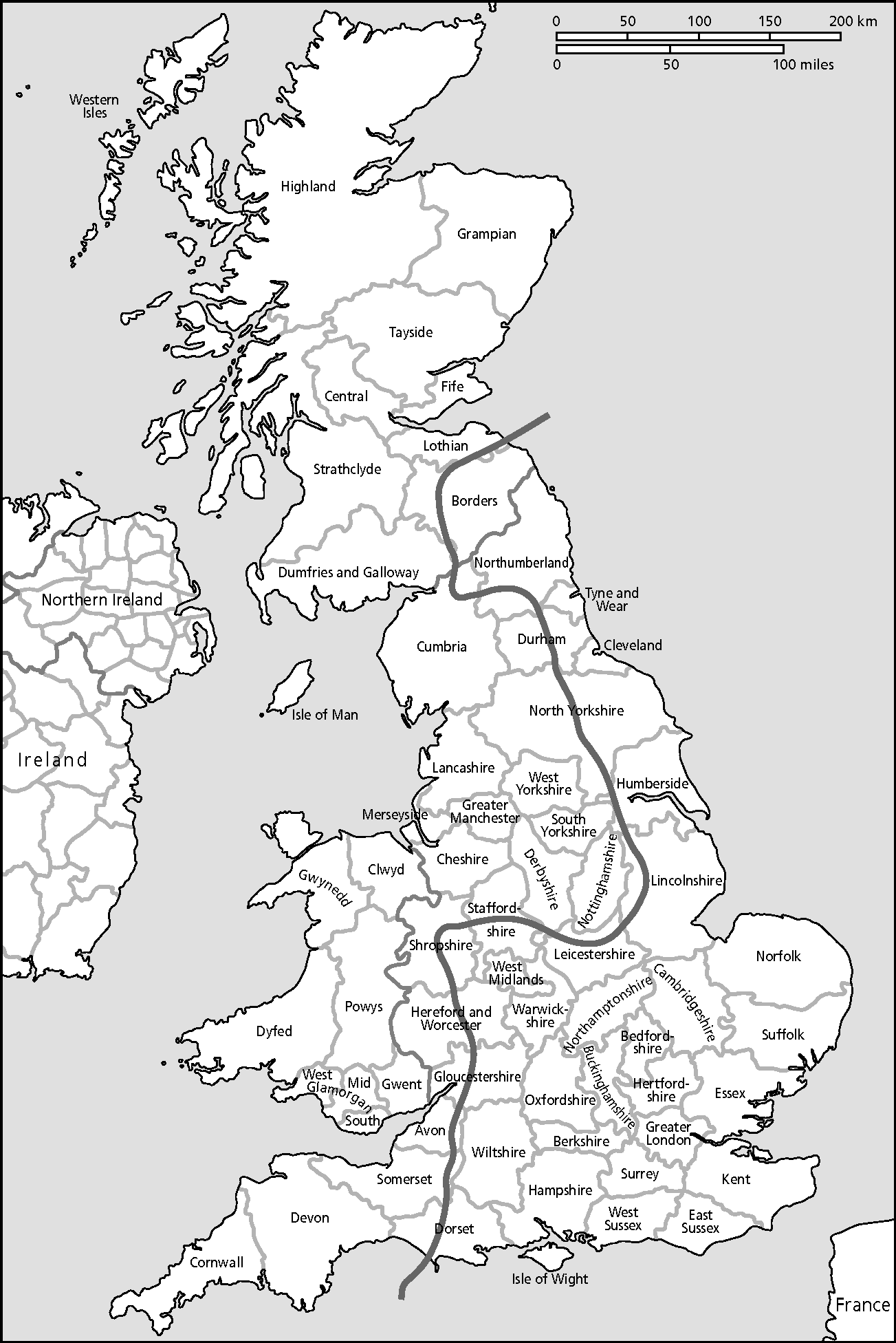
This simplification can be seen from the fact that, while Old English was a highly synthetic fusional language, Middle English was much less fusional, showing a clear move towards a more isolating type of morphology. Many authors have advanced contact-based explanations for this development – Milroy says ‘it seems clear that such a sweeping change is at least to some extent associated with language contact’ (Reference Milroy and Blake1992b: 203). And since simplification is well known to be associated with adult language learning (see above), this would seem to be rather uncontroversial.
However, it is more controversial to argue that it was Celtic speakers who played a role in this contact, since it has been widely accepted that it was contact with Old Norse which was responsible (see below). To argue for the role of Brittonic, linguists who favour this hypothesis have had to counter two widespread misapprehensions, as they would see it.
The first is that Celtic could not have been influential because it died out too early: soon after the first Anglo-Saxon invasions, the Brittonic-speaking population fled, or were killed off, or assimilated. However, there is now much evidence to suggest that this was not at all the case – Celtic actually survived even in the Lowlands of England for many centuries. According to Morris (Reference Morris1973):
spoken Welsh was common in the 7th century…British monks probably preached in Norfolk, and also in Hertfordshire, about the 590s; their activity implies a considerable population who understood their language.
near Peterborough, Guthlac was troubled about 705 by the still independent British of the Fenland who were to retain their speech and untamed hostility into the 11th century.
the population of the English kingdoms in the seventh century consisted of an uneven mixture of men of mixed Germanic origins and of descendants of the Roman British, called Welshman, who are likely to have constituted the larger number in many regions.
Brittonic survived even more strongly, and for much longer, in the Highlands of Britain – and especially in the remotest Highland fringes: in Strathclyde (south-western Scotland) and Cumbria (the neighbouring area of north-western England) where Brittonic Cumbric is believed to have survived until at least the twelfth century; and in Devon, as well as, obviously, Wales and Cornwall. Tristram (Reference Tristram2004: 113) suggests that
in some areas of the Midlands and Northern zone, speakers of the post-conquest Anglian and Mercian dialects ruled the native population of the Britons as their slaves. These continued to speak Brittonic, their native language, for perhaps as many as six or seven generations, before they shifted to Old English.
Gelling (Reference Gelling1993: 55) allows for more than four hundred years for the shift from Brittonic to Old English to have been completed, and suggests that the process was only complete around 900 ad.
The second anti-Celtic argument is that the chronology does not work: the simplification which occurred in Old English did not take place until centuries after the Brittonic language had died out in England and south-eastern Scotland. Tristram (Reference Tristram2004) counters this by pointing to the persistence of a speech-versus-writing diglossia in Anglo-Saxon England. This was an argument first put forward by Dal (Reference Dal1952), in connection with the very low level of occurrence of progressive verb forms in Anglo-Saxon texts. Wagner had a similar insight about this diglossia (Reference Wagner1959), which was developed further by Vennemann (Reference Vennemann and Brinton2001: 364):
Substratal influence originates in the lower strata of a society and usually takes centuries to reach the written language, and regularly only after a period of social upheaval. That this applies to Irish was argued by Pokorny (Reference Pokorny1927–30), and that it applies to English is a fact well known to every Anglicist: Middle English is the period during which the language of the old ruling class dies out because the new ruling class speaks French; and when this French-speaking ruling class switches to English, that English is the Celticized English of the lower strata.
Tristram's specific suggestion is that simplification occurred in Old English very much earlier than has hitherto been thought, at a time when contact with Celtic would have provided a very reasonable explanation. But these fundamental changes occurred in the spoken language without making their way into the written language – which provides the only data that we now have. The written evidence that has survived came from the pens of a small upper-class elite who preserved the knowledge of how Old English was supposed to be written, long after the original morphological complexity had disappeared from everyday speech. Evidence of simplification then appears in the written record only after the social breakdown brought about by the Norman Conquest. This led to the disappearance of the diglossia, producing the first evidence available to us of changes which had actually occurred several centuries earlier.
It makes sense, then, to argue that simplification in Old English was the result of adult language contact, after 600 ad and mainly in the Highland zone of England, between Old English and a substratum of subjugated Late British speakers, with eventual shift on their part to Old English. Crucially, in those Highland areas where Brittonic had survived the West Germanic take-over, its speakers were in a very different type of contact situation with Old English speakers than had been the case before 600 ad. Late British was now in a substratal, not adstratal or superstratal relationship with Old English; and something like a caste system, even involving slavery, was probably in operation (Hickey Reference Hickey1995; Pelteret Reference Pelteret1995; Thomas et al. Reference Thomas, Stumpf and Härke2008).
Demography would also have been very important for these developments – there were relatively few native speakers of Old English around to act as linguistic models. ‘The current discourse [of historians and archaeologists] advocates the theory of an elite take-over of the c. two-million Romano-British population by Anglo-Saxon “fringe barbarians”’ (Härke Reference Härke, Slack and Ward2002: 167).
19.7 English–Old Norse Contact
It thus seems that it was limited contact between a minority of Old English speakers and a majority of socially inferior adult Brittonic speakers in Highland England which set the process of simplification in later Old English going, as the Britons shifted to (their form of) English, and Brittonic was eventually lost. Since it was especially in the Highland zone that this pidginized form of Old English came to dominate, it is not surprising that it is in the north of England that we see the earliest and greatest degree of linguistic simplification in the historical record.
However, this northern locus has more usually been cited as evidence in favour of the argument that simplification in Old English was the result of contact with Old Norse. The Old Norse-speaking population was, after all, geographically concentrated in the north of England. This view concerning the role of Old Norse is inherited from Bradley (Reference Bradley1904: 32), who said that ‘we know for a fact that those districts in which the Danes had settled are precisely those in which English grammar became simplified most rapidly’. Poussa has it that contact with Old Scandinavian was responsible for ‘the fundamental changes which took place between standard literary Old English and Chancery Standard English, such as the loss of grammatical gender and the extreme simplification of inflexions’ (Poussa Reference Poussa1982: 84). Kroch et al. (Reference Kroch, Taylor, Ringe, Herring, van Reenen and Schøsler2000) make the same point. Further extensive and detailed discussions of the nature, extent, and consequences of Old Norse–Old English contact are found in Townend (Reference Townend2002), and in Thomason and Kaufman (Reference Thomason and Kaufman1988: 275–304).
However, a sociolinguistic-typological perspective on linguistic change (see below) suggests that contact with Old Norse is most unlikely to be the explanation for the simplification. Large-scale Viking settlements took place mainly during the ninth and tenth centuries, and led to many areas of eastern and, especially, northern England containing a heavily Scandinavian or Scandinavianized population, as famously witnessed by the hundreds of Norse place-names. The numbers of Scandinavians who actually arrived and settled in Britain is, however, unknown and the subject of much controversy (Härke Reference Härke, Slack and Ward2002; Holman Reference Holman2007).
What we know of the relevant sociolinguistic conditions suggests that contact between Old English and Old Norse speakers in northern England very quickly turned into one of long-term co-territorial cohabitation and intermarriage – very unlike the relationship which existed in the second stage of contact between Anglo-Saxons and subjugated Britons. Townend sees the significance of ‘Anglo-Scandinavian integration and the continued practice of mixed marriage’ (2002: 204), and Laing and Laing (Reference Laing and Laing1979: 185) speak of ‘the cultural fusion of Angle and Dane in the north’.
Moreover, not only did large numbers of words make their way from Old Norse into English (unlike Brittonic words) but, as a very persuasive piece of actual linguistic evidence for the intensity of the long-term contact, the English third-person plural pronominal forms they, them, their, theirs also have their origins in Old Norse, as is well known. The borrowing of pronouns from one language to another is a rather rare type of development which one never sees in short-term adult contact situations but only in long-term co-territorial contact of the type which typifies the growth of linguistic areas or Sprachbünde. According to Nichols and Peterson (Reference Nichols and Peterson1996: 242), the ‘borrowing of pronouns points to unusually close contact’ [my italics].
The fact that the contact was ‘unusually close’, and sufficiently intimate and long-term that pronouns could be borrowed, would seem to render much less tenable the popular thesis that it was contact with Old Norse which led to simplification in late Old English. Old Norse and Old English ‘were roughly adstratal in Viking Age England’ (Townend Reference Townend2002: 204). Contact between Old Norse and Old English was not of the sociolinguistic type that makes for simplification, which typically results from short-term adult second-language learning from limited exposure (Trudgill Reference Trudgill2011b). Rather, the North Germanic people would have had every opportunity to learn this closely related language in a non-pidginized form: this was co-territorial, long-term contact involving child bilingualism and therefore perfect acquisition.
This point of view is strongly supported by work by Emonds and Faarlund (Reference Emonds and Faarlund2014), who cite the Norse character of a number of Middle English syntactic constructions as compared to Old English. For example, van Riemsdijk (Reference Riemsdijk1978) makes the strong claim that the only languages in the world which permit fully developed preposition stranding are members of the North Germanic language family – plus English (example (1)):
(1) Reven ble skutt på
‘The fox was shot at’
(Holmberg and Rijkhoff Reference Holmberg, Rijkhoff and Siewierska1998)
According to Emonds and Faarlund, ‘most languages disallow it completely’, and West Germanic Dutch allows it only ‘under very restrictive conditions’ – which was also the situation in Old English. According to Hoekstra (Reference Hoekstra, Haider, Olsen and Vikner1995), it is also disallowed in Frisian. (However, for a discussion of the work of scholars who have suggested possible Brittonic influence on the development of English preposition stranding, see Roma Reference Roma, Ramat and Roma2007.)
A second example is provided by the fact that in North Germanic and English, the original Germanic genitive -s ending has become a phrasal clitic which can be postposed to phrases as well as to head nouns, as seen in these Norwegian and English examples (2) and (3):
(3) Sjåføren av lastebilens feil
‘The driver of the lorry's fault’
In continental West Germanic, -s continues to be simply a genitive case inflection on head nouns only. Emonds and Faarlund mention only Dutch and German, but this is equally true of North Frisian (Löfstedt Reference Löfstedt1968; Hoekstra Reference Hoekstra, Dammel, Kürschner and Nübling2010) and West Frisian (Hoekstra Reference Hoekstra2006).
A third point is that there was a switch between Old English and Middle English from verbal prefixes to post-verbal particles. In modern German and Dutch, directional and aspectual particles still have to precede non-finite and clause-final finite verbs, as in example (4):
(4) Sie will den Brief herausnehmen
‘She wants the letter out-take’
This was also the situation in Old English. But these grammatical prefixes disappeared in Middle English, and English instead developed a system of post-verbal particles which took over the role of the prefixes. Modern English (example (5))
(5) She wants to take the letter out
exactly reflects the Scandinavian structure, as in Danish (example (6)):
Fourthly, the infinitival marker to always occurred immediately adjacent to the verb in Old English, as it still does in Dutch and German. In Scandinavian, on the other hand, the marker is a free morpheme which can be separated from the verb by adverbs and negatives. The English infinitival to operates in exactly the same way (example (7)):
(7) Det er viktig å alltid komma i tide.
‘It is important to always come on time.’
It seems rather clear from Emonds and Faarlund's work, then, that the character of Modern English has indeed been influenced by Old Norse to some degree in syntax, as well as in lexis.
19.8 English–French Contact
It is equally clear, too, that contact with Norman – and other forms of – French has also had a very considerable impact on the nature of English. As is mentioned in all histories of the English language, this is especially true of English lexis, with 40 per cent of modern English vocabulary often being cited as the proportion of French-based words in the modern language (Rothwell Reference Rothwell1998).
Is it possible, however, that there was also some grammatical influence from French? Dalton-Puffer (Reference Dalton-Puffer and Fisiak1996) has provided us with an extensive and detailed account of the role of French in the development of Modern English derivational morphology. But this was initially a direct consequence of the transfer of massive amounts of French vocabulary to English – as was also, to an extent, the phonemicization of /v/ and /z/.
Otherwise any role for French in the shaping of English grammar would seem, on the face of it, to be unlikely. After all, how would this have happened? The number of native Norman FrenchFootnote 6 speakers in England was never very high – Carpenter (Reference Carpenter2004) gives a figure of 8,000 for the year 1086, out of a total population of perhaps 3 million (Hatcher and Bailey Reference Hatcher and Bailey2001). These figures are extremely approximate but, even so, we can be fairly sure that more than 99 per cent of the population of England in 1100 were English (or Norse or Brittonic) speaking. The proportion of French speakers, whatever it was, would have been even lower in Scotland and, especially, Wales; and very many of them were elite aristocratic members of a ruling class who had very little contact with the bulk of the Germanic-speaking population.
Bailey and Maroldt (Reference Bailey, Maroldt and Meisel1977), however, suggest that the influence of French on English was very considerable. Indeed, they go further than this and argue that Middle English was actually a ‘creole’ which developed as a result of contact and interaction between English and Norman French. This is clearly a misuse of the term ‘creole’, as has been powerfully and carefully demonstrated by Görlach (Reference Görlach, Kastovsky and Szwedek1986) and others; and Bailey and Maroldt's arguments have not been widely accepted (e.g. Danchev Reference Danchev and Fisiak1997 – though see Dalton-Puffer Reference Dalton-Puffer and Fisiak1995 and Rothwell Reference Rothwell1998). But their putative examples of French grammatical influence should nevertheless be considered.
The examples of influence Bailey and Maroldt cite include:
1 The analytic gradation of polysyllabic adjectives, as with Modern English more/most beautiful. West Germanic languages, including Old English, use the bound morphemes -er and -est regardless of the length of the adjective (example (8)):
(8)
German: Sie ist interessanter als ihr Mann. ‘She is interesting-er than her husband.’
Middle and Modern English do not do this, and here Bailey and Maroldt see the influence of French, cf. Modern French (la) plus intéressante.
Interestingly, however, their thesis is undermined by Emonds and Faarlund, who argue that analytic comparative and superlative forms of English adjectives are actually due to Old Norse rather than Old French influence. They point to the fact that North Germanic also uses free words meaning ‘more’ and ‘most’ for the gradation of longer adjectives (example (9)):
(9)
Norwegian: Det var det mest underlege… ‘That was the most remarkable…’
The chronological and demographic case for the influence of Old Norse is more powerful than that for French. In particular, the Scandinavian proportion of the population – although, as we have just noted, not known with any certainty – was much higher, especially in the North of England.
2 Bailey and Maroldt also cite as being the result of Norman French influence the use of oblique forms of personal pronouns in all functions in English except for non-conjoined subjects (example (10)):
(10) Well done him!
John and me left
Who did that? ThemFootnote 7
They compare this to the similar usage in Modern French of the oblique forms lui, moi, toi, eux.
Here too, however, Emonds and Faarlund claim Scandinavian influence. They argue that the modern English pattern is reflected in modern Danish, where we have (examples (11)–(13)):
(11) Mig og Ole gik i bio
‘Me and Ole went to the cinema’
(12) Ole er bedre kvalificeret end dem
‘Ole is better qualified than them.’
(13) Hvem vil have en øl til?
‘Who wants another beer?’
- Os to ‘Us two.’
- Ikke mig ‘Not me.’
- Hende derovre ‘Her over there.’
Other examples given by Bailey and Maroldt, however, perhaps deserve a more sympathetic consideration: they suggest, for instance, that the development of English wh-interrogative pronouns into relative pronouns took place under French influence. In the modern languages, the pronouns who and qui both operate as relatives as well as interrogatives, something which is not generally true in North Germanic.
19.9 Conclusion
English is not a creole. But it is the result, in part, of millennia of language contact. At some points, contact has led to the transfer of additional grammatical categories and has thus added complexity to the structure of English. This was the case, it has been argued, with the borrowing of the progressive aspect from Brittonic Celtic. At other points contact has led to simplification as with, it has been argued, the loss of Old English morphology due to adult language learning by native-speakers of Brittonic Cumbric in a substratum situation in Highland England. And at yet other points it has simply led to replacive borrowing, as with the replacement of verbal prefixes by post-verbal particles under Old Norse influence.
In spite of all the different episodes of contact, English is still by general agreement an Indo-European Germanic language. But we can see, in its modern structures, the results of contact between the Germanic languages Old English and Old Norse, as well as contact with other Indo-European languages: Celtic Brittonic, Italic Latin, and Anglo-Norman. Less certainly, it may also show traces of contact with Continental Celtic and, even less certainly, with Finnic, Afro-Asiatic Semitidic, and Vasconic.
20.1 Introduction
The spread of English beyond the British Isles since the early modern period has resulted in a large number of post-colonial varieties of English. While it is difficult to give precise figures on the number of post-colonial Englishes (should acrolectal, i.e. standard Singaporean English, and basilectal, i.e. colloquial Singlish, be counted as one or as two varieties? Does the use of English in Cyprus qualify as a ‘variety’ of English?), it is clear that nowadays more people use English routinely as a second language than there are speakers who have it as their first language (see Crystal Reference Crystal2008). Different varieties of global English have been distinguished on the basis of their historical origin and/or their current function.
The different conditions under which English spread have been described in terms of ‘colonization types’ that, in turn, gave rise to different contact-induced Englishes (Mufwene Reference Mufwene2001, Schneider Reference Schneider, Schreier and Hundt2013): in countries, where English was used as a lingua franca for trade purposes (i.e. so-called ‘trade colonies’) English-based pidgins emerged, varieties of English with a simplified grammar that lacked native speakers. English was also used as a lingua franca among the African slaves and in communication with their owners on the plantations in places like the Caribbean; in such ‘plantation colonies’ the pidgins were later adopted as the first language by the (former) slaves and subsequently developed in grammatical complexity, thus giving rise to English-based creoles. This outcome from language contact has to be distinguished from the development in so-called ‘exploitation colonies’ such as in India or Singapore, where English was transmitted to a relatively small minority of the local population via second-language acquisition in a formal classroom situation, leading to the development of second-language (ESL) varieties of English, which also show traces of the local, indigenous languages, but are much closer, structurally, to first-language varieties of English than English-based pidgins and creoles. The huge number of English speakers who migrated to America, New Zealand, or Australia provided the input for the first-language (ENL) varieties in the ‘settlement colonies’, which are largely the outcome of dialect contact between different regional varieties of British English, but which also show traces of contact with the local indigenous languages (mainly on the level of the vocabulary). Schneider (Reference Schneider, Schreier and Hundt2013) adds the recent spread of English in countries without a colonial past (e.g. English in China, Japan, or South Korea) to the typology and labels it ‘postcolonial attraction’ (also subsuming the ‘grassroots spread’ of English in India as an example of diffusion among speakers of the lower classes under this label).
In terms of current function, a major distinction of post-colonial Englishes is between those which are spoken as a first language (ENL) and those which are institutionalized second language varieties (ESL). Beyond that, English is learnt as a foreign language (EFL) and used as an international lingua franca. Broadly speaking, this tripartite distinction corresponds to the three circles (inner, outer, expanding) in Kachru's (Reference Kachru and Kachru1992) widely known model. This model focuses mostly on standard or standardizing varieties of English, but language contact has also led to the emergence of structurally very different, non-standard Englishes, notably English-based pidgins and creoles. Thus, some models try to capture the result (with a focus on the ‘typology’ of different new Englishes, e.g. Kachru Reference Kachru and Kachru1992) whereas others (notably Mufwene Reference Mufwene2001 and Schneider Reference Schneider2007) focus on the process that led to the development of new Englishes, trying to capture similarities in the development regardless of whether the outcome is an ENL or ESL variety, or an English-based creole. Such models allow researchers to combine insights from fields as diverse as creole studies and corpus-based description.
In Mufwene's approach, the focus is on the factors that influence the selection of competing features from the input feature pool in a restructuring process that is the same in essentials for both dialect and language-contact situations (Mufwene Reference Mufwene2001: 4–6). The founder principle, for instance, is a concept first adopted from biology by Mufwene (Reference Mufwene1996) to explain the genesis of creole varieties. When applied to contact between different regional dialects of English from the British Isles, it explains the characteristics of new ENL varieties as resulting from those used by the speakers who founded the colonies. The emphasis in Schneider's (Reference Schneider2007) dynamic model is on identity as one of the main driving forces in the evolution of new Englishes, i.e. the change from a colonial identity to a post-colonial one that encompasses the various strands (former colonizers, indigenous population, other migrants) under one national (linguistic) identity.Footnote 1 Biewer (Reference Biewer2012: 126) and Meierkord (Reference Meierkord2012: 64–7) bring together these components and spell out how the process of restructuring is shaped by cognitive principles and processes (i.e. second language acquisition, transfer, typological distance of substrate and target language, etc.), on the one hand, and social factors (identity, accommodation, norm orientation, cultural motivations), on the other hand.
Whenever speakers of English migrated to other parts of the world, they came into contact with speakers of other languages (i.e. the indigenous language(s) and/or other migrant languages). Equally important, migrants came into contact with other English speakers from other parts of the British Isles and Ireland, who tended to use a regional variety such as the Suffolk or Lancashire dialect rather than standard English. The development of new Englishes is therefore the result of both language and dialect contact. Matters are complicated by the fact that a particular feature can often be attributed to language contact with a substrate language or to a vernacular variety that formed part of the input (see Lass Reference Lass and Hickey2004a: 365). Dialect contact has been a major force in the development of ENL varieties in countries such as the US or Australia, but it is also relevant for the development of new Englishes in ESL countries.Footnote 2 Similarly, language contact has been key in shaping ESL varieties on all levels, but it also played a role beyond the borrowing of native vocabulary (and occasionally also of structural patterns) in ENL varieties. Varieties most heavily influenced by language contact are the various pidgins and English-based creoles. However, language contact is also an important aspect of structural nativization (i.e. the adoption of local grammatical features)Footnote 3 and thus the development of ESL varieties. The fact that there is overlap in the processes involved in creole genesis and structural nativization in ESL varieties is also apparent in the terminology, notably the lectal continuum which ranges from the basilectal end showing heavy influence of contact with the indigenous language(s), through the less heavily influenced mesolectal forms to the more standard-like acrolectal varieties.
Influence from language contact is not only limited to indigenous languages spoken in the occupied territories; the input of other non-native speakers of English who migrated to countries where English became the majority language or an institutionalized second language add another layer of contact-induced change. While the native-speaker English input is typically referred to as the ‘superstrate’ and the local language(s) as the ‘substrate’, Schneider (Reference Schneider2007: 58–60) introduced the term ‘adstrate’ for immigrants and contract labourers, who acquired English as a second language and thus are agents in the development of a local variety of English.
The aim of this chapter is to outline research on the global spread of English with a focus on the processes of structural change that have shaped the emergence of new Englishes in both dialect and language contact (i.e. koinéization and nativization discussed in sections 20.2 and 20.3, respectively), and those that are the result of isolation (i.e. divergence and (re-) convergence, in section 20.4). Throughout, these processes will be illustrated with examples from standard and non-standard Englishes, and both ENL and ESL varieties. Research on the global spread of English has been conducted within sociolinguistics, it has relied on corpus-linguistic methodology, the transcription of early recordings, or it has used evidence from contemporary varieties as a window on the past. In other words, the corpus evidence used to study the development of new Englishes consists of collections of historical and contemporaryFootnote 4 texts, with some varieties being better documented than others. The review of the processes involved in the evolution of new Englishes has been informed by studies from these different fields in linguistics.
20.2 Koinéization and beyond
Koinéization (see Trudgill Reference Trudgill1986: 107ff.) is the term applied to the mixing and subsequent levelling of previous dialect differences as well as the development of interdialect forms. Koinéization happens because speakers of different dialect backgrounds tend to accommodate to each other in their speech behaviour (see Kerswill Reference Kerswill, Chambers, Trudgill and Schilling-Estes2002 for details). The outcome of koinéization would be a relatively homogenous variety with fewer dialect features than found in the input varieties. Indirect evidence of homogeneity comes from contemporary meta-comments. Montgomery (Reference Montgomery, Klemola, Kytö and Rissanen1996) found such remarks on the homogeneity of eighteenth-century AmE in letters and journals:
For my part, I confess myself totally at a loss to account for the apparent difference, between the colonists and persons under equal circumstances of education and fortune, resident in the mother country. This uniformity of language prevails not only on the coast, where Europeans form a considerable mass of the people, but likewise in the interior parts, where population has made but slow advances.
The relative lack of regional variation in New Zealand (NZE) and Australian English (AusE) (see Bauer Reference Bauer and Burchfield1994) appears to provide further indirect proof of koinéization.Footnote 5 But lack of regional variation is not necessarily a ‘given’ in dialect contact situations. A case in point is South Africa, where socially distinct input varieties (mainly working class in the Cape Colony but middle or higher class settlers in Natal) prohibited accommodation and led to the development of two relatively distinct ENL varieties in the course of the nineteenth century (see Lanham Reference Lanham, Bailey and Görlach1982).
According to Trudgill et al. (Reference Trudgill, Gordon, Lewis and Maclagan2000: 303–8), koinéization happens in three distinct stages: the first stage (migrant generation) is characterized by rudimentary levelling of dialect differences; extreme intra- and inter-speaker variability and some additional levelling are typical of the second stage (generation of the first native-born speakers); it is only in the third stage (following generation(s)) that a focused variety emerges through further levelling and reallocation (i.e. previously regional variants acquire social connotations; examples of this would be the current social significance of rhoticity in the US or variation in the trap and start vowels in Australia).
Even though koinéization is a concept frequently mentioned in historical accounts of new Englishes, detailed empirical studies of the process are scarce (see Kerswill Reference Kerswill, Chambers, Trudgill and Schilling-Estes2002: 670). A notable exception is Montgomery, who uses eighteenth-century letters by Irish immigrants since ‘Irish varieties of English can make a strong claim for a prominent role as input to Colonial American English, their speakers comprising perhaps one-quarter of all English-speaking emigrants before the American Revolution’ (1996: 222). He concludes that koinéization was a gradual process that is likely to have continued into the nineteenth century (Montgomery Reference Montgomery, Klemola, Kytö and Rissanen1996: 230ff.);Footnote 6 more importantly, the koiné is unlikely to have been widely used:
Colonial American English was probably not a koiné in many places; rather, dialect diversity, especially reflected in style shifting, was the rule.
Koiné and koinéization are clearly terms to use advisedly. Unless we are careful, they will obscure as much as they reveal.
In the study of koinéization, one methodological problem is that formal, written language tends to be closer to standard English than colloquial spoken English. So ultimately, ‘koinéization of Colonial American English is in actuality the spread of literacy and standards of appropriate usage in writing’ (Montgomery Reference Montgomery, Klemola, Kytö and Rissanen1996: 232). Moreover, recent studies of Late Modern English letters have shown that regionally specific language use tends to be curiously absent even in this text type (see, e.g., Hundt Reference Hundt2015). Spoken language would therefore be a better source for the study of dialect birth.
For NZE, such data became available in the form of recordings made throughout rural New Zealand in the 1940s, including some of the first New-Zealand-born speakers. These enabled the Origins of New Zealand Project (ONZE) to document the embryonic stages of the New Zealand accent. According to Gordon et al. (Reference Gordon, Campbell, Hay, Maclagan, Sudbury and Trudgill2004), the New Zealand accent is not simply the outcome of koinéization. They ultimately argue for multiple factors, namely (1) the founder effect (south-eastern dialect features); (2) input from settlers who came via Australia, and (3) swamping effects from large-scale immigration from the south-east of Great Britain in the 1870s; the NZE accent thus developed as ‘a combination of these, the product of all three working in concert, each later one reinforcing the earlier ones’ (2004: 256).Footnote 7
Regarding present-day NZE, Hickey (Reference Hickey and Hickey2003b: 236) claims that the absence of regional variation is not simply due to accommodation and subsequent dialect levelling; instead, he postulates that it arose from supra-regionalization, i.e. ‘the adoption of the focused variety of New Zealand English from areas of high density, varied settlement to areas of lower, less varied settlement’ (ibid.) which resulted in the removal of minority, non-prestige features of local speech in the accents, e.g. of late nineteenth-century Irish immigrants. Additional factors apart from koinéization and supra-regionalization that help explain the apparent homogeneity of New Zealand English are internal migration (see Gordon et al. Reference Gordon, Campbell, Hay, Maclagan, Sudbury and Trudgill2004: 254) and close-knit network ties (see Britain Reference Britain, Bell, Harlow and Starks2005b: 164ff.).
20.3 Nativization
Contact between English and other languages leads to structural nativization, i.e. the adoption of local grammatical patterns.Footnote 8 These may be due to borrowing and transfer. In addition to direct influence through transfer and borrowing, more general cognitive processes related to the acquisition or learning of the target language (such as simplification and convergence) also give rise to contact-induced nativization of a new English.Footnote 9
More superficial signs of language contact are lexical borrowings which occur early on in language-contact situations and do not necessarily require bilingualism (see the many toponyms, terms for flora and fauna, and cultural concepts that English has borrowed from languages around the globe). Quite a few of these items have become part of global English (e.g. pyjamas or budgie), whereas others (e.g. puja ‘Hindi prayers’ and matai ‘NZ native tree’) are restricted to regional varieties. While borrowing most obviously affects lexis, prolonged language contact and bilingualism may also result in the borrowing of grammatical patterns as part of the structural nativization process. A good example is the kena-passive typical of basilectal Singaporean English (e.g. His tail like like kena caught in the in the ratch hut, ICE-Sing S1A-052), which employs the auxiliary kena and has adversative meaning (see Bao and Wee Reference Bao and Wee1999), i.e. it partially overlaps with the semantics of the English get-passive.
Bilinguals and learners of a second language may transfer structural patterns from their dominant/first language to the target language, especially in a situation of language shift. This happens on all levels of the language system: speakers whose first language is syllable-timed, for instance, often transfer the different rhythmical pattern to English to some degree (see, e.g., Low et al. Reference Low, Esther and Nolan2000). Target-language lexical items may be used with meanings closer to the source language(s), as for instance the wider application of aunty as a respectful term for an older woman (who may or may not be a relative) in different varieties of Indian English (IndE). Examples of transfer in the area of grammar would be the Irish after-perfect (e.g. I am after having my lunch ‘I have just had my lunch’; see, e.g., Hickey Reference Hickey2007: 197–200) or the omission of articles by speakers whose first language does not have articles, as in Her husband is manager of Ø sugar mill; see, e.g., Sand Reference Sand2004: 286). Transfer may also occasionally lead to a reintroduction of grammatical contrasts that were present in historical varieties of English but subsequently lost: an example would be the number distinctions in the pronoun system of pidgins and creoles whose substrate languages distinguish between singular, plural, and dual; such dual pronouns are also found in some basilectal ESL varieties (e.g. Fiji English us-two as a first-person dual inclusive and us-gang as a first-person dual exclusive; see Siegel Reference Siegel and Hickey2010: 832). Early attestations of grammatical transfer pose a problem for the description of new Englishes: on purely linguistic grounds, they are indistinguishable from interference phenomena (i.e. negative transfer in second language acquisition); however, once they are used with a certain text frequency, it can be argued that they are no longer contact-induced errors but have developed into features of the emerging variety.Footnote 10 In the following example from the Philippine component of the International Corpus of English (ICE-Phil),Footnote 11 the verb teach is used with a different complementation pattern and word order than the one found in ENL varieties:
(1) STARTING this year, ‘mobile teachers’ will be deployed by the government in far-flung areas to teach the young with the basics of reading, writing and arithmetic. (ICE-Phil, W2C-020)
It is a pattern that is attested only once in the corpus, but if it were found to be used regularly, e.g. in local newspapers, it would be difficult to dismiss it as a contact-induced error.
In addition to borrowing and transfer, simplification and convergence are processes that lead to nativization in new Englishes. Simplification is a natural phenomenon that occurs in natural and instructional settings of second-language acquisition/learning. Simplification to an extreme degree characterizes the development of English-based pidgins and creoles, but it has also affected the ESL varieties in exploitation colonies. Examples of simplification in grammar that are attested from both contexts would be the omission of the third-person singular present tense ending or plural -s as well as copula omission in sentences such as He sick, She teacher. Reducing irregularity is another aspect of simplification in contact varieties that might lead to, e.g. a more general use of regular past tense endings (particularly in basilectal varieties) or the extension of the regular plural ending to non-count nouns in standard(izing) varieties of ESL, as evidenced in the contemporary material from the International Corpus of English (ICE):Footnote 12
(2) It has exported over one thousand heavy equipments…(ICE-Ind, S2B-017)
(3) Basic equipments for flower arrangement include a pair of scissors to cut branches and flowers, flower holders and vases. (ICE-Phil, W2D-012)
At the constructional level, the regularization of prepositional usage for verbs and related nouns can also be used to illustrate this tendency. In inner circle varieties, one can have a discussion about a topic, but to discuss about it is considered ungrammatical. Again, ICE components provide evidence that prepositional usage is regularized in the outer circle, particularly in spoken data:
(4) Now I would like to discuss about Premchands pictorial uses of language. (ICE-Ind, S1A-006)
(5) Can we discuss about our presidentiables. (ICE-Phil, S1A-021)
The collocation is occasionally also attested in written language use in contact varieties of English, as in the following example from ICE-Fiji (which, alongside the regularized use of discuss about also features the extended use of would and the progressive, discussed in more detail in Deuber et al. Reference Deuber, Biewer, Hackert, Hilbert, Hundt and Ulrike2012 and Hundt and Vogel Reference Hundt, Mukherjee, Mukherjee and Hundt2011, respectively):
(6) First, I would be explaining about the gender inequality, which often leads to the high incidence of poverty amongst women, which is what I would be discussing about in the second part of this essay. (ICE-FJ, W1A-016)
Simplification (and regularization) are a more general process in language acquisition, and it is therefore hardly surprising that discuss about is also a common collocation in learner Englishes (e.g. Nesselhauf Reference Nesselhauf2009: 18).
Convergence occurs if a local grammatical feature is found in the substrate and superstrate languages.Footnote 13 In Irish English, the progressive spread in the late modern period just as it did in English English; another example of convergence is the development of group verbs (i.e. phrasal and prepositional verbs) in Irish English and English English (Hickey Reference Hickey2007: 279).
The same processes (borrowing, transfer, simplification, and convergence) apply, in principle, to both substrate and adstrate influence on new Englishes. With more than seven million immigrants, German has had an influence on AmE beyond lexical borrowing: transfer from German has resulted in expressions such as Are you going with? (Wolfram and Schilling-Estes Reference Wolfram and Schilling-Estes2005: 122) and the use of hopefully as a sentence adverbial (meaning ‘it is to be hoped that’) (OED s.v. hopefully adv. 2.). Övergaard (Reference Övergaard1995: 44–6) suggests that the revival of the mandative subjunctive in AmE (e.g. I suggest that he consult a doctor) is likely to have been fostered by language contact with adstrate languages such as German, French, Spanish, and Italian in the Midwest. Adstrate influence is obviously not limited to the US. Clyne (Reference Clyne2003: 153) reports structural influence of German on the English spoken in the Tarrington-Tabor (Western Victoria) area of Australia, where speakers use the definite article with names of languages (the English, the German) while leaving out indefinite articles with occupational terms (e.g. She was teacher from German Sie war Lehrerin). Similarly, in Fiji and South Africa, with sizeable communities of sub-continental Indians (mainly descendants of indentured labourers), influence from Indian adstrate languages (notably Hindi) goes beyond lexical items (e.g. roti, samosa) and includes patterns such as the use of been as a past tense marker, as in You been tell me or affirmative questions without do-support, as in How often she goes to the cinema? (see Mesthrie Reference Mesthrie, Kortmann, Schneider, Burridge, Mesthrie and Upton2004 and Mugler and Tent Reference Mugler, Tent, Burridge and Kortmann2008).
20.4 Divergence vs. convergence – retention and innovation
During earlier periods in the global spread of English, the (relative) isolation of speakers is likely to have led to divergence while the more recent re-establishment of contact, especially via mass media has led to some (re-) convergence. Divergence of new varieties from the input dialects has often been attributed to two competing processes, namely retention (or ‘lag’) and innovation. The terms ‘retention’ and ‘lag’ are at times applied to the alleged wholesale retention of a previous stage of the language. An example would be the claim that, in the Appalachians, people have preserved the language of Shakespeare, i.e. Early Modern English. On closer inspection, wholesale conservation of historical dialects is a myth (e.g. Schneider Reference Schneider and Hickey2004: 262ff.).
One of the most systematic empirical studies of early AmE with respect to retention and innovation is Kytö's work on modals and verb morphology. She finds that modal verbs provide an example of colonial lag (Kytö Reference Kytö1991: 353) whereas verb inflection is an example of colonial innovation (Kytö Reference Kytö1993: 113). Both studies also show that more detailed analyses often reveal more complex historical patterns even in early colonial texts: the use of third-person will is actually a parallel development in both AmE and BrE (see Kytö Reference Kytö1991: 351), whereas AmE is, indeed, more conservative than BrE in retaining -th forms in the specific context of verbs ending in /s/ and /z/ (see Kytö Reference Kytö1993: 132). Likewise, research on southern hemisphere varieties (Trudgill Reference Trudgill1999a and Jeffries Reference Jeffries, Schreier, Trudgill, Schneider and Williams2010) shows that ‘lag’ may have played a role in the development of other (post-)colonial Englishes, but it is typically only one factor responsible for the use of a particular feature.
The main problem with the lag-innovation dichotomy is that it has also been applied to features of post-colonial Englishes (see Hundt Reference Hundt, Rohdenburg and Schlüter2009: 14 for details). However, what at first glance appears to be an archaism may actually be a revival of an old pattern. A case in point is the mandative subjunctive in AmE (see section 20.3), which shows a long-term pattern of decrease followed by a more recent increase in the twentieth century (see Övergaard Reference Övergaard1995; Hundt Reference Hundt, Rohdenburg and Schlüter2009: 31). The (post-colonial) revival of the mandative subjunctive is a change that has been spreading in other varieties in the second half of the twentieth century (see, e.g., Hundt Reference Hundt, Lindquist, Klintborg, Levin and Estling1998; Leech et al. Reference Leech, Hundt, Mair and Smith2009: 53; Peters Reference Peters, Peters, Collins and Smith2009b: 129), i.e. it is a change led by AmE but in which other varieties appear to be following suit. On a global scale, AmE is often found to be the lead variety in ongoing change. This does not only hold for the revival of a conservative feature such as the mandative subjunctive but, as one would expect, also for genuinely innovative constructions. One such example is the spread of pseudo-titles such as lawyer or journalist followed by a proper name (typical of journalistic writing), as in lawyer Peter Russell or journalist Helen Richards: varieties such as NZE or East African English are more advanced in the spread of an originally AmE pattern than BrE (see Bell Reference Bell1988 and Meyer Reference Meyer, Reppen, Fitzmaurice and Biber2002).
Research on one of the most isolated English-speaking communities – Tristan da Cunha – confirms the view that isolation leads to more than simply ‘lag’ or koinéization. Moreover, Schreier's (Reference Schreier2003) sociolinguistic-historical data from Tristan da Cunha provide evidence that dialect formation and change even in small, remote settings need to be attributed to a complex of factors, including the possibility of independent developments (in this case completive done and usta went/had/done).Footnote 14
Patterns of differential change that go beyond the simple dichotomy of lag/retention vs. innovation can only be studied on the basis of diachronic corpora that sample (national) regional varieties. On the basis of ARCHER (A Representative Corpus of Historical English Registers), which provides evidence of Late Modern BrE and AmE, and databases of narrative prose, Hundt (Reference Hundt, Rohdenburg and Schlüter2009: 32ff.) extends the original dichotomy beyond ‘extraterritorial conservatism’ (a more neutral term for ‘lag’) and ‘innovation’, to include ‘divergence’ (i.e. the development of two varieties in different directions), ‘parallel developments’, ‘resurrection/revival’, and ‘kick-down developments’ (i.e. initial conservatism in one variety which then takes the lead in later stages of the ongoing change). Genuine examples of extraterritorial conservatism in differential change are extremely difficult to find. It is much more common that apparent retentions are actually instances of more recent revival. Currently, differential change is difficult to study in varieties other than BrE and AmE, but diachronic reference corpora are beginning to be compiled for other World Englishes (Fritz Reference Fritz2007 or Hundt Reference Hundt2012), including ESL varieties (Collins et al. Reference Collins, Borlongan and Yao2014). However, the corpora for Early SingE and PhilE only provide evidence for developments in the second half of the twentieth century. Other corpora of (post-)colonial Englishes sample only one or a limited set of text types (e.g. the Corpus of Early Ontario English (Dollinger Reference Dollinger, Renouf and Kehoe2006a), the data used in Rossouw and van Rooy (Reference Rossouw and van Rooy2012) or the Corpus of Irish English Correspondence (McCafferty and Amador-Moreno Reference McCafferty, Amador-Moreno, Migge and Chiosáin2012)). Data collections of emerging new Englishes in exploitation contexts are currently still a lacuna for historical corpus linguistics. Thus, for the majority of new Englishes (both ENL and ESL), diachronic corpora are still unavailable.
20.5 Conclusion and outlook
The overview of processes of language change in global English has shown that there are a lot of similarities across the different settings. Both plantation and exploitation colonies have given rise to varieties characterized by language and dialect contact, typically ranging from more heavily influenced, basilectal varieties (e.g. basilectal Jamaican creole or basilectal Fiji English) to varieties that are close to the standard end of the spectrum (e.g. acrolectal Jamaican and Fiji English). While the feature pool that constitutes the input into new dialect formation will vary somewhat, essentially the same processes have been found to occur in the restructuring of the new varieties.
The second half of the twentieth and the beginning of the twenty-first century are characterized by large-scale migration to ENL countries, not only from the former colonies of Britain and the US but also from non-English-speaking parts of the world. The future of global English therefore needs to take into account the possibility of secondary dialect contact, i.e. the influence of ESL varieties and the use of EFL on ENL varieties. A case in point might be the use of the progressive in NZE (see Hundt and Vogel Reference Hundt, Mukherjee, Mukherjee and Hundt2011): close and frequent contact between ENL and ESL speakers in a small country like New Zealand could foster structural influence from ESL on ENL varieties. Outsourcing of business processes and information technology, notably in the form of call centres located in South and East Asia, but increasingly also in EFL countries like Bulgaria and Brazil (see Lim and Ansaldo Reference Lim, Ansaldo, Nevalainen and Traugott2012: 569) might prove an additional source of secondary dialect contact and resulting influence from non-native varieties on ENL in the long run (see below).
Despite the centrifugal forces that have been at work during the colonial and post-colonial history of the English language, English (unlike Latin) has not separated into different languages. Especially at the acrolectal end of the continuum, English has remained a language that allows for international communication on a global scale. There are no signs that this state of affairs will change in the near future. At the same time, speakers have been making use of the inventory available from the feature pool as well as independent developments to adapt the language to their local needs, at times by developing very localized forms of expression which will occasionally make it difficult for other speakers of ‘English’ to understand what they are saying. Some of these originally highly localized varieties have, in turn, been spreading through popular culture and, recently, through the electronic media. To some extent, these also lead to the adoption of vernacular features from varieties such as African American Vernacular English, Jamaican Creole, or Chicano English, as Mair (Reference Mair, Schreier and Hundt2013a: 317–18) points out:
A subset of the non-standard varieties thus deterritorialised has acquired a very high media profile through association with global popular cultural or subcultural movements, so that alongside traditional feature diffusion through face-to-face language and dialect contact, a new sociolinguistic dynamic is set in motion – the potentially instant globalization of vernacular features through the media.
The two opposing trends that we are likely to see in future developments of global Englishes are globalization and localization. Continued language and dialect contact are expected to lead to the global spread of features (e.g. a possible spread of discuss about to ENL varieties) whereas local identity construction is a force that is likely to result in the development of more localized norms of language use (e.g. the ‘exclusive’ use of basilectal varieties in countries such as Jamaica). In addition to the mass media, another force shaping English(es) is the globalization of the market, which has resulted in the outsourcing of communication services from ENL to ESL countries. As mentioned previously, call centres bring the local varieties back into contact with ENL varieties, but they also bring the ENL varieties into close contact with ESL varieties. In this particular area of globalization, we can expect to see mutual convergence of standard varieties, especially in writing, but they may not always be in the direction of the metropolitan varieties, as the example of the progressive in NZE shows.
Another aspect for future developments concerns norm orientation. In the past, teaching materials for ESL and EFL classrooms tended to be produced in Britain and the US, thus contributing to continued exo-normative influence from the two major reference varieties, BrE and AmE.Footnote 15 More recently, however, these materials are beginning to be produced more locally and also in ESL countries such as India, thus opening the possibility of external influence from one ESL variety onto another or on geographically closer EFL varieties; this opens up the potential for varieties such as Indian English to develop into regional epicentres, which would be evidenced in convergence of South African Englishes on the IndE model and divergence from the previous, exo-normative British model.Footnote 16
What is the evidence on which historical studies of new Englishes have been based? The answer to this question depends somewhat on the different structural levels of the varieties under investigation. Lexical borrowings are recorded in sources such as the Oxford English Dictionary allowing us to date, for instance, the first attestation in writing of roti (‘unleavened bread’) from Hindi to 1834; similar historical dictionaries are available for AusE and NZE, and have been used in comparative research on the history of regional lexical vocabulary (see Peters Reference Peters, Hoffmann and Siebers2009a). Recordings of the first locally born speakers of an emerging variety are usually not available (the ONZE project being a notable exception to the rule), and research on the evolution of the local accent therefore usually has to rely on demographic evidence or metalinguistic comments from contemporary sources like school inspectors (on the limitations of such approaches, see Gordon Reference Gordon1998). The evolution of grammatical regional usage can best be traced on the basis of historical corpora, but with the exception of a few varieties from the inner circle (i.e. American, Australian, New Zealand, and Canadian English), we still lack the resources to study grammatical change in real time from the beginning for most global Englishes. The collection of such databases, that should ideally include manuscript material and sociolinguistic background information on the people who produced the texts, is one of the major requirements for future research on the history of global varieties of English. Letters and diaries from immigrants and early newspapers from the colonies that are beginning to be digitized (but not necessarily by linguists) will provide useful resources for future studies of the global spread of English, including the role that adstrate influence may have played.Footnote 17 It is only on the basis of such corpora that researchers will be able to fill in some of the minutiae of the historical development of these varieties.
21.1 Introduction
21.1.1 Types of grammatical change
Numerous major grammatical developments have occurred in English in earlier historical periods, including the change to a relatively fixed SVO word order, the loss of most inflectional morphology (especially case suffixes), the increase in the range of function words (including prepositions, auxiliary verbs, infinitive marker to), and the introduction of the dummy auxiliary verb DO (see Rissanen Reference Rissanen and Lass1999, van Gelderen Reference Gelderen2006; see also Chapter 14 by Fischer in this volume). However, grammatical change over the last 300 years – the period of Late Modern and Present-day English – has been less dramatic, with no major structural innovations (see the surveys in Denison Reference Denison and Romaine1998, Mair Reference Mair2006, Leech et al. Reference Leech, Hundt, Mair and Smith2009, Brinton and Bergs Reference Bergs and Brinton2012). Instead, recent changes have been of two general types:
1 grammatical innovations that result in particular words being used for new grammatical functions;
2 shifts in the use (frequency and functions) of core grammatical features.
The first type of grammatical change has been studied mostly under the rubric of ‘grammaticalization’, which focuses on the way in which content words evolve over time to be used as grammatical function words. Examples include the use of have to and got to as semi-modals, wanna with modal auxiliary functions, and get as an auxiliary verb in passive constructions. Other examples include the use of GO, BE all, and BE like as quotative verbs, well as a discourse marker, pretty as a hedge or intensifier, and sequences like in spite of, with regard to, and because of used as complex prepositions (see, e.g., Krug Reference Krug2000; Hopper and Traugott Reference Hopper and Traugott2003; Hoffmann Reference Hoffmann, Lindquist and Mair2004a; Lindquist and Mair Reference Mair, Lindquist and Mair2004; Nevalainen Reference Nevalainen, Lindquist and Mair2004 Tagliamonte Reference Tagliamonte, Lindquist and Mair2004; Buchstaller and van Alphen Reference Buchstaller and van Alphen2012).
In contrast, the second type of change involves the use of a grammatical feature: its overall frequency, changes in the (probabilistic) constraints on the choice among variants, changes in discourse function, and the co-occurrence of the grammatical feature with an increasing (or decreasing) set of words, associated with expanding (or shrinking) semantic domains. Examples include the increasing use of progressive verbs, multi-word verbs, analytical rather than synthetic comparison, and regular (versus irregular) verb inflections; and the decreasing use of modals, passive voice verbs, reflexives, and the relative pronoun whom (see, e.g., Hundt and Mair Reference Hundt and Mair1999; Mair Reference Mair2006; Hundt Reference Hundt2007; Leech et al. Reference Leech, Hundt, Mair and Smith2009; Rohdenburg and Schlüter Reference Rohdenburg and Schlüter2009).
Most grammatical changes over the past 300 years are of this second type. Even grammatical innovations, like the development of semi-modals and the get-passive, have also gradually continued to increase in frequency and functionality over this period (see, e.g., Leech et al. Reference Leech, Hundt, Mair and Smith2009). Thus, investigations into shifts in use have become increasingly important for the study of recent grammatical change:
changes in the realm of syntax are often a function of quantity, rather than quality; that is, certain structures have expanded in number and frequency of occurrence during the PDE period.
Since relatively few categorical losses or innovations have occurred in the last two centuries, syntactic change has more often been statistical in nature, with a given construction occurring throughout the period and either becoming more or less common generally or in particular registers. The overall, rather elusive effect can seem more a matter of stylistic than of syntactic change.
In the present chapter, we undertake a historical exploration of variation and change in one grammatical characteristic that has exhibited major shifts in use over the past 300 years: the modification of English noun phrases. We focus especially on noun phrases that express genitive relationships, where one noun modifies another noun. In most previous studies, these constructions have been analysed in terms of two structural variants – the s-genitive and the of-genitive – which are often interchangeable. Traditionally, these constructions are associated with meanings of possession:
| s-genitive: | the family's car |
| of-genitive: | the car of the family |
However, in actual use, genitives express a wide array of meaning relations (see Biber et al. Reference Biber, Johansson, Leech, Conrad and Finegan1999: 303), for example:
| Attribute: | Martha's courage failed her. |
| Subjective: | Chiang's recognition of the priority of the spoken language explained… |
| Partitive: | This section of the discussion concerns… |
| Defining: | I live in the city of Lahore. |
| Objective: | The brutal murder of a child causes… |
When this full set of meaning relations is considered, it becomes apparent that there is actually a third structural option that should be compared to traditional genitive constructions: nouns as premodifiers of a head noun (see also Rosenbach Reference Rosenbach2006, Reference Rosenbach2007). Thus consider the following example from a newspaper article:
… the Pope met Mr Gierek, the Communist Party chief…
The final noun phrase in this example illustrates a noun serving as premodifier of a head noun:
| noun + head noun: | the Communist Party chief |
This noun phrase could also be paraphrased with the other two genitive variants, all expressing the same basic attributive meaning relationship:
| noun-'s + head noun: | the Communist Party's chief |
| head noun + of-phrase: | the chief of the Communist Party |
While several previous studies have investigated the choice between s-genitives and of-genitives (e.g. Rosenbach Reference Rosenbach2002; Kreyer Reference Kreyer2003; Stefanowitsch Reference Stefanowitsch, Rohdenburg and Mondorf2003; Hinrichs and Szmrecsanyi Reference Hinrichs and Szmrecsanyi2007; Szmrecsanyi and Hinrichs Reference Szmrecsanyi, Hinrichs, Nevalainen, Taavitsainen, Pahta and Korhonen2008), only a few previous studies have focused on the choice between s-genitives and noun–noun constructions (e.g. Rosenbach Reference Rosenbach2006, Reference Rosenbach2007); and to our knowledge, no previous study has investigated the patterns of variation and change among all three variants.
In the sections below, we explore this issue. These are historical changes of the second type: shifts in the overall frequencies and functions of structural variants. Although we present descriptive findings about the historical development of these noun phrase structures, our goals are also methodological: to carefully document the analytical procedures required for such an analysis, and to explore the consequences of different analytical decisions.
21.1.2 Corpus-based investigations of grammatical change
Corpus-based analysis is ideally suited to the study of historical change in the overall frequencies and functions of structural variants. As noted above, this type of grammatical change is both quantitative and qualitative, involving expansions (or decreases) in frequency, range of lexical co-occurrence and functionality (including sensitivity to contextual factors), and changing sociolinguistic usage patterns. While it might be possible to notice some of these changes by reading texts from different periods, there is no way to reliably study this range of phenomena systematically without access to a large and representative collection of texts: a corpus.
Most recent investigations of historical change that focus on the use of grammatical features have employed corpus-based analyses. The first step for such analyses is to construct a corpus that represents the targeted language varieties and historical periods. For example, Mair (Reference Mair2006) and Leech et al. (Reference Leech, Hundt, Mair and Smith2009) were interested in twentieth century grammatical change, comparing American English (AmE) to British English (BrE). The Brown family of corpora are very well suited to such research questions. These one-million-word corpora were designed to replicate the first large corpus of English: the Brown Corpus, which consists of 500 AmE written text samples published in 1961, taken from fifteen text categories (e.g., newspaper reportage, editorials, biographies, fiction, academic prose). Parallel corpora with this same design have been constructed for 1961 BrE (the LOB corpus), 1992 AmE (the Frown Corpus), 1991 BrE (the F-LOB Corpus), 1931 BrE (the BLOB-1931 Corpus), and 1901 BrE (the Lancaster BrE Corpus). Thus, by applying the same methods to this suite of corpora, it is possible to track quantitative patterns of grammatical change over the course of the twentieth century.
Other studies have utilized corpora specifically designed to represent a range of registers and sub-registers over time. For example, the ARCHER corpus is a 1.8-million-word corpus of texts, organized in terms of eight speech-based and written registers sampled from 1650–1990 (see Biber et al. Reference Biber, Finegan, Atkinson, Fries, Tottie and Schneider1994a; Yáñez-Bouza Reference Yáñez-Bouza2011); the corpus of Early Modern English Medical Texts (EMEMT) contains sub-corpora for sub-registers of medical writing such as scientific journals, general treatises or textbooks, surgical and anatomical treatises, recipe collections, and health guides (see Taavitsainen and Pahta Reference Taavitsainen, Taavitsainen and Pahta2010); and the Corpus of English Dialogues 1560–1760 (CED), which includes text types to represent both authentic and constructed dialogue (see Culpeper and Kytö Reference Kytö, Jucker and Taavitsainen2010).
More recently, researchers have been using much larger historical corpora, such as the Corpus of Historical American English (see Davies Reference Davies, Nevalainen and Traugott2012b). This is a 400-million-word corpus of language from fiction (c.50 per cent of the total), magazines, newspapers, and other books, organized in decades from 1810–2010, with a target of c.20 million words sampled from each historical period (earlier periods have smaller samples, more recent periods are represented by larger samples). An alternative approach was used for the construction of the TIME Magazine Corpus, which focuses on a single register/genre but includes nearly a 100 per cent sample of texts from the magazine for the period 1923–2006 (see Davies Reference Davies, Aarts, Close, Leech and Wallis2013 and Millar 2009 for a study of modal verbs based on this corpus).
The present study is based on three registers from ARCHER (letters, newspaper reportage, and science research articles), which enables a detailed exploration of genitive constructions using a relatively small corpus while still allowing inclusion of register as a factor in linguistic change. Extracting and coding genitive constructions is a relatively labour-intensive task (see section 21.2), which is why we restrict our attention to a manageable dataset. However, because genitive constructions are textually frequent, it is possible to study them quantitatively even on the basis of a relatively small corpus.
21.1.3 Methodological issues for empirical investigations of grammatical change
Methodological issues are always prominent in corpus-based studies of grammatical change. For example, researchers almost always describe the size and design of the corpus, addressing the extent to which the corpus sample represents the target discourse domain. Further, researchers are usually careful to document their corpus analysis procedures, describing the methods used to identify occurrences of the target linguistic features (e.g. through concordancing, hand analyses, or automatic tagging/parsing). In many cases, there is also careful discussion of the quantitative analyses, related to issues like norming and the application of appropriate statistical techniques.
Other methodological issues actually arise before the analysis begins, and these are less often addressed (or even noticed). In the present chapter, we focus on three of these issues: (1) the set of linguistic variants included in the analysis, (2) the set of registers included in the analysis, and (3) the research design employed for the analysis.
The first issue concerns the need to consider the full set of linguistic variants in order to have a complete understanding of historical shifts in use (see Labov's Reference Labov1966: 49 ‘principle of accountability’). Most studies of grammatical variation have instead focused on the choice between only two variants. For example, most previous research on genitive noun phrases has focused on the binary choice between the of-genitive and the s-genitive (e.g. Gries Reference Gries, Brend, Sullivan and Lommel2002; Jankowski Reference Jankowski2009; Grafmiller Reference Grafmiller2014; Shih et al. Reference Shih, Grafmiller, Futrell and Bresnan2015). Rosenbach (Reference Rosenbach2006, Reference Rosenbach2007) is exceptional in that she considers the use of premodifying nouns, but that study similarly focuses mostly on a binary opposition: between premodifying nouns and s-genitives.
This methodological restriction – which more often than not is a matter of convenience rather than conviction – has important implications for the conclusions drawn from a study. So, for example, studies on genitive constructions have generally concluded that the of-genitive is declining in use, being replaced by the s-genitive. Leech et al. (Reference Leech, Hundt, Mair and Smith2009: 225) show that the of-genitive declined in use by 24 per cent from 1961 to 1991, while the s-genitive increased in use by 24 per cent; both trends are reported relative to the combined total of of-genitives and s-genitives. However, as we show in the following sections, inclusion of a third structural variant (nouns as noun premodifiers) in the same analysis leads to somewhat different conclusions concerning these historical changes (because premodifying nouns have been increasing in use much more rapidly than s-genitives).Footnote 1
The second issue has to do with the sample of texts considered in the analysis. Many previous studies of historical variation have been based on analysis of a general purpose corpus, or analysis of a single register. However, as we show below, there are important differences in historical change across registers: in the types of linguistic change, the magnitude of change, and even the direction of change. As a result, historical studies based on a general purpose corpus might fail to capture the actual patterns of change, while studies based on a single register will probably provide only a partial picture.
Finally, quantitative studies of language use can be undertaken with different research designs, which address different research questions. The choice of a particular research design and its influence on the type of quantitative analyses conducted are rarely explicitly discussed within the context of a particular study, aside from describing what sorts of procedures are carried out on the quantitative data. In reality, one of the first decisions a researcher makes involves determining the nature of that quantitative data, which in turn restricts the types of procedures and conclusions that can be drawn. The following section takes a closer look at the issue of research design, comparing how two approaches impact the most basic quantitative measure: how to measure the frequency of use of linguistic features.
21.1.4 Perspectives on ‘frequency’: variationist versus text-linguistic research designs
Empirical research on grammatical change in English has been carried out from two major perspectives: variationist and text-linguistic. These two perspectives approach the quantitative description of language use in fundamentally distinct ways. Simply put, variationist research studies investigate proportional preferences, while text-linguistic studies investigate the rates of occurrence in texts (see Biber Reference Biber2012: 12–17).
The variationist approach was originally developed for sociolinguistic research (see Labov Reference Labov1966, Cedergren and Sankoff Reference Cedergren and Sankoff1974; see also Chapter 1 by Romaine in this volume) but has since been extended to other applications, like research in the Probabilistic Grammar framework (e.g. Bresnan and Hay Reference Bresnan and Hay2008). The variationist method is based on analysis of the variants of a linguistic variable. To be included in the analysis, variants must be interchangeable (i.e. they are both grammatically possible and equivalent in meaning). Tokens of each variant are coded for a range of contextual factors, and then quantitative analysis (often statistical regression analysis) is used to determine the extent to which contextual and possibly language-external constraints (in Labovian parlance, ‘conditioning factors’) favour or disfavour particular variants.
In contrast, in the text-linguistic approach, the quantitative analysis describes the rates of occurrence for linguistic features in texts, typically without extensive annotation of individual occurrences. In this approach, features are not necessarily contrasted with competing features (as they are in the variationist approach). When linguistic variants are contrasted in a text-linguistic design, each variant is treated as a separate linguistic feature.Footnote 2
In terms of their research designs, the primary difference between these two analytical approaches is the unit of analysis (or the ‘observations’):
In variationist studies, the unit of analysis is each occurrence or non-occurrence of a linguistic feature (‘variant’). Variationists are thus interested in individual linguistic choices, and their constraints.
In text-linguistic studies, the unit of analysis is each individual text (or each sub-corpus – see below). Text linguists thus analyse linguistic use on a coarser level of granularity.
The units of analysis are the ‘observations’ that are described in a study. For the most part, each observation in a variationist study (i.e. a token of a linguistic feature) has categorical rather than continuous characteristics; the overall patterns can be quantified by counting the frequency of each category across the full set of observations. By contrast, each observation in a text-linguistic study (i.e. each text) is analysed in terms of quantitative characteristics. Variationist studies tell us the proportional preference for one variant over another, but they are typically agnostic about how often we will encounter a grammatical feature in a text. In contrast, text-linguistic studies are designed for this latter purpose.
In the present chapter, we illustrate this methodological difference through two related studies of noun phrases that express genitive relationships, where one noun modifies another noun. The first case study employs a variationist research design, while the second case study employs a text-linguistic research design. As we show in the following sections, these two approaches answer different research questions and lead to different conclusions. Taken together, they provide a more complete description of historical change than either taken on its own.
In the variationist research design, each occurrence of a genitive noun phrase is treated as an observation; the analysis is restricted to those occurrences of genitive noun phrases that are interchangeable with other structural variants (see discussion in sections 21.2 and 21.3). Each of these noun phrases is coded for several linguistic factors, such as the animacy of the modifying noun, the thematic status of the head noun and modifying noun, the length of the head noun phrase and modifying noun phrase. Then, considering the full set of all interchangeable genitive noun phrases, it is possible to determine the factors that favour one linguistic variant over another. For example, we might find that 75 per cent of all interchangeable noun phrases with an s-genitive have an animate modifying noun (e.g., the president's book), while only 20 per cent of the noun phrases with an of-genitive have an animate modifying noun (e.g. the main goal of the president). In this case, we could conclude that an animate modifying noun favours the s-genitive over the of-genitive. (It is also possible to analyse the complete set of interacting predicting factors through a logistic regression; see below.)
In contrast, each text is an observation in the text-linguistic design. In this case, the rate of occurrence is determined for each grammatical feature in each text, and it is subsequently possible to compute means and standard deviations for those rates in different registers. For example, from this perspective of-genitives occur with a mean of 30.2 per 1,000 words in a corpus of 2,005 science research articles (standard deviation = 6.0), and 36.6 per 1,000 words in a corpus of 2,005 history research articles (standard deviation = 8.1) (see Biber and Gray Reference Biber and Gray2013: 122).
These two types of research design can lead to opposite conclusions regarding which linguistic form is more ‘common’. For example, Figure 21.1 presents corpus findings regarding the use of s-genitives versus of-genitives from a variationist perspective (based on Biber et al. Reference Biber, Johansson, Leech, Conrad and Finegan1999: 302).Footnote 3 At first sight, these findings might lead one to conclude that s-genitives are more common in conversation than in academic writing: c.30 per cent of all genitives in conversation are s-genitives, while only c.5 per cent of all genitives in academic writing are s-genitives. However, because these findings are presented from a variationist perspective, they report proportional preference; they do not actually tell us how often a listener/reader will encounter these structures in texts.

Figure 21.1 Proportional use of s-genitives versus of-genitives modifying a head noun, in late twentieth-century conversation vs. academic writing
In contrast, a text-linguistic design can be used to investigate the rates of occurrence for these different grammatical features. In this case, as Figure 21.2 shows, we would come to exactly the opposite conclusion: s-genitives have a higher rate of occurrence in academic writing (c.2.5 occurrences per 1,000 words) than in conversation (c.0.8 times per 1,000 words).

Figure 21.2 Rate of occurrence for genitive constructions in late twentieth-century conversation vs. academic writing
The apparent contradiction between the two approaches arises because the overall use of genitive constructions (combining all s- and of-genitives) is much higher in academic writing than in conversation: only c.2.5 total genitives per 1,000 words in conversation versus c.34 total genitives per 1,000 words in academic writing. As a result, the proportion of s-genitives is higher in conversation (0.8/2.5 = c.30 per cent; see Figure 21.1), while the actual rate of occurrence for s-genitives is higher in academic writing (see Figure 21.2).
In addition to the nature of the observations (or units of analysis), a second major difference between the two research designs has to do with the population of linguistic instances included in the analysis. Variationist analyses are restricted to a sample of linguistic tokens that are interchangeable variants of the same linguistic variable (Labov's Reference Labov1966: 49 ‘principle of accountability’). The theoretical motivation is that analyses should be restricted only to those linguistic tokens where speakers are genuinely making a choice. Identifying interchangeable tokens of a linguistic variable is a major step in variationist analyses, which often results in a greatly reduced sample of linguistic tokens (see section 21.2). For example, in Hinrichs and Szmrecsanyi (Reference Hinrichs and Szmrecsanyi2007), c.64 per cent of all genitives were considered to be interchangeable; the other 36 per cent were excluded from the analysis.
A related consideration is that the variants of a linguistic variable can differ dramatically in the extent to which they are interchangeable. For example, in the variationist comparison of genitives by Hinrichs and Szmrecsanyi (Reference Hinrichs and Szmrecsanyi2007), c.80 per cent of all s-genitives in their sample were interchangeable and therefore included in the analysis, but only c.56 per cent of all of-phrases (modifying a head noun) were coded as interchangeable.
These differences in inclusion criteria can have major implications for subsequent conclusions. For example, relying on a variationist sample of interchangeable tokens for genitives, Leech et al. (Reference Leech, Hundt, Mair and Smith2009: 225; figure 10.5) show that 58 per cent of these structures were s-genitives in 1991; and based on that finding, they conclude that ‘by 1991, the s-genitive had overtaken the of-genitive in frequency’. However, it is crucially important to be aware of the methodological basis of such claims: this finding is based on the set of interchangeable tokens, which is very different from the total set of occurrences for these features. Thus, Figure 21.2 – based on all occurrences of s-genitives and of-phrases modifying a noun – shows a very different pattern, with of-phrases being much more common than s-genitives (especially in academic writing).Footnote 4
In the following sections, we further discuss and illustrate these methodological considerations through a case study of historical change in the use of genitive constructions. We define ‘genitives’ broadly to include any constructions that involve a noun phrase serving as modifier of a head noun. In particular, we investigate the use of three structural variants: s-genitives, of-genitives, and premodifying nouns. This three-way choice can be studied from a variationist perspective, and all three linguistic features can be investigated from a text-linguistic perspective. The following descriptions compare and contrast the kinds of historical patterns that can be discovered through each approach.
21.2 Methods
The study is based on an analysis of a sub-corpus of ARCHER (see Biber et al. Reference Biber, Finegan, Atkinson, Fries, Tottie and Schneider1994a), including all BrE texts from the registers of personal letters, newspaper reportage, and science articles. In total, the corpus used in this study comprises 327 texts and nearly 390,000 words. These three registers were chosen because they differ with respect to their primary communicative purposes, their interpersonal focus, and their intended audience. Taken together, inclusion of these registers allowed us to investigate the ways in which patterns of linguistic variation are mediated by register differences (see also Biber Reference Biber2012).
We coded all texts to identify occurrences of s-genitives, of-genitives, and premodifying nouns, and determine their interchangeability with the other two variants. For s-genitives and of-genitives, we followed the methods used in Szmrecsanyi and Hinrichs (Reference Szmrecsanyi, Hinrichs, Nevalainen, Taavitsainen, Pahta and Korhonen2008) and Wolk et al. (Reference Wolk, Bresnan, Rosenbach and Szmrecsanyi2013), and we then developed a similar set of methods for coding premodifying nouns.
The first step was to automatically identify potential cases of each of the three variants. For the genitives, we searched for of and final *'s/*s’ (as well as final *s in seventeenth- and eighteenth-century texts, because apostrophes were often omitted from s-genitives during that period). For the premodifying nouns, we used the Biber TaggerFootnote 5 (see Biber et al. Reference Biber, Johansson, Leech, Conrad and Finegan1999: 35–6) to automatically identify nouns and search for instances of two adjacent nouns. We then manually coded each occurrence, to eliminate cases that were not genitives (e.g. of-phrases as part of prepositional verbs, such as think of, speak of, be composed of), and to then mark the boundaries of the two noun phrases in the remaining cases. In the following discussion, we refer to the two parts of these constructions as the ‘possessor’ and the ‘possessum’, even though most instances of genitives do not actually express the meaning of possession.
For the purposes of the variationist study, we analysed each genitive construction by hand to determine if it was ‘interchangeable’ with one or both of the other two variants. This step was based on our intuitions, deciding whether the structure was functionally equivalent and could be rephrased with another variant to express roughly the same meaning. (There has been considerable debate over the years of the extent to which grammatical variants are truly equivalent or interchangeable; see, e.g., Lavandera Reference Lavandera1978; Dines Reference Dines1980; Weiner and Labov Reference Weiner and Labov1983. Stefanowitsch (Reference Stefanowitsch, Rohdenburg and Mondorf2003) includes a critical discussion of similar issues with respect to genitive constructions.) In general, we required that the rephrasing use the same words (e.g. the county justices versus the county's justices). There were two main modifications to this rule, where we additionally allowed:
1 the optional addition or deletion of a determiner to the possessum for of-genitives (e.g. the government's policy ↔ the policy of the government);
2 the optional pluralization or singularization of the possessor for premodifying nouns (e.g. home prices ↔ prices of homes).
The following special cases were coded as not interchangeable:
1 phrases that have been conventionalized (e.g. Murphy's law, post office);
2 constructions in which an s-genitive is not followed by an explicit possessum phrase (e.g. an associate of John's);
3 titles of books, films, etc. that are premodified with an s-genitive (e.g. Van Gogh's Starry Night);
4 measures expressed as of-genitives (e.g. three gallons of milk);
5 of-genitives where the possessor noun phrase has a post-modifier (e.g. the girlfriend of the man that I met);
6 noun premodifiers that are not definite (since the possessum in s-genitives is always definite; e.g. a London college).
Beyond the guidelines enumerated here, coders were instructed to rely on their best judgement to determine interchangeability. After several rounds of trial coding and subsequent revisions to the coding scheme, two coders rated several texts in order to measure inter-coder reliability. Reliability was calculated for each of the nominal modifiers using simple percent agreement and Cohen's k.Footnote 6 The s-genitive (N = 84) coding achieved a simple agreement rate of 95 per cent and a ‘very good’ Cohen's k of 0.91. Reliability for of-genitives (N = 112) achieved a simple agreement of 90 per cent and a ‘very good’ Cohen's k of 0.80. Finally, the reliability analysis for premodifying nouns (N = 91) yielded a lower, yet still acceptable simple percent agreement of 85 per cent, with a ‘good’ Cohen's k of 0.69. Computer programs were developed to automatically count each of the features of interest. The text-linguistic analysis was carried out based on the normalized (per 1,000 words) rates of occurrence for each of the texts in the corpus. The variationist analysis, on the other hand, was based on calculating proportions of the raw counts.
21.3 The variationist analysis of genitive constructions
As described in preceding sections, the first step in the variationist analysis was to consider each linguistic token, to determine if it was interchangeable with one or both of the other variants. One methodological disadvantage of considering three variants is immediately apparent in such an analysis: there are many more alternatives to consider than in a study of a simple dichotomous choice. For example, s-genitives are analysed to determine whether they are interchangeable with of-genitives, interchangeable with nouns as nominal premodifiers, interchangeable with both of-genitives and nouns as nominal premodifiers, or not interchangeable at all. Similarly, of-genitives and nouns as nominal premodifiers are all coded to identify instances that are interchangeable with one, both, or neither of the other two variants.
Tables 21.1–21.3 present the results of this coding. Table 21.1 shows the extent to which s-genitives are interchangeable with the other two variants. Most s-genitives are interchangeable with of-genitives, across registers and across historical periods. In contrast, few s-genitives are interchangeable with premodifying nouns: as low as 5–10 per cent in letters and newspaper articles, and c.20 per cent in science prose. Nearly all s-genitives that are interchangeable with premodifying nouns are also interchangeable with of-genitives (as shown by the last column of Table 21.1).
Table 21.1 Interchangeable occurrences of s-genitives
| Register | Period | Total s-genitives | Interchangeable with OF | Interchangeable with N–N | Interchangeable with OF and N–N |
|---|---|---|---|---|---|
| Letters | 18th c. | 118 | 100 (85%) | 7 (6%) | 6 (5%) |
| 19th c. | 96 | 81 (84%) | 2 (2%) | 0 (0%) | |
| 20th c. | 67 | 52 (78%) | 3 (4%) | 1 (1%) | |
| News | 18th c. | 304 | 260 (86%) | 23 (8%) | 21 (7%) |
| 19th c. | 131 | 109 (83%) | 3 (2%) | 1 (1%) | |
| 20th c. | 297 | 271 (91%) | 33 (11%) | 31 (10%) | |
| Science | 18th c. | 90 | 84 (93%) | 22 (24%) | 22 (24%) |
| 19th c. | 75 | 67 (89%) | 18 (24%) | 18 (24%) | |
| 20th c. | 37 | 35 (95%) | 6 (16%) | 5 (14%) |
Of-genitives are more consistently interchangeable with both of the two other variants, but they show greater differences across registers and periods (see Table 21.2). In letters, c.30–35 per cent of the occurrences of of-genitives are interchangeable with s-genitives, and c.25 per cent are interchangeable with premodifying nouns. Those patterns hold across periods. A higher proportion of of-genitives are interchangeable with s-genitives in newspaper articles: c.50 per cent across periods. But newspaper articles are similar to letters in that only c.25 per cent of of-genitives are interchangeable with premodifying nouns. Science writing is interesting in that it shows an apparent historical increase in the proportion of of-genitives that are interchangeable: from c.30 per cent in the eighteenth century to c.50 per cent in the twentieth century. This same pattern holds for both interchangeability with s-genitives and with premodifying nouns. Finally, the last column in Table 21.2 indicates that interchangeability with s-genitives versus interchangeability with premodifying nouns are relatively independent, since the figures for three-way interchangeability are considerably lower than either of the other two columns.
Table 21.2 Interchangeable occurrences of of-genitives
| Register | Period | Total of-genitives | Interchangeable with 'S | Interchangeable with N-N | Interchangeable with 'S and N-N |
|---|---|---|---|---|---|
| Letters | 18th c. | 767 | 275 (36%) | 176 (23%) | 54 (7%) |
| 19th c. | 420 | 144 (34%) | 94 (22%) | 34 (8%) | |
| 20th c. | 331 | 101 (31%) | 87 (26%) | 19 (6%) | |
| News | 18th c. | 1778 | 910 (51%) | 487 (27%) | 168 (9%) |
| 19th c. | 1558 | 796 (51%) | 346 (22%) | 128 (8%) | |
| 20th c. | 1240 | 617 (50%) | 336 (27%) | 160 (13%) | |
| Science | 18th c. | 1589 | 484 (30%) | 485 (31%) | 465 (29%) |
| 19th c. | 1595 | 678 (43%) | 682 (43%) | 663 (42%) | |
| 20th c. | 1597 | 753 (47%) | 817 (51%) | 651 (41%) |
The patterns of interchangeability for nouns as premodifiers (Table 21.3) are similar to those for s-genitives: relatively few nouns as premodifiers are interchangeable with s-genitives (across registers and periods), but c.50 per cent of nouns as premodifiers are interchangeable with of-genitives (with lower proportions in newspaper articles). And here again, we see that if a premodifying noun is interchangeable with an s-genitive, that token will usually also be interchangeable with an of-genitive (as shown by the last column of Table 21.3).
Table 21.3 Interchangeable occurrences of nouns as noun modifiers
| Register | Period | Total nouns as noun modifier | Interchangeable with ’S | Interchangeable with OF | Interchangeable with ’S and OF |
|---|---|---|---|---|---|
| Letters | 18th c. | 72 | 21 (29%) | 43 (60%) | 18 (25%) |
| 19th c. | 69 | 10 (14%) | 34 (49%) | 8 (12%) | |
| 20th c. | 159 | 28 (18%) | 74 (47%) | 26 (16%) | |
| News | 18th c. | 299 | 23 (8%) | 85 (28%) | 19 (6%) |
| 19th c. | 379 | 52 (14%) | 156 (41%) | 42 (11%) | |
| 20th c. | 984 | 109 (11%) | 330 (34%) | 88 (9%) | |
| Science | 18th c. | 212 | 43 (20%) | 120 (57%) | 42 (20%) |
| 19th c. | 263 | 22 (8%) | 120 (46%) | 13 (5%) | |
| 20th c. | 1122 | 176 (16%) | 577 (51%) | 135 (12%) |
Two general patterns are noteworthy here as background to the interpretation of variationist findings:
1 In general, many tokens of genitive constructions are not interchangeable. In fact, only 10–50 per cent of occurrences are interchangeable for many of the comparisons. The one exception here is for s-genitives, which are usually interchangeable with of-genitives (Table 21.1). But otherwise, fewer than 50 per cent of the occurrences of these constructions are interchangeable with other variants.
2 The extent of interchangeability varies considerably across constructions, across registers, and to some extent, across periods.
While identifying interchangeable tokens is one of the first steps in a variationist perspective, there is usually little consideration of the extent of interchangeability. That is, the analysis is focused on the linguistic variable, operationally defined as the set of interchangeable occurrences. As a result, the extent to which that set of variants represents the total pool of linguistic occurrences has generally been disregarded as theoretically irrelevant. However, a complete historical description of a structural domain must also account for the patterns of variation and change for the non-interchangeable occurrences. We briefly return to this point below and then again in the conclusion.
In the remainder of the present section, though, we adopt the variationist perspective, considering the patterns of variation within the set of interchangeable occurrences of genitive constructions. Figure 21.3 presents our findings for the alternation that has been the focus for most previous work on genitives: the choice between s-genitives versus of-genitives in constructions where the two are interchangeable.Footnote 7 The patterns shown in this figure provide some support for earlier claims that the s-genitive has been increasing historically at the expense of the of-genitive (see, e.g., Potter Reference Potter1969; Leech et al. Reference Leech, Hundt, Mair and Smith2009). However, this figure also shows that this historical trend is mediated by register differences. Thus, in personal letters, the s-genitive increased proportionally in use during the nineteenth century, but that pattern then remained relatively stable over the course of the twentieth century. In newspaper reportage, of-genitives became even more strongly preferred in the nineteenth century, followed by a strong shift towards s-genitives during the twentieth century. As a result, newspaper writing and personal letters are relatively similar in showing c.30–35 per cent proportional use of s-genitives in the latter part of the twentieth century. However, the historical trend in science prose contrasts with both letters and newspaper reportage: a small reliance on s-genitives in the eighteenth century, followed by a steady decline in proportional use over the following two centuries. As a result, only c.5 per cent of interchangeable genitive constructions are realized as s-genitives in twentieth-century science prose.

Figure 21.3 Historical change in the proportional use of the s-variant (vs. the of-variant)
The historical trends are less consistent in Figure 21.4, which plots the proportional use of interchangeable s-genitives versus nouns as premodifiers. This is due in part to the fact that these two construction types are in general not interchangeable, and thus the proportions shown in Figure 21.4 are based on very small samples. For example, the nineteenth-century proportion of 45 per cent s-genitives in science prose is based on a sample of only forty tokens (eighteen s-genitives that are interchangeable with noun-premodifiers – see Table 21.1, and twenty-two noun-premodifiers that are interchangeable with s-genitives – see Table 21.3). Despite the fluctuations, the overall historical trends are consistent across registers, with a notable increase in the proportional use of noun-premodifiers (and decline in the proportional use of s-genitives) across the centuries. Science prose shows the strongest increase, with noun-premodifiers being used over 95 per cent of the time in interchangeable constructions from the twentieth century.
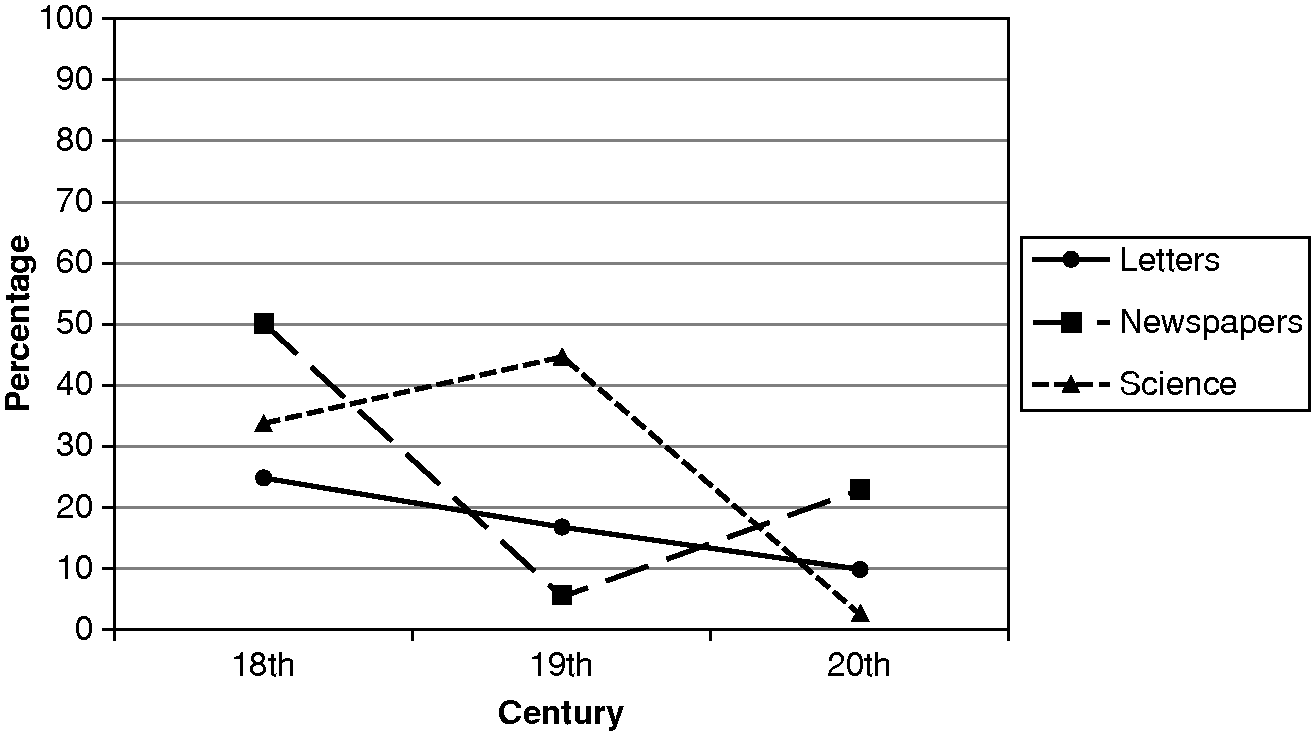
Figure 21.4 Historical change in the proportional use of the s-variant (vs. the premodifying noun variant)
The sample of interchangeable occurrences for the of-genitive versus noun-premodifier alternation is much larger (see Tables 21.2 and 21.3), and correspondingly, the historical trends shown in Figure 21.5 are much more consistent across centuries. For all three registers, there is a strong increase in the proportional use of noun-premodifiers at the expense of of-genitives. Letters and newspaper reportage take the lead in this change during the nineteenth century, while science prose shifted strongly towards increased noun-premodifier variants during the twentieth century (see also Biber and Gray Reference Biber and Gray2011a, 2013; Berlage Reference Berlage2014).

Figure 21.5 Historical change in the proportional use of the premodifying noun variant (vs. the of-variant)
Finally, Figure 21.6 plots the proportional use of variants for those occurrences of genitives that can take all three variants. Similar to Figure 21.4, Figure 21.6 is based on small sample sizes for many data points (see the right columns in Tables 21.1–21.3), but one trend stands out from Figure 21.6: the historical increase in the preference for noun-premodifiers in cases where all three variants are possible. This increase is most pronounced in letters and newspaper reportage, but the same trend occurs to a lesser extent in science prose.

Figure 21.6 Proportional use of s-genitives, of-genitives, and nouns as nominal premodifiers – for noun phrases that can take all three variants
In summary, the variationist findings show that
1 In some registers (letters and newspapers), there has been an increase in the proportional use of s-genitives at the expense of of-genitives.
2 In other registers (science prose), s-genitives have actually decreased proportionally in comparison to of-genitives.
3 There has been a strong increase, across registers, in the proportional use of noun-premodifiers, at the expense of both s-genitives and of-genitives.
21.4 The text-linguistic analysis of genitive constructions
There are actually two different research designs that can be used for text-linguistic analyses of a grammatical feature. The simplest design is to treat each sub-corpus as an observation, computing an overall rate of occurrence for each sub-corpus. For example, Figure 21.7 plots historical change in the rate of occurrence for of-phrases (regardless of syntactic function), based on analysis of COHA (see Davies Reference Davies, Nevalainen and Traugott2012b). In this case, the sub-corpus for each decade is treated as a single observation, and so we computed a single rate for all the combined texts within a decade. The advantages of this approach are that it is efficient, and in the case of corpora like COHA, it permits consideration of very large samples. The major disadvantage of this approach is that it is not possible to compute a statistical measure of dispersion, so it is difficult to determine the extent to which the use of a feature varies across texts within a sub-corpus.

Figure 21.7 Historical change in the rate of occurrence for of-phrases (in COHA)
An alternative research design used for text-linguistic analyses is to treat each individual text as an observation. That is, we can compute a rate of occurrence for the grammatical feature in each text, making it possible to then compute a mean score for all the texts in a category (e.g. a register or a historical period). In this case, it is also possible to compute measures of dispersion, showing the extent of variability among the texts within a category. For example, Figure 21.8 displays box plots for the use of of-genitives in science articles, providing information about the central tendency and the range of variation in each century. (For example, the ‘+’ on Figure 21.8 shows the mean score, and the boxes show the range of the first and third quartiles.) Similarly, Figure 21.9 displays a scatter plot for newspaper texts, showing the year of each individual text correlating with the rate of occurrence for noun premodifiers in that text. Similar to Figure 21.7, these graphs capture historical trends in the use of grammatical features. However, they additionally show the variability among texts within historical periods.

Figure 21.8 Distribution of of-genitives in science articles across centuries
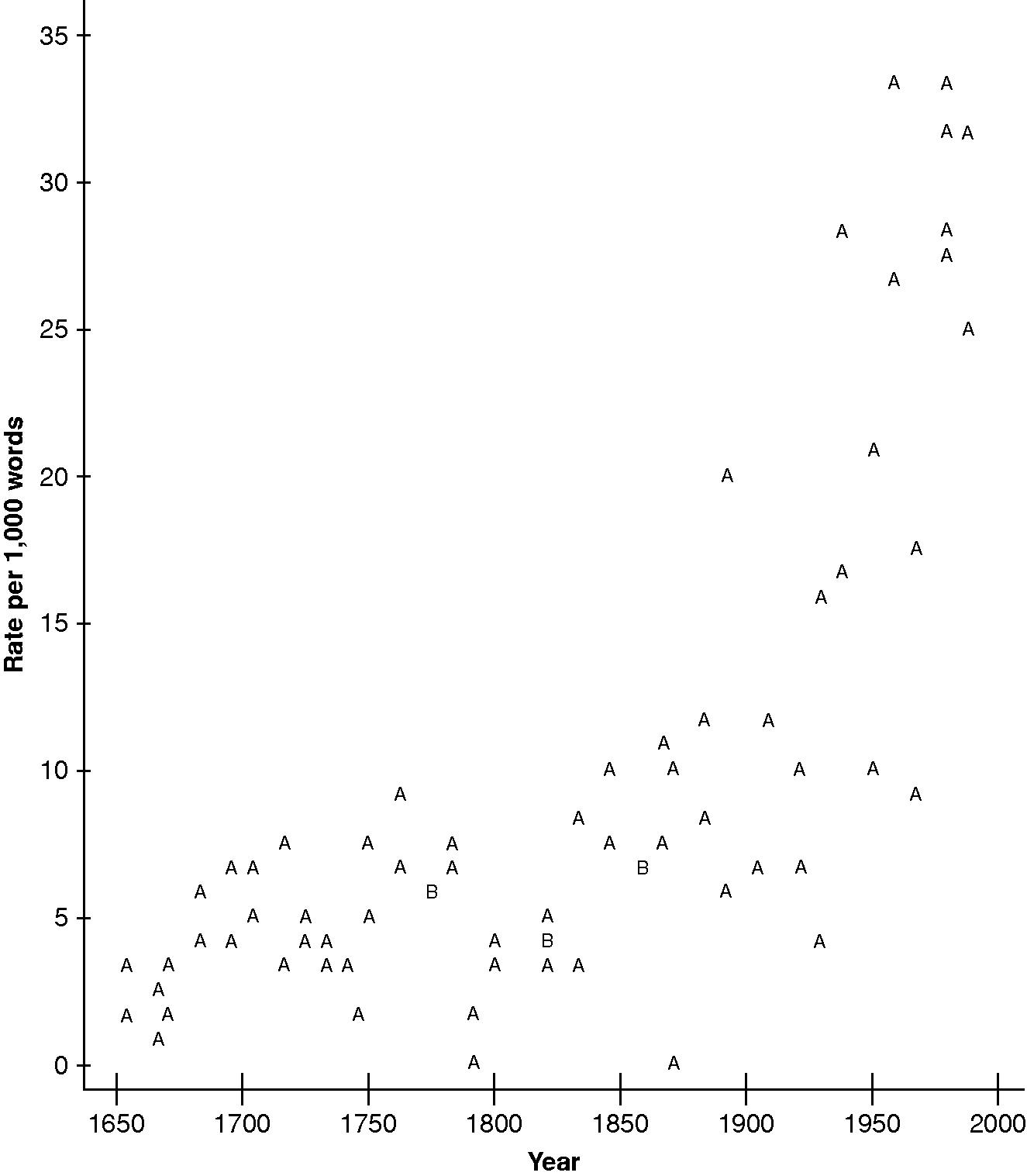
Figure 21.9 Distribution of nouns as premodifiers in newspapers, across years. Legend: A = 1 observation, B = 2 observations
Because they allow measures of dispersion (and also generally include a large number of observations – the texts), text-linguistic designs based on analysis of each text (rather than each sub-corpus) also allow us to compute various statistics that test for significant differences among categories, and measure the strength of relationships. For example, Table 21.4 presents Pearson correlations for the use of the three types of noun phrase modifiers correlated with time (i.e. the year of the text). Pearson correlations measure the strength of the relationship between two numeric variables. Correlation coefficients have a scale of −1 to +1: a value near −1 represents a strong decrease in use over time; a value near +1 represents a strong increase in use over time; and a value near 0.0 indicates that there has not been any consistent pattern of change over time. These correlations measure linear historical trends, regardless of the overall extent to which a feature is used. For example, of-genitives in newspaper reportage have a small correlation of only .12 with year. This correlation tells us that the rate of occurrence for of-genitives in newspaper reportage has changed little over time; but, it does not tell us whether of-genitives have been frequent or rare overall.
Table 21.4 Historical change in the use of general linguistic features, shown by Pearson correlation coefficients (r) for the rate of occurrence correlated with date (1650–1990) Key: .60 to .99 = +++ .30 to .59 = ++ .20 to .29 = +−.20 to −.29 = − −.30 to −.59 = −−
| Letters N = 187 texts | Newspapers N = 70 texts | Science prose N = 70 texts | ||||
|---|---|---|---|---|---|---|
| trend | r | trend | r | trend | r | |
| s-genitives | −.09 | + | .26 | −.10 | ||
| of-genitives | − | −.27 | .12 | +++ | .61 | |
| premodifying nouns | ++ | .41 | +++ | .74 | +++ | .73 |
Table 21.4 shows that there have been important historical changes in the use of these features. S-genitives have increased slightly in newspaper reportage but their use has remained essentially unchanged in the other two registers. Of-genitives have increased strongly in use in science articles, but otherwise have changed little in use in the other registers (and actually declined slightly in personal letters). In contrast, premodifying nouns have increased notably in all registers, and very strongly in newspapers and science articles (see also Biber and Gray Reference Biber and Gray2011a, Reference Biber and Gray2013; Berlage Reference Berlage2014).
Figures 21.10–21.12 summarize these historical developments graphically, and further compare the actual magnitude of use for each of the three features. Figure 21.10 plots the patterns of change in personal letters: very little change in the use of s-genitives; a moderate decline in the use of of-genitives; and a moderate increase in the use of premodifying nouns. Both s-genitives and premodifying nouns are considerably less common than of-genitives in this register. Newspaper reportage (Figure 21.11) shows somewhat different historical patterns: little change in the use of s-genitives, but with a slight increase in the twentieth century; a nineteenth-century increase in the use of of-genitives, followed by a twentieth-century decline; and a strong twentieth-century increase in the use of premodifying nouns. In science articles (Figure 21.12), s-genitives have always been rare, and they have become even less common in the twentieth century. In contrast, of-genitives have always been relatively common; they increased strongly in use during the nineteenth century; and they have decreased only slightly in the twentieth century. However, the most notable historical change in science articles is the strong twentieth-century increase in use for premodifying nouns.
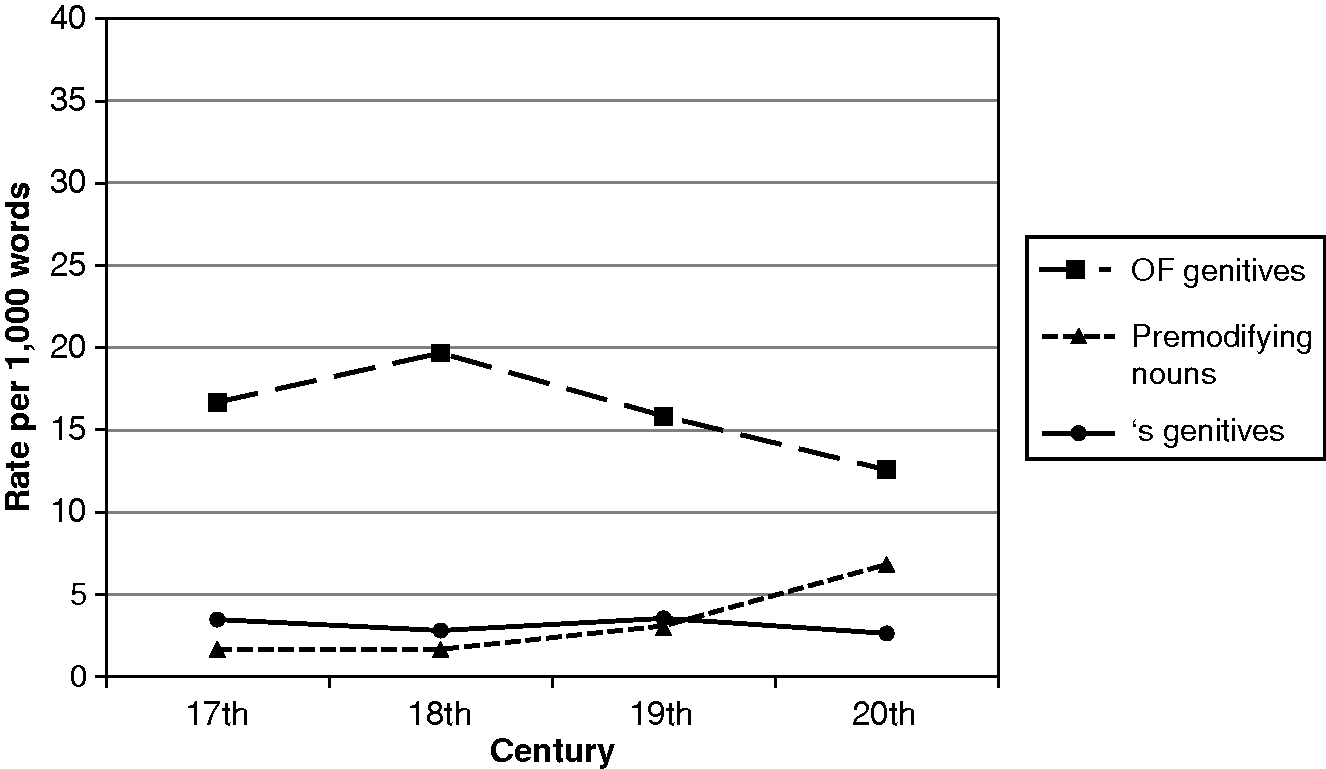
Figure 21.10 Historical change in the use of genitive features in personal letters
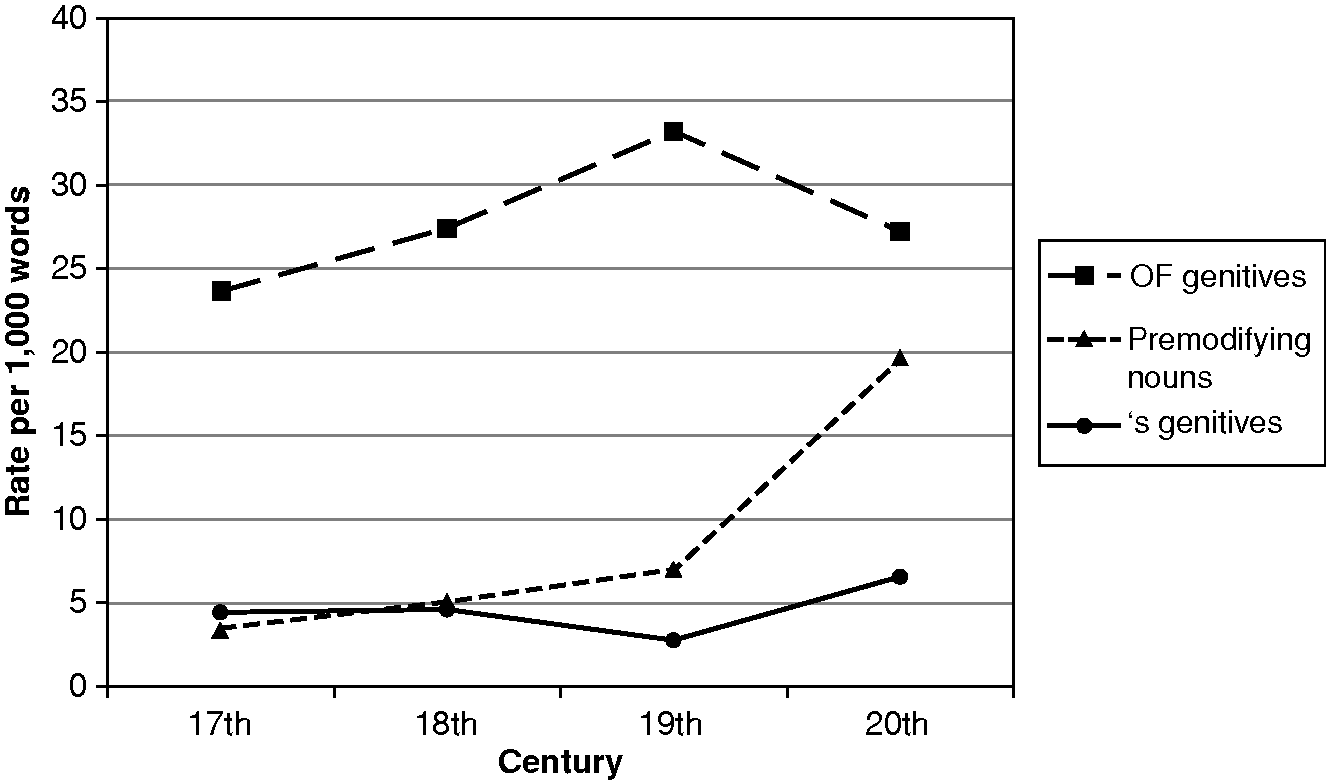
Figure 21.11 Historical change in the use of genitive features in newspaper reportage

Figure 21.12 Historical change in the use of genitive features in science articles
In summary, these findings show several general patterns:Footnote 8
1 There are important differences across registers, in the extent of historical change, the direction of change, and the particular features affected by change. Thus, consideration of only a single register, or analysis of a general corpus with no consideration of register differences, will obscure these more systematic patterns of change within registers.
2 S-genitives are generally rare in Modern English in comparison to these other options for noun modification. (S-genitives have increased slightly in newspaper reportage, but they are still rare in comparison to of-genitives and premodifying nouns.)
3 The of-genitive was especially important in informational prose in the nineteenth century, when it increased in use in both newspaper reportage and science articles. This structure has declined in use in the twentieth century, especially in newspaper reportage.
4 Premodifying nouns are increasing in use in all three written registers. This increase has occurred primarily in the twentieth century, and it has been strongest in the informational written registers (especially science articles).
21.5 Putting it all together
The analyses presented in sections 21.3 and 21.4 have shown how the variationist and text-linguistic approaches yield distinct, yet complementary, descriptions of grammatical change in the use of genitive constructions. At the same time, we hope to have demonstrated the importance of three methodological practices for historical analysis:
1 the need to include the full set of linguistic variants that are potentially relevant in a structural shift;
2 the need to include a range of register variation;
3 the need to consider both variationist and text-linguistic research designs.
As the descriptions in sections 21.3 and 21.4 show, incomplete – and possibly misleading – conclusions would result from more restricted analyses. For example, consideration of only s-genitives versus of-genitives would fail to capture the important shift to the use of premodifying nouns, apparently becoming the preferred choice at the expense of both of the other two options. Consideration of only newspaper reportage would suggest an increase in the use of s-genitives, and a decrease in the use of of-genitives – patterns that are opposite to those found in science articles. And consideration of only variationist or text-linguistic designs, which approach quantitative data in distinct ways, would result in very different conclusions about the magnitude and direction of these historical changes.
In future research, we hope to explore these patterns in much more detail. For example, we plan to use regression analyses to identify the contextual factors that are most influential in predicting these linguistic choices. We also plan to further explore the reasons for non-interchangeability, including consideration of why some variants are more likely to be interchangeable than others.
Our goals here, however, have been more methodological, arguing that the study of grammatical change requires carefully crafted empirical research designs. First, grammar is not (necessarily) a set of binary grammatical alternations, so analysts should consider the full set of variants. Second, when choosing data sources it is crucial to keep in mind that register variation may interact with historical variation, and vice versa. Third, the choice between variationist and text-linguistic research designs has important consequences for subsequent conclusions: the former method explores the factors that influence the linguistic choices that language users make, while the latter approach explores the frequency with which language users use particular linguistic forms in texts. The choice of method also has practical ramifications: variationist designs require potentially laborious coding for interchangeability, while the frequency measurements that underpin the text-linguistic approach are typically more straightforward. Thus, our main goal here has been to lay the foundation for an integrated approach that reconciles the two research designs.
22.1 Introduction
This chapter focuses on how to identify in historical texts when a widely attested change known as ‘subjectification’ has occurred. Subjectification is the development of meanings that are more based in the speaker's perspective than earlier ones. Being a very widespread phenomenon it is important for understanding cognitive and interactional processes in language use. Examples include the use of clearly ‘in a clear manner’ as an evaluative modifier as in They are clearly right, of even ‘smooth’ as a focus marker (cf. Even Mary laughed), and of will ‘intend’ as a future marker (cf. She will arrive shortly). Subjectification is primarily a semantic change, but it often has formal correlates, as will be exemplified below.
A challenge for all historical work is to determine when a ‘change’ as opposed to an ‘innovation’ has taken place. Almost daily speakers/writers produce novel utterancesFootnote 1 and hearers/readers may interpret them in novel ways. Most of these novel utterances are ephemeral and not repeated. A ‘change’, however, requires ‘propagation’ or ‘conventionalization’, in other words, evidence of transmission of the innovation to others and adoption of it by a population of language-users (see Weinreich et al. Reference Weinreich, Labov, Herzog, Lehmann and Malkiel1968; Croft Reference Croft2000). The challenge is particularly great when the change-type under discussion is subject to fairly intense debate, as is subjectification.
The structure of the chapter is as follows. Section 22.2 briefly introduces the two main current approaches to subjectification. It also introduces the construction grammar perspective taken. First steps in identifying subjectification are discussed in section 22.3. Section 22.4 is devoted to brief exemplification from the history of English of how to identify when subjective uses of an item appear in electronic corpora. Discussion of what the examples show about subjectification is provided in section 22.5, and section 22.6 summarizes.
22.2 Approaches to subjectification and to the architecture of language
Extensive accounts of the main approaches to subjectivity and subjectification that have arisen in the last few decades can be found in López-Couso (Reference Lange2010), De Smet and Verstraete (Reference de Fina, Schiffrin and Bamberg2006), Narrog (Reference Narrog2012), and van der Auwera and Nuyts (Reference Auwera and Nuyts2012). Suffice it to say here that most work on subjectification is based on one of two approaches, that of Langacker or that of Traugott. Athanasiadou et al. (Reference Athanasiadou, Canakis and Cornillie2006) and Davidse et al. (Reference Davidse, Vandelanotte and Cuyckens2010) exemplify research within the two approaches respectively.
Langacker's approach is largely, but not exclusively, synchronic and pertains to construal of relationships between figure and ground (e.g. Langacker Reference Langacker1990, Reference Langacker, Blank and Koch1999, Reference Langacker, Athanasiadou, Canakis and Cornillie2006). In Langacker's view, an entity is construed with maximal subjectivity when it is implicit, as is the speaker in It's going to rain. This is a ‘raising’ construction, in which there is no controlling agent. Historically, in the case of BE going to ‘future’, the controlling agent of motion with a purpose BE going to as in I am going to visit my sister has been attenuated, and the situation represented in the clause is construed subjectively. For Langacker, objectivity and subjectivity have to do with how explicitly the speaker is profiled in the form of the utterance: the less overtly the speaker is profiled, the more subjective the expression.
By contrast, Traugott's approach is largely historical, and pertains to the development of expressions that index speaker attitude or viewpoint, among them modals like must and metatextual markers like although and in fact (see, e.g., Traugott Reference Traugott, Lehmann and Malkiel1982,Footnote 2 Reference Traugott1989, Reference Traugott, Stein and Wright1995a, Traugott and Dasher Reference Traugott and Dasher2002). For Traugott, objectivity and subjectivity have to do with the extent to which the expression is based in the speaker's perspective (the stronger the speaker's perspective the more subjective the expression).
The two approaches overlap. Both Langacker and Traugott see subjectivity as a less-or-more, i.e. scalar, phenomenon. Both regard the development of raising uses of auxiliary verbs as prototypical examples of subjectification. But there are significant differences. Most notably Traugott pays attention not only to change but also to pragmatic context, and covers a wider range of linguistic phenomena, including the gradience between subjectivity (speaker-orientation) and intersubjectivity (addressee-orientation).
While subjectification can be studied within any model of a language, provided it embraces pragmatics such as implicatures and pragmatic markers such as anyway, in fact, a particularly helpful usage-based approach is that of construction grammar (see Chapter 4 by Trousdale in this volume). A construction grammar perspective on the architecture of language is adopted here, such as has been developed by Goldberg (Reference Goldberg1995, Reference Goldberg2006) and Croft (Reference Croft2001) for synchronic linguistics and by Fried (Reference Fried2010), Traugott and Trousdale (Reference Traugott and Trousdale2013) for language change, and by Brems (Reference Brems2011) and Margerie (Reference Margerie2011) for subjectification.
A few key points may be mentioned:
(a) Construction grammar is a theory of signs; among basic tenets are that linguistic units are form–meaning pairings that may be of any size from affix to complex clausal structure.
(b) All models use some set of features, minimally for form: syntax, morphology, phonology, and for meaning: pragmatics, semantics, and discourse function (Croft Reference Croft2001). Because construction grammar is non-modular, no one set of features such as syntax is core.
(c) Constructions are conceptualized in terms not only of specific structures but also of sets and abstract schemas.
(d) From this perspective subjectification must be seen not only as codification or semanticization of pragmatics (meaning change), but also as potentially linked to change in form, for example, change in syntactic category and hence in distribution. This will be illustrated in sections 22.4.1 and 22.4.2.
22.3 First steps
As in any historical work, evidence is derived not from data alone, but from data that is theoretically and methodologically evaluated. Therefore the first step is to develop a firm grasp of the theoretical issues, and have a good synchronic analysis of the phenomenon being investigated.
With regard to the theoretical model of subjectification adopted here, a basic assumption is that knowledge of language among a population of language-users is flexible, but nevertheless there is a norm in that population (see Auer and Pfänder Reference Auer, Pfänder, Auer and Pfänder2011). Given this assumption, certain distinctions are crucial for the study of subjectification:
(a) between subjectivity (a relatively time-stable concept) and subjectification (a change concept);
(b) between ‘default subjectivity’ (one largely talks/writes about what one is interested in, wants to get done, etc.) and expressions that are conventionally subjective in at least some of their uses (e.g. epistemic pragmatic markers like no doubt in She has left again, no doubt);
(c) between linguistic contextual effects and inherent subjective semantics. For example, Narrog (Reference Narrog2012: 15) cites Lyons's (Reference Lyons1995: 329–31) discussion of epistemic modal may. While many researchers on modality assume may is always used subjectively, She may not go can mean simply and truth-conditionally ‘It is possible that she will not go’, with minimal subjectivity, but depending on linguistic or situational context, prosodic modulation, etc., it can also be meant and understood as the subjective statement ‘I-think-it-possible that she will not go’. In Lyons's model, although there is often discussion of ‘objective’ or ‘literal’ versus ‘subjective’ or ‘figurative’ meaning, in fact the optimal distinction is between ‘coded’ and ‘contextual’ meaning; a closely related pair of terms is ‘semanticized’ and ‘modulated’.
In contemporary work it is often hoped that linguistic phenomena can be operationalized. In the case of subjectivity, the aim is to identify formal correlates. It has been suggested that subjectified elements show several properties (Ghesquière et al. Reference Ghesquière, Brems, Van de Velde, Brems, Ghesquière and Van de Velde2012: 137). Of these, five in particular are often cited – subjectified elements are said to:
(a) be typically non-truth-conditional,
(b) not to allow pronominal substitution,
(c) not to occur under the scope of negation or WH-interrogation,
(d) to resist focusability,
(e) to resist agent-control.
As will become clearer below, not all of these properties except (a) pertain to all examples. In fact, they apply mainly to subjectified forms that are used as pragmatic markers, and not always even to them.
With regard to the model of subjectification adopted here, Traugott (Reference Traugott, Davidse, Vandelanotte and Cuyckens2010b: 35) characterizes it as a mechanism whereby ‘meanings are recruited by the speaker to encode and regulate attitudes and beliefs’. As a mechanism of change it is enabled by implicatures or ‘invited inferences’ associated with speaker-orientation in the speech situation.Footnote 3 This means it is a type of metonymy, the outcome of which is a new and more subjective coded (semanticized, ‘inherent’) meaning, which typically results in polysemy. The approach is ‘semasiological’, in other words, it starts with a form–meaning pairing and traces the meaning developments over time (Geeraerts Reference Geeraerts1997).
With respect to analysis of the synchronic uses of the item under discussion, the assumption is that variation at some arbitrary point in time is the output of successive changes. Therefore, if one wishes to investigate the development of expressions that currently have subjective uses, e.g. the auxiliary may, the quantifier a lot/bit of, or pragmatic markers like say, I think, the researcher needs to know what polysemies, if any, they have in PDE, and to have a detailed analysis of auxiliaries, quantifiers, and pragmatic markers in general. The task will be to analyse the development of the particular expressions over time. Current polysemies will reflect earlier uses, but whether the earliest uses have persisted or not is a matter of their individual histories. As in all historical work it must be remembered that historical records are not only spotty, but prior to printing they reflect usage and genres that are for the most part far different from those typical today. The ‘earliest’ example is only the earliest in the records we have investigated.
It is probably impossible to operationalize subjectification in general since it is evidenced in so many domains of language change. What can be done, however, is to develop a set of heuristics to be aware of in studying it, as I attempt to do in section 22.4 through analysis of some examples. By way of reminder, two fundamental points are that:
(a) subjectivity is coded speaker-orientation, while subjectification is the historical development of coded subjectivity,
(b) like subjectivity, subjectification is a gradient less-to-more phenomenon that typically develops gradually over time in minimal steps (Torres Cacoullos and Schwenter Reference Torres Cacoullos and Schwenter2007).
22.4 Three brief case studies
In this section I present three brief case studies to illustrate some of the problems in identifying when subjectification has occurred.
22.4.1 The gradual development of BE going to ‘future’
The history of BE going to has been investigated many times (see Pérez Reference Pérez1990; Danchev and Kytö Reference Danchev, Kytö and Kastovsky1994; Garrett Reference Garrett, Jonas, Whitman and Garrett2012, among others). It has become one of the prototype examples of grammaticalization in general and auxiliation in particular (e.g. Kuteva Reference Kuteva2001), as well as of semantic reanalysis (Eckardt Reference Eckardt2006). The reason for using it is that it helps exemplify steps that can be taken as a researcher seeks to find empirical evidence for subjectification in texts, with results that differ somewhat from those of earlier researchers.
We know that in standard British and American English BE going to V can express motion with a purpose. In this case a directional PP can occur before to V, as in She is going to Austin to give a lecture. We also know that there is a ‘future’ BE going to that in spoken usage can be reduced to BE gonna (and more reduced variants) as in She's gonna give a lecture in Austin. Still to be studied is the extent, if any, to which contemporary speakers perceive these as related polysemies or as unrelated homonyms, the quantitative differences between the two uses, and the frequency with which motion BE going to V is ambiguous in writing. The ‘future’ BE going to has been described as ‘agent-oriented’ or ‘arranged’ (controlled by the subject and intentional), ‘scheduled’ or ‘immediate’ (equivalent to ‘be about to’), and predictive (an assertion about future time) (Bybee et al. Reference Bybee, Pagliuca, Perkins, Traugott and Heine1991; Garrett Reference Garrett, Jonas, Whitman and Garrett2012; Nesselhauf Reference Nesselhauf2012). Prediction future is subjective and based in speaker's epistemic state of certainty. Quantitative studies have shown that BE going to is in variation with will, which remains robust and more frequent in both British and American English, despite the rapid increase of BE going to in spoken American English during the twentieth century (Leech et al. Reference Leech, Hundt, Mair and Smith2009). Torres Cacoullos and Walker (Reference Torres Cacoullos and Walker2009) have shown that in Canadian English choice of BE going to or will depends on a number of factors, for example, BE going to is favoured over will in second-person declaratives, in interrogatives (Oh, you're going to go into your Ph.D. too? [p. 343]), in first and second-person negatives, and in complements of predicates like know that express speaker view-point (So I don't know what's going to happen here [p. 343]). These studies suggest that a detailed investigation of the development of subjectification of BE going to should be sensitive to different uses of the ‘future’, and also of possible restriction to morphosyntactic and pragmatic niches.
As is well known, in the late fifteenth century a few examples appear that, at least with hindsight, allow a temporal interpretation. The first known to me is:
(1)
ther passed a theef byfore alexandre that was goyng to there passed a thief before Alexander who was going to be hanged whiche saide… be hanged who said… ‘a thief who was going to be hanged passed before Alexander and said’ (1477 Mubashshir ibn Fatik, Abu al-Wafa', 11th C; Dictes or sayengis of the philosophhres [LION: EEBO; Traugott and Trousdale Reference Traugott and Trousdale2013: 218])
Since the immediate linguistic context is passed, a motion expression, (1) is probably at best an example of a motion BE going to V that contextually renders salient the inference of later time associated with the purposive to V because the syntax is passive and therefore the thief is understood not to control the action (he is being taken somewhere for a purpose). The first examples of BE going to V that can be interpreted as unambiguously temporal appear only at the beginning of the seventeenth century, e.g.:
(2) So, for want of a Cord, hee tooke his owne garters off; and as he was going to make a nooze, I watch'd my time and ranne away.
‘So for lack of a cord, he took his own garters off; and as he was going to make a noose, I took the opportunity and ran away’. (1611 Tourneur, The Atheist's Tragedie [LION: EEBO; Garrett Reference Garrett, Jonas, Whitman and Garrett2012: 69])
Here, the man did not have to go anywhere to make a noose out of his garters; rather, the narrator sees that the man is about to make a noose. What kind of a future is this? Not prediction based in the speaker, but one that can be understood as an intentional future that is grounded in the subject (the man with the garters wanted to make a noose), and immediate (he was about to do so right away). Garrett (Reference Garrett, Jonas, Whitman and Garrett2012) argues that initially BE going to meant ‘be about to’. This is an example of ‘relative’ future tense (making a noose occurs later than taking the garters off). It is somewhat objective since it concerns sequence in time, in contrast to ‘deictic’ predictive future tense, which is grounded in speaker's utterance time.
Out of context, seventeenth century examples of BE going to may appear to be temporal, but when the larger linguistic context is considered, it often turns out that there is ambiguity with the motion expression, or the motion expression is preferred. For example, if only saith he, I am going to see Titus were cited, (3) below would appear to exemplify future BE going to (‘I will visit Titus’). If only saith he, I am going to see Titus, goe along with me were cited, the example could be ambiguous between future and motion with a purpose, i.e. between ‘I am about to visit T’ and ‘I am on my way to visit T’). But given prior context, desire to go along with him to see Titus, motion was probably intended.
(3)
Att. Gen. Did you not meet with William Drake, and desire to go along with him to see Titus? Iaquel. I did so, but I think Drake desired it. I met him in Newgate market, and, saith he, I am going to see Titus, goe along with me. (1652 Trial of Mr. Love [CED 2, D3TLOVE])
The earliest examples are, like (2) third person and past tense. First-person present tense uses appear a bit later, as in (3) and in a passage from the Bible: Esau said, Loe I am going to dye: and wherefore serveth this first-birthright unto me? which is annotated as follows:
(4) going to die] that is, ready or in danger to die. (1639 Ainsworth, Annotations upon the five books of Moses [Traugott and Trousdale Reference Traugott and Trousdale2013: 221])Footnote 4
Here the paraphrase is ‘about to’, i.e. relative tense, not shall or will (prediction futures), showing that first person does not require a prediction interpretation. The change from motion with intention to a statement about an immanent later event may imply that the speaker is certain that it will occur, hence enabling the development of subjective prediction. We cannot, however, be sure that prediction is intended until examples appear with inanimate subjects, and most especially raising syntax. Garrett cites two examples with inanimate subjects in the seventeenth century. These two examples seem to be the only ones in the standard corpora representing the period. Two examples are not enough to suggest conventionalization. At the beginning of the eighteenth century we begin to find several more examples, and also raising:
(5) I am afraid there is going to be such a calm among us, that… (1725 Odingsells, The Bath Unmask'd [LION: English Prose Drama; Traugott and Trousdale Reference Traugott and Trousdale2013: 117])
We can hypothesize that BE going to has by this time become a fully-fledged auxiliary with syntax similar to that of older will and other auxiliaries, which appear in raising constructions as early as the sixteenth century. More importantly for present purposes, raising is associated with the subjectified, prediction meaning of ‘future’. Subjectification has therefore developed gradually out of non-subjective uses, via a series of steps that confirm hypotheses that micro-change occurs in steps that are tiny and maximally unobtrusive both semantically and morphosyntactically (Bybee et al. Reference Bybee, Perkins and Pagliuca1994), a phenomenon that De Smet (Reference De Smet2012: 608) refers to as ‘the apparent sneakiness of change’. When these changes occur, older uses coexist with newer ones, leading to polysemies that overlap and are potentially ambiguous. Subsequent spread of prediction uses, such as Nesselhauf (Reference Nesselhauf2012: 99) traces over the period 1750–1999, shows generalization and expansion of the subjective polysemy. It is not a case of further subjectification because there is no new coded meaning.
With respect to the five properties said to be useful for operationalizing subjectivity, only (a) subjectified elements are ‘typically non-truth-conditional’, and (d) ‘resist focusability’, apply to BE going to used as prediction future. It can occur under the scope of negation and WH-interrogation (counter-exemplifying property (c)).
22.4.2 The subjectification of beside and besides
While the development of BE going to is familiar, that of beside and besides is less so, although Rissanen (Reference Rissanen, Lindquist and Mair2004) discusses parts of it in some detail with respect to grammaticalization. In PDE beside is used mainly as a preposition with either concrete spatial meaning (beside the shed) or more abstract meaning (beside the point). Besides is used as a preposition in the sense of ‘except, other than’ (no one besides us), but is mainly used as an adverb meaning ‘in addition’ (and many other foods besides) or as a pragmatic marker conveying that the upcoming clause adds additional information that is a justification for what has been said before, but presented as incidental (I don't have time to go to the movie. Besides, I hear it's bad). While the first use of the adverb is slightly subjective (the added item is treated textually as an add-on rather than an integral part of the set), the pragmatic marker is highly subjective at the level of discourse combining. This draws attention to a distinction made in the literature between types of textual relationships: local connectivity and discourse connectivity. The former combines linguistic material at the content level, sometimes with additional pragmatic implicatures, while the latter is metatextual, combining and commenting on discourse relationships. The researcher seeking to analyse subjectification on the history of beside and besides needs therefore to be sensitive to the distinction between them.
As is often the case with English adverbs and prepositions, the origin of beside(s) is to be found in a prepositional phrase. The noun side was used in OE mainly with the meaning ‘side of human or animal body’. It occurs with a variety of prepositions, and conventionalization of the fused forms beside(n) and besides does not occur until ME. At this period their syntactic function is underspecified and they both serve as adverb and preposition. Using the Helsinki Corpus and MED Rissanen (2004: 161) cites extension of side during the ME period from reference to concrete spaces (body, wall) to more abstract ones (dispute), and of beside(n)/besides from spatial relation (beside paradise, besides Scotland) to abstract relations such as ‘in addition to’ (beside reason and experience). He also notes the development from ‘proximate space’ to ‘distal space’ (‘aside, outside’), as in:
(6)
Arthur teh bi-side; and said to his iveres ‘Arthur turned aside; and said to his companions’ (c1300 Layamon's Brut, Otho C.13, line 12982)
Rissanen hypothesizes that this extension of meaning is ‘related to subjectification and to the changing point of view’. He goes on to say that ‘as long as the point of view is an outsider's or neutral’ side most naturally refers to something in the immediate vicinity, but ‘when the relation is defined from the point of view of this referent, distancing, movement away becomes a natural extension of the meaning’ (p. 162). While there is a change in point of view, it is not a change in subjectivity, however. The point of view is not grounded in the speaker, and distance is not ‘more subjective’ than closeness, therefore the extension of meaning is not related to subjectification.
Subjectification is, however, evidenced from the mid-sixteenth to the eighteenth centuries, when a few examples appear of beside(s) being used as a connective, usually with that as in:
(7) he need not have been under much Apprehension of meeting any greater [Rogues] than himself, either in Person or Impiety. For besides that he had the Reputation of being a long Practitioner in such Deeds of Darkness, a Record was produc'd in Court of his having been Convicted at Hereford Assizes. (1707 Trial of Joseph Still t17170227-13 [OBP])
This is a case of use of the preposition as a local, clause-combining connective; it is more subjective than use as preposition in a PP because it signals the speaker's conceptualization of the relationship between clauses, in this case additional relevance. Rissanen calls the connective a subordinator, but it appears to function more like a coordinating clause linker (‘in addition to the fact that’). EModE was a time when the current distinction between coordinators and subordinators was still being worked out, at least in writing (Lenker Reference Lenker2010), so this is not surprising. Rissanen points out that there are only four examples in the HC, but as they are spread over two centuries, and examples appear in OBP as well as HC, the connective use must have been conventionalized. This particular use was not long-lived, however.
Out of context besides that is ambiguous: that could be, as in (7), a complementizer (see, e.g., complement, relative, and factive clause that) or an anaphoric pronoun. In identifying examples of the connective use, one needs to identify a finite verb that is plausibly in the same clause as besides (that), as is had in (7). This requires having adequate linguistic context. For example, (8) does not exemplify the connective but the preposition besides ‘except’:
(8) a person that was there alledged, that the now, Prisoner struck the fatal Blow; but besides that there was no former Malice, so 'twas a most unlikely thing, that he should go to hurt one that was his Friend. (1680, Trial of a Waterman t16800526-2 [OBP])
Here that can be understood as anaphoric to struck the fatal blow, and besides that there was no former Malice is best paraphrased as a ‘apart from that, there was…’.
In the later ModE period we find increasing evidence of divergence in form between beside as a preposition and besides as an adverb, and co-option of the adverbial to the pragmatic marker use ‘moreover’ (a discourse linker):
(9) O fie, Mrs. Jervis, said I, how could you serve me so? Besides, it looks too free both in me, and to him. (1740 Richardson, Pamela [CLMETEV])
Besides here serves the metatextual function of signalling not only addition but also a slightly dismissive, offhand stance on the speaker's part.
With respect to the five proposed properties of subjectified items, in the case of pragmatic marker besides, (d) ‘to resist agent-control’ is not relevant. But (a) ‘typically non-truth-conditional’, (b) does ‘not allow pronominal substitution’ (in this case by there), (c) does not ‘occur under the scope of negation or WH-interrogative’, and (d) ‘resist[s] focusability’ are all relevant.
22.4.3 The subjectification of churl
The third example discussed here is lexical. De Smet and Verstraete (Reference De Smet and Verstraete2006), among others, have questioned how useful it is for Traugott (Reference Traugott1989) and Traugott and Dasher (Reference Traugott and Dasher2002) to lump lexical examples such as changes to boor and villain along with grammatical ones in discussion of subjectivity and subjectification. One obvious difference De Smet and Verstraete cite is that lexical changes do not normally entail changes in morphosyntactic category. Since, in Traugott's view, subjectification is a change independent of grammaticalization, this point is moot. Another criticism that has been suggested is that lexical examples such as boor, villain may originate in subjective perspectives, but over time may come to be used with socially widely accepted meanings; the conventionalizing of social evaluation could be interpreted as objectification. This criticism confuses the type of semantic change leading to a new meaning from use and reinterpretation of the output of the change. As we have seen, change requires conventionalization, i.e. sharing of meanings. In the case of boor, for example, although the term is evaluative, expresses point of view, and is non-truth-conditional, it is tied to a referential set of persons. Such conventionalization of subjective meaning can come to have collective validity, but a speaker's choice of using it is subjective. Therefore, pejoration (and some types of amelioration) of lexical meanings can be seen to arise via subjectification and to be used subjectively. A more valid criticism might be that the enabling factors for subjectification in these cases are social and external, while for the most part they are internal and linguistic in cases where grammaticalization is involved. However, the distinction between external and internal is hard to maintain in all instances. Furthermore, many linguistic expressions are hybrids between lexical and grammatical expression (e.g. give someone a roasting, which is partly lexical and means ‘give someone a facetious tribute’, partly grammatical, as evidenced by the durative aspect conveyed by -ing and the ditransitive syntactic structure, Trousdale Reference Trousdale, Trousdale and Gisborne2008a). Therefore the external–internal distinction is not made here. Whether and where to draw the line between lexical and more grammatical is largely a question of the theoretical model used.
In PDE churl is used as a term of contempt to characterize someone as a rude, boorish person. In OE, however, it had no evaluative meaning. It referred to ‘man, husband’ and was positively evaluated: in Beowulf there is repeated reference to snotere ceorlas ‘wise men’. In legal writings it is used to refer to a person of the rank of ‘free man’ of the lowest class. After the Norman Conquest, with the reorganization of social roles brought about by feudalism, a churl came to be a serf or bondman. Speakers, presumably of higher rank, began to use churl metonymically for what they considered to be unrefined behavioural characteristics of members of this rank. The MED and OED both cite examples from the beginning of the fourteenth century that suggest a path of transition, e.g.:
(10)
Wiltu ben erl? Go hom swiþe, fule drit, cherl! Want.thou be earl? Go home fast, foul turd, churl! ‘Do you want to be an earl? Get gone fast, foul turd, churl!’ (c1300 Havelok 682 [MED cherl 2, OED churl 5])
Without knowledge of the rank of the person addressed, a researcher might assume that cherl in (10) is ambiguous between reference to the person's rank, and a pejorative use of the term, given the collocation with fule drit. The prior context shows that in fact the addressee is a bondsman who has been hired to murder Havelock and has demanded to be made a free man as a reward for the deed (which he did not actually perform). Therefore cherl here refers to rank. But because cherl is used as an address term, and because of the rhetorical purpose, the speaker's pragmatic evaluation of the addressee seems to extend to the rank term itself. Later examples use pejorative modifiers, e.g.:
(11) Metillius, the foule cherl, the swyn.
‘Metelius, the foul churl, the swine.’
(c1386 Chaucer, Wife of Bath's Prol. 460 [OED churl 5])
This is a far distance from snotere ceorlas in Beowulf. Key to recognizing the new meaning are the collocates foul and swine, and lack of any linguistic context suggesting rank.
With respect to the five operationalizable properties, only a) has ‘typically non-truth-conditional meaning’ applies. As a nominal it may be pronominalized, occur under the scope of negation and WH-interrogative, be focused, and is favoured in agent-control constructions.
22.5 Discussion
There appears to be no significant difference between lexical and grammatical developments in regard to subjectification. All three cases show that subjectification occurred step-wise in a sequence of micro-changes and that not all of the five alleged criteria mentioned in section 22.3 apply. But there are individual differences. In the case of BE going to, subjectification to deictic prediction is followed by dramatic increase in frequency, while in the case of beside(s) subjectification to connective and further to pragmatic marker status is not. While in the case of BE going to and beside(s) the original uses persist, in the case of churl the original meaning ‘man’ was lost entirely, and the rank term is now used only with reference to social history. This is typical of change, each item is case-specific and has its own history (see Waltereit and Detges Reference Waltereit and Detges2007), constrained by larger systemic changes (see Fischer Reference Fischer2007), whether sociocultural as in the case of churl, or linguistic, as in the case of the other two examples.
De Smet and Verstraete (Reference De Smet and Verstraete2006) have suggested that a distinction should be made between what they call ‘ideational’ subjectivity (subjectivity pertaining to items that represent situations, e.g. use of prediction BE going to, change in use of churl) and ‘interpersonal subjectivity’.Footnote 5 The term ‘interpersonal subjectivity’ is designed to account for the fact that when using connective and pragmatic markers speakers position themselves with respect not only to the ‘ideational’ (conceptual, largely propositional) representation but also to interaction with the interlocutor. The latter is typically correlated with textual and metatextual expressions such as connectives and pragmatic markers. As De Smet and Verstraete say (Reference De Smet and Verstraete2006: 388) the distinction between ‘ideational’ and ‘interpersonal’ is synchronic. It is relevant for judging the appropriateness of some of the criteria for subjectivity that have been proposed, but from a historical perspective it has more to do with the category status of the output than with subjectification as a type of semantic change, and is therefore too restrictive to be criterial in recognizing subjectification. From a historical perspective we can ask whether the histories of BE going to, beside(s), and churl illustrate the development of the two kinds of subjectivity. It appears that BE going to does illustrate ideational subjectification, since, as a future, it encodes the speaker's perspective on the situation described. So does churl, but in a more extreme way. However, in the case of connective or pragmatic marker uses of besides, hearer-orientation appears to be inferred rather than coded,Footnote 6 and the term ‘textual subjectification’ would be more accurate than ‘interpersonal subjectification’. Textually subjectified items may be used to negotiate interpersonal pragmatic meanings, but they are often not coded as interpersonal (‘intersubjective’). How to tease apart subjectification and intersubjectification, the development of coded hearer-oriented, interpersonal meaning is currently a very active research topic. There is not space here to explore this issue, but suggestions can be found in Davidse et al. (Reference Davidse, Vandelanotte and Cuyckens2010) and especially Brems et al. (Reference Brems, Ghesquière and van de Velde2012).
Further, there has been space only to hint at the extent to which subjectification may be enabled by the sets or schemas into which a changing item is recruited, in the case of BE going to, other auxiliaries, especially those expressing future, in the case of beside(s) other clause connectives and pragmatic markers, and in that of churl other evaluative terms for persons. From a constructional perspective, matching to prototypical members of a set and ‘analogical pull’ would be of central interest. We may note that since scalar domains by definition involve alternatives and these alternatives are usually assessed by the speaker, subjectification is likely to occur as items are recruited into scalar domains such as:
adverbial connectors, e.g. although, however
stance and pragmatic markers, e.g. I guess, see, complete, total
evaluation of character, e.g. boor, villain
But not all domains to which a subjectified item is recruited are scalar. The performative use of a speech act or other verb as in I promise to X is an instance of subjectification (Traugott and Dasher Reference Traugott and Dasher2002) in the sense discussed here. However performativity is not scalar since it does not necessarily locate its complement on a scale of alternatives (some performative acts may be more successful than others, and some performative acts may be more socially binding than others, but this is not a linguistic characteristic of performatives).
22.6 Summary
Some guidelines have been suggested for doing research on subjectification. To summarize, before analysis can start:
(a) A theory of subjectivity is needed. Whatever the theory adopted, there is a crucial difference between point of view grounded in the linguistic subject and that grounded in the speaker, as Benveniste (Reference Benveniste and Meek1971 [1958]), one of the founding theorists of subjectivity, observed, even though this difference may sometimes be underdetermined in particular utterances. Only grounding in the speaker involves ‘subjectivity’. Another crucial difference is between default and coded subjectivity at some idealized point in time.
(b) Most importantly, a theory of subjectification as a change-type is needed. A fundamental distinction is between subjectification, the rise of a new coded meaning based in the speaker's perspective, and changes in the frequency with which implied subjectivity is used.
From the perspective outlined in this chapter, a number of factors need to be taken into account when doing any analysis:
(a) Subjectivity is a gradient less-or-more phenomenon; so is subjectification. Therefore an analysis must be sensitive to micro-differences both synchronically and over time.
(b) Because subjectification is highly dependent on linguistic context and interlocutors’ objectives, all putative examples of subjectification must be evaluated in extended textual contexts.
(c) Because most subjectivized items are polysemous and polyfunctional, a paraphrase must be found that will distinguish the subjectivized from the less subjectivized meaning.
23.1 Introduction
This chapter examines some of the potential and challenges in using the Oxford English Dictionary (OED) and other historical dictionaries as research tools, especially in conjunction with the Historical Thesaurus of the Oxford English Dictionary (HTOED) as research tools. It focuses on an extended case study (expanding on material investigated from a more descriptive perspective in Durkin Reference Durkin2014), examining how these tools can be used in conjunction with other resources to investigate the impact of lexical borrowing on the core vocabulary of English from a diachronic perspective. As such, it examines how dictionary etymologies, dictionary dating of first and later attestations, dictionary definitions and sense distinctions, and the semantic structure of the HTOED can be employed in attempting to answer questions about the history and development of the English lexicon. It also seeks to illustrate in close detail some of the difficulties that arise in any practical attempt at semantic and/or etymological classification of lexical items, and which must be wrestled with as part of the preliminary work in any detailed research on historical change in the lexicon.
23.2 The research question to be investigated
It is well established that the English lexicon has been affected to a considerable extent by lexical borrowing, and more specifically by borrowing of loanwords from other languages (as distinct from loan translations or other types of semantic loans). It is also commonly observed that loanwords have had some impact even on the most basic levels of the vocabulary of modern English, but that the impact is much greater in many other lexical strata, for instance in the specialist vocabularies of science and learning, or in more formal stylistic registers, especially as a result of borrowing from Latin and French in the Middle English (especially later Middle English) and Early Modern periods.Footnote 1 However, providing empirical support for such observations is difficult.Footnote 2
Recent research based on analysis of the words that realize basic meanings in a wide range of modern languages across the world has lent some empirical support to the observation that modern English is unusual (if hardly unique) in the degree to which even its basic lexicon incorporates loanwords: see especially Haspelmath and Tadmor (Reference Haspelmath and Tadmor2009) and other publications associated with the Loanword Typology Project and its World Loanword Database (WOLD). The WOLD database takes as its basis an extended version of the meaning list of the Intercontinental Dictionary Series, giving a large list of 1,460 meanings across a range of core vocabulary areas, designed to be relatively ‘neutral’ as to geographical location, although some items such as ‘elephant’, ‘camel’, ‘lion’, ‘panther’, or ‘kangaroo’ are more relevant to some geographical locations than to others, and the list includes a very few modern cultural innovations meanings such as ‘bank’, ‘film/movie’, or ‘driver's license’ which show distinctive patterns of cultural influence across most of the languages surveyed. Grant (Reference Grant, Haspelmath and Tadmor2009) examines briefly the incidence of loanwords as the usual word realizing each of these meanings in contemporary English, and also in the 100-meaning ‘Leipzig–Jakarta list of basic vocabulary’ that was derived from this research project (i.e., the 100 meanings found generally most resistant to borrowing).
The research described in this chapter attempts to extend such research into a diachronic dimension: taking WOLD's meaning lists as a starting point, how far can the OED (and other historical dictionaries) and the HTOED take us in investigating when words that now realize basic meanings first entered English and also (a much more difficult question) when they began to be the usual word realizing this meaning?
This question is approached from a largely descriptive standpoint in Durkin (Reference Durkin2014: 400–23): that is to say, the research methodology is there set out briefly, but the main focus is on the results, i.e. what the investigation reveals about the impact of loanwords on different areas of the core lexicon. This chapter will adopt a different focus: the research will be summarized very briefly, with a focus particularly on those areas that present difficulties of method, data, or interpretation; after this, the second half of the chapter will focus on one particular question, namely the interface between the summary data in the HTOED and data in the OED, especially with reference to the OED as a dynamically changing resource in response both to new data and reappraisal of existing data. This rather unconventional method of presentation, summarizing the broad outlines of the research first before looking in more detail at methodological issues, is adopted here in order to place some of the larger and smaller differences between versions of the HTOED and OED data in an appropriate context of their degree of relevance for research on diachronic change in the lexicon.
23.3 The research briefly summarized
Durkin (Reference Durkin2014: 400–23) looks at penetration of loanwords both in the 100-meaning ‘Leipzig-Jakarta list of basic vocabulary’ and in two components of the much larger 1,460-meaning list from which this was derived, meanings related to the senses, and meanings related to the physical world. The basic methodology is:
1 To match meanings from the WOLD lists to locations in the structure of the HTOED.
2 To identify all of the lexical items populating the relevant category in the HTOED, and identify those items which are loanwords, using etymological information from the OED.
3 To investigate the date of first attestation and other aspects of the history of each loanword using the OED and other historical dictionaries, paying attention to such questions as ‘Was the relevant meaning borrowed, or has it been innovated within English?’, ‘How common has use in this meaning ever been in English?’, ‘Is use in this meaning restricted to certain genres, text types, or registers?’
4 To assess whether a loanword has become the usual word realizing the relevant meaning in contemporary English, and if so, whether we can establish very broadly when it became the usual referent in this meaning.
To summarize the results of this exercise very briefly before looking more closely at some of the issues involved, looking in detail at the 100-meaning ‘Leipzig–Jakarta list of basic vocabulary’ in this way suggests that, while only twenty-two of these meanings appear never to have been realized by a loanword in the data of the OED as summarized in the HTOED, there are only twelve cases where a good case can be made for a loanword being the usual realization of the relevant core meaning in contemporary English:
(from early Scandinavian): root, wing, hit, leg, egg, give, skin, take; (from French): carry, soil, cry, (probably) crush
Closer investigation reveals a variety of different scenarios, and different complicating factors. For instance, to take first the Scandinavian loans (in very brief summary; for Scandinavian contact phenomena, see Chapter 19 by Trudgill in this volume):
the process by which take replaced nimis relatively straightforward, and its diachronic progress has been studied in detail by previous scholars, especially Rynell (Reference Rynell1948);
hit has shown competition with a number of other items in a much more densely populated lexical field, and even today other items such as strike may be preferred in very formal registers;
skin has advanced as its main native rival hide has shown semantic narrowing rather than loss;
root showed early competition with native wort which had both this narrow meaning and the broader meaning ‘plant’ before the Latin and French loanword plant began to supplant it in this meaning;
wing appears to have replaced in this meaning both a lexicalized use of the plural of feather and the related Old English derivative formation fiðere ‘wing’;
leg appears to have competed with conventional uses of shank (also found denoting a part of the leg) and limb (also found in a broader meaning), rather than with a native form which had the core meaning ‘leg’ and only ‘leg’;
give and egg have replaced native cognates similar in form, and it is likely that the borrowing process involved substitution of the Scandinavian form for its native cognate within a bilingual speech community, followed by gradual spread of the Scandinavian form to other varieties of English.
carry is first recorded in English in the fourteenth century and has gradually become more common than bear in the meaning ‘to bear by bodily effort’;
cry presents questions of classification, among other issues, since although the word cry was borrowed from French, its use in the meaning ‘to weep, shed tears’ shows an innovation within English;
soil presents different issues again, since even in contemporary English its relationship with earth, ground, and dirt differs both in different registers and in different varieties of English;
crush may not show a French loanword at all (its etymology presents difficulties), and additionally mapping from WOLD's basic meaning ‘to crush/grind’ to the HTOED presents difficulties, since the HTOED places ‘crush’ and ‘grind’ in different categories, which arguably better reflects the semantic structures of English.
Looking at just this small selection of items has thus thrown up a number of challenges. Some involve questions of competing frequency, as for instance the history of competition between carry and bear in areas in which they show semantic overlap. There are limits to how much dictionary resources can help here: the illustrative quotations, and the evidence of productivity in the formation of new compounds, derivatives, and lexicalized phrases can all offer very useful indications of the timeframe over which carry became thoroughly established in English use, but are an imprecise tool for gauging the relative frequency of two high-frequency words. This question could be approached by a traditional survey of a large number of carefully selected texts, along the lines of Rynell's (Reference Rynell1948) study of competition between borrowed take and native nim, but it is hardly an option to treat a very large number of items in this manner as an adjunct to another piece of research. Alternatively, or in combination with such an approach, particular patterns of collocation can be targeted using corpora or electronic text databases, especially for the Early Modern period Early English Books Online, but without extensive hand-coding of individual examples distinguishing different meanings of a highly polysemous high-frequency verb like bear quickly becomes very challenging. (Investigating these particular issues further is outside the scope of this chapter, which will confine itself to the contribution of dictionary data to such research.)
Other challenges involve questions of uncertain analysis, as raised by doubtful etymologies (as with crush), or with difficulties in identifying what is the usual referent of a particular meaning even in contemporary English (as with soil). Others involve questions of classification, as with cry or (from a different perspective) give or egg.
Such difficulties are to be expected in almost any piece of research on the history of the lexicon. We can summarize results at a certain level of detail, but there will almost certainly be a set of necessary qualifications about the data, which may well prompt valuable new lines of enquiry. One of the difficulties is in setting the bar as to which difficulties of detail are of sufficient intrinsic interest to report, and which can be more or less silently passed over. The remainder of this chapter will look mostly at details which are passed over with relatively little comment in this research as reported in Durkin (Reference Durkin2014), but which nonetheless must be navigated on a daily basis by any researcher using tools such as historical dictionaries in order to make generalizations about historical change across a semantic field (or any other group of lexemes, as for instance all words of a particular origin, or morphological composition).
One of the items in the 100-meaning ‘Leipzig–Jakarta list of basic vocabulary’ about which we can say with confidence that the usual referent in contemporary English is not a loanword is ‘sweet’. However, analysis of the full set of near or full synonyms recorded in the corresponding section of the HTOED and comparing these with the OED's data indicates that a number of loanwords have occurred with the meaning ‘sweet (in taste)’ in the history of English, although data from dictionaries suggests that none of these have ever competed seriously with sweet as the usual word in this meaning. Most attestations of these items are from formal or elevated stylistic registers, and both the dictionary entries for these words and inspection of examples from text databases suggest that they are more typically used in metaphorical or figurative contexts than in describing the taste of particular foodstuffs or drinks. In Durkin (Reference Durkin2014: 411) the set of loanwords is simply reported as follows, with OED first dates (or, for items not yet fully revised as part of the OED's current comprehensive revision, the MED's first dates for Middle English items: see section 23.5 on the reasons for this):
douce a1399, dulcet 1440, luscious c1475, mellite ?1440, dulce 1568, marmalade 1617, ambrosian 1632, dulcid 1657, dulcorous 1676, dulceous 1688, saccharaceous 1689, saccharic 1945
Status as loanwords is here decided on the basis of interpretation of the etymologies given in the OED; for instance, marmalade is identified in the OED as a (very early) loanword from Portuguese (in a revised OED3 entry published in 2000: see section 23.4 on the OED's revision programme), while ambrosian is identified in the OED as a hybrid formation from Latin ambrosius plus the (naturalized) suffix -an (in a dictionary entry first published in 1884 and yet to be revised in detail).
Additionally, the following items from the same thesaurus category show derivatives of loanwords:
sugarish c1450, nectared c1595-, marmalady 1602, sugar-candyish 1874
The remainder of this chapter will look in detail at the steps by which this data was arrived at, with a focus especially on how OED Online as a dynamically changing resource brings to light how larger and smaller changes to a historical dictionary have implications for any set of data derived from that dictionary.
23.4 Some brief comments on OED Online, the HTOED, and the Middle English Dictionary
The Oxford English Dictionary is currently in the course of its first ever comprehensive revision, in the course of which all aspects of each entry (in some cases first published as far back as the 1880s) are being reconsidered and where appropriate rewritten in the light of new evidence. The changes are often extensive, frequently involving new earliest (and later) examples, and detailed reconsideration of definitions and etymologies, and sometimes involving such features as splitting (or more rarely merging) of senses where this better reflects the available evidence, reconsideration of the spelling of lemmata as part of comprehensive reassessment of historical spelling evidence for each lemma, or sometimes reassignment of evidence to a different dictionary entry. Large numbers of additional senses and lemmas are also being added to many existing dictionary entries, as well as new stand-alone entries. Collectively this new and revised material is known as OED3, being so called because the integrated edition of 1989, which brought together in a single sequence the first edition of 1884 to 1928 together with its Supplements of 1933 (in one volume) and 1972–86 (in four volumes), was identified as the second edition, or OED2. Fully revised entries have so far been published for just over a third of the dictionary's wordlist. The revised and new material (collectively OED3) is published as part of OED Online, where it is published side by side with entries which have not yet been fully revised, but which may already incorporate smaller changes. Thus, unrevised entries as they appear on OED Online may differ in small ways from the entries as they appeared in the printed volumes of OED2 in 1989; for instance, there have been many (mostly relatively minor) changes to the dates of quotation evidence, especially for the Early Modern period, reflecting bibliographical work that has already been carried out on the sources cited. (See section 23.5 for some illustration of these features as they apply to the material investigated here.) Updates, involving newly revised as well as newly added entries, are released in OED Online every three months; updates may also incorporate further changes to already revised entries, as new evidence becomes available. Regular users of OED Online thus have to adapt to using a dynamically changing resource, where aspects of the dictionary text change in response to the available evidence.
The Historical Thesaurus of the Oxford English Dictionary (print edition, 2009) was compiled using data from the first edition of the OED (1884–1928) as well as its Supplements (i.e., all of the material which was brought together in a single sequence in OED2 in 1989), as well as drawing on data from other sources for Old English items omitted from the OED's wordlist (since the OED typically omits words obsolete before the beginning of the Middle English period). It places OED senses, represented as lemmas with an indication of their dates of attestation, in a thesaurus structure; in some cases, OED senses were taken to map to more than one location in the thesaurus structure, and in such cases generally the date assigned is that of the earliest quotation given in the OED with the relevant shade of meaning (for illustration see section 23.5). In addition to the printed edition of 2009, the HTOED is also available electronically in two different places: a version on the website of the University of Glasgow replicates data from the printed edition, but incorporates some changes to the overarching classificatory framework; a version incorporated as part of OED Online omits Old English items that are omitted in the OED, but (in addition to also incorporating some changes in the classificatory framework) shows significant differences in data from the printed edition of the HTOED, since each item is linked to the relevant location in OED Online, and reflects editorial changes made to both fully revised (OED3) and unrevised (OED2) entries as they appear on OED Online. Some of the implications of this will be explored in section 23.5.
Although the OED stands alone in its breadth of coverage and chronological time depth, there are a number of historical dictionaries which deal with specific periods and/or varieties of English. The Middle English Dictionary (MED) was published between 1952 and 2001, and is relevant to the data examined in this chapter for two reasons: first, it reflects the fruits of fresh reading of Middle English texts, building on the OED's documentation, and in many cases it offers earlier examples of words and senses than were found for the first edition of the OED; second, it introduced a fresh approach to the dating of Middle English sources in historical dictionaries (outlined in section 23.5.3), which has greatly influenced OED3's approach to this material, and hence has significant implications for how Middle English evidence is dated and presented in OED3.
23.5 Finding and exploring words meaning ‘sweet (in taste)’ in the HTOED and OED
This section returns to the example of words meaning ‘sweet (in taste)’ sketched at the end of section 23.3, and looks in a little more detail at the data found in the OED and the HTOED, and what this tells us about using these in conjunction as research tools.
23.5.1 Finding the right location in the HTOED
A first task is to find the relevant location in the structure of the HTOED. The string ‘sweet’ occurs in a large number of HTOED headings, but we can quickly discount its occurrence in headings as parts of compounds or phrases such as ‘sweet dish’, ‘sweet or rich pastries’, or ‘other confections or sweet dishes’, and it is clear that of the following three locations where ‘sweet’ forms the whole of the heading (given here as they are identified in the HTOED as integrated in OED Online), the one of interest to us is the first:
the external world > sensation > taste or flavour > sweetness > sweet [adjective]
the external world > the living world > food and drink > food > dishes and prepared food > confections or sweetmeats > sweets > [noun] > a sweet
the external world > the living world > health > healing or cure > medicines or physic > medicines for specific purpose > cleansing or expelling medicines > [noun] > purgative > sweet
This corresponds to ‘01.03.05.04 (adj.) Sweet’ in the HTOED (printed edition, 2009).
If further reassurance is wanted that the right location has been found, there are various possible ‘back-up’ procedures: one can search on all categories which include sweet as one of the listed words; and, using the version of the HTOED integrated in OED Online, one can check which OED sense of the word sweet links to this HTOED location. In this instance, the OED definition linking to this HTOED location fully confirms that we have found the right location:
OED, sweet adj., sense 1a:
Pleasing to the sense of taste; having a pleasant taste or flavour; spec. having the characteristic flavour (ordinarily pleasant when not in excess) of sugar, honey, and many ripe fruits, which corresponds to one of the primary sensations of taste. Also said of the taste or flavour. Often opposed to bitter or sour (so also in fig. senses).
23.5.2 Comparing and matching the HTOED's list of lemmas in a category with OED lemmas
The HTOED (printed edition, 2009) records the following near or full synonyms of sweet in the category ‘01.03.05.04 (adj.) Sweet’ within section 01.03.05 ‘taste’:
liþe OE
swæs OE
swotlic OE
þurhwerod OE
unsur OE
werod OE
swoote<swot OE–c1440
sweet<swete OE–
sweetly a1300–1530
sote c1366–c1420
soot c1386–1611
mellite c1420
douce c1420–1542
luscious c1420–
dulcet c1430–1854
sugarish c1450; 1857
honey c1450–
dulce 1500/20–97
figgy 1548
nutsweet 1586
nectared c1595–
fat 1609–1816
unsharp 1611
unsour 1611; a1800
marmalade 1629
ambrosian 1632–1823
dulcid 1657–98
dulcorous 1675
dulceous 1688
saccharaceous 1689
sugar-candyish 1874; 1927
saccharic 1945–
Precisely the same data currently appears in the version on the website of the University of Glasgow, where the category is numbered ‘01.09.06.04 aj’ in its revised hierarchy. The differences between this data and the data appearing in the corresponding location (‘the external world > sensation > taste or flavour > sweetness > sweet [adjective]’) in the version of the HTOED integrated in OED Online will be explored in a little detail here.
Out of the first six of these items, liþe, swæs, swotlic, þurhwerod, and werod are attested only in the Old English period and (like most but not all lexemes attested only in Old English) are not included in the OED, hence they do not appear in the version of the HTOED integrated in OED Online. The fifth item in the list, unsur, falls by default into the same category, although it could alternatively have been collapsed with unsour, which is etymologically identical. The OED entry, published in 1926 and not yet revised, is worth looking at briefly because it illustrates several aspects of the relationship between the OED and the HTOED. The full text of the OED entry is this:
unˈsour, adj.
(un- prefix1 7. Cf. Old English unsúr, ON. úsúrr.)
1611 J. Florio Queen Anna's New World of Words, Inaspro, vnsowre, sweet.
17.. A. Ramsay To D. M'Ewen ii, Health, T' enjoy ilk hour a saul unsow'r.
This entry from the first edition of the OED is highly unusual, in dispensing with the usual distinct definition and etymology, and replacing both with a reference to relevant section of the entry un- prefix1 that deals with formations of this type (‘freely prefixed to adjectives of all kinds…’), and comparisons of the Old English and Old Norse words; this method was adopted for a number of words in un- in the first edition of the OED, probably for ease of presentation of material that would have bulked out the entry un- prefix1 to far more than the fifteen closely printed columns it did occupy in the first edition, but which seemed sufficiently self-explanatory for a formal etymology and definition to be dispensed with. (This type of hybrid entry has been dispensed with entirely in the alphabetical run of entries from unma to unrz published as part of the December 2014 update of OED3.) The OED's comparison of, rather than statement of etymological identity with, Old English unsūr appears to have been followed faithfully by the HTOED. Users of this data must make their own decisions as to whether to treat these as one lexical item or two. Ultimately the OED revision of unsour will surely yield much fuller evidence; however, the word does not appear to be attested in Middle English (the Middle English Dictionary has no lemma unsour, and my searches of likely spellings on quotations in all MED entries has yielded no examples). It is also notable that the quotation from Allan Ramsay shows figurative use, although it would be difficult to assign this single example with any confidence to a different category in the thesaurus structure.
The three separate items ‘swoote<swot’ (an HTOED convention for showing both a later lemmatized form and its Old English antecedent), sote, and soot in fact all map to a single OED entry, soot adj. and n.2, in which the presentation of historical spellings is broken down into three sequences identified by letters of the Greek alphabet (a convention employed in many OED entries where the attested spellings fall into distinct types which can usefully be presented separately):
α. OE suot, OE–ME swot, ME swote, ME suote, ME swoote, 16 swoot. β. ME–15 sote. γ. ME–16 soot, ME–15 soote, 15–16 sout(e.
The editors of the HTOED have chosen to treat each of these as a separate item in this thesaurus category. In this instance the decision is surprising: the loss of /w/ is phonologically unsurprising and has many parallels (compare Jordan (Reference Jordan1934, 147)); and the material dealt with in the OED's entry soot adj. and n.2 probably arose (as the OED's etymology suggests) as variants of sweet influenced by the related adverb soot, yet the HTOED treats soot as a single item (‘soot<swote’) under ‘fragrantly’, presumably because the OED's entry for soot adv., having fewer spelling forms to record, does not break them up into three separate Greek-letter sequences, giving simply ‘OE–ME swote, ME sote, ME–15 soote’. The most important thing is that users of the data for research purposes are alert to such differences and their causes, and hence can accommodate them appropriately in their own research.
The lemma honey does not appear in this category in the version of the HTOED integrated in OED Online, but instead at the sub-category ‘external world > sensation > taste or flavour > sweetness > sweet > like, as, or with honey’. In the HTOED (printed edition, 2009) ‘honey c1450’ in fact appears unusually both under ‘01.03.05.04 (adj.) Sweet’ and under the sub-category ‘01.03.05.04.04 like/as/with honey’. The resolution of this duplication that is adopted in the version of the HTOED integrated in OED Online is worth looking at a little more closely in the context of the revision of the OED entry honey as part of the dictionary's comprehensive revision. The first edition of the OED had a single adjective sense for honey n. (a.), defined ‘Resembling, or of the nature of, honey; sweet, honeyed; lovable, dear. lit. and fig.’, and with eight quotations, the first of these dated c1450; this was unchanged as a result of integrating the OED and its Supplements in OED2 in 1989. As part of the OED's comprehensive revision, a wide range of data sources for all periods of the history of English have been drawn upon, and close consideration of this data has led to a split into two senses in OED3, defined ‘Sweet, delightful; (of speech, etc.) mellifluous; = honeyed adj. 2.’ and ‘Chiefly in forms of address: beloved, dear. Cf. honey baby n. at Compounds 2a, honey child n., etc.’ The existing quotations have been allocated to the appropriate sense, and eighteen new illustrative quotations have been added (and one of the existing quotations has been suppressed, as newly available quotations have been considered preferable), selected from a much larger pool of supporting data. (One entirely new sense has also been added, defined ‘Esp. of the hair or skin: of the colour of honey’, with seven new illustrative quotations.) The sense defined ‘Sweet, delightful; (of speech, etc.) mellifluous; = honeyed adj. 2.’ still has the first edition's c1450 quotation, but two earlier illustrative quotations have been added (both in this instance drawing on the MED's documentation), dated ?c1225 and c1390. As a thesaurus item, this sense of honey therefore has the first date ?c1225. In light of its revised definition (based in turn on reconsideration of the available evidence) its fit is confirmed with ‘external world > sensation > taste or flavour > sweetness > sweet > like, as, or with honey’ rather than with the overarching category ‘the external world > sensation > taste or flavour > sweetness > sweet [adjective]’.
23.5.3 First dates of attestation in the OED and HTOED
As detailed in section 23.4, the dates quoted from the print edition of the HTOED (Reference Kay, Jane, Samuels and Wotherspoon2009) in the preceding section are based on the first edition of the OED plus its Supplements, integrated in 1989 as OED2, rather than on the new edition of the OED (OED3) currently in course of publication. The data in the corresponding section in the version of the HTOED integrated in OED Online show significant differences:
| sweet | c888 |
| Pleasing to the sense of taste; having a pleasant taste or flavour; spec. having the characteristic flavour (ordinarily pleasant when not… | |
| soot | c950 |
| Sweet to the smell or taste; sweet-smelling, fragrant. | |
| sweetly | c1325 |
| Sweet. | |
| douce | c1380 |
| Sweet, pleasant. (A well-known epithet of France, from Chanson de Roland onwards.) Obs. | |
| dulcet | 1398 |
| Sweet to the taste or smell. Obs. or arch. | |
| luscious | c1420 |
| Of food, perfumes, etc.: Sweet and highly pleasant to the taste or smell. | |
| mellite | ?1440 |
| Sweetened with honey. | |
| sugarish | c1450 |
| Sugary, sweet. | |
| dulce | ?a1513 |
| Sweet to the taste or smell. | |
| figgy | ?1549 |
| Resembling figs, sweet as figs; in quot. 1549 fig. | |
| nut-sweet | 1586 |
| nectared | c1595 |
| Filled, flavoured, or impregnated with nectar (literally or figuratively); deliciously sweet or fragrant. | |
| Marmalady | 1602 |
| Resembling or suggestive of marmalade, esp. in sweetness, stickiness, or colour. | |
| fat | 1610 |
| Of wine or ale: Fruity, full-bodied, sugary. | |
| Unsharp | 1611 |
| (un- prefix 7. Cf. Old English unscearp, Dutch onscherp). | |
| unsour | 1611 |
| (un- prefix 7. Cf. Old English unsúr, ON. úsúrr.) | |
| marmalade | 1617 |
| Sweet. Obs. | |
| Ambrosian | 1632 |
| Of or like ambrosia; divinely fragrant or delicious. | |
| dulcid | 1657 |
| adj. Dulcet, sweet. | |
| dulcorous | 1676 |
| Sweet. | |
| dulceous | 1688 |
| Sweet. | |
| saccharaceous | 1689 |
| Containing sugar. | |
| sugar-candyish | 1874 |
| resembling sugar-candy. | |
| saccharic | 1945 |
| Also loosely: sweet. | |
In this version of the HTOED data only first dates of attestation are given, rather than date ranges, as attempted in the HTOED (print edition, 2009). However, the differences as regards dates of first attestation are much more extensive than this, and are worth exploring in a little detail, because they may be among the features of the data most likely to be found disconcerting by users.
As explored in the previous section, twenty-seven of the thirty-three lemmas in the HTOED category ‘01.03.05.04 (adj.) Sweet’ (ignoring subcategories) correspond to locations in the OED (that is to say, excluding the six items restricted in date to the Old English period); once the HTOED's splitting into three of the material from the OED's soot adj. is taken into account, this comes to twenty-five locations in the OED. Of these, in fifteen cases there is an entirely uncomplicated match between the first date in the HTOED and the first date for the corresponding sense in the OED: sweet, soot, luscious, sugarish, nutsweet, nectared, marmalady, unsharp, unsour, ambrosian, dulcid, dulceous, saccharaceous, sugar-candyish, saccharic. Fourteen of these are OED entries that are not yet fully revised; marmalady is a revised entry, but the first date for the relevant sense remains the same. In five cases the existing first quotation has been redated as a result of bibliographical work on quotations in the OED entries that have not yet been fully revised: dulce (where the first quotation at the relevant sense has been redated from 1500/20 to ?a1513), figgy (from 1548 to ?1549), fat (from 1609 to 1610), dulcorous (from 1675 to 1676), and sweetly, where redating of quotations has also changed their sequence (see further on this example below). Similarly, the revised entry mellite has the same first (and only) quotation as in the first edition, but it has been redated from c1420 to ?1440. In the revised entry marmalade, the relevant sense (‘sweet’) has been antedated to 1617 (and what was previously the sole quotation has been redated from 1629 to 1630); thus, if updated, the HTOED's dating would read 1617–30, while the version of the HTOED integrated in OED Online has the date 1617 beside the lemma. (As already noted, honey in the meaning defined ‘Sweet, delightful; (of speech, etc.) mellifluous; = honeyed adj. 2.’ shows a much more dramatic antedating, from c1450 to ?c1225.) Although these small differences in date may be initially somewhat disconcerting for a researcher using the various versions of the HTOED side by side, they are unlikely to have a very large impact on most pieces of research on historical change in the lexicon.
The remaining two cases, douce and dulcet, both unrevised OED entries, are a little more complex. At douce, the HTOED (print edition, 2009) has disregarded the OED's first quotation, dated c1380, probably deliberately because it shows specific use in the epithet douce France, and instead has the date of the next quotation, c1420; the version integrated in OED Online instead uses the date from the c1380 quotation. At dulcet, the HTOED (print edition, 2009) has the date c1430, which is the date of the first quotation appearing in the OED entry, but in fact in this instance (as in many unrevised OED entries) the chronologically earliest quotation is not in fact the first to appear in the entry: in this instance, the quotations are separated into form types grouped as α and β in the forms list, and the first quotation for β, dated 1398, is actually the earliest in the entry, and the item is dated 1398 in the version of the HTOED integrated in OED Online.
The differences in dates are thus attributable to three main causes: to antedatings or changes of analysis in OED3; to bibliographical redating of existing OED quotations; and (in a smaller number of cases) to how the HTOED's compilers interpreted the OED's evidence.
Although they are by far the most impactful, and reflect enormous input of editorial effort in reconsidering word histories, changes resulting from the comprehensive revision of OED entries are perhaps the least surprising factor affecting this data: antedatings are very common, as a result both of the dictionary's own reading and of searching newly available text databases and corpora; reassessment of definitions, and of the division of material into separate senses, is also a frequent phenomenon, as sketched for honey above; in some, rarer, cases more radical reassessment of evidence leads to the conclusion that particular quotations do not show the previously assumed meaning, or even the same word.
Perhaps more surprising is the impact of redating of existing quotation evidence, as a result of bibliographical research as well as reconsideration of some of the principles underlying the dating of quotation evidence. The impact is typically greatest in the Middle English period, as in the case of sweetly or mellite here. The first edition of the OED normally assigned a single date to Middle English quotation, and this was very often a putative date of composition. The Middle English Dictionary took a different course for dating Middle English evidence, attaching primary importance to the date of the manuscript from which the linguistic evidence is being cited, and adopting a system of ‘double dating’ for (non-documentary) sources where there is a sizeable gap between the date of the manuscript and the likely date of composition (see further Lewis Reference Lewis2007). OED3 has now adopted a similar system, in most cases following the same dating as the MED (see further Durkin Reference Durkin2013).
The impact of such changes in dating, and their implications for using the OED's data, are well illustrated by a revised entry from outside the current sample, discord v.1 (meaning ‘to disagree, differ’ and related meanings). In the first edition of the OED sense 1a had the following quotations up to 1400:
a1300 Cursor M. 23640 (Cott.) Þe gode‥wit alkin thing sal þire acorde, Þe wicked‥wit alkin scaft þai sal discord.
a1340 Hampole Psalter cxix. 6 With þaim þat discordis fra þe charite of halikyrke i held anhede.
c1400 Lanfranc's Cirurg. 72 Þer ben manye men þat discorden of dietynge of men þat ben woundid.
In OED3, the primary date used for each of these existing quotations has changed, pushing the examples from Cursor Mundi and Richard Rolle's Psalter back into the 1400s (in the first edition Rolle is identified as Hampole, reflecting his place of residence). A new first example is added from the Earlier Version of the Wycliffite Bible (drawing on evidence in the MED), and also an example from a Scots documentary source of 1459 (illustrating the variety of constructions found, and drawing on evidence in the Dictionary of the Older Scottish Tongue) which now precedes the example from Rolle:
▸a1382 Bible (Wycliffite, E.V.) (Douce 369(1)) (1850) Eccles. Prol. 53 The Seuenti Remenoures..not myche fro Ebrues..discordeden.
a1400 (▸a1325) Cursor Mundi (Vesp.) l. 23640 (MED), Wit alkin scaf þai sal discord.
a1400 tr. Lanfranc Sci. Cirurgie (Ashm. 1396) 72 (MED), Þer ben manye men þat discorden of dietynge of men þat ben woundid.
1459 in Rep. Royal Comm. Hist. MSS: Var. Coll. (1909) V. 82 Qwar that thai discord amang thaim self of the departesyng of the..landis.
a1500 (▸c1340) R. Rolle Psalter (Univ. Oxf. 64) (1884) cxix. 6 With thaim that discordis fra the charite of halikyrke i held anhede.
It will be noted that the newly added first quotation from the Wycliffite Bible has the symbol ▸ preceding the main date, indicating that this is a date of composition: this reflects the MED's policy of giving a composition date as primary date for a small number of (for the most part very frequently cited) texts where the earliest manuscripts are near in date to the date of composition, and where (in most cases) the complexity of the manuscript tradition and the nature of the available scholarly editions mean that quoting from an edited text is the best available option (see further Durkin Reference Durkin2013). The situation with Cursor Mundi and Rolle is different, given the large gap between the date of the documentary evidence and the date of composition, although it is important that the composition dates are still given: readers are thus given an indication that the use may well considerably antedate the secure documentary date, and the most interested readers can pursue this further, for instance comparing readings in the large number of surviving manuscripts both of Cursor Mundi and of Rolle's Psalter. An important, inevitable, element of contingency is thus introduced.
23.6 Conclusions
One of the most striking and well-known features of lexical data is its extreme variability: as the familiar dictum has it ‘chaque mot a son histoire’, and accounting for the varied histories of individual words demands classificatory frameworks that are flexible, but nonetheless consistent in their approach to similar items. Awareness is perhaps less widespread that the data about word histories presented in historical dictionaries and other resources are rarely ‘set in stone’: sometimes certain details of a word's history, for instance the details of a coinage, may leave little or no room for doubt, but more typically what is reported in historical dictionaries is based on analysis of the evidence available at time of publication of the dictionary entry, and may well be subject to review if and when further evidence comes to light. First dates of attestation are particularly subject to change, as new evidence becomes available, and as the dating of existing evidence is reconsidered. In particular, the increased availability of electronic text databases in recent years has swollen the flow of new data to a torrent. The increased availability of data should also not blind us to the fact that the earliest attestation locatable in the surviving written texts may well be significantly later than the actual date of first use, and (especially for periods, varieties, or registers for which written evidence is more scarce) may actually lag behind the date at which a word or meaning had already become well established within particular communities of speakers. Additionally, considering the complexities of dating material from the Middle English period, as in section 23.5.3, highlights the extent to which there may often be genuine uncertainty about the best date to assign to the evidence that we do have, which dictionaries endeavour to convey to their readers by the citation styles adopted. Issues of this sort are grist to the mill of anyone specializing in the history of the lexicon: they mean that the task of drawing broad conclusions about lexical history involves wrestling with a great deal of messy data, but the messiness of the data in itself tells us important things both about the nature of the lexicon and about our limited ability to reconstruct earlier stages of lexical history.
24.1 Introduction
Multilingualism might be considered a linguistic fact of life. Sometimes individual speakers are multilingual, sometimes the entire communities in which they reside are, and sometimes both speakers and communities are. This is a fact present in any number of modern speech communities in which English is used, whether as the sociolinguistically dominant language (e.g. the United States) or as one of several coexistent languages (e.g. South Africa). And it is a fact that has always been present in the language's history. In their Continental homelands, the Angles, Saxons, and Jutes who migrated to what is now England were surrounded by speakers of the languages that became Old High German, Old Saxon, and Old Frisian. Once these Continental emigrants were settled, they found their new neighbours speaking Cornish, Welsh, Cumbrian, Gaelic, and even Latin. Later on, Norse and French colonizers established their own languages as (at least for a time) indigenous to England, while travellers and merchants from Germany, France, Holland, Italy, and Spain introduced their languages as well.
To study how such multilingualism affects individuals and individual languages today, we can draw on a wealth of data, including electronic recordings, face-to-face interviews, and corpora of ordinary speech. We can design and implement research projects meant to determine who uses which kinds of language under specific circumstances. We can examine a broad cross-section of any speech community and the ways in which its language is defined by sex, education, social class, and ethnicity.
None of this is possible for medieval multilingualism, which survives only as written data. These might be contemporary accounts of multilingual practices, or they might be medieval texts that incorporate one or more languages. Anything we might conclude about oral features (such as accent and intonation) or about daily conversations, then, must begin not with speech but with writing. Further, this is writing that is often stylized and that, at least until the end of the Middle Ages, emerged from the relatively small and narrow literate section of the population – often male, clerical or aristocratic, and (necessarily) educated. The kinds of stylization certainly differ between the ‘literary’ and the ‘non-literary’ (a distinction not easily drawn in any case). But all medieval writing, like all writing in general, is generically constrained and never an unmediated witness of linguistic practice.
Medieval data, consequently, cannot be approached with many modern research tools, nor can they tell us as much about language usage as can modern data. If we want to interview the Middle Ages about multilingualism, we have to ask about usage patterns, contextual history, accounts of population movement and growth, manuscript evidence, grammatical structure, rhetorical stylization, and parallels with documented modern practices. Not all works respond to the same lines of inquiry, of course, and not all reveal the same information. Given the nature of the evidence, indeed, any conclusions we draw must always remain provisional. Yet as limited as this evidence might be, it does bear on larger issues of language use and identity, and it can contribute to our understanding of the medieval linguistic repertoire, of the role of languages within this repertoire, and of the function of code-switching among these languages (Nurmi and Pahta Reference Nurmi and Pahta2004; Baldzuhn and Putzo Reference Baldzuhn and Putzo2011; Pahta Reference Pahta, Nevalainen and Traugott2012, Schendl Reference Schendl, Hernández-Campoy and Conde-Silvestre2012).
In this chapter, I consider what the multilingual English Middle Ages, both in the linguistic record and in critical responses to it, can tell us about what can make one medieval language (English) distinct from another. How did medieval speakers know, for example, whether an utterance was in Latin, French, or English? On one hand, such distinctions occur casually and commonly throughout the medieval period. The texts themselves draw them, whenever they mention translators, assert that a foreign king intends to wipe out a language (as King Philip IV of France was alleged to intend to do with English), or code-switch between languages in the same text (Schendl and Wright Reference Schendl and Wright2011). So in explanation of a theological point at the beginning of Piers Plowman, Holy Church observes:
‘Reddite Cesari’, quod God, ‘that Cesari bifalleth, Et que sunt Dei Deo, or ellis ye don ille.’
[‘Pay to Caesar’, God said, ‘what belongs to Caesar, and the things that are God's to God, or you do wrong’.]
A poet like Langland could not very well put switches between Latin and English to artistic effect unless the languages were perceived to have some kind of structural identity and individuality, any more than medieval schoolmasters could have taught Latin or the anonymous authors of works like the Icelandic grammatical treatises could have described the distinctive qualities of their own vernacular. By the same token, modern grammars, dictionaries, and (indeed) language and literature departments all rely on the notion that it is possible to distinguish one language from another.
But on the other hand, whether in the Middle Ages or today, linguistic experience sometimes can be murkier than grammars and dictionaries imply. If Langland demarcates English from Latin by switching from one to the other, for instance, the result is a poem written in what is in effect a third code, one that combines Latin and English. To ask about this code is to ask about pragmatics, or how speakers produce meaning in the way they use language with one another. In this regard in particular, the medieval linguistic record sometimes undermines codification's easy distinctions and along with them a clear sense of any one language's individuality. It sometimes suggests, in fact, that not only were medieval speakers aware of this linguistic murkiness but that they exploited it for rhetorical and even political effects (Trotter Reference Trotter2000b; Jefferson et al. Reference Jefferson, Judith, Putter and Hopkins2013).
This split between the simultaneous maintenance and tempering of distinctions among languages persists throughout the multilingual English Middle Ages. It shapes the broad contours as well as the details of the medieval linguistic landscape, and it informs the grammar, history, and literary achievements of several linguistic traditions. As a result, pragmatic definitions of language in the Middle Ages can be used to construct not so much a narrative of inevitable progress to early modern views as a spectrum of various, sometimes competing ways of looking at Latin, French, Norse, and English in particular. Although arranged chronologically, the following three case-studies have been selected primarily to represent different points on this spectrum and so offer three different opportunities for pursuing three different lines of questioning. They illustrate how critical frameworks themselves occupy a spot on this spectrum, categorizing data in ways that bespeak their own historical contexts; how the structural distinctiveness of medieval English could itself be unstable, with the language depending heavily on non-English features; and how sometimes this same instability might be overlooked so that medieval writers could exploit differences among languages for rhetorical effect. If we want to interrogate the Middle Ages about its multilingualism, we can learn a great deal by asking different questions of different texts.
24.2 Asking about context
Brought to what is now England by Germanic invaders of the fourth, fifth, and sixth centuries, Old English often functions as the origin not only for the English language but for English literature, politics, and cultural practices as well. It is the language of Beowulf, which anthologies and histories of literature present as the originary English epic. Since the seventeenth century, in popular and academic histories of the language, it is the language that leads, inexorably, to what Chaucer would write, and after him Archbishop Cranmer (in the sixteenth-century Anglican Book of Common Prayer), the King James Bible, and the English of today (Machan Reference Machan2013: 85–108). Yet the historical record can suggest otherwise, for Anglo-Saxon notions of English can vary significantly from either their early modern or modern counterparts. This variation makes clear how much the definition of a language can turn on the historical context of those writing the definition and how important it consequently is to evaluate linguistic criticism as well as linguistic detail.
To understand the modern periodization of Old and Middle English, it is useful to know something of the history of linguistic historiography. For the sixteenth- and seventeenth-century historians who first described the language's history, distinctions among the speech of the original Anglo-Saxons and those of Norse or French invaders were more than linguistic curiosities. They were foundations on which the identity of an English nation might be constructed. According to early seventeenth-century antiquarian Richard Verstegan, indeed, the English are fundamentally a Germanic people whose honour lies in the fact that they ‘haue euer kept themselues vnmixed with forrain people, and their language without mixing it with any forrain toung’ (1976 [1605]: 43). Sixteen years later, the scholar Alexander Gil pushed this argument even farther, saying that compared to its Germanic peers English experienced fewer mutations because (in his terms) its speakers better preserved the purity of English from the corruptions of foreign languages (1968 [1621]: B1r).
Brought to England at the Norman Conquest, French not only had a significant impact on English but developed its own insular grammar and discursive practices. Yet whether in the details of grammar and vocabulary or in a broader view of language history, French also particularly exercised these early modern linguists in ways that only recently have come under challenge (Rothwell Reference Rothwell1976, Reference Rothwell, Lafont, Barral, Baylon and Fabre1978, Reference Rothwell1992; Wogan-Browne et al. Reference Wogan-Browne, Collette, Kowaleski, Mooney, Putter and Trotter2009; Ingham Reference Ingham2010). Lamenting how foreign influences had compromised the distinctiveness of English, Verstegan thus observes: ‘Since the tyme of Chaucer, more Latin & French, hath bin mingled with our toung then left out of it, but of late wee haue falne to such borrowing of woords from, Latin, French, and other toungs, that it had bin beyond all stay and limit’ (1976 [1605]: 204). The problem with French was that, as undeniable as its influence on English was, it had been introduced by invaders, foreign in sentiment and social practice as well as language. French therefore had to be owned (as it were) but also rejected, and to accommodate these contradictory impulses linguistic historians (early modern and contemporary) have focused on the significance of the Conquest as a moment that by itself significantly transformed the language without nonetheless disturbing its identity. On one hand, William Camden (another early modern antiquarian) situates the character and virtue of English in qualities that were present and indelible already in Anglo-Saxon England: ‘Great, verily, was the glory of our tongue, before the Norman Conquest, in this – that the old English could express most aptly all the conceits of the mind in their own tongue without borrowing from any’ (1974 [1605]: 29). On the other, for Gil (Reference Gill1968 [1621]: B1v), nineteenth-century philologists, and contemporary histories of the language, the introduction of French represented a rupture in English's history. It has been framed as a moment that caused English-speakers to transform (but not abandon) their language, even though in the tenth century inflectional morphology already had begun to atrophy in ways that would significantly restructure the language's syntax.
In either case, in David Matthews's apt phrasing, the Norman Conquest has ‘exerted a kind of historical gravitational pull on philology in excess of its actual effect on the language’ (Reference Matthews2000: 7). It has done so because as a heuristic for organizing linguistic data – as a stage in English's history that has been cultivated from the earliest days of linguistic historiography – Middle English offers a way to resolve these contradictions. Tied to both political upheaval and grammatical change (Lass Reference Lass, Taavitsainen, Nevalainen, Pahta and Rissanen2000a), it continues to be a social and a linguistic category that both emphasizes linguistic discontinuity and accommodates the impact of medieval multilingualism on English. In effect, the concept of Middle, which remains fundamental to modern histories of the language (Baugh and Cable Reference Baugh and Cable2013: 104–21; Mugglestone Reference Mugglestone2013), allows English to change and yet stay the same: the language absorbed French (which therefore clearly was a distinct language) and yet remained Germanic (preserving the character of the people and their traditions).
In some ways, distinctions between Old English and the Old Norse introduced by Vikings have been more clear-cut. From the sack of Lindisfarne in 793 until the 1016 coronation of King Cnut, Britain's social and political life was far more persistently divisive than what followed the Norman Conquest, and unlike many post-Conquest historians, contemporary writers of the Anglo-Saxon Chronicle or late Anglo-Saxon clerics such as Wulfstan, Archbishop of York, made no attempt to mute the differences between the Norse and the English. To the former (in entries such as those from 867 and 1001), the Vikings were heathens bent on looting and slaughter; to the latter (in his Sermon to the English), they were signs from God that, because of the Anglo-Saxons’ own sins, the end of the world was at hand (Treharne Reference Treharne2012). A distinction between Old English and Old Norse likewise has been fundamental and even axiomatic since the nineteenth-century advent of philology and the efforts of scholars like Rasmus Rask, Jacob Grimm, and John Mitchell Kemble to classify the historical relations among the Germanic languages. To the extent that philology was largely a creation of Germanic scholars, it even might be said the phonological and morphological separation of North Germanic from West Germanic has served as a cornerstone for comparative and historical linguistics in general. Like all historians, then, linguists write in their own historical contexts, and inquiring about these contexts becomes a way to learn about how historical events (linguistic or social) get imagined. In this case, it was because of larger social and political concerns that English and French might merge in Middle English, while English and Norse had to be (and have been) kept separate.
If we turn from interpretative context to primary record, however, we get a slightly different picture. Accounts of contact between French and English sometimes depict that language distinction as a source of confusion and even enmity, as in Ordericus Vitalis's twelfth-century description of what happened when the English and French, each in their own languages, declared their allegiance to William of Normandy: ‘The armed guard outside, hearing the tumult of the joyful crowd in the church and the harsh accents of a foreign tongue, imagined that some treachery was afoot, and rashly set fire to some of the buildings’ (1969–80, Vol. 2: 185). But for all the distinctions that the Anglo-Saxons themselves drew between Norse and English culture, Norse–English language contact (as the surviving records describe it) had no such combustible consequences. Unlike encounters between the English and French or the Norse and the Irish, moreover, those between the English and the Norse rarely mention the presence of translators. As clear-cut as a medieval separation of English from Norse can be, the pragmatics of the period in fact point to more permeable boundaries.
Whether a Viking speaking Norse could understand an Anglo-Saxon speaking English is probably impossible to determine with certainty, though there is provocative evidence of mutual comprehension – or at least mutual non-confusion. In the Old English Battle of Maldon, written to commemorate a valiant but futile stand against an overwhelming Viking force on the river Panta, the Anglo-Saxon leader Byrhtnoth trades boasts across the water with a Norse messenger, and though no translation is mentioned, each understands the other well enough to know that battle is at hand. A century before, two Vikings (named Ohthere and Wulfstan) visited King Alfred and told him in detail of the geography, politics, and natural resources of Norway, Lapland, and the Baltic without (again) any acknowledgment that a distinction between Norse and English affected their accounts. For their part, speakers of Old Norse at the very least adapted well to an English environment. Whenever the poem Beowulf was composed (whether the eighth or the tenth century), its manuscript unarguably dates to the time of Danish dominance and perhaps (because of some dialectal forms) to an area of Danish settlement. This is the same time period to which we can trace a strong interest in Norse skaldic poetry – among Danes to be sure, but Danes who had emigrated to England (Frank Reference Frank and Rumble1994). The late thirteenth-century Icelandic Gunnlaugssaga Ormstungu goes one step further. It offers an account of its eponymous hero's trip in about the year 1000 to England and the court of King Æðelræd Únræd, where language differences present no problem because ‘there was then the same language in England as in Norway and Denmark. The languages first separated in England when William the Bastard conquered England. Afterwards French spread in England, since he was of that lineage’ (Foote and Quirk Reference Foote and Quirk1953: 33).
We might dismiss all these accounts as mere literary license were it not for two things. First, there is no comparable evidence among Anglo-Saxons and Francophones, no claims that French and English were the same language or stories in which the languages were mutually comprehensible. The thirteenth-century historian Giraldus Cambrensis even tells of an encounter between the Francophone Henry II and a strange Anglophone ascetic in which the king and the peasant need a bilingual knight to act as a go-between (Scott and Martin Reference Scott and Martin1978: 111–13). During the medieval period English–Norse contact thus was treated differently from English–French contact, and so there is at least the possibility that the nature of the contact was different as well.
Second, the linguistic history that emerged from English–Norse contact, in spite of the conflicts among speakers, suggests a relationship much closer than the English–French one. Norse expressions dot English poems like the Battle of Maldon, while English inscriptions like an eleventh-century one at Aldrbough point to the borrowing of Norse forms (hanum) in English texts: ‘Vlf het arœran cyrce for hanum 7 for Gvnþara savla’ (Ulf had this church made for himself and for the soul of Gunther). A still later Norse runic graffito in Carlisle Cathedral demonstrates the post-Conquest persistence of that language in the north and west of England (Townend Reference Townend2002: 190–4). In the Orkney and Shetland islands, Norn, a Norse reflex, was spoken around Anglophones into the seventeenth century, and throughout the historical Danelaw Norse reflexes remained in use into the twentieth century: stithy for anvil, lake for play, stee for ladder, mun for must, and so on (Hughes Reference Hughes2000: 95–7). Norse, in turn, has had a profound impact on English, not simply in the many words it produced (which French did as well) but in higher-order grammatical categories of a kind that French did not affect. Personal pronouns ordinarily are considered a closed class of words and not open to borrowings, yet in English they, them, and their are all Norse reflexes. At an even higher order, the verbal inflection -s derives from Norse -r (rather than Old English -ð), while the copulative verb are probably originated in Norse eru. Whether or not Norse and English were mutually intelligible, they thus shared a great deal of phonology, morphology, lexicon, and syntax. These structural overlaps, in turn, may account for the rapidity with which Norse speakers acquired English: still arriving in the south and Midlands in the early eleventh century, they evidently had shifted languages completely within two centuries.
How we make sense of data like these depends, necessarily, on non-linguistic criteria. As I noted above, early language historians established a still-operative framework for understanding the extensive impact of French on English as ultimately an affirmation of the latter's distinct identity. England might have come under the rule of foreign invaders, but English could be understood to persevere by absorbing thousands of French lexical items, greatly simplifying its inflectional morphology, and manifesting a new stage (Middle English) in its history. If the Norman Conquest marks the end of Anglo-Saxon England, it thereby also signals the resurgence of English. If historiographically framed this way some of this seems a stretch, it is a stretch that makes it possible to see the continuity of English and England.
Compared to French and English, Norse and English have had longer and more structurally significant connections with one another. One question to ask of the Anglo-Saxon linguistic record, indeed, would be whether it could be described as a dialect continuum, with Norse functioning as a regional variety of a common Germanic language. This is a question that language historians have not asked until relatively recently (Townend Reference Townend2002). But in fact, by not using Norse contact to mark a stage in the language's history, linguistic historiography has long framed the arrival of the Vikings in England as fundamentally different from the Norman Conquest in its impact on the grammar and distinctiveness of English. Norse, unlike French, thereby has become weirdly foreign but non-invasive. It facilitates a definition of English by being seen not as a disruption of linguistic history but an affirmation of a Germanic past and culture that it shares with English. Whether in the Middle Ages or today, judging Norse, French, and English to be distinct or mutually intelligible languages depends as much on how linguistic data are framed as on the data themselves (Thomason and Kaufman Reference Thomason and Kaufman1988, Mufwene Reference Mufwene2001).
24.3 Asking about language structure
Surviving uniquely in London, British Library MS Cotton Nero A.x and written in a distinctive northwest Midlands dialect, the Middle English poem Pearl has landmark status in modern medieval English studies. While first published in 1864 and for many years after eliciting only philological interest, Pearl has become a fixture in classroom syllabi and critical discussions of late-medieval English piety, court culture, aesthetics, poetics, and spirituality. Generally thought to be by the same author of the three other poems that survive only in Nero A.x, Pearl and its companions (Patience, Cleanness, and Sir Gawain and the Green Knight) figure especially prominently in current evaluations of regional medieval language, literature, and their dynamics with courtly and national cultural practices (Bowers Reference Bowers2001; Burrow and Turville-Petre Reference Burrow and Turville-Petre2004; Barrett Reference Barrett2009; Treharne Reference Treharne2010). What makes Pearl of interest to questions about the individuality of English in relation to other medieval languages is the extent to which this most English of poems depends on non-English structural elements.
Specifically, composed as it was in the northwest Midlands, the poem's language shows Anglo-Saxon reflexes and the influence of both French and Latin – as could be expected of any Middle English work – but also distinctively northern regional forms and forms derived from Welsh and Norse, whose speakers bordered the area where Cotton Nero A.x was written. We begin with the fact, then, that as prominent a landmark as Pearl may be on the medieval English literary landscape, it is a landmark anchored in a kind of multilingualism that defines the shape of English in the Middle Ages.
To explore this claim, I want here to look in detail at the poem's metrics, phonology, morphology, vocabulary, and syntax. These are all features that, ordinarily, serve to demarcate one language from another. Yet the details of just one of the poem's stanzas actually complicate definitions of Middle English by blurring the lines of its linguistic individuality:
Occurring at the end of the second of the poem's twenty fits, the stanza describes what the unnamed Dreamer sees when, having fallen asleep on his young daughter's grave, he finds himself in an other-worldly landscape of crystal cliffs, blue trees with silver leaves, and birds of flaming hues. It is in this landscape that he meets his daughter, now grown to adulthood, and the two of them then walk along the river described above – he on one side, she on the other. While they do so, she reveals that she has become one of the elect and attempts to explain theological mysteries, including the nature of God's mercy and goodness. With God's permission, the Maiden leads the Dreamer to the New Jerusalem, which he glimpses in all its glory from across the river. When he attempts to cross the river to enter the city itself, despite the maiden's admonitions, the Dreamer awakes to find himself still on the grave mound.
As many critics have pointed out, Pearl is a poetic tour de force that combines both native and non-English traditions (Bowers Reference Bowers2012: 103–46). With respect to metre, the ornamental but persistent alliteration (‘dubbemente…derworth depe’) reflects the so-called alliterative revival of the fourteenth century, a poetics utilized largely in the north that recalls (even if it is not directly derived from) the native traditions present in Beowulf, the Battle of Maldon, and other Old English works. The poem's rhyme connects it to other established traditions, those of the kind of courtly poetry found in Havelok or King Horn, though it is worth recalling that these same traditions were in effect borrowings that widely entered English poetry with the presence of Normans and Continental poetry after the Conquest. Rhyme is and is not something that points to the Englishness of Pearl, then, and the same thing might be said even of alliteration. It may appear in Beowulf, but as a Germanic technique, alliteration is also present in non-native works like the Old Norse Poetic Edda and the eleventh-century skaldic verses composed in England that I mentioned above. Moreover, while the poem's complex metrical design seems unique to it – certainly so among extant Middle English poetry – it shares something of the spirit of a Welsh device known as cynghanedd, which occurs in a variety of Welsh poems contemporaneous with Pearl. Like the poetics of Pearl, that is, cynghanedd combines rhyme, metre, and alliteration to produce lines of self-conscious virtuosity. Whether the author of Pearl knew any Norse or Welsh works first-hand is difficult to say, but he certainly did produce an English poem with a good deal of non-English metrics.
The poem's grammar shows this same linguistic blending: uche is a mostly Midlands and northern regional spelling for each that would seem to imply phonological differences as well. The same is true of quen for when, which has the distinctively northern and Scots spelling qu for a sound that had been spelled hw in Old English and that then was pronounced [hw] or [xw]. In this case, spelling might imply not simply phonology but the influence of Norse pronunciation, since the cognate Norse sound, typically spelled hv, remained [xw] before becoming [kv] (at least in Icelandic [Haugen Reference Haugen1982: 66–86]). In morphology, stonden and staren, with their full plural inflection -en, are distinctively Midlands (LALME 1: 467), as are the uninflected possessive hit (MED s. v. pron. 3) and the -ande inflection of the present participles swangeande, rownande, raykande, and stremande; the southerner Chaucer would have used -e (i.e. stonde), his, and -ing. More than simply regional, the -ande form is the same one that occurs in Norse, and so its persistence in the dialect region of Pearl may likewise owe to the presence of Scandinavian descendants, if not Norse speakers, in the area. Since the very next stanza contains wham and more (not quam or the northern mare) and since sykyng (for sykande) occurs later, the poem's versions of English phonology and morphology, like the versions found in many other Middle English works, blend both regional varieties and languages.
Much of the stanza's lexicon consists of unambiguously native Anglo-Saxon words, such as þe, þat, alle, of, lyʒt, so, was, þo, depe, in, wyth, and swete. It also contains, however, immediately French or broadly Romance words, such as dubbemente, beryl, founce, emerad, saffer, gemme, gente. If these Romance words do not bespeak the poem's specific, regional provenance, various Norse-derived ones do: sterneʒ, glente, and possibly glyʒt and stroþe-men. loʒe, meaning ‘pool’, probably derives from Welsh llwch, which has the same sense and likewise signals a western (as well as northern) provenance.
The stanza's syntax transcends linguistic distinctions in the same way. In con swepe, con is what the MED describes as a ‘modal verb stressing the fact of an act or event’ (MED, s. v. can v., OED, can v2). In the form gan (derived from the second element of begin) and meaning essentially ‘began to’, the auxiliary is common throughout the Middle English period; of Theseus's approach to the arena in the Knight's Tale, for example, Chaucer observes: ‘Ful lik a lord this noble duc gan ryde’ (Benson Reference Benson1987: 1. 2569). But the devoiced form con, probably showing the influence of the etymologically separate can in the sense ‘to know’, is a distinctively Midlands and northern (including Scots) form recorded from about 1300 (LALME 1: 477–8). This form may not owe to Norse influence – the word has no clear Norse cognate, and devoicing of [g] is not typical of Norse borrowings – but the usage is characteristically regional. Exactly the opposite is true of stoneʒ stepe, beryl bryʒt, and gemme gente. The post-position of adjectives in Middle English is an issue of register rather than dialect. Derived from ordinary syntactic structures in French, it is an affectation typically found in poetry or stylized prose. But as foreign as it might be, such post-position can involve entirely native Anglo-Saxon words, as is true of the first example above.
The extent to which the author of Pearl was cognizant of any of the multilingual nuances I have described, of course, cannot be known. But the poem shows that sometimes texts can be thoroughly English for authors, readers, and critics alike, even as their Englishness takes shape through a multilingual diversity of registers, varieties, and languages (Machan Reference Machan2003: 71–160). Post-posed adjectives in Middle English may have always announced their foreignness, but as productive features of native poetry they also announced their rhetorical sophistication. Regional forms, whether or not they derive from language contact, can be known as such only if the writer (or readers) has enough familiarity with the regional writing of other areas to recognize as much. Late-medieval readers of Pearl who were conversant with the Canterbury Tales well might have understood that quen, stremande, and logh were characteristic of only some regions where English writing was produced and signalled that writing's non-English origins. But lacking early modern traditions of codification, the technology of modern dialectology, and the literary artifice of nineteenth-century dialect writing, they would have had no way to assign social or rhetorical meanings based only on the medieval linguistic repertoire and the relative status of varieties within that repertoire. To those whose reading experiences were limited to the northwest Midlands, the multilingual Pearl was written in English – simply, English.
24.4 Asking about linguistic difference
Against the backdrop of medieval language practices, then, poems like Pearl or Robert Henryson's late fifteenth-century Orpheus and Eurydice and Morall Fables can evoke multiple linguistic traditions in unstudied ways. Just by being composed in English, they draw on multilingual matters without these matters being the focus of the poems and without the poems depending on clear distinctions between English and other languages. Fifteenth-century London business documents that combine French, Latin, and English achieve much the same effect (Wright Reference Wright, Rissanen, Ihalainen, Nevalainen and Taavitsainen1992, Reference Wright, Skaffari, Peikola, Carroll, Hiltunen and Wårvik2005; Machan Reference Machan2010).
But before concluding that English in the Middle Ages always lacked individuality, we might ask whether grammatical features like syntax and diction ever worked to maintain the distinctiveness of medieval languages. What medieval works sometimes suggest in reply is that speakers in fact could exploit the occasionally nebulous connections among languages by depending on linguistic difference for their poem's achievements. Like numerous lyrics, for instance, some poems can employ a macaronic structure for localized stylistic flourishes. Like Langland's Piers Plowman, others can code-switch in ways that advance character or religious and political commentary. Or like Gower's Confessio Amantis, still others can deploy different languages in ways that evoke medieval linguistic traditions so as to challenge the cultural practices those same traditions support. Gower, for example, frames his English poem with a Latin commentary that both recognizes the prestige of Latin exegesis but also implies the presumptive value of his own vernacular composition to merit such exegesis. In these cases, if writers are going to exploit grammatical and pragmatic distinctions among languages for their own purposes, the distinctions have to be clear. My final case study focuses on just such an instance of the maintenance and exploitation of language individuality.
Surviving uniquely in the sixteenth-century Bannatyne manuscript, Henrysons's Sum Practysis of Medecyne is considerably shorter (just seven thirteen-line stanzas) and less well-known than his Testament of Cresseid, Orpheus and Eurydice, and Morall Fables. Compared to these poems, the structure of Sum Practysis of Medecyne is also slight. The poem begins with two stanzas that express the poet's rejection of another's criticism of his medical skill, continues with four prescriptions (each in its own stanza), and concludes with a brusque dismissal of the poet's critic. The poem has often been called a burlesque in a tradition of mockery directed at medical doctors (partly through emphasis on the recondite terms of their trade) and recalling in particular, in Denton Fox's words, the ‘parodies of a quack's promotional speech’ (Reference Fox1972: 454). The tradition appears in later works like John Heywood's The Four PP, in which four individuals (one of them a Pothecary) ridicule each other's professions, and earlier ones like the French herberies. Rutebeuf's thirteenth-century Le Dit de l'Herberie, for example, is a mixed prose and verse work that pretends to be the pitch of a charlatan physician, advising the reader to make an ointment from ‘graisse de la marmotte, / De la fiente de la linotte / Mardi matin / Et de la feuille du plantain’ (Clédat Reference Clédat1891: 143; ‘fat from a marmot, / the waste of a linnet / on Tuesday morning / and the leaf of a plantain’). These are the kinds of impossibilities that Sum Practysis of Medecyne invokes with ‘sevin sobbis of ane selche, the quidder of ane quhaill’ (‘seven seal sobs and a whale's blow’) or ‘the gufe of anye gryce’ (‘the snort of a suckling pig’; Fox Reference Fox1981: lines 55, 70). While such prescriptions are clearly in jest, the fact of the matter is that the distance between quack remedies and actual medieval medicine was never great. When Sum Practysis of Medecyne specifies hedgehog hair as an ingredient, for instance, it plays off conventional late medieval medical use of hedgehog grease (Fox 1972: 458).
Such satire seems to have been especially popular and even medicinal in late medieval Scotland. Indeed, Bannatyne's preface describes the section of the manuscript that contains Sum Practysis of Medecyne as consisting of works that are ‘blyith and glaid, maid for ouir consollatioun’ (Murdoch Reference Murdoch1896: 1.xiv; ‘happy and wholesome, made for our consolation’). Besides Henryson's poem, this section contains over sixty other works (by diverse hands) about mirth, drinking, and parody, several of them directed specifically at the medical profession.
Sum Practysis of Medecyne is also extraordinarily aggressive, however. It is a burlesque that amounts to what Fox has called half a flyting, in the sense that we hear only the poet's combative reply, not the critic's charges (as in The Flyting of Dunbar and Kennedy). Further, the poet's entire response, including the prescriptions, is written in graphic and sometimes raw language. The prescription for an aphrodisiac advises making an ointment mixed from (among other things) a ‘dram of ane drekters’ (42; ‘a drink from a drake's penis’), ‘the leg of ane lows’ (43; ‘the leg of a louse’), and ‘ane sleifful of slak that growis in the slus’ (45; ‘a sleeve-full of algae that grows in the sluice’). A lethargic patient is advised to use the ointment to ‘bath ʒour ba cod’ (49; ‘bathe your scrotum’ [literally, ‘ball bag’]), after which, perhaps not surprisingly, ‘Is nocht bettir be God, / To latt ʒow to sleip’ (51–2; ‘there's nothing better, by God, to keep you from sleeping’).
But if Sum Practysis of Medecyne is short and crude, it does share the poetic and imaginative flair of Henryson's better-known compositions. By linking prescriptions against colic and coughing, the poem plays off of traditional Scottish associations, which have their own additional associations with old age and virility and which thereby amplify the poem's criticism of its enfeebled addressee (Parkinson Reference Parkinson and McKenna1992: 36). Further, the insults and crudeness themselves show remarkable imaginative range, while the stanzaic form and its alliterative counterpoints are artistic achievements in their own right. All of which, as Douglas Gray comments, renders the poem ‘a rumbustious, Rabelaisian swirl of words and comic impersonation’, with ‘a dazzling verve and vigour that is worthy of Dunbar’ (1979: 1, 244). It is this Rabelaisian swirl that concerns me here, for unlike Pearl or Henryson's longer poems, Sum Practysis of Medecyne takes language, and specifically multilingual virtuosity, as one of its subjects.
To focus my remarks, I quote one prescription (headed ‘Dia culcakit’) in its entirety:
[If you would make a stomach medicine to reduce a swelling, take freshly made excrement and trim some water-pepper, along with sweet wine sediment and sorrel, the juice of sage, the curd of my buttocks cracked with your teeth, laurel and linseed and lovage, the hair of a hedgehog not chopped in half, and the snout of a seal. In our profession this prescription is called dia culcakkit. Put everything into a pan, along with pepper and pitch. Afterwards sit in this, and kiss the cunt of a cow. There's certainly nothing better for the colic.]Footnote 1
A catchall term for many kinds of stomach distress, colic (not to be confused with baby colic) is identified as colica passio by the late medieval Latin–English wordlists Promptorium Parvulorum and Catholicon Anglicum. Its symptoms might include constipation, diarrhoea, or simply diffuse stomach pain, and given this comprehensiveness – as well as, perhaps, pre-modern habits of eating and hygiene – colic is a prominent diagnosis from the Antique through the early modern period. John Trevisa's late fourteenth-century translation of Higden's early fourteenth-century De proprietatibus rerum portrays it as a particularly distressful condition, suggestive of a phlegmatic temperament: ‘Þe ache þat hatte yliacus & colicus, yliaca passio and colica passio…comeþ of winde & fumositees þat strecchiþ & to haleþ þe bowellis…Somtyme of scharpnesse of humours þat fretiþ & bitiþ þe substaunce of boweles & brediþ þerinne whelkes and bocchis’ (‘the ache that's called yliacus and colicus, yliaca passio, and colica passio…comes from wind and odors that distend and push out the bowels…Sometimes [it comes] from the sharpness of humors that devour and bite the bowel itself and produce there pustules and lesions’). A later medical tract advises that ‘in curacione of þe colic no medicyne so sone helpeþ as clistery, ffor why þis bryngeþ out hard squiballez of what euery cause þai be withholden’ (‘in the curing of the colic no medicine works as quickly as an enema, because this brings out stool and whatever is holding it back’; MED, s. v. colik adj. and n.). Needless to say, the cure described in Sum Practysis of Medecyne is as unconventional as the language of its description.
The basic lexis of the stanza (and poem) consists of words that might be described as neutral in their register and, laying aside differences in orthography, regionally non-specific: maid, and, crop, the, Ane, for, ʒe, mak, it, and so forth. Woven through this vocabulary, however, are the words of several other registers. Another sizable part of the poem's lexis thus includes the kinds of technical, pharmaceutical, or Latinate terminology that might be expected in medical matters: medecyne, sege, culome, Lawrean, linget seid, luffage, craft, pepper, and collik (see e.g. Norri Reference Norri, Taavitsainen and Pahta2004; Pahta Reference Pahta, Taavitsainen and Pahta2004). Yet another part is lexis that we today might call casual or even coarse and that Chaucer would have called churlish, whether because of the words themselves (cuk, maw, count) or because of the metaphorical ways in which they are used (crud, with ʒour teith crakit). A smaller part comprises words with specifically northern associations, such as sowrokis, hurcheoun, and selch.
Juxtaposed to all these kinds of words are still other learned forms: cape, colleraige, dia culcakkit. The first is the imperative of Latin capere, and the second a borrowing of Old French culrage. The third is a characteristically early modern hybrid. A medieval Latin noun meaning ‘medical preparation’, dia derives from the preposition διά (‘through’ or ‘by means of’) that in Greek was used with nouns in the genitive case to refer to the ingredients of which a remedy was composed. For the most part, this usage was forgotten already in medieval Latin, where the accompanying noun was reanalysed as a neuter accusative (OED, s. v. dia n.). Culcakit takes this grammatical evolution one step further by combining the learned and the mundane: cul, which derives from Old French cul and ultimately Latin culus, means ‘anus’, while cakit is an uninflected weak preterit participle of a verb to cack / to cake, which is itself either a Middle English borrowing directly from Latin cacare (to void excrement) or a denominal form from Old Norse kaka (cake). Lexically, then, dia culcakkit combines Latin (ultimately Greek), French, and possibly Norse roots into a necessarily English expression. Conceptually, it could mean ‘a prescription against an encrusted buttocks’, ‘a prescription made from an encrusted buttocks’, or even ‘a prescription for an encrusted buttocks’. Such diversity and novelty render Sum Practysis of Medecyne a linguistic spectacle whose ingenuity and humour emerge from the way it juxtaposes discordant registers, attaches sophisticated form to vulgar meaning, and exploits the resources of varieties of English and of the languages with which it coexists.
This is what I mean by saying that the poem depends on and even exploits linguistic difference for its poetic achievement. If the poem is to succeed, readers need to recognize the jarring gaps between its apparently serious subject, the absurdity of its remedies, and the stylistic discord and lexical inflation in which everything is presented. More particularly, they need to appreciate the poem's linguistic dissonances – its mixtures of regionalisms, of languages, and of registers, all of which, if they are to be mixed, require some stable characteristics. Some forms are associated with palliative care, others crudeness and insult, and still others whimsy; some suggest Middle Scots, others a broad kind of Middle English; some evoke the world of learning, others the tavern floor. By using language to point in all directions at once, the poem ultimately alerts the sophisticated reader to the ways in which the differences among language varieties can be both the object of rhetorical artistry and the means towards entertainment, invective, and novelty. If much of the success of Pearl resides in the tacit character of its multilingual English, much of this poem's success resides in its overt manipulation of distinct languages – what Gray (Reference Gray1979: 1) so aptly labelled a ‘Rabelaisian swirl of words’. While it might be possible to compose Sum Practysis of Medecyne simply in Middle Scots or south Midlands English, the result would be a much less-accomplished, and much less interesting, poem.
24.5 Conclusion
The largest issue behind all these case studies leads to yet another question: that of the history of the English language itself. What is it that we call English, how do we do so, and what is it at stake in the designation (Machan Reference Machan2013)? With increasing scholarly interest in the multilingualism of the Middle Ages, it has become common to erase language distinctions, even to argue that English and French (say) were virtually the same, with their differences only a matter of political or literary strategy (Butterfield Reference Butterfield2009). The present case studies suggest, however, that in the Middle Ages as well as today individuals and groups can and do operate with well-defined, if varying, senses of what makes English distinct. They use these senses to interact with others, whether or not these speakers themselves know English; to structure social and literary relations among themselves; and to write histories of their language, themselves, and their country. To pick up on what I said at the outset, if we inquire about medieval multilingualism, and if we ask different questions of different texts, we find that as seductive as the notion of a linguistic mélange might be, it does not fit all the evidence.
But neither do a grammar book's clear-cut distinctions among medieval languages. Much of what functioned as medieval English was itself the result of historical processes that wove together Old English, Welsh, Norse, French, and Latin. On occasion, these various strands might stand out as foreign or regional for one reason or another, but they also could blend into the linguistic fabric of English in ways that left no distinctions among them. When the author of Pearl wrote ‘stoneʒ stepe’, he produced a structure of native English words and inflectional morphology, ordered by originally French syntax. I do not know whether he or his readers understood as much, or only that the phrase was poetic, though I tend to think the latter. Indeed, the larger history of English or any language is one of contact, assimilation, and nativization, all of which render the language, unbeknownst to many of its users, a forever in-process construct.
Distinctions among medieval languages were clear enough for poets like Henryson to exploit but fuzzy enough to allow – maybe, require – the author of Pearl, an emblem of English poetic achievement, to depend heavily on non-native elements. This was indeed a murky situation, whose clarity comes from how users and critics made (and make) sense of it. An individual critic might follow the example of Gower and define language and multilingualism in a case-by-case manner. While his practices recognize commonalities among Latin, French, and English, they also restrict some usages to just one language or another, just as they grant the pragmatic differences of Latin and English in order to elevate the status of the latter (Machan Reference Machan2006). The broader perspective of political or linguistic historians, whether early modern or modern, demonstrates this same adaptive strategy. By absorbing French and being transformed into another (middle) historical stage, English still could and can be viewed as a fundamentally Germanic language and the voice of fundamentally English traditions that contact with Norse helped sustain. But if we ask other questions, other perspectives can appear.
25.1 Introduction: hidden structure
In living languages, some phonological properties can be observed directly: voicing (vocal fold vibration), for example, can be perceived by a trained listener, observed in a waveform or spectrogram, or even measured in the larynx. Stress, in contrast, is observable only indirectly: depending on the language, a stressed syllable may undergo changes to its consonants and vowels, have longer duration, be louder, or be associated with a pitch event. The location of stress in a word is thus not raw data, but rather an inference couched in an analysis of a language and a theory of phonology.
The topic of this chapter, ambisyllabicity, involves structure that is even less observable: syllabification. When an analyst claims a syllabification of es.tar (with a period indicating the syllable boundary) rather than e.star for Spanish ‘to be’, the reason is not that one can somehow hear the syllable boundary, but rather that certain facts of Spanish – such as the lack of words beginning with st – are explained by assuming, among other syllabification rules, a prohibition on syllable-initial st.
Speakers’ overt reports of syllabification can be taken as indirect evidence at best. Some studies directly ask speakers to divide a word into syllables, as in habit [hæbɨt]: should it be ha-bit, hab-it, or hab-bit (e.g. Derwing Reference Derwing1992)? Steriade (Reference Steriade, Fujimura, Joseph and Palek1999), Harris (Reference Harris, Local, Ogden and Temple2004), and Blevins (Reference Blevins2003) (and, to some extent, Eddington et al. Reference Eddington, Treiman and Elzinga2013) suggest that speakers are simply trying to exhaustively divide habit into legal free-standing words, which could explain many cases of uncertainty: [hæ] is illegal as an English word because English words cannot end with the vowel [æ]; this could prevent speakers from offering ha-bit as a ‘syllabification’, regardless of whether that division does accurately reflect the structure of the word. (The fact that words cannot end with [æ] in English does not automatically imply that syllables cannot end with [æ].) Other studies ask speakers to perform a task that implicitly relies on such a division, such as reversing the syllables of the word (bit-ha? it-hab? bit-hab?) (e.g. Treiman and Danis Reference Treiman and Danis1988). Similar considerations apply: bit-ha is illegal because it ends with [æ], and therefore speakers’ reluctance to choose bit-ha does not necessarily mean that the syllabification ha.bit is incorrect.
Investigating syllable structure and other hidden structure, in a living language or in a written record, requires making chains of inferences. The researcher must not just establish the facts, but also make clear what the purported hidden structure predicts. If different observable facts suggest conflicting hidden structure, the analysis must be revised. As we will see repeatedly below, the researcher must be flexible in evaluating a proposal, entertaining alternate analyses of how or whether hidden structure drives the observable.
In this chapter, we examine ambisyllabicity, the idea that a consonant can belong to two syllables at once. We discuss one detailed proposal for ambisyllabicity in Present-day English (PDE) and the facts it has been used to explain, in order to establish what we will be looking for in Old English (OE). We then discuss how to investigate ambisyllabicity in OE, with two case studies, fricative voicing and velar weakening.
25.2 Basics of syllable structure
A syllable is a grouping of one or more consonants or vowels. The syllable-internal structure in (1) is typically assumed. The nucleus is the heart of the syllable, generally a vowel; the onset is the material preceding the nucleus, and the coda is the material following the nucleus.Footnote 1
(1)


Phonologists appeal to syllable structure to explain restrictions on which sounds can occur where (phonotactics), and changes that phonemes undergo in various environments (allophonic alternations). For example, the distribution of the [ɹ] sound in ‘non-rhotic’ dialects of English, such as General RP or Australian English, can be captured with the generalization that [ɹ] is allowed only in onsets, not in codas. Syllable onsets in general seem to support more contrasts and to be subject to strengthening, such as English aspiration, whereas codas often have more restricted contents and are subject to weakening, such as spirantization, debuccalization, and deletion. Spirantization is a change from stop to fricative, and can be seen in OE ac∼ah∼ach ‘but, however’ (section 25.7.2.2), where the stop phoneme /k/ can become the fricative [x] or [h]. Debuccalization is a change of a consonant to [h] or glottal stop, as in OE mearg∼mearh ‘marrow’ (section 25.7.2.1), where the original phoneme /ɣ/ can be pronounced either [x] or [h], and as in feoh ‘cattle’ (section 25.7.2.3), where the phoneme /x/ is pronounced [h]. Deletion of a coda consonant can be seen in OE feoh∼fea∼feo∼fio ‘cattle, fee’ (section 25.7.2.3), where word-final orthographic <-h> can be deleted. Consonant voicing, as in OE hlāf ‘loaf’ with [f], but hlāfas ‘loaves’ with [v] (section 25.7.1) is another weakening process, suggesting a link to syllable structure.
On the other hand, Steriade (Reference Steriade, Fujimura, Joseph and Palek1999) has argued that such phenomena are better explained without reference to the syllable, and instead in terms of the preceding and following sounds; for example, one could say that General RP allows [ɹ] only if followed by a vowel, and as we will see in section 25.7.1, reference to the environment explains well the voicing in hlāfas ‘loaves’.
25.3 Kahn's (Reference Kahn1976) proposal for ambisyllabicity in Present-day English
There are some cases where a sound can be analysed as belonging simultaneously to two syllables, or ambisyllabic. This concept goes back to Anderson and Jones (Reference Anderson and Jones1974) within the generative framework. We take as our starting point Kahn's (Reference Kahn1976) proposal for ambisyllabicity in PDE, because it was the first thoroughly worked-out proposal, and subsequent work tends to take Kahn's proposal as foundational, and build on or modify it. Some studies have used speakers’ overt intuitions as to how to break up a word or reverse its syllables to test ambisyllabicity (e.g. Fallows Reference Fallows1981; Treiman and Danis Reference Treiman and Danis1988): speakers’ uncertainty as to whether to break habit into ha-bit, hab-it, or even hab-bit could be seen as evidence that the b is ambisyllabic. However, as noted in section 25.1, we find this kind of evidence problematic, and will focus on evidence from primary linguistic data – in particular, from how consonants’ pronunciation is affected by the posited syllable structure.
Kahn's best-known evidence for ambisyllabicity is aspiration. In the word appear, the /p/ is aspirated ([ph]), but in happy the /p/ is unaspirated ([p]). On the assumption that syllables preferentially have onsets (see Blevins's Reference Blevins and Goldsmith1995 typological survey), both words’ /p/s should be syllabified as onsets: a.ppear, ha.ppy. The difference in behaviour correlates with a difference in stress: in appéar, the following vowel is stressed, whereas in háppy it is unstressed. So, one approach is to deem syllable structure irrelevant to the aspiration rule, and have the rule refer directly to stress.
Kahn's approach is instead to use stress indirectly, positing that appear and happy have different syllable structures, which as we will see below are driven by stress (omitting the rime node for simplicity):
(2)

In a.ppear, the /p/ is affiliated only to an onset, whereas in ha{pp}y it is ambisyllabic, affiliated to both a coda and an onset (we surround an ambisyllabic consonant with curly brackets, {}). Kahn proposes that English voiceless stops aspirate only when they are not affiliated to a coda – that is, when they are non-ambisyllabic onsets. In section 25.7 we examine instances of various alternations in OE that began as allophonic (and were later phonemicized), to see whether they can be driven by the consonant's ambisyllabicity.
Kahn's rules for English syllabification for normal-rate and fast speech relevant to our discussion in OE can be paraphrased as follows (see Kahn Reference Kahn1976: 32–3 for the remaining rules).
(3) Kahn's syllabification rules
In all speech styles in English:
A. Within a word
I. Each vowel (or other syllabic segment) forms the nucleus of its own syllable.
II. If a nucleus is preceded by one or more consonants, those consonants join the nucleus's syllable as an onset, as long as they belong to the set of English ‘permissible initial clusters’ (p. 32).
For example, /tl/ is not a permissible initial cluster, so in atlas only /l/ becomes an onset, not /tl/:
In slow speech, there are no further changes. In normal-rate and fast speech, syllabification within the word continues, and is sensitive to stress:
III. The first consonant of an unstressed syllable's onset, if preceded by a vowel, joins the preceding syllable as an ambisyllabic coda:


Kahn is thus able to capture most of the aspirating and non-aspirating environments in PDE. Table 25.1 summarizes,Footnote 2 using /t/ instead of /p/, because of its richer and more obvious variants: /t/ can change to [ɾ] (tapping) or [ʔ] (debuccalization) when ambisyllabic, or [ʔt] (preglottalization) when purely in the coda. (For brevity, we use normal spelling, with phonetically transcribed portions of the word enclosed in square brackets []).
Table 25.1 Onset vs. ambisyllabic vs. coda
| pure onset: aspirated | example | reason | |
|---|---|---|---|
| a | Non-word-initial, next vowel (in same word) is stressed | a.[th]íre | /t/ is syllable-initial; it is not ambisyllabic, because the following vowel is stressed. |
| b | Beginning of word, next syllable is not stressed | [th]o.bá{cc}o | /t/ is syllable-initial; it is not ambisyllabic, because there is no preceding syllable to affiliate to. |
| c | Beginning of word, next vowel is stressed | [th]ó{k}en | /t/ is syllable-initial; it is not ambisyllabic, for the reasons in both (a) and (b). |
| ambisyllabic: unaspiratedFootnote 3 | example | reason | |
|---|---|---|---|
| d | Before unstressed vowel | á{[t]}om, mó{[t]}or, cá{p}i{[t]}al (or US á{[ɾ]}om, mó{[ɾ]}or, cá{p}i{[ɾ]}al, informal UK á{[ʔ]}om, mó{[ʔ]}or, cá{p}i{[ʔ]}al) | /t/ is ambisyllabic, because the following vowel is unstressed. The preceding vowel may be long/tense, as in m[óʊt]or, or short/lax, as in [ǽt]om, and the preceding syllable may be stressed (mótor, átom) or unstressed (cápital). |
| pure coda: glottalized | example | reason | |
|---|---|---|---|
| e | In coda of phrase-final syllable | éa[ʔt], éa[ʔt]s | /t/ is in a coda; it is not ambisyllabic, because there is no following syllable to affiliate to. |
| f | In coda, followed by onset of unstressed syllable | á[ʔt].las | /t/ is in a coda; it is not in the onset of the second syllable, either purely or ambisyllabically, because [tl] is not a possible onset. |
More generally, this account of PDE syllabification predicts that positions (a–c) should behave as ‘strong’ (onset-like), (e–f) should behave as ‘weak’ (coda-like), and (d)'s behaviour should be ambiguous or intermediate.
25.3.1 Additional evidence for Kahn's proposal
The ambisyllabic account of allophonic variation, to be tested on OE below, has been applied widely to PDE. Rubach (Reference Rubach1996) proposes that several processes involving sonorants reflect ambisyllabicity: in Received Pronunciation, /ɹ/ is realized as a tap [ɾ] in the ambisyllabic environment (d) of Table 25.1. In that same dialect, a sonorant can become syllabic – the nucleus of a syllable – when it would otherwise be in the coda of an unstressed syllable, as in bacon, bá[{k}ən] or bá[{k}n̩]. The same process can apply to a sonorant that is followed by a vowel, as in the /l/ of Ítaly, Í[{t}ə{l}i] or Í[{t}l̩.i], because the /l/ in Í[{t}ə{l}i] is ambisyllabic, and thus counts as being in the coda of an unstressed syllable.Footnote 4
In ‘informal, colloquial’ British English (p. 125), Gussenhoven (Reference Gussenhoven1986) proposes that weakening of stops to partial continuants (with a closure that is ‘no longer airtight’, p. 125) applies to ambisyllabic position, transcribable roughly as pi{[t̞]}y for pity.
Hayes (Reference Hayes2009) offers a tutorial overview of several processes in PDE reflecting ambisyllabicity. In addition to those already mentioned, Hayes discusses /l/ (unlike pure-onset /l/, ambisyllabic /l/ is velarized, as in ca{[ɫ]}ing for calling, but unlike pure-coda /l/, it cannot be fully vocalized to [ɤ] as in ca[ɤ] for call); nasalization (a vowel becomes nasalized before a coda or ambisyllabic nasal, as in V[ĩ]{n}us for Venus); distribution of [ŋ] (allowed in codas and ambisyllabically, as in Sì{[ŋ]}a.pó{r}e.an, but not in strict onset – there are no words like *[ə.ŋɑˊm]); distribution of [h] (allowed in strict onsets only, as in à{pp}re.[h]énd, not ambisyllabically – there are no words like tá{[h]}er, with only rare loanword exceptions such as Mà{[h]}a.rá{j}a); and distribution of [ʒ] (ambisyllabic only, for some speakers).
25.4 Alternatives to Kahn's ambisyllabicity
We forgo discussion of alternative formulations of ambisyllabicity and their motivation (see Gussenhoven Reference Gussenhoven1986; Booij Reference Booij1995 for Dutch; Hammond Reference Hammond1999: ch. 6), but before the historical perspective is introduced we must consider how researchers have decided whether an ambisyllabic analysis is justified. We do this by mentioning some non-ambisyllabic analyses of PDE allophony, and their advantages and disadvantages.
Selkirk (Reference Selkirk, Hulst and Smith1982), for example, rejects ambisyllabicity, and proposes that unaspirated consonants are pure codas. A stressed syllable ‘steals’ a consonant from a following unstressed syllable, producing the difference between a.[ph]éar and há[p].y. Cases like cápi[ɾ]al are problematic for this approach, though, because the /t/ behaves as coda-like but is not preceded by a stressed vowel. Borowsky Reference Borowsky1986 addresses the cápi[ɾ]al problem by suggesting that unstressed syllables optionally steal a consonant too.
Several non-ambisyllabic analyses of English have relied on another layer of hidden structure, feet (see Hayes Reference Hayes1995), which group syllables. English feet are generally thought to consist of one stressed syllable, as in be(thóught), where parentheses surround the foot, or a stressed plus an unstressed syllable, as in (cóme)dy. In many cases, then, a purportedly ambisyllabic consonant is described instead as foot-medial, as in (átom). But, when the preceding syllable is unstressed, the ambisyllabic consonant would not typically be considered foot-medial: (cápi)tal. The fact that the /t/ in cá{p}i{[ɾ]}al undergoes tapping in American English is usually taken as evidence for ambisyllabicity, since foot structure alone cannot explain the tapping.
Withgott (Reference Withgott1982), however, proposes that the conditions for aspiration and tapping do lie in foot structure, and ambisyllabicity is unnecessary. Following Kiparsky (Reference Kiparsky1979), Withgott proposes that ‘stray’ syllables like the tal of capital join an adjacent foot: (cápi[ɾ]al), with the /t/ being tapped because it is foot-medial. Withgott's crucial examples are words like Mèdi[th]erránean and àbra[kh]adábra, where aspiration occurs at the beginning of an unstressed syllable, counter to the predictions of Kahn's ambisyllabicity. When a stray syllable such as the te of Mediterranean has a choice of preceding and following feet to join, it joins the following foot: (Mèdi)([th]erránean), where the /t/ is aspirated because it is foot-initial. Morphologically derived words may inherit footing from their morphological base, as in (càpi[ɾ]a)(lístic).Footnote 5
Harris (Reference Harris2012) addresses phonotactic restrictions on vowel–consonant sequences and argues that they too are conditioned by foot structure rather than syllable structure. For example, Harris notes that a consonant following /aw/ must be coronal, as in powder or loud – unless a stressed vowel follows, as in cówpàt. The restriction could be described as one on vowels and following coda consonants, including ambisyllabic ones, but, Harris argues, it is better described as a restriction on vowel–consonant sequences that are in the same foot: (pówder), (lóud). Harris argues in favour of the foot-based analysis on the grounds that if the putatively ambisyllabic /d/ in powder belonged to the first syllable, the result would be a ‘superheavy’ syllable, which, Harris argues, is problematic for an account of English word prosody. The argument that footing is responsible rather than syllabification thus depends on the analysis of quite another area of the language.
Bermúdez-Otero (Reference Bermúdez-Otero, van Oostendorp, Ewen, Hume and Rice2011) also proposes doing away with ambisyllabicity, but in favour of derivational ordering – an aspect of the theory's architecture – rather than in favour of feet. He reviews cases in which different English processes yield contradictory evidence: on the one hand, tapping indicates that a word-final /t, d/ followed by a vowel is ambisyllabic (gé[ɾ] óut, just as in gé[ɾ]ing), but /l/ in the same position is realized with its non-velarized pure-onset allophone: Bée[l] equátes vs. Bée[ɫ]ik (citing Sproat and Fujimura Reference Sproat and Fujimura1993). Bermúdez-Otero argues for an analysis where consonants are either pure codas or pure onsets, and the ordering of morphological changes, resyllabification, and changes to onsets or codas (which may later become onsets) explain the facts. Not all phonologists accept the idea that phonological and morphological operations are interleaved, so here the non-ambisyllabic analysis depends on – and is used as evidence for – aspects of the theoretical framework itself, not just aspects of the analysis for English.
The observable variability of consonantal realizations in PDE and the analytical challenges it presents prompt new diachronic research topics. Diachronic data-analysis has long been an important testing ground for linguistic theories and in turn synchronic theoretical work provides the foundation of explanations of historical change. We have seen that even in PDE, where the observable facts are readily ascertained, debates about ambisyllabicity depend on arguments about the architecture of phonological theory, and the language's weight and footing systems. We now turn to some practical and methodological points in researching Old English syllable structure.
First we have to ask how phonetic ‘facts’ can be extracted from accidentally surviving chunks of language, recorded in a static, essentially phonemic orthographic system. Next, we must find out what type of relevant consonantal allophonic variation can be reconstructed in earlier English. Once we have gathered the data, the goal is to see which analytical framework fits those data best. This is a broad and ambitious research design; our much more modest objective in sections 25.5–25.7 will be a brief survey of the sources and the rationale of phonetic reconstruction of Old English, followed by two case studies related specifically to ambisyllabicity.
25.5 Extracting phonetic data from the Old English Corpus
25.5.1 Collecting OE spelling data: the electronic resources
Containing over three million words of OE, the Dictionary of Old English Web Corpus is the single most exhaustive and reliable OE database. It consists of at least one copy of every surviving Old English text; if the dialect or date is significantly different, other copies are also included.Footnote 6 It provides an indispensable source for establishing frequency of occurrence, variant spellings, and text-type: prose, verse, and glosses. The frequency of occurrence of a specific form of a whole word is easily retrievable under ‘Research Tools’ on the Toronto Web Corpus site, but there the distribution of that form in individual text types has to be tracked separately. Single whole-word distributional frequencies in different text types can be retrieved under ‘Simple searches’ in the 2005 version of the DOE.Footnote 7 Alternate spellings and separate frequencies for base vs. inflected forms have to be recorded separately. Neither site allows searches for variant consonant spellings, though the Toronto link performs wild-card searches on vowels. Finding variant consonant spellings beyond A–G is thus a manual and possibly unreliable procedure: the best electronic access to spelling alternations without reference to frequency or text-type is the online version of Bosworth and Toller's Anglo-Saxon Dictionary. No source provides even hypothetical phonetic transcriptions; there is no OE text corpus tagged for pronunciation, so our case studies in section 25.7 draw on manual sampling of a selection of forms containing the relevant VCV strings.Footnote 8
25.5.2 The trustworthiness of OE spelling
No written document prior to the introduction of the IPA in 1888 can be taken as a reliable record of pronunciation. The limitations of the evidential basis for the historical phonologist preclude anything approaching ‘direct’ observation. The problem is less acute when it is contrastive units that are the focus of reconstruction: regularities of spelling, verse evidence such as alliteration, and subsequent history are commonly regarded as dependable cumulative bases for positing phonemic inventories. Allophonic realizations, on which a hypothesis such as ambisyllabicity rests, are much more difficult to establish, however, and some scholars find such pursuits ‘fruitless for a dead language’ (Fulk Reference Fulk, Rauch and Carr1997: 29). The matching of OE letters to sounds can never be completely unequivocal, but there are considerations that strengthen the researcher's confidence in the empirical soundness and the theoretical validity of the enterprise. Such considerations have to do with the agency of the scribes, the social and cultural history of OE writing and the types of texts that have come to us, and the relevance of the written data to panchronic issues of structure and causality in language.
As far as we know, the production of written materials in Old English was almost entirely in the hands of clerics, members of small monastic or administrative communities.Footnote 9 It is logical to assume that the populations of the various OE kingdoms spoke distinct dialects, and that the selection of forms was socially marked, yet what we can reconstruct for the bulk of the surviving material from the second half of the tenth century onwards is not strictly area-determined, nor socially stratified, but based on clusters of texts reflecting the scribal traditions in major monastic centres such as Durham, Lichfield, Winchester, Canterbury (Hogg Reference Hogg, Hogg and Denison2006: 358). The majority of the late Old English records show strong normative practices characteristic of a ‘focused variety’ of late Old English.Footnote 10 The coherence and stability of these texts brings this variety close to a supra-regional ‘prestige’ text language.Footnote 11 For many of the scribes training in the vernacular went hand in hand with training in Latin, with the same detachment and discipline applying in both cases. Though scribes remain anonymous for us, their ability to read and write must have been a valued professional skill and a full-time occupation. They had to follow conventions and do their job responsibly, which presumably involved keeping their own linguistic identity at bay. The existence of a ‘focused’, though not fully standardized written language, is important: against the dominant background of ‘regular’ forms, spelling deviations become significant as potential documentation of linguistic variation. Put differently, rare forms, even if labelled ‘errors’ by the editors, can be material signals of phonetic alternation.Footnote 12
Another methodological consideration refers to the types of texts that have been preserved. In the predominantly illiterate Anglo-Saxon society the texts produced by the scribes were rarely, if ever, intended for private reading. Homilies, poetry, and proclamations were recorded from dictation, or copied for repeated shared use, to be read aloud in a communal setting, where intelligibility of the written word was essential. For such texts the consistency of spelling was critical, and it is likely that in such material the learned technology of writing was most strictly adhered to. A somewhat different type of texts of more secular nature: wills, charters, ritual charms, possibly sermons, are considered more likely to be the outcome of oral interaction (Kohnen and Mair Reference Mair, Nevalainen and Traugott2012: 263–5). Such records, especially local legal transactions, are generally found in late copies, and they reveal more individual variation. Aberrant forms in such single-use, speech-based texts are good evidence of a scribe's uncertainty about letter–sound correspondences.Footnote 13
Even with those considerations in mind, the reconstructions of phonetic variability remain speculative. Occasionally confirmation of our assumptions can be found in the ways in which a hypothetical variant affects the subsequent shape of the word or its onomastic use as in PDE porridge < ME potage (1230), later podech (1528) ∼ porage (1533) ‘porridge’ (OED); OE oter ‘otter’ > Oderingden (1278 record of a Kentish place name); these are good cases for early tapping of [t]. Later history supports the interpretation of irregular spellings of intervocalic velars as indicative of weakening (section 25.7.2). Typological comparisons are also useful: recall the evidence for /t/-lenition either in the form of tapping or preglottalization in PDE, as in atom, motor, capital in Table 25.1. In the light of such data, positing /t/-lenition in OE gȳta ‘yet’ from the form gedda in eleventh-century liturgical directions is not too far-fetched in spite of the editorial label ‘anomalous’ for this form in the DOE.
The next section is a brief survey of the discussions of ambisyllabicity in the history of English.
25.6 Positions on ambisyllabicity in earlier English
The modes of syllabification were not a research topic in the early canonical studies of Old and Middle English. Campbell (Reference Campbell1959), Luick (Reference Luick1921), and Jespersen (Reference Jespersen1909) tacitly assume onset-maximality, though Jespersen (Reference Jespersen1909: §16.44) comments on the lack of a ‘marked syllable boundary’ after the short stressed vowels in coming, better, copy, sister in PDE. The centrality of the syllable in phonological theory in the last decades of the twentieth century led to a recognition of the need to address the principles of syllabification diachronically. The Cambridge History of the English Language (Hogg Reference Hogg and Hogg1992b: 96–7) allows both onset-maximality (V.CV) and ambisyllabicity (V{C}V), dividing stānas ‘stones’ as staa.nas (p. 96) and staa{n}as (p. 97) without arguing for either option. For Old English, ambisyllabicity of intervocalic singletons after short stressed vowels is assumed in Hogg (Reference Hogg1992a: 44–5), while Suzuki (Reference Suzuki1994) extends the discussion to pre-OE and posits ambisyllabicity for all OE singletons and possible word-initial and -final clusters. Across the board ambisyllabicity in Middle English (ME) is the analysis in Jones (Reference Jones1989), Lass (Reference Lass and Blake1992), and Ritt (Reference Ritt1994). The traditional hypothesis of onset-maximal syllabification for OE and ME has been defended by Fulk in his entire work, most prominently 1997.Footnote 14 The polarization of the positions on syllabification in Old and Middle English makes this research area an ideal target for further investigation of the empirical and theoretical issues addressed in sections 25.1–25.4.
Arguments in favour of ambisyllabicity in Old English have been made on the basis of syllabification of the PrG trisyllabic sequence VVCR̩(R)V in pre-OE, OE Breaking, voicing of fricatives, and /h/-deletion (Suzuki Reference Suzuki1994). Fulk's vigorously ‘contrary’ position (Reference Fulk, Rauch and Carr1997) highlights a number of problematic philological points in Suzuki's choice of examples of ambisyllabicity, especially with regard to the behaviour of intervocalic clusters and consonants flanked by unstressed vowels. He also points out that in some cases alternative accounts may predict the same behaviour, as is the case with one of Suzuki's central examples, the intervocalic voicing of fricatives surfacing in PDE in alternations such as knife–knives, grass–graze, bath–bathe. Fulk's objections go beyond the strictly segmental philological inaccuracies; he adds arguments from processes linked to syllable weight. The key problem with considering the consonant in a VCV sequence ambisyllabic in his view is that it would make the first syllable heavy: sci{p}u ‘ships’, like *wor.du ‘words’, would have a heavy first syllable, because the stressed syllable coda is filled, and is thus subject to high-vowel deletion: one would expect *scip for ‘ships’, like the form word ‘words’ – when in fact only input wordu underwent deletion. A heavy stressed syllable in scipu is also problematic for resolution in the meter (scipu is metrically equivalent to ēa ‘river’, possible only if scipu's first syllable is light – see also section 25.8), and for ME open-syllable lengthening (sceadu ‘shade’ undergoes lengthening, possible only if its first syllable is light, as in scea.du, not heavy as in scea{d}u; cf. acc. pl. scead.we ‘shadows’ with no lengthening).
Another possible source of information, not considered in the OE ambisyllabic proposals is the metalinguistic data on OE word division at line ends. Though of great interest, issues of weight and word division in the manuscripts will not be addressed here.Footnote 15 Instead, we concentrate on two case studies illustrating how the same empirical base provides a range of analytical options.
25.7 Case studies
In Old English, stress was always initial in unprefixed words, and therefore nearly all word-medial consonants in Old English should be ambisyllabic if something like Kahn's rules discussed in section 25.3 apply. The only exceptions would be consonants in sequences that cannot belong to a single syllable and thus must be a pure coda followed by a pure onset, as in Os.borne, discussed below. Thus, one disadvantage for the research in OE syllabification is the Germanic stress system itself: we cannot make monomorphemic comparisons between words like PDE a.ttíre and á{t}om (a vs. d in Table 25.1), where the /t/s’ environments differ only in stress. Instead, we can ask whether word-medial consonants share behaviours with both word-initial (pure-onset) and word-final (pure-coda) consonants; and, sometimes we can ask whether word-medial consonants that cannot be ambisyllabic (Os.borne) behave differently from those that can.
25.7.1 Fricative voicing: <f, s, ð∼þ>Footnote 16
For our first case we revisit a well-studied historical alternation with long-lasting results in PDE. It demonstrates how the same historical change can be attributed to different factors: syllable structure, phonological environment, and even foot structure. It is appropriate in the context of historical ambisyllabicity because it illustrates well the problem of applying phonological theory to only a portion of the available historical ‘raw data’.
All accounts of OE assume that the OE non-velar fricatives were realized as voiceless unless flanked by sonorants. We ‘know’ that the voicing occurred from later history, e.g., loaves, to house, to bathe. (4) shows their complementary distribution.
(4) The realization <f, s, ð∼þ> in OE:

In the textbook tradition, the alternations in (4) are attributed to assimilation. The high sonority of the environment in items such as hlāfas ‘loaves’, hūsian ‘to house’, baþian ‘to bathe’ is sufficient for fricative voicing; in exceptions such as be-foran‘before’, a morpheme boundary (-) interrupts the environment and [f-] in -foran is treated as a pure onset. Suzuki (Reference Suzuki1994), whose study is the most extensive application of the idea of ambisyllabicity to pre-OE and OE sound changes, proposed that in OE fricative voicing the targeted sounds were ambisyllabic: hlā{f}as, hū{s}ian, ba{þ}ian, and thus subject to coda weakening, manifested as voicing. His analysis preserves the idea of voicing assimilation as a contributing factor, but he restricts it to the effect of the following segment. In his account the environment for fricative voicing is (a) not dependent on the sonority of the preceding segment, and (b), limited to the post-stress environment.
Claim (a) is important for the ambisyllabicity account: there are no cases of regressive voicing assimilation in CV́-words in OE (we do not find *<bæð> for pæð ‘path’), so, if the preceding sound is not relevant, fricative voicing has to be triggered by syllable position and/or stress. A closer look at the full set of cases of fricative voicing in OE reveals, however, that the claim is falsifiable (Fulk Reference Fulk, Rauch and Carr1997: 32–4) with counterexamples such as weaxan ‘grow’ and oxa ‘ox’, where <x> = [ks], and the [s] fails to voice even though it is followed by a vowel. We note also that the near-minimal pair bletsian ‘bless’, where the <s> remains voiceless, and clǣnsian ‘cleanse’, where the <s> becomes voiced, is another obstacle for Suzuki's claim (a): the only difference seems to be the preceding sound.
Claim (b) turns out to be problematic too. Recall from Table 25.1 (d) that in PDE ambisyllabicity is observed before any unstressed vowel: the preceding syllable attracts a following onset consonant into its coda. Was the OE situation really different? The bulk of the OE instances of fricative voicing do conform to the post-stress environment condition, as in (4), and Fulk (Reference Fulk, Rauch and Carr1997) notes the attractiveness of ambisyllabicity, even calling it ‘elegant’ (p. 32), because the testable, surviving cases of voicing mostly follow stressed syllables.Footnote 17 Once again the claim faces an empirical challenge because of some non-surviving cases like fracuþ-ne ‘bad, acc. sg. masc.’ Claim (b) predicts [θ], because the consonant is flanked by unstressed vowels. But, the records show also <fracodne, fracodes, fracodre fracedum>: 53 of the 79 forms of the word in the DOEC have <d>; the only form in the MED is <fraced>. The hazards of orthographic support for fricative voicing are well known: the letters <z>, or <v> for /v/, were not used in OE, and <þ> and <ð> were interchangeable, but <t> and <d> were not, so <d> can be taken as a reliable indication of voicing of the interdental fricative.
Fricative voicing in an unstressed coda in fracode ‘evil’ is similar to PDE capital cá{p}i{[ɾ]}al∼cá{p}i{[ʔ]}al (Table 25.1 (d)). The significance of this parallel for the analyst of OE is that voicing after an unstressed syllable is not an argument against ambisyllabicity as the driving force behind fricative voicing; rather, it could be taken as an argument against Suzuki's particular formulation of the syllabification rules and in favour of a formulation like Kahn's for PDE. The lesson from our survey of the accounts of fricative voicing in OE so far is not that ambisyllabicity was non-existent, or that the OE situation really differed from PDE, but that the available philological facts were not fully addressed by the analysis.
This section would be incomplete without our own position on the appropriateness of an ambisyllabic analysis of OE fricative voicing. A consideration against syllabification as the driver of fricative voicing, not discussed by Fulk, is that unambiguous onset and coda fricatives (that is, word-initial and word-final), were voiceless in OE. It would therefore be less likely that voicing targeted codas. This does not preclude voicing specifically in ambisyllabic codas, but it does undermine the motivation for viewing voicing as a coda weakening process. On the other hand, voicing assimilation as the primary motivation for the observed alternations in (4) is a commonly observed synchronic change, solidly phonetically grounded, and therefore it seems to be the more defensible hypothesis. Thus the ambisyllabicity of intervocalic fricatives irrespective of stress remains a plausible correlate of voicing, but it cannot be claimed to be its trigger.
25.7.2 Intervocalic velars
25.7.2.1 The voiced velar fricative /ɣ/
Turning to the velars: (5) shows the reconstructed distribution of the PrG voiced velar fricative in OE:
(5) PrG /ɣ/ in OE:Footnote 18

In palatal environments the realization of the voiced velar is either a palatal fricative in onset, as in ġiet ‘yet’, or a palatal central approximant in the coda, as in mæġden ‘maiden’, dæġ ‘day’. By the middle of the tenth century, as evidenced by the alliterative practice, onset /ɣ/ before back vowels and the sonorants /r, l, n/ was subject to fortition to [g]. A singleton voiced velar fricative /ɣ/, alternating with a voiced velar approximant [ɰ], was preserved until late OE only between back vowels.
Since /ɣ/ in word onsets undergoes fortition to [g] before back vowels, one might look for parallel changes in V/ɣ/V contexts, where both vowels are back: onset-maximal syllabification would clearly place /ɣ/ in a fortition context (pure onset); if fortition does not apply, this could be explained by assuming that the consonant is ambisyllabic (V{ɣ}V) and that fortition applies only to pure onsets. Testing this scenario is hampered by two factors: spelling, and the prosodic system. In OE edited texts, dictionaries, and palaeographic transcriptions, the Insular letter-form <ᵹ> is replaced by <g>. With rare exceptions, the scribes do not keep apart the ‘normal’ Caroline <g> and the <ᵹ> for different sounds, see Roberts (Reference Roberts2005: 8–9). The other problem is the lack of simplex V<g> words, where <g> would be syllabified as a primary-stressed syllable onset, for comparison: the intervocalic consonant either precedes unstressed vowels, as in dragan ‘draw’, or [g] is inherited from the base in prefixed words (a-gúnnan ‘begin’, to-góten ‘exhausted’) and compounds (wúdu-gàt ‘wood-goat’, néaru-gàrp ‘near-grasp’, tó-gàng ‘access’).
While there is no testable association of intervocalic <g> with the onset, its association with the coda can be related to the later history of the set of  <g>V forms: the voiced velars uniformly show evidence of lenition compatible with coda position, often resulting in diphthongal nuclei already in OE.
(6) Intervocalic [ɣ] in OE:
OE boga; bogæ ‘bow, weapon’∼bohe (dat.sg., xii)∼bowa (xiii)∼bowe (xiii)
OE cugele ‘cowl’, cuhle∼cule, pl. culan∼culon
OE dagum∼dahum ‘day, dat. pl’; dawes ‘pl.’
OE drūgung(e)∼drūwung(e) ‘dryness’
OE flugol ‘swift, fleeting’∼fluwol
OE fugel ‘bird’∼fuhlas, comp. fuhelere (xii)∼fuwelare ‘fowler’
OE geoguþ ‘youth’∼guðe∼guiuðu
OE maga ‘maw, stomach’∼mahe
OE muga∼muha∼muwa ‘mow [maʊ] ‘a stack of corn’
Devoicing of [ɣ] to a velar voiceless fricative in final position is widespread, shared with other Germanic languages. In common words the spelling with <h> may outnumber the spelling with <g>, as in OE ge-nog (x82)∼-nōh (x227) adj. ‘enough’.Footnote 19 The use of <-h> both in pure codas and intervocalically therefore suggests ambisyllabicity: the <g> in muga is lenited because it is in a coda. Intervocalic voiced velar fricatives in pre-atonic position are therefore one case where ambisyllabicity provides a probable account of the change of [ɣ] > [x] > [h]∼[w].
25.7.2.2 The voiceless velar stop /k/
The realizations of the voiceless velar stop were also context-sensitive:
(7) PrG /k/ in OE

In order to establish whether <c> could represent an ambisyllabic voiceless velar, we need to look at its behaviour at syllabically unambiguous positions. In stressed-syllable onsets before high front vowels the voiceless palatal stop [c-] was treated as a stop and not as an affricate until quite late in OE; the evidence of alliteration shows that [c-] is likely to have survived into the eleventh century (Minkova Reference Minkova2003: ch. 3).
In pure codas there are two orthographic tendencies: <c> either changes to <h>, or to <ch>, often in prosodically weak function words or affixes.Footnote 20
(8) OE [k] in coda position:
OE ac∼ah∼ach ‘but, however’
OE mec (Dat. sg)∼meh∼mech ‘me’
OE ūsic∼ūsih∼usich ‘we, dat.’
OE anlic∼anlich ‘alike’
OE croh < crocus ‘saffron’
OE puh∼puca ‘goblin’, Icel. púki, Welsh pwca
The interpretation of these spellings is challenging: was it [-h], [-x], or [tʃ] that should be posited in these words? Using the history of the pronoun ic ‘I’, Laing and Lass (Reference Laing and Lass2013) highlight this problem and make a strong case for the coexistence of independent phonetic ‘pathways’ traceable in texts from different dialects. The details of these pathways for all eligible items have not been worked out, though it is a common assumption that word-finally and intervocalically next to a front vowel affrication was ‘regular’; examples are shown in (9).
(9) Word-final and intervocalic <c>∼<ch>∼<cc> in OE
brǣċ ‘breach’∼brache∼bracca
bēċ ‘books’∼becc∼bech
ēċe ‘eternal’∼ecce∼ech(es)
greċisc, grecis ‘Greek’∼grechiss∼grechiscre
miċel(e) ‘big’∼michel(e)
Campbell (Reference Campbell1959: 174–5) assumes that the intervocalic voiceless velars duplicate the earlier word-final change in (8). Hogg (Reference Hogg and Hogg1992b: 106) dates the affrication of [c] to [tʃ] to the ninth century, initially allophonic. Again, the exact phonetic content of the forms remains unclear, and is often a matter of hindsight, as in brǣċ ‘breaking, breach’, compare break < OE brecan. A related question is whether affrication constitutes weakening. The chronology of affrication – word-finally, first in affixes and form words, then intervocalically in pre-atonic position, and finally in stressed onsets – is compatible with weakening, because it began in weaker positions and spread to stronger positions. On the other hand, the relatively greater intensity of /tʃ/ compared to the intensity of /k/, and the duration of /tʃ/, topping the chart of average consonant durations at 133 ms, and /k/ at 101 ms (Lavoie Reference Lavoie and Minkova2009: 35–6), make the process look more like strengthening. What we are left with then is the chronological progression from affrication in absolute coda to intervocalic affrication, i.e., possibly ambisyllabic, and lastly, onset affrication. Thus the currently available information on the allophonic behaviour of <c> in OE disallows firm conclusions about ambisyllabicity.
25.7.2.3 The voiceless velar fricative /x/
The history of <h> is a topic heavily researched and debated in the literature. The PrG voiceless velar fricative /x/ from IE */k/ was subject to further weakening in OE:
(10) PrG /x/ in OE

Again, in order to test the relevance of syllable structure to the behaviour of intervocalic <h>, first we look into <h> in pure onsets and codas. Word-initially and pre-consonantally [x] was stable.Footnote 22 Lenition to glottal [h] is the norm between voiced segments after a stressed vowel (Hogg Reference Hogg1992a: 279–81), ultimately resulting in loss: PrG. sexw- > seohan > seo-an > OE sēon ‘to see’; PrG *sleah-an > OE slēan ‘slay’, PrG *þleu.han > OE flēon ‘flee’. Word-final lenition/deletion is rare on the whole, except in prosodically weak words such as ēac∼ea ‘also’, mec∼meh∼me ‘me’, though one does find occasional spellings such as fāh∼fa∼faa∼fæ ‘hostile’, feoh∼fea∼feo∼fio ‘cattle’. The loss of < -x> in inflected monosyllables is the norm: feorh ‘body’, inflected <feores, feore, feora, feorum>; feoh ‘cattle’, plural <feos, feona>.
Fulk (Reference Fulk, Rauch and Carr1997: 32) considers that invoking syllable structure to account for /h/-loss is ‘excessively elaborate’; in his view the adjacency to a voiced segment is sufficiently explanatory. We do not consider the question closed, however. Why is loss in unstressed onsets a simpler or a more likely account than loss in codas, including ambisyllabic ones? The asymmetrical behaviour of [h] in onsets and codas in English is well-known, as in ‘high’ < OE hēah. In OE too, word-initially the fricative was generally stable, so the loss may be linked to something other than the intervocalic context, namely lack of stress. The usual explanation of the lengthened vowel is vowel contraction, but an alternative scenario would be lengthening as a consequence of the weakening and loss of ambisyllabic [h] which yields its weight to the preceding vowel. The loss of the already weak consonant partially in the coda leads to increased vowel length; coalescence with the previously unstressed vowel follows automatically. Both pre- and post-h-loss coalescence rely crucially on the /h/'s propensity for weakening, but attributing /h/-loss to the association of the consonant with the coda has the (limited) advantage of avoiding the problem of stability of OE /h-/ word-initially.
In sum: there is some evidence that intervocalically the velars could function both as onsets and as codas. The weakening of the voiced velar fricative is testable only in pre-atonic position. The affrication of the voiceless velar stop in palatalized environments cannot be attributed to ambisyllabicity alone. The weakening and loss of the voiceless velar fricative correlates well with ambisyllabicity.
25.8 Summary and conclusions
Did the phonology of earlier English have ambisyllabicity and why does it matter? The principles and methods of speech segmentation lie at the core of any linguistic analysis. Decisions on boundary placement for a dead language are critical for the reconstruction of morphological change, as in the case of the OE compound dæges eage, ME daysy(e) ‘day's eye’ > PDE simplex daisy, where <s> changes from being part of the genitive marker, strictly in the coda, to a simple, morphologically inert onset or possibly ambisyllabic [z]. The absence of voicing of [f] in be.fore, glee.ful (section 25.7.1), compare OE beofor, befor ‘beaver’, OE yfel ‘evil’, also shows the significance of morpheme boundary placements in phonological change.Footnote 23 The assignment of syllable boundaries is the first step in scanning OE verse, where the scribes observed the equivalence of disyllabic (C)V́.CV(C) structures to monosyllables of the type (C)VC, (C)VV(C), (C)VCC, a metrical accommodation known as resolution. The distribution of ‘resolved’ (C)V́.CV(C) words in particular verse positions is an important diagnostic for the dating of the poems and the level of formal artistic skill displayed in them. As noted in section 25.6, a metrical analysis based on resolution and a phonological analysis based on ambisyllabicity are not directly compatible, a conflict reconciled by positing selective ambisyllabicity in speech, ignored by the well-trained verse-copyists (section 25.5.2). Not least, syllable division is also a rationale for specific segmental realizations – it is this latter aspect of historical syllabification that this chapter addresses.
Focusing on the realization of singletons in -VCV-structures, our survey in sections 25.1–25.4 shows that ambisyllabicity is just one of the ways of modelling consonantal allophonic variation in PDE. As for Old English, quantitative historical studies based on spelling variation are labour-intensive and the results are approximate at best, but the methodology of data-collection is straightforward and the growing availability of electronic corpora facilitates the process. The historical samples examined here did not lead to unequivocal conclusions. Their inconclusiveness notwithstanding, our case studies augment the empirical scope of research material relevant to the issue of syllabification in earlier English. The more general points highlighted by this study are that discovering and evaluating hidden structure, be it synchronic or diachronic, continues to be a serious empirical and analytical challenge, and that a truly revealing analysis of the historical phonological facts cannot be conducted without reference to the PDE phonetic facts. PDE provides us with a language closely related to OE, but where we can directly observe pronunciations. There is also a more local and specific result: recognizing that other theories may predict the same behaviour, we nevertheless found some support for positing ambisyllabic status of the OE intervocalic velars.
Many areas remain open to further exploration: since alveolar tapping in PDE provides the most easily observable variation, the history of the alveolar dentals in ME, Early Modern English, and in different varieties of English today, is another potentially informative area of research. Post-long vowel ambisyllabicity remains unexplored historically or regionally, and so does pre-tonic ambisyllabicity. The interplay between ambisyllabicity and syllable weight in quantitative changes such as Middle English open-syllable lengthening, in stress placement, and in verse structure is yet another promising area of further research.
26.1 Introduction
In the course of its history, English has undergone dramatic changes. Some of these changes can arguably be seen as linked together as part of a general typological shift. Typological shifts are of great importance as they shed light on questions of how one change in the grammar may necessitate or facilitate another change. Can we, for example, see some changes as making the grammar more ‘harmonic’ or homogeneous in type? Also, researchers such as McWhorter (Reference McWhorter2002) have suggested that contact with other languages has caused English to differ fundamentally in ‘type’ from other Germanic languages, and so it is important to study the relationship between language contact and typological change. Detailed case studies of individual changes are essential in determining the role of typology in linguistic change, and conversely, the place of diachronic linguistics in linguistic typology.Footnote 1 Comparisons with developments in related languages, which started from the same typological status, are also crucial.
The study of typological change is complicated by the fact that what constitutes a typological shift will depend on the criteria we use for drawing up our linguistic types as well as the linguistic framework we assume. For example, whatever framework is adopted by the researcher, the change in English from generally OV to pretty strictly VO order must be considered a typological change of some sort. Explanations for this typological shift differ sharply, however. In earlier generative work it was assumed that one major typological divide was between languages which assign case to the left and ones in which case assignment is to the right. With this assumption, along with the assumption of an underlying OV word order in Old English, the shift to VO order was treated as a change in the direction of case marking. In current generative theory, this parameter no longer exists and there is no longer a universal assumption that English previously had an underlying OV order, so new accounts of this change in surface word orders have been proposed depending on the assumptions adopted. Another change which is closely related to this change is the loss of the ‘Verb Second’ or V2 constraint in main clauses, making English typologically distinct from all other Germanic languages.
These two changes have both been argued to have been triggered by the loss of inflection. English has undergone a typological change from a language in which inflection signalled grammatical relations such as subject and object to one which uses the order of constituents to convey this information. In addition, English has lost most of the inflection on verbs that provided information about the subject of the sentence. This ‘deflexion’ (loss of inflection), which belongs mainly to the Middle English period, has been linked to numerous other syntactic changes as well as to the changes just mentioned concerning the placement of S, O, and V. This chapter examines the evidence for the relationship between deflexion and a selection of these typological changes and highlights the need for a careful examination of the inflectional systems underlying the language of the texts in assessing the link between deflexion and syntactic change.
Deflexion is by no means the only explanation which has been advanced for the developments discussed in this chapter. However, since deflexion is widely assumed to have played a central role in accounts of grammatical change in Middle English, deflexion-based accounts will be my focus here. This chapter will argue that a systematic empirical study of the inflectional systems found in Middle English is essential in evaluating the evidence for the nature of the connection between the broad typological shift to an inflection-poor language and the specific syntactic changes which have been seen as part of this typological change. Before discussing the individual changes, therefore, it is necessary to introduce the concept of ‘case rich’ and ‘case impoverished’ texts in the Early Middle English (EME) period, the time when case syncretism was bringing about the loss of morphological categories.
26.2 Case rich and case impoverished
Middle English was a period when it was normal to write in one's local dialect. These dialects varied greatly in their inflectional morphology. A major difference relevant when examining the role of deflexion in syntactic change is the extent to which the case system of Old English was maintained. EME dialects can be divided roughly into ‘case rich’ and ‘case impoverished’ ones. To oversimplify, the syncretism of case categories started in the north, being evident even in texts such as the Lindisfarne Gospels in the tenth century, and so as early as c.1155 we find a complete loss of inflection of determiners in the Final Continuation of the Peterborough Chronicle, written in the southernmost extreme of the Northeast Midlands area. Similarly, in the Ormulum, written a bit further to the north in the East Midlands around the end of the twelfth century, it is clear that the dative and accusative category distinction is entirely gone. The south-eastern dialects were the most conservative with regard to case marking, and in the homilies found in British Library Manuscript Cotton Vespasian D. xiv, which were written in this area around the middle of the twelfth century, we find only the beginnings of the use of indeclinable determiners, although we do find considerable syncretism of formerly distinct forms. Unsurprisingly, the Midlands lie somewhere in between. For example, in the Southwest Midlands, there was considerable literary activity in the first quarter of the thirteenth century. Two important manuscripts from this area show such consistency in usage (a rarity in EME) that they are considered to be identical in dialect, and this dialect is known as ‘AB’ because these two manuscripts generally go by the identifiers ‘A’ and ‘B’ used by the editors of the texts contained in them.Footnote 2 In these texts, we find some remnants of the old dative–accusative distinction in some pronominal forms, but evidence for a systematic category distinction is lacking, and the best explanation for these old forms is probably that these are copied texts, copies of originals written in a dialect in which the distinction was still systematic. In other words, the dialect of the AB scribes was case impoverished, but the impoverishment was quite recent.
It should be kept in mind that ‘case impoverished’ is not quite the same thing as ‘inflection impoverished’. For one thing, as discussed in Allen (Reference Allen2008: §4.2.1), some texts can be categorized as ‘case rich but inflection impoverished’ on the basis that they show a great deal of syncretism of forms but nevertheless show convincing evidence that the dative–accusative distinction is still alive as a category distinction, although this category is maintained by only a small number of formal distinctions. Also, d'Ardenne (Reference d'Ardenne1961) notes that dialect AB has conservative inflection in the verbs but advanced reduction of case marking. Facts of this sort are problematic for explanations of deflexion in terms of contact; if the reduction of case morphology in AB is to be attributed to contact with the Scandinavians who King Cnut settled in this area, how did the verbal inflectional distinctions survive?
The designation of a text as case rich vs. case impoverished is complicated by the fact that many EME texts were copies of earlier compositions. In a period when the case marking system was collapsing, it does not take a large temporal difference between original and copy to raise the possibility that a text is being copied by a scribe with a substantially different system. So for example d'Ardenne (Reference d'Ardenne1961: 222) suggests that the very occasional use of the accusative form hine found in one of the AB manuscripts is due to the fact that the scribe no longer had this form in his own speech, but was copying from a manuscript which maintained the distinction with dative him. I therefore place the AB texts in the ‘case impoverished’ category, but care must be taken to consider whether a particular example of a construction is likely to be an old-fashioned retention from the original which does not represent the scribe's language very well. The situation is quite different with the Ormulum, which can be classed as case impoverished without hesitation. This verse version of the gospels is found in an autograph manuscript and so the study of the case forms is not complicated by layers of copying. Even here, however, it is important to be aware that some inflections are retained which might give the idea of a retained accusative case, but turn out to be representatives of a new general object case instead.
It should finally be noted that by the end of the twelfth century, even the case rich texts show an important difference with Old English: much of the inflectional morphology had become optional. So for example determiners are usually inflected for case in some original texts of the twelfth century, and these inflections are used in a historically correct way, but uninflected determiners are occasionally found. This optionality may be of great importance, since many syntactic changes seem to have taken place around the same time in the case rich and case impoverished dialects, making it impossible to link the changes to the loss of the case categories. It may nevertheless be possible to link the changes to a core shift which was taking place in all dialects, namely from a language in which case marking played a central role in conveying grammatical relationships to one where it had only a secondary role.
The variability in case forms found in the EME texts means that the linguist interested in examining the connection between deflexion and syntactic change must have considerable familiarity with the texts they are examining. It is not possible, for example, to use an example of him used where hine would have been used in Old English to establish ‘confusion’ about the dative–accusative distinction, because in some texts this replacement is often found, but it only goes one way: him is used instead of hine, but not vice-versa. This suggests a writer who controlled the dative–accusative distinction but considered him an exponent of both cases.
26.2.1 Explanations for deflexion
Why did English lose inflection so extensively? A traditional explanation for the fact that the majority of the Germanic languages have had significant deflexion is that the Germanic stress pattern, which leaves the suffixes unstressed, caused vowel reduction in these suffixes, making them less capable of conveying grammatical categories. Lass (Reference Lass and Blake1992: 76) considers this position ‘untenable’ on the basis that strong initial stress in Finnish has not caused unstressed syllable to lose vocalic distinctions; one could mention Icelandic as a Germanic language which has managed to retain inflectional distinctions in unstressed syllables. As Lass notes, however, there is a cross-linguistic correlation between low prominence and loss. So it is likely that speakers are more likely to merge vowel distinctions in unstressed syllables, although there is no reason why this has to happen. A couple of other important phonological changes which affected the inflection of determiners are the change of m>n in final syllables and subsequent loss of final /m/. These changes resulted in more radical deflexion than is found in German, for example, where determiners continue to convey feature distinctions that are no longer signalled by nouns.
It also seems likely that language contact played a role here. It is frequently noted that deflexion happened most rapidly in the northern part of England, where contact with Scandinavian was the greatest. However, this contact did not initiate the process of deflexion. Rather, it sped up a process which was already of long standing in Germanic before it was transported to England. In a consideration of the role of contact in inflectional loss, we should also not lose sight of the fact that contact between different dialects could have played a part in the vowel reduction found in suffixes already in Old English, since the Anglo-Saxon settlers came from different areas. Vowel levelling is a typical result of the koinéization that takes place when dialects mingle.
Whatever the explanations for the reduction of formal marking of category distinctions, this deflexion did not impair the communication of the most essential information – the grammatical relations – because pragmatically based default word orders had developed previously and could be exploited by becoming grammaticalized.
26.2.2 Object positions
26.2.2.1 OV to VO
One change in English often linked to deflexion, e.g. by Vennemann (Reference Vennemann and N. Li1975), is the shift from OV to VO order. Hawkins (Reference Hawkins, Nevalainen and Traugott2012) proposes an explanation in terms of processing for the fact that typologically, languages with essentially (but not fixed) OV order typically have some sort of coding devices which indicate the subject and the object. An explanation in terms of deflexion is complicated by the fact that a similar shift to VO has taken place in the Scandinavian languages generally. For the Mainland Scandinavian languages, deflexion could be implicated, but Icelandic retains as much case marking as Old English had but also participated in the shift to VO (see for example Hróarsdóttir Reference Hróarsdóttir2000). This means that case marking loss cannot have been the only factor in a trend towards VO order in Germanic languages, although it does not rule out this deflexion as playing a role. We might treat case marking as a necessary but not sufficient condition for the retention of the variation between OV and VO order that is observed in the earlier Germanic languages.
Formal attempts to provide a mechanism linking deflexion in English to this typological shift have not been successful in the face of empirical difficulties such as the long retention of OV order as a productive possibility long after overt case marking had disappeared, as McFadden (Reference McFadden2005) argues. It is notable that more recent formal accounts such as Biberauer and Roberts (Reference Roberts2005) show a trend towards exploring entirely novel parametric changes as explanations.Footnote 3
There is in fact some correlation between case-impoverished dialects and more frequent VO order. Allen (Reference Allen, Bermúdez-Otero, Denison, Hogg and McCully2000) shows that in the EME period when case morphology was being lost, VO order was more frequent in the Midlands areas, where this morphology was lost fairly early, than in the southern areas, which were more conservative in this respect. However, this was probably more of a matter of a change which was taking place across the country being more advanced in some areas than in others, and the substantial variation in frequency of VO order in different texts from the same area seems to reflect individual preferences rather than differences stemming from the richness of the morphological systems. Furthermore, the correlation between the case-impoverished dialects and more frequent VO order is to some extent a correlation with areas where there was greater contact with Scandinavian, making it difficult to disentangle the two possible factors. An advantage of a contact-based explanation is that with such explanations it is not necessary to show that a particular syntactic pattern has been transferred directly from one language to another. It is well established that simplification of the grammar is a frequent result of contact; see for example Van Coetsem (Reference Van Coetsem2000). Contact may have accelerated a trend towards the ‘easier’ SVO order in areas where immigrants were learning English and the native population had to communicate with them.
Whatever the causes of the eventual establishment as VO order as the only possible one, the typological shift from OV to VO is one that started well before the case marking system broke down, and it should be kept in mind that from an Old English perspective, it amounts to the loss of a dominant grammatical option in favour of a much less frequently used one. Since this is a change which happened also in the Scandinavian languages, it is important in any explanation of the loss of this option to ensure that the explanation is also compatible with similar changes that happened in those languages.
26.2.2.2 Direct and indirect objects
Part of the general shift of English from a language which relied on case marking to signal grammatical relations was the fixing of the order of two NP objects of ditransitive verbs. In Old English, the direct object got accusative case and the indirect object got dative. They could appear in either order:Footnote 4
(1a)
Se mennisca crist dælde his god his The human Christ distributed his goods:acc.pl his ðeowum servants:dat.pl ‘The human Christ distributed his goods to his servants’ (cocathom2,ÆCHom_II,_43:319.44.7210)
(1b)
for ðon he forgeaf his geleaffullum þa gastlican for that he gave his faithful:dat.pl the:acc.sg spiritual gife grace ‘because he gave his faithful the spiritual grace’ (cocathom2, ÆCHom_II,_43:319.44.7210)
The two orders were approximately equally frequent with nominal objects in the writings of Ælfric (end of the tenth century) although when both objects were pronouns, the accusative usually preceded the dative, while a dative pronoun regularly preceded an accusative nominal object. During the Middle English period, the IO DO order became the dominant one. The loss of the DO IO order is typical of syntactic change in that a construction becomes infrequent before it becomes impossible.
Since the fixing of IO DO order happened in roughly the same period as the loss of the dative–accusative distinction, that is, in the Middle English period, scholars have assumed a causal link between the two. Taking a long view, the to dative essentially replaced DO IO order. Formal accounts which have attempted to show that the DO IO order became impossible because of the deterioration of the case-marking system and which propose specific mechanisms for the disappearance of this order include McFadden (Reference McFadden and Lightfoot2002) and Polo (Reference Polo and Lightfoot2002). However, such accounts run into trouble when proper scrutiny is given to the facts of the case-rich and case-impoverished dialects. To start with, the DO IO order was declining at the same time in both types of dialects, suggesting that the preference for an unmarked order extended to dialects where a fixed order was by no means necessary for signalling the grammatical relations. Furthermore, DO IO order was found in case-impoverished texts of the twelfth century. In the Final Continuation of the Peterborough Chronicle we find:
(2)
…and te king iaf ðat abbotrice an prior of Sanct Neod and the king gave that abbacy a prior of Saint Neot ‘and the king gave that abbacy to a prior of Saint Neot's’ (CMPETERB,54.376) Annal 1132, Final Continuation
This portion of the Peterborough Chronicle represents a case-impoverished text, since the dative–accusative distinction has completely disappeared. Further examples can be produced from texts up until the first half of the fourteenth century, long after this distinction was maintained. The result is that any account which assumes that this order became impossible once this case distinction was lost must assume a very abstract notion of Case distinct from overt case. Moreover, even if we assume this abstract Case, we are left without an explanation for why the decline in DO IO order is a feature of both the case-rich and case-impoverished texts.
It seems clear that there is a link between the loss of case morphology and the fixing of the order of both a single object and of two objects, but it is also clear that the relationship is not a simple one. The clue to the puzzle of why word order was becoming more fixed in the case-rich dialects as well as the case-impoverished ones may lie in the fact that even in the dialects which maintained the old case-marking categories, the formal expression of case marking had become optional. Although Old English allowed a good deal of freedom in constituent order, some orders were unmarked. If we assume that the advent of optional expression of case signalled a general shift by English speakers to relying on word order as the main indicator of grammatical relations – that is, that a hearer would assume that grammatical relations could be read off the word order unless morphological marking indicated a contrary reading – then we can make sense of the fact that word order became more fixed even in the dialects where it was not actually essential for conveying this information. In other words, case marking had become essentially an ornament to the grammar rather than a core part of it even in the dialects where it was retained and could still be deployed as a back-up to word order.
26.2.3 Loss of V2
While some other Germanic languages are similar to English in having the verb in a medial position in both main and subordinate clauses, English is unique among the Germanic languages in having lost the V2 constraint, which puts the verb in second position. Although V2 is often referred to as a ‘constraint’, this terminology is somewhat misleading for approaches that treat this phenomenon as a matter of the movement of verbs and topics into possible landing sites, and the explanations for the loss of V2 will naturally depend on the theoretical assumptions behind a specific analysis of V2 in OE. However, the basic functional insight is that case marking allows the grammatical relations of a preverbal topic to be calculated from the form alone, and so the loss of case marking would make it necessary to use word order as the determinant of the grammatical relation of this phrase. Since topics were most often also subjects, this preverbal position became reinterpreted as the subject position. Van Kemenade and Milićev (Reference Kemenade, Milićev, Jonas, Whitman and Garrett2012) offer a new twist on this idea by suggesting that the loss of morphology on determiners led to a restructuring of the left periphery of subordinate clauses which led to a fixed SV order in these clauses. This restructuring is hypothesized to have been triggered in EME by the loss of inflection of the determiner. However, this account does not take into consideration the fact that deflexion of the determiner took place at different rates in different dialects, and the authors do not address the question of whether there is any correlation between the amount of deflexion found in a given EME dialect and the retention of the older system. It is also not clear how the retention of V2 in the Mainland Scandinavian languages, which have had a similar loss of case categories to English, fits into this approach. However, it must be noted that although these languages have lost case marking, the determiners still convey information about gender and number. It is differences of this sort that a researcher looking for system-internal explanations for the typological shift in English but not in these other Germanic languages will want to investigate.
An example of a different explanation within the same broad formal approach is Kroch et al. (Reference Kroch, Taylor, Ringe, Herring, van Reenen and Schøsler2000). Although these researchers also see a direct connection between deflexion and the loss of the particular type of V2 that was characteristic of OE, the particular deflection they see as crucial is not the loss of case marking, but the loss of agreement morphology on the verb. This is argued to have resulted in the loss of the old ‘landing site’ for the verb in northern dialects, where agreement was radically reduced. The northern dialects developed a different type of V2, similar to those found in modern Mainland Scandinavian languages, and the authors draw an explicit parallel in the association of loss of agreement in the Mainland Scandinavian languages with this particular version of V2 in those languages. The authors’ explanation for the fact that this V2 was lost only in English is that speakers exposed to both the northern and southern types of V2 had insufficient evidence for constructing a V2 grammar of any kind and gave it up. This account has the advantage of explaining how V2 could remain in Scandinavian languages with as much reduction, but it depends heavily on specific theoretical assumptions. These authors also note that V2 was never as absolute in OE as it is in Modern German and Dutch, a fact which would have made it more difficult for speakers to learn a V2 grammar.
26.2.4 Adnominal genitives
The loss of the old system of case categories has also been implicated in a number of changes which took place surrounding the genitive case and also alternative ways of expressing the most central function of the genitive case, i.e. possession. We will limit the discussion here to a brief review of the interaction between case reduction and changes in genitive types within the nominal phrase and a more extensive discussion of the loss of ‘external possessors’, which were an alternative to genitive case in Old English.
26.2.4.1 Postnominal genitives
In Old English, adnominal genitives could occur either prenominally or postnominally:
(3a)
þæs cyninges wif the:m.gen.sg king(m)gen.sg wife (coorosiu,OrHead:1.11.12)
(3b)
for unwæstmbærnesse þæs londes for barrenness the:n.gen.sg land(n)gen.sg. ‘because of the barrenness of the land’ (coorosiu,Or_1:1.12.6.175)
By the beginning of the thirteenth century, the postnominal genitive had pretty much disappeared, essentially being replaced by of phrases. In all dialects, postnominal genitives such as *sune þe kinges, ‘son of the king’ which have no genitive inflection on the first element, disappeared. It is therefore tempting to suggest that genitives simply became impossible in this position in the nominal phrase when the modifiers of the genitive possessor lost the ability to inflect, with the details of the explanation depending on the treatment of case marking in a given theoretical framework. However, when we compare the case-rich and case-impoverished dialects of EME, it becomes apparent that things are not so simple. In the case-rich Vices and Virtues of the early thirteenth century, inflection of the determiner for genitive case was not only common but usual:
(4)
ic wolde bliðelicor þoliȝen ðas lichames I would more.gladly suffer the:neut.gen.sg body:(n)gen.sg deað death ‘I would more gladly suffer the death of the body’ (CMVICES1,9.84)
In this dialect, therefore, no lack of inflection should have prevented postnominal genitives. Nevertheless, we find that in this and other case-rich texts, postnominal genitives are highly restricted. That is, postnominal genitives are found only in partitive functions. This is the same restriction we find in inflection-poor texts, where partitive genitives are still found with pronouns:Footnote 5
(5)
All þatt tatt owwþerr here comm All that which either 3pers.gen.pl came ‘All that which came to either of them’ (CMORM,I,85.756)
We see that even when the inflection was still there to be used, genitives were still very restricted in the postnominal position. The fact that the situation is essentially the same in the case-rich and case-impoverished texts must sink any analysis which is predicated on a loss of the genitive as a case category which was triggered by the loss of the nominative–accusative distinction. Furthermore, the corpus study of early and late West Saxon texts of Allen (Reference Allen2008) shows a significant decrease in postnominal genitives within the period when the old case categories were still clearly marked. Clearly, there is more going on here than a simple correlation of case distinctions – whether concrete forms or more abstract categories – with freer constituent order.
26.2.4.2 Introduction of the group genitive
Another change which has been treated as a consequence of a typological shift to a language without case categories is the introduction of the ‘group genitive’ found in expressions such as the king of France's army. The status of the possessive marker in this construction as a clitic or a ‘phrasal inflection’ is disputed (see Allen Reference Allen, Börjars, Denison and Scott2013), but what is clear is that it is no longer an inflection of the possessor N. The reason why this could be seen as a typological change is that it has been suggested, e.g. by Lightfoot (Reference Lightfoot2006), that the group genitive arose because children in the thirteenth century were unable to learn that genitive case existed in English because it is typologically impossible for a language to have a genitive case when it does not have a dative–accusative distinction. English had shifted from a language which had case categories to one that did not. Thus, when children heard phrases like þe kinges sune ‘the king's son’, they were unable to interpret kinges as being in the genitive case and had to reanalyse it as a clitic.
If this appealing suggestion could be maintained, it would give us an explanation for the disappearance of constructions such as genitive objects of verbs also, despite the fact the ‘inflection’ remained clear with the genitive. However, it does not work as an explanation for the introduction of the group genitive, as argued extensively by Allen (Reference Allen2008). Apart from the fact that this typological claim does not hold up cross-linguistically, there is a huge gap between the loss of the dative–accusative distinction in the case-impoverished dialects in the twelfth century and the first appearance of the group genitives towards the end of the fourteenth century, a gap which cannot be a mere gap in the data, as numerous examples abound in all dialects of prenominal genitives. In all these dialects, the genitive-marked possessor was directly adjacent to the possessum N. Any other material belonging to the possessor phrase had to be ‘split’ around the head, as in (6), from the case-impoverished Final Continuation of the Peterborough Chronicle:
(6)
þe kinges sune Henries the king:poss son Henry:poss ‘the son of King Henry’ (CMPETERB,57.519, Annal 1140.2, Final Continuation)
If the person who composed this phrase lacked a genitive case, it is mysterious how the ‘extraposed’ appositive Henries can agree in case with þe kinges. Individual examples like this can be explained away, especially since non-agreement is also found in such appositives in this same text, but if the genitive were not a case in the case-impoverished dialects, we would expect early evidence of the clitic status of the possessive marker in these dialects, but no such evidence is forthcoming. The evidence suggests that the genitive remained a true case inflection for a long time after the disappearance of the nominative–accusative distinction.
This is not to suggest that deflexion had nothing to do with the appearance of the group genitive. The loss of inflection on the determiner and other modifiers created ‘once only’ marking of the genitive case. Since this marking was on the possessor N, which was at the end of the possessor phrase, the possessive marker was liable to a reanalysis as a clitic or right-edge inflection rather than an inflection of the possessor N. The timing of the reanalysis and consequent appearance of the group genitive is not explained by the loss of case categories, but rather by the fact that by the end of the fourteenth century the -s inflection had replaced the other variants of the genitive inflection. If we are thinking in terms of a typological shift from a language which had morphologically expressed case categories to one which did not, the group genitive cannot be counted among the consequences of this change. However, it does represent a shift from ‘once only’ marking to ‘right edge’ marking.
26.2.5 External possessors
English is unusual from a Germanic perspective in lacking ‘external possessors’ except in a few fixed expressions such as look me in the eyes. In an external possessor construction, the possessor is found outside the nominal phrase containing the possessum, acting as a constituent of the clause instead. External possessors were productive in Old English:
(7)
þæt heo healfne forcearf þone sweoran him that she half:acc cut the:acc neck him:dat ‘that she cut half way through his neck’ (Judith 105–6, Griffith Reference Griffith1997 ed.)
In Modern English, we must use an ‘internal’ possessor, as in the translation of (7). Haspelmath (Reference Haspelmath, Payne and Barshi1999) argues that external possessors are a feature of the European Sprachbund, which means that English is typologically distinct from most other Germanic and European languages. Since the external possessor disappeared as a productive construction in Middle English and case marking disappeared in this period also, scholars have assumed a causal link, and there is a long tradition of attributing the loss of external possessors in English to the loss of the dative–accusative distinction; see especially Ahlgren (Reference Ahlgren1946).
Problems with this explanation have been pointed out by many observers. From a purely functional perspective, it is not obvious why a lack of distinct dative and accusative marking would have caused a hearer to have trouble processing a sentence like she cut him the neck. This is especially true when we consider that Norwegian, which has undergone the same loss of the dative–accusative distinction as English, retains an external possessor construction with ‘unergative’ verbs (i.e. intransitive verbs with Actor subjects). Lødrup (Reference Laitinen, Nurmi, Nevala and Palander-Collin2009) gives this example:
(8)
Han tråkket henne på føttene he stepped her on feet.def ‘He stepped on her feet’ (Lødrup Reference Lødrup2009: 425 ex. 13)
It is true that the construction is more limited in its range than the external possessor in the dative case was in Old English or still is in German; according to Lødrup it is limited to a particular class of verb and is used only when the possessum is the object of a preposition. Nevertheless, it is clear that if we want to attribute the loss of external possessors in English we are going to have to come up with an explanation of why Norwegian managed to retain the productive construction exemplified by (8) but English did not. A comparison with other Germanic languages should be enlightening in understanding the loss of the external possessive in English. From the fact that Icelandic has retained the same case categories that Old English had but has lost the dative external possessor, it is clear that there is no simple connection between the health of the case-marking system and the retention of the type of external possessor that all Germanic languages had at one point.
Furthermore, the attractiveness of the assumed link between deflexion and the loss of the external possessor as a productive construction rests on the idea that these two events happened at the same time, or rather that the external possessor became impossible once the accusative–dative distinction was lost. The problem with this is that the Middle English period is centuries too long to be considered the ‘same time’. When we consider the case-rich and case-impoverished texts of EME, we find that the construction had become unusual even in the most highly inflected texts. They are still found (at the same low rate) in the case-impoverished texts. Example (9) is from the Final Continuation of the Peterborough Chronicle, a completely case-impoverished text:
(9)
& þrengde þe man þærinne ðat him bræcon alle þe limes and crushed the man therein that him broke all the limbs ‘and crushed the man in it so that all his limbs broke’ (CMPETERB,55.444, Annal 1137, Final Continuation)
A systematic corpus-based investigation also shows that the external possessor was a marked construction already in Old English. A discussion of the details of the investigation carried out on the York–Toronto–Helsinki Parsed Corpus of Old English Prose (YCOE) is beyond the scope of this chapter, but I will sketch a comparison between Early and Late West Saxon texts (EWS and LWS, late ninth and late tenth–early eleventh century, respectively). In the Late West Saxon texts, case marking is very well preserved. I limited my investigation to a large list of body parts, since the external possessor construction is associated with inalienable possession and body parts are prototypical inalienable possessions. I furthermore limited my search to body parts which were the subjects or accusative objects of ‘highly affecting’ verbs, since the external possessor is most likely to be found when the effect is not simply on the body part, but on the person as a whole.
Table 26.1 Internal and external possessors of body parts in Early West Saxon and Late West Saxon
| Subject | Object | |||
|---|---|---|---|---|
| EWS | LWS | EWS | LWS | |
| Internal | 5 | 7 | 12 | 56 |
| External | 5 | 7 | 13 | 5 |
The results from the EWS texts are only suggestive, since the numbers are small, but they show that internal possessors were by no means uncommon even at this early stage with highly affected possessors. The LWS results show unambiguously that the external possessor had become a marked construction by this time with body part objects, although they are still as frequent with a body part subject as in the earlier texts. Also, it is notable that in LWS the external possessor of object body parts is almost completely limited to events of drastic effect, such as decapitations.
These results are not consistent with deflexion being the trigger for the initial restriction of the external possessor, which started when the case-marking system was still healthy. Alternative explanations based on language contact have been proposed. McWhorter (Reference McWhorter2002) argues that contact with Scandinavian is the cause of the loss of this and several other typically Germanic features. Since it is now clear that the initial decline of the external possessor began before contact with Scandinavian was a possible factor, the possible role of that contact is limited to hastening the demise of a waning option. Such a role would fit well with the sort of simplification of grammars typically found with language contact. Vennemann (Reference Vennemann, Lucas and Lucas2002a) argues that it was contact with Celtic that is responsible, stressing the parallel with the Brythonic languages, which have exclusively internal possessors. It remains possible that contact with Celtic played a role in the comparatively high frequency of internal possessors in the predominantly West Saxon texts of Old English. However, the body part investigation shows that if we make this assumption, then we must give up on the idea, espoused by Vennemann and others, that Celtic influence in English grammar was suppressed until the Norman Invasion did away with the West Saxon Schriftsprache and allowed Celtic constructions to start appearing in writing.
26.3 Conclusion
No attempt has been made to discuss typological changes outside the realm of syntax in this short chapter, but see for example Kastovsky (Reference Kastovsky, van Kemenade and Bettelou2006) on the shift in English from a language which makes heavy use of derivational morphology for building new words to one which tends to rely heavily on borrowing.
The changes discussed here are all linked by the fact that they have been attributed to a basic typological shift from a language which relied principally on case marking to convey grammatical relations to one in which constituent order does this job. Of course, our idea of what constitutes a typological change will depend on what criteria we use for assigning a language to one type or another. For example, Roberts (Reference Roberts2007) proposes three important parameters that have changed their settings in English, none of which are directly linked to case marking. By the parameter setting approach, a language has shifted to a new type when it changes a parameter setting.
However we typologize English, we will want to ask why a particular change happened. The fixing of word order has traditionally been seen as a result of the deterioration of the case system, a change which itself has usually been given a system-internal explanation, namely the Germanic stress pattern. Explanations in terms of language contact are currently popular. I have stressed in this chapter that whatever explanations we give for the loss of case marking in English, only close attention to the systems underlying the forms found in the texts will yield the answers we seek to how deflexion might have affected syntax. It is only by keeping the different systems apart instead of comparing a generalized ‘Middle English’ to other periods that we can hope to understand why certain syntactic changes seem to have taken place about the same time in all dialects and why others seem to happen only in some dialects or happen at different times in different dialects, and also to determine the role of language contact in the observed changes.
With what we know at this point about these different morphological systems, we conclude that it is certainly probable that the high degree of syncretism of forms which is found even in the earliest English texts led to an increased dependence on default word orders to calculate grammatical relations. Once speakers depended more on word order to signal and decode these relations, case marking took a secondary role, a fact which may itself have contributed to the reduction of distinctions as speakers did not need to take as much care to keep the case suffixes distinct. When we compare the case-rich and case-impoverished texts, it appears that the best marker of the watershed between the old type and the new one was not the loss of case categories, but rather the development of optionality in the case-marking forms.
The systems of the different dialects need much more research, however. In addition, when claims are made about how typological changes come about, it is important to compare English with other Germanic languages. The comparison must not be just with German to oppose English to a language that has retained case, but also to the Scandinavian languages, some of which have undergone deflexion almost to the same extent as English but have taken a very different path in some syntactic changes. Only such comparisons will enable us to evaluate competing hypotheses for the origins of some changes in English.
27.1 Introduction
In the history of English there has been variation with regard to third-person present singular verb inflection, namely between -s, -th, and zero inflection (e.g. ‘she does’, ‘she doth’, or ‘she doe’).Footnote 1 This variation in verb inflection, and changes across time regarding -s and -th in particular, has been the object of much study in English historical linguistics. Previous research has shown that the -s ending spread from Northern England, replacing -th in standard English across the Early Modern English period. This happened first in genres such as personal letters, and later in the more formal genres, with the verbs do, have, and say resisting -s longer than other verbs. This indicates that the factors of region, time, genre, and type of verb play an important role in the use of third-person present singular verb inflection. The present study treats verb inflection in Early Modern English depositions. Depositions comprise formal written records, based on oral testimonies: this genre has hitherto been rather neglected, and is likely to offer further insights into this well-researched phenomenon. The material for the investigation is the recently published edition entitled An Electronic Text Edition of Depositions 1560–1760 (ETED), which is a computer-searchable edition of transcribed manuscript depositions material. The study adopts a variationist approach, investigating -s, -th, and zero inflection primarily in terms of the influence of the factors of region and time as well as the type of verb (for the variationist approach, see Chapter 1 by Romaine in this volume).
The study of third-person present singular inflection in depositions is useful for demonstrating a number of methodological issues in a variationist study. To what extent should zero inflection be focused on, given the apparent infrequency of this form (see Kytö Reference Kytö1993), as well as the difficulties involved with searching for and identifying examples of the indicative, rather than the subjunctive, mood? How does one deal with searching for verb inflection in a computer-searchable edition that does not lend itself to automatic tagging without extensive pre-processing? How can one best exploit the different format versions offered by ETED? This chapter offers suggestions for how these and similar issues may be dealt with.
The genre of depositions is the focus of this study of third-person present singular inflection for a number of reasons. First, researchers have previously had to transcribe their own depositions material or rely on the few printed editions, which helps explain why -s and -th variation in this genre has not received much attention. Now ETED gives access to 30 deposition collections or 905 individual depositions, amounting to a total of 267,238 words (Kytö et al. Reference Kytö, Grund, Walker, Kytö, Grund and Walker2011a: 5–6). This should supply sufficient data upon which to base conclusions on third-person present singular verb inflection in Early Modern English (cf. a total of 199,200 words for six genres representing British English in Kytö Reference Kytö1993). Second, unlike many other genres, depositions represent a variety of regions. ETED contains material from London and the North, South, East, and West of England, representing the periods 1560–99, 1600–49, 1650–99, and 1700–60, making it ideally suited for a study of linguistic variation across region and time. Third, depositions are speech-related in that they are written records of oral testimonies regarding a criminal, civil, or ecclesiastical court case, and thus may give us glimpses of the spoken language of the time. This might encourage the use of -s forms, given that personal letters, a genre which has been found to be more ‘oral’ in style than other written genres (see, e.g., Nevalainen and Raumolin-Brunberg Reference Nevalainen and Raumolin-Brunberg2003: 29), favoured the -s form earlier than other genres (see section 27.2). At the same time, depositions are official legal documents and thus the language may be closer in some respects to formal genres such as scientific or religious writing, which retained -th. This makes depositions an exciting genre to investigate. In deposition texts, the testimony is framed using scribal formulae, and the deponent's testimony is primarily presented in the form of a third-person narrative, but when a deponent cites an earlier utterance or dialogue, this may be recorded by the scribe as direct speech. An example is ‘James Bothe of the Cittie of Norwch Taillor […] Sayeth that vpon Wedensdaye last John Taillor cam to this examinate and sayde naybor Bothe I Owe to the Goodman Narfforde ijs and I wolde paye hym […]’ (Norwich 1560–6: F_1EC_NorwichA_016). Both the record of the oral testimony and the direct speech contained within it make the genre ‘speech-related’ in nature, but the use of third-person present singular verb inflection may vary between the passages of direct speech and the rest of the narrative, as there is possibly less scribal interference in the former (see sections 27.3 and 27.5.4).
The chapter is organized as follows: section 27.2 gives an overview of research on the subject of verb inflection in the third-person present singular, followed by a description of the genre of depositions (section 27.3). The hypotheses and method are treated in section 27.4. The results are presented and discussed in section 27.5, focusing first on regional variation across time (section 27.5.1). The distribution of -s and -th with particular verbs is considered in section 27.5.2, after which regional variation across time with the exclusion of the verbs do, have, and say is examined (section 27.5.3). Third-person present singular verb inflection including zero inflection is investigated in two case studies in sections 27.5.4 and 27.5.5: first the depositions material that is presented as direct speech is studied, and then a comparison is made of two eighteenth-century deposition collections in ETED, from the East and London. Section 27.6 offers a summary of the chapter and suggestions for further research.
27.2 Previous studies of third-person present singular verb inflection
As mentioned above, there has been a great deal of previous work on the subject of third-person present singular verb inflection. A general overview is presented first, before attention is paid to work on linguistic factors: other than the type of verb factor, these are not the focus of the present study, but this will offer a more complete picture of work on verb inflection. Previous research pertaining to the factors of region, time, and genre is then described, to place the present study in context.
Early works are von Staden (Reference Staden1903), on present indicative verb inflection in a variety of texts (including drama, poetry, letters, and diaries) in the sixteenth century, and the seminal work by Holmqvist (Reference Holmqvist1922), in which the primary focus is on verb inflection in Middle English dialects as evidenced in a wide range of texts (discussed further below). A valuable summary tracing the use of -s and -th across time is found in Wyld (Reference Wyld1956 [1920]), whose findings are expanded upon by Holmqvist (Reference Holmqvist1922). Jespersen (Reference Jespersen1942) gives a concise discussion of the origin of the -s inflection and the development of verb inflection in the history of English. Moreover, he draws attention to statements in texts from the 1640s that people both read and pronounced -th as -s, with the exception of hath, doth, and to some extent saith (Jespersen Reference Jespersen1942: 19–20). Subsequent studies focusing on the origin of the -s inflection are Stein (Reference Stein, Kastovsky and Szwedek1986) and Miller (Reference Miller2002). Current research includes work on regional variation in late Middle English (Jensen Reference Jensen2013).
Many studies consider linguistic factors: frequently said to promote -th are the verbs do, have, and say (see, e.g., Holmqvist Reference Holmqvist1922: 90, 186–8), which is investigated in the present study (see further below). Ogura and Wang (Reference Ogura, Wang and Britton1996: 120–4) demonstrate the importance of the less frequent verbs in the spread of the -s inflection. A factor found to promote -th is sibilant-ending verbs, as in purchaseth; conversely, stem-final non-sibilant verbs encourage -s (see, e.g., Holmqvist Reference Holmqvist1922: 184; Stein Reference Stein, Hammond and Noonan1988: 237–8; Stein Reference Stein, Andersen and Koerner1990: 493; Kytö Reference Kytö1993: 129–30; Ogura and Wang Reference Ogura, Wang and Britton1996: 122–4). Applying a method known as ‘generalized linear mixed-effects modeling’ to the parsed version (PCEEC) of the Corpus of Early English Correspondence (CEEC), Gries and Hilpert (Reference Gries and Hilpert2010: 310) were able to show that ‘the presence or absence of final sibilants’ did not play a role in the corpus except in the period 1610–47. Syncopation (i.e. the use of non-syllabic inflectional endings) is another factor influencing verb inflection: Nevalainen and Raumolin-Brunberg (Reference Nevalainen and Raumolin-Brunberg2003: 178) argue that the resurgence of -s in the sixteenth century attested in CEEC is encouraged by syncopation (in contrast to the use of syllabic -th after stem-final sibilants). Stein (Reference Stein, Eaton, Fischer, Koopman and Leek1985a, Reference Stein, Andersen and Koerner1990) discusses how -s and -th could be used as discourse and style markers (see also Wyld Reference Wyld1956 [1920]: 334; Agari Reference Agari2005). Other factors claimed to promote -s are negation, when not follows the verb, and consonantal verb endings, especially /t/ and /d/, as opposed to vowel-sound endings (Stein Reference Stein1987: 408–11, 427). In addition to investigating the type of verb, it would be intriguing to examine other linguistic factors mentioned here, but this is unfortunately beyond the scope of the present study.
Previous research on the factors of region, time, and/or genre is treated in what follows. According to Holmqvist (Reference Holmqvist1922: 2, 49), the -s inflection in the third-person singular is first found in texts in the Northumbrian dialect from the tenth century, after which there are ‘practically no specimens’ of Northern texts until the fourteenth century, when -s is the only form found. Holmqvist (Reference Holmqvist1922: 52–3, 61–3) gives evidence for the spread of -s, with -s ousting -th in the Northeast Midlands at the end of the thirteenth century, and in isolated areas of western Norfolk in the late fourteenth century (1922: 64–7). By this time, -s was exclusively used in the Northwest Midlands dialect of Lancashire (Holmqvist Reference Holmqvist1922: 78–9), and in the fifteenth century, in the central West Midlands, Holmqvist (Reference Holmqvist1922: 90) finds the -th inflection essentially restricted to ‘hath, doth and sayth, the very forms in which -th was adhered to, in literature, in the 16th and 17th cent. when it had long since been displaced by -s in all other cases’. However, in the southern West Midlands, -th still dominated (Holmqvist Reference Holmqvist1922: 99). At this time, the rise of the East Midlands dialect of London and the surrounding area as the standard initially halted the spread of the incoming -s form and even led to Northern writers using more -th than -s (Holmqvist Reference Holmqvist1922: 88, 49–50). However, Holmqvist argues that, in the last part of the fifteenth century, the -s inflection ‘gained currency in colloquial speech’ in London and the surrounding area and ‘towards the close of the 15th cent. was the regular ending in the spoken language’ (1922: 114–15, 166). Evidence from letters shows that while the older generation of writers prefer -th, the younger generation exhibit some -s forms, with the more ‘careless’ writers even showing a preference for -s (Holmqvist Reference Holmqvist1922: 113–14, 127–33). There is also some evidence of zero inflection in the third-person singular: Holmqvist concludes that this originated in East Anglian dialects during the fifteenth century (Reference Holmqvist1922: 106–8, 115–16, 134–7).
With regard to Early Modern English, Holmqvist finds that the -s inflection is still not the regular form in prose texts until the end of the sixteenth century, except in the diary of Henry Machyn, a London merchant, which exhibits a colloquial language style (Holmqvist Reference Holmqvist1922: 177–80). In letters, however, he finds that -th is the regular ending in the sixteenth century, with -s chiefly occurring in personal rather than official correspondence (Holmqvist Reference Holmqvist1922: 184). Holmqvist points out that early seventeenth-century prose drama is where -s first prevails, followed by most other types of prose texts, although -th is not infrequent in prose texts of the first half of the seventeenth century (cf. Bambas Reference Bambas1947), and still dominates in biblical quotations, and learned writing (1922: 180–3). Holmqvist argues that -s was universally used by all ranks in the spoken language from the early sixteenth century, and that the persistence of -th in literature reflects tradition and ‘the conservative character of the written language’ (Holmqvist Reference Holmqvist1922: 185–6).
Kytö (Reference Kytö1993) examines a subset of the Helsinki Corpus consisting of history writing, diaries, private and official letters, sermons, and trial proceedings. Kytö (Reference Kytö1993: 120) finds that -s was barely used in British EnglishFootnote 2 texts before 1570 (3 per cent versus 97 per cent -th in the period 1500–70), increasing to 18 per cent in the period 1570–1640, and dominating in the period 1640–1710 (76 per cent). Zero inflection was rare (29 instances, compared with 1,606 instances of -s/-th), occurring mostly in private letters, especially those by women writers (Kytö Reference Kytö1993: 118). Compared to other verbs, the verbs do, have, and say resist -s: even in the period 1640–1710, -th is still preferred with have: -s prevails with the verbs do and say (54 and 83 per cent -s respectively), but they still lag behind other verbs (94 per cent -s) in that period (Kytö Reference Kytö1993: 121–3). Genre is an important factor prior to 1640 (Kytö Reference Kytö1993: 124): -s only occurs in private letters in the period 1500–70 (cf. Holmqvist Reference Holmqvist1922: 184), and in the period 1570–1640 -s predominates in this genre (79 per cent), with 28 per cent -s in official letters and trials proceedings, and minimal or no -s in the other genres. After 1640, -s accounts for over 90 per cent in all six genres. Interestingly, in private letters prior to 1640, the genre which offers sufficient evidence of women's writing, women lead in the use of -s (as also noted by Nevalainen and Raumolin-Brunberg Reference Nevalainen and Raumolin-Brunberg2003: 123), and they also use -s with do and have: this possibly reflects their lack of exposure to educated writing traditions that promoted the use of the older, prestigious form (Kytö Reference Kytö1993: 128–9).
Nevalainen and Raumolin-Brunberg (Reference Nevalainen and Raumolin-Brunberg2003), using the letter corpus (CEEC), and excluding the verbs do and have, reveal clear regional differences (2003: 177–80): in the North -s was favoured as early as the late fifteenth century, when it was also found in London, encouraged by an influx of migrants from the north. After this the use of -s declined. In the North, the use of -s increased steadily from the mid-sixteenth century, becoming the majority form after 1620. In London, the increase was sharper, with -s dominating from the late sixteenth century. The -s inflection was rare in East Anglia until the period 1620–59, when it became the preferred form. The delay in the adoption of -s in East Anglia is possibly due to the ‘relative isolation and self-sufficiency’ of the region, but also the fact that zero inflection was a competing option from the fifteenth century, and remains a feature of the present-day dialects of this region (Nevalainen and Raumolin-Brunberg Reference Nevalainen and Raumolin-Brunberg2003: 179).
Kohnen (Reference Kohnen, Pahta, Taavitsainen, Nevalainen, Tyrkkö, Frenk and Steveker2011) compares religious and secular writing from 1550–1700. He concludes that whereas secular treatises rarely used -s until the second half of the seventeenth century, when it became the dominant form (92 per cent), religious texts were relatively advanced in their use of -s between 1550 and 1650, but that non-conformist authors then introduced -th as a marker of ‘genuine’ religious language (Kohnen Reference Kohnen, Pahta, Taavitsainen, Nevalainen, Tyrkkö, Frenk and Steveker2011: 282, 286–7).
Wright (Reference Wright2001: 239–41), looking at speech-related documents, namely court transcriptions of petitions and declarations brought to the Court of Governors of Bridewell and Bethlem in the period 1575–1648, finds that -th is the default form, possibly as ‘a written marker of formality’ or, in contrast to the claims of Holmqvist (Reference Holmqvist1922: 166, 185), representing spoken London forms as late as the 1640s.
With regard to usage in depositions in early modern England, the genre in focus in the present chapter, Cusack (Reference Cusack1998: 95–6) claims that ‘[m]ost clerks tend to prefer the -eth ending, but the witnesses [sic] own language may favour -s’: she argues that it is likely the scribes use -th because they judge the conservative form to be appropriate in the formal context. Grund and Walker (Reference Grund, Kytö, Grund and Walker2011: 47–8) suggest that certain phrases such as ‘[w]ho vpon his oath saith yt’ (or similar phrases with verbs such as ‘deposeth’, ‘confesseth’, etc.) may be formulaic (see section 27.3 for further discussion), which might explain the apparent inconsistency in ‘he saith yt he thinke; [thinkes]’ in a deposition from the 1560s. However, as noted above, the verb say was one of three verbs that have been found to have retained the old inflection longer than other verbs.
27.3 The genre of depositions
As many readers may be unfamiliar with this genre, some description of the context and structure of depositions is called for, as well as commentary on how speech is presented in this genre, and how this relates to the third-person singular verb forms in the texts. Depositions are documents produced in connection with a criminal, civil, or ecclesiastical court case. They comprise the scribe's rendering of the oral testimony of the deponent, whether a witness, plaintiff, or defendant. Both female and male deponents, from a cross-section of society, are represented in the genre. The testimony tended to be taken down in advance of the court hearing, and produced as evidence during the hearing (for details of procedure and the different types of court, see Walker Reference Walker, Kytö, Grund and Walker2011: 101–46). As illustrated in (1), pertaining to a criminal court case from the northern county of Yorkshire, a deposition contains information on the deponent, followed by the testimony proper. Optional elements included below are information on the location, the case (‘v∼s∼ Willm Swaine et Jacobum Hargreaues’), and the signature of the presiding magistrate (for details of organizational structure, including further optional elements, see Grund and Walker Reference Walker, Kytö, Grund and Walker2011: 24–37). In (1), the third-person singular verb forms are highlighted in bold, revealing both -th and -s in this deposition (see also below, and section 27.5.4).
(1) <f. 85r> <Hand 5> Westriding ss
Com∼ Ebo2;
<Hand 6> Informaco Robti Holmes de Bradford capt∼ sup; scrm suu
v∼s∼ Willm Swaine et Jacobum Hargreaues p∼d septimo
die January 1648. Cora∼ me
He saith thatt vpon tewsday last he this informt his Brother John Goodbourne and Willm Swaine was drincking together in the howse of John Blackbourne in Hallifax And that he this informt heareing some discourse betweene his Brother & Willm Swaine tending to a quarrell ˄{saide} Pray yw William Swaine Lett vs be quiett and medle with a Cupp of wine for if yw wrong my freind yw wrong me And that the saide James Hargreaues came at that instant out of the Chamb∼ into the howse and tooke hold of this informt saying he wold Burne him and endeavored him to throw him into the fire But this informt preventing him by defending himselfe the saide James Hargreaues struck vpp the heeles of this informt And further saith that when he arose he saw the saide Willm Swaine assault his brother with a walking staff and strike him vpon his heade And that therevpon his saide Brother fledd backwards and the saide James Hargreaues followed him and struck him the saide John Good-bourne vpon his right eye with the saide stoole and that he vpon that stroke fell to the grounde & ley about halfe a quarter of an hower deade as was thought by all that was present and further he saith that he this informt saide vnto Willm Swaine yw haue killed my Brother to which the saide Willm Swaine answered he lighes but for falshood and wants a few slapps.
Hen∼ Tempest
(Northern 1646–9: F_2NC_Northern_015)
The speech presentation in (1) is typical of depositions (see Grund and Walker Reference Walker, Kytö, Grund and Walker2011: 44–7 for details). The testimony is introduced by the scribe in the present tense: ‘He saith that’. In many depositions, the testimony is not just introduced by such scribal formulae, as in (1), but often framed by these, with phrases such as ‘and further this deponent sayeth not’ (Norwich 1560–6: F_1EC_NorwichA_002) marking the end of the testimony. As in the majority of depositions, the scribe in (1) renders the oral testimony of the deponent – which would naturally have been spoken in the first person – as a third-person narrative, in the past tense. This narrative is interspersed with stock words and phrases added by the scribe to disambiguate references. For example, in the first line of the testimony proper in (1), ‘he’ is disambiguated by the addition of ‘this informt’ by the scribe. In (1) the only part of the testimony presented as direct speech is when the deponent is citing his own words, and those of another, from an earlier speech event, which, in this example, is where -s occurs: the majority of direct speech in the depositions in ETED is found in speech cited by the deponent (see section 27.5.4). The words, including third-person singular present tense verb forms, cited by the deponent may or may not be those actually spoken at the earlier speech event: they are subject to the memory – or interests of – the deponent, or may reflect the words of the examiner or articles of libel (i.e. written statements or questions that the deponent responds to), or be influenced by the scribe (for a detailed discussion, see Grund and Walker Reference Walker, Kytö, Grund and Walker2011: 47–56). Most third-person singular forms in the present tense occurring outside the citations from earlier speech events are the words of the scribe, used when framing or qualifying the deponent's testimony, as in ‘and sayth hee doth verily beleive […]’ (Chelmsford 1652–7: F_3EC_Chelmsford_009) and ‘on saturdaie wch was the tenth day of June last past (as he remembreth) this depone∼t […]’ (Winchester 1566–77: F_1SD_Winchester_007) respectively. However, third-person singular forms which might be attributed to the deponent or the scribe occur when the scribe renders the deponent's testimony in the present tense: ‘this depont saies that Alex∼ Liney is a very poore man and hath bene latelye arrestid of felonye and hath Confessid the same’ (Chester 1562–6: F_1ND_Chester_036).
27.4 Hypotheses and approach to the data
Before I describe the method adopted in this study, a number of hypotheses can be put forward on the basis of the discussion in sections 27.2 and 27.3. One can reasonably expect an increase in -s at the expense of -th in the depositions across the Early Modern English period. Also, the verbs do, have, and say are expected to demonstrate a resistance to the -s inflection compared to other verbs (Holmqvist Reference Holmqvist1922: 90, Kytö Reference Kytö1993: 121–3). Depositions from the North should exhibit an early preference for -s, followed by those of the London area, after which -s should be disseminated to other regions, such as the East (Nevalainen and Raumolin-Brunberg Reference Nevalainen and Raumolin-Brunberg2003: 177–80). It should be noted, however, that we cannot be certain that the scribe or the deponent (and others whose speech is represented in a deposition) had not migrated from other regions. It is hypothesized that this pattern of development across time and region will occur later in depositions than for other speech-related genres, such as letters. The genre of depositions, comprising formal legal texts, might be expected to preserve the traditional -th form, especially in formulaic phrases (cf. Cusack Reference Cusack1998: 95–6; Kohnen Reference Kohnen, Pahta, Taavitsainen, Nevalainen, Tyrkkö, Frenk and Steveker2011: 282; Wright Reference Wright2001: 241); conversely, the reports of earlier speech events in the depositions are perhaps more likely to exhibit forms found in everyday speech (Cusack Reference Cusack1998: 95).
The data for this study was drawn from ETED, as mentioned above. For the corpus analysis, I used the TXT versionFootnote 3 of the edition in order to enable searches using WordSmith Tools (Version 5). Searching for third-person singular verb forms in ETED is not straightforward for a number of reasons. First, there is a great deal of spelling variation in the documents: for example the -th form of the verb believe has fourteen spelling variants: ‘beeleeveth’, ‘beleaueth’, ‘beleeueth’, ‘beleeveth’, ‘beleiueth’, ‘beleiveth’, ‘beleivth’, ‘beleueth’, ‘beleuethe’, ‘beleveth’, ‘belevethe’, ‘beliuethe’, ‘belivith’, and ‘belyvith’ (see also Grund Reference Grund, Kytö, Grund and Walker2011: 158–63).
Second, this variation is further complicated by other manuscript features such as unclear characters, scribal emendations, cancellations, underlining, and abbreviations, which is rendered in the TXT version by means of coding (see Kytö Reference Kytö, Kytö, Grund and Walker2011: 276–7). For example, ‘saith’ and ‘saysh’ in the manuscript (and the HTML and PDF versions) are rendered as ‘[-saith-]’ and ‘says[-h-]’ respectively and ‘come’ (comes) is rendered as ‘[+com+]ES’ in the TXT version. (For the convenience of the reader, examples given in the text in the rest of this chapter are presented as they appear in HTML format, minus the coloured fonts, which is more easily read than the TXT version: to do this I cut and pasted the examples from the HTML version and replaced the images conveying the special characters using the depos1 font that is available on the ETED CD.) WordSmith can be set to treat symbols such as ‘+’ and ‘[’ as part of a word when carrying out searches of the TXT version of ETED, but one has first to be aware of the full range of symbols used in ETED. Instead of using the WordList function in WordSmith, the end-user can benefit from the wordlist with mark-up that accompanies ETED, in order to avoid potential oversights. For this study, all entries from the wordlist with mark-up that could be third-person singular -th or -s forms were then searched for in WordSmith and saved as Excel files, which were then combined as one large file for editing. Plural nouns, words cancelled by the scribe (e.g. ‘[-saith-]’ above), and examples of plural verb forms were then deleted.
This approach, involving a great deal of manual sorting, results from the fact that the edition is faithful to the language of the original source manuscripts, which means that automatic taggers cannot easily be applied to the data. Thus there is no way for a search program to distinguish between verbs and nouns, let alone between finite and non-finite verb forms and so forth. This fact, supported by the relative lack of zero inflection found by Kytö (Reference Kytö1993), led to my decision not to extend the search to include zero inflection, as such forms are not only indistinguishable from nouns in many cases, but also from the infinitive, first-person singular, and plural verb forms in the present tense (but see sections 27.5.4 and 27.5.5 for case studies which do take zero inflection into account). An initial foray into searching for zero inflection in the data revealed that the number of relevant examples was unlikely to justify carrying out a huge number of searches and then trawling through the search results to remove the irrelevant hits that would form the great majority.
27.5 Results and discussion
There are 3,311 examples of -s and -th inflection in the third-person present singular in ETED. Table 27.1 shows the distribution across the five regions represented in ETED. London, and the North and South show a similar percentage for -s, between 25 and 28 per cent, whereas the East and West both have a much lower percentage, 8 per cent. The difference in distribution is statistically significant (χ2 = 133.18, p < .0001, df = 4).
Table 27.1 Distribution of -s and -th in ETED by region
| -s | -th | |
|---|---|---|
| East | 33 (8%) | 403 (92%) |
| London | 143 (25%) | 428 (75%) |
| North | 323 (26%) | 918 (74%) |
| South | 167 (28%) | 437 (72%) |
| West | 37 (8%) | 422 (92%) |
| Total | 703 (21%) | 2,608 (79%) |
The results suggest that the Northern form has spread to the more central regions (London and the South) but is lagging behind in the more remote West as well as the East (cf. Nevalainen and Raumolin-Brunberg Reference Nevalainen and Raumolin-Brunberg2003: 177–80). However, these results are for the whole 200-year period: clearly we need to look at changes in these regions within the four sub-periods in order to get a clearer picture. Changes across time and region are thus the focus of section 27.5.1.
27.5.1 Regional variation across time: -S versus -TH
Table 27.2 reveals the patterns of distribution in each region across the four sub-periods in ETED. The change over time is illustrated in Figure 27.1, which shows the percentage of -s inflection in each region across the four sub-periods.
Table 27.2 Distribution of -s and -th in ETED by region and sub-period
| 1560–99 |
1600–49 |
1650–99 |
1700–60 |
|||||
|---|---|---|---|---|---|---|---|---|
| -s | -th | -s | -th | -s | -th | -s | -th | |
| East | 0 (0%) | 234 (100%) | 5 (8%) | 56 (92%) | 4 (6%) | 67 (94%) | 24 (34%) | 46 (66%) |
| London | 1 (1%) | 100 (99%) | 0 (0%) | 141 (100%) | 23 (32%) | 48 (68%) | 119 (46%) | 139 (54%) |
| North | 172 (38%) | 286 (62%) | 4 (1%) | 392 (99%) | 33 (18%) | 150 (82%) | 114 (56%) | 90 (44%) |
| South | 0 (0%) | 41 (100%) | 2 (1%) | 143 (99%) | 53 (29%) | 129 (71%) | 112 (47%) | 124 (53%) |
| West | 0 (0%) | 66 (100%) | 5 (3%) | 142 (97%) | 5 (4%) | 118 (96%) | 27 (22%) | 96 (78%) |
| Total | 173 (19%) | 727 (81%) | 16 (2%) | 874 (98%) | 118 (19%) | 512 (81%) | 396 (44%) | 495 (56%) |
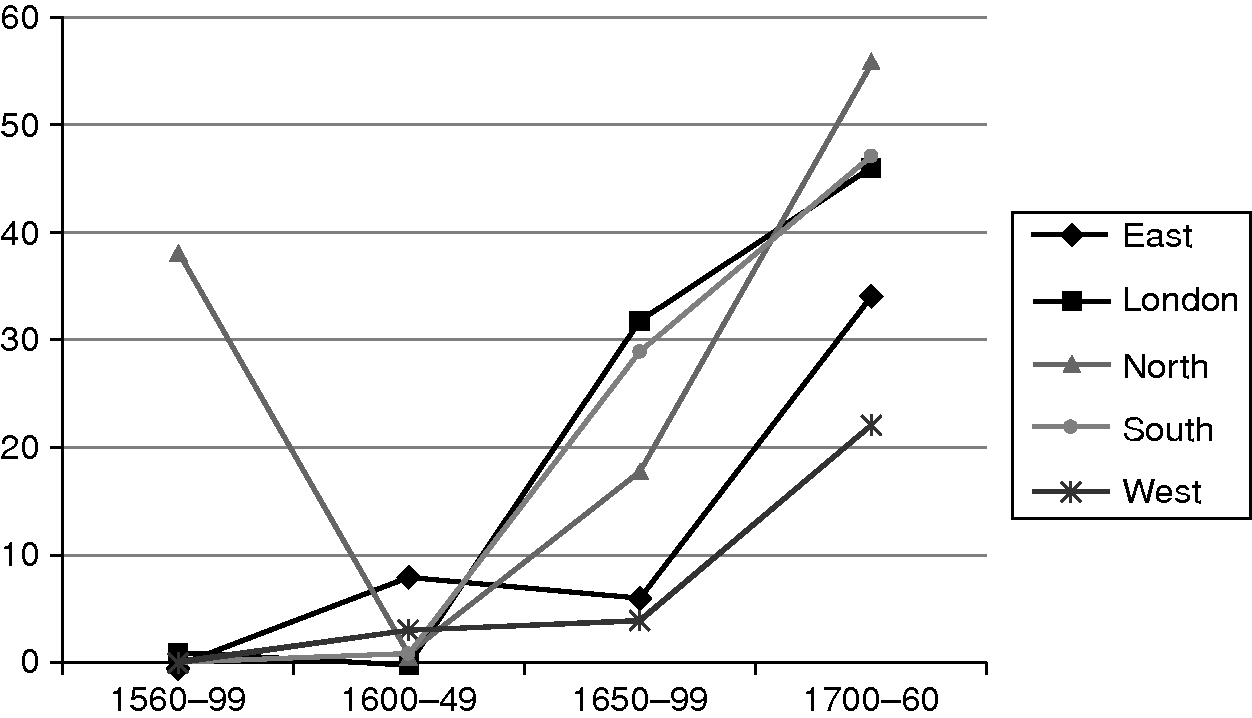
Figure 27.1 Percentage of -s in ETED by region and sub-period
The results show that the use of -s inflection is rare in London and the South until the second half of the seventeenth century, whereas it remains rare in the East and West until the eighteenth century: thus, as predicted, the East and West lag behind the other regions. Nevertheless, in all regions except the North the percentage of -s remains below 50 per cent throughout the 200-year period. The figures for the North reveal a rather erratic pattern, which probably reflects the fact that the North covers a large area. The Northern deposition collections can be divided into those from the North-west and those from the North-east, which may clarify the picture (see Table 27.3). We then see that the North-west (Chester and Lancaster) has a consistently higher proportion of -s than does the North-east (Durham, and the ‘Northern’ collections, which predominantly represent Yorkshire). Only in the North-west is -s inflection over 50 per cent, in the late sixteenth and early eighteenth century.
Table 27.3 Distribution of -s and -th in ETED in collections from the North-east (NE) and the North-west (NW)
| Period | Collection (sub-region) | -s | -th |
|---|---|---|---|
| 1560–99 | Chester 1562–6 (NW) | 164 (69%) | 72 (31%) |
| Durham 1567–74 (NE) | 8 (4%) | 215 (96%) | |
| 1600–49 | Durham 1628–38 (NE) | 1 (0%) | 338 (100%) |
| Northern 1646–9 (NE) | 3 (5%) | 54 (95%) | |
| 1650–99 | Lancaster 1696–8 (NW) | 13 (25%) | 40 (75%) |
| Northern 1654–99 (NE) | 20 (15%) | 110 (85%) | |
| 1700–60 | Lancaster 1700–60 (NW) | 58 (67%) | 29 (33%) |
| Northern 1724–58 (NE) | 56 (48%) | 61 (52%) |
In the North-east, the percentage of -s decreases in the period 1600–49 (with 1 per cent -s for the two North-eastern collections taken together), but the use of the -s inflection increases steadily from the middle of the seventeenth century. It is more difficult to draw conclusions about the North-west, given the lack of material for the first half of the seventeenth century, but the high proportion of -s in Chester suggests this form was already well-established there in the mid-sixteenth century. However, it is important to note that this particular Northern collection is the work of one scribe, and thus usage may be idiosyncratic.
What we also need to consider when looking at the patterns of distribution is that certain verbs have been found to have resisted the change, namely the high-frequency verbs do, have, and say (e.g. Holmqvist Reference Holmqvist1922: 90, 186–8; Kytö Reference Kytö1993: 121–3). Also, in depositions there are other verbs that occur in formulaic contexts, which might be expected to be resistant in this genre. Thus in section 27.5.2 the most frequent verbs in ETED are examined to see how they affect the distribution of -s and -th.
27.5.2 The case of DO, HAVE, and SAY and other frequent verbs in ETED
There are six verbs with the third-person singular -s and -th inflection that occur in ETED far more frequently than other verbs: believe, do, have, know, remember, and say occur sufficiently often (with over 100 examples each) to allow an examination of these in the four sub-periods. The results are given in Table 27.4, and illustrated in Figure 27.2.
Table 27.4 Distribution of -s and -th with the most frequent verbs in the four sub-periods in ETED
| 1560–99 |
1600–49 |
1650–99 |
1700–60 |
|||||
|---|---|---|---|---|---|---|---|---|
| -s | -th | -s | -th | -s | -th | -s | -th | |
| believe | 1 (3%) | 36 (97%) | 1 (2%) | 63 (98%) | 19 (49%) | 20 (51%) | 94 (100%) | 0 (0%) |
| do | 0 (0%) | 32 (100%) | 0 (0%) | 29 (100%) | 1 (1%) | 68 (99%) | 14 (33%) | 29 (67%) |
| have | 1 (1%) | 189 (99%) | 0 (0%) | 185 (100%) | 7 (9%) | 69 (91%) | 59 (38%) | 95 (62%) |
| know | 16 (24%) | 50 (76%) | 3 (6%) | 44 (94%) | 17 (63%) | 10 (37%) | 21 (95%) | 1 (5%) |
| remember | 8 (13%) | 53 (87%) | 0 (0%) | 30 (100%) | 3 (50%) | 3 (50%) | 16 (100%) | 0 (0%) |
| say | 104 (30%) | 242 (70%) | 2 (1%) | 398 (99%) | 8 (3%) | 289 (97%) | 92 (22%) | 332 (78%) |
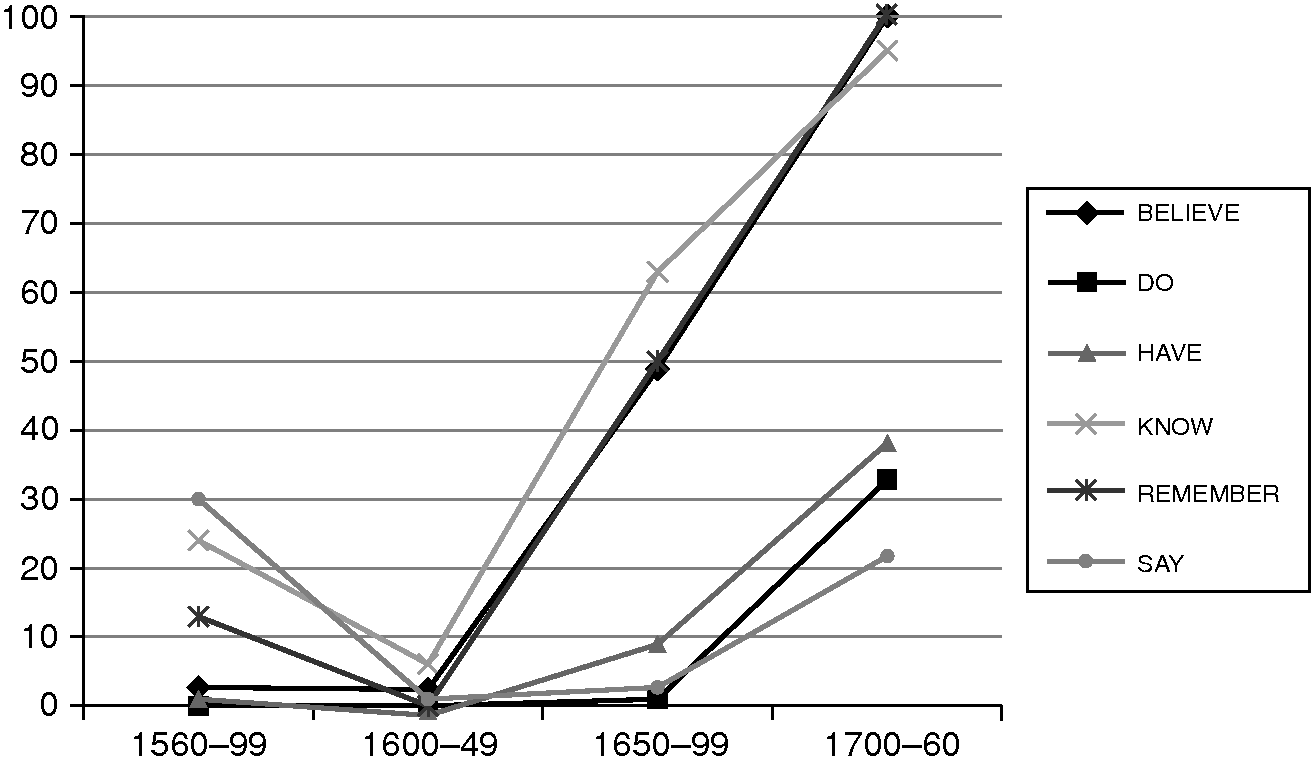
Figure 27.2 Percentage of -s with the most frequent verbs in the four sub-periods in ETED
What emerges from Table 27.4 and Figure 27.2 is that believe, know, and remember overwhelmingly favour the -s inflection in the eighteenth century, and even in the late seventeenth century the -th inflection is losing ground to -s. By contrast, do and have are very resistant to -s inflection: even in the eighteenth century, -s is only used with these verbs between 33 and 38 per cent respectively. Whereas, in Kytö (Reference Kytö1993), have proved more resistant to -s than did do and say in the genres examined, in depositions say is more resistant than either do or have, with only 22 per cent -s in the eighteenth century. Also shown in Table 27.4 and Figure 27.2 is that say, know, and remember all occur with -s in the late sixteenth century more than they do in the early seventeenth century (and in the case of say it occurs in the first sub-period more than in any other sub-period). All the -s examples with these verbs in the late sixteenth century in fact come from one collection, Chester 1562–6, a collection that has the highest percentage of -s overall (69 per cent, see Table 27.3) compared to other collections in ETED.
The verb say is probably resistant to the -s inflection in the genre of depositions due to the formulaic usage to introduce (and often to close) the testimony of the deponent, as can be seen in example (1) in section 27.3. Other verbs, such as depose and confess, are also used in this context, but are not sufficiently frequent to substantially affect the data. The occasional -s inflection with the verb say is used to introduce the deponent's testimony in 7 of the 30 deposition collections in ETED; it is more frequently found in three further collections: Henley 1751 (from the South), Lancaster 1700–60, and Chester 1562–6. Throughout ETED, the -s form with the verb say is only preferred to -th in two collections, from the North-west, Chester 1562–6, and Lancaster 1700–60.
27.5.3 Regional variation across time: -S versus -TH excluding DO, HAVE, and SAY
The exclusion of the three verbs do, have, and say from the data leaves 1,066 examples, with 415 -s (39 per cent) and 651 -th (61 per cent); Table 27.5 and Figure 27.3 give the results across region and time.
Table 27.5 Distribution of -s and -th in ETED by region and sub-period, excluding do, have, and say
| 1560–99 |
1600–49 |
1650–99 |
1700–60 |
|||||
|---|---|---|---|---|---|---|---|---|
| -s | -th | -s | -th | -s | -th | -s | -th | |
| East | 0 (0%) | 95 (100%) | 4 (27%) | 11 (73%) | 3 (27%) | 8 (73%) | 9 (53%) | 8 (47%) |
| London | 0 (0%) | 47 (100%) | 0 (0%) | 46 (100%) | 21 (57%) | 16 (43%) | 111 (100%) | 0 (0%) |
| North | 68 (49%) | 72 (51%) | 4 (3%) | 124 (97%) | 20 (54%) | 17 (46%) | 51 (76%) | 16 (24%) |
| South | 0 (0%) | 19 (100%) | 2 (4%) | 50 (96%) | 53 (62%) | 32 (38%) | 46 (94%) | 3 (6%) |
| West | 0 (0%) | 31 (100%) | 4 (11%) | 31 (89%) | 5 (28%) | 13 (72%) | 14 (54%) | 12 (46%) |
| Total | 68 (20%) | 264 (80%) | 14 (5%) | 262 (95%) | 102 (54%) | 86 (46%) | 231 (86%) | 39 (14%) |

Figure 27.3 Percentage of -s in ETED by region and sub-period, excluding do, have, and say
Excluding the resistant verbs allows a comparison with the results of Nevalainen and Raumolin-Brunberg (Reference Nevalainen and Raumolin-Brunberg2003) in which the verbs do and have (but not say) were excluded. If we take a look at the distribution of -s and -th in each region and sub-period without the three resistant verbs, the results in Table 27.5 and Figure 27.3 show that London and the South favour -s from the late seventeenth century slightly more than does the North, while it is not until the eighteenth century that the East and West favour -s over -th. In the eighteenth century, London and the South almost exclusively favour -s (100 per cent and 94 per cent respectively), while the North still has as much as 24 per cent -th. These regional patterns correspond to some extent with those shown by Nevalainen and Raumolin-Brunberg (Reference Nevalainen and Raumolin-Brunberg2003: 177–80) for letters for the periods 1580–1619 and 1620–50, with London the first to show a preference for -s, the East late to show a preference for -s, and with the North following a short distance behind London. However, compared to Nevalainen and Raumolin-Brunberg's results, there is a time lag regarding these patterns in depositions of up to eighty years. This supports the hypothesis that the genre of depositions would retain the -th inflection for a longer period, due to its formal, conservative, and formulaic nature.
27.5.4 Third-person present singular verb inflection in direct speech
The part of the depositions genre least likely to be affected by any formulaic use of -th is where previous speech events are cited by the deponent (to the best of his or her remembrance and/or with prompts from e.g. the examiner) and rendered by the scribe as direct speech. In example (1) in section 27.3 we can see the -s inflection in the dialogue presented as direct speech, in contrast to the formulaic -th elsewhere in the deposition. By examining the direct speech in ETED, the opportunity presents itself to compare the inflections purportedly used in everyday language by ordinary men and women, as well as considering regional variation; however, the data is limited. The stretches of direct speech comprise about 9 per cent of the total word count of ETED, excluding Latin text (Kytö et al. Reference Kytö, Grund and Walker2011b: 328).
Given the much smaller data set, it was feasible to include zero inflection as well as -s and -th forms, and preferable to include all verbs (i.e. do, have, and say were not omitted). When dealing with zero inflection, the question arises: how should we deal with subjunctive forms? Ideally these should be omitted from the data. However, for this study, all zero forms in the third-person singular, including potential subjunctive forms, were added to the data for -s and -th that had already been collected. The reasoning behind this was that although zero forms after subordinating conjunctions such as if might have been excluded, it would have been difficult to ensure that zero forms after all conjunctions and in all constructions that might trigger the subjunctive in this period were excluded. Moreover, potential subjunctives are taken into account in the discussion below.
The stretches of direct speech can be searched separately in WordSmith, by instructing the program to search only the text within ‘[@…@]’ in the TXT version of ETED. It would also be possible to create another wordlist with mark-up to enable a full search of just this section of ETED. However, the same problems described in section 27.4 with regard to extracting zero forms would apply here; moreover, the -s and -th forms had of course already been collected. Instead, the approach adopted was to identify and copy the -s and -th forms in direct speech in the Excel spreadsheet into a new Excel file. After this, the stretches of text coded as direct speech were carefully scrutinized using the HTML version of ETED – in which direct speech is conveniently highlighted in red – and the zero forms identified and manually added to the new Excel file. Repeating the examination confirmed that no -s, -th, or zero forms had been missed. This approach resulted in a mere 165 examples of third-person singular inflection, but despite the relatively small number of examples, some patterns can be discerned.
Compared with the depositions data as a whole (with 21 per cent -s: see Table 27.1) and the data excluding do, have, and say (with 39 per cent -s: see section 27.5.3), the data for direct speech shows a much greater preference for -s (58 per cent: calculated from the ‘Total’ row in Table 27.7, excluding the data for zero inflection). This suggests there is a great contrast between the language in the formal setting of taking down an official record, and that reported by the deponent, pertaining to an earlier speech event beyond the legal setting.
Table 27.6 Distribution of -s, -th, and zero inflection in direct speech in ETED by gender and sub-period
| Men |
Women |
|||||
|---|---|---|---|---|---|---|
| -s | -th | zero | -s | -th | zero | |
| 1560–99 | 0 (0%) | 20 (80%) | 5 (20%) | 4 (20%) | 11 (55%) | 5 (25%) |
| 1600–49 | 4 (17%) | 17 (74%) | 2 (9%) | 2 (14%) | 7 (50%) | 5 (36%) |
| 1650–99 | 9 (69%) | 0 (0%) | 4 (31%) | 12 (75%) | 3 (19%) | 1 (6%) |
| 1700–60 | 17 (85%) | 1 (5%) | 2 (10%) | 32 (94%) | 0 (0%) | 2 (6%) |
| Total | 30 (37%) | 38 (47%) | 13 (16%) | 50 (60%) | 21 (25%) | 13 (15%) |
Table 27.7 Distribution of -s, -th, and zero inflection in direct speech in ETED by region
| -s | -th | zero | |
|---|---|---|---|
| East | 5 (19%) | 13 (50%) | 8 (31%) |
| London | 4 (50%) | 4 (50%) | 0 (0%) |
| North | 37 (60%) | 16 (26%) | 9 (15%) |
| South | 34 (52%) | 25 (38%) | 7 (11%) |
| West | 0 (0%) | 1 (33%) | 2 (67%) |
| Total | 80 (48%) | 59 (36%) | 26 (16%) |
There is sufficient data to permit an overview of third-person singular inflection by men and women in each of the four sub-periods (see Table 27.6). The number of examples for men and women are roughly equivalent (eighty-one by men, and eighty-four by women).
Table 27.6 reveals that there is no clear pattern regarding zero inflection, but the use of -s inflection increases across time for both men and women, primarily at the expense of the -th inflection. It is women who have the highest percentage of -s in all periods but the early seventeenth century, and they use more -s (60 per cent) than -th (25 per cent) overall (cf. Kytö Reference Kytö1993: 128–9; Nevalainen and Raumolin-Brunberg Reference Nevalainen and Raumolin-Brunberg2003: 123). By contrast, men use more -th (47 per cent) than -s inflection (37 per cent) in the 200-year period as a whole. We should remember that these reports of speech events are mediated through the language of the deponent, the scribe, and perhaps the examiner: we cannot rule out the possibility for example that reporting or recording the -s form rather than the -th form (or vice versa) might be a means of constructing gender. Also, as region has proven to be a key variable, ideally the possible effect of gender and region together on third-person singular verb inflection should be considered (cf. Nevalainen and Raumolin-Brunberg Reference Nevalainen and Raumolin-Brunberg2003: 122–3), but the data set is too small to allow this.
Table 27.7 shows the variation in inflection in each region in the stretches of direct speech in ETED. Clearly, there is insufficient data for London and the West, with only eleven examples in these two regions. However, the results show that the North and South both favour -s inflection over the other options across the 200-year period as a whole, while the East favours -th. However, the East has the highest percentage for zero inflection.
Whereas the zero inflection in other regions is primarily found in contexts likely to encourage the subjunctive, as in example (2), this does not seem to be the case with the examples from the East. The East is a region in which zero inflection in the third-person singular indicative is a feature of the local dialects (Holmqvist Reference Holmqvist1922: 136–7, Nevalainen and Raumolin-Brunberg Reference Nevalainen and Raumolin-Brunberg2003: 179), illustrated in example (3), a context in which a subjunctive seems unlikely (see also example (5) in section 27.5.5).
(2) and she answered whether he doe or noe he
hath kept hir as I knowe as comonlie this
twelmonthes daie as anie make man keepes
his wyfe,
(Oxford 1609–15: F_2SD_Oxford_011)
(3) when the mayd layd on the bed she
layd her hand on her head and fetched a greate sigh and this
informant thought she wold haue then died. but this informan[t] {her dame}
sayd still she doe but counterfit.
(Suffolk 1645: F_2EC_Suffolk_004)
The results validate the exclusion of the zero inflection from the data as a whole in this study, given that most examples are likely to be subjunctives, but also warrant an investigation of zero inflection in the East. Throughout the results presented in this chapter, the East (and the West) has tended to have a relatively low percentage of -s inflection compared to the North, South, and London regions, at least after 1650. To investigate this further, within the scope of this chapter, the use of -s, -th, and zero inflection in the full text of two deposition collections is examined in section 27.5.5. These are Norwich 1700–54, the eighteenth-century collection from the East, in which zero inflection might well play a role, and, by contrast, London 1714–15, the eighteenth-century collection that favours the -s inflection to the extent that -th is only found with the verbs do, have, and say (see Tables 27.2 and 27.5).
27.5.5 Zero inflection in eighteenth-century depositions: the East and London
The method adopted was similar to that used for the case study reported in 27.5.4; however, here the printed PDF version of ETED was used to identify examples of zero inflection. As mentioned above, the two eighteenth-century collections investigated are Norwich 1700–54 (comprising 8,705 words), representing the East, and London 1714–15 (comprising 14,154 words). Table 27.8 shows the variation in third-person singular inflection in these two collections, when all verbs, including do, have, and say, are taken into account.
Table 27.8 Distribution of -s, -th, and zero inflection in Norwich 1700–54 and London 1714–15
| -s | -th | zero | |
|---|---|---|---|
| Norwich 1700–54 | 24 (28%) | 46 (54%) | 15 (18%) |
| London 1714–15 | 119 (46%) | 139 (54%) | 0 (0%) |
Table 27.8 shows that both eighteenth-century collections still have a preference for the -th inflection (54 per cent) but while the -s inflection (46 per cent) is the only alternative used in London, Norwich has both -s and zero inflection.
Interestingly, the zero inflection in Norwich 1700–54 is primarily with the verbs do (7x), have (2x), and say (2x), whereas the London collection still favours -th with these verbs, and say only occurs with the -th inflection (57x). The results excluding these three verbs are presented in Table 27.9.
Table 27.9 Distribution of -s, -th, and zero inflection in Norwich 1700–54 and London 1714–15 excluding do, have, and say
| -s | -th | zero | |
|---|---|---|---|
| Norwich 1700–54 | 9 (43%) | 8 (38%) | 4 (19%) |
| London 1714–15 | 111 (100%) | 0 (0%) | 0 (0%) |
Given that there is no zero inflection in London 1714–15, we see once again (cf. Table 27.5 in section 27.5.2) that only the -s inflection occurs in London when the verbs do, have, and say are excluded. With regard to Norwich 1700–54, there is much less data after excluding do, have, and say, but a look at the examples reveals that the remaining -th forms occur only with formulaic phrases, especially the phrase ‘Maketh Oath’ as in ‘Robert Lacy Maketh Oath before us’ (Norwich 1700–54: F_4EC_Norwich_035). The examples of -s and zero inflection are not in these formulaic contexts, as illustrated in examples (4) and (5), which suggests that these were in competition in the region (cf. Nevalainen and Raumolin-Brunberg Reference Nevalainen and Raumolin-Brunberg2003: 179).
(4) there was a Number of people gott
together amongst Whom were Joseph Steward
Keelman who is now present & Tho: Rannalls
a Carpenter & One John Jermy who lives in the
Close & diverse others unknown who all
behaved verry insolently
(Norwich 1700–54: F_4EC_Norwich_027)
(5) That on ffryday last going
past Rachel the wife of Wm ffuller
as shee sett in the streett, shee called
after him, there goe a Croaking rogue
Dam∼ them all.
(Norwich 1700–54: F_4EC_Norwich_015)
27.6 Concluding remarks
This chapter has illustrated how research into linguistic variation, in this case third-person present singular verb inflection, can be carried out in order to answer particular research questions. The questions addressed in this study are what role is played by region, time, and type of verb on -s and -th inflection, and does verb inflection in depositions resemble formal texts or a more ‘oral’ genre such as personal letters. The study indicates that despite a great deal of previous research on the subject of verb inflection, examining the genre of depositions was a worthwhile undertaking. The genre is of particular interest due to its representing a variety of regions, and its relationship to the spoken language, as well as the fact that a newly available corpus of depositions facilitated the study of verb inflection in this genre. Several methodological issues have been addressed: it was suggested that a computer search for all forms that might be instances of zero inflection in the indicative was not justified; instead it was shown that carrying out case studies examining parts of ETED was a fruitful approach. The chapter has also demonstrated the need to familiarize oneself with the options that the corpus offers: it was illustrated how ETED can be exploited, for example, by taking advantage of the word list provided, and by using the various format versions supplied for different tasks.
Using a corpus-based variationist approach, the data from An Electronic Text Edition of Depositions 1560–1760 (ETED) has provided new insights into third-person singular verb inflection in Early Modern English. Clearly region and time are highly relevant factors in the depositions genre. When focusing on one genre, it is important to place the results in a wider context by relating the findings to those for other genres. The findings for the depositions genre supported the hypotheses proposed in section 27.4 on the basis of previous research: do, have, and say resisted the incoming -s form, and a clearer picture of development across region and time was possible by excluding these from the data. During the period 1560–1760, the North showed an early preference for -s when compared with the other regions, but it was London that led the change from -th to -s in the depositions, with the East and West lagging behind. One explanation for the resistance of the East to -s might be that it was in competition with the zero inflection. Previous research into the letters genre found women to have used -s more than men did: the data for the investigation of gender differences in depositions was rather limited, but the figures hinted at a similar result.
One fascinating aspect of the depositions genre is their ‘formal yet speech-related’ nature. The present study revealed that the depositions genre resembles secular treatises and similar formal genres in being slow to adopt -s, compared to genres such as letters. The earlier speech events presented by the scribe as direct speech showed a clear preference for -s, but these stretches of text are in the minority (comprising only 9 per cent of the material). What this result suggests is that the text rendered as direct speech in depositions is freer from scribal intervention than other parts of the deposition texts, and thus may more accurately reflect the language of the original speech event.
In this handbook chapter intended to exemplify empirical research in the field of historical linguistics, it was not practical to examine zero inflection in the data as a whole or to investigate a number of potential linguistic factors affecting third-person singular inflection. However, it would be of great value to pursue these areas further, in the depositions genre in particular, as well as to further explore these and the regional factor in other genres. New methods are constantly being developed (see Gries and Hilpert Reference Gries and Hilpert2010 and Chapter 2 by Hilpert and Gries in this volume) which provide opportunities for increasing our knowledge of the interplay between a range of factors influencing linguistic variation. There are many aspects of the English language in past periods that have been scrutinized by historical linguists, but the potential for further insights remains.
28.1 Introduction
To study speech presentation is to examine the ways that speakers and writers indicate when they are shifting modes of discourse from offering their own words to depicting the words of another. In the late medieval period, with an increase in lay literacy and a proliferation of written manuscripts, we find a fascinating multiplicity of strategies for marking presented speech in written texts: from ink colour and marginal notes to discourse markers and grammaticalized verbs. This diversity in late Middle English manuscripts can help us to understand how modes of reporting speech were understood and how speech presentation overlaps with other pragmatic impulses in texts. Examining speech presentation in manuscripts underscores, moreover, the importance of considering polyfunctionality in historical pragmatic research: the ways that the pragmatic choices of speakers and writers function on multiple levels for semantic, rhetorical, organizational, communicative, and ideological ends. This chapter presents an illustrative example of a pragmatic case study of manuscripts, examining genre and manuscript variation as ways to approach speech presentation in premodern texts.
When we consider how fruitful the study of variation in the orthography of early manuscripts has been to our understanding of phonological and dialectal variants, it seems exciting to contemplate the analogous opportunities available for using variation in manuscript marking to study pragmatic and discourse strategies. The diversity of possibilities open to the medieval scribe can shed light on the modes of organizing written discourse and on the pragmatic pressures that act upon different genres of texts. More and more research in historical linguistics has recognized the importance of original texts and layouts or recommended further work with manuscripts (Lass Reference Lass, Dossena and Lass2004b; Grund Reference Grund2006; Laing and Lass Reference Laing, Lass, van Kemenade and Los2006; Fitzmaurice and Taavitsainen Reference Fitzmaurice2007; Hiltunen and Peikola Reference Hiltunen and Peikola2007; Kytö et al. Reference Kytö, Walker and Grund2007; Peikola Reference Peikola, Caie and Renevey2008; Kytö et al. Reference Kytö, Grund and Walker2011b; Pahta and Jucker Reference Pahta, Taavitsainen and Pahta2011; Machan Reference Machan, Schendl and Wright2011; Carroll et al. Reference Carroll, Peikola, Salmi, Varila, Skaffari and Hiltunen2013). As our research tools expand, manuscripts can be approached through electronic corpora and text collections (Kytö Reference Kytö, Jucker and Taavitsainen2010: 42), but often qualitative examination of particular manuscripts provides an essential complement to quantitative comparison. Case studies of manuscripts permit us direct access to the written page and its linguistic choices, and are a critical window into the context of early written language (for discussion of the relation of context to historical pragmatics, see Taavitsainen and Jucker Reference Jucker, Fried, Östman and Verschueren2010: 20–1 and Culpeper Reference Culpeper, Andreas and Taavitsainen2010; see also Chapter 3 by Mazzon in this volume).
Speech presentation is a growing topic for research (Coulmas Reference Coulmas1986; Collins Reference Collins2001; Semino and Short Reference Semino and Short2004; Holt and Clift Reference Holt and Clift2007; Vandelanotte Reference Vandelanotte2009; Moore Reference Moore2011; see also Chapter 27 by Walker in this volume), but it poses particular challenges because of its multifunctionality and the way that it operates in different areas of inquiry. At its root, speech presentation is a pragmatic issue: the ways that speakers or writers have of communicating shifts of orientation in the discourse. In Present-day English, we depend upon punctuation – upon quotation marks – to delineate most instances of direct discourse, and we depend upon grammatical constructions and discourse conventions to clarify most instances of indirect discourse and free indirect discourse. Premodern English, by contrast, is far more dependent on words to carry this functional load (Moore Reference Moore2011). Without quotation marks, a panoply of other conventions were variously employed to indicate shifts to presented speech, and lexical inquit tags become the most expedient method for writers to signal shifts in speech mode (other intradiscursive methods are listed in Moore Reference Moore2011: 44). It is important, however, to understand these speech marking conventions in their manuscript context, since, even though they bear most of the functional load, these words work in conjunction with the organizing strategies of the manuscript page.
Methodologically, scholars who investigate speech presentation can do so through multiple channels and can examine a variety of questions, since speech presentation is an important topic for a number of fields. It presents issues for syntax (how do constructions mark shifting between narrative and presented speech?), for manuscript and textual studies (how does the written page negotiate presented speech?), for literary scholars (how is voice and narrative represented in literary texts?), for dialectologists (how do written texts mark the intervention of spoken voices and how much like speech are these intrusions intended and understood to be?), and, certainly, for pragmatics (how do speakers and writers distinguish levels of discourse and how faithful is presented speech to spoken language?). These questions take on particular urgency for historical research of early periods (in which our only evidence for spoken language comes from written sources), and it becomes particularly important to consider how these sources were employing conventions of discourse organization like presented speech.
This chapter will examine how questions of speech presentation can be approached in manuscripts. Examining pragmatic issues in manuscripts entails considering both variation and polyfunctionality – which, in turn, entails examining the overlapping functions for manuscript ordering marks. For speech marking, this means considering the relationship between marks that indicate presented direct speech and marks of auctoritas (the presence of the voice of acknowledged ‘authorities’). Marking auctoritas was a central impulse for medieval scribes: it was critical to set apart parts of the text that were sanctioned by culturally recognized experts (Parkes Reference Parkes, Alexander and Gibson1976: 127; Minnis Reference Minnis1988: 94–5). Because the same strategies could mark presented speech and auctoritas, their use creates ambiguity: a functional doubleness in the use of particular markings (especially rubrication) as tools for ordinatio. I submit that such polyfunctionality is a product of the cultural production of texts in the period and that an increase in manuscript production accompanies an increasing sophistication in strategies of textual organization that have not yet been thinned out by the standardizing winnowing of print. Scribal decisions about ordinatio and textual organization were not made ex novo every day, of course; scribes drew on their habits and on precedent in the form of the textual organizational methods of the texts that they were copying, or other texts that they had read or written (Partridge Reference Partridge, Gillespie and Wakelin2011: 82). What we see in late Middle English manuscripts, then, is a proliferation of strategies for flagging different aspects of discourse; to examine the marking of presented speech, we must look at it in this context.
To study speech marking, then, it is important to select manuscripts judiciously, since different kinds of insight can be obtained from different kinds of variation. Comparing different versions of texts from a similar genre permits us to examine different variations on the structures and tropes that characterize a genre, and comparing different versions of one text permits us to examine different variations in scribal practice and ordinatio. This chapter will take a multi-tiered approach and consider each of these in turn: section 28.2 will look at several manuscripts of medieval saints’ lives in English and consider how the pragmatic pressures of the genre of saints’ legends shaped the use of speech marking strategies, and section 28.3 will examine variants in versions of the fifteenth-century manuscripts of Nicholas Love's Mirror of the Blessed Life of Jesus Christ to consider the implications of differences in layout. The aim is not to present an exhaustive or even representative look at how texts mark direct speech (for this, see Moore Reference Moore2011), but to show what happens when we approach manuscripts on their own terms and to exemplify how one might use manuscripts to examine topics in presented speech.
28.2 Comparing texts within a genre: saints’ lives
To work on manuscripts, we must consider the purpose and material production of the text – the motivations of the people behind the words. Why and how did they create and copy a text, and why and how did they read it? In the case of a saint's life, these questions must be understood partly through text type, since any given saint's life is a part of a larger context of saints’ legends that shared features of production and consumption, and that made use of shared generic tropes and structures. Many pragmatic conventions and constraints come through shared features in textual genres. To study pragmatic variation, then, we should consider the ways that genre provides context for textual and linguistic choices.
28.2.1 The genre of saints’ lives
Saints’ lives and legendaries were influential and popular texts in Middle English, and we have many surviving versions. These texts form a useful source of evidence for devotional practices, and also for the kinds of exemplary narratives that speakers and writers shared for entertainment and edification. Since many saints’ lives treat female saints, these legends present an important resource for the presented public speech of women (Wogan-Browne Reference Wogan-Browne2001: 223). In addition, since many saints’ lives treat native English saints, these legends provide an important vision of what a specifically English sanctity might look like (Sanok Reference Sanok2007: 87). Saints’ lives are a good source for investigation of presented speech because they contain many occurrences of direct and indirect speech and because they are narratively dependent on speech acts and utterances.
Considering the materiality of the manuscript page takes on particular cultural resonance when we look at saints’ lives, because the physical manifestation of the text assumed a talismanic value. The written life of a saint was revered both as a spiritual guide (taking its place among breviaries, missals, and books of hours) and also as a sacred object (in company with medals, scapulars, pious images, and pilgrimage tokens) (Boureau Reference Boureau, Chartier and Cochrane1987: 17). For pragmatic understanding of manuscript context, therefore, it is important to perceive how the sacred role of the material text is fundamental to its reception.
Manuscript context for these texts also entails considering the legends intertextually: how did they function in compilations and how do we read them differently in response to their different textual neighbours? Some saints’ lives are collected in legendaries; others are distinct narrative vitae (see Long Reference Long and Salih2006: 62, and Görlach Reference Görlach1998b). Many Middle English collections contain saints’ lives, and the inclusion of saints’ lives can shape how we perceive the purpose of the large collections and coucher books that contain them. A manuscript collection like Speculum Sacerdotale (British Library, MS Add. 36791), for instance, seems to have been primarily homiletic; it includes saints’ lives together with sermons as a guide for priests. The Auchinleck manuscript (National Library of Scotland, Adv. MS 19.2.1), on the other hand, is a broader reaching miscellany and contains saints’ lives such as Seynt Mergrete and Seynt Katerine in conjunction with romances (e.g. Sir Tristrem, or Horn Childe and Maiden Rimnild), moral tales (e.g. The Sayings of the Four Philosophers), even a fabliau (The Wenche þat Loved þe King), and an ABC poem (Praise of Women). Saints’ lives read as different kinds of texts depending on the company they keep – when read with sermons they can seem like religious exemplars, and when read with romances they can take on some literary qualities of adventure tales.
28.2.2 Speech in saints’ lives
Saints’ lives present multiple examples of straightforward back-and-forth dialogue – a textual situation which necessitates flagging transitions from one speaker to another. For the most part, such transitions are signalled lexically and grammatically with inquit phrases indicating the speaker of given passages. The mise-en-page (the layout on the manuscript page) can assist in marking transitions, though, and some manuscript markings and marginalia seem to reflect an awareness that they will be used for this purpose, at least in part.
In Figure 28.1, from Lydgate's Life of St. Alban and St. Amphibal (Huntington Library, HM 140), the turn-taking is highlighted by the scribe's practice of underlining the names in red ink (unfortunately printed here in grayscale and thus less visually arresting than in the original). The inquit phrases are particularly visible on fol.17r, because the scribe marks the onset of each stanza with an enlarged red letter, which flags the word Quod two times on this page. The red underlining is part of the organizing apparatus for the manuscript page; it typically marks auctoritas, sometimes extending to mark all proper names and sometimes extending to mark speech. In Figure 28.1, red underlining indicates the speakers ‘Amphibalus’ and ‘Albon’, but also marks ‘Criste Jhesu’, and ‘fader’ and even a couple of others: ‘paynems’, ‘cite’, ‘in carnate’, and ‘flesh’. (Could these last be tied to proper names? And is the reference to the material form of Christ enough to link the words ‘in carnate’ and ‘flesh’ with proper names?) The red underlining on the page is clearly polyfunctional, indicating a number of differing things. We do see in this image, though, how mise-en-page markings like rubrication can be co-opted for discourse organization.

Figure 28.1 San Marino, Huntington Library, MS HM 140 fol.17r St. Alban and St. Amphibal
Assorted manuscript marks and marginalia can assume discourse organizing functions, particularly the management of direct speech. I mentioned ink colour (and will discuss this in more detail in the next case study on Love's Mirror). Changes in ink colour can be in the form of red letters, red underlining, or red ink highlighting the initial letter of other words. I even found a yellowish ink used to highlight the initial letters of boundary-marking words, including the boundaries of presented speech, in the early folios of a Latin copy of Jacobus de Voragine's Legenda Aurea, the most popular late medieval collection of saints’ lives (Huntington Library, HM 3027). Other organizing marks include punctuation such as the virgule, the punctus elevatus, and the paraph; these are used not exclusively for speech presentation, but onsets and offsets of presented speech are one of the boundaries that they signal (Parkes Reference Parkes1993).
Consider a sample passage like this one from John Capgrave's life of St. Norbert (Huntington Library, HM 22):
(1)
[In the original, the initial letters of each line (presented here in grey) are touched with red, the paraph marks are red, and, most noticeably (though not depicted here), transecting red brackets crisscross in the right margin, connecting the rhyme words.]¶Many īnuectif wordes aʒens her aʃtaatwhech was to hem grete ʃlaūdir þei saydeThei ʃaide eke how he had take a new habitʒ laatof holy religion and not down ilaydethe ppirtee of worldly good al þis þei upbraydeand whi he þrew a wey al precious wedewhech was not þe cuʃtom ī þat ilk stede¶aʒens þese obieccionis þis mā witʒ meke voysStood vp to answere and asked ʃilensffirst with his hand he bleʃʃed him witʒ þe croysand aftir þat he ʃpak in open audiensSwech man̉ wordes and in ʃwech ʃentensif I be accuʃed as of religion herewhat is my religion now may ʒe here…(fols.5v–6r)[Stated many invective words against himwhich was great slander to him they saidThey said also how he had taken a new habit recentlyof holy religion and not laid downthe property of worldly goods; all this they upbraided,and which he threw away all precious weedswhich was not the custom in that same placeagainst these objections this man with meek voicestood up to answer and asked for silencefirst with his hand he blessed them with the crossand after that he spoke openlysuch words and in such sentences:‘if I be accused as of religion herewhat my religion is now may you hear…’]
This passage presents an interchange of spoken language. It begins by narratively describing the bishops’ speech (‘…grete ʃlaūdir þei sayde’), then represents indirectly the bishops’ complaints about his behaviour and clothing (‘Thei ʃaide eke how he had…’), continues by narratively describing St. Norbert's opening prayer (‘asked ʃilens…he bleʃʃed him’), and then shifts into direct speech for his defence of himself (‘if I be accuʃed…’). Without a clear and consistent system of conventions for setting off discourse levels of presented speech, the distinctions between the levels of discourse (direct speech, indirect speech, and narrative description of speech) are not always demarcated in the passage, and the discursive organization is less delineated.
In the passage as it appears on the manuscript page, we can see a few kinds of organization that have some bearing on speech presentation. There is red ink – the first place that our eyes are drawn: rubricated letters begin each line, and red connecting lines link rhyming words at the end of lines: these organize the text poetically, highlighting the line breaks and phonetic repetitions. We also note the red paraph markers that begin the stanzas; these are important metrically, syntactically, and pragmatically since they signal breaks in metrical stanzas and also serve as syntactic and pragmatic breaks for organizing the discourse. In this context, for example, the stanzaic boundary serves as a narrative break between the description of the bishops’ complaints against St. Norbert and St. Norbert's response (‘aʒens þese obieccionis…’), but in other texts paraphs can be used to flag onsets of direct speech.
We can also recognize the organizing importance of content in the presentation strategies of a particular genre – here, the ways that the saint's life incorporates persecution by the establishment as a narrative trope. The bishops have accused Norbert of insufficient attention to pious observance, and the passage sets up Norbert's expected telling off of the bishops and their expectations. When we read saints’ lives, we note certain repeated speech forms of the genre, and what we might call a ‘defiant address’ is one of them. In a sense, then, the passage itself serves as an extended speech marker: the narrative lays the ground for Norbert's defiant address so that the onset of Norbert's speech is explicit.
Formulaic usage can be seen in types of speech utterance, and it can also be seen in certain intertextual moves in St. Norbert's narrative. His conversion scene, for example, is discursively linked to Saint Paul's, and the manner of it echoes the account of Paul's conversion as described in Acts 9:4 (‘Saul, Saul, why do you persecute me?’):
(2)
As þouʒ he had be very new Seynt PouleThus cryed oure lord pryuyly to his soule¶Norbert Norbert tende now onto meWhy purʃueʃt me Whi art þou inobedient…[As though he had been a very new St. PaulThus cried our lord privately to his soul,‘Norbert, Norbert, listen now to me.Why do you pursue me? Why are you inobedient…’](fol.3r)
Here, the tale is not silently valorizing St. Norbert with associations of St. Paul; it explicitly points out the parallel before describing it. Interestingly, the end of the narrative gives another kind of intertextuality, a tip of the hat to a literary envoi this time:
(3)
¶Go litil book to hem þat wil ye redeSey you were made to þe abbot of derham(fol.59v)
Quotation (3), here, echoes Chaucer's conclusion to Troilus and Criseyde's ‘Go litel bok’ (and other similar apostrophes in Bocaccio and Ovid), and demonstrates the ways that Capgrave's hagiography is in conversation not only with religious works but with literary ones. The life of St. Norbert, then, uses direct speech and direct address to connect rhetorically with biblical and literary texts.
Direct address can be a narrative organizing tool and can mark narrative breaks, even as it simultaneously instructs readers in their practice. The tale of St. Ursula and the eleven thousand virgins (fols.154–155v in HM 140), for example, contains no discourse shifting or presented speech in the tale itself, but there is an envoi to the narrative that is indented and instructs the reader that he who would prayfully honour the 11,000 virgins with that many pater nosters and aves will be delivered from much care and woe and find grace (fol.155v). This kind of post-tale direct address helps to discursively organize large manuscript collections, and helps to connect with readers: pointing out the relationship between manuscripts and their lives.
28.2.3 Stylistic significance of variation
We see the stylistic significance of variation in Huntington Library, HM 129 (a copy of the Northern Homily Cycle). HM 129 contains a version of the life of St. Thaïs (fol.114r–114v) that has an interesting interchange between Thaïs and a monk, in which their dialogue shifts back and forth with differing levels of attention to the switches in speaker.
(4)
He come and gaff pennyis twelfeAnd sayd I woll syn with thee myselfeAnd into chamyr scho hym ledAnd schowyd hym a fayr bed,And bade hym stey and do thi willAnd he answerd and sayd hyr tillThis sted is noght privey inoghe[He came and gave twelve penniesAnd said, ‘I will sin with thee myself.’And she led him into a chamberAnd showed him a fair bed,And bade him, ‘Stay and do thy will.’And he answered and said to her,‘This place is not private enough…’]
The turn-taking in this dialogue between the monk and Thaïs (employed in the sex trade at the tale's onset) presents their dialogue through their own voices and marks these in the original manuscript with the verbs sayd and bade, and with the shifts in pronouns that indicate a change in orientation (quotation marks are not yet employed in English). The interchange is presumably intended to startle, since readers are obliged to wonder if a monk is really soliciting a prostitute in a narrative about the life of a saint – creating a contrast between our knowledge of the genre of saints’ lives and the content of the passage. The conversation in HM 129 does not make clear (to either Thaïs or to the reader) that the monk's real intention is to convert Thaïs, and the effect is that we sit up and take notice; the story draws us in. The Vernon manuscript version of the life (Bodleian Library, MS Eng. poet.a.1), on the other hand, presents a variant form of the passage with the dialogue represented indirectly.
(5)
he com and ʒaf hire penies twelueAnd seide he wolde synge wt hir hi selveAnd in to a chambre heo hi leddeAnd schewed hym a feir beddeAnd bad him anon don his willeAnd he anon seide hire tilleþis stude is not priue I nouh[He came and gave her twelve penniesAnd said he would sin with her himself.And she led him into a chamberAnd showed him a fair bed,And bade him then to do his will.And he then said to her,‘This place is not private enough…’]
In the Vernon manuscript version, the dialogue does not switch voices; rather than make clear that the speaker has changed (‘And sayd I woll syn with thee myselfe’), the passage retains the third-person pronouns that represent the speech indirectly (‘And seide he wolde synge wt hir hi selve’). This difference in mode can affect the intensity and vividness of the reader's impression, since direct speech is sometimes described as feeling more immediate to readers than indirect speech. Further, since direct presentation of speech predominates as a reporting strategy in spoken language, it can be used to make a written narrative feel more oral and more proximate, and in the case of HM 129, it can be said to build the tension of the account of Thaïs's conversion. This stylistic variation in reporting mode overlaps in varying ways with differences in content: the Harley manuscript version even adds an introductory couplet that spells out the monk's virtuous intent, creating a text that is safer but less absorbing. The reader's experience of the dialogue, therefore, and initial assumptions about the monk's intentions can be quite different depending upon which manuscript he or she happens to be reading. In the tale of St. Thaïs, the variation in speech presentation shapes the stylistic effect and even the organization of the narrative.
Saints’ legends employ presented speech in different ways, and rhetorical effects and choices vary. Looking at speech presentation strategies within the genre, though, we find less-determined methods of indicating direct discourse and indirect discourse, and these texts can slip more easily between modes of discourse (for fuller explanation, see Moore Reference Moore2011: 130). We also find a multiplicity of mise-en-page strategies to mark aspects of discourse, and some of these seem to flag presented speech. Such markings are polyfunctional, though, and they underscore several (sometimes overlapping) pragmatic aspects of texts. We also see in saints’ lives (for instance in the life of St. Norbert) the ways that a genre can solicit particular kinds of speeches and particular expectations of communicative situations. To compare different manuscript incarnations of saint's lives, then, is to uncover some of the differences in pragmatic pressures upon a scribe – his choices in arranging a text indicate conflicting impulses: to clarify the speakers and the switches in voice, to tell a good story, to avoid misunderstanding, to stay on the safe side of religious censorship, to stay faithful to the source material.
28.3 Comparing manuscript variants: the case of Nicholas Love's Mirror of the Blessed Life of Jesus Christ
28.3.1 The manuscripts
Nicholas Love's fifteenth-century Mirror of the Blessed Life of Jesus Christ, an adaptation/translation of the pseudo-Bonaventuran Meditationes Vitae Christi and an extremely popular, ecclesiastically sanctioned meditation on the life of Christ, presents a good source for comparing manuscript witnesses because it survives in about sixty manuscripts. Its many manuscript witnesses employ scribal markings for different interpretational purposes and differing pragmatic functions, and speech presentation is clearly vital among these.
When studying manuscripts, it is important to consider the material aspects of production: the ways that scribes copied and passed along copies of a text. We need to keep in mind the origins of a manuscript and its lines of recension (in a pre-print age, these are the historical paths of descent of the text from copyist to copyist) in order to assess the choices that scribes had available to them and the strategies that they selected. For Love's Mirror, we find that the scribes’ use of textual organization strategies derives in large part from the manuscripts that they were copying, and that variation in manuscript practice is often variation between groups of manuscripts with a shared source rather than variation between individual manuscripts (though there is both). This does not diminish, of course, the interpretative importance of the scribe. Scribal practices order texts on the page, and the fact that some scribal decisions represent collective practice rather than individual practice does not lessen the significance of the mise-en-page for ordering written language.
28.3.2 Speech marking in the context of polyfunctional practices of rubrication
In Love's Mirror, speech presentation overlaps with marking of auctoritas in scribal practice. Fol.16v of Huntington Library, HM 149, for example, employs red for two passages on this page.
…………………………¶ Goddes ʃone cōforteþ his peple.¶ Wolt þu knowe his peple þat ys of whome ʃpekeþ Dauid yn þe ʃaut̉ & ʃeiþe yn þe goʃpelle. lordeto þe ys by laʃte þe pore peple and he hymʃelfe ʃeiþe yn þe ʃame. Wo to ʒow ryche men þat hauen ʒou conforte her ffor how ʃhulde he conforde hem þat hauen here her owne conforte where fore.….
[Letters that are touched with red in the manuscript are given grey background shading here. Phrases that are presented with red letters in the manuscript are marked here with editorial underlining. All paraph markers are red in the manuscript]
The two passages that appear in red are quotations from scripture – from the psalms and from the gospel – the red ink sets apart the words, so that we can tell that they have auctoritas. In a scriptural meditation, the text tends to start from a citation and then push outwards: expanding and elaborating. This passage offers two citations and explicates them, and illustrates for us how the double functionality of the red ink might evolve. The red is an auctoritas marking (flagging a quotation from scripture), but it also happens to mark instances of quoted direct speech: the words of David and the words of Christ. At different points in the text, then, the rubrication marks auctoritas or quoted direct speech or sometimes both, and passages can often become muddled about whether the rubrication flags quotation in the sense of direct discourse or quotation in the sense of scriptural precedent (for more discussion of the use of rubrication in the text, see Machan Reference Machan, Schendl and Wright2011: 311). This is not a unique functional overlap, of course; compare, for example, the way that the verb say can mark direct or indirect speech (as in, he said, ‘I'll be there’), or quoted written discourse (Shakespeare says brevity is the soul of wit – where Shakespeare wrote this rather than spoke it), or can even become generalized as a broader authoritative marker (as in, they say you should eat lots of leafy greens – where they say merely indicates generalized authority). That is the kind of functional shiftiness that occurs in premodern manuscripts: the manuscript signals are sometimes used for auctoritas and sometimes for quoted direct speech more broadly.
Examining sociopolitical context can be also critical to noting the overlapping pragmatic impulses for textual organizing strategies; it is important not to ignore the cultural implications of markings when we examine their discursive ones. Love's Mirror also illustrates for us the ways that the polyfunctionality of manuscript marking can take on an ideological dimension; it is significant for the positioning of the text as an anti-Lollard work. Vernacular texts in the fifteenth century were subject to widespread tension over the issue of translating scripture, and the Constitutions issued by Archbishop Arundel in 1409 contributed to a generalized anxiety about even quoting scripture in the vernacular. We can see this by examining a passage like this one, telling of the Annunciation.
asked of þe angel þe manere of hire conceyuyng in þees words. ‘How & [in] what maner sal þis be done, siþen I know no man fleshly, & i haue made a vowe to kepe me chast to my lord god, without faile, & I sal neuer dele with man fleshly. And þen þe angel answered & seid to hire, It sal be done be þe worching of þe holi gost, þat sal liʒten in to þe in a singulere manere, & þorh his vertue þat is alþerhiest.’ þou shalt conceyue sauyng þi maidenhede & þerfore þat holi þinge þat sal be born of þe, sal be named goddus son. And in confort forþermore hereof, Lo, Elizabeth þi cosyn þat is olde & was baren haþ conceyued a child nowe sex moneþes apassed, for þer sal no þinge be impossible to god.
[asked of the angel the manner of her conceiving in these words, ‘How and in what manner shall this be done, since I know no man fleshly and I have made a vow to keep me chaste to my Lord God without fail, and I shall never deal with man fleshly?’ And then the angel answered and said to her, ‘It shall be done by the working of the Holy Ghost, that shall light into thee in a singular manner, and through his virtue that is the highest, thou shalt conceive, saving thy maidenhead, and therefore that holy thing that shall be born of thee shall be named God's son. And in comfort furthermore hereof, lo, Elizabeth thy cousin that is old and was barren has conceived a child now six months along, for there shall be nothing impossible to God.’]
This passage describes the angel Gabriel's visit to Mary; it gives the account from Luke's gospel – with some artistic license. Mary's reported speech begins by questioning how she will conceive since she is a virgin (which appears in Luke's version), and then goes on to assert that she has made a lifelong vow of chastity (which does not appear in Luke's version). The expanded bit about her strict vow might strike the present-day reader as odd – first, because she is engaged to be married, and also because this passage is often cited as a prototypical example for submission to the will of God, so it jars a bit for Mary to draw a line in the sand to the messenger of God about what she will never do. The passage above is quoted from Sargent's edition which employs italics to mark distinctions made with red ink in manuscripts. The edition, of necessity, erases manuscript variation, which uses red ink in quite divergent ways. In Huntington Library, HM 149 (Figure 28.2), for example, the red ink marks the words from scripture and shifts from red to brown when the text departs from Luke's gospel – which means that the ink colour changes in the middle of Mary's utterance. It then shifts back for the quotative (And þen þe angel answered & seid…) and for Gabriel's words (although the phrase about ‘saving thy maidenhood’ is not from Luke). In Huntington Library, HM 1339 (Figure 28.3), which uses red underlining rather than red letters for its auctoritas marking, the words of Mary to Gabriel that have scriptural precedent are marked, but not the expanded version of her speech, and not Gabriel's reply. Different manuscripts employ the rubrication in different ways, and the differences are quite significant for interpretation. In Bodleian Library, MS Bodley 207, none of Mary's speech is marked; the words shift to red only at the onset of Gabriel's utterance. By contrast, in Lambeth Palace, MS 328, and in Cambridge University Library, MS Addl 6686 (one of the manuscripts that Sargent uses for a copy text), the entire passage (all of Mary's speech, the quotative margin, and Gabriel's speech) is underlined in red, which, if the red words are taken for scriptural quotation, creates the impression that Mary swears eternal virginity in the gospel. The theological implications of this variation are striking; the doctrine of the perpetual virginity of Mary has no scriptural source, but is a product of the third and fourth century church fathers, and the notion of Mary's vow of eternal chastity was in full force only by the twelfth and thirteenth centuries. Distinguishing (or not distinguishing) between the parts of Mary's utterance that have gospel precedent and the parts that derive from ecclesiastical tradition, therefore, is theologically significant, and also assumes political significance in the fifteenth century. The manuscript copies of Love's Mirror, therefore, are capable of highlighting or dissolving the boundary between gospel source and commentary tradition, depending on how the scribes employ the red ink.
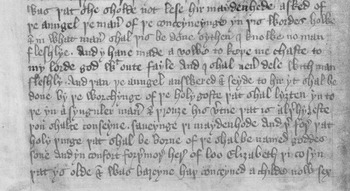
Figure 28.2 San Marino, Huntington Library, MS 149 fol.9v Mirror of the Blessed Life of Jesus Christ

Figure 28.3 San Marino, Huntington Library, MS 1339 fol.9v Mirror of the Blessed Life of Jesus Christ
The manuscripts of Love's Mirror indicate the functional overlap between auctoritas markers and direct speech markers; we can see how the two merge functionally. The ambiguous and sometimes conflicting uses of the mise-en-page markers, particularly of the red ink, show the polyfunctionality of these pragmatic strategies and illustrate the flux in writing conventions in the late medieval period. The variation in the manuscripts also assumes ideological significance, since practices of reading and translating sacred texts were politically contentious in the early fifteenth century. To examine speech marking in Love's Mirror is to consider pragmatic questions hand in hand with ideological ones, and the variation in the manuscripts shows the conflicting pressures. An investigation of speech marking in Love's Mirror that looked only at lexical speech markers without acknowledging the emerging kinds of mise-en-page marking would be flattening the story.
28.4 Conclusion
Current research in historical English language study has increased our attention to sociopragmatic context and given us more and sharper tools for analysing it. One important kind of context can be found in the textual presentation of language: the manuscripts that are our primary source of evidence for early English. To study early language, therefore, we must consider the communicative importance of its physical manifestation: the ways that language is its appearance on the page. Speech presentation, we see, is marked largely through lexical and grammatical means, but it is marked partly through the mise-en-page. To study the pragmatics of speech marking, therefore, we must consider how linguistic strategies for marking presented speech work together with (or in opposition to) scribal strategies. It is critical, then, to examine the material page, to look beyond the organization of the modern printed text to the manuscripts that lie beneath.
This chapter examined manuscript variation in two ways: within a genre and within variant manuscripts. Section 28.2 investigated variation in the genre of saints’ lives – looking at how different incarnations of saints’ vitae and legendaries indicate textual shifts between narrative and direct discourse. Section 28.3 examined variation in discourse marking strategies within the existing manuscript witnesses of Love's Mirror of the Blessed Life of Jesus Christ. Both case studies found that mise-en-page marking in early manuscripts is polyfunctional – that such marking can (among other things) indicate sententiae (particular passages that derive from recognized authorities), and can also indicate boundaries of discourse mode (such as shifting between narrative and direct speech).
Variation in the mise-en-page and polyfunctionality of organizational marks may seem at first glance to be superficial differences in textual manifestations – minor by-products of the proliferation of manuscript copies and of the multiplicity of texts within genres. In fact, however, as studies of linguistic variation teach us, variation sets the stage for language change, and it is by studying manuscript variation that we can examine the dynamics of change in the organization of written language. The proliferation of written manuscripts in the late Middle Ages and the accompanying proliferation of strategies for organizing discourse create an abundance which prepares the field for the narrowing conventions of print. Examining the visual effects of these variations on the page helps us to contextualize intertextual and lexical strategies of pragmatic organization.