

Bibeeya!
Psycholinguistics is where linguistics and psychology meet. As such, it is a huge field, covering areas as rich and diverse as language learning and acquisition, language disorders (what happens to someone’s language when they get certain kinds of brain damage), and how we ‘process’ language in real time as we hear it. In recent years, as new techniques for monitoring and imaging brain activity have been introduced, the questions surrounding how language is embodied in the brain have become more and more important. Neurolinguistics is the field which studies these questions in detail, but, aside from a brief discussion of aphasia, I will leave that aside here (partly because it requires some technical knowledge of neurology, and partly because there is little clear consensus on the central questions).
I’m going to limit the discussion here to just two areas of psycholinguistics: the study of aphasia, one kind of language disorder, and the study of how small children acquire their first language. This topic has a natural fascination, and, as we’ll see, raises questions that are central for linguistics and have relevance for certain venerable philosophical debates.
*
Let’s look first at aphasia. As I already mentioned, language disorders (or language pathology) is the study of what happens to a person’s language if they suffer brain damage of some kind (this usually arises either from a nasty accident or from a stroke). Nowadays this area is more and more part of neurolinguistics as we are becoming increasingly able to pinpoint the relation between damage to certain areas of the brain and various effects on language, but I’ll just give an overview of the main kinds of aphasia, which were identified long before the current brain-imaging techniques were developed.
Aphasia is a general term for a range of syndromes involving language impairment as a consequence of brain damage. It has been known since the nineteenth century that there are two main kinds of aphasia: Broca’s aphasia and Wernicke’s aphasia. These are named after the individuals who first identified them, Paul Broca (1824–1880) and Carl Wernicke (1848–1905). Broca’s aphasia (also known as expressive aphasia or agrammatic aphasia) typically involves rather halting speech, with many functional categories such as auxiliaries, determiners and complementisers (see Chapter 4) missing, along with inflections and other aspects of morphology and disturbances to intonation and stress. The following is an example of the speech of a Broca’s aphasic trying to describe going to the hospital for a dental appointment (from H. Goodglass and N. Geschwind [1976]. ‘Language disorders’. In E. Carterette and M. P. Friedman. Handbook of Perception: Language and Speech. Vol VII. New York: Academic Press):
Yes … ah … Monday … er … Dad and Peter H … [his own name], and Dad … er … hospital … and ah … Wednesday … Wednesday, nine o’clock … and oh … Thursday … ten o’clock, ah doctors … two … an’ doctors … and er … teeth … yah.
It doesn’t take any great expertise in syntax to see that the individual who produced this utterance is having severe problems. Very interestingly, deaf patients who communicated with sign language before becoming aphasic show very similar symptoms. This kind of aphasia can be very severe: in fact, one of Broca’s original patients was nicknamed ‘Tan’, after the only syllable he could say. However, some rote-learning can be retained, such as the ability to count from one to ten. At the same time, Broca’s aphasics who can do this are incapable of producing the same numbers in ordinary conversation. This suggests that it is some aspect of the generative capacity for syntax (the PS-rules for example) that is disturbed in this type of aphasia. This idea is supported by the fact that individual words are recognised and understood, but understanding is impaired where syntax is needed in order to get the correct meaning. For example, Broca’s aphasics tend to confuse passives and actives, i.e. they understand The mouse was eaten by the cat (passive) as The mouse ate the cat (active). Again, we see that this kind of aphasic seems to be unable to recognise the role of auxiliaries such as be and prepositions such as by, as well as the inflections on the verbs.
Wernicke’s aphasics (also known as receptive aphasia), on the other hand, are usually quite fluent and seem to be well in control of grammatical nitty-gritty like auxiliaries and inflections. But their speech, although fluent, doesn’t really make sense. In particular, lexical words, especially nouns, seem to be missing and are very often paraphrased in highly roundabout and rather confusing ways, as we can see from the following example, where a Wernicke’s aphasic is asked to describe a picture (‘What’s happening there?’):
I can’t tell you what that is, but I know what it is, but I don’t know where it is. But I don’t know what’s under. I know it’s you couldn’t say it’s … I couldn’t say what it is. I couldn’t say what that is. This shu-that should be right in here
The differences in the linguistic production of the two kinds of aphasics are quite apparent. Wernicke’s aphasics also have trouble understanding others, and indeed understanding their own speech. After recovery, some report that they couldn’t stop themselves from speaking, even though they couldn’t understand themselves. So we can also see major differences in comprehension between the two types of aphasia.
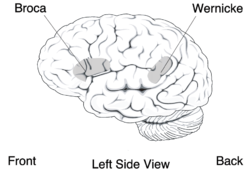
So the two types of aphasia are rather different (in medical terms, they have different etiologies). What is really interesting from a psycholinguistic (and neurolinguistic) perspective is that they involve damage to different parts of the brain. Broca identified his aphasics as having damage to a particular part of the left hemisphere of the brain (known as the inferior frontal gyrus, a rather small part of the brain, low-ish on the left side of the brain a little above and in front of the left ear). This is now known as Broca’s area, and is obviously of central importance for language. It is tempting to conclude from observation of Broca’s aphasics that that part of the brain makes possible the mastery and use of PS-rules. Nonetheless, one should be careful about connecting abstract theoretical constructs like PS-rules with actual pieces of brain anatomy. The brain is so complex that this kind of simple connection is almost certain to be proved wrong.
Wernicke’s aphasics, similarly, show damage to a nearby but distinct area known as Wernicke’s area. This is in the posterior part of the superior temporal gyrus in the left hemisphere (in most people, i.e. about 95 percent of right-handed people); this is an area a little behind and above the left ear, two or three inches back from the position of Broca’s area. The two areas are connected by part of a tract of white matter, known as the uncinated fasciculus, which also links various other parts (of both hemispheres) and whose exact general function is unclear, although because it links Broca’s and Wernicke’s areas it seems to be important for language. The two areas are shown in Figure 9.1.

So here we see how the study of a particular kind of language disorder has led to some insight into how language is represented in the brain, in that at least two main ‘language areas’ have been identified. Broca’s area, in particular, seems to be particularly important for structural aspects of language, perhaps especially syntax (although, as I mentioned above, we should be careful about making simplistic connections between parts of the brain and aspects of our linguistic abilities). Until the recent development of brain-imaging techniques, this was the only way to find out how language is embodied in the brain. Nowadays, however, there are other techniques, and we are no longer forced to rely on damaged brains to find out how language is embodied. However, to go into this further would take us into neurolinguistics proper, which I do not intend to do here, for the reasons I gave earlier.
*
Let’s turn now to our other psycholinguistic topic: how children acquire their first language. Normally, linguists talk about children acquiring, rather than learning, a first language since learning generally implies being taught and, as we’ll see, small children are not really taught their first language. Rather than laboriously learning it, children seem to rather effortlessly acquire their first language.
Before getting into the detail of what the little children do, a couple of central issues should be clarified. As we’ll see, these clarifications also apply retrospectively to much of what we’ve been looking at in the preceding chapters.
One thing that I haven’t done so far is define the word ‘language’. I’ve been relying on an intuitive understanding of what this is, and of course we’ve been building up a picture of how language works – and therefore getting a clearer idea of what it ‘really is’ – as we’ve been going along. But, in order to clarify some of the issues in psycholinguistics, we need to be clearer about our definitions now.
The problem is that language is very difficult to define, and how you define it depends partly on what you’re interested in studying. For us, though, a distinction made by Chomsky between Internal Language (I-language) and External Language (E-language) is useful. I-language is language seen as something internal to the individual: language as ultimately a property of the mind or brain. E-language, on the other hand, sees language as external to the individual minds and brains, a property of societies, cultures, etc.
I-language is the relevant concept of language for psycholinguistics. Everything we said in Chapters 1 to 5 about phonetics, phonology, morphology, syntax and semantics was really about I-language too. Also, pragmatics relies on our ability to make inferences about others’ intentions through Theory of Mind allied to I-language, so it’s really about how our minds exploit contextual information, and as such it concerns I-language rather than E-language. Historical linguistics and sociolinguistics seem to have to do with E-language. But in the case of sociolinguistics, our ability to recognise and respond to different social and regional varieties has at least an I-language component. And when we reconstruct sound changes and other lost things in historical linguistics, we are, at least in part, trying to find out what the I-languages of long-ago people were like.
So, arguably, I-language is more important than E-language. In fact, it’s really logically prior: you can’t have any E-language unless someone’s got an I-language in their head, but you could at least imagine I-language without E-language.
Another important distinction, also due to Chomsky, is that between linguistic competence and linguistic performance. We mentioned this in connection with infinite sentences in Chapter 4, but it’s worth recapitulating here. A person’s competence in their native language is their ability to control all the aspects of that language’s structure: the huge, complex, intricate array of things we saw in Chapters 1 to 5. Performance is putting competence into action: actually speaking and understanding your language. Performance depends on competence but draws on more than just linguistic abilities; when talking and listening other factors, long- and short-term memory, concentration, Theory of Mind and others, all come into play. Competence refers to the ‘pure’ linguistic abilities. This implies, for example, that competence is distinct from actually speaking and listening; my linguistic competence as a native speaker of English remains in my mind when I’m asleep, or just keeping quiet.
Competence is closely identified with I-language; we can say that a native speaker of English, for example, has native competence in their I-English (which might be different from other people’s I-English; terms like ‘English’, in normal usage, actually refer to complex cultural, sociological and historical E-things). Performance is not E-language, though; performance involves a whole range of psychological and cognitive factors in addition to I-language/competence while E-language is by definition a non-psychological notion,
Now, when we look at how a child acquires their native language, what we are interested in is the development of the I-language competence in the child’s mind. Of course, one thing that we look at is what the child says, but this is only part of the story; this is the child’s performance, which may only indirectly reflect competence, given all the other factors involved.
With these clarifications behind us, we can now start looking at how child language acquisition actually proceeds.
*
Thanks to over fifty years of quite intensive study, we now have a pretty good picture of the various stages of first-language acquisition. So here goes: it’s a pretty amazing story, as any parent can attest.
It seems that very young babies, newborns just a day or two old, can distinguish their mother tongue (quite literally: the language that their mother speaks) from other languages. What the babies seem to be sensitive to are the basic rhythm and intonation patterns of the language (aspects of phonetics and phonology we unfortunately couldn’t go into in Chapters 1 and 2). You might wonder how we know this, since babies that small obviously can’t speak and in fact don’t communicate much (except hunger and pain). Babies that age will happily suck on anything that seems like a nipple, and the sucking rate varies according to the stimuli the baby is getting. If the baby takes an interest in something in its environment, the sucking rate increases and then if there is no interesting new stimulus the sucking rate gradually tails off. So psycholinguists hook a dummy to a machine and record the sucking rates. When exposed to a recording in the mother tongue, the sucking rate increases and stays pretty high throughout the recording, but when exposed to a recording of some other language, it tails off much more quickly. So the babies seem more ‘interested’ in their mother tongue, and clearly seem able to distinguish it from other languages.
The first real linguistic behaviour (as opposed to various noises, mainly crying, gurgling and burping) emerges usually at about six to eight months.
Health warning: all the statements I’ll be making about when things happen in language acquisition are average estimates. Of course, there’s no such thing in real life as ‘the average child’; every one is different. So don’t worry if your child or sibling seems to be ‘late’. The chances are that this is just a quirk of statistics.
At this point, ‘babbling’ starts. Children start to make seemingly controlled vocalisations, i.e. they’re controlling their organs of speech. Initially, babbling consists of a range of sounds, with no particular reference to the sounds of the mother tongue. Babbling consists of simple ‘syllables’ on the general pattern of Consonant-Vowel (CV). Gradually, though, at around eight to ten months, the babbling starts to feature recognisable sounds of the mother tongue (it’s hard to say whether we could really call them phonemes or allophones at this stage).
Next, at around ten to twelve months, the first word or two comes out. Of course, it can be hard to tell what is meaningless babble and what is an intentionally produced ‘word’, and still harder to tell what the ‘words’ mean at first (and parental indulgence may dull the scientific desire for accurate knowledge). Usually the first words have a very simple phonetic structure, often a bilabial ([p], [m] or [b]) followed by a low vowel such as [ɑ]. The fact that the words for ‘mother’ and ‘father’ in many languages have a form like ma and pa is probably connected to this. At this point, then, when the babbling begins to take on meaning, we can say that the child has (somehow) acquired, and put into action, duality of patterning.
So we come to the one-word stage. The child gradually picks up a simple vocabulary and extends the repertoire of syllable types. Some time around eighteen months, the two-word stage starts. This, as the name implies, involves the apparent juxtaposition of words in order to create some kind of (compositional) meaning. Typical two-word utterances by English-speaking children are:
a. Daddy shoe.
b. Allgone milk.
c. Hit doggy.
The typical semantic relation between the two words seems to be generally either possession (‘daddy’s shoe’), predication (‘the milk is all gone/finished’) or verb-object with the subject not there, as in (1c). The order of verb and object (and other combinations) is usually the right one for the language, so English-acquiring children produce VO orders like (1c). It can often be very hard to tell what the semantic relations are, and of course there is always a temptation to read too much into a child’s utterances.
It’s important to point out that terms like ‘one-word stage’ and ‘two-word stage’ refer only to children’s production. We’re merely observing their performance here, not their competence. In fact, children understand longer sentences at these stages, indicating that their competence outstrips their performance. Indeed, it’s quite possible that children at these stages already have a fully specified, recursive syntactic system but they can’t put it to full use at this early age because of performance factors such as memory limitations, short attention span, limited vocabulary, etc.
One important feature of this period is that there are no words representing functional categories such as articles or auxiliaries and no inflections in the children’s production; again, though, there is evidence that children understand these elements at this stage. This is also true of the next stage of acquisition, from roughly twenty-four to thirty months. Here we see longer utterances but still no words belonging to functional categories or inflectional morphology, as in:
a. Baby doll ride truck.
b. Pig say oink.
c. Want lady get chocolate.
(You can see that in (2c) the subject is missing, but probably the intended subject is 1sg here; ‘missing’ subjects are another striking syntactic feature of early speech). Owing to the lack of closed-class words and inflections, this stage is often referred to as ‘telegraphic speech’ (harking back to the days of telegrams, an obsolete means of communication where you had to pay for every word, so people tended to leave out the functional words and stick to the lexical categories).
The next stage is perhaps the most interesting. We’ve just seen that after the two-word stage somewhat longer sentences start to emerge. There is apparently no recognisable three-word or four-word stage. At around thirty months, what happens is a kind of grammatical explosion. The child starts producing something very close to fully grammatical, adult-like sentences, complete with closed-class elements like articles and auxiliaries, as well as inflections:
a. I’m having this little one.
b. Mummy hasn’t finished yet, has she?
It seems, then, that at this stage the syntax comes on line for real. Of course, there’s more to do still: lots of vocabulary to learn and often inflections need sorting out.
One well-established result in the research literature on first-language acquisition concerns past-tense inflections in English. As we saw in Chapter 2, the regular past-tense ending is <(e)d>, phonologically conditioned as /d, t, ɪd/. Then there are the various irregular verbs such as sing, bring, etc. One perfectly reasonable thing to expect children might do is to overgeneralise the regular inflections, saying things like singed and bringed and so on. Children do in fact do this, but it’s more interesting. The acquisition of past-tense inflections follows a U-shaped curve, in that, at first, children mostly ‘get it right’: they correctly produce both regular and irregular inflections. Then they go through a phase of overgeneralising, and then, finally, they distinguish the irregulars from the regulars, approximating very closely to the adult language. Psycholinguists have interpreted this to mean that, at first, children treat all verbs as irregular; they simply haven’t figured out any ‘rule’ for the past tense and are learning the past-tense verbs one by one. Then they figure out the ‘add-<(e)d>’ rule and over-apply it. And finally they work out which verbs are regular and which are not. So the children go from no rule, to an over general rule, to the ‘correct’ rule.
Here’s another one, this time involving how children acquire quantification. It has long been observed, possibly first by the Swiss psychologist Jean Piaget and his collaborator Barbara Inhelder, that children between roughly ages three and seven make interesting errors with universal quantifiers. Look at the following array of shapes:

Are all the circles black? Of course they are. But when children are asked this, they typically reply ‘No: there are two black squares’. In other words, they interpret the question to mean ‘Are all the black things circles?’ This result has been quite consistently attained for four- and five-year-olds in a variety of different experimental settings. At a later stage of acquisition, they correctly apply the quantifier. There is much debate among psycholinguistics as to what is going on here, but two things are clear. First, the phenomenon is real; children really do this at a certain stage of language acquisition. Second, they only do it with universal quantifiers. Fascinating and mysterious stuff, I’m sure you’ll agree.
So there is absolutely no question that first-language acquisition is an impressive feat. Children appear to have all of the structural mechanisms we described in Chapters 1 to 5 – fine-grained control of the organs of speech, phonological rules, duality of patterning, recursive syntax and compositional semantics – in place before they start school. In fact, in most cases, well before they can tie their shoelaces. It is a simply staggering intellectual feat, probably the most impressive such feat most of us ever manage in our whole lives.
Just to rub the point in, think of the acquisition of vocabulary alone. So forget all the fancy phonetics, phonology, morphology and syntax for a moment. How do children figure out that words mean what they mean? We don’t know, but we do know that, at around three to five years old, children are learning on average ten new words a day. Given that they typically sleep ten to twelve hours a day at that age, they’re almost learning one new word every waking hour!
Now think of learning a foreign language (which I’m sure you’ve tried to do at some point). Learning ten words a day (seventy a week, three hundred a month) is damn hard work. And if your French teacher tells you that vache means ‘cow’, you have the advantage of already knowing what a cow is. Children learning their first language don’t have dictionaries and translations. Ok, you might say that they learn by being shown what a cow is. You can learn what a cow is if someone points at one and says ‘cow’. But try figuring out whether it’s the cow’s colour, its shape, the space it’s occupying, a future hamburger or a non-detachable cow-part that’s being pointed at. This method of learning word meanings gets you nowhere. Try to work out the meaning of three, not, give, climb, me, you, that or existence on this basis.
So how on earth do children do it? This is where the philosophers come in …
*
The great Cambridge philosopher Alfred North Whitehead (friend and collaborator with the even greater Bertrand Russell) once said ‘the safest general characterisation of the European philosophical tradition is that it consists of a series of footnotes to Plato’. The issues connected to first-language acquisition make up one of the longer and, certainly for linguists, one of the more interesting footnotes. The fundamental question is this: is there such a thing as ‘innate ideas’, ideas – or knowledge – inborn in us and so not determined purely by experience? This question is fundamental to philosophy of mind and epistemology (the study of the nature of knowledge). Over the centuries it has also taken on political and religious connotations.
Plato believed that we do have innate ideas. He thought we remembered these from an earlier existence. His mentor Socrates demonstrated the existence of such ideas by eliciting a theorem from a boy untrained in mathematics. Under the questioning of Socrates (the ‘Socratic method’), the boy had nothing other than his innate geometrical intuitions for answers on the nature of shapes, areas and related concepts: he could just see – with his mind’s eye – how these concepts fit together (literally), just as we can know how it must be true that the square of the hypotenuse of a right-angled triangle is equal to the sum of the squares of the other two sides (a2 + b2 = c2). Plato’s solution to the problem of how we can see this kind of truth is that we were born with the relevant knowledge.
This point of view has come down through the centuries in various guises. The seventeenth-century French philosopher René Descartes (who we briefly encountered in the last chapter) held a similar view. For example, he pointed out that we never see a true triangle, as every ‘actual’ triangle we see in this imperfect world has wiggly bits instead of three perfectly straight sides, and the angles don’t add up to precisely 180°. But when your geometry teacher starts telling you about triangles, you can intuitively understand what a true triangle looks like because you have an innate idea of The Triangle. Descartes went on to suggest that the contents of our minds (which he held to be made of a different substance from our – or any – body, the doctrine known as metaphysical dualism) consist in part of ‘clear and distinct’ ideas, put there by God. On the other hand, various British philosophers, notably John Locke and David Hume, argued that the mind is a blank slate on which experience writes. According to them, knowledge comes either from experience or from ‘association of ideas’.
What has first-language acquisition got to do with all this high-flown philosophising? The astonishing feat of acquiring such complex knowledge at such an early age (and seemingly without trying too hard) raises the issue of innate ideas all over again. The central question is this: what does a newborn know about language? The obvious answer is ‘not much’, but not much isn’t the same as nothing, and first-language acquisition raises the question in an acute way. In fact, we’ll see later that it may be that newborns actually know quite a bit.
The common-sense view (which many people in the English-speaking world in particular have inherited from Locke and Hume without realising it) is that newborns know nothing about anything, except perhaps nipples. They learn their first language from experience, and their parents and siblings play a role in ‘teaching’ it to them (for example, by pointing at a cow and saying ‘cow’). Partly for reasons given earlier (point at the cow’s colour, etc.), partly because of the results of psycholinguistic research and partly because it’s very hard to see how notions such as duality of patterning, recursion and compositional semantics could be taught to babies or toddlers, we know that the idea that parents and siblings ‘teach’ little children their language is a non-starter. Children are linguistic autodidacts, although of course they need to hear a language in their environment, and which language they hear will determine which language they end up speaking.
More generally, common sense has no role in scientific or philosophical investigation. Ask a physicist what she thinks about the common-sense view of space and time and how that relates to what physicists now understand as ‘physical reality’. Common sense has absolutely no logical or epistemological priority.
So: what do newborns ‘know’ about language? Chomsky has put forward a view which has become known as the argument from the poverty of the stimulus. It goes like this: Any form of a person’s knowledge must either come from experience, i.e. from outside the person, or from within. If it comes from within, it arises either by inference – as a matter of logical deduction – or from some predetermined constraint on knowledge, i.e. as a kind of innate idea. Where does knowledge of your native language, competence in your I-language, fit into this picture?
Well, very little of that knowledge can be deduced from first principles using known forms of logical inference, so that method doesn’t seem to apply. The central question then is: can linguistic knowledge be entirely learned from experience? Chomsky’s answer is no: the knowledge in its final state – the I-language competence of the average five-year-old – is too complex, too structured and too rich to have been learnable on the basis of experience alone. The simple facts about vocabulary acquisition – so many words, so little time and nothing to go on – bear this out. And of course when we think of the phonetics, the phonology, the morphology and, above all, the recursive syntax and the compositional semantics, the point becomes still more forceful.
So I-language competence is neither deduced nor picked up from experience (at least not in total). Therefore, something must be there at the start; the blank-slate idea just won’t allow us to make sense of first-language acquisition. More precisely, the ‘something’ must be a general schema for language which constrains the acquisition process by making certain logically possible or imaginable types of language actually impossible. So then all human languages must conform to certain general predetermined schemata (e.g. they must have phonemes, morphemes, PS-rules, etc). These things must be ‘there’, i.e. in the newborn mind, at the start, at birth or even before (depending on how much cognitive development goes on in the womb). So, linguistic innate ideas – a very nice footnote to Plato.
Where do these innate ideas come from? Probably nobody literally believes in Plato’s ideas about remembering an earlier existence any more, and God is pretty much absent from modern scientific thinking (mainly because He doesn’t seem to do much; most things can be explained without divine intervention). But nowadays we have genetics: the innate ideas might reside in the human genome. Given that only humans have language, the innate language faculty could be a product of our special 2 percent, which I mentioned in the Introduction.
So that’s the view: the complexity of the linguistic knowledge of the usual five-year-old is such that it is implausible to think that it was all acquired from experience. Experience must be shaped and constrained by something predetermined: a set of ‘innate ideas’ about the structure of language, presumably somehow encoded in our special 2 percent of genome, the 2 percent that distinguishes us from chimps.
This argument is important, and has been hugely influential in linguistics, psychology and philosophy. It is also, you won’t be surprised to learn, very controversial. Before getting to the controversies, let’s just clarify two points.
The first is that the argument is not a deductive proof (although it may be possible to prove that recursion can’t be learned from experience, but this would go beyond the informal version of the argument that I gave above). The crucial word in my summary of it above is ‘implausible’. It’s implausible, but not impossible, that all aspects of linguistic knowledge are learned from experience. The second point is that Chomsky isn’t saying, and has never said, that all linguistic knowledge is innate; some of it comes from experience for sure. For example, which language you end up speaking is determined by your linguistic environment, so nobody is suggesting that Chinese or English are innate.
The principal criticism of Chomsky’s position to emerge in recent years is that it is possible, and some developments in computer science make it plausible, that humans are much more efficient learners than has been assumed. In particular, certain kinds of statistical learning (figuring out what’s most likely to follow what on the basis of exposure to examples) may be able to account for an awful lot of the mysterious-seeming aspects of first-language acquisition. It certainly can’t be denied that predictive text is possible; you’ve probably got it in your phone. That kind of thing is based on modelling and learning statistical correlations (which your phone can do). So are children just really smart smartphones?
As I said, it’s possible. But smartphones have ‘innate ideas’ too. They’re programmed to do predictive text and programmed to learn. So really the statistical learning idea doesn’t do away completely with the idea that something about language is predetermined. But this position contrasts with the Chomskyan view as I presented it in two ways. First, there’s arguably less stuff predetermined, and, second, it’s not specific to language. The statistical learner can learn all sorts of things. So the real questions that first-language acquisition raises are not whether something is innate, but how much, and what. These remain open and much-debated questions. Research on areas as diverse as language acquisition, how computers can simulate learning, how different we really are from chimps and – as we’ll see in the next chapter – the diversity of languages contributes to trying to figure out the answers to these very important questions.
*
Here we’ve looked at just three questions in psycholinguistics. The first one was a brief look at the main kinds of aphasia that have been identified. The second was what goes on when children acquire their first language, and here we saw the stages of acquisition and some of the rather surprising things that psycholinguistic research in this area has turned up. The third related to Chomsky’s argument from the poverty of the stimulus that something predetermines the form of language, which explains how children are so incredibly good at language acquisition. This ‘something’ predetermining the form of language revives the age-old philosophical question of innate ideas.
There’s another consequence of Chomsky’s argument which I’ve barely mentioned here. If there is some innate linguistic capacity, and if we’re all the same (at least as newborns), then all languages must show signs of this capacity. There must be universal features of language. This is why Chomsky’s theory is referred to as Universal Grammar. In the next chapter, I’ll turn to the question of whether, by studying the diversity of languages, we can discern at the same time what does not vary, what is universal.