

Read this sentence aloud slowly and carefully, feeling what your tongue, lips and other speech organs are up to. Then pronounce it at normal speed, which takes about five seconds. The sentence contains sixty-eight sounds. As far as we know, no other species on earth has this degree of fine control over their counterparts of the human speech organs, whose primary role – and what they mainly evolved for – was something else: chewing, swallowing and breathing mainly.
But of course language isn’t just pyrotechnics; we’re not just making noises for fun. Our five-second, sixty-eight-sound burst of intricate activity by the tongue, lips and so on results in noises that mean something. If you produce that five-second, sixty-eight-sound gyration, I can understand what the words mean (which of course means finding the words in there, and then putting them together somehow). And I can do it in real time. You don’t have to wait, not even for a few seconds, after finishing your cleverly modulated exhalation for me to register it, process it and come up with an answer; I can do it (almost) instantaneously. This, the simplest everyday currency of human interaction, is a staggeringly complex physical and neurological feat, so complex that there remains much that we don’t understand. But we do know a fair bit, and over the next few chapters we’ll look at some aspects of what is going on in these banal everyday speech interactions. We begin by looking at the noises themselves.
The main topics of this chapter are:
Consonants and how to classify them
Vowels and how to classify them
The International Phonetic Alphabet
A sketch of the phonetics of English
Normally we speak by modulating air exhaled from the lungs. This is the only way we do it in normal English although some languages make partial use of other air-streams (as they are called). The passage from the larynx through to the lips (as well as the alternative exit through the nose) is known as the vocal tract. The various organs that the airstream encounters on its way out from the lungs are the organs of speech. A diagram of the organs of speech is given in Figure 1.1.
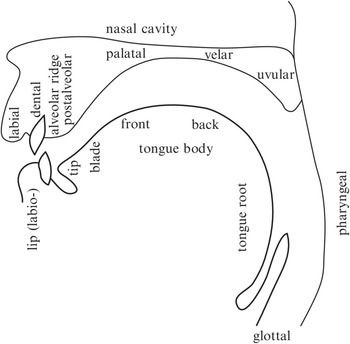
Figure 1.1 The Organs of Speech.
Consonants modulate the airflow by creating an obstacle that creates a noise in one way or another. Vowels modulate it by altering the shape of the vocal tract so that it resonates in different ways. Now let’s look at these two basic types of speech sound in turn. I’ll limit the discussion and illustrations largely to (Standard British) English, although of course other languages have other sounds, one or two of which I’ll briefly mention.
Consonants
Let’s start with consonants, as they’re easier to feel, in a way. Actually, it’s a good idea to practice making the various noises that I’ll be talking about as we go along; I promise you’ll be able to do them all. It might be a good idea to do your phonetics practice somewhere private, as your friends, relatives and possibly your pets may be alarmed by some of the noises you start to emit.
So, start with an s-sound. Pretend you’re a snake and just say the longest ‘s’ you can: [sssssssssssssssss].
Now stop hissing and make the longest ‘z’ sound you can: [zzzzzzzzzzzzzzzzz] (a bee rather than a snake). Now (and this is where you really should be somewhere private), put your finger on your Adam’s Apple and repeat the long ‘s’, followed immediately by the ‘z’, followed again by the ‘s’: [sssszzzzsssszzzz]. Do that a few times. You should be able to feel vibration in your larynx when you’re saying the z’s, which is turned off when you say the s’s. Everything else, notably the position of your tongue, is the same. You should in fact be able to feel that the sides of your tongue are touching an area just above and behind your top teeth (this is called the alveolar ridge, see Figure 1.1), while there’s a little groove down the middle of your tongue, right to the tip, through which the air is passing. The [s] and [z] sounds both have the same place of articulation, i.e. the tongue and all of the other organs of speech are in the same position for both sounds. What distinguishes them is the vibration that you can feel in your larynx – this is called voicing. So we call [z] a voiced, alveolar, fricative: ‘voiced’ because your larynx is buzzing, ‘alveolar’ because of the position of your tongue and ‘fricative’ because the air becomes turbulent passing through that little groove in your tongue and the gap between your tongue and your top teeth, creating a high-frequency noise. Correspondingly, we call [s] a voiceless alveolar fricative. It’s an alveolar fricative like [z] – same place of articulation, tongue and all other speech organs in the same place – but the larynx is switched off, so there’s no voicing.
What’s really going on in the larynx that makes the difference between [s] and [z]? Some aspects of voicing are quite complex – both in terms of the physics of the airstream and the very precise anatomical position of the vocal folds (commonly but inaccurately called the vocal cords) – so I won’t go into full detail here. Suffice it to say that when there is no voicing the vocal folds are at rest and apart, as in normal breathing, so the air passes through on its way out from the lungs unimpeded; thus, there is no acoustic effect. Voicing is produced when the vocal folds are drawn together in such a way as to create turbulence in the passing airstream, giving the acoustic effect of a kind of buzzing sound (this will be lower frequency in adult males as their larynxes are somewhat bigger than women’s and children’s). It is also possible to close the vocal folds completely. We’ll come back to the glottal stop – the sound that emerges when your vocal folds pop open again and air comes rushing out – later.
Let’s come back to fricatives. Try saying a really long [f]-sound: [ffffffffffff] (here you might imagine wanting to use a certain swear word but feeling too polite to get beyond the first consonant). Now say a long [v]-sound: [vvvvvvvvv]. Now alternate them with your finger on your larynx again: [ffffvvvvffffvvvv]. You should notice the same effect as earlier with the [s]’s and [z]’s. That’s because [f] is voiceless (no laryngeal buzz, vocal folds apart and at rest), while [v] is voiced (larynx ‘switched on’, vocal folds vibrating). But the place of articulation of [f] and [v] is different to that for [s] and [z]. In fact, you should be able to feel it quite easily: your top teeth are just lightly touching your lower lip, just enough to create high-ish frequency noise in the airstream (lower than the noise in [s] and [z]). For these reasons, we call them labio-dental fricatives; labio for ‘lip’ and dental for ‘teeth’. So [f] is a voiceless labio-dental fricative and [v] is a voiced labio-dental fricative.
Here’s another pair of fricatives: try saying a really long ‘th’-sound (imagine a lisping snake). Since English awkwardly writes this single sound with two letters, the International Phonetic Alphabet (IPA) symbol is the Greek letter theta: [θθθθθθθθθθ]. Now, putting your finger on your larynx you should feel nothing: [θ] is voiceless. Its place of articulation? You should be able to feel your tongue between your teeth, or more precisely the part just behind the tip of your tongue (called the ‘blade’) pushing against your top teeth, again creating turbulence and making a high-frequency noise. So we call this an interdental fricative.
Now put your finger against your larynx and try to switch on the voicing. You should hear a sort of ‘dddhhh’ sound. This sound is also, confusingly, written <th> in English: it’s the <th> of mother, brother, father, this, that, those, these and the (the other sound written <th>, the voiceless [θ], is that of earth, birth, mirth and thing, for example). The phonetic symbol for the voiced <th> sound is [ð] (an old Germanic letter, still used in Modern Icelandic, called ‘eth’). So [θ] is a voiceless interdental fricative and [ð] is a voiced interdental fricative.
One final pair of English fricatives. The voiceless one is the sound usually written <sh>, as in shop, ship and fish. If you compare this with [s], for example by saying sip then ship in quick succession, you’ll feel your tongue move backwards and change shape for the articulation of the <sh> sound, with the sides of the tongue curling up slightly. This sound, since it’s articulated a little behind the position for the alveolar fricatives [s] and [z], is known as post-alveolar. Again, since it’s a single sound written with two letters in English, we use the IPA symbol [ʃ]. The voiced counterpart of [ʃ] is found in the middle of words such as measure, leisure and treasure, as well as in words like rouge. You can tell it’s the voiced counterpart of [ʃ] by applying the usual finger-on-larynx test. The IPA symbol for this sound (which doesn’t have a unique or terribly consistent spelling in English) is [ʒ]. So [ʃ] is a voiceless post-alveolar fricative and [ʒ] is a voiced post-alveolar fricative.
So, now we’ve seen almost all of the fricatives of English, which we can put in a table as follows:
Standard English has one other fricative, [h] as in hill, hair and hide. This sound is made by the creation of slight turbulence – but no voicing – as the air passes through the larynx. Accordingly, it is technically a voiceless glottal fricative. English has no voiced counterpart to [h], although this sound is found in Czech, Hebrew and a few other languages.
Some varieties of English, notably Liverpudlian and some types of Scots, have another fricative, the ‘guttural’ sound at the end of loch. This sound is also found in German, as in the name of the composer, Bach, and in Welsh, where bach means ‘little’. To pronounce this sound, raise the back of your tongue towards the roof of your mouth, keeping the tip and blade in their resting position behind the back teeth. The IPA symbol for this sound is [x]. Raising the tongue as just described causes turbulence as the air passes between the tongue and the soft palate or velum (see Figure 1.1). Accordingly, this is called a voiceless velar fricative. If you can switch the voicing on while pronouncing [x], you’ll get the sound written in IPA as [γ], the voiced velar fricative. This sound is how the <g> is pronounced in a Spanish word like avogado (‘lawyer’).
Next, we come to stop consonants. As their name implies, stop consonants involve a complete blockage of the vocal tract. To see this, try pronouncing a [p] (as in pea, pee or 20p). You can easily tell that it involves closing your lips. If you try to ‘hold’ the [p], you’ll feel air pressure building up behind your lips. If you then open your lips, the pressure is released with a little explosion of air, making the characteristic sound of a [p]. (In fact, you can’t really hold a [p] for any length of time without going blue in the face – again, this is because your lips are completely blocking the airflow to and from your lungs). Interestingly, then, you can only really ‘hear’ a [p] when you finish pronouncing it; the ‘hold’ phase of a [p] consists of silence. This can be seen in a spectrogram, as shown in Figure 1.2.
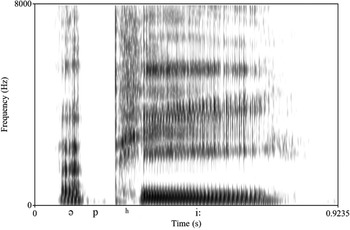
The ‘release’ phase – the little explosion – is what we hear. For this reason, stops are also known as plosives. Since the articulation of [p] involves closing both lips, it is known as a bilabial stop. Furthermore, the silence during the hold phase indicates that [p] is voiceless, so the full description of [p] is voiceless bilabial stop.
The voiced counterpart of [p] is [b] (as in bee, bear, brain, etc). If you try to hold a [b] you’ll notice the same build-up of air behind your closed lips as for [p], but you’ll also notice a kind of repressed grunt coming from your larynx. This is the effect of the vocal folds vibrating while the lips are closed, so the air coming from the lungs is affected by the action of the vocal folds in the same way as for the voiced fricatives but then gets blocked behind the closed lips. In the release phase, there is again a small explosion as the lips part, as for [p]. So [b] is a voiced bilabial stop.
There are two other pairs of stops in English: [t, d] and [k, g]. Each of these is a voiceless-voiced pair, as for [p] and [b], and each involves blockage of a different place in the vocal tract. The [t, d] pair are alveolar stops. So here the blockage is at the alveolar ridge, the place where the fricatives [s] and [z] are articulated, as we saw. Pronounce a [t] and you should be able to feel your tongue (for most English speakers, it’s the blade of the tongue) against the alveolar ridge just behind your top teeth. As you might expect by now, [d] is pronounced at the same place but with the larynx buzzing.
The [k, g] pair are pronounced by raising the back of the tongue to the velum (or soft palate), as we saw for the velar fricatives [x, γ]. If you pronounce key and ghee, you should be able to feel this. Again, holding the [k] produces silence while the air builds up behind the blockage, and holding [g] produces a little grunt from the larynx.
Before leaving the stops, we should come back to the glottal stop. Remember that this is produced by closing the vocal folds completely, causing air pressure to build up below the larynx and giving rise to the usual little explosion when they pop open. Glottal stops are common in English, especially British English, although there is no standard spelling for them. The glottal stop is common in the colloquial Southern British English pronunciation of <t> in between vowels, in a word like water; this pronunciation is sometimes written wa’er in an attempt to indicate the glottal stop. The IPA symbol for the glottal stop is [Ɂ] (note that this symbol isn’t the same as a question mark ‘?’). So we can write the colloquial pronunciation of water as [wɔ:Ɂə] (don’t worry about the vowel symbols [ɔ:] and [ə] for now; we’ll get to those later). The ‘correct’ British pronunciation of water can be written in IPA as [wɔ:tə].
Our next little group of consonants are the nasals. As the name implies, their articulation involves the nasal cavity (see again Figure 1.1). The airstream gets access to the nasal cavity when the velum is lowered, allowing the air to pass through it. In normal, at rest, breathing the mouth is closed and the air goes in and out this way, as you notice when you get a cold and your nose is bunged up and you have to breathe through your mouth.
In speaking, of course, the mouth is mostly open (except when bilabial stops are being pronounced). And in the pronunciation of all of the consonants we’ve seen so far, the velum is raised, preventing the airstream from getting out through the nose – hence the silence in the hold phase of voiceless stops. Since nasals involve air going out through the nasal cavity, their articulation involves the velum being lowered to allow this. In the oral cavity, however, there is the same complete blockage as in the stops, and so the only way for the air to get out is through the nose. You can see this if you try to say a long [m]: [mmmmmmmmmmm]. Now try saying [mmmmmmmm] while holding your nose. You’ll find you can’t, and you’ll quickly feel the air pressure building up in your nasal cavity (you can actually pop your ears this way). This is because pronouncing [m] involves closing the lips, but lowering the velum so the air flows out through the nose. So when you block your nose, the air has no way out. The resonance in the nasal cavity gives [m] its acoustic characteristics. You’ll notice that the larynx is switched on when you say [mmmmmmmmmm]. So [m] is a voiced bilabial nasal (technically it’s a stop, since the airstream is blocked in the oral cavity).
English has two other nasals. There is the alveolar [n] (as in night, nun, noon, etc), pronounced with blockage at the same place of articulation in the oral cavity as [t] and [d] but, again, with the velum lowered allowing the airstream to pass through the nasal cavity. For example, try saying [nnnnnnnn] and holding your nose. Then there is the velar nasal, which English writes as <ng>, as in king, thing and bringing, for example. The IPA symbol for the velar nasal is [ŋ]. This nasal is pronounced like the stops [k] and [g] but with the velum lowered so the air goes out through the nose. Try the nose-holding test again and you’ll see.
The English stops and nasals are given in Table 1.2.
Table 1.2 English Stops and Nasals
| Bilabial | Alveolar | Velar | Glottal | |
|---|---|---|---|---|
| Voiceless stop | p | t | k | Ɂ |
| Voiced stop | b | d | g | |
| Nasal | m | n | ŋ |
English has two affricates, a voiced and voiceless pair again. The voiced one is usually written <j> or <dg>, as in judge, where it occurs twice, once in each spelling. The voiceless one is usually written <ch>, as in church (again occurring twice). Affricates are complex sounds, involving a stop phase followed by a slow-release phase, so that as the articulators come apart from the stop phase, some turbulence characteristic of the fricatives is created, rather than a neat little explosion as in the case of ‘pure’ stops. Because they have two parts from a phonetic perspective, the IPA writes these affricates as digraphs. The English affricates involve an alveolar stop but with post-alveolar release, which is the tongue moving back from the point of blockage (you can feel this if you say jump or chump really slowly). Thus, the IPA combines the symbols for alveolar stops with those for post-alveolar fricatives: [ʤ] as in jump and [ʧ] as in chump.
There are just two more consonants in English, usually known as the liquids. These are the lateral [l], as in leap or peel, and the rather complex [r]. The lateral [l] is so called because the tongue makes a blockage, again with the blade against the alveolar ridge, but the sides of the tongue are held down so that air passes through that way. This consonant gets its name from this lateral airflow. There’s no turbulence here, so [l] isn’t a fricative.
The Standard English [r] is rather complex, as I already mentioned. Try to hold the [r] in a word like round and you will probably notice several things: your lips are pursed and your tongue is bunched forwards towards, but not touching, the alveolar ridge, in fact it’s in the post-alveolar area. There’s also voicing, as you’ll note in the usual way. There isn’t any blockage of the airstream here.
In many languages, the sound written <r> is very different to the English one. In quite a few languages, it is an alveolar trill, involving the tongue vibrating against the alveolar ridge. This is what we find in Spanish and Italian, for example (it is also found in many varieties of Scots English). The French <r> is different again, involving the uvula, an articulator not used in Standard English.
Since neither [l] nor [r] involve either turbulence or blockage of the vocal tract, they are neither fricatives nor stops. Since they do involve turbulence and blockage, fricatives and stops can be grouped together as obstruents (obstructing the airstream). Sounds like [l] and [r], on the other hand, can be classed as sonorants, since they are more ‘sonorous’ (admittedly a rather subjective notion) than the other consonants of English.
So now we have the complete inventory of the consonants of Standard English, shown in Table 1.3.
Table 1.3 English Consonants
| Bilabial | Labio-dental | Alveolar | Post-alveolar | Velar | Glottal | |
|---|---|---|---|---|---|---|
| Stop | p, b | t, d | k, g | Ɂ | ||
| Nasal | m | n | ŋ | |||
| Fricative | f, v | s, z | ʃ, ʒ | (x) | h | |
| Affricate | ʧ, ʤ | |||||
| Sonorant | l | r |
Vowels
Vowels differ from consonants in that they don’t involve any blockage of the airstream going through the vocal tract, but rather alter its shape so that the cavities in the vocal tract resonate in different ways, producing different patterns of harmonics which give rise to the different ‘qualities’ we hear in different vowels. The detailed study of these harmonics is fascinating and would take us well into the domain of acoustic phonetics, the study of the physics of the speech sounds.
The shape of the cavities of the vocal tract can be changed in three main ways. You can do it by rounding or spreading your lips, by moving your tongue so as to change the shape of the oral cavity, or by opening and closing the velum to let air out through the nose (or not). In Standard English, all vowels are oral, i.e. they are produced with the velum raised so that air goes out through the mouth only. So the third option isn’t active in English (it is in French, which has three or four nasalised vowels, depending on the dialect).
The options for moving the tongue around in the mouth are quite complex: the tongue is a very mobile, muscular organ. But we can simplify a bit and describe many English vowels in terms of two dimensions for the tongue: it can move forwards and backwards and up and down. So we classify vowels as front, central or back, according to the tongue’s position in the horizontal dimension, and high, mid or low, according to its position in the vertical dimension. The position of the lips offers a further classification into rounded (lips pursed) and unrounded (lips spread or neutral).
Now try saying the words ‘really small’ in as slow and drawn-out a way as you can: ‘reeeeeeeaaaaaaaally smaaaaaaaaall’. As you say the <ea> of ‘reeeeeeeaaaaally’ you can feel your lips spread and the body of your tongue raised to a position close to – but not touching – the roof of your mouth (actually the hard palate). So this vowel is a high (tongue raised), front (tongue forward), unrounded (lips spread) vowel. The IPA symbol for this vowel is [i].
Note: English spelling is highly idiosyncratic. For this reason, we’ll see a lot of mismatches between the spellings of English vowels and their IPA symbols. The reason for this is that English is spelled roughly the way it was pronounced in about 1450. The pronunciation of the vowels has changed a lot since then, but the spelling hasn’t.
Transition from ‘reeeeeeeeeaaaaaaaaally’ to ‘smaaaaaaaaaaall’. You can feel you tongue dropping and backing inside your mouth (your lower jaw opens a bit too) while your lips purse. This is because the vowel written <a> in small is a low (tongue dropped), back (tongue backed), rounded (lips pursed) vowel, IPA [ɔ].
Warning to American readers: I’m describing the (Southern) British English pronunciations here and below. American English has a somewhat different vowel system, especially as regards the phonetics. It would take too long, almost a whole book in itself, to systematically point out all of the differences (and of course, there are differences among American varieties, especially in the South and in New England). I’ll point out the most important ones, and I apologise for not being able to do more. You may also want to try and follow the descriptions of the British pronunciations here, and see how you sound (I make no guarantees, but you might have some fun with it anyway). An immediate example is the <a> in small, which in most American varieties has the tongue in about the same position as in British English but the lips are neutral rather than rounded. The same warning applies to most speakers of Scots or Irish varieties of English, which are different again. I’ll come back to some of these questions in Chapter 8.
Now say ‘smaaaaaaaaall caaarrrrrr’. Here you can feel your tongue move forward from the position for the [ɔ] of small, down a bit (with the jaw opening a bit more) and the lips unpursing. So the vowel of car is a low, central and unrounded vowel, IPA [ɑ]. (If you’re American, Scottish or Irish, you probably also pronounce the <r> in car; if you’re English, Australian or a New Zealander, you probably don’t. We’ll come back to this in Chapter 8).
Next, say ‘Are you . . . ?’ as slowly as you can (some of you may remember the scene in The Railway Children where the children first encounter the Russian migrant, and politely speaking very slowly, ask him ‘Are you Welsh?’). The vowel in are is the same as the one in car, [ɑ]. Going from are to you, you can feel your tongue move up and back (with your lower jaw closing partially) and your lips pursing. That’s because the <ou> of you is high (tongue raised), back (tongue retracted) and rounded (lips pursed), IPA [u].
These four vowels are the principal long vowels of English. In IPA, long vowels are written with a colon after them, [i:, ɑ:, ɔ:, u:]. English, particularly British English, has an unusually complex vowel system compared to many languages. In addition to the long vowels, there are several short vowels, as well as a number of diphthongs (I’ll explain what these are below).
Now try saying the following words one after the other: bead, bed, bad, bud and bod. As you say these words, you should be able to feel your tongue moving down from the high, front position for bead (in IPA [bi:d]), through the <e> of bed, the <a> of bad, the <u> of bud and the <o> of bod. The last four are all short vowels: front mid in bed (IPA [ɛ]), front low in bad (IPA [æ]), central and a bit below mid in bud (IPA [ʌ]) and low back in bod (IPA [ɒ]). All are unrounded except for the [ɒ] of bod. (The last two vowels are different in American English, and if you’re from the North of England, you probably have a different vowel in bud, the high, back, rounded [ʊ]). These short vowels don’t directly contrast in length with the four long vowels we saw earlier, in that they are different both in quality and in length from the long ones (although [ɒ, ɔ:] and [æ, ɑ:] are fairly close in quality in some varieties of British English). There are two short vowels that almost contrast in length with [i:] and [u:], though. These are found in words such as bid and look. Compare bid and bead. You should be able to hear a length difference, in that the bid vowel is shorter than the one in bead. You should also be able to tell that the position of the tongue in the bid vowel is slightly lower and more central than the bead one. In IPA the bid vowel is written [ɪ]. So we have [bɪd] (bid) vs [bi:d] (bead). Comparing your articulation of these two vowels, you may be able to feel a difference in the ‘tenseness’ of your tongue and lips: the muscles are quite tense in bead but somewhat more lax in bid. For this reason, these two vowels are sometimes referred to as tense and lax respectively, but I’ll stick to the length distinction, with bead long and bid short. (Things are very different in Scots and Ulster English; I’ll briefly come back to this in Chapter 8).
The difference between the vowel of look and that of the proper name Luke is similar. The Luke vowel is the long, high, back and rounded [u:] of you, which we’ve already seen. If you compare the pronunciations of look and Luke, you should again be able to discern a difference in length, with Luke noticeably longer than look. Again, comparing your tongue position in the two words, you can feel that the look vowel is a little more central and slightly lower than the Luke vowel. The look vowel is IPA [ʊ]. Also, there is a similar tense (Luke) vs lax (look) difference to that we saw in bead vs bid just now. (If you’re from the North of England, you may find that you also pronounce luck with an [ʊ], just like look; in southern varieties, luck has the [ʌ] of bud, described above, but in many northern varieties [ʌ] doesn’t exist at all).
There’s one further short-long pair, at least in Standard British English. The short one is the first vowel in words such as around, about and asleep or the vowel in the way words like the and a are pronounced in connected speech (as in the book and a person). This is a mid-central unrounded vowel. It is known as ‘schwa’ and its IPA symbol is [ə]. This vowel is extremely common in unstressed syllables (syllables with no emphatic accent) in most varieties of English. Schwa is a short vowel, as you can see from the examples. British English also has a long mid-central unrounded vowel, found in bird, word and third, for example. This is almost exactly a long version of schwa, at least for many speakers. Its IPA symbol is [ɜ:].
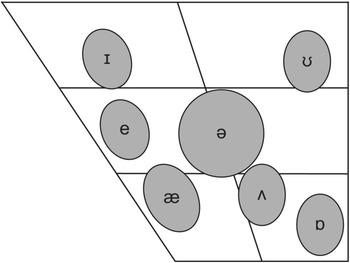
We can plot the horizontal and vertical positions of the tongue on an equilateral intended to schematise the space in the oral cavity within which the tongue moves to produce vowels, as in Figure 1.3 (this is sometimes rather misleadingly called the ‘vowel triangle’). Figure 1.3 gives the short vowels of English, as we’ve seen them up to now. They are plotted on the equilateral diagram indicating their tongue positions in the oral cavity along the two dimensions.

Figure 1.3 Short Vowels of Standard Southern British English.
Next we need to look at diphthongs. A diphthong is a complex vowel. All the vowels we’ve seen up to now involve holding the tongue in a steady position, which we can describe in the way we’ve seen and plot on the equilateral as in Figure 1.3. Diphthongs, on the other hand, involve movement of the tongue from one vowel position to another. So, really, diphthongs are combinations of simple vowels, and we can describe them in terms of their component simple vowels.
Standard Southern British English has up to nine diphthongs. Let’s look at them in two groups. The first five are found in bide, bowed (the past tense of the verb bow, as in bow down), bode, bade and buoyed (as in buoyed up by the good news). Pronounce bide first. You should be able to feel your tongue rising from a low front position, roughly that of [ʌ] (or perhaps a bit lower) to a high front position. There is no lip-rounding. So we write this diphthong in the IPA as [aɪ], the two symbols roughly indicating the starting and finishing positions of the tongue.
In bowed, the tongue starts at around the same position as the first part of [aɪ] (in more conservative varieties, further back; in more advanced ones, further front) but moves up and back to roughly the position of [ʊ]. Also, the lips round during its articulation. Thus, the IPA writes this one as [aʊ]. The vowel of bode starts right in the middle, around the position of schwa, and again the tongue moves up and back to the [ʊ] area, and again the lips round. So this one is written [əʊ]. In bade, the tongue starts near the position of the [ɛ] of bed and raises to the [ɪ] position, this time without lip-rounding. So we write this one [eɪ]. Finally, the vowel in buoyed starts in the [ɔ] position and, once again, moves to the [ɪ] position. Here the lips start off rounded as for [ɔ:] and unround during the diphthong.
The other four diphthongs are [ɪə], [ɛə], [ʊə] and [ɔə]. As you can see, all of them involve moving the tongue from a peripheral (front or back) position to mid, central [ə]. For this reason, they are known as centring diphthongs. The [ɪə] diphthong is found in here, beer, queer and weird. The tongue moves from the high front [ɪ] position to the [ə] position.
The other three centring diphthongs are all marginal to varying degrees in current Standard British English, especially for younger speakers (and in my English too!). The pronunciation of [eə] is fairly straightforward: the tongue starts in the same position as the [eɪ] diphthong and centres to [ə]. This vowel is found in there, hair, where and scare, for example. For many younger speakers, this diphthong has been simplified to a long [ɛ:]. For these speakers, bed and bared or dead and dared differ only in the length of the vowel. If, like me, you have this pronunciation, then you have one less diphthong and one more long vowel.
The [ʊə] diphthong is found in some pronunciations of pure, lure, obscure and poor. Again the articulation is clear from the IPA symbols. Most younger speakers of British English don’t have this vowel and pronounce these words with the long vowel [ɔ:] instead. In that case, paw, poor and pour are all pronounced [pɔ:].
Last is [ɔə] as in a rather conservative pronunciation of words such as soar and roar. Again, the pronunciation is clear from the IPA symbols, and, again, this diphthong has mainly been replaced by [ɔ:] in the speech of most speakers of British English. In that case, soar, sore and saw are pronounced alike, as [sɔ:]. In my English, both [ʊə] and [ɔə] have been ‘levelled’ to [ɔ:].
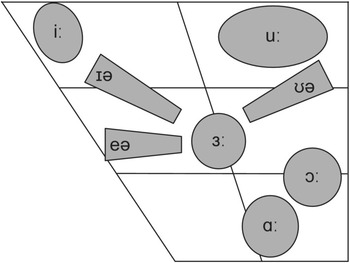
We can plot the diphthongs on the equilateral with boxes, indicating the movement of the tongue in the oral cavity during their articulation, as shown in Figures 1.4 and 1.5.

Figure 1.4 Some British English Diphthongs and Long Vowels Plotted on the Equilateral (the marginal centring diphthong [ɔǝ] is not shown).

Figure 1.5 British English Closing Diphthongs.
The centring diphthongs are not found in most American, Scots and Irish varieties of English. One thing you might notice about all of the words containing these diphthongs is that they are spelled with an <r>, which is not pronounced. Or, more precisely, it is not pronounced as [r] in British English. In American, Scots and Irish varieties these words are pronounced with an [r]. So, if we take the words here, there, poor and soar, we have the following different pronunciations:
Table 1.4 Centring Diphthongs and Their Counterparts
| here | there | poor | soar | |
|---|---|---|---|---|
| Conservative British English | hɪə | ðɛə | pʊə | sɔə |
| Younger British English | hɪə | ðɛ: | pɔ: | sɔ: |
| American English | hir | ðɛr | pʊr | sɔr |
Since we saw that English spelling reflects the pronunciation of an earlier stage of the language, the pronunciation of the written <r> in American English reflects an older pronunciation of British English (these <r>’s started to be ‘dropped’ in the eighteenth century in Southern British English). In the conservative British English varieties, it looks as though [ə] simply ‘stands for’ the <r>. In the younger varieties, the diphthongs are gradually being simplified and merged with long vowels. There’s much more to say about how <r> is pronounced (or not) in various kinds of English, and we’ll come back to it in Chapter 8. Just one final note for now, the same applies to the vowel of bird and word as to the centring diphthongs: in American English, these words are pronounced roughly as [bərd] and [wərd], while in British English we saw the long mid-central vowel [ɜ:] here.
This almost concludes our survey of the vowels and consonants of English. There are just two sounds left to look at: the semi-vowels.
The term ‘semi-vowel’ seems a bit strange at first sight. Can something really be half a vowel? Well, in a sense, it can. The semi-vowels are like vowels – and unlike typical consonants, especially obstruents – in that their articulation does not place obstacles in the way of the airstream but rather modifies the resonant properties of the vocal tract, particularly the oral cavity, by changing its shape. But, semi-vowels are unlike typical vowels in one very important way. If you look back at all of the vowels we introduced earlier, you’ll see that they occur in the middle of their word. More precisely, they occur in the middle of their syllable (most of the words I used to illustrate vowels have just one syllable – they’re monosyllabic – so it comes to the same). The syllables in question mainly begin with one or more consonants, then have a vowel and then end with a consonant or two. So they have the general shape Consonant(s)-Vowel-Consonant(s), or CnVCn for short (where the subscript n just means ‘any number’). You can see from this that consonants show up at syllable edges and vowels in the middle.
Semi-vowels, however, sound like vowels (no obstruction of the vocal tract), but they act like consonants since they come at syllable edges. Standard English has two: [w] and [j] in IPA notation. The [w] is spelled <w> or <wh> and [j] (called ‘yod’, not ‘jay’) is usually spelled <y>. Examples of [w] are word, why, watch, wave, wink, etc. Examples of [j] are you, yesterday, young and use (in this last example [j] doesn’t really have a spelling at all, unless we say that <u> corresponds to [ju:]). Both semi-vowels are quite straightforward to pronounce: you should, by now, be able to tell that in pronouncing [j] your tongue is in a high, front position and your lips are unrounded. In pronouncing [w], on the other hand, your lips are rounded and your tongue is in a high, back position. So the semi-vowels correspond, in a way, to [i:] and [u:] respectively.
Now we’ve looked at all the vowels and consonants (and semi-vowels) of English. You’ve also seen the IPA symbols for all of them. So you should be able to put all of this together and read IPA symbols. As you’ve probably realised, the IPA is useful as it gets us away from the vagaries, inconsistencies and plain craziness of English spelling. Moreover, you can learn it in an afternoon. Putting together everything in Table 1.3 and Figures 1.3, 1.4 and 1.5, you’ve got all of the vowel and consonant symbols for English, except for the semi-vowels [j] and [w]. Thus, you should be able to read an IPA transcription, or: səʊ naʊ ju: ʃʊd bi: eɪbəl tə ri:d ən aɪ pi: eɪ trænskrɪpʃən. Try this one and see how you get on:
*
So now you know about noises. Of course, you always knew how to make the English noises. But, as you can see from the above description of the sounds of English, even an act as simple and everyday as pronouncing an English sentence involves a highly intricate, complex and very tightly coordinated dance of the various organs of speech: switching the larynx on and off; raising and lowering the velum; moving the tongue around in the oral cavity; obstructing, blocking and altering the progress of the airstream and pursing and unpursing the lips.
Now go back to the first sentence of this chapter and pronounce it slowly and carefully again. You can now describe what your speech organs are doing. As an exercise, write the sentence in IPA and list how many vowels, fricatives, stops, etc. there are. The impressive achievement of fine control of the speech organs I talked about at the beginning of the chapter should seem all the more impressive now that you actually know what they’re doing.
But of course there’s more to language than noise. Anything that complex has to be highly organised – you just can’t do it with chaos – and organisation implies structure. That’s why, for the next four chapters, we’re going to be looking at the structure of language. We begin with sound structure, or phonology, in the next chapter.


.gif/640px-RP_vowel_chart_(diphthongs).gif)
