Figures
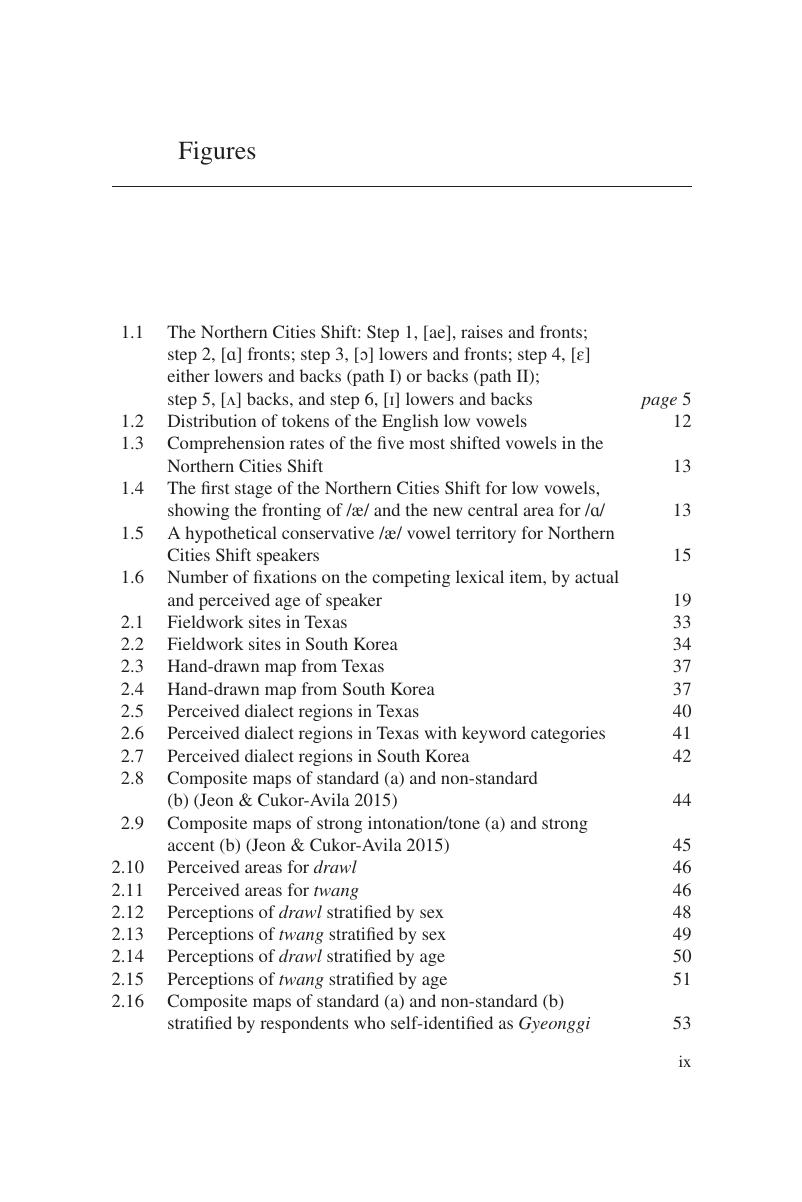
1.1The Northern Cities Shift: Step 1, [ae], raises and fronts; step 2, [ɑ] fronts; step 3, [ɔ] lowers and fronts; step 4, [ɛ] either lowers and backs (path I) or backs (path II); step 5, [ʌ] backs, and step 6, [ɪ] lowers and backs
1.3Comprehension rates of the five most shifted vowels in the Northern Cities Shift
1.4The first stage of the Northern Cities Shift for low vowels, showing the fronting of /æ/ and the new central area for /ɑ/
1.5A hypothetical conservative /æ/ vowel territory for Northern Cities Shift speakers
1.6Number of fixations on the competing lexical item, by actual and perceived age of speaker
2.6Perceived dialect regions in Texas with keyword categories
2.8Composite maps of standard (a) and non-standard (b) (Jeon & Cukor-Avila 2015)
2.9Composite maps of strong intonation/tone (a) and strong accent (b) (Jeon & Cukor-Avila Reference Jeon, Cukor-Avila and Tiwari2015)
2.16Composite maps of standard (a) and non-standard (b) stratified by respondents who self-identified as Gyeonggi
2.17Composite maps of non-standard stratified by respondents who self-identified as Gyeongsang (a) and Jeolla (b) (Jeon & Cukor-Avila Reference Jeon, Cramer and Montgomery2016)
3.2Overall composite map of 50 percent agreement among Louisvillians
3.3Washington residents’ perceptions, areas labeled “Gangster”
3.4Sample map of Kentucky, drawn by twenty-two-year-old white male from Edgewood, Kentucky
3.5Sample map of Kentucky, drawn by a thirty-year-old white female from Bardstown, Kentucky
3.6Overall composite map of 50 percent agreement among Kentuckians
5.2Heeringa’s (2004:276) multidimensional scaling plot representing distances in percentages between dialect varieties to standard Dutch
5.3Internet meme depicting Captain Picard from Star Trek: The Next Generation
5.4Jean Gouder’s illustration accompanying the article “De vijand heet Zuid-Limburg” (“The enemy is called South-Limburg”) in the provincial newspaper De Limburger Dagblad, published February 26, 2014
5.5Map of where Limburg respondents (N=17) were born and raised
5.6Composite maps showing respondents’ (N=15) perceptions of where the highest dialect use can be found in Limburg
5.7Composite maps showing respondents’ (N=15) perceptions where respectively the lowest dialect use can be found in Limburg
5.8Composite map showing respondents’ (N=16) perceptions of where the most beautiful dialect is spoken in Limburg
5.9Composite map showing respondents’ (N=16) perceptions of where the ugliest dialect is spoken in Limburg
6.1Number of respondents who completed seven “grammatical hurdles”
6.2Acceptability judgments of sentence (5) in Transylvania, Romania (N=208) and Hungary (N=106), Chi-square (df=3) = 94.713, p = 0.000
6.3Judgment and oral sentence completion tasks by respondents’ reported importance of correct speech, Hungarian National Sociolinguistic Survey (N=832)
6.4Responses from Budapest speakers (N=200) to the question, “When you turn on the radio and hear an unknown person speak for two minutes, can you judge how smart or intelligent the person is?”
7.1/e/~/ɛ/ identification for 508 participants across three regions (/b/ context)
7.2/e/~/ɛ/ identification for 508 participants across three regions (/d/ context)
7.3/e/~/ɛ/ identification for 380 Western participants in four conditions (/b/ context)
7.4/e/~/ɛ/ identification for 380 Western participants in four conditions (/d/ context)
7.5/e/~/ɛ/ identification for 165 Southern participants in four conditions (/b/ context)
7.6/e/~/ɛ/ identification for 165 Southern participants in four conditions (/d/ context)
8.1Logging correctness instructions: Listen to the audio and indicate how correct the speech of each man seems to you. Move the button on the scale toward 1 if it seems less correct and toward 7 if it seems more correct
12.1Speakers’ suitability for the job as a lecturer of French as a second language: Participants’ responses (on a 6-point scale) by speakers’ country and level of education
12.2Speakers’ suitability for the job as a lecturer of French as a second language: Hierarchical cluster analysis (Ward method)
12.3Speakers’ comprehensibility: Participants’ responses (on a 4-point scale) by speakers’ country and level of education
13.1Occurrences of wedgie in large-circulation Canadian newspapers 1990–2000
15.2Linguistic and political boundaries of the Iberian Peninsula
16.1Map of Denmark with LANCHART sites Copenhagen, Næstved, Vissenbjerg, Odder, Vinderup, and potential linguistic norm centers Odense, Århus, Holstebro
16.2SEE results in the five LANCHART communities: Subconsciously offered evaluations of conservative (dotted line), modern (solid line), and local (dashed line) in terms of personality traits
16.3Three accents judged by males (black) and females (gray)
16.4Three accents spoken by males and females (two voices each) and judged by males and females (Note: Vinderup is not included in conservative and local)