

This brief segment from Hillary Clinton’s concession speech during the 2008 U.S. Democratic presidential primary campaign blends several apparently distinct metaphors into a coherent whole that expressed something very important to her and to millions of her supporters. The segment can be understood in several ways, most obviously as a story about her first (2008) campaign for the Democratic Party nomination for president, and about the disappointing end to that campaign. It also illustrates several points about metaphor use and comprehension that I will expand on throughout this book. The metaphors, which I have marked in italics (see inset for an explanation of terminology and typographical conventions1), are all quite conventional – indeed, many who heard and read about her speech may not have recognized all of them as metaphors.
Notation: I mark metaphorical phrases by placing metaphorical elements in italics and the entire phrase within quotation marks (or in a block quote, as above). I use single quotes for invented examples (‘my lawyer is a shark’) and double quotes for attested examples from actual discourse (“filling us all with the hope”). I refer to the metaphorical word or phrase (e.g., “filling us with”) as the “vehicle” and the entity, object, or concept described (in this case, Clinton’s strong showing in the campaign) as the “topic.” The idea that is described or expressed (in this case, “causing people to experience something intensely”) is the apparent meaning. The relationship between vehicle, topic, and apparent meaning is described as “the vehicle mapping onto the topic.”
The passage as a whole also tells a story; it is an example of something quite different, which has not received much attention among metaphor researchers and scholars: a metaphorical story. I will begin this chapter by discussing the passage as a story. Then I will show how the individual metaphors might be explained by several conventional approaches to metaphor, and finally I will show how understanding it as a metaphorical story adds to the meaning of the passage. In the last half of the chapter, I will introduce several other blends of story and metaphor that will be discussed in detail in later chapters, including metaphors transformed into stories, stories implied by metaphors, and visual images that portray, evoke, or imply metaphorical stories. By the end of this book I hope to have convinced you that many metaphors, including very familiar metaphors, imply and bring to mind stories, that these stories contribute in fundamental ways to understanding metaphors, and that metaphors can often be fully understood only through the implied stories.
Stories from Hillary Clinton’s Concession Speech
“We make narratives many times a day, every day of our lives” (Abbott, Reference Abbott2008, p. 1). Clinton’s concession speech is no exception. She began with an ironic comment about the social context, “this isn’t exactly the party I’d planned, but I sure like the company,” which implies a contrast with an alternate story in which she would have given a victory speech, not a concession speech. She proceeded to tell the story of her campaign, opening with a brief generic story about her campaign volunteers, in which she expressed her gratitude toward “everyone who poured your hearts and your hopes into this campaign, who drove for miles and lined the streets waving homemade signs, who scrimped and saved to raise money, who knocked on doors and made calls, who talked, sometimes argued with your friends and neighbors.” This was followed immediately by two specific stories, each expressing a different facet of the campaign. The first story exemplifies dedication and sacrifice, and anchored the campaign in very young women like “thirteen-year-old Anne Riddell from Mayfield, Ohio, who had been saving for two years to go to Disney World and decided to use her savings instead to travel to Pennsylvania with her mom and volunteer there.”
Terminology: For the present I will refer to any sequence of causally or thematically related events as a story. When the story is presented in a more highly structured way, with a goal, opposition or setback, and resolution, I will refer to it as a narrative. Stories and narratives will be defined and discussed in greater detail in Chapter 2.
The second story referred to the story of women’s suffrage, and anchored the campaign in the very old, women who were “born before women could vote,” exemplified by Florence Stein of South Dakota,
who was eighty-eight years old and insisted that her daughter bring an absentee ballot to her hospice bedside. Her daughter and a friend put an American flag behind her bed and helped her fill out the ballot. She passed away soon after and, under state law, her ballot didn’t count, but her daughter later told a reporter, “My dad’s an ornery, old cowboy, and he didn’t like it when he heard Mom’s vote wouldn’t be counted. I don’t think he had voted in twenty years, but he voted in place of my mom.”
Each of these stories provides a context in time and place; both satisfy some of the elements usually associated with a complete narrative. The story about Florence Stein is the more complete of the two: It includes a setback (Stein’s death) and a resolution (her husband cast a vote for Clinton in his wife’s memory). It also represents a minor victory that implicitly contrasts with the major primary election defeat Clinton had just experienced. Finally, it embeds Clinton’s story in the broader, more universal story of women’s struggle for political rights, a story to which Clinton referred repeatedly throughout the speech.
After several more brief stories about her own campaign, Clinton congratulated Obama on his victory and briefly recounted the story of her relationship with Obama, followed by a summary of Obama’s own story. Then she merged the two stories, as a basis for urging her followers to work for Obama’s election: “We may have started on separate journeys, but today our paths have merged. And we’re all heading toward the same destination, united and more ready than ever to win in November and to turn our country around, because so much is at stake.”
According to Schank and Berman (Reference Schank, Berman, Green, Strange and Brock2002, p. 288) a story is “a structured, coherent retelling of an experience or a fictional account of an experience. A satisfying story will include … themes, goals, plans, expectations, expectation failures (or obstacles), and perhaps, explanations or solutions.” According to Bruner (Reference Bruner2002, p. 18), “narrative in all its forms is a dialectic between what was expected and what came to pass. For there to be a story, something unforeseen must happen.”
These and many other passages from Clinton’s concession speech satisfy both of these definitions. The speech as a whole is a retelling of Clinton’s experience, shared with her supporters. This particular passage has the form of a story about a “journey” that she and Obama have been taking separately but now are taking together. That is the vehicle of the metaphorical story: The topic is the campaign for the presidency, which they were undertaking separately and in competition but are now taking together. The topic story is motivated by her goal of being nominated and her defeat by Obama, and thus it also satisfies Bruner’s criterion that “something unforeseen must happen.” It provides a partial resolution by transferring her and her supporters’ hopes and aspirations to her victorious rival, Barack Obama, and extending the story of the campaign into a future story of Obama’s victory – and beyond, to an eventual successful campaign by a woman, who might just possibly be Hillary Clinton.
After another series of future-oriented stories focused on the coming campaign, Clinton returned to the theme that was implicit in her opening stories: “But I am a woman and, like millions of women, I know there are still barriers and biases out there, often unconscious, and I want to build an America that respects and embraces the potential of every last one of us.” She then exhorted her supporters to “aim high,” and drew the following comparison:
As we gather here today in this historic, magnificent building, the fiftieth woman to leave this Earth is orbiting overhead. If we can blast fifty women into space, we will someday launch a woman into the White House.
This passage was followed immediately by the “glass ceiling” passage, which reprises and summarizes the entire story of the campaign. In parallel to the overall story of her campaign, the “glass ceiling” story describes a reversal of expectations, the “glass ceiling” that led to the failure of her expectations, along with an explanation and a potential solution. Although this story does not culminate in the protagonist overcoming the obstacle, it does include her receiving help along the way, and it does culminate in her promise that the story is not “over,” that the canonical ending, overcoming obstacles and succeeding, will happen “next time.”
A more extensive and detailed account of narrative and storytelling will be provided in Chapter 2.
“Glass Ceiling” and Other Metaphors in the Clinton Speech
Even relatively brief stories often include metaphors. In the brief story about Clinton’s defeat and her subsequent support of Obama’s campaign, several metaphors related to “journey” appear. The “glass ceiling” story also includes several metaphors in addition to “glass ceiling.” In fact, it is saturated with metaphors: about a third of the 53 words in the passage are metaphors or part of a metaphorical phrase. The speech as a whole is only slightly less densely populated with metaphors.
Traditionally, metaphors have been defined as substituting one word for another, or comparing one word with another. Traditional metaphor theory focused primarily on noun-for-noun metaphors, often invented (‘a lawyer is a shark’) or taken out of context (“Juliet is the sun”). Clinton’s speech includes only a few metaphors that consist of a single noun (e.g., “hearts,” “journey,” and “destination”) and none that take the traditional form of “x is a y.” The speech also contains some other parts of speech used as single word metaphors (“poured your hearts and hopes,” “under state law,” “barriers and biases,” “launch a woman into the White House”). However, most of the metaphors in Clinton’s speech, including “aim high” and “glass ceiling,” have to be analyzed as phrases of two or more words.
Conventional approaches to metaphor comprehension. Linguists and other metaphor researchers have proposed a variety of approaches to explain how people understand metaphors. One approach is to look at attributes or qualities of the metaphor vehicle that might be ‘transferred’ to the topic. “Ceiling” transfers the attributes of being a ‘higher’ part of a ‘space-enclosing structure’ to the topic, which in this sentence is not explicitly mentioned. From the context we can infer that the topic has something to do with conditions that prevented Clinton, a woman, from achieving career advancement. “Glass” transfers the attributes of “hard” and ‘transparent’ to the topic, which is most directly the word it modifies, “ceiling.” Since the topic of “ceiling” is ‘obstacles preventing career advancement,’ by extension “glass” transfers attributes of “hard” and ‘transparent’ to ‘obstacles preventing career advancement.’ The apparently simple two-word metaphor requires a complex, two-stage interpretation beginning with the nominative metaphor (the noun, “ceiling”) and proceeding with the noun “glass,” grammatically transformed into a metaphorical adjective. This apparently simple interpretation also requires that we make inferences based on the immediate context (a political concession speech by a woman who sought the Democratic nomination for president) as well as on the larger cultural context, including the history of women’s participation in U.S. politics and the origin of the “glass ceiling” metaphor and its previous uses in other contexts.
A related approach is to show how the metaphor vehicle establishes an ad hoc category of things (or actions) that have similar attributes (Glucksberg, Reference Glucksberg and Gibbs2008; Wilson & Sperber, Reference Wilson, Sperber, Horn and Ward2004). Glass is hard and transparent, and ceiling is a part of a structure that is above the speaker or other reference point. “Glass ceiling” establishes a category of things that are hard, transparent, and overhead. To shatter is to break or destroy violently; a crack is a line along which a brittle substance is weakened or partially but incompletely broken. To “shatter a glass ceiling” establishes a category of actions that break or destroy something hard, transparent, and overhead.
Clinton was clearly not talking about a physical structure. Her political advancement was not blocked by a hard, flat surface above her head. Her political advancement may have been blocked by subtle and unacknowledged (‘unseen’) biases against women serving as political leaders, biases that are unacknowledged (‘transparent’), difficult to counteract, and even more difficult to change (“hard”). In order to make sense in the context of Clinton’s speech, since she is clearly not talking about a physical structure, the qualities transferred from vehicle to topic, the qualities that form the basis for an ad hoc category, require further metaphorical interpretation (Ritchie, Reference Ritchie2003b). It is conventional to refer to an organizational hierarchy in terms of vertical location in space (e.g., to ‘move up in the organization’ means to get a series of promotions). By extension, “ceiling” is a ‘barrier to upward motion,’ a “hard” ceiling is a ‘difficult barrier to upward motion,’ and a “glass ceiling” is a ‘barrier that is unseen until one encounters it,’ also a ‘barrier through which one can see the levels one is unable to reach.’ As the italics indicate, all of these explanations are themselves metaphorical, so they do not really explain how people make sense of the phrase, but they at least express the idea in terms of more conventional and familiar metaphors (Ritchie, Reference Ritchie2003a).
Broadening and narrowing. Wilson and Sperber (Reference Wilson, Sperber, Horn and Ward2004) argue that all language is ambiguous, so that understanding any language, including metaphorical language, requires a process of broadening the meaning of words and phrases to encompass the topic, and narrowing the meanings to exclude irrelevant or inapplicable meanings. According to Wilson and Sperber, then, “ceiling” and ‘barrier’ are broadened to include “any aspect of a situation that impedes one from accomplishing something” and narrowed to exclude “part of a building or other physical object.” ‘Upward motion’ is broadened to include “achieving a position of greater power and prestige” and narrowed to exclude “physical movement in a vertical direction.” These ideas help move us a little closer to understanding how a metaphor like “glass ceiling” can come to make sense in the context of Clinton’s speech. However, like the attribute transfer and categorization account, Sperber and Wilson’s account still does not specify how this process of broadening and narrowing happens, and how it leads to a particular interpretation of a metaphorical phrase (Ritchie, Reference Ritchie2003b; Reference Ritchie and Schell2009).
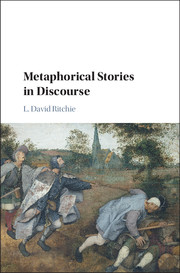
Conceptual Metaphor Theory (CMT). In 1980, George Lakoff and Mark Johnson introduced a radically new way of looking at metaphors – Conceptual Metaphor Theory (CMT). According to CMT, the linguistic form of most metaphors is but an overt expression of an underlying conceptual metaphor, a cognitive relation in which one concept (usually more abstract) is experienced as or understood in terms of another concept (usually less abstract) from a different kind of experience. These conceptual metaphors are expressed in a number of linguistic metaphors; for example, knowledge is light and understanding is seeing are the basis for common metaphorical expressions like ‘I see what you mean,’ ‘keep someone in the dark,’ ‘the Age of Enlightenment,’ ‘an illuminating conversation,’ and the ironic aphorism “blind leading the blind” (cover image; Preface; Chapter 11). The metaphors in the brief passage in which Clinton joins her campaign to Obama’s, discussed in a previous section, express a common conceptual metaphor politics is a journey: “We … started on separate journeys … our paths have merged. And we’re all heading toward the same destination, … turn our country around.”
Notation: Following the convention introduced by Lakoff and Johnson, I designate conceptual metaphors by placing them in small capital letters, e.g., knowledge is light and understanding is seeing.
According to Lakoff and Johnson (Reference Lakoff and Johnson1980; Reference Lakoff and Johnson1999), conceptual metaphors are based on correlations in experience. For example, because young children tend to feel loved at the same time that they feel the physical proximity and warmth of a caregiver, this repeated association leads to the conceptual metaphors love is physical warmth (or emotion is temperature) and love is physical proximity. These conceptual metaphors are expressed in common expressions like ‘a warm reception,’ ‘an icy stare,’ and ‘a close friend.’ Looking closely at an object or pattern is often associated with understanding it better, and it is easier to see an object in sufficient detail to understand it when it is well illuminated; these associations provide the basis for knowledge is light and understanding is seeing. Taller people tend to be more powerful, stronger, and more persuasive, and high places are militarily easier to defend, thus powerful is up, a conceptual metaphor reinforced by location of temples and palaces on high hills, location of the executive suite on the top floor of corporate headquarters, and the nearly universal custom (among many species of animal as well as humans) of showing respect and submission by bowing or otherwise lowering one’s head and upper body (Schubert, Waldzus, & Seibt, Reference Schubert, Waldzus, Seibt, Semin and Smith2008).
In “shatter that highest, hardest glass ceiling,” “shatter” and “cracks in it” are expressions of to overcome is to break and “hardest” is an expression of difficult is physically hard. “Highest” and “ceiling” are expressions of powerful is up. “Glass,” “light,” and “shining through” are expressions of knowing is seeing, knowledge is light, and hope is light. The latter interpretation is strengthened by the next line, “filling us all with the hope.” Here, “filling us all with” seems to be a linguistic manifestation of hope is a substance and a person is a container. The final line of this passage, “knowledge that the path will be a little easier next time,” expresses A career / election is a journey.
Metaphor and metonym. Metonym is an expression in which the vehicle and topic belong to the same domain; in metaphor, vehicle and topic come from different domains. However, as the discussion of CMT makes clear, these categories are not always distinct. If common conceptual metaphors originate in correlations in our experience of the world, then many of them started as metonyms: in a “close” or “warm” relationship, the actual physical proximity (and resultant body warmth) of the caregiver stands as a metonym for the entire experience of being loved and cared for. In an example much discussed by Lakoff and Johnson, argument is war, the conceptual relationship is probably based on early experiences in which arguments are associated with physical violence or threats of violence. In a corporate office building, senior executives usually occupy offices that are literally higher in the building; ‘higher authorities’ is thus both a metonym and a metaphor for organizational power.
Ruiz de Mendoza and Galera-Masegosa (Reference De Mendoza Ibanez and Masegosa2011) identify two types of metonym: part-whole metonyms (‘all hands on deck,’ in which the hand stands for the entire person) and whole-part metonyms (‘the court ordered his immediate release,’ in which the institution stands for the person or persons who belong to it). As will be discussed in greater detail in Chapter 3, these are not discrete categories: metaphors and metonyms are often blended, and it is sometimes difficult to classify a word or phrase as either metaphorical or metonymic. For many, ‘passed away’ is a metaphorical euphemism for death, but for others it is a metonymic expression of the actual passage of a spiritual essence out of the body to some other location in time and space. In Robert Frost’s (Reference Frost1969) poem, “The Road Not Taken,” the entire story can be read as a literal account of a ride through the woods, a metonymic account of a ride through the woods as part of an independent-minded life, or a purely metaphorical account of the poet’s choices of vocation and topic. The relationship of metonym to metaphor will figure in several sections of this book.
Perceptual simulations. In the past decade or so, scientists who study mind and brain have begun to turn away from the classic idea that mind is separate from the body, including the physical brain. Barsalou (Reference Barsalou1999; Reference Barsalou2007) demonstrated that in principle all thought, including abstract logic as well as language use and comprehension, can be accomplished through perceptual simulations. In perceptual simulations, the perceptual neural systems (hearing, sight, awareness of our own inner physical state, etc.) and the motor control neural systems, used to contract (and relax) muscles for various kinds of movements, become partially activated, just as if the brain had actually perceived a sight or sound, or had actually begun to clench a fist or tense a leg muscle.
Gibbs (Reference Gibbs2006; Reference Gibbs and Gibbs2008) has conducted a series of experiments supporting his contention that language activates perceptual simulations. In particular, a metaphor activates simulations associated with the vehicle. When people hear ‘grasp the concept,’ the neural systems that would be used to grasp a physical object become weakly activated. Similarly, Zhong and Leonardelli (Reference Zhong and Leonardelli2008) have shown that people experience social exclusion as being physically cold (this will be discussed in greater detail in Chapter 3; for a comprehensive review, see Bergen, Reference Bergen2012).
According to Perceptual Simulation Theory, we would expect that people who hear “shatter that highest, hardest glass ceiling” would experience a partial simulation of a transparent pane that was blocking someone’s upward motion then being violently shattered. “It’s got about eighteen million cracks in it” would be experienced as a partial simulation of a glass pane with a network of cracks, like a windshield that has been struck by a heavy object but not broken. “The light is shining through” would be experienced as a partial simulation of bright light coming through the cracked glass pane. “Filling us all with the hope” would be experienced as simulations of fullness, hope, and optimism. “The path will be a little easier” would probably be experienced as simulations of motion along a smooth, level path.
These and other theories about the identification, use, and comprehension of metaphors will be discussed in greater detail in Chapter 3.
Understanding the “Glass Ceiling” Passage as a Metaphorical Story
Taken together, these approaches help us to understand how the various words and phrases in this passage from Clinton’s speech might be understood, but they leave out something important. Like the “different paths” story discussed before, the “glass ceiling” passage tells a story about someone trying to break a hard transparent overhead structure but only putting cracks in it. The speech in which the passage appears, taken as a whole, tells an overtly different story, about a woman trying to achieve a high-status position and failing to achieve her objective, possibly because of unacknowledged (‘invisible’) gender biases. In this section I will show how our understanding of the passage is enriched by treating the entire passage as part of a metaphorical story, specifically as the vehicle in a metaphor. The immediate topic of the story metaphor is the story, or part of the story, about Clinton’s campaign, but it also maps onto a more general topic story about women’s struggle for equal opportunity and equal access to positions of power and influence.
Each metaphor in the passage seems to express a distinct idea, but taken as a sequence, they blend into a single complex story that maps metaphorically onto the story of Clinton’s campaign to become the first female president of the United States, within the larger context of women’s long struggle for political, economic, and social equality.
“Glass ceiling,” a now-familiar metaphor, was initially coined by Gay Bryant (Reference Bryant1984), former editor of Working Woman magazine; Bryant was also quoted in an Adweek article by Nora Frenkiel (Reference Frenkiel1984): “Women have reached a certain point – I call it the glass ceiling. They’re in the top of middle management and they’re stopping and getting stuck.” This quote blends two common conceptual metaphors, a career is a journey and social power is up. It also implies another familiar metaphor in which these two conceptual metaphors are merged, ‘climbing the corporate ladder.’ The metaphor, “glass ceiling,” only makes sense in the context of an implied story about a person climbing a ladder and being blocked from making further progress by an overhead barrier. “Glass” implies that the person is able to see farther up, above her position on the ladder, but “ceiling” implies she is stopped from ‘making further progress.’
The “glass ceiling” metaphor has appeared in many articles and as a visual metaphor in political cartoons over the past 30 years, almost always in reference to members of some group who manage to earn promotions to a certain level, then are prevented by various ‘structural obstacles’ and ‘invisible’ biases from “reaching” the ‘higher levels,’ which they can ‘see’ but never “reach.” It was incorporated into the name of a unit of U.S. government, the Federal Glass Ceiling Commission (1991–1995), formed to investigate barriers affecting the careers of not only women but other demographic groups as well, including ethnic minorities and persons with disabilities. In the context of Clinton’s speech, then, “glass ceiling” refers to the story of past attempts of women politicians, including Clinton, to achieve high political office (‘climb the political ladder’) and their failure to ‘break through’ to the “highest” office in the nation: the presidency.
Most elements of a narrative are either explicitly present or strongly implied by the passage. Although the element of resolution is still only implied, the ‘unseen obstacle’ has been weakened (“about eighteen million cracks in it”) and further ‘progress’ is implicitly promised. Clinton’s narrative is more complex than Bryant’s initial story, and blends elements from several conceptual metaphors. It begins with a metaphorical story about attempting to destroy a ceiling made of glass, but only damaging it. Then it shifts to a story about light shining through the damaged “glass ceiling,” and ends with a story about the “path” that Clinton and her supporters are “traveling.” As a series of story fragments this narration is hardly coherent, but it maps smoothly onto the story of Clinton’s political career, in which the presidency is the “highest” (powerful is up) and the ‘barriers’ to attaining the presidency are the “hardest” (difficult is hard).
With “we weren’t able to shatter … thanks to you, it’s got about eighteen million cracks in it,” Clinton transformed the canonical career story into a story of a collective (“we”) attempt not merely to ‘break through’ the ‘unseen barrier’ but to “shatter” it – to destroy it completely. The attempt failed, but the barrier is weakened – not “shattered” or even ‘broken’ but at least “cracked.” Not only is it “cracked,” it has “about eighteen million cracks.” In the canonical story, the ‘transparency’ of the “glass” implies that the ambitious woman can ‘see’ the “higher office,” with all of its privileges and power; it also implies that the biases preventing her from “reaching the top” are not ‘visible.’ But “the light is shining through like never before” exploits another aspect of the ‘transparent glass’ metaphor: “Light” is a common metaphor for both knowledge and hope, and that “light” of knowledge and hope is now “shining through” the “glass ceiling.”
The second metaphor in the passage, “it’s got about eighteen million cracks in it,” transforms the original metaphor in a way that changes the implications about the present state of affairs from one of frustrated talent to one of potential future ‘progress.’ The next series of metaphors, culminating in a journey metaphor, “the path will be a little easier next time,” extends the story into the future and changes its valence from one of past defeat and present resignation to one of potential future victory. The vehicle story as a whole is the story of a woman who attempts to ‘climb the ladder,’ encounters a ‘transparent,’ hence ‘invisible’ ‘barrier,’ through which she can ‘see the top’ but not ‘reach the top.’ She tries, and fails, to “smash through” the invisible barrier, but she does manage to “put a million cracks in it,” with the result that it will be easier for her, or some other woman in the future, to “break through the glass ceiling” and ‘reach the top.’
The canonical ‘career ladder’ story underlying the “glass ceiling” metaphor is part of the change is motion and power is up metaphor fields, in which career promotion is expressed sometimes as ‘climbing higher’ and sometimes as ‘moving forward’ or ‘progressing.’ Just as ‘climbing higher’ implies a ‘career ladder,’ ‘moving forward’ implies a ‘career path,’ a metaphor invoked by Clinton’s final phrase, “the path will be a little easier next time.” These separate (but interrelated) metaphors are blended together in a single story metaphor about trying to ‘break’ or even “shatter” a “glass ceiling,” but only “cracking it.” However, it now has so many “cracks” that “light” (knowledge and hope) is “shining through.” This invites or leads into another story, located in the future, in which “the path will be a little easier” – and by implication, the “glass ceiling” will then be ‘broken.’ All of this is mapped onto the story of Clinton’s attempt to secure the Democratic nomination – and win election to the presidency, in which she achieved much more than previous women, with the result that a future candidate (perhaps Clinton herself) will have a greater chance to succeed.
The base metaphor vehicles, ‘ladder,’ “level,” and “ceiling” / ‘obstacle,’ all imply a small space, a ladder in a room. At first glance the time (in the vehicle story) seems to be a minute or so, all that it takes to climb a ladder. The person on the ladder might conceivably wait for some time – at most, perhaps, a few hours – at the level on the ladder where further progress is blocked. The corresponding topics, career, position, unwritten rules, and unspoken biases exist in the much larger space of a corporate headquarters (for Bryant) or national politics (for Clinton). The topic story also occurs over a much larger extent of time – advancement to middle management (‘climbing the ladder’) may take a decade or longer, and several years may pass before the woman in the topic story realizes that further promotion is ‘blocked’ by unwritten rules and unspoken biases (‘unseen obstacles’). Thus, “glass ceiling” maps a vehicle story located in a few square feet and taking place within a few minutes or maybe an hour onto a topic story that may be located over a space of thousands of miles and take place over several decades. In Clinton’s telling of the story, by implication the topic story is the pursuit of political rights – and power – by American women that has continued for two centuries and will extend for an indefinite time into the future.
The first part of the story maps readily onto the topic story, Clinton’s unsuccessful attempt to obtain the Democratic nomination, with the unspoken implication that her defeat resulted from a ‘barrier’ to further ‘upward motion’ (a “ceiling”), a gender bias that is unacknowledged hence ‘unseen’ (‘glass’; thus, the “glass ceiling”). Thus far, the metaphor is consistent with, and draws on, the standard use and interpretation of “glass ceiling.” However, the second part of the passage transforms the metaphor vehicle into a story about a hopeful and potentially successful future campaign, and by extension suggests a similar transformation of the topic story, with the further implication that she (or some other female candidate) will win the next time.
“The light is shining through” does not imply any defined time or space: It does permit expanding time and space somewhat beyond that of the “ladder”/ “glass ceiling” story. “The path will be a little easier next time” potentially extends the vehicle story in both space and time, but not to nearly the same extent as a political campaign, which crosses back and forth across an entire nation, and in the United States extends over a full year or longer. A path is not clearly bounded in space, nor is a journey along a path clearly bounded in time, although one ordinarily does not think of a literal path as extending more than a few miles, or taking more than a few hours, perhaps a few days, to traverse. Thus, the entire story metaphor still maps a relatively restricted extent of time and space onto a much larger time and space.
The metaphorical story about putting “about eighteen million cracks” in a “glass ceiling” maps directly onto the story of Clinton’s successes in several of the primary elections and the fact that she did succeed in being taken seriously as a viable candidate for president. The extension into a metaphorical story about the future, when “the path will be a little easier,” maps onto the implied story of a future woman candidate who will be “launched into the White House.” This metaphor itself is foreshadowed by the thematically connected advice to young women in the audience to “aim high” and the exultant story about the 50th woman astronaut who was orbiting the Earth as Clinton spoke.
Two ideas become apparent from this discussion. First, note the separate entailments of the metaphor “glass,” which “allows us to see the unattainable higher levels” and also ‘presents a barrier that cannot be seen.’ These two interpretations are compatible, and both have appeared in other discussions of “glass ceiling,” so it is reasonable to combine them. Second, note that Clinton doesn’t actually provide the mapping – she just tells the vehicle story and leaves it to the audience to map it onto the topic, the story of her unsuccessful bid for the nomination. Also note that the metaphorical phrase, “glass ceiling,” implies a metaphorical story, and lends itself to elaboration and application to many different topic stories. These ideas will be covered in more detail throughout this book.
As a side note, Clinton’s use of this metaphor, and the blend of metaphor with her actual political history, has had an interesting effect on vernacular understanding of the metaphor. In fall 2014 (when Clinton had not yet announced her candidacy for 2016) during a classroom discussion of this metaphor, several women in the class put can be broken above hard as a relevant quality of glass. Thus it seems that the “glass ceiling” does indeed have “about eighteen million cracks in it”; some of these cracks were ‘visible’ in that classroom discussion. At least in part as a result of Clinton’s campaign “glass ceiling” has been transformed from a metaphor of frustrated ambition to a metaphor of hope.
Interpreting metaphors. How do we know that particular persons interpret career advancement as ‘moving up,’ and biases that prevent career advancement as a “ceiling”? How do we know that particular persons interpret the metaphor “glass” in terms of both ‘unseen’ and ‘transparent’? The short answer is that we don’t and we can’t. Even literal language is ambiguous (Wilson & Sperber, Reference Wilson, Sperber, Horn and Ward2004), and figurative language is even more ambiguous. Both in our everyday interactions and as researchers, we rely on what we know about past uses of language – but with full awareness that different people may be thinking of different meanings associated with a metaphor vehicle. We also rely on clues from the surrounding context, which in this case includes the nature of workplace biases, which are rarely acknowledged and in many cases may not even be conscious. As researchers we can also garner clues from previous researchers and commentators. For example, according to the Federal Glass Ceiling Commission (1995, p. 4), “glass ceiling” describes “the unseen, yet unbreachable barrier that keeps minorities and women from rising to the upper rungs of the corporate ladder, regardless of their qualifications or achievements” (italics added to mark metaphors). In 1986, the same year Gay Bryant’s book was published, Hymowitz and Schellhardt included the phrase in the title of an article in the Wall Street Journal: “The glass ceiling: Why women can’t seem to break the invisible barrier that blocks them from the top jobs.” Similarly, Hesse-Biber and Carter (Reference Hesse-Biber and Carter2005) explain that “glass ceiling” is used to describe “invisible barriers” (“glass”) through which women can see elite positions they cannot reach (“ceiling”). And of course we sometimes have direct evidence from members of the audience itself, as when women in my classroom provided the “can be broken” entailment of “glass.”
The ‘transparent barrier’ interpretation of “glass ceiling” is sufficiently obvious that Nicholson (Reference Nicholson2008) could use it in a cartoon based on a wordplay where he transformed “glass ceiling” into “class ceiling.” The cartoon shows two women, dressed in business suits and one man dressed in what appears to be carpenter’s overalls standing on a glass surface (a “glass floor”). The man and one woman are looking up through a “glass ceiling”; the other woman is looking down through the “glass floor” at three other women, one of whom is cooking, one doing janitorial work, and one working on an assembly line. The cartoon makes sense only if “glass” is understood to entail ‘transparent’ as well as “barrier to vertical motion.”
All of these clues tell us that many people do interpret “glass ceiling” in ways consistent with the foregoing discussion, but they do not tell us how specific persons in Senator Clinton’s audience may have understood the metaphor, or even how Senator Clinton may have intended the metaphor. Indeed, the metaphor is sometimes used in a lexicalized way to which both the ‘transparent’ and the “barrier” entailments are irrelevant: In a recent book about the role of language in human evolution, Dunbar (Reference Dunbar2014) refers to the “glass ceiling” that has prevented other primates from evolving anything like language. Since members of a species lacking language would presumably not be able to ‘perceive’ the capabilities they are unable to attain, ‘transparent’ is irrelevant. It seems most likely that Dunbar was just using the metaphor in a generic sense of ‘barrier,’ with no intention of activating other entailments. (Regarding intentionality in metaphor use, see Steen [Reference Steen2015], discussed in Chapter 3.) Even the ‘upward motion’ entailment of “ceiling” is inconsistent with the doctrine, in evolution theory, that evolution has no objective or ‘direction.’ Dunbar’s use of the metaphor in a much broader sense reminds us that metaphors often become partially or wholly lexicalized, and applied in contexts very different from the context in which they originated. Indeterminacy in the face of ambiguous language is a weakness of interpretive research that can be alleviated but never completely overcome. In Chapters 3, 4, 11, and 12, I will discuss methodological issues involved in metaphor research, including the problem of ambiguity, in more detail.
Metaphorical stories in visual communication. Nicholson’s “class ceiling” cartoon is a good example of another phenomenon, which will be covered in greater detail in Chapter 11: visual images, especially in advertising, editorial cartoons, and other forms of cartoon art, often illustrate, draw on, or imply conceptual metaphors, which are sometimes but not always familiar from idiomatic metaphorical expressions. Nicholson’s cartoon is particularly interesting because it extends the ‘upward mobility’ and ‘ambition frustrated by unacknowledged biases’ stories implicit in Gay Bryant’s initial use of the metaphor ‘downward’ as well as ‘upward’ in the corporate hierarchy. The more customary topic story about a woman’s ambition to ‘rise beyond middle management’ is represented by images of two people in business suits gazing upward through a glass ceiling. A different topic story about working-class men and women who are unable even to reach ‘middle’ management (and the ‘middle class’) is represented by a third figure, looking downward through a glass floor at three figures below doing manual labor (janitorial and assembly-line work), for whom the “glass floor” of those in the middle is a “glass ceiling.” The combination of these images blends these two versions of the implicit metaphorical story into a single metaphorical story about the rigidity of socioeconomic class structure in contemporary U.S. society, reinforced by the wordplay title “class ceiling.”
Metaphorical Stories and Story Metaphors
Extended metaphorical stories. When first encountering the idea of metaphorical stories, it is likely that most people, including social scientists and scholars who study language, will not think of examples like Hillary Clinton’s concession speech. For most people, metaphorical stories are more likely to call to mind the allegories, fables, and parables that have been told and retold over many centuries; these have also received the most attention from scholars in the literary disciplines. Probably the most commonly encountered form of metaphorical story encountered in literature is the allegory, which is sometimes explained as a metaphor that has been so extended that it becomes something more than a metaphor (Crisp, Reference Crisp2001). More specifically, allegory refers to examples like Pilgrim’s Progress, in which the topic is often not explicitly mentioned, but the metaphorical mapping is guided by the use of overtly metaphorical names such as “Sinner,” “Everyman,” “Idleness,” and “Christian,” and place names like “Slough of Despond.” In the typical allegory, the vehicle story is created as a self-contained world with its own rules. Characters are given allegorical names, but are rarely developed beyond the stereotypes suggested by these names. According to Crisp, the topic of the allegory is not directly mentioned, although the allegorical language provides abundant clues to guide interpretation – and it is assumed that the process of interpretation will illuminate and add meaning to the topic.
Perhaps more familiar to lay persons are fables like Aesop’s story of the Fox and the Grapes, from which the commonplace metaphor ‘sour grapes’ derives, and parables like Jesus’s parable of the Prodigal Son. Some of these, like Aesop’s animal fables and some of Jesus’s parables, resemble allegory in that the topic is not mentioned within the story, although both the topic and the intended interpretation is often made explicit in a coda or “moral” at the end of the story. In others, like Jesus’s parable of the wise man who built his house on solid rock, contrasted with the foolish man who built his house on sand, the mapping onto the topic is incorporated into the story. Parables often take a form closer to metonym than to metaphor, and many of Jesus’s parables are overtly metonymic. The Prodigal Son in the well-known vehicle story leads a sinful life, repents, and is forgiven, mapping onto and at the same time providing an example of the more general topic story of sin, repentance, and forgiveness; the Good Samaritan in the vehicle story displays kindness and charity, mapping onto and providing an example of the topic story about kindness and charity. Both of these parables afford both a metonymic and a metaphorical interpretation. In contrast, the story about building one’s house on the sand is clearly not intended as a lesson in safe home construction: it is purely metaphorical, with no elements of metonym.
Until quite recently, the study of stories and storytelling has been largely concentrated in disciplines associated with literary criticism and literary studies generally, although there has also been some attention to stories elicited during therapeutic interviews as a diagnostic and treatment method within clinical disciplines. Within literary disciplines, research on metaphorical stories has focused primarily on allegory. Chapter 5 will discuss these familiar and formal types of metaphorical stories, many of which illustrate religious or philosophical ideas, but some of which simply illustrate ideas about the “human condition.” Chapter 6 will examine metaphorical stories that appear in non-literary discourse, including speeches like Senator Clinton’s concession speech as well as casual conversations.
Metaphorical story scenarios. Based on an analysis in which he applied Conceptual Metaphor Theory to partisan political discourse, Lakoff (Reference Lakoff1996) argued that political thought and rhetoric in the United States is organized around two linked conceptual metaphors, a nation is a family and leaders are parents. According to Lakoff’s analysis, conservatives generally prefer metaphors based around a strict parent metaphor and liberals prefer nurturant parent as a metaphorical base. Musolff (Reference Musolff2006) generalizes and extends this idea, arguing that conceptual metaphors are often developed into scenarios, such as the love-marriage-family scenario discussed by Lakoff. According to Musolff, political discourse within (and about) the European Union is often characterized by family-based scenarios such as cooperation between states in marriage. Metaphorical story scenarios will be discussed in greater detail in Chapter 7.
Abbreviated and Implied Story Metaphors
Often in discourse, stories are just mentioned or alluded to, with the apparent expectation that listeners will understand the reference; this is true of metaphorical stories as well. Well-known fables or parables may be invoked by simple reference to a character (‘he’s kind of a Prodigal Son,’ ‘he’s being a Good Samaritan’) or phrase (‘that sounds like sour grapes,’ ‘he cried wolf once too often’). Hearers may not always activate the full underlying story, but it is likely that they often do – and the speaker’s intended meaning may not be fully understood without activating the story and applying it to the subject of the remark. Brief metaphors often require activation of a metaphorical story to be fully understood. ‘It’s time to fall back and punt’ makes no sense without activating the story of a team in American football, facing a third down with several yards to go, and mapping it onto a topic story about whatever situation provoked the remark.
Aphorisms (usually metaphorical) distill a bit of commonsense wisdom in a way that requires activation of at least a vehicle story and usually require mapping it onto a topic story. A ‘bull in a china shop’ is merely something or someone in the wrong place until a story about a bull clumsily destroying the entire contents of the shop is activated, and mapped onto an already-salient story about some behavior of the subject of the remark, usually metaphorically ‘clumsy’ behavior that ‘destroys’ social harmony, interpersonal trust, or some other valued social state of being. ‘Let sleeping dogs lie’ merely seems like advice to be kind to exhausted pets until a vehicle story about someone awakening a sleeping dog and getting bitten is contrasted with a vehicle story about the same person tiptoeing around the dog and not getting bitten, and both vehicle stories are mapped onto the topic, some potentially troublesome social situation.
Sometimes a nonmetaphorical story is mentioned in a way that invites mapping it as a metaphor vehicle onto a topic story. The refrain, “where will you meet your Waterloo?” from the popular song “Waterloo”2 (Wilkin & Loudermilk, Reference Wilkin and Loudermilk1959) means little without activating the story of Napoleon’s disastrous defeat (which is mentioned in the song) and mapping it onto a story of potential personal disaster. Glucksberg and McGlone (Reference Glucksberg and McGlone1999) provide the example ‘Cambodia is Vietnam’s Vietnam,’ which appeared in several media commentaries on Cambodia’s 1978 invasion of Cambodia. This metaphor requires activating the story of the long and costly U.S. engagement in Vietnam and mapping it onto the story of Vietnam’s subsequent intervention in Cambodia. Brief stories, metaphors that imply stories, and allusions to stories that invite or demand a metaphorical interpretation will be discussed in detail in Chapters 6 and 7.
Metaphorical Stories and Story Metaphors in Language Play, Irony, and Humor
Metaphorical stories and story metaphors often have an element of irony. The ironic use of ‘Vietnam’ as vehicle in a metaphorical comment on Vietnam’s own actions makes ‘Cambodia is Vietnam’s Vietnam’ particularly interesting. The song “Waterloo,” mentioned in the last section, uses a playful reference to the story of Napoleon’s defeat to make a serious comment about life. The overall playful tone of the song is underscored by playful transformation of the conventional metaphor ‘every dog has its day’ into a diminutive form in “Every puppy has its day.” Popular music is replete with playful use and distortion of metaphors. One of Johnny Cash’s satirical songs, “Flushed from the Bathroom of Your Heart” (Clement, Reference Clement1968), consists entirely of a string of humorously vulgar and ridiculous metaphorical stories about love, all in the same vein as the title. Gamson (Reference Gamson1992, p. 23) reports an exchange between two participants in a focus group after the conclusion of the formal conversation that includes an exchange in which one participant uses a conventional metaphor to claim that his participation in the conversation had been forceful and forthright: “I didn’t pull any punches anyways …” and another participant transformed the metaphor into a playfully deflating tease: “You didn’t throw any either.” Playful transformation of metaphors into stories, and the use of metaphorical stories and story-metaphors in irony and jokes will be discussed in greater detail in Chapter 7. Chapters 8 through 10 will examine metaphorical stories and story metaphors in three specific discourse contexts: journalism, a campaign speech by Barack Obama, and several speeches on the topic of climate change.
Yet another form of figurative language, hyperbole (extreme exaggeration) is apparent in Clinton’s phrase “it’s got a million cracks in it.” Hyperbole is often, as here, combined with metaphor and metonym, sometimes as a means of emphasizing the speaker’s point but also often in a spirit of playfulness (referring to ordinary life setbacks as “your Waterloo” is an example).
Metaphorical Stories in Visual Communication
Language-based metaphors are often depicted in political cartoons (and other cartoons), as well as in advertising and other visual media. Nicholson’s (Reference Nicholson2008) cartoon in which he visually transformed “glass ceiling” into “class ceiling” has already been discussed. Almost every year at New Year’s, cartoons appear showing the Earth with an ice pack on its head, suggestive of a headache, possibly a hangover. Bruegel’s painting The Blind Leading the Blind, reproduced on the cover of this book and discussed in the Preface and Chapter 11, is another example.
Visual metaphors, including metaphorical stories, are also a staple of commercial advertising. The Schick razor company recently ran a series of ads for the Schick Quattro, a razor designed for trimming women’s pubic hair (colloquially referred to as “bush”). One ad in the series shows a formal garden featuring three potted topiary plants (bushes), one in the shape of a perfect cube, the second a perfect sphere. The third, a small inverted cone, is strategically placed in front of a nude statue in the neoclassical style, so it looks like a triangle of neatly trimmed pubic hair on the statue. This visual metaphor is quite complex; part of what it accomplishes is to activate a story about topiary gardening and map it onto an implicit story about intimate personal grooming. Metaphorical stories that are implied by visual images, and visual images that draw on metaphorical stories to comment about a topic will be discussed in Chapter 11.
Summary
The importance of metaphor in storytelling has long been recognized, although until recently most analysts followed Aristotle’s lead in treating metaphor as primarily a matter of embellishment or decoration. Until recently scholarly attention has focused almost entirely on instructive story metaphors, especially allegories, as well as fables and parables. Story-based jokes have been extensively analyzed in the humor literature, but remarkably little attention has been given to the metaphorical aspects of many story jokes. Similarly, although story metaphors appear with some frequency in formal discourse such as political speeches as well as in informal conversations, their metaphorical aspects have received almost no attention.
Even less attention has been given to the playful transformation of metaphors into stories, or to the stories that are often implied by metaphors. In this book I argue that analysis of story metaphors is crucial to discourse analysis. I also argue that even metaphors that take the form of a single word or short phrase often imply a story, and that the implied story must be activated in order to fully understand the metaphor.
