

As pointed out in Chapter 2, often a single word or phrase (a story index) is enough to activate an entire story. For example, for many people including most social scientists, Stanford Prison Experiment indexes a story about an oft-criticized experiment in which Stanford Psychologist Phil Zimbardo demonstrated that ordinary people, put into positions of power, will abuse that power. Abu Ghraib similarly indexes and activates a real-life story about a U.S. military prison during the recent Iraq war, in which Zimbardo’s results were, unfortunately, confirmed. Both the experiment and the wartime incident have become metonymic representations of the broader theme.
Single words can also index, or activate, metaphorical stories. Some metaphorical words and phrases seem to invite activation of a metaphorical story – many others, which I will call story metaphors – either require activation of a metaphorical story in order to make sense, or become much more meaningful if a metaphorical story is activated. In this chapter, I will begin with story metaphors from some recent political speeches and other campaign material, followed by discussion of story metaphors from other discourse. Then I will discuss story metaphors implied by aphorisms, including aphorisms that, themselves, are derived from and index parables and fables. Finally, I will address the question of which metaphors do and which do not invite or require activation of a metaphorical story, and what factors influence whether a metaphorical story is activated. That is, what makes a metaphor a story metaphor?
Metaphors That Allude to, Invite, or Require Stories
During one of the 2012 Republican Presidential primary debates, Governor Rick Perry referred to Mitt Romney as a “vulture capitalist.” On the surface this is a nominal metaphor, simply associating Romney with a culturally disfavored bird, and it is quite possible that some of those who heard the comment processed it as a simple nominal metaphor. By way of comparison, when U.S. Civil War General McClellan repeatedly called Abraham Lincoln a “gorilla,” presumably his intention was to map qualities associated in the popular imagination with that animal, such as ugliness and ungainliness, onto Lincoln. Similarly, Perry’s metaphor could be understood as a simple transfer of qualities associated in popular culture with vultures, such as ugly, smelly, and ungainly. More likely, these qualities would be metaphorically interpreted and mapped onto metaphorically-implied personality characteristics (Ritchie, Reference Ritchie2003a).
The mapping, shown in Figure 7.1, would draw on conventional metaphors: ‘ugly’ is often applied to a policy or action proposal with the implication that it is either difficult to implement or is likely to have undesirable consequences. ‘Smelly’ is often used, along with the related vehicle, ‘rotten,’ to imply moral or ethical ‘corruption,’ i.e., that a particular action is unethical or that a person is prone to unethical or immoral behavior. Compare “Something’s rotten in the State of Denmark” (Shakespeare, Hamlet, act I, scene 4) and “I smell a rat,” attributed to Patrick Henry and Big Mama Thornton, among many others.

Although the interpretation as a simple nominative metaphor is plausible, “vulture” also indexes a culturally familiar story, in which vultures spot a dying animal, circle around, then descend and strip the flesh off the animal’s bones. The ready accessibility of this vehicle story, along with the political and historical context, invites a more elaborated interpretation of the metaphor.
A major theme in Romney’s campaign was his claim to managerial competence, based on his role in managing the 2002 Winter Olympics in Salt Lake City and his career as a co-owner of Bain Capital, a venture capital firm. One of the primary ways Bain Capital makes money is by purchasing companies that are failing; usually these companies have assets worth much more than the market value of outstanding stock so that, if the acquiring firm is not able to turn the company around and make it profitable within a short time, a large profit can still be made by simply closing the company down, laying off its workers, and selling (‘stripping’) its assets.1 The acquiring firm often burdens the company with debt to repay the purchase price of the stock, then sells the now debt-ridden and financially weakened company to other investors. Under any of these topic stories the results often include massive layoffs of the company’s employees, leaving them and their communities impoverished.
The vulture is a common and widely feared symbol of death. Vultures circle in the sky above a weak or dying animal, and it is widely believed that vultures, impatient for their meal, will sometimes hasten an animal’s death by starting to feast on it before it is completely dead, thereby increasing the animal’s suffering (and – relevant to Perry’s metaphor – leaving the animal’s babies motherless in order to feed its own chicks). The image of a vulture often appears in political cartoons, sometimes as a token of death, but often as an index to a story involving vultures’ reputed treatment of weak and dying animals (or prospectors).
This vehicle story about actions associated with vultures is easily mapped onto the topic stories about venture capitalists (Figure 7.2), and this mapping is supported by Perry’s statements during the South Carolina primary debates, when he described two South Carolina companies purchased and closed down by Bain Capital, and summed up with the declaration that Romney and his company had “picked their bones clean.” Interpreting the metaphor as a story metaphor greatly adds to the meaning, and makes far more sense in the context of the political debates in which it was used. Compared to the simple attribute transfer interpretation, the story metaphor interpretation is also more consistent with the commonplace role of the vulture in the popular culture of the United States, especially the popular culture of the western United States.
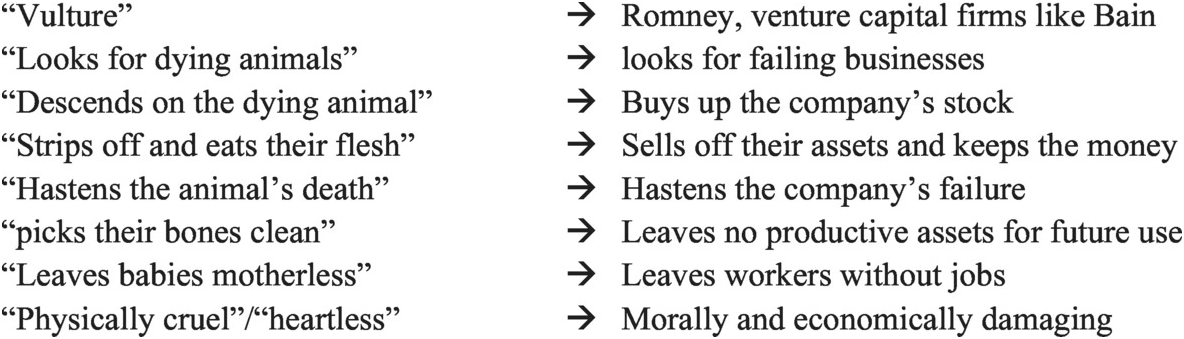
Figure 7.2 “Vulture Capitalist” as story metaphor
This mapping, shown in Figure 7.2, is reinforced (and may have been initially suggested) by the alliteration of venture with vulture; this alliteration certainly renders the metaphor more memorable, and it probably contributed to its rapid spread by making it more interesting to repeat and discuss. Later in the campaign, during the South Carolina primary, Governor Perry described two South Carolina companies that Romney’s venture capital firm, Bain Capital, had bought and closed down; Perry claimed that Romney and his company had “picked their bones clean.” This phrase can only be understood as a metaphorical reference to a ‘predator’ or ‘scavenger’ of some sort, and supports the claim that Perry intended the phrase “vulture capitalism,” not as a simple nominal metaphor but as the index to a metaphorical story.
Considering the actual role of vultures in an ecosystem potentially leads to an interesting extension of the metaphorical story. In the natural environment, vultures play an important role by disposing of rotting corpses, which might otherwise spread disease, and recycling their nutrients. Apologists for venture capitalists claim that they play an analogous role in the economy, disposing of failing companies and freeing their resources for more productive uses. This would lead to something like the mapping shown in Figure 7.3. It is interesting (but not particularly surprising) that Romney’s defenders did not exploit this extension of the metaphorical story. To have made this extension would have required making the story itself even more salient – and Romney’s campaign staff no doubt preferred to ‘let sleeping dogs lie.’

I will take up the topic of aphorisms, including ‘let sleeping dogs lie,’ later in this chapter.
Another example of a political put-down that implied a metaphorical story occurred in 1984, when Senator Gary Hart and former vice president Walter Mondale were competing for the Democratic presidential nomination. Throughout the campaign, Hart repeatedly claimed to have a large list of specific policy proposals – but he always described them in vague terms, without providing any specific details. During two televised debates prior to the New York and Pennsylvania primary elections, Mondale referred to Hart’s repeated claims about the policies he would champion and his repeated failure to provide any details, then asked Hart, “Where’s the beef?” In the United States, ‘meaty’ and ‘substantial’ are common metaphors for detailed and well-reasoned ideas, consistent with a detailed argument is meat and ideas are objects / thought is substance. Like “vulture capitalist,” a satisfying interpretation of Mondale’s metaphorical question is possible on this basis alone – but for viewers familiar with the contemporary culture of TV advertising, the question activated a story metaphor that greatly enriched the meaning.
In the months immediately prior to the Democratic primary debates, a humorous and highly successful television commercial for the Wendy’s chain of hamburger restaurants featured an elderly lady played by actress Clara Peller, sitting at a fictitious competing restaurant and looking at a very small hamburger patty on a massive hamburger bun. She lifts the top of the bun, looks with an expression of dismay at the tiny beef patty, then turns toward the camera and exclaims, “Where’s the beef?” Mondale’s question activated the story from the Wendy’s commercial as a metaphor vehicle, and mapped it onto an imagined story of voters looking for ‘meat’ in Hart’s policy proposals. The near absence of meat in the competing restaurant’s hamburger maps onto the lack of details in Hart’s proposals, implying that Peller’s angry rejection of the hamburger would also map onto an equally angry rejection of Hart by the voters.
Gamson (Reference Gamson1992, p. 23) reports another example of a conventional metaphorical idiom developed into a truncated story then transformed into a tease. At the end of a modified focus group conversation, the participants (a group of middle-aged men who knew each other quite well prior to the focus group) were chatting about their feelings about the focus group experience:
Bill: I’ve been enlightened.
Paul: I enjoyed it.
Joe: You didn’t throw any either.
Ken’s assertion that he didn’t “pull any punches” implies a truncated story based on a standard idiom from boxing. While sparring (practicing) with a person of lesser ability, a skilled boxer will often “pull his punches,” reduce their force to avoid seriously injuring the sparring partner. To “pull one’s punches” is to reduce the force of something, such as a criticism, in order to avoid another person’s feelings (see also Ritchie, Reference Ritchie2008; Ritchie & Negrea-Busuioc, Reference Ritchie and Negrea-Busuioc2014).
Ken’s remark implied a metaphorical mapping of the vehicle story from boxing onto the story of his own performance in the focus group discussion, implying a mapping of the expert boxer’s skill and the ‘power’ of the boxer’s punches onto his own rhetorical skill and ‘power,’ implying that he ‘threw powerful punches,’ i.e., expressed strong opinions. Joe’s reply, “You didn’t throw any either,” altered the vehicle story and by implication altered the topic story: Ken the ‘boxer’ did not “throw any powerful punches,” so Ken the focus group participant did not express powerful or uncompromising opinions. This takes the apparent form of a serious criticism but it is typical of spontaneous jibes among close friends, usually not to be taken seriously (Norrick, Reference Norrick1993; Ritchie, Reference Ritchie2008).
In a conversation about police-community relations among a group of middle-class neighbors in an urban neighborhood (Ritchie, Reference Ritchie2011b), one of the participants, referring to recent incidents in which police shot and killed unarmed civilians, characterized a typical alibi as follows:
whenever I hear a an officer say .. it seems like the magic words.. like the get out of jail free card.. is.. ‘I felt.. that.. my life was in.. that I was being threatened or..’ like these magical phrase that police officers it’s like .. they’re trained that’s the word like if anything bad ever goes down say.. ‘I felt you know I felt that my life was in jeopardy.’
The first metaphor, “magic words,” might be construed as a straightforward descriptive metaphor, except that the word “magic” denotes not just a quality but an entire process. For most people it will also activate one or more stories – of stage magic performances, of passages from fairy tales and novels where a character uses some “magical” phrase to accomplish an objective. The speaker’s intention was obviously to map a story of this kind onto the police officer’s use of the stock phrase, “my life was in jeopardy.”
The second metaphor, “get out of jail free card,” makes sense only in reference to the popular game, Monopoly, in which it figures in a subplot within the larger narrative of the game, a subplot in which a player is suspended from participation (“in jail”) and uses the card to “get out of jail” without paying the usual penalty. (The word “jail” and the phrase “get out of jail free” are themselves metaphors of course. Within the game, temporary suspension from participation is metaphorically described as being “in jail,” a metaphor reinforced by a visual metaphor, a drawing of a barred window, metonymically evoking a jail cell, on the game board.) The phrase is widely used in application to any situation in which a person invokes some principle or status to excuse some logically unrelated act in an overtly nonsensical way. Any or all of these cultural stories may be activated as the metaphor vehicle in addition to or even in place of the Monopoly story.
Several examples of metaphors that refer to and potentially activate story metaphors can be found in Cameron’s (Reference Cameron2007) analysis of the “Reconciliation Talks,” a series of conversations between Jo Berry, whose father, a Member of Parliament in the Thatcher government, was killed by a terrorist bomb and Pat Magee, the IRA operative who planted the bomb. One such example, mentioned in Chapter 6, began when Jo read a poem she wrote about “building bridges” between communities, a metaphor that activates a story about building physical bridges so that members of two communities previously separated by a barrier such as a body of water can communicate with each other and participate in common activities. This story maps readily onto a story about learning and developing ways to understand the perspective of members of other, previously hostile, groups (i.e., build empathy between groups) in order to communicate with each other. In response, Pat pointed out that a bridge has “two ends,” implying that the perspectives of both groups must become part of the bridge.
At a different point, Pat developed the “bridges” metaphor into a fairly complex metaphorical story:
Pat: there’s an inverse, to that er, (1.0) you know, er, (2.0) figure of speech you know, bridges. Bridges can be built. and that is if you, actively – er, create, er, .. distances … barriers … or what are they? they are exclusions . . .(1.0) and er, . . a thing I believe absolutely fundamentally, 1652 is that er, . . .(1.0) if you exclude anybody’s voice, . . .(1.0) you know, . . . you’re … you’re sowing the seed for later violence. (1.0) the way to counter that, . . .(1.0) is to build bridges …(1.0) the way to ensure it doesn’t happen, is to build bridges.
Pat began by pointing out that a (physical) bridge can become a barrier as well as a connection. Then he introduced a different metaphor, “sowing the seed for later violence.” This is also a fairly common metaphor, and appears in various versions throughout the Bible, for example in Galatians 6:7–9, “whatever one sows, that will he also reap.” Understanding the metaphor requires activating a vehicle story about planting seeds in a field or garden. Following the “sowing” metaphor, Pat returned to the “building bridges” metaphor.
The Reconciliation talks began with Jo’s desire to understand the motives that would lead someone to plant a bomb like the one that killed her father. It appears that Pat’s initial motive for participating in the talks was to get Jo to understand his – and the IRA’s – view of British-Irish history. However, the talks quickly developed their own logic, and both participants became committed to reconciling and bringing about peace between the two groups, a prospective story for which a story about “building bridges” is a conventional – and apt – metaphor.
Aphorisms
Aphorisms are short, pithy statements that capture some accepted bit of wisdom, usually in a metaphor. In most cases, the metaphor implies a metaphorical story, or requires activation of a metaphorical story to make sense. In fact, aphorisms are often based on a well-known metaphorical story such as a parable or fable, so that the aphorism indexes the parable or fable. I will begin this section with ‘let sleeping dogs lie,’ introduced in regard to the situation apparently faced by Mitt Romney’s staff with respect to potential positive implicatures of “vulture capitalist.”
‘Let sleeping dogs lie.’ Even more than “vulture capitalist,” this common aphorism seems to require at least a weak activation of a story that implicitly goes something like this: a person, walking down a path or sidewalk, comes to a place where a dog lies asleep in the middle of the path, making it difficult to pass by. If the person awakens the dog in order to move it off the path, the person might be attacked and bitten. If the person lets the dog sleep and detours around the dog, it is possible to continue onward without the risk of being bitten. This maps onto a situation, such as that faced by Romney’s campaign staff, as shown in Figure 7.4.

I would not propose that the implied story is activated in this level of detail every time someone encounters a parable or aphorism of this sort; it seems plausible that sometimes a phrase like ‘sleeping dog’ is processed as a lexical unit with a direct link to lexical meanings, along the lines of it’s best not to mention a disagreement if no one else does. However, when the stories indexed or summarized by these metaphors are activated, the increment to processing effects is sufficiently large to justify a fairly large increment to processing effort – the stories are highly relevant.
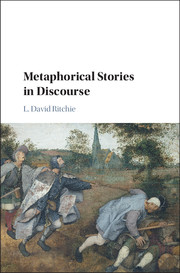
The painting by Bruegel reproduced on the cover of this book illustrates another common saying, “The blind leading the blind,” which is the title of the painting. The metaphor is based on knowing is seeing or understanding is seeing. So “blind” is often used as a metaphor for not knowing or not being aware of, as in the familiar statue of the goddess of justice wearing a blindfold (see Chapter 11). “The blind leading the blind” blends this metaphor with the journey or motion metaphor, implying that a person who is instructing someone else about a topic is equally ignorant about the topic. This implies a vehicle story about the consequences of a blind person leading another blind person that maps onto a topic story about ignorant people receiving direction from someone who is equally ignorant. As I will discuss in more detail in Chapter 11, Breugel’s painting fleshes out the vehicle story and makes it explicit.
Aphorisms based on fables and parables. A familiar form of story metaphors is the fable or parable, discussed in Chapter 5. Many aphorisms refer in one way or another to a well-known story. A speaker might refer to an errant offspring as a “prodigal son,” indexing Jesus’s story with the same name. However, it is also possible that people who hear – or even people who use – this phrase may not think of or may not even know the parable, in which case they might be referring only to an offspring who behaves irresponsibly, with none of the implications of repentance and forgiveness. (A person who does not know the meaning of “prodigal” might confuse it with another word like “prodigious,” and misunderstand the comment entirely. This kind of misunderstanding probably happens much more frequently than most of us realize.)
“Sour grapes,” indexing the story of the fox and the grapes, has also become a commonplace in ordinary speech. It is also possible to process this phrase as a metaphor without activating the fable on which it is based. One expects grapes to be sweet, and will be disappointed if they are sour; “sour grapes” could refer simply to a person’s disappointment with an outcome that had been desired, without activating the resolution of cognitive dissonance by devaluing the outcome, as is implied by the moral of the fable.
Jesus’s parable of the woman taken in sin is often indexed by simply repeating the punch line, “Let one who is without sin cast the first stone.” Although the parable refers to a harsh punishment prescribed by certain religious traditions for the sin of adultery, it is routinely mapped onto criticizing anyone for any fault whatsoever. ‘Adultery’ maps readily onto any socially disapproved act, and “casting a stone” maps onto criticizing as well as punishing. Indeed, a common variant of the metaphor is to ‘cast aspersions’ regarding someone else’s suspected actions or motives.
Much the same idea has also been captured by an aphorism that is apparently independent of the parable: ‘People who live in glass houses should not throw stones.’ This aphorism implies, and probably requires, activation of a story about someone who throws a rock at a neighbor’s house and hits his own house, or the neighbor retaliates by throwing a rock back. This metaphorical story vehicle then maps readily onto any topic story in which a person, who is vulnerable to criticism, criticizes someone else. However, the fact that all of those who had brought the woman to Jesus for judgment in the story silently slipped away strongly implies that everyone is guilty of some sin (everyone ‘lives in a glass house’), while ‘people who live in glass houses’ seems to suggest, or at least can be interpreted as suggesting that (1) not everyone is necessarily guilty (most people do not live in houses made entirely of glass), and (2) only those who are guilty of some sin or fault need refrain from criticizing others.
It is common for aphorisms to abstract away from the richer meaning of the parable or other story on which they are based. Jesus’s story of the Good Samaritan has to do not only with kindness to strangers, which is how the phrase “Good Samaritan” is often used. In the parable it is also important that several people who were supposedly holy men passed by the stricken man, ignoring his need, and that the Samaritan was not only a stranger but also a stranger from a different, and much despised, social group – who had thus every reason to ignore the needy victim. This “despised outsider” part of the story is only occasionally part of the meaning implied by use of the metaphorical aphorism in a particular context.
Another example, discussed by Moscovici (Reference Moscovici1961), comes from the Greek story about King Oedipus, as told by Sophocles. In the story, Oedipus is abandoned by his parents as an infant because of a prediction that he will kill his father. He grows up, encounters but does not recognize his father and kills him, then proceeds to his father’s city, where he meets and marries his mother. Freud adapted “Oedipus complex” as a metaphor for the sexual and emotional maturation of boys who, Freud claims, have an innate sexual attraction to their mothers and competition with their fathers. Moscovici shows how the specific term “Oedipus complex” as well as the more generic term “complex” was taken into popular culture during the 1950s as a metaphor for all sorts of emotional difficulties, often with no identifiable relationship to Freud’s actual theories or to the underlying Greek myth.
This kind of abstracting is also nicely illustrated by the common usage of “a dog in the manger.” This is often applied to people who spoil or otherwise deprive others of objects or situations for which they themselves have no use or desire. In the fable, the dog actually does make use of the hay, but as a soft place to sleep and not as something to eat. The fable seems to be about appropriating for one’s own use something that belongs to and is needed by someone else, but this aspect is often missing from the idiomatic use of the phrase.
Aphorisms in political and commercial discourse. A rather earthier example of an aphorism comes from President Lyndon Johnson’s remark about J. Edgar Hoover, the controversial director of the FBI. Hoover had used his position to gather potentially embarrassing and in some cases incriminating information (‘dirt’) about almost every public figure in the United States, including most politicians, and it was widely claimed that he had abused this information to discredit opponents and in some cases, destroy careers of people he did not like, and generally to wield a dangerous amount of power over public affairs. When he was asked why he didn’t fire Hoover, Johnson commented that “It’s probably better to have him inside the tent pissing out, than outside the tent pissing in” (New York Times, October 31, 1971).
This aphorism elaborates a relatively conventional metaphor. To ‘piss on’ something or someone is to show extreme disrespect. In New Zealand, as exemplified in the title of an article by Fine and DeSoucey (Reference Fine and DeSoucey2005), “Taking the piss” refers to something that might be expressed as reacting with good humor when subjected to jocular abuse. In the United States an exchange of vitriolic insults (in a political campaign but also in other contexts) is often referred to as a ‘pissing contest’ or ‘pissing match.’ ‘Pissing contest’ itself has a strong potential to activate a set of vivid and disgusting perceptual simulations (two 10-year-old boys urinating on each other, a scene sometimes observed during recess in elementary school). This in itself qualifies as a story index: The school-yard pissing match is part of a more extended narrative that may have begun with name-calling or other acts of belligerence, and is likely to end with the boys rolling around on the ground pounding on each other, then sitting in opposite corners of the principal’s office. This story maps onto a political ‘pissing match’ in which opponents exchange disrespectful and insulting accusations in a sequence that “degrades” both of them. (A related political story metaphor, also traceable to preadolescent boys, is ‘mudslinging.’)
Johnson’s aphorism expands this metaphor image and locates it in a tent which, depending on what is most salient to the hearer, may be simulated as a camping tent at night or as a shade tent during the day. In any event, “inside the tent pissing out” may be disgusting to the other inhabitants of the tent, but not nearly as disgusting as the opposite, “outside the tent pissing in.” These two phrases together have the effect, or at least have a strong potential to have the effect of constructing a story world (Gerrig, Reference Gerrig1993; Green, Reference Green2004) in which Johnson and the other members of his team are together in a tent, with Hoover either inside the tent with them (hence “pissing out”) or outside the tent (“pissing in”). This story world is blended with the actual story with its own literal alternatives: either Hoover is retained as part of Johnson’s government, making accusations and releasing embarrassing information about people who are not part of the government, or Hoover is fired from Johnson’s government, and begins to make accusations and release embarrassing information about people who remain in the government (presumably including Johnson himself). Among the implications: Hoover’s actions are diminished to the level of spiteful schoolboys, and by implication his political importance is also diminished. Hoover is going to be “pissing” in one direction or another, and Johnson can’t control that. The best he can do is to control the ‘direction’ of the “piss,” i.e., who ‘gets pissed on.’ It would be difficult to understand Johnson’s aphorism without activating some simulation of this sort, and it seems likely that the strength and rawness of the language promotes the hearer’s “transportation” into the story world, thereby increasing the persuasive power of Johnson’s explanation (Green, Reference Green2004; Green & Brock, Reference Green and Brock2000).
Johnson’s aphorism is an example of a metaphor that may be processed through purely semantic connections, through the activation of perceptual simulations, or both. In American slang, as well as apparently in the slang of Australian and other English-speaking cultures, ‘piss’ is extensively connected with a number of meanings that are likely to have been activated in the minds of those who heard or read about it. But the contrasting phrases, “inside the tent pissing out” and “outside the tent pissing in,” also have the potential to activate strong story schemas and perceptual simulations. Activation and partial simulation of these contrasting stories add a rich layer of meaning to Johnson’s explanation of why he did not fire Hoover, and it would be difficult to understand the aphorism at all without at least partially activating these story schemas and accompanying simulations. At the same time, the semantic connections with other vernacular uses of “piss” adds to the meaning, in particular by linking Johnson, the president of the United States at the time, with many other speakers in many other social contexts.
When the vehicle is a word or phrase. According to traditional definitions a metaphor is a single word. This raises the question, to what extent does the activation and blending of stories contribute to processing metaphors in which the vehicle is a single word, or a short phrase? Since most verbs identify actions, they are probably the easiest case to deal with. When President Obama, in his Georgetown speech on the environment, declared, “It’s just time for Washington to catch up with the rest of the country,” “catch up” activates the idea, and most likely a simulation, of motion. In the context, it seems quite likely that a story is activated in which one person or group of persons hurries after a large group (policy-making is a journey); this is easily blended with the story of public opinion polls that favor a more active approach to climate change while political leaders dither.
It seems evident that the story metaphor account does not fit some metaphor vehicles at all well. That hoary old standard, ‘Achilles is a lion,’ is usually assumed to activate only some of the qualities associated with a lion, such as its strength, and not necessarily its activities. It is possible to think of a story about ‘a lion’ that might map onto a story about Achilles (for example, if Achilles was accused of having killed his lover’s children by a previous lover), but in the absence of a specific context there is very little to activate either the story-vehicle or the story-topic. Even more to the point ‘beanpole,’ as a description of a tall, thin child activates only the physical qualities, specifically the shape, of a bean pole, and ‘willow-waisted’ activates only the slenderness and suppleness associated with willows. It seems highly unlikely that any of these metaphors would activate a metaphorical story line. Similarly, ‘the eagle is the lion among birds’ (Tourangeau & Rips, Reference Tourangeau and Rips1991) has been interpreted primarily in terms of the lion’s culturally-imputed qualities of “nobility” and top-of-the-food-chain dominance. But consider a different bird and a different mammal: ‘the crow is the coyote among birds.’ Although one might focus on a culturally imputed quality such as wiliness, that quality itself implies action, for those familiar with both animals, a story about doing something in a “wily” way. If the metaphor is interpreted according to Native American mythology, stories must almost inevitably become activated; similarly, if it is interpreted according to observation of actual coyotes and crows, these observations are likely to involve stories of typical behavioral sequences that can be blended.
Another of the old standards, ‘cigarettes are time bombs,’ can only be understood by activating a story-schema, or script, for time bombs. (As much is implied by the typical explication of this metaphor.) Growing up in the 1950s, when lung cancer research was beginning to ring the alarm bells, I more frequently heard ‘cancer sticks’ and ‘coffin nails.’ ‘Coffin nails’ appeared as slang for cigarettes as early as the late 19th century and was a commonplace by the 1930s; it has appeared as an image in many antismoking cartoons, and is likely to activate a “still picture” perceptual simulation of a coffin with cigarettes sticking out all around the edges, but it also activates a more dynamic script in which some entity nails down the lid of a coffin, and blends it with a script of chain-smoking.
Similarly, ‘some jobs are jails’ has been explained in terms of ‘unpleasant and confining,’ but confining implies a story, and any way in which someone might actually utter the metaphor (‘this job is a jail!’) almost demands activation of a detailed story about the speaker’s work life (the exclamation is unlikely to have any meaning otherwise) and blending it with a jail script. Again, I have more often heard ‘dead-end job,’ which taps into a career is a journey, a conceptual metaphor that is implicitly a generic career script. The underlying story of moving along a path also implies the possibility of ‘meeting obstacles,’ ‘taking a wrong turn,’ and ‘coming to a dead-end.’ As with other examples encountered earlier, it is conceivable that these expressions could be understood through simple lexical connections, e.g., “a job with no possibility of promotion.” However, if it is encountered in a conversation that includes a topic story about the speaker’s actual career, the meanings will be richer if the vehicle story is also activated.
Some nominal metaphors seem to require activation of a vehicle story. For example, ‘bulldozer’ (discussed by Wilson & Carston, Reference Wilson and Carston2006; see also Ritchie, Reference Ritchie and Schell2009) is a massive, heavy piece of construction equipment. As a metaphor for a demanding boss or obstinate negotiator, it only makes sense in terms of a story that can be blended with the story of the topic person’s actions in a staff meeting or negotiation. Associated metaphors like ‘push people around’ and ‘run over people’ likewise require at least partial activation of a vehicle story in order to make sense. Similarly, ‘a bull in a china shop,’ without activation of a vehicle story, merely transfers a sense of ‘being out of place’. With activation of a vehicle story of wanton and possibly unintended destructiveness, it has much richer meaning.
Near the other end of the power spectrum, the rhetorical question ‘are you a man or a mouse?’ is only meaningful in the context of a story in which the topic person confronts some challenging, probably dangerous situation. Here, it is not the size, quick movements, or temperament of the mouse that is relevant. Rather it is the culturally imputed behavior of a mouse in the face of danger, and the resultant vehicle story of ‘fleeing and hiding’ that blends with the topic story to produce the blended story about the disfavored behavior.
Framing Effects and Conflicting Story Metaphors: An Example from Health Communication
Thibodeau and Boroditsky (Reference Thibodeau and Boroditsky2011) argue that metaphors embedded in metaphorical stories can influence how people think about and search for information about a topic, and what solutions they deem appropriate. Mattingly (Reference Mattingly2011) identifies three metaphors widely used in medicine. Healing is ‘sleuthing,’ the body is ‘a crime scene,’ and the doctor is a ‘detective’; healing is ‘battling disease,’ the body is ‘a battlefield’ or ‘war zone,’ and the doctor is a ‘warrior’; healing is ‘mechanical repair,’ the body is ‘a machine,’ and the doctor is a ‘mechanic.’ Each of these implies a vehicle story that maps onto the topic story about treating a disease. The first maps onto a story from the familiar detective genre; the second onto a familiar genre of war stories, and the third onto the everyday story about experiencing automotive problems and taking the vehicle to a mechanic. A very different kind of story is implied by the use of ‘vegetable’ and ‘vegetative state’ to describe a patient who has experienced severe damage to the brain. At a surface level, this metaphor does not necessarily imply a story; it is just a descriptive metaphor that compares the person to a plant, which is biologically alive, but does not have a functioning nervous system. Indeed, the fact that plants do not appear to “behave” in the ordinary sense of the word would seem to rule out a story. However, ordinary people can be quite creative in using language to accomplish their objectives, and that creativity often includes transforming metaphors, even static metaphors like ‘vegetable,’ into dynamic stories.
Mattingly (Reference Mattingly2011) tells a story about an infant born with severe spinal bifida who was kept alive solely by technology that sustained several of her vital biological functions. The medical staff wanted to withdraw artificial support and allow the infant to die a natural death, but the deeply religious parents wanted to keep the infant alive at all costs.
The body is a machine metaphor in this case was somewhat ironic because in many senses, the child was part of and kept alive by a literal complex of machines; the medical intervention had turned her into a kind of “artificial baby,” more machine than person. In an attempt to convince the parents to allow them to disconnect the child from these machines, the medical staff compared her to “an old car with a bad engine, too broken down to repair.” However, to the parents, the fact that this supportive technology was available fit within a very different story, a narrative about God’s creativity, a miracle in which God used the scientists to create the technology that could save their baby and keep her alive. When a nurse warned the parents that “Your daughter’s going to be a vegetable,” the child’s mother extended and developed this static metaphor into a dynamic counternarrative: “That’s okay, we’re going to be her garden. We will water her and she will grow.”
What Metaphors Index or Activate Stories – and When?
How important is the activation and blending of stories in comprehending a single word or short phrase as a metaphor? Do all or even most metaphors activate associated stories or do metaphors differ with respect to their potential to activate stories associated with vehicle, topic, or both? In most of the examples in my own data, verbs used as metaphors imply actions, and these are often either sequences of actions or actions that typically occur as part of a sequence.
On this basis it seems reasonable to infer that metaphors based on action verbs have at least the potential to activate a story. Returning to the previously-quoted passage from Tony Blair’s (Reference Blair2005) party conference speech at Gateshead, “events that tested me” seems to imply a narrative – an encounter with (personified) “events” that opposed Blair’s skillful execution of plans and had to be overcome. “Media mood turning” presents the mood of the media as either a ‘vehicle turning onto the wrong street’ or ‘milk turning sour,’ itself a metaphor based on change of state is change of direction. Both metaphor layers imply at least a brief narrative. “Friends … being lost,” and “decisions mounted” also seem to suggest metaphorical narratives that map onto subnarratives within the overall story of Blair’s early years in office. On the other hand, the canonical form ‘X is a Y,’ as in ‘Achilles is a lion’ often implies a static state.
Counterexamples are easy to come by. Also from the Blair speech, “irritate” and “grate” both suggest a single continuing action, and map readily onto a topic verb such as annoy, with no obvious story implied. Nouns and adjectives also vary in the degree to which they seem likely to activate or invite activation of stories. As pointed out in the foregoing, at least in the context of a political debate, Rick Perry’s metaphor “vulture capitalist” seems almost to demand activation of stories associated with both topic and vehicle. In contrast, when U.S. Civil War General McClellan repeatedly referred to President Lincoln as “a gorilla,” there is no indication that he intended to activate any associated story, or anything beyond a simple descriptive insult. ‘Cigarettes are time bombs’ and ‘coffin nails’ both demand activation of stories associated with both topic and vehicle – without the stories they make no sense. ‘Dead-end job’ and ‘dead-end relationship’ both seem likely to invite metaphorical stories (about a journey) to complete their meaning, but ‘dead battery’ and ‘deadly bore’ do not.
Some metaphorical words and phrases refer to or index well-known metaphorical stories such as parables and fables – “sour grapes,” “prodigal son,” “Good Samaritan.” Others, like ‘coffin nails,’ “glass ceiling,” and “vulture capitalist,” imply vehicle stories that are not necessarily spelled out, but are necessary to understand the metaphor. Conversely, communicators, including speakers, writers, and cartoonists, frequently develop metaphorical stories out of commonplace metaphors, as in the example “if she’s a vegetable, we’ll be her garden.”
Steen’s (Reference Steen2015) ideas about intentionality (discussed in Chapter 3) is helpful here. If the metaphor is novel, or has been transformed in a way that makes it seem novel, or if it is developed in more than one metaphorical phrase within the same passage or the surrounding context calls attention to the metaphorical potential of a word or phrase, hearers or readers are more likely to recognize and process it as a metaphor. By extension, if these same factors call attention to the narrative potential of a word or phrase, hearers or readers may be more likely to process it as a metaphorical story. The use of grammatical metaphor (Halliday, Reference Halliday1985; see Chapter 3) may also provide a cue to metaphorical intention – again, if the context calls attention to the grammatical transformation it may be recognized and interpreted as a metaphorical story, as in the example in which then Senator Obama used both the word “divide” and the phrase “racial divisions” in the same passage, thereby allowing the concept of “divide” to assume causal agency.
Petty and Cacioppo’s (Reference Petty and Cacioppo1981) Elaboration Likelihood Model (see Chapter 3) provides a more general account. They show that the degree to which people think about and elaborate on a message is influenced by both their motivation and their ability. Perceptions about the intention of the speaker, as addressed by Steen’s concept of intentionality, are only part of motivation. Perceived personal relevance is also important, as is a factor Petty and Cacioppo call need for cognition. They described need for cognition as a kind of mental drive, but it can be conceptualized more broadly as a response to the entertainment or amusement value of an idea. A phrase like Rick Perry’s “vulture capitalist” or Lyndon Johnson’s “outside the tent pissing in” may motivate elaboration and further processing simply because it is amusing and may provide a rhetorical resource for subsequent conversations (or for use in a book about metaphorical stories).
Ability to process also merits closer examination. In Petty and Cacioppo’s initial formulation, it included mental capacity (intelligence and verbal ability), freedom from distraction, available energy (is the person tired or fresh), and access to relevant background contextual knowledge. In the case of metaphors, contextual knowledge would include knowledge about both vehicle and topic – in the example of “vulture capitalist,” knowledge about vultures and their culturally imputed behavior and about venture/equity capitalists and their culturally imputed behavior. Contextual knowledge also interacts with motivation; for example, a voter who favored Romney would have had a motivation to process and elaborate the metaphor that would be very different from that of a voter who favored Perry.
Petty and Cacioppo’s discussion of the Elaboration Likelihood Model tacitly assumes a “code” model of communication, in which speaker and hearer potentially have access to the same context, the same background knowledge. This assumption is rarely true, and it is probably never true with respect to public discourse such as political speech. Ritchie and Cameron (Reference Ritchie and Cameron2014) analyze a public meeting held to discuss an incident (one of a series of such incidents) in which a police officer shot and killed an unarmed African American during a routine traffic stop. They showed how both the representatives of the Police Bureau and the representatives of the African American community addressed multiple audiences, and how failure to account fully for the differences in context salience among these audiences led to the breakdown and failure of the meeting. These differences in context salience led to different interpretations of several metaphors used by both sets of speakers, and sustained the lack of mutual understanding and empathy that motivated the meeting in the first place. Generalizing from this example, it appears that access to particular contextual knowledge is at least as important as general contextual knowledge in determining whether and how metaphors will be processed. Even when metaphorical stories are elaborated and processed, they will not necessarily be the same stories, or processed in the same way, by various members of the audience. (Here again, motivation interacts with background knowledge: hearers can and often do actively choose which of the available contexts to consider when processing a metaphor.)
To sum up, it seems that the potential of a metaphor to activate a metaphorical story might be influenced by several factors: Is a story necessary for the metaphor to make sense? Are there indications in context that a speaker may have intended for a story to be activated (e.g., Governor Perry’s contention that Romney’s company had bought two companies and “picked their bones clean”)? Does the metaphor have richer or deeper meaning that reward the extra processing effort if a story is activated? Is the metaphorical story enjoyable or entertaining in its own right – and does it have the potential for repetition and re-use in other communicative contexts? Finally, even when all these conditions are satisfied, it may still be difficult to predict how diverse members of an audience may interpret and elaborate the metaphorical story. I will return to this question in Chapter 11.


