

Now, who, if endowed with intelligence, will believe that a first, a second, and a third day, and an evening and a dawn, took place without sun, moon, and stars? And that the day that should have been the first took place even without sky? Who is so stupid as to believe that God, like a human farmer, has planted a garden in Eden toward the East and put a visible and sense-perceptible tree of life therein, so that one, by eating its fruit with one’s bodily teeth, could acquire life, and also could participate in good and evil after munching what is taken from that tree? If, then, God is said to stroll in the garden/ Paradise in the evening, and Adam to hide under the tree, I do not think that anybody will doubt that these things indicate symbolical truths in an allegorical way, by means of what looks like a historical account, and yet has never happened corporeally.
The word allegory has been used to describe many kinds of metaphorical texts, and defined in many different ways. The noun, which derives from ancient Greek allegoria, “other speaking” (Crisp, Reference Crisp2005a), has sometimes been used broadly to include all metaphor, but it is more commonly restricted to some combination of metaphor and story. The related noun, allegoresis, refers both to the practice of giving an allegorical interpretation to existing texts and to the practice of creating allegorical texts. Crisp (Reference Crisp2008) defines allegory as an extended or “super-extended” metaphor, a fiction that is subject to a continuous and consistent metaphorical interpretation (Crisp, Reference Crisp2001), any metaphorical passage in which overt reference to the “target” (topic) domain is omitted (Crisp, Reference Crisp2005b). Gibbs (Reference Gibbs2011, p. 121) gives an equally broad definition of allegory as “a cognitive action in which people apply a metaphoric mode of understanding to situations and discourse that typically does not contain metaphorical language per se.” Gibbs (Reference Gibbs2011) implicitly anchors the concept to storytelling: “Allegory involves an extended metaphor in which the entire narrative introduces and elaborates upon a metaphoric source domain … to evoke larger life themes.”
In this chapter, I will briefly review several examples of literature that are clearly allegorical, along with some of the recent discussion of allegory by metaphor theorists and researchers. The aim is not to provide a comprehensive discussion of allegory – that would require a very large book in itself (Whitman, Reference Whitman2003). The aim of this chapter is twofold. First, because allegory is a familiar form of metaphorical story, it is useful to begin with an examination of a few texts that are often cited as examples of allegory. Second, based on a discussion of literary allegories, this chapter will distinguish allegory as a literary form from other kinds of metaphorical story as a basis for discussing the allegorical elements that may be found in other forms of metaphorical story.
Allegory in Antiquity
By the sixth and fifth century BCE, Greek philosophers were attempting to come to terms with stories about the all too human behavior of the Gods, as portrayed by Homer, Hesiod, and others, while honoring the genius of these early authors. One strategy was to give these texts an allegorical interpretation, in which each of the gods, and their various interactions with each other and with humans, stands for some abstract idea or principle. According to Whitman (Reference Whitman2003), allegorical interpretation of this sort allows thinkers to come to terms with texts produced in very different cultural situations. The Stoic philosophers initially assigned scientific and ethical meanings to mythological stories (for example Zeus represents the ether, Hera represents the air), then extended the strategy by creating their own allegorical expressions of core philosophical ideas. Indeed, Ramelli (Reference Ramelli2011) argues that, for the Stoics, allegory was inseparable from philosophy. “Allegoresis had been used since the very beginning of Stoicism, from Zeno’s commentaries on Homer and Hesiod onwards” (Ramelli, Reference Ramelli2011, p. 336). Chrysippus, in On Divinities, argued that poetry, myth, and cultic traditions require an allegorical interpretation in order to detect the truth hidden in them (Ramelli, Reference Ramelli2011).
By the first century, Jewish philosophers and scholars were adapting the Greek allegorical methods to the exegesis of Judaic scripture. For example, Philo of Alexandria claimed that “the biblical injunction not to eat the fruit of trees for three years (Leviticus 19:23) suggests that the fruit of instruction remains intact throughout the threefold division of time into past, present, and future” (as quoted in Whitman, Reference Whitman2003, p. 7). Christian philosophers and exegetes, especially the “esoteric” commentators Clement and Origen (second and third centuries CE) in turn used allegorical interpretations of Plato, Aristotle, and other pre-Christian Greek writers to establish the truth of Christian faith, and adapted the same methods of allegorical exegesis to the Christian Bible itself (Ramelli, Reference Ramelli2011).
As the passage from Origen quoted at the beginning of this chapter illustrates, allegorical interpretation was sometimes used to come to terms with apparently contradictory or otherwise intellectually embarrassing passages. However, the preferred approach was to treat biblical passages as simultaneously literal and allegorical. According to this approach, the events described (such as the Great Flood) really happened, but they also express allegorical meanings. An example of this approach is a passage from Paul’s letter to the Galatians:
Tell me, ye that desire to be under the law, do ye not hear the law? For it is written, that Abraham had two sons, the one by a bondmaid, the other by a freewoman. But he who was of the bondwoman was born after the flesh; but he of the freewoman was by promise. Which things are an allegory: for these are the two covenants; the one from the mount Sinai, which gendereth to bondage, which is Agar. For this Agar is Mount Sinai in Arabia, and answereth to Jerusalem which now is, and is in bondage with her children. … what saith the scripture? “Cast out the bondwoman and her son: for the son of the bondwoman shall not be heir with the son of the freewoman.”
Paul’s interpretation here is a complex expression of several themes, including the replacement of the “old” covenant of enslavement and Jewish Law by the “new” covenant of emancipation and spiritual law, which is spelled out in explicit detail in other epistles (Whitman, Reference Whitman1991). Paul also replaces the idea of generational succession, birth “after the flesh” with succession by “divine covenant,” thus associating the Jews of his time with Ishmael, not Isaac – who is thus cast as the spiritual progenitor of the Christians, gentile as well as Jew: “So then, brethren, we are not children of the bondwoman, but of the free” (Galatians 4:31).
In this explicit bit of allegorical exegesis Paul extends the idea of allegory to include a temporal dimension, in which historical events both prefigure future events and signify spiritual ideas and principles. “‘Allegory’ of this kind suggests not just the turning of a story, but a transformation in history” (Whitman, Reference Whitman1991, p. 163). Commenting on the passage from Galatians in his fifth-century treatise On the Trinity, Augustine explicitly codified the distinction between allegories that express abstract ideas in a fictional story, expressed only in words (in verbis) and allegories in which these ideas are present in facto, in actual historical events (Whitman, Reference Whitman1991). Much of the Christian use of allegory follows the same model as Paul’s interpretation of the story of Sarah and Hagar, giving an allegorical reading to events while asserting their historical facticity.
Well before the Christian era, Stoics and other philosophers were concerned about the related problems of how to present philosophical, ethical, and spiritual ideas to unsophisticated audiences, and how to conceal sacred mysteries from the uninitiated, who are not prepared to receive and understand them. Allegory was presented as a solution to both problems. On the one hand, when esoteric mysteries are expressed in complex allegories, they can be clearly revealed to those who have been initiated into the esoteric knowledge needed to interpret the allegory. On the other hand, if religious and ethical ideas are wrapped in suitable allegorical stories, unsophisticated audiences can only catch some glimmer of the underlying ideas while more sophisticated audiences can appreciate the full richness of the message. Early in the Christian era Latin poet Prudentius wrote an allegorical account of a battle, the Psychomachia, written in the epic style of Virgil, in which Christian faith is attacked by pagan idolatry. The battle includes seven personified vices who attack and are defeated by seven personified virtues: Chastity is attacked by Lust; Anger attacks Patience, and so on. I will discuss this allegory, which is often regarded as the first medieval allegory, in the next section along with other classical examples.
Initial definition: Allegory refers to a style of displaced writing about abstract ideas, including scientific and philosophical as well as religious and ethical ideas in which persons, places, and actions stand for abstract ideas and relations among abstract ideas. Allegoresis refers to a practice of inventing or finding an allegorical interpretation of existing texts, a practice of creating texts that express abstract allegorically, or both. The texts may be overtly allegorical or they may be written in such a way that a simple, nonallegorical reading is readily accessible. According to many of the Stoic philosophers, texts may be legitimately subject to allegorical interpretation regardless of the author’s intentions. Allegory may displace ideas across domains (as when Zeus stands for ether) or across temporal eras (as when Sarah and Hagar stand for Jews and Gentiles or, in Paul’s reinterpretation, for Christians and contemporary unbaptized Jews). The allegorical story may be historically true (Sarah and Hagar) or entirely fictional (Odysseus’s visit to the Underworld).
Allegory in the Late Medieval and Early Modern Ages
Throughout the Middle Ages, scholars developed ‘multilevel’ methods of scriptural exegesis. A fourfold approach was commonly followed, in which an event like the Great Flood or the Exodus out of Egypt was simultaneously understood as (1) historical fact; (2) allegory, with particular focus on typological fulfillment of Old Testament figures in Christ or the Church; (3) morally, as a representation of conversion and salvation of the soul through grace; and (4) analogically, representing the passage of the soul to Heaven (Whitman, Reference Whitman2003). Concerns about the difficulty of presenting sacred mysteries to those unready to receive and understand them, and allegory as a partial solution to this problem, also persisted through the Middle Ages and up to the Reformation era, and the allegorical interpretation of ancient mythology continued throughout the Renaissance.
However, Luther and other reformers rejected both the idea that common folk are incapable of understanding religious truths and the use of allegorical interpretations, and advocated a simple, literal reading of Christian scripture (Whitman, Reference Whitman1991; Reference Whitman2003). By the 18th century, theologians increasingly approached the Christian Bible from a “rationalist” and historical/critical perspective based on investigation of the text’s origins and development. At the same time the Romantics objected to allegorical interpretations of all ancient texts because they feared losing the original meanings.
It is particularly interesting that, during this time in which philosophers and theologians came to devalue and reject allegory as an approach to biblical exegesis, several extended allegories were produced, not for the purpose of biblical exegesis or reinterpreting pre-Christian classical texts, but as a way of representing abstract and often complex political, religious, and social ideas. Beginning with Prudentius in the fifth century, authors discovered the power of allegory as a means, not only of expressing abstract ideas but also of expressing potentially dangerous political criticism against both religious and secular leaders. In this section I will discuss four examples that represent different approaches to the genre. Psychomachia, The Divine Comedy, The Faerie Queene, and Pilgrim’s Progress differ from one another in many ways, but a common thread runs through them that will help extend and refine the definition of allegory given above.
Psychomachia (fifth century CE): Written by the Latin poet Prudentius in the style of Virgil’s Aeneid, Psychomachia relates a war between Christian faith and paganism, in which paganism is defeated. The poem opens with a prayer to Christ that parallels the prayer to the Muse that open classical epic poems like the Odyssey:
The poem is divided into a series of cantos, each devoted to the single combat between a vice and a matching virtue, all depicted as female warriors, beginning with the combat of “Faith” and “Idolatry.” “Faith” enters the battle unarmed, “wholly trusting to a dauntless heart, / No shield she carried, nor envenom’d dart.” “Idolatry” attacks; “Faith” throws “Idolatry” to the ground and steps on her neck, choking the life out of her.
The metaphor is sustained in many of the cantos in the description of the combat and the weapons used. In the battle between the maid “Chastity” and the harlot “Lust,” “Lust” throws flaming torches (sexual passion is fire) and tries to choke “Chastity” with sulfur and smoke. Then “Chastity” throws a rock that breaks “Lust’s” arm, and cuts off her head with a sword. The poet compares this battle to the victory of the biblical Judith. In the battle between “Pride” and “Humility,” “Humility” also, like “Faith,” enters the field of battle unarmed. “Pride” sees “Humility’s” lack of sword and shield, and scoffs at the opposing forces, gloats at how she subdues men everywhere, beginning with Adam, who “friendly Pride taught him with leaves that nakedness to hide.” Disdaining to stain her sword “With the ignoble blood of such a crew” “Pride” decides to crush them under the feet of her courser. But the steed falls into a hidden ditch, dug and covered over by “Fraud,” which “Humility” avoided. The steed falls on top of “Pride” and crushes her to death. “Humility’s” “Guardian” gives her a sword with which she severs the head of the fallen “Pride.” Then “Hope” declaims over the fallen “Pride,” and compares this battle to similar previous fights, including David’s fight against Goliath.
Crisp (Reference Crisp2008) claims that in classical allegory, in contrast to extended metaphor, the metaphorical mapping is sustained but never made explicit. However, this claim is contradicted by several passages in which Prudentius explicitly refers to the allegorical connection between the battles he depicts and the topic of his poem. For example, after “Patience” mildly proclaims her triumph over “Wrath,” the poet comments,
Here Job is introduced; then the poet comments:
The poem closes with a coda in which the poet explicitly maps the entire story onto his own personal spiritual “struggles” (faith is war):
Crisp’s intention was to argue that allegory and extended metaphor are distinct and separate, and argue against the claim that these two types fade into one another along a continuum, with many texts exhibiting some but not all features of allegory. However, the presence of explicit mapping in Psychomachia, otherwise a nearly perfect example of allegory, undermines this claim, and it is easy to find examples of literary text that fall between the extremes of pure allegory and non-allegorical extended metaphor. One such example is provided by Dante’s Divine Comedy.
The Divine Comedy (Dante, Reference Dante1320): The Divine Comedy combines several genres. Overall it takes the form of a blend of epic and allegory, recounting the author’s journeys through the regions of Hell, Purgatory, and Heaven. A metaphorical mapping of this journey is stated in the opening triplet:
A guide appears at once – the pre-Christian Roman poet Virgil, representing the scholarly tradition of wisdom and intellect, who is himself unable to enter Heaven because he lived too early to have the opportunity to profess faith in Jesus, be baptized, and thereby be redeemed from the “stain” of original sin. Virgil accompanies Dante through Inferno and Purgatorio, then hands him off to another guide, Beatrice, representing pure spiritual Love, who guides him through Paradiso. Consistent with the epic format, the author/traveler faces many dangers. During his journey through Hell, these take the form of encounters with the demons and various features of the landscape, which are metaphorically mapped onto the torments of the damned souls, and which Virgil helps Dante to avoid. During his journey through Paradise, the dangers are of a different sort: Dante’s mortal senses are inadequate to cope with the glorious splendor of the Heavenly state of bliss, which is metaphorically expressed as fire and intense light. Here, Beatrice advises him on how to perceive the glories of Paradise without being blinded by them.
Throughout, the focus is on what Dante learns about the spiritual life from what he experiences and sees, and particularly from conversations with the persons he encounters. Most of these are actual historical figures, many of them contemporaries of Dante. The physical “journey” maps explicitly onto Dante’s journey of life in the opening lines; then it implicitly maps onto his journey of understanding; this mapping is reinforced by passages throughout in which Virgil and others provide theological explanations and instruction.
Especially in the Inferno, the poem also has the character of political commentary, even polemic, as Dante describes the crimes and sins committed by figures from recent history, including popes and rulers as well as merchants and other notables, and assigns torments (in Il Inferno) and cleansing punishments (in Purgatorio) to these figures, each punishment reflecting the nature of the sins Dante ascribes to them. The action is also interspersed with moral homilies and instruction in Catholic doctrine, illustrated by the punishments meted out in Il Inferno and Purgatorio. In Il Paradiso, the poem is interlaced with theological argumentation that follows the form in some places of a catechism, as when Dante is asked to recite his faith and his reasons for believing, and in many places it follows the form of a philosophical dialogue, in which Dante’s questions about apparent paradoxes are answered with philosophical arguments, sometimes by these saints, sometimes by Beatrice. Sometimes Beatrice encourages him to give voice to these questions and doubts; sometimes she reads his mind and voices them for him, then answers them.
The “journey” described by the poem is doubly metaphorical, representing both Dante’s own life and the journey of faith and understanding that all Christians must undertake. It is significant that explanations of Divine Justice in Il Inferno and Purgatorio are provided by the poet Virgil, representing Intellect and Inspiration; explanations of Faith and Grace are provided by Beatrice, representing Love. These elements clearly fit the definition of allegory as stated by Harris and Tolmie (Reference Harris and Tolmie2011): a genre in which abstract personification of moral concepts like Gluttony and Lust (Faerie Queene) act within a conceptually laden locale like the Celestial City (Pilgrim’s Progress) or the Cave of Error (Faerie Queene). On the other hand, Harris and Tolmie’s definition is apparently contradicted by the amount of attention given to historical figures and events, especially in the first two books, and the literal explanations of both recent history and Catholic doctrine throughout, as well as the philosophical argumentation in Il Paradiso.
The Faerie Queene (Spenser, Reference Spenser1590): The Faerie Queene is presented in the form of an Arthurian romance, complete with magicians, witches, and fantastical beasts and demons. Spenser wrote in his introductory letter that his purpose was to “fashion a gentleman or noble person in virtuous and gentle discipline.” Elements of the poem also map onto the topical struggle between Catholicism and Protestantism, as well as onto recent English history, including a justification and critique of Tudor rule. Six books represent six virtues, Holiness, Temparance, Chastity, Friendship, Justice, and Courtesy. Spenser’s letter to Sir Walter Raleigh, presented as a preface to the work, suggests that the figure of King Arthur, who appears throughout, represents Magnificence, “the perfection of all the rest,” and the Faerie Queene, Gloriana, represents Glory.
In addition to representing specific virtues, characters in the poem also map onto contemporary and historical figures, real and mythic. Queen Elizabeth I is represented by Gloriana, the Faerie Queene, and several other figures; some of these representations are laudatory, some critical of her and her court. Her half sister Mary, Queen of Scots, is represented by the evil and deformed witch Duessa. King Arthur appears repeatedly, performing heroic exploits under his own name. The protagonist of Book I, The Redcrosse Knight, according to a passage in Book I, will come to be revered as Saint George, patron saint of England.
The poem follows the exploits of several knights, each representing different virtues, as they battle dragons, sorcerers, and other mythical figures. Book I begins with an elf warrior, the Redcrosse Knight, with his lady Una, the daughter of a king and queen who are being held captive by an evil dragon; the elf warrior has been charged by the Faerie Queene with the quest of killing the dragon and liberating the captives. (Later in the book it is revealed that Redcrosse is not an elf but the son of a royal human couple stolen from his parents and given to the faeries to rear.) After the Redcrosse Knight fights and defeats the dragon Errour, he is tricked by a dream sent by the wizard Archimago into believing that Una is unfaithful to him, and flees in the night, abandoning her. He meets and defeats another knight, Sans Foy, the eldest of three brothers. Sans Foy is accompanied by the sorceress Duessa, who presents herself as Sans Foy’s captive as a means of trapping the Redcrosse Knight.
Duessa leads the Redcrosse Knight to a castle, the House of Pride, which is built “on so weake foundation … on a sandie hill,” and “all the hinder parts, that few could spie, / were ruinous and old, but painted cunningly” (p. 56). There they are ushered by Vanitie into the presence of the queen Lucifera, who is characterized as a usurper “that made her selfe a Queene, and crond to be, / Yet rightfull kingdome she had none at all, / Ne heritage of native sovereaintie, / But did usurpe with wrong and tyranie” (p. 58). Lucifera rules with the advice of “six wisards old,” named Idlenesse, Gluttony, Lechery, Avarice, Envie, and Wrath. Sans Foy’s brother, Sans Joy, shows up, and challenges Redcrosse, who defeats him also. However, Duessa conceals the defeated Sans Joy within a dense fog, then spirits him away to save his life. Fearing treachery, Redcrosse leaves the House of Pride. Duessa catches up with him, tricks him into bathing in a spring that weakens him, then betrays him to the giant Orgoglio, who imprisons him in the dungeon of Despair. Una escapes from the sorcerer and overcomes various perils and meets Arthur, who defeats the giant Orgoglio and frees the Redcrosse Knight from Duessa and the Dungeon of Despair. However, the Redcrosse Knight has been weakened by his long imprisonment, so Una leads him to the House of Holiness, where he is healed. There he is also introduced to the ideal of a spiritual life, which he vows to follow. He then accompanies Una to her parents’ land, where he defeats the dragon who has held them captive, frees them, and is betrothed to Una. However, the marriage cannot take place until he returns to the Faerie Queene to complete one final quest.
The Faerie Queene is a complex weaving of allegories. The political, moral, and religious allegory is reflected in much of the naming, with places like the House of Pride, dungeon of Despair and the House of Holiness and person names like named Idlenesse, Gluttony, Lechery, Avarice, Envie, and Wrath. Each place is associated with activities and events matched to its allegorical name, and each person with name-appropriate behavior, all of which serves to keep the metaphorical mapping active in the reader’s working memory.
Pilgrim’s Progress (Bunyan, 1678/Reference Bunyan1969): Pilgrim’s Progress opens with a brief framing narrative: “As I walk’d through the wilderness of this world, I lighted on a certain place where was a den, and I laid me down in that place to sleep; and as I slept, I dreamed a dream.” This frame is continued in a series of dreams, which allows the narrator to insert himself and his authorial commentary from time to time, and at the same time in effect provides a cover story for the more fanciful parts of the narrative. “Wilderness” appears as a metaphor for Earthly existence in many texts (The Faerie Queene and The Divine Comedy also open in a “wilderness” setting) – and it still shows up in contemporary idioms, both secular and religious, for example, ‘It’s a jungle out there.’ “I walk’d” also activates a standard conceptual metaphor that forms the basis for the entire book, life is a journey, although it is rapidly narrowed and focused into a more specific application of the journey conceptual metaphor, salvation is a journey. The book as a whole takes the form of a novel in two parts – a narrative and a sequel. Both part one and part two of Pilgrim’s Progress have all the defining features of a complete narrative, with a protagonist who sets out on a quest, strives to achieve an objective, experiences and overcomes a sequence of setbacks. It is presented in two parts, a narrative about Christian, followed by a parallel, but inter-connected novel about Christian’s wife, Christiana.
The plot is motivated by the book Christian is reading (by implication, the Bible, although that is never made explicit), from which he learns that the city in which he was born and lives, the City of Destruction, is to be destroyed along with all who live there. The quest he sets out on is to escape the fate of being destroyed along with his city. Early in the first part, Christian pleads with his wife and children to accompany him on his quest and so escape destruction along with him, but they refuse to come with him, so he sets out alone, in spite of his professed love for them. The plot of the second part is motivated when Christiana learns that her husband was successful in his quest, and determines to join him after all.
The characters and places in Pilgrim’s Progress all bear names that identify them with moral, psychological, or spiritual qualities. Christian lives in the city of Destruction and journeys toward the Celestial City. His neighbors are Obstinate and Pliable. He meets Evangelist, who sets him on his way, and whom he encounters again from time to time. His misadventures include sinking into the Slough of Dispond and passing in darkness through the Valley of the Shadow of Death. He turns aside onto an easier path and is caught by the giant, Despair, and thrown into the dungeon of Doubting Castle.
Prefiguring the modern psychological novel, each part of the book presents two parallel stories, an external saga of heroic adventure and an internal story of spiritual struggle and growth. These two stories are intertwined in a way that contradicts Crisp’s (Reference Crisp2005b, p. 116) claim that “allegories … never refer directly to their metaphorical target.” In the first part, the immediately apparent story is about Christian, who learns from a book he is reading (the Bible) that the city where he lives is going to be destroyed. After worrying for some time about how to escape destruction, he encounters Evangelist, who sets him on a road to safety. At this level the story reads like The Odyssey (with Evangelist in the role of Athena) or any of dozens of “road novels”: Christian encounters a series of setbacks and misadventures, including swamps, giants, ogres, and so on. Each of these has a metaphorical name that guides the mapping onto the topic story about ‘the road to salvation.’ However, the story is also a psychological novel, about the hero’s struggles with his neuroses, or ‘internal demons.’ These are often, though not always, matched with the metaphorically named external demons.
Christian carries a burden on his back that, like the book he reads, is not explained – it is left to the reader to arrive at an interpretation based on background knowledge of Christian theology. On the other hand, the very first obstacle encountered in the physical journey narrative is the Slough of Dispond, into which he and his companion Pliable stumble, so that they become mired and are unable to go farther. Here, both men become literally despondent (in the psychological novel); Pliable responds by becoming angry with Christian and giving up the quest, but Christian recovers his determination and his will enough to struggle to the other side of the bog, where he encounters the metaphorically named Help, who (literally) helps him out of the bog and sets him back on the road. Later in the book, when he is caught by the giant, Despair, and thrown into the dungeon of Doubting Castle, he is (in the parallel psychological novel) beset by literal despair and doubt, which he must overcome before he recalls that he was given a key that will unlock the doors to the dungeon and let him escape the castle of doubt and despair.
Even Christian’s interactions with the helpers he meets along the way, such as Evangelist, have this dual quality, in which the topic as well as the vehicle is often explicit, sometimes within the flow of the psychological novel, sometimes as commentary. For example, in the passage (pp. 21–29) in which Christian follows the advice of Worldly Wiseman and turns aside in hopes of freeing himself of his burden, Evangelist reassures him that “all manner of sin and blasphemies shall be forgiven unto men; be not faithless, but believing.” The Evangelist concludes by instructing Christian about the three reasons why he must “utterly abhor” the counsel of Worldly Wiseman with his “carnal ways.” The novel – throughout both Parts One and Two – is interrupted with these homilies (which may well have come straight from the sermons Bunyan preached to his congregation); they take up a large part of the novel.
In sum, Pilgrim’s Progress is presented as a story with a well-developed narrative structure, and abstract qualities are represented by naming both places and characters. The characters have personalities that fit their names, and they behave in each place in a way that fits the metaphorical place-name. However, even over and above the character and place-names, there are many ways in which the author indicates how the vehicle story is to be mapped onto the topic story. This includes a surprisingly modern “psychological novel” element that runs throughout the first part (but is less overt in the second part) as well as the frequent literal religious homilies. In spite of his generic abstract name, Christian is well developed as a character, although the other persons in Pilgrim’s Progress are rather one-dimensional.
Allegory as a literary genre. Although they differ in several ways, these examples share some important common themes that point toward a specification of allegory as a genre. All four represent religious ideas and concepts in allegorical form; in the first and last, Psychomachia and Pilgrim’s Progress, the ideas are almost exclusively religious. However, both Divine Comedy and Faerie Queene freely intermix political ideas with the religious ideas. In Divine Comedy the political ideas are overt; Dante places popes, cardinals, and princes in situations in Hell that clearly represent his views of their political as well as spiritual sins. In the Faerie Queene, most of the political concepts are presented in allegorical form, often intermixed with religious and moral ideas. The Divine Comedy and The Faerie Queene also differ from Pilgrim’s Progress in their heavy admixture of classical mythology and pagan ideas such as the elves/faeries and sorcerers who inhabit The Faerie Queene. Finally, The Divine Comedy intermixes literal discussion of recent Italian history as well as Church history into the allegorical action, especially in the first two books. English history is also present in The Faerie Queene, although in a more mythic, symbolic, and in many places metaphorical form. Pilgrim’s Progress is totally separated from secular history.
All four texts are presented as some form of narrative. Divine Comedy presents a coherent story, with many shorter narratives woven in throughout, but it lacks the element of surprise and reversal that characterizes a true narrative. Pilgrim’s Progress is a fully developed and coherent narrative; each book presents a journey with a goal, and a series of adventures based on set-backs that are overcome. Book I and Book II of Pilgrim’s Progress together constitute an overarching narrative of domestic relationship, in which Christian’s wife, Christiana, along with their children initially refuse to accompany him on his quest, but later embark on their own journey, culminating in re-uniting the family – in the Celestial City, i.e., after death of the corporeal body. Each book of Faerie Queene presents a coherent narrative based on a knightly quest, based on the traditional design of the Arthurian romance. These are woven together in a grand narrative in which the knights errant are pitted against the wiles of Archimago and Duessa, and against the various giants, monsters, and evil knights with whom Archimago and Duessa are allied.
The narrative plot itself is clearly allegorical in Divine Comedy, Faerie Queene, and Pilgrim’s Progress. Dante’s journey through Hell, Purgatory, and Paradise allegorically represents the intellect’s journey of understanding and the soul’s journey of salvation. In the first two stages of his journey he is guided by Virgil, who represents the classical ideals of poetic and philosophical understanding. In the final stage he is guided by Beatrice, who represents the courtly ideal of spiritual love (prefiguring later Romantic ideas). The struggles of the Faerie Queene’s knights against Archimago and his allies represent both Queen Elizabeth’s political struggles and the struggles of Good against Evil, Christianity against Paganism. Christian’s flight from the city of Destruction and his journey toward the Celestial City allegorically represents the ordinary Christian’s journey of salvation, bearing the ‘burden of sin.’ In Faerie Queene, the religious allegory might be characterized as the quest for salvation, although it is also reasonable to interpret the knights’ journeys in terms of life is a journey.
All of these texts use allegorical names. Pilgrim uses almost exclusively allegorical names, both for characters and for places. Divine Comedy uses only a smattering of allegorical names – most names are historical or mythological, but the named persons are given allegorical relations to the particular moral sins / virtues they are represented as having committed during life. Faerie Queene mixes the two devices. In both The Divine Comedy and The Faerie Queene, the characters represent abstract ideas even when, like Arthur in Queene, they are not given allegorical names. In all of these examples, the allegorical meanings are supported and reinforced by actions and events. Sans Loy, in Queene, acts in a lawless manner. When Christian, in Pilgrim, falls into the Slough of Dispond, he becomes despondent, and when Redcrosse, in Faerie Queene, is thrown into the Dungeon of Despair, he experiences debilitating despair. Sometimes the allegorical meanings are merely stated and briefly illustrated, but as in the example of the dungeon of Despair, they often serve to advance the plot and develop the character.
Revised definition. Allegory is a literary text based on a metaphorical story in which the narrative plot as well as persons, places, and events are constructed with a consistent metaphorical relation to abstract ideas, and sometimes also to actual (historical or contemporary) persons, places, and events. An allegory is usually organized around a single unifying conceptual metaphor or a set of metaphors, e.g., faith is combat in Psychomachia and Faerie Queene, salvation is a quest in Faerie Queene, and salvation is a journey in The Divine Comedy and Pilgrim’s Progress. Allegories often have didactic, instructional, or illustrative functions, as all of these examples have; they may also serve as social commentary and critique. Often, as in The Faerie Queene, these functions are all present. Allegories are also sometimes constructed around real events or around narratives that were not necessarily originally written with allegorical intent, as in Paul’s allegorizing of the story of Abraham’s two sons.
This definition is largely but not completely consistent with Harris and Tolmie (Reference Harris and Tolmie2011), who further note that “the genre is characterized by abstract personifications, concepts that walk and talk, like Reason and Conscience (Piers), Gluttony and Lust (Queene) … by topifications, conceptually laden landscapes like the Celestial City (Pilgrim’s) the Cave of Error (Queene) … within the frame of a journey or quest” (p. 112). It is also somewhat consistent with Crisp’s (Reference Crisp2008) general discussion of allegory, although his claim that all language in allegory is source related and literal is contradicted by all of these examples. It is true that the characters and places in The Faerie Queene and Pilgrim’s Progress are presented as real people and places, and events are presented as events that actually happened; in brief these works are presented as ordinary narrative accounts. However, the “story-frame” of the presentation is repeatedly broken by the “concepts that walk and talk,” persons and places that bear allegorical names and demonstrate the characteristics of abstract moral and spiritual qualities (e.g., the dragon “Errour,” “Christian,” “Evangelist,” the dungeon in the castle “Despaire,” “Slough of Dispond”). Crisp dismisses these as equivalent to mere nicknames, but in many examples, especially Pilgrim’s Progress, they play crucial roles in advancing the plot, and in general are too obtrusive to be dismissed so easily. Moreover, in each of these examples, the characters as well as the poet enact and comment on the psychological and spiritual qualities implied by the names. Bunyan, Prudentius, and Spenser explicitly address the allegorical nature of the writing in a preface, and all four authors insert Christian homilies that explicitly connect source with target. All four examples include passages of explicit, literal theological argumentation and moral instruction; these passages constitute nearly half of Il Paradiso.
The relatively narrow definition of allegory proposed above is particularly important for distinguishing between allegorical elements and other metaphorical stories that are embedded in the text, not as part of the allegory but to serve explanatory or expository purposes. An example comes in Faerie Queene near the end of Book I (p. 209) when Spenser uses a nautical metaphorical story to describe the storytelling process:
Early in Book II, explaining why Duessa and the Archimage relented in their attacks on Redcrosse and turned their attention to another knight, Guyon, Spenser tells us that
And a few lines later, “The fish that once was caught, new bait will hardly bite.” Like the language used in the narrative itself, this language is apparently literal but clearly metaphorical, and it is recognizably distinct from the overall allegorical design of both the poem generally and the adventure to which these lines are a preface. Limiting the definition of allegory as I propose provides a ready means both for distinguishing the stories implied by these metaphors from the allegory they serve and for understanding how they contribute to the transition between Book I with its focus on Redcrosse and Book II with its focus on the knight Guyon. Otherwise we would be left with only a paraphrase of a line from Animal Farm: all allegories are equal, but some allegories are more equal than others.
To summarize the argument thus far, as a literary genre allegory is identified with a handful of typical characteristics. Allegory is a metaphorical story organized around one or more unifying conceptual metaphors. The narrative plot of the vehicle story as well as persons, places, and events in the story map in a way that is consistent with the unifying conceptual metaphors onto corresponding elements of the topic story, and this relationship is often reflected in names. Allegory may serve didactic functions or provide philosophical or political commentary on the topic. In the next section of this chapter, I will discuss some recent research on how people understand allegorical elements of metaphorical stories and some examples of discourse in which allegorical elements are (apparently intentionally) introduced into metaphorical stories.
Allegoresis: Creating, Finding, and Interpreting Allegorical Elements in Literary Texts
Gibbs (Reference Gibbs2011, p. 121) claims that the “allegorical impulse” (allegoresis), the tendency to give allegorical interpretations to ordinary events as well as to literary creations, is fundamental to cognition. He also reports experimental evidence that people readily detect and interpret allegory in poetry and satirical writing.
In one study (Gibbs & Boers, Reference Gibbs, Boers and Maalej2005), college student participants read a poem, Robert Frost’s (Reference Frost1969) “The Road Not Taken,” and describe their thoughts about its meaning. Participants were asked to read the poem in three line segments, one per page, and write interpretations of each segment. Then they read the complete poem one more time and wrote down what they now thought it meant. Participants provided very few personal associations, suggesting that they focused on the poet’s message, not their own concerns, and more than 70 percent of the interpretations were metaphorical.
In another series of studies, students read a satirical story in which Garner (Reference Garner1994) rewrote a series of folktales, including “The Three Little Pigs,” using language associated with “politically correct” ideas, e.g., “along came a big, bad wolf with expansionist ideas …” When students were asked to interpret the stories and explain the point of them, 65 percent gave an allegorical interpretation, but only 23 percent explicitly mentioned satire. Of the responses that gave an allegorical interpretation, 67 percent interpreted the author’s intention as supporting political correctness. However, when the author was described as politically conservative, liberal, or neutral in a follow-up study, students attributed intentions to the author that were consistent with the author’s reported political views.
Gibbs and Boers conclude that, at least among college students, a sizable majority readily and easily provide allegorical interpretations, although they do not necessarily arrive at the same allegorical interpretations. Even among college students, people are less able to perceive satire and, when they do, they are if anything even more likely to interpret it according to preconceptions based on their own beliefs or on what they think the author believes. Citing Jerzy Kosinski’s (Reference Kosinski1970) story Being There, Gibbs also points out that people sometimes interpret statements that were intended literally as metaphorical.
These results generally support the claim that most people readily understand metaphor and allegory, but it would be interesting to know more about the 35 percent of participants who did not give an allegorical or metaphorical interpretation to a poem like “The Road Not Taken,” and the 77 percent in the Politically Correct study who did not explicitly mention satire. Did these participants see the metaphorical and satirical implications but not mention them? Are they capable of understanding allegory and satire in some but not all texts? How would participants respond to a selection from Psychomachia or Pilgrim’s Progress, where the allegory is more clearly marked? Further research is obviously needed.
Cognitive processing. Drawing on his previous research with metaphorical phrases like ‘tear apart the argument’ (Gibbs, Gould, & Andric, 2005–Reference Gibbs, Gould and Andric2006) and ‘grasp the concept’ (Wilson & Gibbs, Reference Wilson and Gibbs2007), Gibbs argues that people understand allegory through embodied simulations of the source (vehicle) actions. When people read “The Road Not Taken,” they experience a partial activation of the actions described by the author – the visual perception of a “yellow wood” (suggesting autumn) where “two roads diverged,” and so on, up to starting to go forward on “the one less traveled by.” This is consistent with Gerrig’s (Reference Gerrig1993) claim that people experience a story by being “transported into” the “story-world,” and Green’s (Reference Green2004) claim that “transportation” leads to greater persuasiveness. However, the account is not complete; activation of partial simulations of the source (vehicle) is only half the story. Somehow, to complete the allegorical understanding, a simulation of the topic must also be activated, and related in some way to the source. One account of how this might take place is suggested by Conceptual Integration Theory (Fauconnier & Turner, Reference Fauconnier and Turner2002), briefly described in Chapter 3. Another, more fully specified account is provided by Thagard’s (Reference Thagard2011) convolution and cognitive-affective model, also discussed in Chapter 3. Crisp (Reference Crisp2008) applies Conceptual Blending Theory in developing an allegorical reading of a poem from William Blake, and Thagard applies convolution theory to George Orwell’s Animal Farm. I will review both of these analyses in the next section, followed by Oakley and Crisp’s (Reference Oakley and Crisp2011) analysis of allegory in a popular music video.
Conceptual Integration Theory (Fauconnier & Turner, Reference Fauconnier and Turner2002), also known as blending theory, briefly described in Chapter 3, provides a useful tool for analyzing metaphors, including allegories. Crisp (Reference Crisp2008, p. 291) acknowledges that blending theory is “almost vacuous in its most general versions,” and that there is “no evidence from experimental psychology for the occurrence of blending.” However, he argues that it does have content as a theory of figurative thought, and develops a detailed analysis of Blake’s poem “A Poison Tree” in support of this claim. Toward this end, he distinguishes between “extended metaphor” and allegory: “While extended metaphor involves both source-related and target-related language, allegory involves only source-related language” (Reference Crisp2008, p. 291). As noted in the preceding, this definition is immediately problematic, since it would exclude three of the most commonly cited examples of allegory, all three of which involve extensive source-related language. This objection could be circumvented by separating out the passages of religious homily and theological argumentation from the story line, which would entail distinguishing between allegories and works of literature that contain allegorical passages. It is far from clear why this is a useful step to take. It is also important to distinguish passages of extended metaphor that have no narrative structure from allegories, in which the narrative structure itself is metaphorical.
Crisp (Reference Crisp2008) supports the distinction by noting that, in extended metaphor, the topic is explicitly mentioned alongside the vehicle, so that the reader is consciously aware of the blended space, using an example from Charles Causley’s (Reference Causley1975) “A Ballad for Katherine of Aragon”:
Because both war and mistress are mentioned together, “the reader consciously experiences a strange, seemingly impossible, fusion of war and mistress, a metaphorical blend … Allegory may, as a part of the unconscious cognition underlying it, involve blended spaces, but the reader is not directly aware of these” (Crisp, Reference Crisp2008, p. 292). Crisp’s intention is to argue against the idea of a continuum connecting extended metaphor to allegory. Crisp uses a detailed analysis of William Blake’s “A Poison Tree” to develop the distinction between allegory and extended metaphor. According to Crisp, allegory develops a fictional world in overtly literal language as if it were a real world, and extended metaphor provides an explicit metaphor mapping.
“A Poison Tree.” Crisp (Reference Crisp2008) argues that “A Poison Tree” begins as a literal narrative then, about halfway through, is transformed into allegory. Crisp’s argument is supported by the assumption that reference is absolute: either an utterance refers to something else or it does not. Based on this definitional assumption, Crisp concludes that the vehicle story must either refer to the topic or not refer to the topic, and since extended metaphor does refer to the topic and, according to Crisp’s definition, allegory does not, “there must be an exact point in a text where a reader shifts from extended metaphor to allegory” (p. 294). Given these assumptions, the transformation from literal story to allegory must happen at some specific point, which, Crisp acknowledges, might be located anywhere between line 4 and 10. In the following, I have separated the section of the poem, the last half of line 4 through all of line 8, in which the transition might be found according to Crisp’s reasoning.
The poem begins with a simple literal statement, “I was angry with my friend,” followed by a second line that ends with a simple lexical metaphor: “I told my wrath, my wrath did end.” This is followed by a parallel couplet: “I was angry with my foe: / I told it not, my wrath did grow.” The second phrase in line 4 is ambiguous: “my wrath did grow” can be read as a simple lexical metaphor for “I became angrier,” but it also introduces the extended botanical metaphor developed in lines 5–8 (a metaphorical story), beginning with “I water’d it in fears,” leading to line 10, where Crisp claims the poem makes the transition to allegory: “Till it bore an apple bright.”
Crisp’s (Reference Crisp2008) claim that there must be a precise location for the shift from extended metaphor to allegory follows from his assumption that reference is an “either/or” phenomenon and his definition of allegory as an extended account that includes no reference to the topic. But these claims are both purely a matter of definition, and overlook allusion, which can be understood as a form of indirect reference. If the concept of reference is allowed to expand to include indirect reference, and if it is recognized, as I have shown earlier in this chapter, that allegory frequently includes reference to the topic, then the middle section of Blake’s poem can be seen as a gradual, rather than abrupt, transition from literal to allegorical. In each line of this middle section, the pronoun “it” clearly refers simultaneously to my wrath and the metaphorical “tree,” tying the literal story, beginning with “I was angry with my foe,” to the allegorical ending, “In the morning glad I see / my foe outstretch’d beneath the tree.” Line 8, “And with soft deceitful wiles,” can be read as literal within the preceding metaphorical story about the poet’s nurturing of his wrath/“plant” and the following allegory of wrath as an “apple tree.” Although this reading of the poem undermines Crisp’s use of the poem in support of Fauconnier and Turner’s Conceptual Blending Theory, it is otherwise consistent with the concept of allegory. It is also consistent with the allegorical naming in Pilgrim’s Progress, in which names like “Slough of Dispond” refer simultaneously to geographical locations in the vehicle story and to emotional states in the topic story. However, Oakley and Crisp (Reference Oakley and Crisp2011), in an essay discussed later in this chapter, make a stronger case for including conceptual blending in a cognitive processing account of allegory.
This intermediate approach also undermines Crisp’s (Reference Crisp2008) attempt to distinguish between the cognitive processes involved in reading allegory vs. extended metaphor. For example in Pilgrim’s Progress, when Christian falls into the “Slough of Dispond,” or in The Divine Comedy when Dante, “midway through life’s journey,” awakes to find himself “alone in a dark wood,” it is somewhat difficult to credit the idea that an attentive reader (who has the requisite background cultural knowledge) would not be consciously aware of the blend. Even an inattentive reader must surely notice the relationship between “Dispond” and Christian’s decidedly despondent behavior while mired in the slough in Pilgrim’s Progress, and Dante’s opening, “midway through life’s journey,” clearly marks what follows in The Divine Comedy as metaphorical. Crisp’s point probably applies to certain forms of esoteric philosophy that are presented in deliberately obscure allegorical form, but it does not seem relevant to the more familiar examples discussed earlier in this chapter.
Animal Farm. Animal Farm (Orwell, Reference Orwell1946) is presented as a novel, with a well-developed plot that satisfies all the criteria of narrative form: the characters strive to accomplish a goal, encounter betrayals and other setbacks, strive to overcome these setbacks, and ultimately fail. The plot involves a successful revolt by the much-abused animals on a farm owned by drunken and abusive Farmer Jones. After they drive off the farmer, they set up an egalitarian society, and live for a time in peace, harmony, and happiness. However the pigs assert themselves as leaders over the other animals, and the cleverest and most ruthless of these, aptly named Napoleon, manages through scheming and deceit to become an all-powerful dictator. Eventually Napoleon is transformed into a humanoid farmer, with all the characteristics of Farmer Jones. In the very last line of the novel, when Napoleon hosts a dinner for the human farmers in the neighborhood and the animals gather to peer in through the windows of the farmhouse, “the creatures outside looked from pig to man, and from man to pig, and from pig to man again; but already it was impossible to say which was which” (p. 128).
Animal Farm possesses few of the formal characteristics of allegory, as identified by Harris and Tolmie (Reference Harris and Tolmie2011) and defined earlier in this chapter. There are no homilies, and the nearest thing to a lesson comes from the cynical donkey, Benjamin, who comments from time to time that “things never had been, nor ever could be much better or much worse – hunger, hardship, and disappointment being, so he said, the unalterable law of life” (Orwell, Reference Orwell1946, p. 120). Aside from Napoleon, the animal names are typical of the names humans give their domestic animals – Snowball, Boxer, Clover, etc. Many of these animals can be readily identified with figures or types from the Russian Revolution. Character traits are mapped onto specific animals, usually representing how different groups among the Russian population reacted to events, e.g., the horse Boxer is the credulous prototypical Worker who continues to believe in the Revolution in spite of all evidence, but these are not reflected in metaphorical names. Thagard (Reference Thagard2011) refers to Animal Farm both as an allegory and as a “beast fable,” implying that he regarded fables as a subcategory of allegory. However, as discussed in the above, it is worth distinguishing between these two genres, just as it is worth distinguishing between metaphors and analogies (which Thagard also conflates).
In Animal Farm, Thagard (Reference Thagard2011) points out that the metaphorical mapping of relations among the various actors, and the mapping of the causal and explanatory relations among events, is more important than the mapping of particular persons. He argues that the vehicle in an effective analogy generates emotional responses that map onto the topic. Consequently, analysis of allegory must begin with a theory of emotion. Thagard rejects the idea that emotion is an abstract cognitive state, claiming instead that emotion integrates physiological perception of associated bodily states with appraisal (In Barsalou’s terms, interoception and introspection). These responses are activated by the vehicle and associated by metaphorical mapping with the topic.
Thagard (Reference Thagard2011) has developed a useful system for diagramming these affective mappings, which I have further adapted in Figure 4.1 to illustrate the overall plot. Positive entities and actions are shown in ovals, negative in squares. Metaphorical mappings are shown by dotted lines. Thagard argues that “effective allegories like Animal Farm engage neural processes for both cognitive appraisal and physiological perception” (Reference Thagard2011, p. 139) and map the emotional responses to the source onto the target. This is consistent with Gerrig (Reference Gerrig1993) and Green (Reference Green2004). Figure 4.2 illustrates the mapping of the evaluative and emotional responses conveyed by the final sentence of Animal Farm. Figures 4.1 and 4.2 illustrate the utility of Thagard’s analytic approach; they also support his claims about the importance of both physiological and evaluative aspects of emotion in interpreting and understanding allegory.
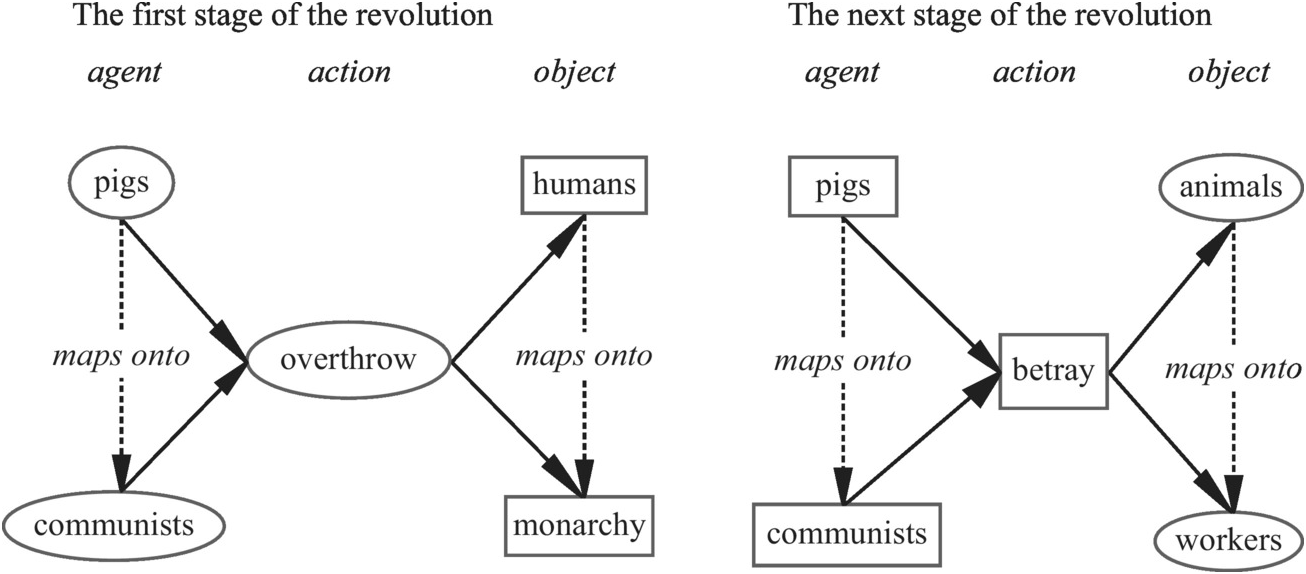
Figure 4.1 Cognitive-affective diagram of revolution in Animal Farm
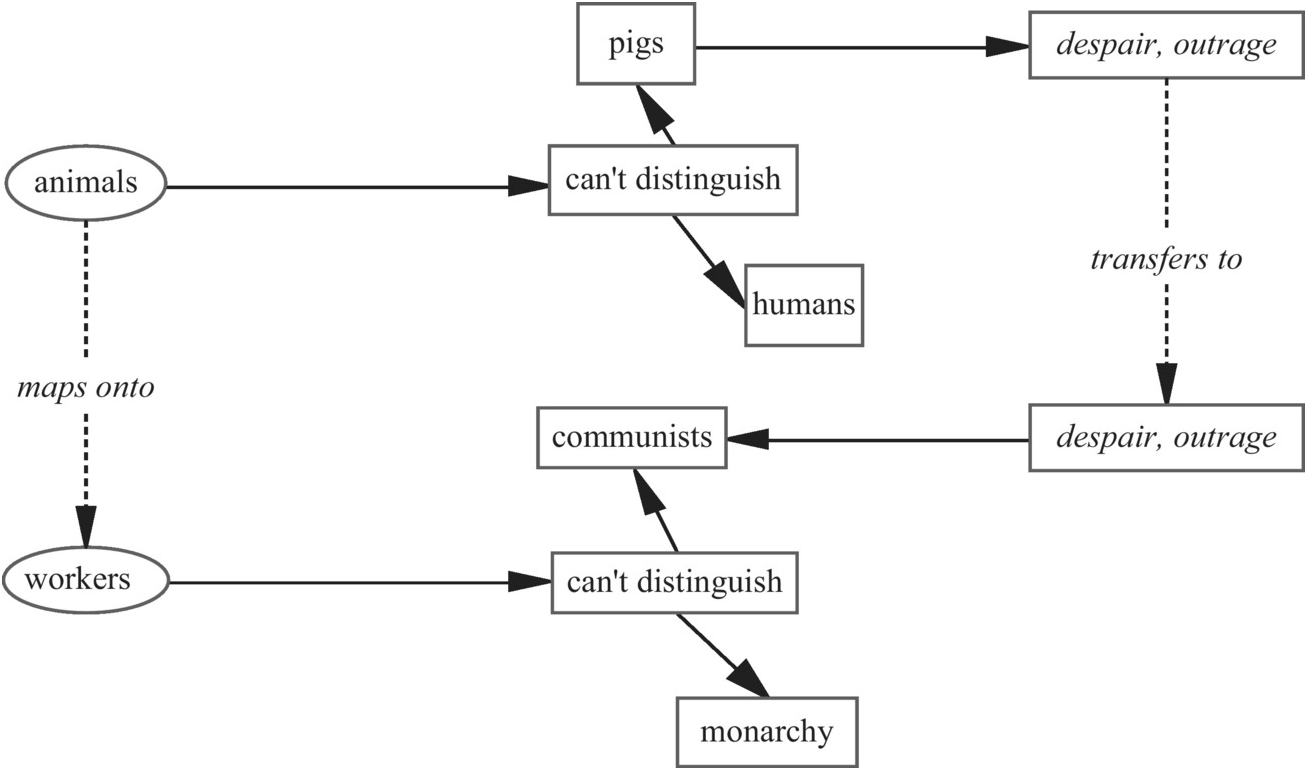
Figure 4.2. “The creatures outside looked from pig to man, and from man to pig, and from pig to man again; but already it was impossible to say which was which”
In Chapter 11, I will discuss a political cartoon that builds on the allegorical structure of Animal Farm and applies it as a commentary on recent political rulings by the U.S. Supreme Court. In the next section, I will discuss a group of popular culture texts, a music video and several popular songs, that incorporate allegorical elements organized around the conceptual metaphor love is a journey.
“Third Race at the Honeymoon-Is-Over Downs.” Oakley and Crisp (Reference Oakley and Crisp2011) apply conceptual integration / mental space approach to a contemporary music video, “Third Race at the Honeymoon-Is-Over Downs,” which bears a close resemblance to the country song “The Race Is On” by George Jones and Don Rollins (Reference Rollins1964), recorded by George Jones in 1964 and subsequently covered by an assortment of artists ranging from Alvin and the Chipmunks (1965) to the Grateful Dead (1981). Oakley and Crisp argue that a “network of mental spaces” makes a special contribution to understand the conceptual processes involved in understanding allegory, which, they claim, cannot be explained as a simple mapping of source to target.
The video consists of an audio file by Nick Sanabria, synchronized to a video of a horse race by Marc Bolton that the authors downloaded from YouTube. A series of phrases related to a marriage that begins in bliss and ends in a nasty breakup; each phrase is converted to a racehorse name, and the whole is narrated using the rhythms and intonations of a radio sportscaster announcing a literal horse race. As the authors point out, a marriage and breakup that extends over several years is compressed into a minute and 16 seconds. The authors identify three “mental spaces”: the presentation space (i.e., vehicle or source story) of a horse race; a reference space (i.e., topic or target), the marriage relationship gone sour; and a blended scenario, in which elements from these two “input spaces” are blended into a unified story.
The video begins with a metaphorical title, “Welcome to the third race, at the Honeymoon-is-over-downs.” As the race begins, “jumping out in the lead is Romance-and-Affection with Domestic Bliss in close behind.” Other “horses” are named “Marriage Vows,” “Immediate Child,” “Nasty Attitude,” “More Children,” and “Drinking Heavily.” The race ends: “At the wire, it’s Up-Yours, Keep-The-Fucking-House … and I-Am-Outta-Here.” As the authors point out, this works primarily because the use of horse-race announcement style maintains the “horse-race” scenario (activated by the opening line “Welcome to the third race”) and the escalation of relationship and relationship-breakup terms maintains the relationship breakup scenario.
It is not clear what the metaphor “mental space” adds to the more familiar concept of schema, i.e., a coherent set of ideas and experiences related to a topic, or what jargon like “double-scope blend” adds, but I find the authors’ claim convincing, that the idea of “blending” goes beyond the more familiar idea of a source-to-target (vehicle-to-topic) mapping in explaining how an extended metaphor of this sort works. It is clear that both the horse-race schema and the marriage break-up schema must be activated simultaneously for the emotional effects to be achieved; this is probably true of most truly effective metaphors.
Given the history of heartbreak metaphors in popular culture, we also need to invoke a third schema to explain the effects of “Third Race.” A common conceptual metaphor, love is a journey or more precisely love is motion through space, underlies “Third Race,” and it has been developed along similar lines several times. Fauconnier and Turner (Reference Fauconnier and Turner2002) initially specified a generic space that underlies both input spaces and links them together, but the “horserace” / “movement through space” schema doesn’t fit their characterization of a generic space. (Something more like optimism ➔ wagering ➔ losing the wager ➔ disappointment would better serve the role of a generic space.)
Preceding “Third Race” by several decades is Rollins’s (Reference Rollins1964) “The Race Is On,” which has been covered by a series of artists since its initial release. The chorus begins
And ends
Like “Third Race,” “The Race Is On” blends a familiar horse race announcing schema with a relationship breakup schema. It also makes extensive use of metaphorical puns (including “going to the inside” and “holding back,” which have distinct relevance in both input schemas, and thus facilitate the blend, leading to the ironic conclusion that “the winner loses all,” also meaningful in both schemas. Adding a synchronized video may have contributed to the effect of the contemporary version, but in 1964, many people would have been familiar with the structure and style of a horse race reported on the radio.
Casting the net slightly more widely, Ariana Grande’s (Reference Grande2013) “Honeymoon Avenue” begins with “I looked in my rear view mirror” and maps heartbreak onto driving home in the rain, “Stuck in the same old lane / Going the wrong way home.” “Honeymoon Avenue” accomplishes its effects by blending the breakup schema with an even more familiar schema of driving in dense traffic. Her heart is “stuck in bumper-to-bumper traffic” and, later, “my heart is at a yellow light, a yellow light” (as a traffic signal, a yellow light signifies both warning and transition from go to stop). This also has a precedent, “Heartbreak Hotel” (Axton, Crudup, Durden, & Presley, Reference Axton, Crudup, Durden and Presley1956), which is located “Down at the end of Lonely Street.”
None of these examples quite qualifies as allegory, except in a very broad sense, but all of them use the tools of allegorical naming. “Honeymoon Avenue” develops journey fairly coherently as an extended metaphor, and “The Race Is On” develops horse-race as a coherent extended metaphor, blending journey with competition. “Third Race” enhances the metaphoric coherence by adopting the rhythm, tone, and timing of a radio announcer relating an actual horse race – a clear example of a musical metaphor (Forceville, Reference Forceville, Forceville and Urios-Aparisi2009b). All of them assume familiarity with both “input spaces” or schemas; all of them are, arguably, also enhanced by familiarity with the underlying conceptual metaphors love is a journey and love is a contest, and with the tradition of love poetry and love songs built on one or the other, or both, of these metaphors.
Conclusion
Based on several examples of medieval allegory, I have proposed a definition of allegory as displaced writing about abstract ideas in which persons, places, and actions stand for abstract ideas and relations among abstract ideas, usually with a didactic or persuasive motivation. Evidence shows that, at least among college students, most are able to recognize and interpret allegory. However, a sizable minority do not readily recognize allegory, and those who do recognize allegory do not agree on the interpretations or evaluations offered. (In Chapter 11, I will discuss research on visual metaphors showing that, at least in some instances, a majority of readers either fail to arrive at the artist’s [stated] intention or fail altogether to arrive at a coherent interpretation.)
There is considerable evidence that, when people process language generally, neural systems that would be activated by the experiences described are at least weakly and briefly activated (Bergen, Reference Bergen2012; Gibbs, Reference Gibbs and Gibbs2008); these perceptual simulations apparently play a role in processing metaphors, although how central a role has yet to be determined. Similarly, research has shown that “transportation” into a “story world” – simulating the places and events described so vividly as to feel like a participant – greatly enhances both enjoyment and persuasiveness of a story. The Elaboration Likelihood Model (Petty & Cacioppo, Reference Petty and Cacioppo1981, discussed in Chapter 3) suggests that the degree to which perceptual simulations (and transportation into a story world) are experienced is likely to be a function of both motivation (including personal involvement) and ability (including background knowledge). Combining these lines of research suggests that allegories (and, by extension, other story metaphors) will be both more enjoyable and more persuasive for readers who have the background knowledge required to understand them and who are sufficiently motivated, by interest and personal relevance, to become “immersed” in the story to the point of experiencing it as “real.” Familiarity with the genre – both with the strategy of allegoresis in general and with a specific sub-genre, such as love songs based on activities such as “horse race,” “auto race,” and “travel,” will contribute to the ability to process and enhance depth of processing.
Traditional approaches to metaphor specify in effect a one-way mapping, in which attributes of the vehicle are mapped or projected onto the topic. For allegory this would imply that aspects of the vehicle story, such as Christian’s feelings of despondency when he becomes mired in the Slough of Dispond (in Pilgrim’s Progress), will be simply projected onto the topic, in this case the despondency of an individual who has difficulty living by Christian principles. However, Fauconnier and Turner’s (Reference Fauconnier and Turner2002) conceptual blending model suggests that, at least for readers with sufficient background knowledge, the input space (schema) of Christian faith will be activated alongside the input space of this particular passage in the story, and the two blended in an output space that includes elements of both. Thagard (Reference Thagard2011) has shown how this kind of blending can be accomplished in a mathematically and neurologically plausible way through what he calls convolution. Since this kind of blending is likely to require considerable cognitive effort, the Elaboration Likelihood Model applies here as well: readers who lack either the ability to process, including the requisite background knowledge as well as familiarity with allegory as a literary device, or the motivation in terms of interest and relevance, are unlikely to process the allegorical elements sufficiently to experience this kind of blend. This may help explain why 30 percent or more of the participants in the experiments reported by Gibbs (Reference Gibbs2011) failed to furnish an allegorical interpretation for the stimulus materials in his experiments.
Allegory as a strategy includes several devices that may facilitate the process of conceptual blending or convolution. For example, the use of allegorical person and place-names tells the reader how to connect features of the vehicle and topic stories, and may also guide the activation of relevant schemas in the first place: in “Welcome to the third race, at the Honeymoon-is-over-downs,” “third race” and “downs” activate a horse-race schema; and “Honeymoon-is-over” activates a breakup schema. Even if the listener has not personally experienced a relationship breakup, popular culture is saturated with movies, songs, novels, and other examples to draw on. However, as Animal Farm illustrates, allegorical names are not necessary. The opening of the story activates the animal fable schema, and the language in which the plight of the animals is described is likely to activate the revolution schema for anyone with even a cursory knowledge of recent world history. The unfolding of the story engages the reader in accessing even more elements from both schemas. From persuasion research (Petty & Cacioppo, Reference Petty and Cacioppo1981), we know that readers and listeners remember a message longer and more accurately and are more persuaded by a message when they are actively engaged in elaborating it by filling in details. The effectiveness of Animal Farm is in part a function of its ability to engage the reader in working out the various parallels between the animals’ experience and the events of the Russian Revolution.


