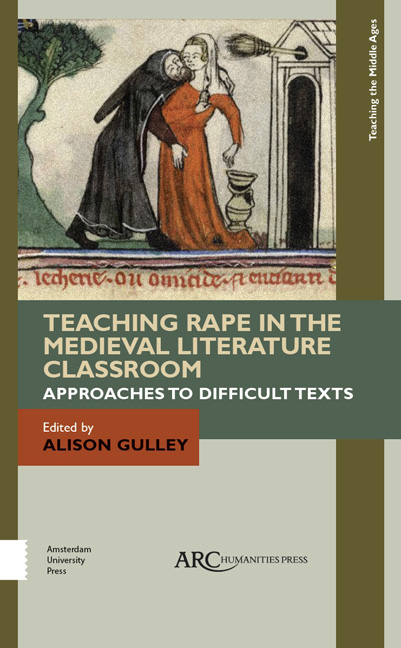
Book contents
- Frontmatter
- Contents
- Acknowledgements
- Chapter 1 Introduction: Teaching Rape and Meeting the Challenges of the TwentyFirstCentury Classroom
- Chapter 2 Medieval Saints and Misogynist Times: Transhistorical Perspectives on Sexual Violence in the Undergraduate Classroom
- Chapter 3 Teaching Medieval Rape Culture across Genre: Insights from Victimology
- Chapter 4 Bringing the Bystander into the Humanities Classroom: Reading Ancient, Patristic, and Medieval Texts on the Continuum of Violence
- Chapter 5 From Bystander to Upstander: Reading the Nibelungenlied to Resist Rape Culture
- Chapter 6 Speech, Silence, and Teaching Chaucer’s Rapes
- Chapter 7 Classroom PSA: Values, Law, and Ethics in “The Reeve’s Tale”
- Chapter 8 “How do we know he really raped her?”: Using the BBC Canterbury Tales to Confront Student Skepticism towards the Wife of Bath
- Chapter 9 Teaching the Potiphar’s Wife Motif in Marie de France’s Lanval
- Chapter 10 Sexual Compulsion and Sexual Violence in the Lais of Marie de France
- Chapter 11 Troubadour Lyric, Fin’amors, and Rape Culture
- Chapter 12 The Knight Coerced: Two Cases of Raped Men in Chivalric Romance
- Chapter 13 Teaching Rape to the HeMan Woman Haters Club: Chrétien de Troyes at a Military School
- Chapter 14 Rape, Identity, and Redemption: Teaching “Sir Gowther” in the Community College Classroom
- Notes on Contributors
- Index
Chapter 12 - The Knight Coerced: Two Cases of Raped Men in Chivalric Romance
Published online by Cambridge University Press: 23 January 2021
By
Edited by
Book contents
- Frontmatter
- Contents
- Acknowledgements
- Chapter 1 Introduction: Teaching Rape and Meeting the Challenges of the TwentyFirstCentury Classroom
- Chapter 2 Medieval Saints and Misogynist Times: Transhistorical Perspectives on Sexual Violence in the Undergraduate Classroom
- Chapter 3 Teaching Medieval Rape Culture across Genre: Insights from Victimology
- Chapter 4 Bringing the Bystander into the Humanities Classroom: Reading Ancient, Patristic, and Medieval Texts on the Continuum of Violence
- Chapter 5 From Bystander to Upstander: Reading the Nibelungenlied to Resist Rape Culture
- Chapter 6 Speech, Silence, and Teaching Chaucer’s Rapes
- Chapter 7 Classroom PSA: Values, Law, and Ethics in “The Reeve’s Tale”
- Chapter 8 “How do we know he really raped her?”: Using the BBC Canterbury Tales to Confront Student Skepticism towards the Wife of Bath
- Chapter 9 Teaching the Potiphar’s Wife Motif in Marie de France’s Lanval
- Chapter 10 Sexual Compulsion and Sexual Violence in the Lais of Marie de France
- Chapter 11 Troubadour Lyric, Fin’amors, and Rape Culture
- Chapter 12 The Knight Coerced: Two Cases of Raped Men in Chivalric Romance
- Chapter 13 Teaching Rape to the HeMan Woman Haters Club: Chrétien de Troyes at a Military School
- Chapter 14 Rape, Identity, and Redemption: Teaching “Sir Gowther” in the Community College Classroom
- Notes on Contributors
- Index
Summary
A major shift has occurred in how higher education understands and confronts rape. This shift is seen most practically in campus life as colleges and universities adopt policies that define rape according to the positive consent (“yes means yes”) model: that is, without the explicit assent of both parties, any sexrelated activity constitutes sexual assault, and any sexual intercourse constitutes rape. It is natural that this shift should be engaged in departments of languages and literature, often a haven for ignored voices, and so enter medieval literature classrooms. Not that talk of rape has even been alien in that environment: Geoffrey Chaucer's “The Wife of Bath's Tale” famously hinges on a rape's aftermath, while Chaucer himself, like Thomas Malory, was accused of complicity in an act of raptus. However, as the campus conversation on rape shifts to new channels, so too the medieval literature classroom may enrich its own conversation about rape with the positive consent model's insights. This essay will apply those insights to the cases of two raped men in chivalric romances: Sir Launcelot of Malory's Morte d’Arthur and Sir Perion of the Spanish Amadis de Gaula.
Medieval Literature in the Gen Eds: A Pedagogical Note
One issue must be raised before we proceed: in order for the positive consent model to enrich our classroom conversations about rape in medieval literature, those conversations need to be happening. And whether they’re happening often hinges on the courses and students in question. The approach this essay takes is shaped by the teaching setting in which I labour, and the methods I’ve found that make conversations of this kind possible in these conditions.
I teach at a small private liberal arts college. Our students are all undergraduates, most of whom are athletes, and many the first in their families to pursue secondary education. Our English majors number (from year to year) a dozen or less. As a result, the bulk of my teaching load is in the general education courses of the English department— composition and sophomorelevel writingintensive literature courses. In these writingintensive literature courses, most students are not English majors, and have no previous literature course work beyond high school (and that usually minimal).
Information
- Type
- Chapter
- Information
- Teaching Rape in the Medieval Literature ClassroomApproaches to Difficult Texts, pp. 164 - 182Publisher: Arc Humanities PressPrint publication year: 2018
Accessibility standard: Unknown
Why this information is here
This section outlines the accessibility features of this content - including support for screen readers, full keyboard navigation and high-contrast display options. This may not be relevant for you.Accessibility Information
Accessibility compliance for the PDF of this chapter is currently unknown
and may be updated in the future.
- 1
- Cited by