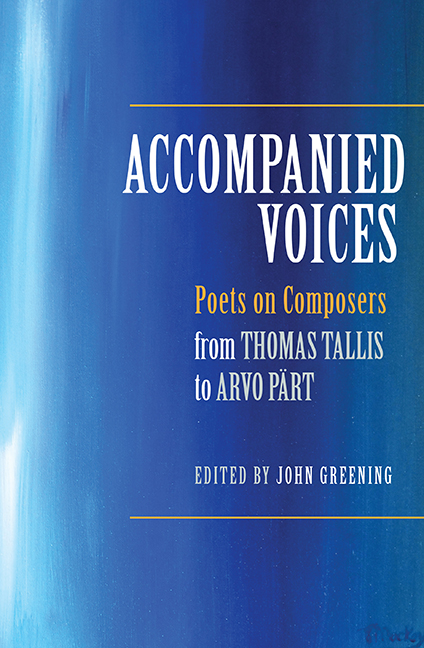
Book contents
- Frontmatter
- Contents
- Neil Powell: ‘Music’
- Introduction
- Dana Gioia: ‘Lives of the Great Composers’
- Thomas Tallis (1505–85)
- William Byrd (?1543–1623)
- John Dowland (?1563–1626)
- Claudio Monteverdi (1567–1643)
- Gregorio Allegri (1582–1652)
- Orlando Gibbons (1583–1625)
- Dietrich Buxtehude (1637–1707)
- Henry Purcell (1659–95)
- François Couperin (1668–1733)
- Antonio Vivaldi (1678–1741)
- Jean-Philippe Rameau (1683–1764)
- Johann Sebastian Bach (1685–1750)
- George Frideric Handel (1685–1759)
- Domenico Scarlatti (1685–1757)
- Christoph Willibald von Gluck (1714–87)
- Franz Joseph Haydn (1732–1809)
- Antonio Salieri (1750–1825)
- Wolfgang Amadeus Mozart (1756–91)
- Ludwig van Beethoven (1770–1827)
- Niccolò Paganini (1782–1840)
- John Field (1782–1837)
- Franz Schubert (1797–1828)
- Hector Berlioz (1803–69)
- Felix Mendelssohn (1809–47)
- Fryderyk Chopin (1810–49)
- Robert Schumann (1810–56)
- Franz Liszt (1811–86)
- Giuseppe Verdi (1813–1901)
- Richard Wagner (1813–83)
- Anton Bruckner (1824–96)
- Bedřich Smetana (1824–84)
- Johannes Brahms (1833–97)
- Camille Saint-Saëns (1835–1921)
- Pyotr Tchaikovsky (1840–93)
- Antonín Dvořák (1841–1904)
- Arthur Sullivan (1842–1900)
- Edvard Grieg (1843–1907)
- Gabriel Fauré (1845–1924)
- Leoš Janáček (1854–1928)
- Edward Elgar (1857–1934)
- Giacomo Puccini (1858–1924)
- Hugo Wolf (1860–1903)
- Gustav Mahler (1860–1911)
- Frederick Delius (1862–1934)
- Claude Debussy (1862–1918)
- Richard Strauss (1864–1949)
- Jean Sibelius (1865–1957)
- Erik Satie (1866–1925)
- Amy Beach (1867–1944)
- Ralph Vaughan Williams (1872–1958)
- Sergei Rachmaninov (1873–1943)
- Gustav Holst (1874–1934)
- Arnold Schoenberg (1874–1951)
- Maurice Ravel (1875–1937)
- Ottorino Respighi (1879–1936)
- Béla Bartók (1881–1945)
- Igor Stravinsky (1882–1971)
- Percy Grainger (1882–1961)
- Arnold Bax (1883–1953)
- Anton Webern (1883–1945)
- Alban Berg (1885–1935)
- George Butterworth (1885–1916)
- Bohuslav Martinů (1890–1959)
- Ivor Gurney (1890–1937)
- Sergey Prokofiev (1891–1953)
- Peter Warlock (Philip Heseltine) (1894–1930)
- Francis Poulenc (1899–1963)
- Aaron Copland (1900–90)
- Gerald Finzi (1901–56)
- Michael Tippett (1905–98)
- Dmitry Shostakovich (1906–75)
- Olivier Messiaen (1908–92)
- Samuel Barber (1910–81)
- John Cage (1912–92)
- Benjamin Britten (1913–76)
- Witold Lutosławski (1913–94)
- György Ligeti (1923–2006)
- Harrison Birtwistle (b.1934)
- Peter Maxwell Davies (b.1934)
- Arvo Pärt (b.1935)
- Epilogue
- Composers
- Poets
- Acknowledgements
- Index of First Lines
- Index of Titles
Giacomo Puccini (1858–1924)
Published online by Cambridge University Press: 29 May 2021
Edited by
Book contents
- Frontmatter
- Contents
- Neil Powell: ‘Music’
- Introduction
- Dana Gioia: ‘Lives of the Great Composers’
- Thomas Tallis (1505–85)
- William Byrd (?1543–1623)
- John Dowland (?1563–1626)
- Claudio Monteverdi (1567–1643)
- Gregorio Allegri (1582–1652)
- Orlando Gibbons (1583–1625)
- Dietrich Buxtehude (1637–1707)
- Henry Purcell (1659–95)
- François Couperin (1668–1733)
- Antonio Vivaldi (1678–1741)
- Jean-Philippe Rameau (1683–1764)
- Johann Sebastian Bach (1685–1750)
- George Frideric Handel (1685–1759)
- Domenico Scarlatti (1685–1757)
- Christoph Willibald von Gluck (1714–87)
- Franz Joseph Haydn (1732–1809)
- Antonio Salieri (1750–1825)
- Wolfgang Amadeus Mozart (1756–91)
- Ludwig van Beethoven (1770–1827)
- Niccolò Paganini (1782–1840)
- John Field (1782–1837)
- Franz Schubert (1797–1828)
- Hector Berlioz (1803–69)
- Felix Mendelssohn (1809–47)
- Fryderyk Chopin (1810–49)
- Robert Schumann (1810–56)
- Franz Liszt (1811–86)
- Giuseppe Verdi (1813–1901)
- Richard Wagner (1813–83)
- Anton Bruckner (1824–96)
- Bedřich Smetana (1824–84)
- Johannes Brahms (1833–97)
- Camille Saint-Saëns (1835–1921)
- Pyotr Tchaikovsky (1840–93)
- Antonín Dvořák (1841–1904)
- Arthur Sullivan (1842–1900)
- Edvard Grieg (1843–1907)
- Gabriel Fauré (1845–1924)
- Leoš Janáček (1854–1928)
- Edward Elgar (1857–1934)
- Giacomo Puccini (1858–1924)
- Hugo Wolf (1860–1903)
- Gustav Mahler (1860–1911)
- Frederick Delius (1862–1934)
- Claude Debussy (1862–1918)
- Richard Strauss (1864–1949)
- Jean Sibelius (1865–1957)
- Erik Satie (1866–1925)
- Amy Beach (1867–1944)
- Ralph Vaughan Williams (1872–1958)
- Sergei Rachmaninov (1873–1943)
- Gustav Holst (1874–1934)
- Arnold Schoenberg (1874–1951)
- Maurice Ravel (1875–1937)
- Ottorino Respighi (1879–1936)
- Béla Bartók (1881–1945)
- Igor Stravinsky (1882–1971)
- Percy Grainger (1882–1961)
- Arnold Bax (1883–1953)
- Anton Webern (1883–1945)
- Alban Berg (1885–1935)
- George Butterworth (1885–1916)
- Bohuslav Martinů (1890–1959)
- Ivor Gurney (1890–1937)
- Sergey Prokofiev (1891–1953)
- Peter Warlock (Philip Heseltine) (1894–1930)
- Francis Poulenc (1899–1963)
- Aaron Copland (1900–90)
- Gerald Finzi (1901–56)
- Michael Tippett (1905–98)
- Dmitry Shostakovich (1906–75)
- Olivier Messiaen (1908–92)
- Samuel Barber (1910–81)
- John Cage (1912–92)
- Benjamin Britten (1913–76)
- Witold Lutosławski (1913–94)
- György Ligeti (1923–2006)
- Harrison Birtwistle (b.1934)
- Peter Maxwell Davies (b.1934)
- Arvo Pärt (b.1935)
- Epilogue
- Composers
- Poets
- Acknowledgements
- Index of First Lines
- Index of Titles
Summary
Libretto
Libretto. That's the first Italian word
she wants to teach me: ‘little book.’
This afternoon (but why are we alone?
Were Daddy and my brothers gone
all day, or has memory with its flair
for simple compositions airbrushed
them from the shot?) she's set aside
just for the two of us, and a lesson.
On an ivory silk couch that doesn't fit
the life she's given in Detroit,
we gaze across the living room at the tall
‘European’ drapes she's sewn
herself: a work of secret weights and tiers,
hung after cursing at her own
mother's machine. She lets the needle fall
onto the record's edge; then turns
to pull a hidden cord, and the curtain rises
on Puccini's strings and our front view
of shut two-car garages, built for new
marriages constructed since the war.
Well, not so new. It's 1962
and though I’m only eight, I know
that with two cars, people can separate.
He went away; he came back for more
operatic scenes heard through the wall
as if through a foreign language. Muffled
fury and accusation, percussive sobs:
they aren't happy. Who couldn't tell
without the words? Libretto. On my knees
the English text, the Italian on hers,
and a thrill so loud the coffee table throbs.
I’m following her finger as
we’re looping to a phrase already sung
or reading four lines at a time
of people interrupting and just plain
not listening, and yet the burden
of the words is simple: Butterfly must die.
Pinkerton will betray her, though the theme
rippling above him like a hoisted flag
is The Star-Spangled Banner. Mother, why
would a Japanese and an American
sing Italian at each other?
Why would he get married and not stay?
And have a child he’d leave to wait
with the mother by the screen with her telescope
for the ship of hope? Why, if he knew
it wouldn't last, did he come back to Japan?
Information
- Type
- Chapter
- Information
- Accompanied VoicesPoets on Composers: From Thomas Tallis to Arvo Pärt, pp. 97 - 99Publisher: Boydell & BrewerPrint publication year: 2015
Accessibility standard: Unknown
Why this information is here
This section outlines the accessibility features of this content - including support for screen readers, full keyboard navigation and high-contrast display options. This may not be relevant for you.Accessibility Information
Accessibility compliance for the PDF of this chapter is currently unknown
and may be updated in the future.