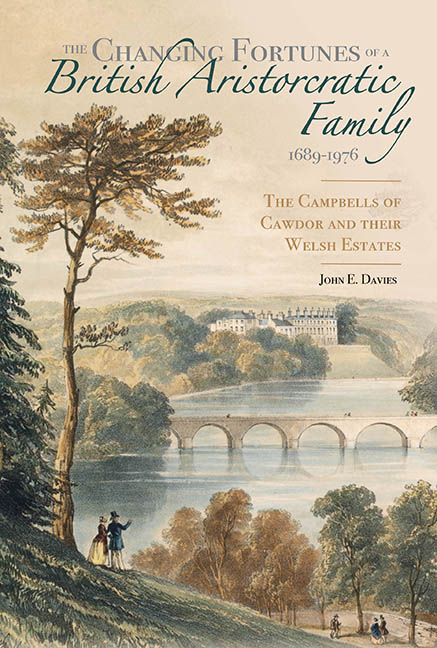
 The Changing Fortunes of a British Aristocratic Family, 1689–1976
 The Campbells of Cawdor and their Welsh Estates
Book contents
- Frontmatter
- Contents
- List of Illustrations
- Acknowledgements
- List of Abbreviations
- Pedigree
- Introduction
- 1 Cawdor and Campbell
- 2 Estate Administration
- 3 The Agricultural Estate: The Cawdors as Farmers and Landlords
- 4 The Cawdors as Industrial Landowners
- 5 The Cawdors in the Community: Church and Education
- 6 The Mêlée of Local Governance
- 7 The Cawdors in Politics: Interest Building, Consolidation and Decline
- 8 Private and Exclusive Lives
- 9 The End of the Welsh Estates
- Conclusion
- Bibliography
- Index
2 - Estate Administration
Published online by Cambridge University Press: 21 March 2020
Book contents
- Frontmatter
- Contents
- List of Illustrations
- Acknowledgements
- List of Abbreviations
- Pedigree
- Introduction
- 1 Cawdor and Campbell
- 2 Estate Administration
- 3 The Agricultural Estate: The Cawdors as Farmers and Landlords
- 4 The Cawdors as Industrial Landowners
- 5 The Cawdors in the Community: Church and Education
- 6 The Mêlée of Local Governance
- 7 The Cawdors in Politics: Interest Building, Consolidation and Decline
- 8 Private and Exclusive Lives
- 9 The End of the Welsh Estates
- Conclusion
- Bibliography
- Index
Summary
Finding an efficient and loyal land agent was often a hit-and-miss affair, yet the agent was the single most important worker on the estate, as far as the landlord's interest was concerned. From the mid-eighteenth century onwards many books of instruction were written advising landowners on estate management, and, since the agent was central to good estate management, of what to look for in agents. However, in practice many landowners were unfortunate in their choice of agent. In Wales, the Abadam family of Middleton Hall, a few miles west of Golden Grove, had the misfortune to hire an English agent in the early nineteenth century who was rabidly anti-Welsh and an Anglican religious zealot. This was in contrast to his employer's agnosticism and caused great friction. While on the Tivy valley estate of Alltyrodyn, the agent, a Mr Allen, has been described as ‘nefarious’. In England, on the Holkham estate, Norfolk, the landlord had to deal with wholesale fraud by his agent, a Mr Caldwell. And in 1860 Aberdeen society was astounded by the ‘failure of John Blaikie’, a respected agent for several substantial landowners, who absconded owing over £300,000. Yet the competence of an estate agent was fundamental to the success of the estate not only in terms of giving the owner a return, however small, on his investment, but also in determining the relationship between the estate and its tenants, the estate and the local community, and indeed, the estate and the wider world. This was especially so when the owner was either absentee, as was mostly the case with regard to the Cawdor Castle estate, or semi-absentee, as was the case with regard to the Cawdors’ Welsh estates.
J. L. Morton's treatise of 1858, The Resources of Estates, catalogues the qualifications expected of a good land agent. He should be: a practical farmer, a scientist, a lawyer, an accountant and a general businessman; he should also be skilled in wood science, fence-making and have knowledge of mineral extraction. An agent should also be something of a psychologist, and a diplomat with skill in prudence and self-command.
Information
- Type
- Chapter
- Information
- The Changing Fortunes of a British Aristocratic Family, 1689–1976The Campbells of Cawdor and their Welsh Estates, pp. 29 - 53Publisher: Boydell & BrewerPrint publication year: 2020
Accessibility standard: Unknown
Why this information is here
This section outlines the accessibility features of this content - including support for screen readers, full keyboard navigation and high-contrast display options. This may not be relevant for you.Accessibility Information
Accessibility compliance for the PDF of this chapter is currently unknown
and may be updated in the future.