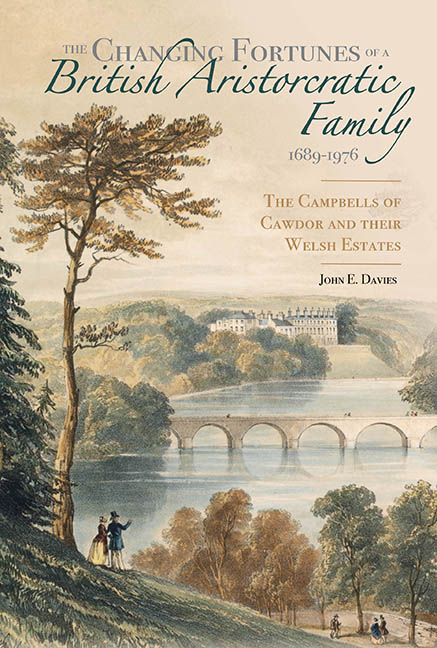
 The Changing Fortunes of a British Aristocratic Family, 1689–1976
 The Campbells of Cawdor and their Welsh Estates
Book contents
- Frontmatter
- Contents
- List of Illustrations
- Acknowledgements
- List of Abbreviations
- Pedigree
- Introduction
- 1 Cawdor and Campbell
- 2 Estate Administration
- 3 The Agricultural Estate: The Cawdors as Farmers and Landlords
- 4 The Cawdors as Industrial Landowners
- 5 The Cawdors in the Community: Church and Education
- 6 The Mêlée of Local Governance
- 7 The Cawdors in Politics: Interest Building, Consolidation and Decline
- 8 Private and Exclusive Lives
- 9 The End of the Welsh Estates
- Conclusion
- Bibliography
- Index
8 - Private and Exclusive Lives
Published online by Cambridge University Press: 21 March 2020
Book contents
- Frontmatter
- Contents
- List of Illustrations
- Acknowledgements
- List of Abbreviations
- Pedigree
- Introduction
- 1 Cawdor and Campbell
- 2 Estate Administration
- 3 The Agricultural Estate: The Cawdors as Farmers and Landlords
- 4 The Cawdors as Industrial Landowners
- 5 The Cawdors in the Community: Church and Education
- 6 The Mêlée of Local Governance
- 7 The Cawdors in Politics: Interest Building, Consolidation and Decline
- 8 Private and Exclusive Lives
- 9 The End of the Welsh Estates
- Conclusion
- Bibliography
- Index
Summary
The driving force behind so much of the landowners’ activities was the desire for ‘consequence’ and the recognition from others, both within and without their group, of their superior status in society. The country house was a symbol of that status, and at the same time gave the owner ‘a sense of identity, of achievement and of permanence’. In the 1730s, as an indication of the Campbells’ increasing consequence in society, they rebuilt the manor house at Stackpole. It was one of several Pembrokeshire houses which underwent extensive work in the eighteenth century, as Slebech Hall, Ffynone, Picton Castle, Colby House, Landshipping and Orielton testify, their owners ‘driven by motives of ostentatious display and an infectious desire to outdo their neighbours’. At Stackpole Court, the rebuilding doubled the size of the old house, which had been taxed for twelve hearths in 1670, and the finished product has been referred to as an ‘essay in pure Palladianism, [which was] all the more unexpected in so remote an area’. Building work continued for many years: Pryse Campbell wrote in 1755 that his father ‘is still afflicted with the Disease of Building & takes as much pleasure as ever in Lime & Stone’, which may explain why John Campbell was parsimonious in other areas of life. The extensive rebuilding of the eighteenth century rendered Stackpole Court one of the biggest houses in Wales. Even so, John Campbell's building work and layout of the parkland were further advanced by his grandson, the first baron. In his desire to beautify the landscape, the baron was no different from other gentry, except, perhaps, in the scale of his ambitions. By the early 1780s Campbell had had Stackpole demesne and surrounding land extended and re-designed in a – successful – attempt to create an idyllic ‘natural’ landscape. The demesne then established was 1,375 acres in extent, and included ‘house pleasure grounds and lodge’, covering forty-two acres, a ‘new garden’ of over four acres, and ‘water’ of forty acres.
Information
- Type
- Chapter
- Information
- The Changing Fortunes of a British Aristocratic Family, 1689–1976The Campbells of Cawdor and their Welsh Estates, pp. 243 - 288Publisher: Boydell & BrewerPrint publication year: 2020
Accessibility standard: Unknown
Why this information is here
This section outlines the accessibility features of this content - including support for screen readers, full keyboard navigation and high-contrast display options. This may not be relevant for you.Accessibility Information
Accessibility compliance for the PDF of this chapter is currently unknown
and may be updated in the future.