Book contents
- Frontmatter
- Contents
- List of Illustrations
- List of Contributors
- List of Abbreviations
- Introduction
- 1 ‘Jewish Christianity’ in Antiquity: Meaningless Category or Heuristic Irritant?
- 2 ‘Sola Fide’: the Wrong Slogan?
- 3 Both Cromwellian and Augustinian: the Influence of Thomas Cromwell on Reform within the Early Modern English Austin Friars
- 4 Lex, Rex and Sex: The Bigamy of Philipp of Hesse and the Lutheran Recourse to Natural Law
- 5 The Authority of Scripture in Reformation Anglicanism: Then and Now
- 6 Orthodoxy and Heresy in the Post-Reformation
- 7 Profanity and Piety in the Church Porch: the Place of Transgression in Early Modern England
- 8 Writing on the Walls: Word and Image in the Post-Reformation English Church
- 9 The Myth of the Church of England
- 10 Mysticism, Orthodoxy and Reformed Identity before the English Revolution: the Case of John Everard
- 11 Sacrilege and the Sacred in England’s Second Reformation, 1640–1660
- 12 ‘I had not the patience to be quiet’: Arthur Bury and The Naked Gospel
- 13 ‘A soul-corrupting indifferentism’: the Intellectual Development of Benjamin Henry Latrobe
- 14 Newman, Dogma and Freedom in the Church
- 15 ‘Tommy, ’ow’s yer soul?’ Reconsidering Religion and the British Soldier
- 16 The King James Vulgate
- 17 The Myth of the Anglican Communion?
- Select bibliography of Diarmaid MacCulloch’s scholarly publications
- Bibliography
- Index
- Tabula Gratulatoria
- Studies in Modern British Religious History
8 - Writing on the Walls: Word and Image in the Post-Reformation English Church
Published online by Cambridge University Press: 09 January 2024

Book contents
- Frontmatter
- Contents
- List of Illustrations
- List of Contributors
- List of Abbreviations
- Introduction
- 1 ‘Jewish Christianity’ in Antiquity: Meaningless Category or Heuristic Irritant?
- 2 ‘Sola Fide’: the Wrong Slogan?
- 3 Both Cromwellian and Augustinian: the Influence of Thomas Cromwell on Reform within the Early Modern English Austin Friars
- 4 Lex, Rex and Sex: The Bigamy of Philipp of Hesse and the Lutheran Recourse to Natural Law
- 5 The Authority of Scripture in Reformation Anglicanism: Then and Now
- 6 Orthodoxy and Heresy in the Post-Reformation
- 7 Profanity and Piety in the Church Porch: the Place of Transgression in Early Modern England
- 8 Writing on the Walls: Word and Image in the Post-Reformation English Church
- 9 The Myth of the Church of England
- 10 Mysticism, Orthodoxy and Reformed Identity before the English Revolution: the Case of John Everard
- 11 Sacrilege and the Sacred in England’s Second Reformation, 1640–1660
- 12 ‘I had not the patience to be quiet’: Arthur Bury and The Naked Gospel
- 13 ‘A soul-corrupting indifferentism’: the Intellectual Development of Benjamin Henry Latrobe
- 14 Newman, Dogma and Freedom in the Church
- 15 ‘Tommy, ’ow’s yer soul?’ Reconsidering Religion and the British Soldier
- 16 The King James Vulgate
- 17 The Myth of the Anglican Communion?
- Select bibliography of Diarmaid MacCulloch’s scholarly publications
- Bibliography
- Index
- Tabula Gratulatoria
- Studies in Modern British Religious History
Summary
Not even the finest network for the dissemination and maintenance of a new orthodox doctrine will serve its purpose as long as the ‘last mile’, actually reaching into the lives of individual parishioners, remains only fitfully under the hierarchy’s control. This essay on the visual imagery of post-Reformation English churches uses the record of church buildings’ walls to track how the national church’s evolving orthodoxies were interpreted by the laypeople who actually created and paid for these images. Once again, church buildings were sites where laypeople could wrest orthodoxy in their own direction. The essay shows that, while policy and practice were not exactly at odds, nor were they in unison: some parishes dragged their feet, while others chose to find ways of implementing the new orthodoxies which ran ahead of, subverted or simply put their own distinctive mark on their bishops’ and archdeacons’ intentions. The hierarchy’s vision of uniform, scripturally driven reform was compelled to negotiate with pre-existing orthodoxies and loyalties.
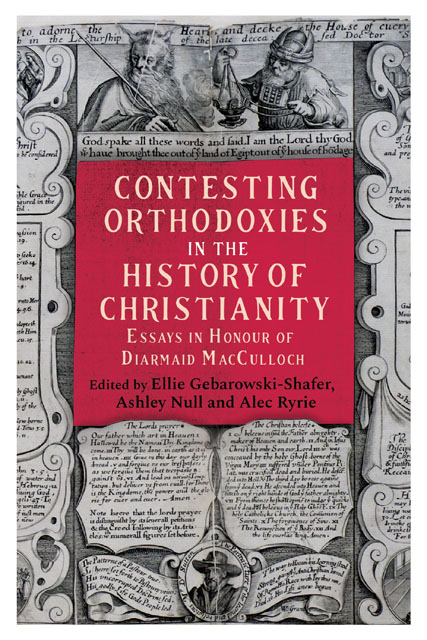
In 1624 a London printer issued a broadsheet in memory of Dr Thomas Sutton, the godly young lecturer at St Saviour, Southwark who had been drowned the previous year travelling from Newcastle to London. The central panel of the broadsheet shows Moses and Aaron presiding over tablets of the law, with the Lord’s Prayer and the Articles of Belief squeezed in above the image of Sutton with verses in praise of his spiritual leadership (figure 1). The panel has two outer leaves with engravings explaining the two dominical sacraments and the ritual practice of their rites of passage under the old and the new law. The whole image is headed with a note that this ‘Christians Jewell’ should adorn the home of every Protestant, and that it had been ‘taken’ from St Saviour’s church during Sutton’s lectureship. An act of imagination is required to move from the engraving to whatever was ‘taken’ from the church. But we can establish that some sort of Decalogue Board was located there in a prominent position. The enlargement of John Stow’s Survey of London, undertaken by Anthony Munday in the 1630s, remarks on ‘an extraordinary fair and curious Table of the Commandments’ set up, possibly on the screen at the West door, in 1618.
Information
- Type
- Chapter
- Information
- Contesting Orthodoxies in the History of ChristianityEssays in Honour of Diarmaid MacCulloch, pp. 138 - 158Publisher: Boydell & BrewerPrint publication year: 2021
Accessibility standard: Unknown
Why this information is here
This section outlines the accessibility features of this content - including support for screen readers, full keyboard navigation and high-contrast display options. This may not be relevant for you.Accessibility Information
Accessibility compliance for the PDF of this chapter is currently unknown
and may be updated in the future.