Book contents
- Frontmatter
- Dedication
- Contents
- Acknowledgements
- Introduction
- 1 Yugoslavia: Destroying States for Fun and for Profit
- 2 In Search of the Good War: Bosnia: April 1992 to May 1993
- 3 Peacemaking v. Humanitarianism: Bosnia and Croatia: June 1993 to December 1995
- 4 Humanitarianism Fulfilled: Bosnia’s Unsafe Areas
- 5 Kosovo: The Denial of Sovereignty
- 6 Kosovo: The set-up
- 7 Kosovo: Standing up to the Yugoslav Goliath
- Conclusions: Ensuring Success by Lowering Standards
- Notes
- Select Bibliography
- Index
This chapter is part of a book that is no longer available to purchase from Cambridge Core
7 - Kosovo: Standing up to the Yugoslav Goliath
Book contents
- Frontmatter
- Dedication
- Contents
- Acknowledgements
- Introduction
- 1 Yugoslavia: Destroying States for Fun and for Profit
- 2 In Search of the Good War: Bosnia: April 1992 to May 1993
- 3 Peacemaking v. Humanitarianism: Bosnia and Croatia: June 1993 to December 1995
- 4 Humanitarianism Fulfilled: Bosnia’s Unsafe Areas
- 5 Kosovo: The Denial of Sovereignty
- 6 Kosovo: The set-up
- 7 Kosovo: Standing up to the Yugoslav Goliath
- Conclusions: Ensuring Success by Lowering Standards
- Notes
- Select Bibliography
- Index
Summary
The conflict in Kosovo “threatens our national interests,” Clinton explained on March 19. “If it continues, it will push refugees across borders and draw in neighboring countries. It will undermine the credibility of NATO on which stability in Europe and our own credibility depend. It will likely reignite the historical animosities, including those that could embrace Albania, Macedonia, Greece, even Turkey.”
Here, then, was the standard heady U.S. brew: a combination of wildly implausible scenarios, suggestions of falling dominoes, and chilling warnings about loss of “credibility.” It wasn't the credibility of the mammoth nato military machine that was in danger: it was the credibility of its bombing threats. There was an easy remedy for that. NATO could have tried something it had hitherto eschewed: diplomacy.
Clinton's White House announcement was a typical Clinton event. In other words, almost nothing he said was true. For example, he asserted that “Today the peace talks were adjourned because the Serbian negotiators refused even to discuss key elements of the peace plan … [I]t was an agreement worked out and negotiated and argued over, with all the parties’ concerns being taken into account.” This was an outright lie, made all the more shameless by the media's reluctance to call him out on it. No discussions had taken place at Rambouillet; the U.S. plan was delivered as a take-it-orleave- it package. Yugoslavia had not rejected the Rambouillet plan outright. Even the Kosovo Diplomatic Observer Mission (KDOM) Daily Report had admitted on March 12 – days before the resumption of the conference – that Milošević had “called the Rambouillet peace plan a good basis for a political settlement in Kosovo. [Milošević] said, however, that the deployment of nato troops in Serbia (Kosovo) as a part of the implementation of such a plan remains unacceptable.”
It was unrestricted nato occupation that was at issue, something Clinton was understandably anxious to conceal from the public. His administration had known from the start that Belgrade wouldn't accept the presence of nato forces on Serbian soil, and Clinton officials had pointedly refused to enter tain alternatives such as a genuinely international peacekeeping force, one that would be under the authority of the U.N. or perhaps the OSCE.
Information
- Type
- Chapter
- Information
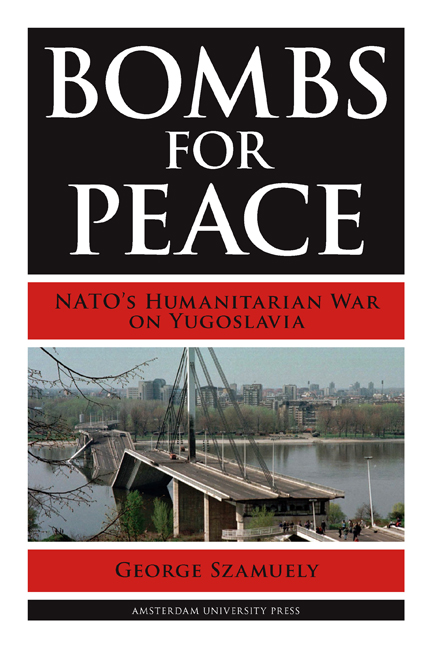
- Bombs for PeaceNATO's Humanitarian War on Yugoslavia, pp. 445 - 504Publisher: Amsterdam University PressPrint publication year: 2013
Accessibility standard: Unknown
Why this information is here
This section outlines the accessibility features of this content - including support for screen readers, full keyboard navigation and high-contrast display options. This may not be relevant for you.Accessibility Information
Accessibility compliance for the PDF of this chapter is currently unknown
and may be updated in the future.