Book contents
- Frontmatter
- Contents
- Acknowledgements
- Abbreviations
- List of Figures
- Notes on Usage
- Introduction
- 1 “Gentiles by Nature,” 1566–1626
- 2 “So That the Fullness of the Gentiles Might Gradually Come In,” 1627–1642
- 3 “A Church and Community among the Christians and the Blind Gentiles,” 1642–1652
- 4 “We, with God’s Help, Hope to Bring the Barbarous Tribes to Devotion,” 1652–1660
- 5 “Who Gave Jacob for a Spoil and Israel to the Robbers?” 1660–1664
- 6 “A Gentile Woman, Karanondo, … Now Called Lidia,” 1664–1750
- Conclusion
- Appendix A Dutch References to Indians: 1609–1664
- Appendix B Indian Baptisms, Professions of Faith, and Marriages in the Dutch Reformed Churches of New York: 1690–1750
- List of Archival Sources
- Bibliography
- Index
This chapter is part of a book that is no longer available to purchase from Cambridge Core
3 - “A Church and Community among the Christians and the Blind Gentiles,” 1642–1652
Book contents
- Frontmatter
- Contents
- Acknowledgements
- Abbreviations
- List of Figures
- Notes on Usage
- Introduction
- 1 “Gentiles by Nature,” 1566–1626
- 2 “So That the Fullness of the Gentiles Might Gradually Come In,” 1627–1642
- 3 “A Church and Community among the Christians and the Blind Gentiles,” 1642–1652
- 4 “We, with God’s Help, Hope to Bring the Barbarous Tribes to Devotion,” 1652–1660
- 5 “Who Gave Jacob for a Spoil and Israel to the Robbers?” 1660–1664
- 6 “A Gentile Woman, Karanondo, … Now Called Lidia,” 1664–1750
- Conclusion
- Appendix A Dutch References to Indians: 1609–1664
- Appendix B Indian Baptisms, Professions of Faith, and Marriages in the Dutch Reformed Churches of New York: 1690–1750
- List of Archival Sources
- Bibliography
- Index
Summary
Abstract
Chapter three details the period between 1642 and 1652. Megapolensis accepted the call to establish a church and community “among the Christians and blind Gentiles” in New Netherland in 1642. The Megapolensis family arrived at a time when New Netherlanders were increasingly spreading throughout the Northeastern Woodlands. They soon realized the extent to which New Netherlanders relied on their Gentile Indian neighbors. Indeed, Native Americans secured their survival by unwittingly living out the gospel: Indians provided them with food and taught them how to clear the land, cultivate corn, fish the local waters, hunt turkeys, and construct and use canoes and snowshoes.
Keywords: New Netherland, Dutch Calvinism, Lenape Indians, Mohawk Indians, Mahican Indians, Native–Dutch Relations
Amsterdam, 1642
When the Classis of Amsterdam formally called Johannes Megapolensis to advance the gospel in Rensselaerswijck, the expectation to convert the Gentiles was once again made explicit:
[May the colonists of Rensselaerswijck] acknowledge and uphold the aforementioned appointed servant [Megapolensis] in his office so that he might administer the Gospel to the glory of God's Holy Name and toward the conversion of poor blind people. May the Almighty God, who hath called him to this ministry, and instilled this good zeal in his heart, to proclaim the crucified Christ to Gentile peoples in such distant lands, strengthen him, more and more …
Kiliaen van Rensselaer also reinforced the expectation of converting the Indians to the Reformed faith in the contract he made with Megapolensis. Megapolensis was, according to the contract, expected to diligently perform his duties, which included the “edifying instruction of the inhabitants and the Indians.” Eight months after the Megapolensis family arrived in Nieuw Nederland (New Netherland), Van Rensselaer reinforced the call to “proclaim the crucified Christ to [the] Gentile peoples” in and around Rensselaerswijck. In his letter, Van Rensselaer borrowed the imagery and theology of the conversion of the “blind Gentiles” as it had been articulated by the orthodox predikanten in the Republic:
We do not fail to join our daily prayers with yours, nor do we fail to continue therein, hoping that … he [God] … extending His blessing over yourself … especially to make your reverence a blessed instrument in His service to establish there a church and community both among the Christians and the blind Gentiles …
Information
- Type
- Chapter
- Information
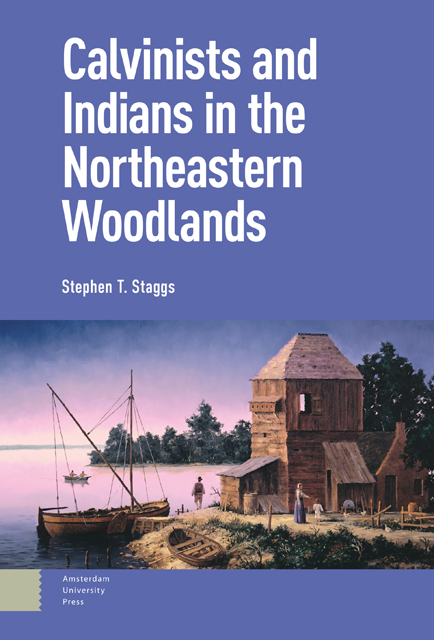
- Calvinists and Indians in the Northeastern Woodlands , pp. 93 - 130Publisher: Amsterdam University PressPrint publication year: 2023
Accessibility standard: Unknown
Why this information is here
This section outlines the accessibility features of this content - including support for screen readers, full keyboard navigation and high-contrast display options. This may not be relevant for you.Accessibility Information
Accessibility compliance for the PDF of this chapter is currently unknown
and may be updated in the future.