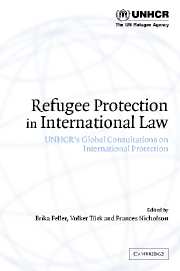
Book contents
- Frontmatter
- Contents
- List of annexes
- Notes on contributors and editors
- Foreword
- Preface
- Acknowledgments
- Expert roundtables and topics under the ‘second track’ of the Global Consultations
- Table of cases
- Table of treaties and other international instruments
- List of abbreviations
- Part 1 Introduction
- 1.1 Refugee protection in international law: an overall perspective
- 1.2 Age and gender dimensions in international refugee law
- 1.3 Declaration of States Parties to the 1951 Convention and/or its 1967 Protocol Relating to the Status of Refugees
- Part 2 Non-refoulement (Article 33 of the 1951 Convention)
- Part 3 Illegal entry (Article 31)
- Part 4 Membership of a particular social group (Article 1A(2))
- Part 5 Gender-related persecution (Article 1A(2))
- Part 6 Internal protection/relocation/flight alternative
- Part 7 Exclusion (Article 1F)
- Part 8 Cessation (Article 1C)
- Part 9 Family unity (Final Act, 1951 UN Conference)
- Part 10 Supervisory responsibility (Article 35)
- Index
1.1 - Refugee protection in international law: an overall perspective
Published online by Cambridge University Press: 28 August 2009

Book contents
- Frontmatter
- Contents
- List of annexes
- Notes on contributors and editors
- Foreword
- Preface
- Acknowledgments
- Expert roundtables and topics under the ‘second track’ of the Global Consultations
- Table of cases
- Table of treaties and other international instruments
- List of abbreviations
- Part 1 Introduction
- 1.1 Refugee protection in international law: an overall perspective
- 1.2 Age and gender dimensions in international refugee law
- 1.3 Declaration of States Parties to the 1951 Convention and/or its 1967 Protocol Relating to the Status of Refugees
- Part 2 Non-refoulement (Article 33 of the 1951 Convention)
- Part 3 Illegal entry (Article 31)
- Part 4 Membership of a particular social group (Article 1A(2))
- Part 5 Gender-related persecution (Article 1A(2))
- Part 6 Internal protection/relocation/flight alternative
- Part 7 Exclusion (Article 1F)
- Part 8 Cessation (Article 1C)
- Part 9 Family unity (Final Act, 1951 UN Conference)
- Part 10 Supervisory responsibility (Article 35)
- Index
Summary
Background
The 1951 Convention Relating to the Status of Refugees and the 1967 Protocol to the Convention are the modern legal embodiment of the ancient and universal tradition of providing sanctuary to those at risk and in danger. Both instruments reflect a fundamental human value on which global consensus exists and are the first and only instruments at the global level which specifically regulate the treatment of those who are compelled to leave their homes because of a rupture with their country of origin. For half a century, they have clearly demonstrated their adaptability to changing factual circumstances. Beginning with the European refugees from the Second World War, the Convention has successfully afforded the framework for the protection of refugees from persecution whether from repressive regimes, the upheaval caused by wars of independence, or the many ethnic conflicts of the post-Cold War era.
International refugee protection is as necessary today as it was when the 1951 Convention was adopted over fifty years ago. Since the end of the Cold War, simmering tensions of an inter-ethnic nature – often exploited by populist politicians – have erupted into conflict and strife. Communities which lived together for generations have been separated and millions of people displaced – whether in the former Yugoslavia, the Great Lakes, the Caucasus, or Afghanistan. The deliberate targeting of civilians and their enforced flight have not only represented methods of warfare but have become the very objectives of the conflict.
Information
- Type
- Chapter
- Information
- Refugee Protection in International LawUNHCR's Global Consultations on International Protection, pp. 3 - 45Publisher: Cambridge University PressPrint publication year: 2003
Accessibility standard: Unknown
Why this information is here
This section outlines the accessibility features of this content - including support for screen readers, full keyboard navigation and high-contrast display options. This may not be relevant for you.Accessibility Information
Accessibility compliance for the PDF of this chapter is currently unknown
and may be updated in the future.
- 6
- Cited by