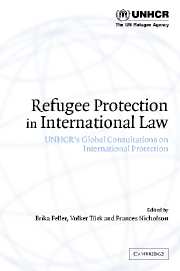
Book contents
- Frontmatter
- Contents
- List of annexes
- Notes on contributors and editors
- Foreword
- Preface
- Acknowledgments
- Expert roundtables and topics under the ‘second track’ of the Global Consultations
- Table of cases
- Table of treaties and other international instruments
- List of abbreviations
- Part 1 Introduction
- 1.1 Refugee protection in international law: an overall perspective
- 1.2 Age and gender dimensions in international refugee law
- 1.3 Declaration of States Parties to the 1951 Convention and/or its 1967 Protocol Relating to the Status of Refugees
- Part 2 Non-refoulement (Article 33 of the 1951 Convention)
- Part 3 Illegal entry (Article 31)
- Part 4 Membership of a particular social group (Article 1A(2))
- Part 5 Gender-related persecution (Article 1A(2))
- Part 6 Internal protection/relocation/flight alternative
- Part 7 Exclusion (Article 1F)
- Part 8 Cessation (Article 1C)
- Part 9 Family unity (Final Act, 1951 UN Conference)
- Part 10 Supervisory responsibility (Article 35)
- Index
1.3 - Declaration of States Parties to the 1951 Convention and/or its 1967 Protocol Relating to the Status of Refugees
Published online by Cambridge University Press: 28 August 2009

Book contents
- Frontmatter
- Contents
- List of annexes
- Notes on contributors and editors
- Foreword
- Preface
- Acknowledgments
- Expert roundtables and topics under the ‘second track’ of the Global Consultations
- Table of cases
- Table of treaties and other international instruments
- List of abbreviations
- Part 1 Introduction
- 1.1 Refugee protection in international law: an overall perspective
- 1.2 Age and gender dimensions in international refugee law
- 1.3 Declaration of States Parties to the 1951 Convention and/or its 1967 Protocol Relating to the Status of Refugees
- Part 2 Non-refoulement (Article 33 of the 1951 Convention)
- Part 3 Illegal entry (Article 31)
- Part 4 Membership of a particular social group (Article 1A(2))
- Part 5 Gender-related persecution (Article 1A(2))
- Part 6 Internal protection/relocation/flight alternative
- Part 7 Exclusion (Article 1F)
- Part 8 Cessation (Article 1C)
- Part 9 Family unity (Final Act, 1951 UN Conference)
- Part 10 Supervisory responsibility (Article 35)
- Index
Summary
Preamble
We, representatives of States Parties to the 1951 Convention relating to the Status of Refugees and/or its 1967 Protocol, assembled in the first meeting of States Parties in Geneva on 12 and 13 December 2001 at the invitation of the Government of Switzerland and the United Nations High Commissioner for Refugees (UNHCR),
Cognizant of the fact that the year 2001 marks the 50th anniversary of the 1951 Geneva Convention relating to the Status of Refugees,
Recognizing the enduring importance of the 1951 Convention, as the primary refugee protection instrument which, as amended by its 1967 Protocol, sets out rights, including human rights, and minimum standards of treatment that apply to persons falling within its scope,
Recognizing the importance of other human rights and regional refugee protection instruments, including the 1969 Organization of African Unity (OAU) Convention governing the Specific Aspects of the Refugee Problem in Africa and the 1984 Cartagena Declaration, and recognizing also the importance of the common European asylum system developed since the 1999 Tampere European Council Conclusions, as well as the Programme of Action of the 1996 Regional Conference to Address the Problems of Refugees, Displaced Persons, Other Forms of Involuntary Displacement and Returnees in the Countries of the Commonwealth of Independent States and Relevant Neighbouring States,
Acknowledging the continuing relevance and resilience of this international regime of rights and principles, including at its core the principle of non-refoulement, whose applicability is embedded in customary international law,
[…]
Information
- Type
- Chapter
- Information
- Refugee Protection in International LawUNHCR's Global Consultations on International Protection, pp. 81 - 84Publisher: Cambridge University PressPrint publication year: 2003
Accessibility standard: Unknown
Why this information is here
This section outlines the accessibility features of this content - including support for screen readers, full keyboard navigation and high-contrast display options. This may not be relevant for you.Accessibility Information
Accessibility compliance for the PDF of this chapter is currently unknown
and may be updated in the future.