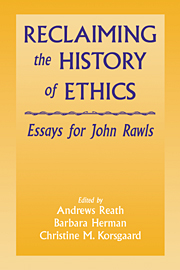
Book contents
- Frontmatter
- Contents
- List of Contributors
- Introduction
- Aristotle on the Soul's Conflicts: Toward an Understanding of Virtue Ethics
- Coercion, Ideology, and Education in Hobbes's Leviathan
- The Hobbesian Side of Hume
- The Natural Goodness of Humanity
- Metaphysics, Philosophy: Rousseau on the Problem of Evil
- Within the Limits of Reason
- A Cosmopolitan Kingdom of Ends
- Legislating for a Realm of Ends: The Social Dimension of Autonomy
- Kant on the Objectivity of the Moral Law
- Kantian Virtue: Priggish or Passional?
- Taking the Law into Our Own Hands: Kant on the Right to Revolution
- Kant on Aesthetic and Biological Purposiveness
- Kant on Ends and the Meaning of Life
- Community and Completion
Taking the Law into Our Own Hands: Kant on the Right to Revolution
Published online by Cambridge University Press: 04 November 2009

Book contents
- Frontmatter
- Contents
- List of Contributors
- Introduction
- Aristotle on the Soul's Conflicts: Toward an Understanding of Virtue Ethics
- Coercion, Ideology, and Education in Hobbes's Leviathan
- The Hobbesian Side of Hume
- The Natural Goodness of Humanity
- Metaphysics, Philosophy: Rousseau on the Problem of Evil
- Within the Limits of Reason
- A Cosmopolitan Kingdom of Ends
- Legislating for a Realm of Ends: The Social Dimension of Autonomy
- Kant on the Objectivity of the Moral Law
- Kantian Virtue: Priggish or Passional?
- Taking the Law into Our Own Hands: Kant on the Right to Revolution
- Kant on Aesthetic and Biological Purposiveness
- Kant on Ends and the Meaning of Life
- Community and Completion
Summary
If we place ourselves at the end of this tremendous process, where the tree at last brings forth fruit, where society and the morality of custom at last reveal what they have simply been the means to: then we discover that the ripest fruit is the sovereign individual, like only to himself, liberated again from the morality of custom, autonomous and supramoral.
NietzscheTaking the Law into Our Own Hands
Morality is unconditional and overriding. Its demands are uncompromising and its claims take priority over all others. Yet we can all think of situations in which, for reasons that seem to us honorable, unselfish, or conscientious, we would do things which morality seems to forbid. I want to ask how we can account for this fact.
There are two attempts to deal with the problem which, for obvious reasons, I will call skepticism and dogmatism. The skeptic denies that morality is unconditional and overriding. The dogmatist insists that it is, and argues that either the actions in question are not wrong, or, if they are, a good person just won't do them.
Some skeptics and dogmatists are merely trying to domesticate the phenomena. The skeptic may have pretensions to being worldly and realistic, laughing at the ponderous claims of moralists. The dogmatist may simply be a moralistic prig. But there are serious and attractive versions of both views. The skeptic may think, as Bernard Williams does, that a life in which moral considerations can always override love and the cherished projects of a lifetime is not recognizably human.
Information
- Type
- Chapter
- Information
- Reclaiming the History of EthicsEssays for John Rawls, pp. 297 - 328Publisher: Cambridge University PressPrint publication year: 1997
Accessibility standard: Unknown
Why this information is here
This section outlines the accessibility features of this content - including support for screen readers, full keyboard navigation and high-contrast display options. This may not be relevant for you.Accessibility Information
Accessibility compliance for the PDF of this chapter is currently unknown
and may be updated in the future.
- 19
- Cited by