Book contents
- Frontmatter
- Contents
- List of Figures and Tables
- List of Acronyms
- Preface
- Acknowledgments
- RUSSIA IN THE 21ST CENTURY
- Introduction
- 1 After “The End of History”
- 2 Prodigal Superpower
- 3 Structural Militarization
- 4 What Could Have Been Done?
- 5 Muscovite Metamorphosis
- 6 Military-Industrial Reform
- 7 National Vulnerabilities
- 8 The Miasma of Global Engagement
- 9 Putin's Choice
- 10 Candor
- Conclusion
- Glossary
- Notes
- Selected Bibliography
- Index
Introduction
Published online by Cambridge University Press: 18 December 2009

Book contents
- Frontmatter
- Contents
- List of Figures and Tables
- List of Acronyms
- Preface
- Acknowledgments
- RUSSIA IN THE 21ST CENTURY
- Introduction
- 1 After “The End of History”
- 2 Prodigal Superpower
- 3 Structural Militarization
- 4 What Could Have Been Done?
- 5 Muscovite Metamorphosis
- 6 Military-Industrial Reform
- 7 National Vulnerabilities
- 8 The Miasma of Global Engagement
- 9 Putin's Choice
- 10 Candor
- Conclusion
- Glossary
- Notes
- Selected Bibliography
- Index
Summary
The corpse of the Soviet Union was still warm when Francis Fukuyama heralded the “end of history” in 1992, using a phrase reminiscent of Karl Marx's utopian prediction that history would stop once the world had become fully communist. For a decade, it seemed that the “idea of the West” – liberal, democratic, humanitarian free enterprise – had vanquished its “Muscovite” authoritarian rival and would reign supreme. As in Marx's adolescent idyll, peace, harmony, prosperity, and happiness would flourish forever under a new world order once the post-Soviet transition was complete. Whatever the Soviet economic and military realities may have been, they couldn't deflect Russia from its progressive course or form the basis for transmuted conflict.
Of course, few expected smooth sailing and no one expected perfection. The “end of history” was only a metaphor conjuring a glimpse of the paradise that might be attained if the West had the pluck and wit to press forward. Western leaders did not flinch. They embarked on ambitious programs of liberalization, democratization, market building, globalization, and arms reduction, but with mixed results. The transformational depression in the former Soviet Union (far deeper than the drop in consumption during World War II), the financial crises of 1998, flagging growth, widening global economic inequality, nuclear proliferation, the Balkan wars, the Arab–Israeli crisis, Indian–Pakistani brinkmanship, 9/11, and the Iraq war in 2003 have all been discouraging, but it can still be argued that, though history continues to unfold, liberal democratic free enterprise has taken root throughout Eurasia and a revival of superpower rivalry is unthinkable.
Information
- Type
- Chapter
- Information
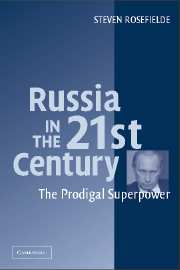
- Russia in the 21st CenturyThe Prodigal Superpower, pp. 1 - 10Publisher: Cambridge University PressPrint publication year: 2004
Accessibility standard: Unknown
Why this information is here
This section outlines the accessibility features of this content - including support for screen readers, full keyboard navigation and high-contrast display options. This may not be relevant for you.Accessibility Information
Accessibility compliance for the PDF of this chapter is currently unknown
and may be updated in the future.