Book contents
- Frontmatter
- Contents
- List of Figures and Tables
- List of Acronyms
- Preface
- Acknowledgments
- RUSSIA IN THE 21ST CENTURY
- Introduction
- 1 After “The End of History”
- 2 Prodigal Superpower
- 3 Structural Militarization
- 4 What Could Have Been Done?
- 5 Muscovite Metamorphosis
- 6 Military-Industrial Reform
- 7 National Vulnerabilities
- 8 The Miasma of Global Engagement
- 9 Putin's Choice
- 10 Candor
- Conclusion
- Glossary
- Notes
- Selected Bibliography
- Index
9 - Putin's Choice
Published online by Cambridge University Press: 18 December 2009

Book contents
- Frontmatter
- Contents
- List of Figures and Tables
- List of Acronyms
- Preface
- Acknowledgments
- RUSSIA IN THE 21ST CENTURY
- Introduction
- 1 After “The End of History”
- 2 Prodigal Superpower
- 3 Structural Militarization
- 4 What Could Have Been Done?
- 5 Muscovite Metamorphosis
- 6 Military-Industrial Reform
- 7 National Vulnerabilities
- 8 The Miasma of Global Engagement
- 9 Putin's Choice
- 10 Candor
- Conclusion
- Glossary
- Notes
- Selected Bibliography
- Index
Summary
Vladimir Putin doesn't know whether Russian “civilization” is compatible with the enlightenment precepts of economic liberty, democracy, and social justice – precepts that, according to Samuel Huntington, are founded on rational individual utility seeking, guided by the Golden Rule, and implemented through the rule of contract. Putin cannot be sure that Russian culture is any more compatible with the EU social democratic welfare state or that Russia can survive with its Muscovite economy, representational authoritarianism, and structural militarization. But he must somehow decide whether to preserve the status quo, tilt to the American or Franco-German dream, or chart some other course, cognizant that the “rest” cannot be best.
There are numerous “third paths” other than the Muscovite model that might be considered. The Kremlin could look to the past for inspiration, resurrecting Soviet administrative command planning, East European market communism, or Yugoslav worker management, but these options seem political and economic dead ends. It could survey the orient. The closest fit would be China. Until recently China, like the Soviet Union, had a one-party communist government and an economy featuring state ownership of the means of production, central planning, and physical systems management. The path of Russia and China diverged, however, following the dissolution of the Soviet Union. Where the Russians opted for a “demobilization model,” showcasing oligarchic privatization and relatively unrestricted capital flows, the Chinese preserved their resource “mobilization strategy,” retained state ownership in core enterprises, invested heavily in public works, gradually privatized without severe oligarchic distortions, maintained strict financial controls, and adopted a vigorous manufacturing export-oriented strategy, integrating it into the global economy.
Information
- Type
- Chapter
- Information
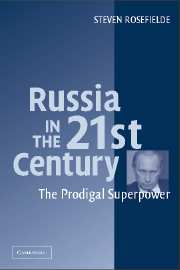
- Russia in the 21st CenturyThe Prodigal Superpower, pp. 117 - 122Publisher: Cambridge University PressPrint publication year: 2004
Accessibility standard: Unknown
Why this information is here
This section outlines the accessibility features of this content - including support for screen readers, full keyboard navigation and high-contrast display options. This may not be relevant for you.Accessibility Information
Accessibility compliance for the PDF of this chapter is currently unknown
and may be updated in the future.