Book contents
- Frontmatter
- Contents
- Preface
- List of Contributors
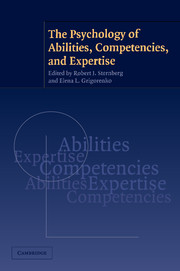
- The Psychology of Abilities, Competencies, and Expertise
- 1 Trait Complexes, Cognitive Investment, and Domain Knowledge
- 2 Intelligence as Adaptive Resource Development and Resource Allocation: A New Look Through the Lenses of SOC and Expertise
- 3 Developing Childhood Proclivities into Adult Competencies: The Overlooked Multiplier Effect
- 4 The Search for General Abilities and Basic Capacities: Theoretical Implications from the Modifiability and Complexity of Mechanisms Mediating Expert Performance
- 5 On Abilities and Domains
- 6 Expertise and Mental Disabilities: Bridging the Unbridgeable?
- 7 The Early Progress of Able Young Musicians
- 8 Expertise, Competence, and Creative Ability: The Perplexing Complexities
- 9 Biological Intelligence
- 10 What Causes Individual Differences in Cognitive Performance?
- Index
- References
3 - Developing Childhood Proclivities into Adult Competencies: The Overlooked Multiplier Effect
The Overlookied Multiplier Effect
Published online by Cambridge University Press: 05 June 2012

Book contents
- Frontmatter
- Contents
- Preface
- List of Contributors
- The Psychology of Abilities, Competencies, and Expertise
- 1 Trait Complexes, Cognitive Investment, and Domain Knowledge
- 2 Intelligence as Adaptive Resource Development and Resource Allocation: A New Look Through the Lenses of SOC and Expertise
- 3 Developing Childhood Proclivities into Adult Competencies: The Overlooked Multiplier Effect
- 4 The Search for General Abilities and Basic Capacities: Theoretical Implications from the Modifiability and Complexity of Mechanisms Mediating Expert Performance
- 5 On Abilities and Domains
- 6 Expertise and Mental Disabilities: Bridging the Unbridgeable?
- 7 The Early Progress of Able Young Musicians
- 8 Expertise, Competence, and Creative Ability: The Perplexing Complexities
- 9 Biological Intelligence
- 10 What Causes Individual Differences in Cognitive Performance?
- Index
- References
Summary
In this chapter, we tackle a problem that has been at the heart of the debate over the relative influence of genes and environments in producing cognitive competencies. Our goal is to attempt to reconcile the disparate claims of behavior genetics researchers who stress the prepotency of genes in producing intellectual competence (for example, Bouchard, Lykken, Tellegan, and McGue, 1998) with those whom Scarr (1997) refers to as “socialization theorists” because of their stance on the crucial role of the social and material environment in shaping developmental outcomes.
Our means of making this reconciliation is to describe recent efforts by diverse scholars to explain cognitive growth in terms of theories, models, and metaphors that are inherently multiplicative, more so than prior ones. We do not intend to delve into a comparative analysis of the strengths and weaknesses of each model or metaphor, as that is not our goal, but instead we want to make the point that various researchers, coming from very different orientations, have found the need to postulate similar types of multiplier effects to account for cognitive growth across a wide range of attainments (reading, intelligence, mathematics, motoric).
In the treatment that follows we use the terms “proclivities,” “penchants,” and “abilities” interchangeably, to refer to basic, underlying “resource pools” that are undoubtedly biologically based. Thus, we speak of a newborn's penchant, ability, or proclivity to stare, attend, remember, and process the perceptual world.
Information
- Type
- Chapter
- Information
- The Psychology of Abilities, Competencies, and Expertise , pp. 70 - 92Publisher: Cambridge University PressPrint publication year: 2003
References
(1988). Peer interaction and problem solving: When are two heads better than one?Child Development, 59, 87–96CrossRefGoogle Scholar
& (1998). Analyzing the development of individual differences in terms of Matthew effects in reading: Results from a Dutch longitudinal study. Developmental Psychology, 34(6), 1373–1399CrossRefGoogle ScholarPubMed
Bouchard, T. J., Jr., Lykken, D. T., Tellegan, A. C., & McGue, M. (1998). Genes, drives, environment and experience: EPD theory – revised. In C. P. Benbow & D. Lubinski (Eds.), Psychometrics and social issues concerning intellectual talent (pp. 141–173). Baltimore, MD: Johns Hopkins Press
Bronfenbrenner, U., & Ceci, S. J. (1993). Heredity, environment, and the question “how.” In R. Plomin & G. McClearn (Eds.), Nature nurture & psychology (pp 313–324). Washington, DC: American Psychological Association
, & , (1994). Nature-nurture in developmental perspective: A bioecological theory. Psychological Review, 101, 568–586CrossRefGoogle Scholar
Ceci, S. J. (1996). On intelligence: A bio-ecological treatise on intellectual development (2d ed.). Cambridge, MA: Harvard University Press
, & , (1992). The development of dynamic system reasoning. Human Development, 35, 121–137CrossRefGoogle Scholar
Cook, T. K., Appleton, H., Conner, R., Shaffer, A., Tamkin, G., & Weber, S. J. (1975). Sesame Street revisited. NY: Russell Sage Foundation Publication
(2000). Tests, affirmative action in university admissions, and the American way. Psychology, Public Policy, and Law, 6(1) 44–55CrossRefGoogle Scholar
& (2001a). Heritability estimates versus large environmental effects: The IQ paradox resolved. Psychological Review, 108(2), 346–69CrossRefGoogle Scholar
, & , (2001b, April 21). Great leap forward, New Scientist, vol. 170, no 2287, pp. 44–47Google Scholar
, , , & (2001). Class size and student achievement. Psychological Science in the Public Interest, 2, 1–30CrossRefGoogle ScholarPubMed
, , & (1993). The role of deliberate practice in the acquisition of expert performance. Psychological Review, 100(3), 363–406CrossRefGoogle Scholar
Flynn, J. (2001). The history of the American mind in the 20th century: A scenario to explain IQ gains over time and a case for the irrelevance of g. Otago, New Zealand. Unpublished manuscript
Gleick, J. (1987). Chaos: Making a new science. New York: Viking Penguin, Inc
Hamilton, B. H., Nickerson, J. A., & Owan, H. (2001, April 19). Team incentives and worker heterogeneity: An empirical analysis of the impact of teams on productivity and participation. Organizational Behavior Workshop, Cornell University. Unpublished manuscript
(1988). Computer-based drill and practice in arithmetic: Widening the gap between high-and low-achieving students. American Educational Review Journal, 25, 366–397CrossRefGoogle Scholar
Howe, M. J. A. (1989). Fragments of genius: The strange feats of idiots savants. London: Routledge
, , & (1998). Innate talents: Reality or myth?Behavioral and Brain Sciences, 21(3), 399–442CrossRefGoogle ScholarPubMed
Jensen, A. R. (1997). The puzzle of nongenetic variance. In R. J. Sternberg & E. L. Grigorenko (Eds.), Intelligence, heredity, and environment (pp. 42–88). New York: Cambridge University Press
, & , (1982). Lasting effects of early education: A report from the Consortium for Longitudinal Studies. Monographs of the Society for Research in Child Development, 47(2-sup-3), 1–151CrossRefGoogle Scholar
Loehlin, J. C., Horn, J. M., & Willerman, L. (1997). Heredity, environment, and IQ in the Texas Adoption Project. In R. J. Sternberg & E. L. Grigorenko (Eds.), Intelligence, heredity, and environment (pp. 105–125). New York: Cambridge University Press
, , , , , & (1997). Substantial genetic influence on cognitive abilities in twins 80 or more years old. Science, 276, 1560–1563CrossRefGoogle ScholarPubMed
, , , , , , & , (1998). Genetic and environmental relationship between general and specific cognitive abilities in twins age 80 and older. Psychological Science, 9, 183–189CrossRefGoogle Scholar
, (1978). Effects of caregiver behavior on habituation rate and self-efficacy in infants. International Journal of Behavioral Development, 1, 105–130CrossRefGoogle Scholar
(1992). Developmental theories for the 1990s: Development and individual differences. Child Development, 63, 1–19CrossRefGoogle ScholarPubMed
Scarr, S. (1997). Behavior-genetic and socialization theories of intelligence: Truce and reconciliation. In R. J. Sternberg & E. L. Grigorenko (Eds.), Intelligence, heredity, and environment (pp. 3–41). New York: Cambridge University Press
& (1983). How people make their own environments: A theory of genotype → environment effects. Child Development, 54, 424–435Google ScholarPubMed
, , , , , , & (1995). A Matthew effect for IQ but not for reading: Results from a longitudinal study. Reading Research Quarterly, 30(4), 894–906CrossRefGoogle Scholar
Smith, L. B., & Thelen, E. (1993). A dynamic systems approach to development: Applications. Cambridge, MA: MIT Press
(1986). Matthew effects in reading: Some consequences of individual differences in the acquisition of literacy. Reading Research Quarterly, 21(4), 360–406CrossRefGoogle Scholar
(1998). Correcting estimates of shared environmental variance for range restriction in adoption studies using a truncated multivariate normal model. Behavior Genetics, 28(6), 429–441CrossRefGoogle ScholarPubMed
(1999). Implications of the restricted range of family environments for estimates of heritability and nonshared environment in behavior-genetic adoption studies. Psychological Bulletin, 125(4), 392–409CrossRefGoogle ScholarPubMed
(1992). Development as a dynamic system. Current Directions in Cognitive Science, 1(6), 189–193CrossRefGoogle Scholar
Thelen, E., & Smith, L. B. (1994). A dynamic systems approach to the development of cognition and action. Cambridge, MA: MIT Press
(1991). A dynamic systems model of cognitive and language growth. Psychological Review, 98(1), 3–53CrossRefGoogle Scholar
Waddington, C. H. (1957). The strategy of the genes. Winchester, MA: Allen & Unwin
, & (1997). Are Americans becoming more or less alike?: Trends in race, class, and ability differences in intelligence. American Psychologist, 52(11), 1226–1235CrossRefGoogle Scholar
Accessibility standard: Unknown
Why this information is here
This section outlines the accessibility features of this content - including support for screen readers, full keyboard navigation and high-contrast display options. This may not be relevant for you.Accessibility Information
Accessibility compliance for the PDF of this chapter is currently unknown
and may be updated in the future.
- 21
- Cited by