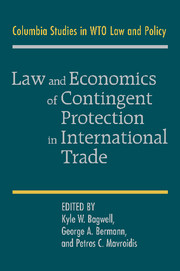
Book contents
- Frontmatter
- Contents
- Contributors
- Introduction
- 1 An Overview of the Agreement on Subsidies and Countervailing Measures – Including a Discussion of the Agreement on Agriculture
- 2 Do the World Trade Organization Disciplines on Domestic Subsidies Make Sense? The Case for Legalizing Some Subsidies
- 3 Subsidies and Countervailing Measures: Determining the Benefit of Subsidies
- 4 The Enduring Problem of World Trade Organization Export Subsidies Rules
- 5 The Boeing–Airbus Dispute: A Case for the Application of the European Community State Aid Rules?
- 6 Antidumping: Overview of the Agreement
- 7 Price Differentiation in Antitrust and Trade Instruments
- 8 Nonpreferential Origin Rules in Antidumping Law and Practice
- 9 The Appellate Body Interpretation of “Sunset Reviews” Provisions of Anti-Dumping and Countervailing Measures Agreements: A Critical Analysis
- 10 The Safeguards Agreement – An Overview
- 11 Why Are Safeguards Needed in a Trade Agreement?
- Index
- References
1 - An Overview of the Agreement on Subsidies and Countervailing Measures – Including a Discussion of the Agreement on Agriculture
Published online by Cambridge University Press: 03 May 2010

Book contents
- Frontmatter
- Contents
- Contributors
- Introduction
- 1 An Overview of the Agreement on Subsidies and Countervailing Measures – Including a Discussion of the Agreement on Agriculture
- 2 Do the World Trade Organization Disciplines on Domestic Subsidies Make Sense? The Case for Legalizing Some Subsidies
- 3 Subsidies and Countervailing Measures: Determining the Benefit of Subsidies
- 4 The Enduring Problem of World Trade Organization Export Subsidies Rules
- 5 The Boeing–Airbus Dispute: A Case for the Application of the European Community State Aid Rules?
- 6 Antidumping: Overview of the Agreement
- 7 Price Differentiation in Antitrust and Trade Instruments
- 8 Nonpreferential Origin Rules in Antidumping Law and Practice
- 9 The Appellate Body Interpretation of “Sunset Reviews” Provisions of Anti-Dumping and Countervailing Measures Agreements: A Critical Analysis
- 10 The Safeguards Agreement – An Overview
- 11 Why Are Safeguards Needed in a Trade Agreement?
- Index
- References
Summary
Introduction
The present contribution aims to provide an insight into the World Trade Organization's (WTO's) multilateral disciplines on subsidies related to trade in goods and on unilateral measures to respond to these subsidies, in other words, countervailing duties (CVDs). In our discussion, we focus on the legal analysis and thus leave the economic analysis to other contributions in this book. As such, we offer only one part of the introduction to the Agreement on Subsidies and Countervailing Measures (“SCM Agreement”), which should be complemented with the economic analysis to evaluate the subsidy and CVD disciplines from a normative point of view.
Our legal analysis is structured around six parts. After a short overview of the legal and historical context, we clarify the object and purpose of the SCM Agreement and examine the various aspects of the definition of “a subsidy” included in the SCM Agreement. When a specific subsidy is deemed to exist under the SCM Agreement, a traffic light metaphor can be made when categorizing subsidies. Some types of subsidies are prohibited (red light), whereas all other specific subsidies are allowed as long as they do not cause adverse effects (yellow light). At present, no type of subsidy gets the green light under the SCM Agreement. Later in this chapter, we look at how WTO Members may respond to subsidies provided by other WTO Members.
Information
- Type
- Chapter
- Information
- Publisher: Cambridge University PressPrint publication year: 2009
References
, World Trade and the Law of GATT – A Legal Analysis of the General Agreement on Tariffs and Trade (Indianapolis, The Bobbs-Merrill Company, 1969), 948 pp., 368–371Google Scholar
(Ed.), The GATT Uruguay Round – A Negotiating History (1986–1992) (Deventer, Kluwer, 1993, 3 Volumes), Volume I, 1,382 pp., 817
, The World Trading System: Law and Policy of International Economic Relations (Massachusetts, MIT Press, 2nd ed., 1997), 441 pp., 288–289Google Scholar
and , “The Agreement on Subsidies and Countervailing Measures,” in , , and (Eds.), The World Trade Organization: Legal, Economic and Political Analysis (New York, Springer, 2005, x Volumes), 3120 pp., 686Google Scholar
, “Negotiations on Safeguard and Subsidies in Services: A Never-ending Story?” 10(2) Journal of International Economic Law (2007), 235–265CrossRefGoogle Scholar
, with and , “Déjà vu, or new beginning for safeguards and subsidies rules in service trade?”, in and , GATS 2000 – new directions in services trade liberalization (Washington D.C., The Brookings Institution, 2000), pp. 165–183, 177Google Scholar
, “Public services and Trade Liberalisation: Mapping the Legal Framework”, 6(2) Journal of International Economic Law 2003, 341–367, 361CrossRefGoogle Scholar
, , and , The World Trade Organization – Law, Practice and Policy (Oxford, Oxford University Press, 2nd ed., 2006), 889 pp., 660–661Google Scholar
, International Trade Regulation – GATT, The United States and the European Community (Exeter, Globefield Press, 1986), 629 pp. at 312Google Scholar
, “The International Context of EC State Aid Law and Policy: The Regulation of Subsidies in the WTO,” in , , and (Eds.), The Law of State Aid in the European Union (Oxford, Oxford University Press, 2004), 149, at 160Google Scholar
, “Foreign Sales Corporation – Subsidies, Sanctions, and Trade Wars,” 35 Vanderbilt Journal of Transnational Law (2002), 151–210Google Scholar
and , “United States – Tax treatment for ‘Foreign Sales Corporations’ Recourse to Arbitration by the United States under Article 22.6 of the Dispute Settlement Understanding and Article 4.11 of the SCM Agreement (WT/DS108/ARB),” 4:1 World Trade Review (2005), 101–124CrossRefGoogle Scholar
, “Industrial Subsidies: Tax Treatment of ‘Foreign Sales Corporations”, in and (Eds.), Transatlantic Economic Disputes – the EU, the U.S., and the WTO (Oxford, Oxford University Press, 2003), 175–205Google Scholar
, “WTO Rules on Direct Taxation,” World Trade Organization, Discussion Paper number 9 (2005), 4–5Google Scholar
, “Trade-Related Aspects of International Taxation: A New WTO Code of Conduct?” 30:2 Journal of World Trade 161 (1996), 161Google Scholar
, Regulation of Subsidies and State Aids in WTO and EC Law (the Netherlands, Kluwer Law International, 2006), 586 pp., 122Google Scholar
and , “International trade: Barriers to Trade,” in and (Eds.), Research Handbook in International Economic Law (Cheltenham, Edward Elgar, 2007), 640 pp., 21–22Google Scholar
, , and , “Reconsidering Prohibited Export Subsidies in Doha Negotiations,” in , , and (Eds.), The WTO Trade Remedy System: East Asian Perspectives (London, Cameron May, 2007), 337–355Google Scholar
and , “Agreement on Subsidies and Countervailing Measures: Need for Clarification and Improvement,” 39:6 Journal of World Trade 1009 (2005), 1014Google Scholar
, “Legal Aspects of the IMF/WTO Relationship: The Fund's Articles of Agreement and the WTO Agreements,” 96:3 American Journal of International Law 561 (2002), 596CrossRefGoogle Scholar
, “Safeguard, Anti-Dumping, and Countervailing Duty Disputes in the Transatlantic Partnership: How to Control ‘Contingency Protection’ More Effectively,” in and (Eds.), Transatlantic Economic Disputes – the EU, the U.S., and the WTO (Oxford, Oxford University Press, 2003), 141Google Scholar
, Trade Rules Behind Borders: Essays on Services, Investment and the New Trade Agenda (London, Cameron May, 2003), 666 pp., 313–318Google Scholar
, , and , The World Trade Organization – Law, Practice and Policy (Oxford, Oxford University Press, 1st ed., 2003), 334Google Scholar
, WTO Litigation – Procedural Aspects of Formal Dispute Settlement (London, Cameron, May, 2002), 935 pp., 644–645Google Scholar
and , “Production and Export Subsidies in Agriculture: Lessons from GATT and WTO Disputes Involving the U.S. and the EC,” in and (Eds.), Transatlantic Economic Disputes – the EU, the U.S., and the WTO (Oxford, Oxford University Press, 2003), 606 pp., 215Google Scholar
, The WTO Agreement on Agriculture – a Commentary (Oxford, Oxford University Press, 2006), 333, pp. 90CrossRefGoogle Scholar
(Ed.), Putting Development First – The Importance of Policy Space in the WTO and International Financial Institutions (New York, Zed Books, 2005), 301
and , “Preserving Policy Space for Sustainable Development: The Subsidies Agreement at the WTO,” International Institute for Sustainable Development (December 2005), 28Google Scholar
, “Facilitating Development in the World Trading System – A Proposal for Development Facilitation Tariff and Development Facilitating Subsidy,” 38(6) Journal of World Trade 2004, 935–954Google Scholar
, “Export Promotion and Economic Development,” 40(1) Journal of World Trade 2006, 153–166Google Scholar
Accessibility standard: Unknown
Why this information is here
This section outlines the accessibility features of this content - including support for screen readers, full keyboard navigation and high-contrast display options. This may not be relevant for you.Accessibility Information
Accessibility compliance for the PDF of this chapter is currently unknown
and may be updated in the future.
- 4
- Cited by