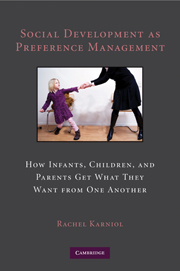
 Social Development as Preference Management
 How Infants, Children, and Parents Get What They Want from One Another
Book contents
- Frontmatter
- Contents
- Acknowledgments
- Introduction
- 1 The Baby “Preference Game”
- 2 Children's Expression of Preferences
- 3 Emerging Meta-Preferences
- 4 Other People's Preferences
- 5 Parenting and Preference Management
- 6 Channeling Children's Preferences
- 7 Temporizing Preferences
- 8 Restricting Children's Preferences
- 9 Disciplining Noncompliance
- 10 Planes of Transformational Thought: Temporal, Imaginal, and Mental
- 11 Manipulating Others
- 12 Coping and Self-Regulating
- 13 Mind Play: Applying Transformational Thought
- 14 Minding One's Own Versus Others' Preferences: Altruism, Aggression, and Morality
- 15 Tying Up
- References
- Subject Index
- Name Index
4 - Other People's Preferences
Published online by Cambridge University Press: 05 June 2012

Book contents
- Frontmatter
- Contents
- Acknowledgments
- Introduction
- 1 The Baby “Preference Game”
- 2 Children's Expression of Preferences
- 3 Emerging Meta-Preferences
- 4 Other People's Preferences
- 5 Parenting and Preference Management
- 6 Channeling Children's Preferences
- 7 Temporizing Preferences
- 8 Restricting Children's Preferences
- 9 Disciplining Noncompliance
- 10 Planes of Transformational Thought: Temporal, Imaginal, and Mental
- 11 Manipulating Others
- 12 Coping and Self-Regulating
- 13 Mind Play: Applying Transformational Thought
- 14 Minding One's Own Versus Others' Preferences: Altruism, Aggression, and Morality
- 15 Tying Up
- References
- Subject Index
- Name Index
Summary
A child of 36 months is planning to put sand in a friend's watering can. She says, ‘I'm going to…. When she comes home, she will say “There's sand in the watering can” … and she can't water it’ When chastised by her mother for doing so, with “she doesn't like you doing that,” the child responds, ‘I know she doesn't!’
(Dunn, 1988, p. 146)A 5-year-old child makes a toy lighter out of aluminum foil; his sister says, ‘Well don't take that to school … You could get in big trouble. If I took something like that to school? And the teacher thought it was a cigarette lighter? She'd – I'd get suspended.’
(Ochs, 2004, p. 274)In Chapters 1–3, children were expressing preferences for what they wanted to have and do and what they wanted others to do – but they did not refer to other people's preferences. In fact, Budwig (2002) found that between 18 and 36 months of age, both children and their parents used the verb want primarily in reference to the child as the experiencer of wants. Children talked of what they want and adults inquired as to children's wants, so that primarily children's preferences were alluded to over the 4 months of the study. Yet children do learn of others people's preferences in their interaction with them. In this chapter, I focus on how children learn of other people's preferences and how they indicate their awareness of such preferences.
Information
- Type
- Chapter
- Information
- Social Development as Preference ManagementHow Infants, Children, and Parents Get What They Want from One Another, pp. 63 - 88Publisher: Cambridge University PressPrint publication year: 2010
Accessibility standard: Unknown
Why this information is here
This section outlines the accessibility features of this content - including support for screen readers, full keyboard navigation and high-contrast display options. This may not be relevant for you.Accessibility Information
Accessibility compliance for the PDF of this chapter is currently unknown
and may be updated in the future.