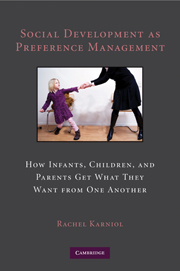
 Social Development as Preference Management
 How Infants, Children, and Parents Get What They Want from One Another
Book contents
- Frontmatter
- Contents
- Acknowledgments
- Introduction
- 1 The Baby “Preference Game”
- 2 Children's Expression of Preferences
- 3 Emerging Meta-Preferences
- 4 Other People's Preferences
- 5 Parenting and Preference Management
- 6 Channeling Children's Preferences
- 7 Temporizing Preferences
- 8 Restricting Children's Preferences
- 9 Disciplining Noncompliance
- 10 Planes of Transformational Thought: Temporal, Imaginal, and Mental
- 11 Manipulating Others
- 12 Coping and Self-Regulating
- 13 Mind Play: Applying Transformational Thought
- 14 Minding One's Own Versus Others' Preferences: Altruism, Aggression, and Morality
- 15 Tying Up
- References
- Subject Index
- Name Index
10 - Planes of Transformational Thought: Temporal, Imaginal, and Mental
Published online by Cambridge University Press: 05 June 2012

Book contents
- Frontmatter
- Contents
- Acknowledgments
- Introduction
- 1 The Baby “Preference Game”
- 2 Children's Expression of Preferences
- 3 Emerging Meta-Preferences
- 4 Other People's Preferences
- 5 Parenting and Preference Management
- 6 Channeling Children's Preferences
- 7 Temporizing Preferences
- 8 Restricting Children's Preferences
- 9 Disciplining Noncompliance
- 10 Planes of Transformational Thought: Temporal, Imaginal, and Mental
- 11 Manipulating Others
- 12 Coping and Self-Regulating
- 13 Mind Play: Applying Transformational Thought
- 14 Minding One's Own Versus Others' Preferences: Altruism, Aggression, and Morality
- 15 Tying Up
- References
- Subject Index
- Name Index
Summary
Doll falls out of bed. 22-month-old girl says, ‘Oh-oh, need bandaid,’ adding: ‘J (own name) fall down…hurt here (shows eyebrow)…ouch…Mommy ice…Poor J…J cry…Dada car…J. car…Go hospital…. All better,’ referring to an incident several weeks earlier.
(Wolf, 1982, p. 320)Playing house, a 3-year-old girl tells a boy ‘You're the baby.’ He counters, ‘No I'm not; I'm the Superman getting away from you, witch.’
(Pitcher & Schultz, 1983, p. 45)Thinking need not remain tied to the here-and-now. As Bickerton (1995) contends, although much of our thinking is online, devoted to the immediate environment, we also engage in extensive offline thinking, performing computations, and transforming our internal representations. Gärdenfors (2005) differentiates cued versus detached representations, with the former referring to representations that are cued by something in the current external situation and the latter being independent of the current context. Our minds can create imaginary objects, situations, and people that are independent of any apparent changes in the external environment but despite their imaginary status may nonetheless be as powerful as external cues in terms of their motivational force. In this chapter, I focus on the emergence of transformational thought and how parents foster it in three planes of representation: (1) the temporal plane, as evident in talking of the past and future, (2) the imaginal plane, as manifest in pretend play, and (3) the mental plane of transformation, as evident in talk of covert, psychological experiences.
Information
- Type
- Chapter
- Information
- Social Development as Preference ManagementHow Infants, Children, and Parents Get What They Want from One Another, pp. 190 - 218Publisher: Cambridge University PressPrint publication year: 2010
Accessibility standard: Unknown
Why this information is here
This section outlines the accessibility features of this content - including support for screen readers, full keyboard navigation and high-contrast display options. This may not be relevant for you.Accessibility Information
Accessibility compliance for the PDF of this chapter is currently unknown
and may be updated in the future.