Book contents
- Frontmatter
- Contents
- Preface
- Acknowledgments
- 1 From Religion to Risk Management: What to Do When Facing Uncertainty?
- 2 Anything Wrong with Gambling as a Pastime?
- 3 Are You Rich? Risk-Taking and Gambling, or the Leapfrogging Instinct
- 4 Betting on Futures and Creating Prices
- 5 Gambling as Banking: Poker, Junk Bonds, and Central Banks
- 6 Lottery Is a Taxation, and Heav'n Be Prais'd, It Is Easily Rais'd
- 7 Politics and Prohibitions; or, What's a Good Tax Anyway?
- 8 How Gamblers and Risk-Takers Correct the Future
- Appendix 1 Gambling and Risk-Taking: The Leapfrogging Instinct
- Appendix 2 Human Nature and the Civilizing Process
- Appendix 3 A Statistical Profile of Gamblers
- Notes
- Bibliography
- Name Index
- Subject Index
1 - From Religion to Risk Management: What to Do When Facing Uncertainty?
Published online by Cambridge University Press: 06 July 2010

Book contents
- Frontmatter
- Contents
- Preface
- Acknowledgments
- 1 From Religion to Risk Management: What to Do When Facing Uncertainty?
- 2 Anything Wrong with Gambling as a Pastime?
- 3 Are You Rich? Risk-Taking and Gambling, or the Leapfrogging Instinct
- 4 Betting on Futures and Creating Prices
- 5 Gambling as Banking: Poker, Junk Bonds, and Central Banks
- 6 Lottery Is a Taxation, and Heav'n Be Prais'd, It Is Easily Rais'd
- 7 Politics and Prohibitions; or, What's a Good Tax Anyway?
- 8 How Gamblers and Risk-Takers Correct the Future
- Appendix 1 Gambling and Risk-Taking: The Leapfrogging Instinct
- Appendix 2 Human Nature and the Civilizing Process
- Appendix 3 A Statistical Profile of Gamblers
- Notes
- Bibliography
- Name Index
- Subject Index
Summary
Which shows how societies dealt with uncertainty and risk when their population was small and immobile, and when it grew; why traditions and customs can be wisdom, but often become wrong when circumstances change.
Thomas Jefferson called the lottery a “wonderful thing: It lays taxation only on the willing.” In one sense, Jefferson's statement is erroneous. After all, taxing tobacco and pornography implies that the tax is imposed only on those willing to smoke or to watch. Yet these actions do not necessarily turn indulging in either act into a wonderful thing.
Jefferson's statement may be linked to Britain's tax on tea, which, when imposed on the unwilling American settlers, resulted in the tea being thrown into Boston's harbor – certainly a way to avoid paying taxes. One can only speculate on the future of colonies if Britain, instead of imposing tax on tea, had decided to raise revenues by selling lotteries on the North American continent.
In another sense, though, Jefferson was right: governments would be better off taxing and regulating an activity that many people want to pursue, even if it is not perhaps perceived as particularly virtuous, rather than outlawing it. Yet where are the Jeffersons when one needs them?
On October 13, 2006, the president of the United States signed a bill – the Unlawful Internet Gambling Enforcement Act (UIGEA) passed by Congress – to make it illegal for financial institutions to transfer payments to online gambling companies, whose services millions of American citizens were buying.
Information
- Type
- Chapter
- Information
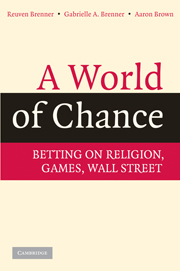
- A World of ChanceBetting on Religion, Games, Wall Street, pp. 1 - 16Publisher: Cambridge University PressPrint publication year: 2008
Accessibility standard: Unknown
Why this information is here
This section outlines the accessibility features of this content - including support for screen readers, full keyboard navigation and high-contrast display options. This may not be relevant for you.Accessibility Information
Accessibility compliance for the PDF of this chapter is currently unknown
and may be updated in the future.