Book contents
- Frontmatter
- Contents
- Preface
- Acknowledgments
- 1 From Religion to Risk Management: What to Do When Facing Uncertainty?
- 2 Anything Wrong with Gambling as a Pastime?
- 3 Are You Rich? Risk-Taking and Gambling, or the Leapfrogging Instinct
- 4 Betting on Futures and Creating Prices
- 5 Gambling as Banking: Poker, Junk Bonds, and Central Banks
- 6 Lottery Is a Taxation, and Heav'n Be Prais'd, It Is Easily Rais'd
- 7 Politics and Prohibitions; or, What's a Good Tax Anyway?
- 8 How Gamblers and Risk-Takers Correct the Future
- Appendix 1 Gambling and Risk-Taking: The Leapfrogging Instinct
- Appendix 2 Human Nature and the Civilizing Process
- Appendix 3 A Statistical Profile of Gamblers
- Notes
- Bibliography
- Name Index
- Subject Index
5 - Gambling as Banking: Poker, Junk Bonds, and Central Banks
Published online by Cambridge University Press: 06 July 2010

Book contents
- Frontmatter
- Contents
- Preface
- Acknowledgments
- 1 From Religion to Risk Management: What to Do When Facing Uncertainty?
- 2 Anything Wrong with Gambling as a Pastime?
- 3 Are You Rich? Risk-Taking and Gambling, or the Leapfrogging Instinct
- 4 Betting on Futures and Creating Prices
- 5 Gambling as Banking: Poker, Junk Bonds, and Central Banks
- 6 Lottery Is a Taxation, and Heav'n Be Prais'd, It Is Easily Rais'd
- 7 Politics and Prohibitions; or, What's a Good Tax Anyway?
- 8 How Gamblers and Risk-Takers Correct the Future
- Appendix 1 Gambling and Risk-Taking: The Leapfrogging Instinct
- Appendix 2 Human Nature and the Civilizing Process
- Appendix 3 A Statistical Profile of Gamblers
- Notes
- Bibliography
- Name Index
- Subject Index
Summary
Which shows how gambling was banking, and how it is linked to the development of clearinghouses, central banking, and creating wealth in a country.
How do you sell a relatively expensive property in a society that does not have banks or developed financial institutions? How can the owner of this property raise money to reinvest it elsewhere? How can entrepreneurs raise money in a world where there is no venture capital and there are usury laws that prevent banks from giving loans to newcomers with no credit rating?
The answer is – surprising perhaps – by gambling, whether selling lottery tickets, or around the gambling table.
Merchants in Italy, the German states, and England discovered during medieval times that they could make more money if they auctioned off their relatively expensive goods as prizes in lottery drawings. This practice gained currency later in the New World, where relatively large property, which could not be divided, was the prize. Thomas Jefferson explained the rational for such financing:
An article of property, insusceptible of division at all, or not without great diminution of its worth, is sometimes of so large a value that no purchaser can be found … The lottery is here a salutary instrument for disposing of it, where men run small risks for a chance of obtaining a high prize.
Information
- Type
- Chapter
- Information
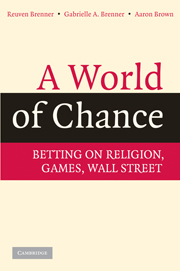
- A World of ChanceBetting on Religion, Games, Wall Street, pp. 90 - 123Publisher: Cambridge University PressPrint publication year: 2008
Accessibility standard: Unknown
Why this information is here
This section outlines the accessibility features of this content - including support for screen readers, full keyboard navigation and high-contrast display options. This may not be relevant for you.Accessibility Information
Accessibility compliance for the PDF of this chapter is currently unknown
and may be updated in the future.