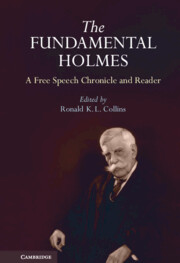
 The Fundamental Holmes
 A Free Speech Chronicle and Reader – Selections from the Opinions, Books, Articles, Speeches, Letters and Other Writings by and about Oliver Wendell Holmes, Jr.
Book contents
- Frontmatter
- Contents
- Timeline: Holmes's Life and Free Speech Jurisprudence, 1841–1935
- Prologue: The Father of the Modern First Amendment
- Part I On Life and War
- Part II General Conceptions: The Early Writings
- Part III The State Court Years: Fettered Freedom
- Part IV Supreme Court Opinions: The Early Years
- Part V Supreme Court Opinions: “When a nation is at war”
- Part VI Supreme Court Opinions: Experimenting with Freedom
- Epilogue: The Long Shadow
- Appendix 1 Holmes on Free Speech and Related Matters: Selected Quotations
- Appendix 2 Holmes's Supreme Court Voting Record in Free Speech Cases
- About the Editor
- Index
Prologue: The Father of the Modern First Amendment
Published online by Cambridge University Press: 05 August 2012
Edited by

Book contents
- Frontmatter
- Contents
- Timeline: Holmes's Life and Free Speech Jurisprudence, 1841–1935
- Prologue: The Father of the Modern First Amendment
- Part I On Life and War
- Part II General Conceptions: The Early Writings
- Part III The State Court Years: Fettered Freedom
- Part IV Supreme Court Opinions: The Early Years
- Part V Supreme Court Opinions: “When a nation is at war”
- Part VI Supreme Court Opinions: Experimenting with Freedom
- Epilogue: The Long Shadow
- Appendix 1 Holmes on Free Speech and Related Matters: Selected Quotations
- Appendix 2 Holmes's Supreme Court Voting Record in Free Speech Cases
- About the Editor
- Index
Summary
He liked the idea of risk.
– Louis MenandHolmes's footprint on the American law of free speech is gigantic. Like Atlas, he is a titan in that world. No one else quite casts a shadow so long. Although James Madison is the grand pater of the historical First Amendment, its modern father figure is surely Justice Oliver Wendell Holmes Jr. (1841–1935). His thought can be found in bold relief in many Supreme Court opinions on freedom of expression, in every contemporary history of the subject, in every casebook and textbook used in law schools and in colleges, and in every serious scholarly treatment of the matter. This is so because “Holmes laid the foundations… for the expansive modern view of free speech.…” Having done so, he then “left a profound imprint on the law of free speech.” Without exaggeration, then, it would be impossible to have any serious discussion of modern free speech theory or law without some consideration of his views.
But from what well does Holmes's fame spring? Does it derive mainly from three opinions – Schenck v. United States, Abrams v. United States, and Gitlow v. New York – issued late in the long life span of this great jurist and scholar?
Information
- Type
- Chapter
- Information
- The Fundamental HolmesA Free Speech Chronicle and Reader – Selections from the Opinions, Books, Articles, Speeches, Letters and Other Writings by and about Oliver Wendell Holmes, Jr., pp. xiii - xxviPublisher: Cambridge University PressPrint publication year: 2010
Accessibility standard: Unknown
Why this information is here
This section outlines the accessibility features of this content - including support for screen readers, full keyboard navigation and high-contrast display options. This may not be relevant for you.Accessibility Information
Accessibility compliance for the PDF of this chapter is currently unknown
and may be updated in the future.