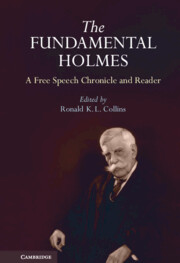
 The Fundamental Holmes
 A Free Speech Chronicle and Reader – Selections from the Opinions, Books, Articles, Speeches, Letters and Other Writings by and about Oliver Wendell Holmes, Jr.
Book contents
- Frontmatter
- Contents
- Timeline: Holmes's Life and Free Speech Jurisprudence, 1841–1935
- Prologue: The Father of the Modern First Amendment
- Part I On Life and War
- Part II General Conceptions: The Early Writings
- Part III The State Court Years: Fettered Freedom
- Part IV Supreme Court Opinions: The Early Years
- Part V Supreme Court Opinions: “When a nation is at war”
- Part VI Supreme Court Opinions: Experimenting with Freedom
- Epilogue: The Long Shadow
- Appendix 1 Holmes on Free Speech and Related Matters: Selected Quotations
- Appendix 2 Holmes's Supreme Court Voting Record in Free Speech Cases
- About the Editor
- Index
- References
Part IV - Supreme Court Opinions: The Early Years
Published online by Cambridge University Press: 05 August 2012
Edited by

Book contents
- Frontmatter
- Contents
- Timeline: Holmes's Life and Free Speech Jurisprudence, 1841–1935
- Prologue: The Father of the Modern First Amendment
- Part I On Life and War
- Part II General Conceptions: The Early Writings
- Part III The State Court Years: Fettered Freedom
- Part IV Supreme Court Opinions: The Early Years
- Part V Supreme Court Opinions: “When a nation is at war”
- Part VI Supreme Court Opinions: Experimenting with Freedom
- Epilogue: The Long Shadow
- Appendix 1 Holmes on Free Speech and Related Matters: Selected Quotations
- Appendix 2 Holmes's Supreme Court Voting Record in Free Speech Cases
- About the Editor
- Index
- References
Summary
September 6, 1901, is one of the most important dates in American constitutional history, though few think of it as such. On that day, Leon Czolgosz attempted to assassinate President William McKinley at the Pan-American Exposition in Buffalo, New York. Though the president would live several more days, the two shots the anarchist fired ultimately killed him and thereby put in motion a string of events that led to Oliver Wendell Holmes Jr. becoming the fifty-eighth justice on the Supreme Court. But for the death of the president, the seat vacated by Justice Horace Gray would not have gone to Holmes, as President McKinley had other plans.
As the summer of 1901 came to an end, it became apparent to McKinley and others that Justice Gray was ill and was likely to retire soon. So the president turned to his friend John Davis Long, then secretary of the navy, for advice. Though Long had nominated Holmes to the Massachusetts bench when he was governor, he did not recommend him for the Supreme Court. Instead, Long urged the president to select Alfred Hemenway, his law partner. And Hemenway was prepared to accept the position if and when offered. But as it turned out, Horace's delay in retiring combined with McKinley's assassination changed everything. Thereafter, Henry Cabot Lodge, a U.S. senator from Massachusetts and one of Theodore Roosevelt's close friends, recommended Holmes for Gray's seat when the ailing justice stepped down in July 1902. Roosevelt acted on Lodge's suggestion and nominated Holmes.
Information
- Type
- Chapter
- Information
- The Fundamental HolmesA Free Speech Chronicle and Reader – Selections from the Opinions, Books, Articles, Speeches, Letters and Other Writings by and about Oliver Wendell Holmes, Jr., pp. 161 - 204Publisher: Cambridge University PressPrint publication year: 2010
References
, Free Speech in Its Forgotten Years (New York: Cambridge University Press, 1997), at 25–26Google Scholar
, ed., The Collected Works of Justice Holmes (Chicago: University of Chicago Press, 1995) at 3:505, 507
Accessibility standard: Unknown
Why this information is here
This section outlines the accessibility features of this content - including support for screen readers, full keyboard navigation and high-contrast display options. This may not be relevant for you.Accessibility Information
Accessibility compliance for the PDF of this chapter is currently unknown
and may be updated in the future.