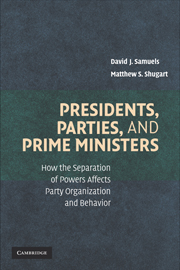
 Presidents, Parties, and Prime Ministers
 How the Separation of Powers Affects Party Organization and Behavior
Book contents
- Frontmatter
- Contents
- Preface and Acknowledgments
- Presidents, Parties, and Prime Ministers
- 1 Introduction
- 2 Political Parties in the Neo-Madisonian Theoretical Framework
- 3 Insiders and Outsiders
- 4 Constitutional Design and Intraparty Leadership Accountability
- 5 Electoral Separation of Purpose within Political Parties
- 6 The Impact of Constitutional Change on Party Organization and Behavior
- 7 Parties' “Presidential Dilemmas” in Brazil and Mexico
- 8 Presidents, Prime Ministers, and Mandate Representation
- 9 Conclusion
- References
- Index
2 - Political Parties in the Neo-Madisonian Theoretical Framework
Published online by Cambridge University Press: 05 June 2012

Book contents
- Frontmatter
- Contents
- Preface and Acknowledgments
- Presidents, Parties, and Prime Ministers
- 1 Introduction
- 2 Political Parties in the Neo-Madisonian Theoretical Framework
- 3 Insiders and Outsiders
- 4 Constitutional Design and Intraparty Leadership Accountability
- 5 Electoral Separation of Purpose within Political Parties
- 6 The Impact of Constitutional Change on Party Organization and Behavior
- 7 Parties' “Presidential Dilemmas” in Brazil and Mexico
- 8 Presidents, Prime Ministers, and Mandate Representation
- 9 Conclusion
- References
- Index
Summary
Our theoretical approach for thinking about how variation in the structure of executive-legislative relations affects political parties is rooted in the Federalist Papers. The Federalists advocated on behalf of the proposed US Constitution, and offered a theory of how institutions shape politicians' behavior. Contemporary rational choice and institutionalist political science provide a modern synthesis of key concepts from the Federalists, and result in what we call the neo-Madisonian theoretical perspective (Carroll and Shugart 2007).
This framework starts from the Federalists' core hypothesis: the extent to which government ensures liberty or gives way to tyranny is directly related to the manner in which the institutions of government structure the representation of societal interests and channel political ambition. In Federalist #10, James Madison articulated the core problem all democracies face: representative government necessarily entails delegation of power from voters to a small number of politicians, yet politicians can turn this delegated power against voters. Madison feared that tyranny would result if politicians' selfish motivations, which he took for granted, were not held in check. To preserve liberty, Madison favored the establishment of an “extensive republic” in which a diversity of interests would gain representation and be pitted against one another, thereby preventing a single faction from dominating the entire political system.
What is often forgotten is that Madison's original constitutional proposal for achieving this goal bore scant resemblance to the theory of government that is most widely associated with him today, separation of powers and institutional checks and balances.
Information
- Type
- Chapter
- Information
- Presidents, Parties, and Prime MinistersHow the Separation of Powers Affects Party Organization and Behavior, pp. 22 - 61Publisher: Cambridge University PressPrint publication year: 2010
Accessibility standard: Unknown
Why this information is here
This section outlines the accessibility features of this content - including support for screen readers, full keyboard navigation and high-contrast display options. This may not be relevant for you.Accessibility Information
Accessibility compliance for the PDF of this chapter is currently unknown
and may be updated in the future.