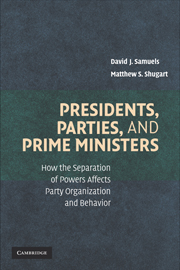
 Presidents, Parties, and Prime Ministers
 How the Separation of Powers Affects Party Organization and Behavior
Book contents
- Frontmatter
- Contents
- Preface and Acknowledgments
- Presidents, Parties, and Prime Ministers
- 1 Introduction
- 2 Political Parties in the Neo-Madisonian Theoretical Framework
- 3 Insiders and Outsiders
- 4 Constitutional Design and Intraparty Leadership Accountability
- 5 Electoral Separation of Purpose within Political Parties
- 6 The Impact of Constitutional Change on Party Organization and Behavior
- 7 Parties' “Presidential Dilemmas” in Brazil and Mexico
- 8 Presidents, Prime Ministers, and Mandate Representation
- 9 Conclusion
- References
- Index
3 - Insiders and Outsiders
Madison's Dilemma and Leadership Selection
Published online by Cambridge University Press: 05 June 2012

Book contents
- Frontmatter
- Contents
- Preface and Acknowledgments
- Presidents, Parties, and Prime Ministers
- 1 Introduction
- 2 Political Parties in the Neo-Madisonian Theoretical Framework
- 3 Insiders and Outsiders
- 4 Constitutional Design and Intraparty Leadership Accountability
- 5 Electoral Separation of Purpose within Political Parties
- 6 The Impact of Constitutional Change on Party Organization and Behavior
- 7 Parties' “Presidential Dilemmas” in Brazil and Mexico
- 8 Presidents, Prime Ministers, and Mandate Representation
- 9 Conclusion
- References
- Index
Summary
If we think of parties as teams of politicians who cooperate in elections and in government, then a critical question is, How do parties select their leaders? All organizations must cope with delegation problems, as principal-agent theory suggests. In this chapter, we consider how different democratic regimes shape the central issue parties face in terms of delegation: selection of those who seek the offices of president and prime minister.
As noted in Chapter 2, principals who hire agents face the inherent potential for agency losses, which occur when agents do not act faithfully in their principals' interest. In business or industry, disputes often emerge over the amount of effort the agents expend (“slacking”). In politics, by way of contrast, conflicts frequently emerge over the course of action agents pursue (Kiewiet and McCubbins 1991, 24). Parties have good reason to fear such agency losses due to two problems: adverse selection and moral hazard.
Adverse selection is a danger because prospective agents have incentives to misrepresent their preferences, downplay their character flaws, and hide their lack of experience or skills – particularly if their true plans clash with the organization's preferences. When agents have misrepresented themselves, they can make Madison's worst nightmare come true if after selection to the leadership post they pursue their own interests, or pursue their own vision of what the party's goals ought to be – even if their personal interests or goals are adverse to the party's.
Information
- Type
- Chapter
- Information
- Presidents, Parties, and Prime MinistersHow the Separation of Powers Affects Party Organization and Behavior, pp. 62 - 93Publisher: Cambridge University PressPrint publication year: 2010
Accessibility standard: Unknown
Why this information is here
This section outlines the accessibility features of this content - including support for screen readers, full keyboard navigation and high-contrast display options. This may not be relevant for you.Accessibility Information
Accessibility compliance for the PDF of this chapter is currently unknown
and may be updated in the future.
- 4
- Cited by