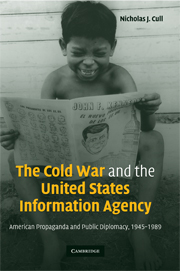
 The Cold War and the United States Information Agency
 American Propaganda and Public Diplomacy, 1945–1989
Book contents
- Frontmatter
- Contents
- List of Illustrations
- Preface
- Abbreviations
- THE COLD WAR AND THE UNITED STATES INFORMATION AGENCY
- Prologue
- 1 Getting the Sheep to Speak
- 2 Mobilizing “the P-Factor”
- 3 In the Shadow of Sputnik
- 4 Inventing Truth
- 5 Maintaining Confidence
- 6 “My Radio Station”
- 7 Surviving Détente
- 8 A New Beginning
- 9 From the “Two-Way” Mandate to the Second Cold War
- 10 “Project Truth”
- 11 Showdown
- Epilogue
- Conclusion
- Selected Bibliography
- Index
- Plate section
4 - Inventing Truth
The Kennedy Administration, 1961–63
Published online by Cambridge University Press: 05 February 2015

Book contents
- Frontmatter
- Contents
- List of Illustrations
- Preface
- Abbreviations
- THE COLD WAR AND THE UNITED STATES INFORMATION AGENCY
- Prologue
- 1 Getting the Sheep to Speak
- 2 Mobilizing “the P-Factor”
- 3 In the Shadow of Sputnik
- 4 Inventing Truth
- 5 Maintaining Confidence
- 6 “My Radio Station”
- 7 Surviving Détente
- 8 A New Beginning
- 9 From the “Two-Way” Mandate to the Second Cold War
- 10 “Project Truth”
- 11 Showdown
- Epilogue
- Conclusion
- Selected Bibliography
- Index
- Plate section
Summary
American traditions and the American ethic require us to be truthful, but the most important reason is that truth is the best propaganda and lies are the worst. To be persuasive we must be believable; to be believable we must be credible; to be credible we must be truthful. It is as simple as that.
Edward R. Murrow, May 1963.In January 1961, two speeches vied for world headlines. The first was made in secret on 6 January to a select group of Soviet propagandists and released to the press twelve days later. In it Nikita Khrushchev formally declared his intention to extend the Communist revolution and sponsor “wars of National Liberation” around the world. He spoke intending to pull Mao's China into line, but his words terrified the United States. The second speech was delivered in public, a little after noon on 20 January, on the steps of the Capitol in Washington, DC. In it the newly inaugurated President John F. Kennedy matched the Soviet Union with a global commitment of his own, to “pay any price, bear any burden, meet any hardship, support any friend, oppose any foe, in order to assure the survival and the success of liberty.” Mutually alarmed, Soviet and American propagandists broadcast these words around the globe. An ideological duel followed, fought in the newspapers, classrooms, airwaves, and cinema screens of the developing world. The USIA sat at its heart.
Information
- Type
- Chapter
- Information
- The Cold War and the United States Information AgencyAmerican Propaganda and Public Diplomacy, 1945–1989, pp. 189 - 226Publisher: Cambridge University PressPrint publication year: 2008
Accessibility standard: Unknown
Why this information is here
This section outlines the accessibility features of this content - including support for screen readers, full keyboard navigation and high-contrast display options. This may not be relevant for you.Accessibility Information
Accessibility compliance for the PDF of this chapter is currently unknown
and may be updated in the future.
- 1
- Cited by