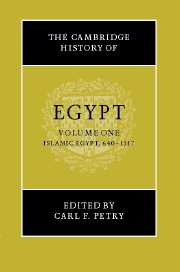
Book contents
- Frontmatter
- 1 Egypt under Roman rule: the legacy of ancient Egypt
- 2 Egypt on the eve of the Muslim conquest
- 3 Egypt as a province in the Islamic caliphate, 641–868
- 4 Autonomous Egypt from Ibn Tūlūn to Kāfūr, 868–969
- 5 The Ismā‘īlī Da‘wa and the Fātimid caliphate
- 6 The Fātimid state, 969–1171
- 7 The non-Muslim communities: Christian communities
- 8 The non-Muslim communities: the Jewish community
- 9 The crusader era and the Ayyūbid dynasty
- 10 The Bahrī Mamlūk sultanate, 1250–1390
- 11 The regime of the Circassian Mamlūks
- 12 The monetary history of Egypt, 642–1517
- 13 Art and architecture in the medieval period
- 14 Culture and society during the late Middle Ages
- 15 Historiography of the Ayyūbid and Mamlūk epochs
- 16 Egypt in the world system of the later Middle Ages
- 17 The military institution and innovation in the late Mamlūk period
- 18 The Ottoman occupation
- The Rulers of Egypt, 254–922/868–1517
- Glossary
- Bibliography
- Index
- References
2 - Egypt on the eve of the Muslim conquest
Published online by Cambridge University Press: 28 March 2008
By
Edited by

Book contents
- Frontmatter
- 1 Egypt under Roman rule: the legacy of ancient Egypt
- 2 Egypt on the eve of the Muslim conquest
- 3 Egypt as a province in the Islamic caliphate, 641–868
- 4 Autonomous Egypt from Ibn Tūlūn to Kāfūr, 868–969
- 5 The Ismā‘īlī Da‘wa and the Fātimid caliphate
- 6 The Fātimid state, 969–1171
- 7 The non-Muslim communities: Christian communities
- 8 The non-Muslim communities: the Jewish community
- 9 The crusader era and the Ayyūbid dynasty
- 10 The Bahrī Mamlūk sultanate, 1250–1390
- 11 The regime of the Circassian Mamlūks
- 12 The monetary history of Egypt, 642–1517
- 13 Art and architecture in the medieval period
- 14 Culture and society during the late Middle Ages
- 15 Historiography of the Ayyūbid and Mamlūk epochs
- 16 Egypt in the world system of the later Middle Ages
- 17 The military institution and innovation in the late Mamlūk period
- 18 The Ottoman occupation
- The Rulers of Egypt, 254–922/868–1517
- Glossary
- Bibliography
- Index
- References
Summary
Egypt’s population in the early seventh century AD cannot be determined with any certainty, but it probably numbered less than the five million persons frequently attributed to the province at the height of the Roman Empire in the Early Principate. By the year 600, the population may have declined to three million; mortality resulting from plagues erupting during Justinian’s reign in the sixth century cannot be accurately estimated. Many Egyptians were designated “Chalcedonians” or “Monophysites,” but this distinction did not represent a genuine cleavage of ethnic identity in Egyptian society. An assumption that “Chalcedonian” referred exclusively to Greeks rather than to native Egyptians is erroneous. Greek remained an important spoken and written language in Egypt, although by the early seventh century Coptic was used increasingly in written records. Subliterary texts in Coptic dated back to the early third century.
Many other aspects of Egypt’s economy, social structure and spiritual outlook during Late Antiquity persisted into the early seventh century. But the privatization of public functions by owners of great estates intensified from the fourth century, a process that significantly altered institutional structures during the remaining periods of Byzantine administration. Members of the social elite could still acquire some familiarity with the repertory of Greek authors of antiquity, as testified by the writings of the poet Dioskoros of Aphrodito in the sixth century or the historian Theophylact Simocatta in the early seventh. Theatrical performances in Alexandria during the early seventh century continued to entertain audiences that included high officials.
Information
- Type
- Chapter
- Information
- The Cambridge History of Egypt , pp. 34 - 61Publisher: Cambridge University PressPrint publication year: 1998
References
. Patrologia Orientalis 8.
, , et al., Christianismes orientaux. Introduction à l’étude des langues et des littératures (Paris, 1993).Google Scholar
Anastasii Sinaitae Opera. Sermones duo in constitutionem hominis secundem imaginem Dei necnon Opuscula adversus Monotheletas, ed. , Corpus Christianorum, Series Graeca, 12 (Brepols-Turnhout, 1985).Google Scholar
BGU 314 [Herakleopolis]; 370 [Arsinoe] = Ägyptische Urkunden aus den Königlichen Museen zu Berlin, Griechische Urkunden (Berlin, 1895–1898),vols. 1, 2; P. Ross, iii, 51; 58.
BGU = Ägyptische Urkunden aus den Königlichen Museen zu Berlin, Griechische Urkunden (Berlin, 1895–98).
, The Arab Conquest of Egypt and the Last Thirty Years of Roman Dominion, Containing also the Treaty of Misr in Tabarī (1913); Babylon in Egypt, with a Critical Bibliography and Additional Documentation (1914; revised edition by , Oxford, 1978).Google Scholar
(ed.), States, Resources, Armies, esp. , “L’État à la recherche de nouveaux modes de financement des armées (Rome et Byzance, IVe-VIIIe siècles,” The Byzantine and Early Islamic Near East, vol. 3 (Princeton, 1996).Google Scholar
and (eds.), Problems in the Literary Source Material, The Byzantine and Early Islamic Near East, 1 (Princeton, 1992).Google Scholar
“Theophanes and the Arabic Historical Transmission: Some Indications of Intercultural Transmission,” Byzantinische Forschungen, 15 (1990).Google Scholar
CPRF 556; SB 9748 = CPRF 552; SB 9749 = CPRF 553; SB 9755 = CPRF 554; SB 9751 = CPRF 559; SB 9752 = CPRF 560; SB 9753 = CPRF 561, from , contd. by , Sammelbuch griechischer Urkunden aus Ägypten (Wiesbaden: Harrasowitz, 1965), 8; all of these last are from Herakleopolis Magna, or modern Ihnāsīyat al-madīna, in the Fayyūm area.Google Scholar
, “Living in a City and Living in a Scetis: The Dream of Eustathios the Banker,” Byzantinische Forschungen, 21 (1995).Google Scholar
“De nouveau sur la colonat du Bas-Empire,” Miscellanea papyrologica in occasione del bicentenario dell’edizione delta Charta Borgiana, Papyrologica Florentina, 19 (Florence, 1990).Google Scholar
, ed. trans., Saint Anastase le Terse et l’histoire de la Palestine au début du VIII siècle (Paris, 1992).Google Scholar
“De Byzance à l’Islam,” Journal of the Economic and Social History of the Orient, 26 (1983).Google Scholar
. “L’Institution des bucellaires,” Bulletin de l’Institut français d’archéologie orientale au Caire, 76 (1976).Google Scholar
. “Les grands domaines, la cité et l’état en Égypte byzantine,” Travaux et Mémoires, 9 (1985).Google Scholar
. “Les institutions de l’hippodrome en Egypte byzantine,” Bulletin de l’Institut Français d’Archéologie Orientate du Caire, 76 (1976).Google Scholar
. Un codex fiscal Hermopolite (P. Sorb. II 69). American Studies in Papyrology, 32 (Atlanta, 1994).Google Scholar
, “Military Service, Military Lands and the Status of Soldiers,” Dumbarton Oaks Papers 45 (1993).Google Scholar
, , et al., Corpus Papyrorum Raineri vol. 10, Griechische Texte 7 (1986)
, Kitāb Futūh Misr wa-Akhbārihā (The History of the Conquest of Egypt, North Africa and Spain), ed. (New Haven, 1922).Google Scholar
, Kitāb Tutūh Misr wa-Akhbāruhā (The History of the Conquest of Egypt, North Africa and Spain), ed. (New Haven, 1922).Google Scholar
, The Chronicle of John (c. 690 AD) Coptic Bishop of Nikiu: Being a History of Egypt before and during the Arab Conquest, Translated from Hermann Zotenberg’s Edition of the Ethiopic Version with an Introduction, Critical and Linguistic Notes, and an Index of Names, trans. (London, 1916).Google Scholar
, P. Heidelberg V, in Vertragliche Regelungen von Arbeiten imspäten griechsprachigen Ägypten (Heidelberg, 1990).Google Scholar
“Byzantine Logistics: Problems and Perspectives,” in (ed.), Feeding Mars (Boulder, 1993).Google Scholar
“A Constantinople Loan, AD 541,” Bulletin of the American Society of Papyrologists, 29 (1992).Google Scholar
“Papyrology and Byzantine Histoirography,” Bulletin of the American Society of Papyrologists, 30 (1993).Google Scholar
“Pastoralism in Roman Egypt,” Bulletin of the American Society of Papyrologists, 26 (1989).Google Scholar
, ‘Abd Allāh Ibn Lahī‘a (97–174/715–790,). Juge et grand maître de I’école égyptienne (Wiesbaden, 1986).Google Scholar
, Oxyrhynchos in der Kaiserzeit: Studien zur Topographie und Literaturrezeption (Frankfurt, Bern, New York, 1990).Google Scholar
(ed.), Biblical Commentaries from the Canterbury School of Theodore and Hadrian (Cambridge, 1994).Google Scholar
, “Un épitomé inédit de la Vie de S. Jean l’Aumônier,” Analecta Bollandiana, 88 (1970).CrossRefGoogle Scholar
“A. Byzantine Hagiographer at Work: Leontios of Neapolis,” Sitzungsberichte, Österreichische Akad. d. Wiss., philosoph.-Hist. Kl., 432 (1984).Google Scholar
, “A Byzantine Gold-Mining Town in the Eastern Desert of Egypt: Bir Umm Fawakhir, 1992–1993,” Journal of Roman Archaeology, 8 (1995).CrossRefGoogle Scholar
(ed.), Oxford Encyclopedia of Archaeology of the Near East, 5 vols. (Oxford, New York, 1997).Google Scholar
, with , The Early Arabic Historical Tradition: A Source-Critical Study, trans. (Princeton, 1994).Google Scholar
, Roman Defeat, Christian Response, and the Literary Constuction of the Jew (Philadelphia, 1994).CrossRefGoogle Scholar
P. Flor. 306, in (ed.), Papiri Greci Egizii, 3: Papiri Fiorentini (Milan, 1915), No. 306 [Oct/Nov 635].Google Scholar
P. Lond. 113,10, in , Greek Papyri, 1.
P. Lond. i, 113, 6 (b), in (ed.), Greek Papyri in the British Museum (London, 1893), 1.Google Scholar
P. Oxy. LVIII 3959, in (ed.) The Oxyrhynchus Papyri, Egypt Exploration Society, Graeco-Roman Memoirs, No. 78 (London, 1991), 48.Google Scholar
Papyri russischer und georgiscber Sammlungen. Ill: Spätrömische und byzantinische Texte. Ed. , . 1930.Google Scholar
, “P. Hamb. 56 et P. Lond. 1419 (notes sur les finances d’Aphrodito du Vie siècle au VIIIe siècle,” Chronique d’Égypte, 40 (1965)).Google Scholar
, Relatio motionis factae inter domnum abbatem Maximum et socium ejus atque principes in secretario, ed. , Patrologia Graeca, XC.
SB 4488; P. Lond. 1012, in , (eds.), Greek Papyri in the British Museum (London, 1893), 3.Google Scholar
SB 6271 = , Sammelbuch griechischer Urkunden aus Ägypten (Berlin: De Gruyter, 1926), which is dated 640/641, from Apollonos Magna [Idfu, in the Thebaid]; esp. P. Lond..Google Scholar
, “The Budge Coptic Papyrus of Columbia University and Related Greek Papyri of the British Museum,” Actes du Xe Congrès International des Papyrologues (Warsaw, 1961).Google Scholar
, “Die Bucellarii. Eine Studie zum militärischen Gefolgschaftswesen in der Spätantike,” Tyche, 9 (1994).Google Scholar
, Synopsis Chronike, ed. , in his Mesaionike Bibliotheke, VII (Paris, 1984; reprint, Athens, 1972).Google Scholar
, Chronographia, ed. , 2 vols. (Leipzig, 1883); The Chronicle of Theophanes the Confessor, trans. and (Oxford, 1997).Google Scholar
, “Ägypten und Byzanz vor der arabischen Eroberung,” Byzantinoslavica, 40 (1979), reprinted in , Studen zu Konstantin den Grossen und zur byzantinischen Kirchengeschichte, ed. and (Birmingham, 1993).Google Scholar
argues against any nationalist thesis, in “Le nationalisme a-t-il existé dans l’Égypte byzantine?” The journal of Juristic Papyrology, 22 (1992)Google Scholar
, Études sur le christianisme dans l’Egypte de l’antiquité tardive, Studia Ephemeridis Augustinianum, 52 (Rome, 1996).Google Scholar
, “La vie de Saint Jean Higoumène de Scété au VIIe siècle,” Analecta Bollandiana, 114 (1996).CrossRefGoogle Scholar
Accessibility standard: Unknown
Why this information is here
This section outlines the accessibility features of this content - including support for screen readers, full keyboard navigation and high-contrast display options. This may not be relevant for you.Accessibility Information
Accessibility compliance for the PDF of this chapter is currently unknown
and may be updated in the future.
- 5
- Cited by