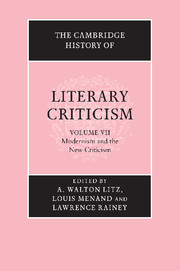
Book contents
- Frontmatter
- Introduction
- THE MODERNISTS
- THE NEW CRITICS
- THE CRITIC AND THE INSTITUTIONS OF CULTURE
- 14 Criticism and the academy
- 15 The critic and society, 1900–1950
- 16 The British ‘Man of Letters’ and the rise of the professional
- 17 F. R. Leavis
- 18 Lionel Trilling
- 19 Poet-critics
- 20 Criticism of Fiction
- Bibliography
- Index
- References
16 - The British ‘Man of Letters’ and the rise of the professional
from THE CRITIC AND THE INSTITUTIONS OF CULTURE
Published online by Cambridge University Press: 28 March 2008

Book contents
- Frontmatter
- Introduction
- THE MODERNISTS
- THE NEW CRITICS
- THE CRITIC AND THE INSTITUTIONS OF CULTURE
- 14 Criticism and the academy
- 15 The critic and society, 1900–1950
- 16 The British ‘Man of Letters’ and the rise of the professional
- 17 F. R. Leavis
- 18 Lionel Trilling
- 19 Poet-critics
- 20 Criticism of Fiction
- Bibliography
- Index
- References
Summary
Today most literary criticism takes place in institutions of higher education, and most literary critics, by virtue of their academic qualifications and institutional employment, are considered (and consider themselves) to be members of a profession. Indeed the widespread use by publishers of the term ‘academic writing’ is an acknowledgement that most of what is called literary criticism is now written for professional and pedagogic purposes. It is rare for the professional critic to address a general (that is a non-academic) audience. A hundred years ago, however, matters were rather different. The professional procedures with which we are now so familiar were then being put into place for the first time, and reaction to them was mixed. In The Importance of Being Earnest Oscar Wilde has Algernon Moncrieff deflate Jack Worthing's intellectual pretensions with the comment: ‘literary criticism is not your forte my dear fellow. Don't try it. You should leave that to people who haven't been at a University.’ Wilde was referring to the newly professionalised academic literary critic, a species from which he constantly and strenuously tried to distance himself. Moreover, he was not unique in his antagonism to professionalisation. For the next thirty years or so a number of critics, located for the most part outside institutional structures, also attempted to resist the discourses of the new academic professionalism. They did so in a variety of ways: they adopted different styles and objectives, wrote on different topics, but principally they addressed their work to a different audience.
Information
- Type
- Chapter
- Information
- The Cambridge History of Literary Criticism , pp. 377 - 388Publisher: Cambridge University PressPrint publication year: 2000
References
, ‘Status and Strain in the Professions’, American Journal of Sociology, 86 (1981).CrossRefGoogle Scholar
Countries of the Mind: Essays in Literary Criticism, Second Series (1922; rpt. Oxford, 1931).
, Institutionalizing English Literature: The Culture and Politics of Literary Study, 1750–1900 (Stanford, 1992).Google Scholar
, ‘The Professionalization of History in the Late Nineteenth and Early Twentieth Centuries’, Storia della Storiografia, 1 (1983).Google Scholar
, The Rise and Fall of the Man of Letters: A Study of the Idiosyncratic and the Humane in Modern Literature (New York, 1969).Google Scholar
Keats (New York, 1962).
, ‘Some Thoughts on Poetry and its Varieties’, in and (eds.), The Collected Works of John Stuart Mill: Autobiography and Literary Essays (London, 1981).Google Scholar
, Proceedings of the English Association Bulletin, 22 (February 1914).
, Countries of the Mind: Essays in Literary Criticism, First Series (Freeport, N. Y., 1968).Google Scholar
, Keats and Shakespeare: A Study of Keats's Poetic Life from 1816 to 1820 (London, 1925).Google Scholar
, Poets, Critics, and Mystics: A Selection of Criticisms Written Between 1919–1955 (Carbondale, Ill., 1970).Google Scholar
, Professional Men: The Rise of the Professional Classes in Nineteenth-Century England (London, 1966).Google Scholar
Readers and Writers (London, 1922).
Swift (London, 1970).
Accessibility standard: Unknown
Why this information is here
This section outlines the accessibility features of this content - including support for screen readers, full keyboard navigation and high-contrast display options. This may not be relevant for you.Accessibility Information
Accessibility compliance for the PDF of this chapter is currently unknown
and may be updated in the future.
- 2
- Cited by