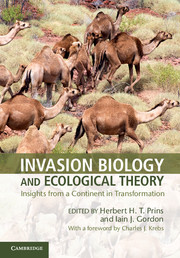
Book contents
- Frontmatter
- Contents
- List of Contributors
- Foreword
- 1 Testing hypotheses about biological invasions and Charles Darwin’s two-creators rumination
- Part I Ancient invaders
- 2 Australia’s Acacia: unrecognised convergent evolution
- 3 The mixed success of Mimosoideae clades invading into Australia
- 4 Perspectives from parrots on biological invasions
- 5 Invasion ecology of honeyeaters
- 6 The invasion of terrestrial fauna into marine habitat: birds in mangroves
- 7 The biological invasion of Sirenia into Australasia
- 8 Flying foxes and drifting continents
- 9 Invasion ecology of Australasian marsupials
- 10 Murine rodents: late but highly successful invaders
- 11 Drift of a continent: broken connections
- 12 The development of a climate: an arid continent with wet fringes
- Part II Modern invaders
- Index
- References
2 - Australia’s Acacia: unrecognised convergent evolution
from Part I - Ancient invaders
Published online by Cambridge University Press: 05 February 2014

Book contents
- Frontmatter
- Contents
- List of Contributors
- Foreword
- 1 Testing hypotheses about biological invasions and Charles Darwin’s two-creators rumination
- Part I Ancient invaders
- 2 Australia’s Acacia: unrecognised convergent evolution
- 3 The mixed success of Mimosoideae clades invading into Australia
- 4 Perspectives from parrots on biological invasions
- 5 Invasion ecology of honeyeaters
- 6 The invasion of terrestrial fauna into marine habitat: birds in mangroves
- 7 The biological invasion of Sirenia into Australasia
- 8 Flying foxes and drifting continents
- 9 Invasion ecology of Australasian marsupials
- 10 Murine rodents: late but highly successful invaders
- 11 Drift of a continent: broken connections
- 12 The development of a climate: an arid continent with wet fringes
- Part II Modern invaders
- Index
- References
Summary
Introduction
This chapter takes a slightly different, long-term, view of continental collisions and invasions. Here we investigate Acacia s.l. from the Eocene to the Miocene to understand how it invaded the evolving landscapes of the Americas, Africa and Australia. This history highlights the convergent evolution within the paraphyletic genus as species invaded and dominated new arid landscapes that expanded at this time. Different lineages of Acacia s. l. evolved remarkably similar suites of adaptations in response to the increasing aridity, obscuring the independent evolutionary origins of ecological traits which we are only now discovering.
The taxonomic history of Acacia s.l. has been and still is a complex topic. Taxonomists defined Acacia s.l. over centuries of plant discovery as botanists explored the world. This ad hoc compilation of species into a genus resulted in the amalgamation of species that have converged within a similar type of habitat but the main morphological characters that define Acacia s. l. are symplesiomorphies, not synapomorphies of a unique lineage. It is now accepted that the genus, in its broad sense, is not monophyletic and thus it has been split into three large genera and two small genera.
Information
- Type
- Chapter
- Information
- Invasion Biology and Ecological TheoryInsights from a Continent in Transformation, pp. 23 - 38Publisher: Cambridge University PressPrint publication year: 2014
References
, and (2006). Niche evolution and adaptive radiation: testing the order of trait divergence. Ecology 87: S50–S61.CrossRefGoogle ScholarPubMed
, and (2008). Invasive mutualists erode native pollination webs. PLoS Biology 6: e31. .CrossRefGoogle ScholarPubMed
, , and (2006). A year-long plant-pollinator network. Austral Ecology 31: 975–983.CrossRefGoogle Scholar
(1875). Revision of the suborder Mimoseae. Transactions of the Linnean Society of London 30: 335–664.CrossRefGoogle Scholar
, , and (2009). Plant–pollinator networks: adding the pollinator’s perspective. Ecology Letters 12: 409–419.CrossRefGoogle ScholarPubMed
, , and (2010). The evolutionary history and biogeography of Mimosoideae (Leguminosae): an emphasis on African acacias. Molecular Phylogenetics and Evolution 57: 495–508.CrossRefGoogle ScholarPubMed
, and (2011). Relationships of the Australo-Malesian genus Paraserianthes (Mimosoideae: Leguminosae) identifies the sister group of Acacia sensu stricto and two biogeographical tracks. Cladistics 27: 380–390.CrossRefGoogle Scholar
, , and (2008). Acacia s.s. and its relationship among tropical legumes, Tribe Ingeae (Leguminosae: Mimosoideae). Systematic Botany 33: 739–751.CrossRefGoogle Scholar
, (1825). Prodromus systematis naturalis regni vegetabilis. Vol. 2. Paris: sumptibus sociorum Treuttel et Würtz.Google Scholar
, and (2000). Implications of chloroplast DNA restriction site variation for systematics of Acacia (Fabaceae: Mimosoideae). Systematic Botany 25: 618–632.CrossRefGoogle Scholar
, , and (2002). Evolutionary shifts between host oak selection and host plant organs in Andricus gallwasps. Evolution 56: 1821–1830.CrossRefGoogle Scholar
, , et al. (2009). Phylogenetic biome conservatism on a global scale. Nature 458: 754–756.CrossRefGoogle ScholarPubMed
(1990). The contribution of a successful biocontrol project to the theory of agent selection in weed biocontrol: the gall wasp Trichilogaster acaciaelongifoliae and the weed Acacia longifolia. Agriculture, Ecosystems and Environment 31: 47–154.CrossRefGoogle Scholar
, and (1993). Expansion of host-plant range of a biological agent Trichilogaster acaciaelongifoliae (Pteromalidae) released against the weed Acacia longifolia in South Africa. Agriculture, Ecosystems and Environment 43: 1–10.CrossRefGoogle Scholar
, , et al. (2011). Reproductive biology of Australian acacias: important mediator of invasiveness?Diversity and Distributions 17: 911–933.CrossRefGoogle Scholar
, , and (2011). Spatial distribution of species richness and endemism of the genus Acacia in Australia. Australian Journal of Botany, 59: 601–609.CrossRefGoogle Scholar
and (2007). Adaptive radiation of gall-inducing insects within a single host-plant species. Evolution 61: 784–795.CrossRefGoogle ScholarPubMed
and (1985). Self-incompatibility in the nitrogen-fixing tree, Acacia retinodes: quantitative cytology of pollen tube growth. TAG Theoretical and Applied Genetics V 69: 481.CrossRefGoogle ScholarPubMed
and (2001). Small-subunit rRNA genotyping of rhizobia nodulating Australian Acacia spp. Applied and Environmental Microbiology 67: 396–402.CrossRefGoogle ScholarPubMed
, and (2005). Evolutionary rates analysis of Leguminosae implicates a rapid diversification of lineages during the Tertiary. Systematic Biology 54: 575–594.CrossRefGoogle ScholarPubMed
, , and (2003). A phylogenetic analysis of the Mimosoideae (Leguminosae) based on chloroplast DNA sequence data. In and (eds), Advances in Legume Systematics, part 10. Richmond, UK: Royal Botanic Gardens, Kew, pp. 197–220.Google Scholar
, and (2011). Assessing the suitability and safety of a well-known bud-galling wasp, Trichilogaster acaciaelongifoliae, for biological control of Acacia longifolia in Portugal. Biological Control 56:193–201.CrossRefGoogle Scholar
(1988). Should Acacia be divided?Bulletin of the International Group for the Study of Mimosoideae 16: 54–76.Google Scholar
, and (2003). Overview of the generic status of Acacia (Leguminosae : Mimosoideae). Australian Systematic Botany 16: 1–18.CrossRefGoogle Scholar
(1999). The structure of a plant-pollinator food web. Ecology Letters 2: 276–280.CrossRefGoogle Scholar
and (2002). Integration of alien plants into a native flower–pollinator visitation web. Proceedings of the Royal Society of London B 269: 2395–2399.CrossRefGoogle ScholarPubMed
and (2000). Molecular phylogenetics of Acacia (Fabaceae: Mimosoideae) based on chloroplast TrnK/MatK and nuclear histone H3-D sequences. In and (eds), Advances in Legume Systematics 9. Richmond, UK: Royal Botanic Gardens, Kew.Google Scholar
and (2001). Molecular phylogenetics of Acacia (Fabaceae : Mimosoideae) based on the chloroplast matK coding sequence and flanking trnK intron spacer regions. American Journal of Botany 88: 697–705.CrossRefGoogle ScholarPubMed
and (2011). Acacia seedling morphology: correlation of juvenile leaf forms and seed weight. Australian Journal of Botany. 59: 185–196.CrossRefGoogle Scholar
and (2012). The generic status of Acacia sensu lato (Leguminosae: Mimosoideae). Australian Systematic Botany. 25: 217–224.CrossRefGoogle Scholar
, , , and (2003). A phylogenetic analysis of the Acacieae and Ingeae (Mimosoideae : Fabaceae) based on trnK, matK, psbA-trnH, and trnL/trnF sequence data. Systematic Botany 28: 558–566.Google Scholar
, , , and (2011). The evolution and phylogenetic placement of invasive Acacia species. Diversity and Distributions 17: 848–860.CrossRefGoogle Scholar
, and (2000). Evolution of gall morphology and host-plant relationships in willow-feeding sawflies (Hymenoptera: Tenthredinidae). Evolution 54: 526–533.CrossRefGoogle Scholar
and (2002). Geographic patterns in plant-pollinator mutualistic networks. Ecology 83: 2416–2424.Google Scholar
(1986). Derivation and dispersal of Acacia (Leguminosae) with particular reference to Australia and the recognition of Senegalia and Racosperma. Botanical Journal of the Linnean Society 92: 219–254.CrossRefGoogle Scholar
(2005). The pollination ecology of a south-eastern Australia Acacia community. PhD thesis, Oxford University, Oxford, UK.
and (2007). Revision of the pteromalid wasp genus Trichilogaster Mayr (Hymenoptera: Chalcidoidea): gall-inducers on Australian acacias. African Entomology 15: 161–184.CrossRefGoogle Scholar
, , and (2001). The niche of higher plants: evidence for phylogenetic conservatism. Proceedings of the Royal Society of London B 268: 2383–2389.CrossRefGoogle ScholarPubMed
, and (2002). Spatial structuring and floral avoidance behavior prevent ant-pollinator conflict in a Mexican ant–Acacia. Ecology 83: 3086–3096.Google Scholar
, , , and (2007). Non-random coextinctions in phylogenetically structured mutualistic networks. Nature 448: 925–928.CrossRefGoogle ScholarPubMed
, , et al. (2011). Human-mediated introductions of Australian Acacia species: a global experiment in biogeography. Diversity and Distributions 17: 771–787.CrossRefGoogle Scholar
and (2006). A taxonomic revision of Acaciella (Leguminosae, Mimosoideae). Annales del Jardin Botanico de Madrid 63: 189–244.Google Scholar
and (2000). A plastid DNA phylogeny of the genus Acacia Miller (Acacieae, Leguminosae). Botanical Journal of the Linnean Society 132: 195–222.CrossRefGoogle Scholar
and (2008). Plant–pollinator interactions and the assembly of plant communities. Trends in Ecology and Evolution 23: 123–130.CrossRefGoogle ScholarPubMed
, and (2005). Biogeography of the Leguminosae. In , , and (eds), Legumes of the World. Richmond, UK: Royal Botanic Gardens, Kew, pp. 21–54.Google Scholar
, and (2006a). Mariosousa, a new segregate genus from Acacia s.l. (Fabaceae, Mimosoideae) from Central and North America. Novon 16: 413–420.CrossRefGoogle Scholar
, and (2006b). The genus Senegalia (Fabaceae: Mimosoideae) from the New World. Phytologia 88: 38–93.Google Scholar
, , et al. (2009). Extreme host plant conservatism during at least 20 million years of host plant pursuit by oak gallwasps. Evolution 63: 854–869.CrossRefGoogle ScholarPubMed
, , and (2003). Pollination ecology of acacias (Fabaceae, Mimosoideae). Australian Systematic Botany 16: 103–118.CrossRefGoogle Scholar
, and (1998). Partitioning of pollinators during flowering in an Acacia community, Ecology 79: 2808–2827.CrossRefGoogle Scholar
and (1988). Extrafloral nectaries and pollination of Acacia pycnantha Benth. by birds. Australian Journal of Botany 36: 519–531.CrossRefGoogle Scholar
and (2004). Asymmetric specialization: a pervasive feature of plant-pollinator interactions. Ecology 85: 1251–1257.CrossRefGoogle Scholar
(1972). Apport des recherches ontogeniques et seminologiques a l’etude morphologique, taxonomique et phylogenique du genre Acacia. Bulletin de la societe d’histoire naturelle de Toulouse 108: 105–247.Google Scholar
, , et al. (2009). Invasive plant integration into native plant–pollinator networks across Europe. Proceedings of the Royal Society of London B 276: 3887–3893.CrossRefGoogle ScholarPubMed
Accessibility standard: Unknown
Why this information is here
This section outlines the accessibility features of this content - including support for screen readers, full keyboard navigation and high-contrast display options. This may not be relevant for you.Accessibility Information
Accessibility compliance for the PDF of this chapter is currently unknown
and may be updated in the future.
- 1
- Cited by