Book contents
- Frontmatter
- Contents
- List of Contributors
- Foreword
- 1 Testing hypotheses about biological invasions and Charles Darwin’s two-creators rumination
- Part I Ancient invaders
- 2 Australia’s Acacia: unrecognised convergent evolution
- 3 The mixed success of Mimosoideae clades invading into Australia
- 4 Perspectives from parrots on biological invasions
- 5 Invasion ecology of honeyeaters
- 6 The invasion of terrestrial fauna into marine habitat: birds in mangroves
- 7 The biological invasion of Sirenia into Australasia
- 8 Flying foxes and drifting continents
- 9 Invasion ecology of Australasian marsupials
- 10 Murine rodents: late but highly successful invaders
- 11 Drift of a continent: broken connections
- 12 The development of a climate: an arid continent with wet fringes
- Part II Modern invaders
- Index
- References
7 - The biological invasion of Sirenia into Australasia
from Part I - Ancient invaders
Published online by Cambridge University Press: 05 February 2014

Book contents
- Frontmatter
- Contents
- List of Contributors
- Foreword
- 1 Testing hypotheses about biological invasions and Charles Darwin’s two-creators rumination
- Part I Ancient invaders
- 2 Australia’s Acacia: unrecognised convergent evolution
- 3 The mixed success of Mimosoideae clades invading into Australia
- 4 Perspectives from parrots on biological invasions
- 5 Invasion ecology of honeyeaters
- 6 The invasion of terrestrial fauna into marine habitat: birds in mangroves
- 7 The biological invasion of Sirenia into Australasia
- 8 Flying foxes and drifting continents
- 9 Invasion ecology of Australasian marsupials
- 10 Murine rodents: late but highly successful invaders
- 11 Drift of a continent: broken connections
- 12 The development of a climate: an arid continent with wet fringes
- Part II Modern invaders
- Index
- References
Summary
Introduction
To understand the biological invasions of dugongs in relation to ecological theory, we first need to look into the early evolution of tetrapods and their return to an aquatic habitat, and then study the evolution and spread of seagrass habitats and their interactions with modern sirenians.
Whereas amphibians never quite parted from the water, all other tetrapod groups (mammals, birds and reptiles) have a number of representatives that have returned to marine or aquatic environments from a fully terrestrial or an amphibious lifestyle. We know that mammals, in particular, have returned to the marine and aquatic environment in at least seven separate taxonomic lineages: Cetacea (whales), Pinnipedia (seals, sea lions and walruses), Sirenia, Ursus maritimus Phipps, 1774 (polar bear), Enhydra lutris nereis Merriam, 1904 (sea otter), and the extinct Desmostylia and Thalassocnus spp. (aquatic sloths). Five of these lineages are still extant, and two are extinct. The ancestry of Sirenia is distinct from that of Cetacea and Pinnipedia, although they are thought to have evolved an aquatic lifestyle around the same time as the cetaceans.
Information
- Type
- Chapter
- Information
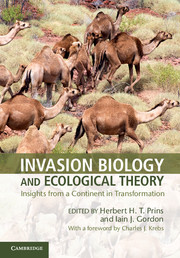
- Invasion Biology and Ecological TheoryInsights from a Continent in Transformation, pp. 118 - 137Publisher: Cambridge University PressPrint publication year: 2014
References
(1982). Studies on dugongs at Shark Bay, Western Australia: II. Surface and subsurface observations. Australian Wildlife Research 9: 85–99.CrossRefGoogle Scholar
(1985). Aerial surveys for dugongs: a review and recommendations. Proceedings Symposium Endangered Marine Mammals and Marine Parks 1: 188–198.Google Scholar
(1986). Dugongs of Shark Bay, Australia: seasonal migration, water temperature and forage. National Geographic Research 2(4): 473–490.Google Scholar
and (1985). Predation on dugongs: attacks by killer whales. Journal of Mammalogy 66: 554–556.CrossRefGoogle Scholar
, and (2005). Comparison of the diets of sympatric dugongs and green turtles on the Orman reefs, Torres Strait, Australia. Wildlife Research 32: 53–62.CrossRefGoogle Scholar
, , et al. (2010). The lesser of two evils: seasonal migration of Amazonian manatees in the western Amazon. Journal of Zoology 280: 247–256.CrossRefGoogle Scholar
and (1997). A new dugongine sirenian from the Early Miocene of India. Journal of Vertebrate Paleontology 17: 219–228.CrossRefGoogle Scholar
, , and (2009). A new middle Eocene sirenian (Mammalia, Protosirenidae) from India. Neues Jahrbuch für Paläontologie, Abhandlungen 252–253: 257–267.CrossRefGoogle Scholar
, , , and (2006). Eocene and Oligocene sirenians (Mammalia) from Kachchh, India. Journal of Vertebrate Paleontology 26: 400–410.CrossRefGoogle Scholar
, , et al. (2008). Peri-Messinian dwarfing in Mediterranean Metaxytherium (Mammalia, Sirenia): evidence of habitat degradation related to the Messinian Salinity Crisis. In , , and (eds), Circum-Mediterranean Geology and Biotic Evolution during the Neogene Period: The Perspective from Libya, Special Issue 5. Benghazi, Libya: Garyounis Scientific Bulletin, pp. 145–157.Google Scholar
(1980). Nutrition and grazing behaviour of the green turtle Chelonia mydas, Marine Biology 56: 147–154.CrossRefGoogle Scholar
(2001). Manatees. In , and (eds.), Marine Mammal Medicine, 2nd edn. Boca Raton, FL: CRC Press, pp. 939–960.Google Scholar
, , and (1981). The status of dugongs at Palau, an isolated island group. In (ed.) The Dugong, Proceedings of a Seminar/Workshop held at James Cook University of North Queensland 8–13 May 1979. Department of Zoology, James Cook University, Townsville, Queensland, Australia, pp. 11–23.
(1996). Herbivore–plant interactions between dugongs and seagrass in a tropical small island ecosystem, East Indonesia. PhD dissertation, LEI Universiteit Leiden, The Netherlands.
, , and (2007). A review of research on the interaction between dugongs (Dugong dugon Muller 1776) and intertidal seagrass beds in Indonesia. Hydrobiologia 591(1): 73–83.CrossRefGoogle Scholar
, and (1998). Movement and home ranges of dugongs, satellite tracked in the Moluccas, Indonesia, Marine Ecology 19(3): 179–193.CrossRefGoogle Scholar
, and (1995a). Seagrass distribution and seasonal biomass changes in relation to dugong grazing in the Moluccas, Indonesia. Aquatic Botany 50: 1–19.CrossRefGoogle Scholar
, , and (1995b). Aerial survey of the dugong (Dugong dugon Müller 1776) in coastal waters of the Lease islands East Indonesia. Australian Journal for Marine and Freshwater Sciences 46: 759–61.CrossRefGoogle Scholar
(1978). Sirenian evolution in the north Pacific Ocean. University of California Publications in Geological Sciences 118: 1–176.Google Scholar
(1982). Evolution of manatees: a speculative history. Journal of Paleontology 56: 599–619.Google Scholar
(1997). Fossil Sirenia of the West Atlantic and Carribean region: VI. Crenatosiren olseni (Reinhart, 1976), Journal of Vertebrate Paleontology 17: 397–412.CrossRefGoogle Scholar
(2001a). Evolution of the Sirenia and Desmostylia. In and (eds), Secondary Adaptation of Tetrapods to Life in Water. Proceedings of the International Meeting, Poitiers, 1996, Munich, Germany, pp. 151–168.Google Scholar
(2001b). Sirenians, seagrasses, and Cenozoic ecological change in the Caribbean. Palaeogeography, Palaeoclimatology, Palaeoecology 166: 27–50.CrossRefGoogle Scholar
(2001c). The earliest known fully quadrupedal sirenian. Nature 413: 625–627.CrossRefGoogle ScholarPubMed
(2002). The terrestrial posture of desmostylians. In (ed.), Cenozoic Mammals of Land and Sea, Tributes to the Career of Clayton E. Ray. Washington DC: Smithsonian University Press, pp. 99–111.Google Scholar
(2005). Fossil Sirenia of the West Atlantic and Carribean region: VII. Pleistocene Trichecus manatus Linnaeus, 1758. Journal of Vertebrate Paleontology 25, 685–701.CrossRefGoogle Scholar
(2009). Sirenian evolution. In , and (eds), Encyclopedia of Marine Mammals. Burlington, VT: Academic Press, pp. 1016–1019.CrossRefGoogle Scholar
(2010). Bibliography and Index of the Sirenia and Desmostylia. Available at: . Accessed 19 September 2010.
and (1994). Summary of taxa and distribution of Sirenia in the north Pacific Ocean. The Island Arch 3: 506–512.CrossRefGoogle Scholar
and (1986). Interspecific and intraspecific morphological variation in manatees (Sirenia: Trichechus). Marine Mammal Science 2: 87–144.CrossRefGoogle Scholar
and (1987). Metaxytherium serresii (Mammalia: Sirenia) from the Early Pliocene of Libya and France: a reevaluation of its morphology, phyletic position, and biostratigraphic and paleoecological significance. In , , and (eds), Neogene Paleontology and Geology of Sahabi. New York: Alan R. Liss Publishers, pp. 205–232.Google Scholar
, and (1986). Two new Oligocene desmostylians and a discussion of tethytherian systematics. Smithonian Contributions to Paleobiology 59: 1–56.Google Scholar
(1992). Parasites and Diseases of Wild Mammals in Florida. Gainesville, Florida: University Press of Florida.Google Scholar
(2009). Paleocene emergence of elephant relatives and the rapid radiation of African ungulates. Proceedings of the National Academy of Sciences USA 106: 10 717–10 721.CrossRefGoogle ScholarPubMed
, , , and (2005). Protosiren and Babiacetus (Mammalia, Sirenia and Cetacea) from the Middle Eocene Drazinda formation, Sulaiman Range, Punjab (Pakistan). Contributions of the Museum of Paleontology, University of Michigan 29: 331–357.Google Scholar
and (1974). Effects of a tropical cyclone on littoral and biotic communities and on a population of dugongs (Dugong dugon Müller, 1776). Biological Conservation 6: 21–23.CrossRefGoogle Scholar
, , and (1977). The dugong (Dugong dugon (Müller)) in the seagrass system. Aquaculture 12: 235–248.CrossRefGoogle Scholar
and (2004). The unified neutral theory of biodiversity and biogeography: reply. Ecology 85: 3175–3178CrossRefGoogle Scholar
and (1990). Manatee Grazing Impacts on Seagrass in Hobe Sound and Jupiter Sound in South East Florida during the Winter of 1988–1989. Alexandria, VA: US Department of Commerce, National Technical Information Service, pp. 42.Google Scholar
, , , and (2001). Status and biogeography of the West Indian manatee. In and (eds), Biogeography of the West Indies: Patterns and Perspectives, 2nd edn. Boca Raton, FL: CRC Press, pp. 425–474.CrossRefGoogle Scholar
(2005). Population genetics of dugongs around Australia, implications of gene flow and migration. PhD thesis, James Cook University, Townsville, Australia.
(1975). Toward a phylogenetic classification of the Mammalia. In and (eds), Phylogeny of Primates, A Multidisciplinary Approach. New York: Columbia University Press, pp. 21–46.CrossRefGoogle Scholar
and (1989). Distribution and abundance of dugongs in the northern Great Barrier Reef Marine Park. Australian Wildlife Research 16: 429–440.CrossRefGoogle Scholar
, , and (1984). Status of the dugong in the Torres strait Area: results of an aerial survey in the perspective of information on dugong life history and current catch levels. Report to the Australian National Parks and Wildlife Service.
, and (2011). Ecology and Conservation of Sirenia, Dugongs and Manatees. Cambridge: Cambridge University Press.CrossRefGoogle Scholar
, , and (2002). Dugong Status Report and Action Plan for Countries and Territories. Early Warning and Assessment Report Series. Nairobi, Kenya: UNEP.Google Scholar
, and (2001). Emerging and resurging diseases. In and (eds), Marine Mammal Medicine, 2nd edn. Boca Raton, FL: CRC Press, pp. 15–30.Google Scholar
and (1985). The dugong Dugong dugon (Müller 1776). In and (eds), Handbook of Marine Mammals, Vol. 3. London: Academic Press, pp. 1–31.Google Scholar
, and (1988). The major groups of eutherian mammals. In (ed.), The Phylogeny and Classification of Tetrapods, Vol. 2. Oxford: Clarendon Press, pp. 31–71.Google Scholar
, , et al. (2004). Florida manatees, Trichechus manatus latirostris, respond to approaching vessels. Biological Conservation 119: 517–523.CrossRefGoogle Scholar
, , et al. (2006). A global crisis for seagrass ecosystems. Bioscience 56: 987–996.CrossRefGoogle Scholar
(1989). The status and conservation of dugongs in the Arabian region. MEPA Coastal and Marine Management Series Report, No 10.
(1993). Interactions between dugongs and seagrasses in a subtropical environment. PhD thesis, Department of Zoology, James Cook University of N. Queensland, Australia.
and (1995). Response of dugongs to large-scale loss of seagrass from Hervey Bay, Queensland, Australia. Wildlife Research 22: 507–519.CrossRefGoogle Scholar
, , and (1988). Status of dugongs in waters around Palau. Marine Mammal Science 4(3): 265–270.CrossRefGoogle Scholar
(1945). The principles of classification and a classification of mammals. Bulletin of the American Museum of Natural History, 85: 1–350.Google Scholar
, , et al. (1999). Are seagrass growth and survival constrained by the reducing conditions of the sediment?Aquatic Botany 65(1–4): 175–197.CrossRefGoogle Scholar
, , , and (1984). Role of larger herbivores in seagrass communities. Estuaries 7: 351–376.CrossRefGoogle Scholar
(1995). Results of a dugong (Dugong dugon) survey in the Philippines. Proceedings Mermaid Symposium, 15–17 November, Toba, Japan.
(2007). Evolution of marine mammals: back to the sea after 300 million years. Anatomical Record 290: 514–522.CrossRefGoogle ScholarPubMed
, and (2012). Iterative evolution of sympatric seacow (Dugongidae, Sirenia) assemblages during the past ~26 million years. PLoS ONE 7(2): 8CrossRefGoogle ScholarPubMed
, , et al. (2005). Phylogeography, phylogeny and hybridization in trichechid sirenians: implications for manatee conservation. Molecular Ecology 15: 433–447.CrossRefGoogle Scholar
, and (2007). Fear factor: do dugongs (Dugong dugon) trade food for safety from tiger sharks (Galeocerdo cuvier)?Oecologia 153: 1031–1040.CrossRefGoogle ScholarPubMed
Accessibility standard: Unknown
Why this information is here
This section outlines the accessibility features of this content - including support for screen readers, full keyboard navigation and high-contrast display options. This may not be relevant for you.Accessibility Information
Accessibility compliance for the PDF of this chapter is currently unknown
and may be updated in the future.