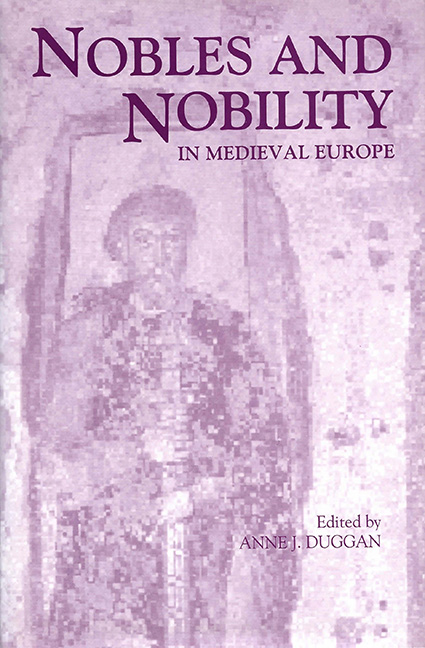
 Nobles and Nobility in Medieval Europe
 Concepts, Origins, Transformations (King's College London 1998)
Book contents
- Frontmatter
- Contents
- List of Illustrations
- Contributors
- Abbreviations
- Preface
- Dedication
- Introduction: Concepts, Origins, Transformations
- I Early Middle Ages
- 1 The Origins of the Nobility in Francia
- 2 The Nearly Men: Boso of Vienne and Arnulf of Bavaria
- 3 Nobility in the Ninth Century
- 4 Continuity and Change in the Tenth-Century Nobility
- 5 The Old English Vocabulary of Nobility
- 6 Nobles and Others: The Social and Cultural Expression of Power Relations in the Middle Ages
- II Central Middle Ages
- III Late Middle Ages
- Index
1 - The Origins of the Nobility in Francia
from I - Early Middle Ages
Published online by Cambridge University Press: 25 October 2017

Edited by
Book contents
- Frontmatter
- Contents
- List of Illustrations
- Contributors
- Abbreviations
- Preface
- Dedication
- Introduction: Concepts, Origins, Transformations
- I Early Middle Ages
- 1 The Origins of the Nobility in Francia
- 2 The Nearly Men: Boso of Vienne and Arnulf of Bavaria
- 3 Nobility in the Ninth Century
- 4 Continuity and Change in the Tenth-Century Nobility
- 5 The Old English Vocabulary of Nobility
- 6 Nobles and Others: The Social and Cultural Expression of Power Relations in the Middle Ages
- II Central Middle Ages
- III Late Middle Ages
- Index
Summary
Any review of work on the early medieval nobility quickly reveals that historians use the term ‘nobility’ to refer to an élite which was open, imperfectly defined, and subject to regional variation. With regard to the Frankish nobility, one can apply a series of normative statements about its origins and nature, but any general observations must always be qualified, or even contradicted, in the light of particular case studies. We can, for instance, observe that Frankish sources laid great emphasis on birth as the basis of nobility. That a person was ‘born noble’ was a standard way of indicating high social status at the beginning of Saints Lives, at least from the early seventh century onwards. Yet the Frankish nobility was by no means a closed élite. One can detect sentiments of exclusiveness, a horror, almost, of people who had risen from below to occupy the highest positions. This was contempt based on real, not just imagined, cases of dramatic upward social mobility: that of Leudast, for instance, Gregory of Tours's bête noir, who became count of Tours, or that of Ebbo, allegedly a serf, who became Archbishop of Reims and was said to have betrayed his lord and benefactor, the Emperor Louis the Pious, in a predictably base manner. It is often said that this was an élite which channelled property through sons, but we can find cases in which daughters received equal shares of a given inheritance. Female inheritance rights were supposedly postponed behind males, except that sometimes they were not. Unforgettable here is an extraordinary passage in the (probably) late seventh-century Formulary of Marculf which gives a model for a charter in which a father states that the custom of preferring sons to daughters as heirs is ‘impious’. Since all his children are God-given and he loves them all equally, he wishes to divide his property among them equally, thus making his daughter the equal and legitimate co-heir of her brothers.
The Frankish élite was also one which apparently united family wealth with political and ecclesiastical high office, and expected to pass on wealth and office to the next generation.
Information
- Type
- Chapter
- Information
- Nobles and Nobility in Medieval EuropeConcepts, Origins, Transformations (King's College London 1998), pp. 17 - 24Publisher: Boydell & BrewerPrint publication year: 2000
Accessibility standard: Unknown
Why this information is here
This section outlines the accessibility features of this content - including support for screen readers, full keyboard navigation and high-contrast display options. This may not be relevant for you.Accessibility Information
Accessibility compliance for the PDF of this chapter is currently unknown
and may be updated in the future.