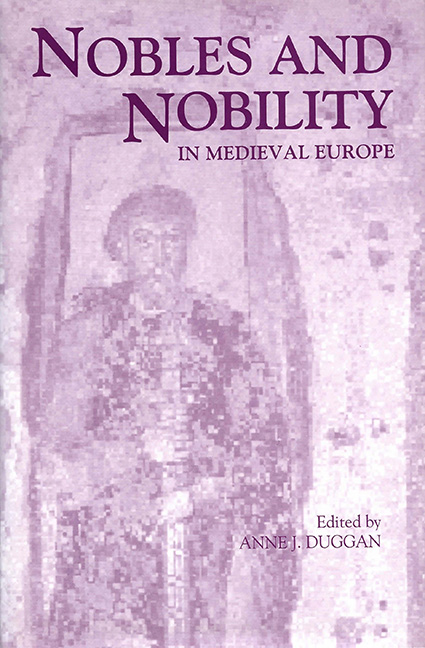
 Nobles and Nobility in Medieval Europe
 Concepts, Origins, Transformations (King's College London 1998)
Book contents
- Frontmatter
- Contents
- List of Illustrations
- Contributors
- Abbreviations
- Preface
- Dedication
- Introduction: Concepts, Origins, Transformations
- I Early Middle Ages
- 1 The Origins of the Nobility in Francia
- 2 The Nearly Men: Boso of Vienne and Arnulf of Bavaria
- 3 Nobility in the Ninth Century
- 4 Continuity and Change in the Tenth-Century Nobility
- 5 The Old English Vocabulary of Nobility
- 6 Nobles and Others: The Social and Cultural Expression of Power Relations in the Middle Ages
- II Central Middle Ages
- III Late Middle Ages
- Index
3 - Nobility in the Ninth Century
from I - Early Middle Ages
Published online by Cambridge University Press: 25 October 2017

Edited by
Book contents
- Frontmatter
- Contents
- List of Illustrations
- Contributors
- Abbreviations
- Preface
- Dedication
- Introduction: Concepts, Origins, Transformations
- I Early Middle Ages
- 1 The Origins of the Nobility in Francia
- 2 The Nearly Men: Boso of Vienne and Arnulf of Bavaria
- 3 Nobility in the Ninth Century
- 4 Continuity and Change in the Tenth-Century Nobility
- 5 The Old English Vocabulary of Nobility
- 6 Nobles and Others: The Social and Cultural Expression of Power Relations in the Middle Ages
- II Central Middle Ages
- III Late Middle Ages
- Index
Summary
My aim in this paper is a modest one. By way of a very brief survey of the premedieval history of the idea of nobility, and an only slightly less brief account of the appearances of the term nobilis and its cognates in capitularies, I want to see something of what the idea of nobility meant to ninth-century lay people by looking through the eyes of three writers working in the generation just after Charlemagne.
Late antiquity
It is always as well to start with the Fathers, for it was they who already got under way that synthesis of classical with Christian moral ideas which underlies so much of what was thought and written in the Middle Ages. This is very evidently true in the case of nobility. One form of entrée, or foray, into a large field is to consider the appearances of nobilis and related terms in the works of St Jerome, and then in Jerome's Vulgate Bible (the latter not a hard task with the lovely new concordance to hand). In Jerome's works, the terms nobilis, nobilitas, nobilitare occur no fewer than 474 times: more even than in Ambrose or Augustine. In Jerome's letters are a number of appearances of a theme that would become a topos: ‘noble by birth, but in Christ nobler still’. In a letter to his friend Pammachius, Jerome exclaimed: ‘In our times Rome possesses what the world did not know before: then few of the wise or powerful or noble were Christians, now many wise and powerful and noble men are monks – and among them all, my Pammachius is wisest, most powerful, and most noble!’ Further ennobling those already noble, Christianity comfortably incorporated traditional Roman notions of family, rank, and office in its own hierarchy of values, while emphasizing the noble virtues of self-discipline and (if in a new sense) publicspiritedness.
In Jerome's Vulgate Bible, there are eighteen occurrences of nobilis and its cognates in the Old Testament, seven in the New Testament, and eleven in the two apocryphal but firmly Vulgate books of Maccabees. Briefly, Jerome used the terms nobilis, etc in ways that would be thoroughly familiar and intelligible for his late-Roman audience, ways, that is, that blended the moral with the sociological.
Information
- Type
- Chapter
- Information
- Nobles and Nobility in Medieval EuropeConcepts, Origins, Transformations (King's College London 1998), pp. 43 - 52Publisher: Boydell & BrewerPrint publication year: 2000
Accessibility standard: Unknown
Why this information is here
This section outlines the accessibility features of this content - including support for screen readers, full keyboard navigation and high-contrast display options. This may not be relevant for you.Accessibility Information
Accessibility compliance for the PDF of this chapter is currently unknown
and may be updated in the future.