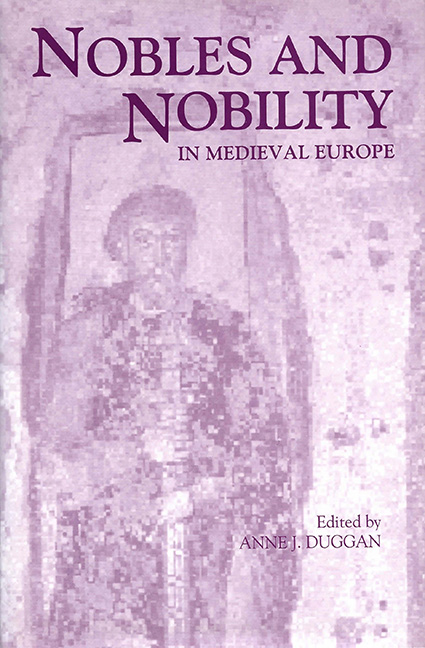
 Nobles and Nobility in Medieval Europe
 Concepts, Origins, Transformations (King's College London 1998)
Book contents
- Frontmatter
- Contents
- List of Illustrations
- Contributors
- Abbreviations
- Preface
- Dedication
- Introduction: Concepts, Origins, Transformations
- I Early Middle Ages
- II Central Middle Ages
- 7 Princely Nobility in an Age of Ambition (c. 1050–1150)
- 8 Words, Concepts, and Phenomena: Knighthood, Lordship, and the Early Polish Nobility, c. 1100 – c. 1350
- 9 Nobles and Nobility in the Narrative Works of Hartmann von Aue
- 10 A Noble in Politics: Roger Mortimer in the Period of Baronial Reform and Rebellion, 1258–1265
- 11 King Magnus and his Liegemen's ‘Hirdskrå’: A Portrait of the Norwegian Nobility in the 1270s
- III Late Middle Ages
- Index
8 - Words, Concepts, and Phenomena: Knighthood, Lordship, and the Early Polish Nobility, c. 1100 – c. 1350
from II - Central Middle Ages
Published online by Cambridge University Press: 25 October 2017

Edited by
Book contents
- Frontmatter
- Contents
- List of Illustrations
- Contributors
- Abbreviations
- Preface
- Dedication
- Introduction: Concepts, Origins, Transformations
- I Early Middle Ages
- II Central Middle Ages
- 7 Princely Nobility in an Age of Ambition (c. 1050–1150)
- 8 Words, Concepts, and Phenomena: Knighthood, Lordship, and the Early Polish Nobility, c. 1100 – c. 1350
- 9 Nobles and Nobility in the Narrative Works of Hartmann von Aue
- 10 A Noble in Politics: Roger Mortimer in the Period of Baronial Reform and Rebellion, 1258–1265
- 11 King Magnus and his Liegemen's ‘Hirdskrå’: A Portrait of the Norwegian Nobility in the 1270s
- III Late Middle Ages
- Index
Summary
To the memory of Aleksander Gieysztor (1916–1999)
The study of the early history of the Polish nobility is strongly affected by its well known political, constitutional, and cultural importance between the late Middle Ages and the crisis of the Polish ‘republic of nobles’ in the eighteenth century. Throughout this period, the Polish–Lithuanian nobility had been a clearly defined group, distinguished from the rest of society in several ways: by exclusive access to political power, high office, and representative institutions; by sovereign authority over a dependent peasantry; by control over recruitment into (and exclusion from) its own ranks; by membership in large familial groups, or ‘clans’, within which noble status was reproduced, and among which nobles intermarried; and by the use of several ritual devices that expressed group membership, above all proper names of the ‘clans’, their visual counterparts the heraldic badges, and distinct cries whose meanings and functions have been debated, but which appear to have been used in battle or assembly.
The two historical watersheds for current study of the nobility as a distinct social group are the reunification of the Polish kingdom under the later Piasts at the turn of the thirteenth and fourteenth centuries, and the generation of the fifteenth-century chronicler Jan Długosz, who, among his prolific writings on Polish history and heraldry, produced the earliest systematic treatise on the coats of arms of the most important noble ‘clans’ in the kingdom. Both watersheds occur late in the process of the formation and self-definition of the Polish ‘nobility’ as a distinct social group. In the process of Polish reunification, noble ‘clans’ appear to have functioned as important, well-defined political agents; while the noble families whose heraldic identity Długosz began to systematize had clearly been defined (at least in part) in terms of ritual elements of status – ‘clan’ structure, ‘clan’ names, coats of arms, and the distinct cries – for some time.
Because of the historical importance of Poland's reunification as a kingdom, and of Jan Długosz's towering presence as an author and thinker, the current historiography of the Polish nobility during the three or four centuries that preceded these two watersheds has largely been a search for the origins and antecedents of those traits and features that most clearly defined it in the fourteenth and fifteenth centuries, especially in Długosz's generation – its ‘clan’ structure;…
Information
- Type
- Chapter
- Information
- Nobles and Nobility in Medieval EuropeConcepts, Origins, Transformations (King's College London 1998), pp. 115 - 156Publisher: Boydell & BrewerPrint publication year: 2000
Accessibility standard: Unknown
Why this information is here
This section outlines the accessibility features of this content - including support for screen readers, full keyboard navigation and high-contrast display options. This may not be relevant for you.Accessibility Information
Accessibility compliance for the PDF of this chapter is currently unknown
and may be updated in the future.