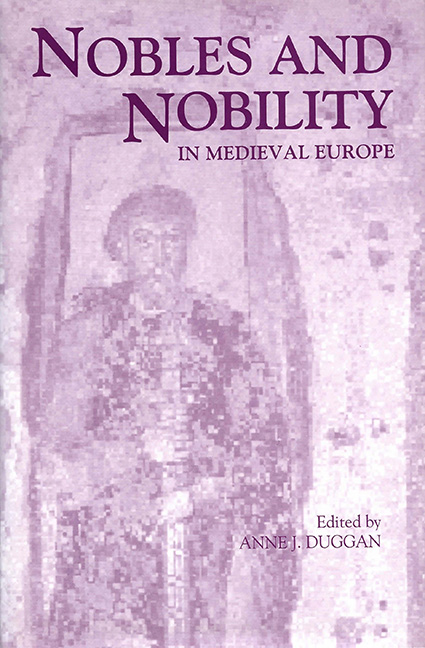
 Nobles and Nobility in Medieval Europe
 Concepts, Origins, Transformations (King's College London 1998)
Book contents
- Frontmatter
- Contents
- List of Illustrations
- Contributors
- Abbreviations
- Preface
- Dedication
- Introduction: Concepts, Origins, Transformations
- I Early Middle Ages
- II Central Middle Ages
- 7 Princely Nobility in an Age of Ambition (c. 1050–1150)
- 8 Words, Concepts, and Phenomena: Knighthood, Lordship, and the Early Polish Nobility, c. 1100 – c. 1350
- 9 Nobles and Nobility in the Narrative Works of Hartmann von Aue
- 10 A Noble in Politics: Roger Mortimer in the Period of Baronial Reform and Rebellion, 1258–1265
- 11 King Magnus and his Liegemen's ‘Hirdskrå’: A Portrait of the Norwegian Nobility in the 1270s
- III Late Middle Ages
- Index
11 - King Magnus and his Liegemen's ‘Hirdskrå’: A Portrait of the Norwegian Nobility in the 1270s
from II - Central Middle Ages
Published online by Cambridge University Press: 25 October 2017

Edited by
Book contents
- Frontmatter
- Contents
- List of Illustrations
- Contributors
- Abbreviations
- Preface
- Dedication
- Introduction: Concepts, Origins, Transformations
- I Early Middle Ages
- II Central Middle Ages
- 7 Princely Nobility in an Age of Ambition (c. 1050–1150)
- 8 Words, Concepts, and Phenomena: Knighthood, Lordship, and the Early Polish Nobility, c. 1100 – c. 1350
- 9 Nobles and Nobility in the Narrative Works of Hartmann von Aue
- 10 A Noble in Politics: Roger Mortimer in the Period of Baronial Reform and Rebellion, 1258–1265
- 11 King Magnus and his Liegemen's ‘Hirdskrå’: A Portrait of the Norwegian Nobility in the 1270s
- III Late Middle Ages
- Index
Summary
Hirdskrå and nobility
The composite noun hirdskrå is made up of Old Norse hirð and skrá. The term hird in the Hirdskrå itself, like the almost contemporary Konungs skuggsiá (the King's Mirror), was believed to derive from the Old Norse hirða, which means to guard, watch over, or herd. But this is wrong. Norse hirð is borrowed from Anglo-Saxon hîred or hîrd, which means household, retinue, brotherhood, or company. Despite the false etymology, Old Norse hirð in fact corresponds to this original meaning of the word, since it refers partly to the royal retinue or the king's liegemen as a group, partly to the royal household or court.
The noun skrá means parchment or book, and to skrá or to skrásettia means to put on parchment or enter in a book. Hirdskrå then can be understood as a document or book containing written customs, by-laws, and statutes concerning the king's liegemen and the royal household. Such a codex was compiled during the reign of Magnus Håkonsson (1263–80), and should be seen as part of a comprehensive project of legislation, which comprised a common civil code for the whole realm, ‘the Landlaw’ (1274), and a codex for the city of Bergen (1276) that soon afterwards was also adopted in Trondheim, Oslo, and Tønsberg. King Magnus's hirdskrå, the Hirdskrå as we call it today, must have been finished before August 1277, probably as early as the summer of 1274.
According to the Hirdskrå itself, there was already an older, now lost, law- code for the royal hird, which historians associate with the reigns of King Sverre (1177–1202) and his grandson Håkon IV Håkonsson (1217–63), King Magnus's father. This former hirdskrå was certainly embodied entirely or in part in King Magnus's compilation, which contains hird-custom dating back at least to the eleventh century. The Hirdskrå has been transmitted in nine almost complete versions from the fourteenth century, most of them from the first half of the century. In addition we have many fragments, some dating back to the end of the thirteenth century, and later copies and translations.
Information
- Type
- Chapter
- Information
- Nobles and Nobility in Medieval EuropeConcepts, Origins, Transformations (King's College London 1998), pp. 205 - 220Publisher: Boydell & BrewerPrint publication year: 2000
Accessibility standard: Unknown
Why this information is here
This section outlines the accessibility features of this content - including support for screen readers, full keyboard navigation and high-contrast display options. This may not be relevant for you.Accessibility Information
Accessibility compliance for the PDF of this chapter is currently unknown
and may be updated in the future.