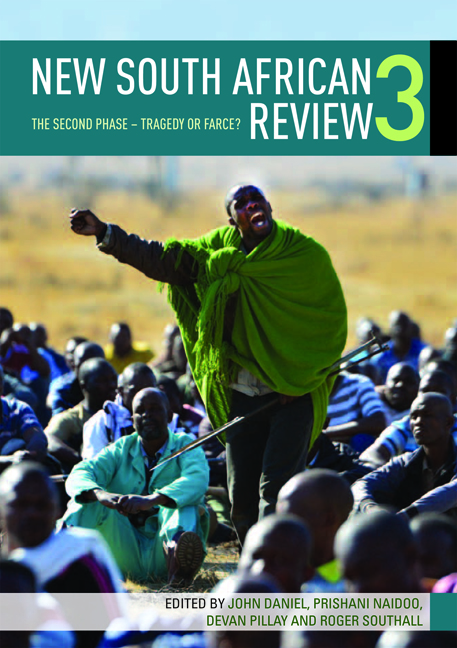
Book contents
- Frontmatter
- Contents
- Preface
- Introduction: The second phase – tragedy or farce?
- PART 1 Party, Power and Class
- PART 2 Ecology, Economy and Labour
- PART THREE Public Policy and Social Practice
- PART 4 South Africa at Large
- Introduction: South Africa at large
- Chapter 15 South Africa and the BRIC: Punching above its weight?
- Chapter 16 The Swazi Nation, the Swazi government and the South African connection
- Contributors
- Index
Chapter 16 - The Swazi Nation, the Swazi government and the South African connection
from PART 4 - South Africa at Large
Published online by Cambridge University Press: 31 May 2019

Book contents
- Frontmatter
- Contents
- Preface
- Introduction: The second phase – tragedy or farce?
- PART 1 Party, Power and Class
- PART 2 Ecology, Economy and Labour
- PART THREE Public Policy and Social Practice
- PART 4 South Africa at Large
- Introduction: South Africa at large
- Chapter 15 South Africa and the BRIC: Punching above its weight?
- Chapter 16 The Swazi Nation, the Swazi government and the South African connection
- Contributors
- Index
Summary
Singing, swaying, dust and heat,
Glistening bodies damp with sweat,
Rhythmic noise of beating feet,
Coloured cloth and plastic beads,
The tension of the crowds rises,
The shrill piercing cry of the crowd
Tells us outsiders the King has arrived
(Thembi Russell 1986)The bare-bone facts of the Swazi political economy are well known: an undemocratic no-party state presided over by an unelected and autocratic monarch who in his reign of twenty-six years has accumulated a personal fortune estimated by Forbes Magazine in 2010 (7 July) to be in the region of US$100 million, making him the fifteenth richest monarch in the world, albeit some way behind Africa's richest king, Mohammed 1V of Morocco, whose fortune was put at US$2.4 billion. Beyond the Swazi king#x0027;s thirteen palaces, just over two-thirds of his citizenry live at or below the poverty line and its government is unable to cover its monthly wage bill and other costs to the point where in 2011 it sought a R2.4 billion bail-out from South Africa. Landlocked, Swaziland depends on South Africa for about 80 per cent of its imports and sells South Africa 60 per cent of its exports; GDP growth has declined through the first decade of the century to under 1 per cent in 2010, and the annual revenue pay-out from the Southern African Customs Union#x0027;s common tariff pool has slumped by nearly two-thirds. This, combined with rampant state corruption and the monarchy#x0027;s lavish lifestyle, has generated the current economic crisis in the kingdom, one that, however, barely impacts on the monarch and his vast aristocratic network, the Swazi Nation. ‘They are flying, we are dying’ is a common expression mouthed in opposition circles in Swaziland.
Yet in the face of glaring inequality, vast poverty and no meaningful political rights, opposition is not widespread and what there is, is easily, though often harshly, contained. Even so, by modern African standards Swaziland is not a Zimbabwean or Sudanese-type tyranny – but then it does not need to be. King Mswati is neither a candidate for arraignment at the International Criminal Court (ICC) and nor, it seems, need he fret at the possibility of a North African-type ဘSwazi Springမ or any form of decisive regional or international intervention.
Information
- Type
- Chapter
- Information
- New South African Review 3The second phase - Tragedy or Farce?, pp. 314 - 332Publisher: Wits University PressPrint publication year: 2013
Accessibility standard: Unknown
Why this information is here
This section outlines the accessibility features of this content - including support for screen readers, full keyboard navigation and high-contrast display options. This may not be relevant for you.Accessibility Information
Accessibility compliance for the PDF of this chapter is currently unknown
and may be updated in the future.