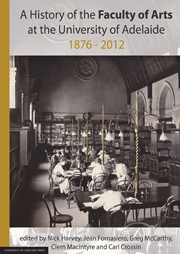
Book contents
- Frontmatter
- Contents
- List of Contributors
- 1 The Faculty of Humanities and Social Sciences and the BA Degree at the University of Adelaide since 1876
- 2 Webs of Significance: an Ethnographer's Account of Anthropology at the University of Adelaide from 1973 to 2011
- 3 The History of the Centre for Asian Studies at the University of Adelaide
- 4 Classics at the University of Adelaide (1874–2012)
- 5 English and Creative Writing: ‘the abode of … literature; the home of poetry and fiction’
- 6 A Tale of Resilience: the History of Modern European Languages at the University of Adelaide
- 7 Geography, Environment and Population at the University of Adelaide, 1904–2012
- 8 Gender Studies and Social Analysis
- 9 History
- 10 The History of Aboriginal Languages and Linguistics at the University of Adelaide
- 11 The Digital, Participatory and International Turn: Media at the University of Adelaide
- 12 Musical fusions
- 13 Philosophy at the University of Adelaide
- 14 Politics at the University of Adelaide
- Appendices
2 - Webs of Significance: an Ethnographer's Account of Anthropology at the University of Adelaide from 1973 to 2011
Published online by Cambridge University Press: 05 June 2013
By

Book contents
- Frontmatter
- Contents
- List of Contributors
- 1 The Faculty of Humanities and Social Sciences and the BA Degree at the University of Adelaide since 1876
- 2 Webs of Significance: an Ethnographer's Account of Anthropology at the University of Adelaide from 1973 to 2011
- 3 The History of the Centre for Asian Studies at the University of Adelaide
- 4 Classics at the University of Adelaide (1874–2012)
- 5 English and Creative Writing: ‘the abode of … literature; the home of poetry and fiction’
- 6 A Tale of Resilience: the History of Modern European Languages at the University of Adelaide
- 7 Geography, Environment and Population at the University of Adelaide, 1904–2012
- 8 Gender Studies and Social Analysis
- 9 History
- 10 The History of Aboriginal Languages and Linguistics at the University of Adelaide
- 11 The Digital, Participatory and International Turn: Media at the University of Adelaide
- 12 Musical fusions
- 13 Philosophy at the University of Adelaide
- 14 Politics at the University of Adelaide
- Appendices
Summary
In this chapter, I spin ‘webs of significance’ — to use Geertz's well-known rendition of Max Weber's phrase — about a past of which I was and still am an active participant. I came to the Department of Anthropology in 1975 as a Tutor and will retire as Professor at the end of 2012. The account of the past I present is interpretive in a number of ways. First, it is constructed. I received several suggestions about how to periodise flow of events that took place from the establishment of the Department in 1973 to the present. Many proposed I do so around the three occupants of the Chair of Anthropology — Bruce Kapferer (1973–1985), James Weiner (1994–1999) and myself (2003—present) — on the presumption that it is the leadership of an individual that is most important in understanding the events and evolution of historical processes. My rejection of this approach was guided by Foucault's scepticism of the modern era's presupposition of the ‘sovereign subject’ whose actions provide the principal dynamic of history. Still, I include some of Kapferer's vision because it provided the starting point for the Department and consequently for my account of it. In reflecting back on the nearly forty years since the Department was established, I analyse and name one of the periods that I identify, well known within the University community, around Turner's conception of ‘social drama’, which he described as ‘a way of understanding a sequence of social events which, seen retrospectively by an observer, can be shown to have a [processual] structure’.
Information
- Type
- Chapter
- Information
- A History of the Faculty of Arts at the University of Adelaide1876-2012, pp. 23 - 50Publisher: The University of Adelaide PressPrint publication year: 2012
Accessibility standard: Unknown
Why this information is here
This section outlines the accessibility features of this content - including support for screen readers, full keyboard navigation and high-contrast display options. This may not be relevant for you.Accessibility Information
Accessibility compliance for the PDF of this chapter is currently unknown
and may be updated in the future.