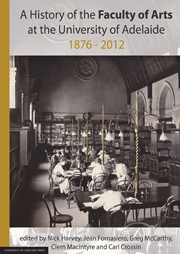
Book contents
- Frontmatter
- Contents
- List of Contributors
- 1 The Faculty of Humanities and Social Sciences and the BA Degree at the University of Adelaide since 1876
- 2 Webs of Significance: an Ethnographer's Account of Anthropology at the University of Adelaide from 1973 to 2011
- 3 The History of the Centre for Asian Studies at the University of Adelaide
- 4 Classics at the University of Adelaide (1874–2012)
- 5 English and Creative Writing: ‘the abode of … literature; the home of poetry and fiction’
- 6 A Tale of Resilience: the History of Modern European Languages at the University of Adelaide
- 7 Geography, Environment and Population at the University of Adelaide, 1904–2012
- 8 Gender Studies and Social Analysis
- 9 History
- 10 The History of Aboriginal Languages and Linguistics at the University of Adelaide
- 11 The Digital, Participatory and International Turn: Media at the University of Adelaide
- 12 Musical fusions
- 13 Philosophy at the University of Adelaide
- 14 Politics at the University of Adelaide
- Appendices
8 - Gender Studies and Social Analysis
Published online by Cambridge University Press: 05 June 2013

Book contents
- Frontmatter
- Contents
- List of Contributors
- 1 The Faculty of Humanities and Social Sciences and the BA Degree at the University of Adelaide since 1876
- 2 Webs of Significance: an Ethnographer's Account of Anthropology at the University of Adelaide from 1973 to 2011
- 3 The History of the Centre for Asian Studies at the University of Adelaide
- 4 Classics at the University of Adelaide (1874–2012)
- 5 English and Creative Writing: ‘the abode of … literature; the home of poetry and fiction’
- 6 A Tale of Resilience: the History of Modern European Languages at the University of Adelaide
- 7 Geography, Environment and Population at the University of Adelaide, 1904–2012
- 8 Gender Studies and Social Analysis
- 9 History
- 10 The History of Aboriginal Languages and Linguistics at the University of Adelaide
- 11 The Digital, Participatory and International Turn: Media at the University of Adelaide
- 12 Musical fusions
- 13 Philosophy at the University of Adelaide
- 14 Politics at the University of Adelaide
- Appendices
Summary
RESEARCH CENTRE FOR WOMEN'S STUDIES 1982–2000
Women's Studies arrived late at the University of Adelaide. In mid-1981, rumblings of concern about the position of women in the University finally gained a hearing. Four women — Amanda Cornwall, representing the Students' Association; Fay Gale, Professor of Geography and the only woman in a senior position on the teaching staff; Alison Mackinnon, a full-time Tutor in the University's Education Department; and Jill Thomas, Personal Assistant to the Vice-Chancellor — presented a discussion paper on the subject to the University's Executive Committee. Executive Committee debated the paper. It began to appear that the women's concerns would disappear into a cloud of confusion. But then Professor Gale, dramatically, lost her temper: she thumped the table and raised her voice. The effect was dramatically instantaneous. Executive Committee established a working party to examine the position of women, and it invited submissions. By the middle of 1982, the University Council had accepted most of its far-reaching recommendations — including an excellent case against Sexist Language, which deserves revisiting — and appointed an implementation committee.
In this process, the Faculty of Arts secured one-off funding to establish a Research Centre for Women’s Studies. Late in 1982, it advertised for a Director for this new body, the first of its kind in Australia. In 1983, Susan Magarey — a graduate of both the University of Adelaide and the Australian National University — accepted the position, and moved from Canberra where she had been teaching an undergraduate major in Women’s Studies since 1978.
Information
- Type
- Chapter
- Information
- A History of the Faculty of Arts at the University of Adelaide1876-2012, pp. 209 - 234Publisher: The University of Adelaide PressPrint publication year: 2012
Accessibility standard: Unknown
Why this information is here
This section outlines the accessibility features of this content - including support for screen readers, full keyboard navigation and high-contrast display options. This may not be relevant for you.Accessibility Information
Accessibility compliance for the PDF of this chapter is currently unknown
and may be updated in the future.