A collection of out-of-copyright and rare books from the Cambridge University Library and other world-class institutions that have been digitally scanned, made available online, and reprinted in paperback.
To save content items to your account,
please confirm that you agree to abide by our usage policies.
If this is the first time you use this feature, you will be asked to authorise Cambridge Core to connect with your account.
Find out more about saving content to .
To save content items to your Kindle, first ensure no-reply@cambridge.org
is added to your Approved Personal Document E-mail List under your Personal Document Settings
on the Manage Your Content and Devices page of your Amazon account. Then enter the ‘name’ part
of your Kindle email address below.
Find out more about saving to your Kindle.
Note you can select to save to either the @free.kindle.com or @kindle.com variations.
‘@free.kindle.com’ emails are free but can only be saved to your device when it is connected to wi-fi.
‘@kindle.com’ emails can be delivered even when you are not connected to wi-fi, but note that service fees apply.
Educated in Prague, Vienna and Leipzig, Moritz Steinschneider (1816–1907) was a Jewish Bohemian orientalist with a deep understanding of classical and Semitic languages and cultures, specialising in bibliography. He edited twenty-one volumes of the journal Hebräische Bibliographie from 1859 to 1882, and his 1878 catalogue of the Hebrew manuscripts held in the Hamburg State Library is also reissued in this series, along with his 1877 review of Arabic polemic and apologetic literature among Muslims, Christians and Jews. Published between 1878 and 1897, this two-volume work is a descriptive catalogue of the Hebrew manuscripts in what is now the Berlin State Library. In Volume 1, Steinschneider categorises and describes 124 manuscripts. The volume also includes reproductions of Hebrew handwriting.
A renowned Enlightenment polymath, Sir William Jones (1746–94) was a lawyer, translator and poet who wrote authoritatively on politics, comparative linguistics and oriental literature. Known initially for his Persian translations and political radicalism, Jones became further celebrated for his study and translation of ancient Sanskrit texts following his appointment to the supreme court in Calcutta in 1783. He spent the next eleven years introducing Europe to the mysticism and rationality of Hinduism through works such as his nine 'Hymns' to Hindu deities and his translation of the Sanskrit classic Sacontalá, influencing Romantic writers from William Blake to August Wilhelm Schlegel. Volume 11 of his thirteen-volume works, published in 1807, contains most of Jones' Histoire de Nader Chah (1770), a memoir of the famed Iranian ruler, translated into French from the Persian. Commissioned by the king of Denmark, this was Jones' first publication. Widely praised, it established him as a pre-eminent orientalist.
The greatest actor of his day, Sir Henry Irving (1838–1905) thrilled audiences with his tragedy and melodrama, his Hamlet and Richard III, most famously at the Lyceum Theatre in London. Born John Henry Brodribb, he took the name Irving for his first professional stage appearance in 1856. A long and exhausting apprenticeship followed, during which he played some 700 roles in theatres up and down the country before establishing his reputation in 1871 in the psychological thriller The Bells. In 1878, he took over the Lyceum and here, with his business manager Bram Stoker (1847–1912) and actress Ellen Terry (rumoured to be his mistress), he became the theatrical icon of his age. This engaging two-volume tribute by Stoker, his closest friend, was first published in 1906. Volume 1 includes reminiscences of Irving's Shakespeare, performances of The Bells, Faust and Tennyson's plays, Ellen Terry's acting and his appearances in America.
Described by The Morning Post as exhibiting 'facilities of observation never before possessed by a European lady', Anne Katharine Elwood was the ideal narrator for an exotic and exciting travel journal. The first woman to travel overland to India, she acquired a reputation as a pioneer even before her diary was published. When it first appeared in 1830 this work attracted much praise from critics and the general public alike. Elwood's account introduces readers to locations, cultures and sights as diverse as the duomo of Turin, a picnic at the Pyramids, and the 'the private lives of Mahometan and Hindoo Ladies'. It was recommended by one critic as 'the most amusing book of travels we have read for a long time'. Volume 1 takes readers from England to Bombay via France, Italy, Malta and Egypt. For more information on this author, see http://orlando.cambridge.org/public/svPeople?person_id=elwoan
Published in 1803, this is the third part of a three-volume descriptive catalogue of the Hebrew codices in the personal library of Giovanni Bernardo De Rossi (1742–1831), professor of oriental languages at the University of Parma. Each codex is numbered and its contents briefly described in Latin. Volume 3 features descriptions of codices 859–1,377 as well as an appendix of his codices in other languages. De Rossi was an important collector of manuscripts and incunabula, and an authority on Hebrew typography and textual variants. The Hebrew manuscripts described in this catalogue were obtained as a result of his exhaustive researches into variant readings of the Old Testament, the results of which he published as Variae lectiones veteris testamenti (1784–8). He also produced groundbreaking studies of printed Hebrew texts, and a catalogue of Jewish anti-Christian polemics, Bibliotheca judaica antichristiana (also reissued in this series).
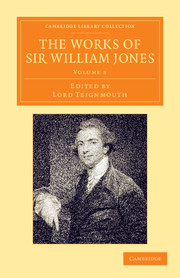
A renowned Enlightenment polymath, Sir William Jones (1746–94) was a lawyer, translator and poet who wrote authoritatively on politics, comparative linguistics and oriental literature. Known initially for his Persian translations and political radicalism, Jones became further celebrated for his study and translation of ancient Sanskrit texts following his appointment to the supreme court in Calcutta in 1783. He spent the next eleven years introducing Europe to the mysticism and rationality of Hinduism through works such as his nine 'Hymns' to Hindu deities and his translation of the Sanskrit classic Sacontalá. Volume 8 of his thirteen-volume works, published in 1807, contains more of Jones' legal work, including his pre-India tracts on Islamic laws of succession and inheritance - culturally comparative works debunking prejudiced claims that Islamic cultures denied private property. Also included is his formative 'Essay on the Law of Bailments' (1781), a work still cited in some legal cases today.
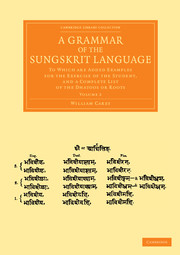
The Indo-Aryan language of Sanskrit is the primary language of Hinduism and also a scholarly language of Buddhism. Dating back to the second millennium BCE, it is considered to be the parent of most modern languages of India, and remains central to work in Indo-European studies, philology and linguistics today. First published in 1806, this is a comprehensive grammar of Sanskrit, compiled by the Baptist missionary William Carey (1761–1834) during his time in India. Its purpose was to make the language accessible to European learners, presenting its complex systems of verb conjugation, compound words and affixation in a straightforward way. Reissued here in a two-volume set, Volume 2 contains Books 4 and 5 of the work (covering word formation and syntax), a detailed appendix on the roots of Sanskrit words, and an index. Carey's reference works on Marathi and Bengali are also reissued in this series.
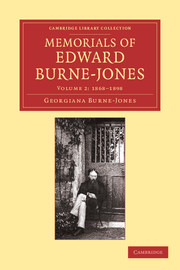
Sir Edward Coley Burne-Jones (1833–98) emerged from a solitary, motherless childhood to form close friendships with William Morris and such other luminaries of the Victorian art world as Dante Gabriel Rossetti and John Ruskin. A second generation Pre-Raphaelite and founder member of the Morris firm, he was influential in many areas, from painting, stained glass and tapestry design to book illustration. His later work, including such iconic paintings as The Wheel of Fortune, The Golden Stairs (which caused a sensation when exhibited at the Grosvenor Gallery) and The Sleep of Arthur in Avalon, influenced and exemplified the Aesthetic Movement, and inspired the European Symbolists. His wife, Georgiana Burne-Jones (1840–1920), published this engaging two-volume biography in 1904. Volume 2 hints at the emotional turmoil behind paintings like Love Among the Ruins, reveals the impact of his visits to Italy, and usefully contextualises the haunting masterpieces of his later years.
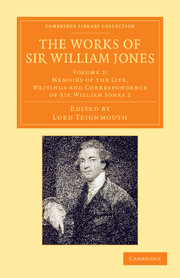
A renowned Enlightenment polymath, Sir William Jones (1746–94) was a lawyer, translator and poet who wrote authoritatively on politics, comparative linguistics and oriental literature. Known initially for his Persian translations and political radicalism, Jones became further celebrated for his study and translation of ancient Sanskrit texts following his appointment to the supreme court in Calcutta in 1783. He spent the next eleven years introducing Europe to the mysticism and rationality of Hinduism, becoming a pioneer in comparative religion. Through works such as his nine 'Hymns' to Hindu deities and his translation of the Sanskrit classic Sacontalá, Jones inspired and influenced Romantic writers from William Blake to August Wilhelm Schlegel. These thirteen volumes of his works, published in 1807, begin with a memoir by his friend and editor Lord Teignmouth (1751–1834). Volume 2 covers Jones' life and death in India, and includes important correspondence and unpublished work.
Published between 1909 and 1955, this ten-volume collection contains deeds relating to all of Yorkshire, from the twelfth to the seventeenth century. The deeds are of local historical interest, and provide topographical, philological and genealogical information, as well as insights into daily life. The majority of the records here are presented as abstracts, while documents in the vernacular that are of greater interest or importance are printed in full. Where possible, the documents are dated. Thorough background information and discussion of the deeds is included, as are notable physical descriptions, in particular of the seals. Each volume concludes with an index of people and places. Edited by William Brown (1854–1924) and published in 1914, Volume 2 contains documents relating to all of Yorkshire, most notably Bolton Hall as well as Manston and Moor Monkton manors. In his introduction, Brown points out deeds which are of particular interest to women's history.
The purpose of this book, published in 1813 by Thomas Duer Broughton (1778–1835), is to provide an English audience with an accurate description of 'the character, manners, domestic habits and religious ceremonies of the Mahrattas'. Broughton, an army officer in the East India Company, first arrived in India while serving as a cadet in the Bengal establishment in 1795, and eventually rose to the positions of captain in 1805, major in 1816 and colonel in 1829. The book consists of a series of thirty-two letters addressed to his brother, and most of the letters describe the events and the environment of the Rajputana region, beginning with an account of a journey from Agra to Kerowli. The letters which follow all contain fascinating descriptions of festivals and other events, and cultural encounters of all kinds, painting a vivid portrait of life for the British in early nineteenth-century India.