A collection of out-of-copyright and rare books from the Cambridge University Library and other world-class institutions that have been digitally scanned, made available online, and reprinted in paperback.
To save content items to your account,
please confirm that you agree to abide by our usage policies.
If this is the first time you use this feature, you will be asked to authorise Cambridge Core to connect with your account.
Find out more about saving content to .
To save content items to your Kindle, first ensure no-reply@cambridge.org
is added to your Approved Personal Document E-mail List under your Personal Document Settings
on the Manage Your Content and Devices page of your Amazon account. Then enter the ‘name’ part
of your Kindle email address below.
Find out more about saving to your Kindle.
Note you can select to save to either the @free.kindle.com or @kindle.com variations.
‘@free.kindle.com’ emails are free but can only be saved to your device when it is connected to wi-fi.
‘@kindle.com’ emails can be delivered even when you are not connected to wi-fi, but note that service fees apply.
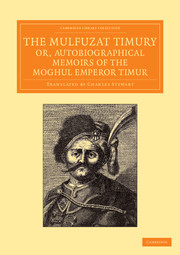
The Mughal emperor Timur (1336–1405), known also as Tamerlane, conquered large parts of central Asia in the fourteenth and early fifteenth centuries. He was renowned for being an exceptionally good military strategist, but also for being a ruthless conqueror. His purported autobiography was not published in English until 1830, when it was translated by the orientalist Charles Stewart (1764–1837) from a Persian version of the Chagatai original. This reissue offers an insight into Timur's motives and the detail of his strategy. The book begins with a statement of the principles that he ruled by, along with an account of certain events which led him to believe he was receiving divine aid. The narrative then becomes chronological and covers the period of his life up to 1375, when Timur was in his forties.
Born and educated in Ireland, Max Arthur Macauliffe (1841–1913) joined the Indian Civil Service in 1862. In 1882 he was promoted to the post of deputy commissioner of the Punjab. But it was after he retired from the civil service in 1893 that he gained public attention. Macauliffe developed a close affinity with Sikhism while in the Punjab, eventually converting to the religion. His translation into English of the Guru Granth Sahib, the holy book of Sikhism, is recognised as the most accurate to date. Following this project, he set to work on this six-volume set, covering the history and philosophy of Sikhism, first published in 1909 and still regarded as the definitive work on the subject. Volume 5 covers the life and compositions of Gobind Singh, the tenth guru, along with the life of Banda Bahadur, who established the first Sikh state.
A renowned Enlightenment polymath, Sir William Jones (1746–94) was a lawyer, translator and poet who wrote authoritatively on politics, comparative linguistics and oriental literature. Known initially for his Persian translations and political radicalism, Jones became further celebrated for his study and translation of ancient Sanskrit texts following his appointment to the supreme court in Calcutta in 1783. He spent the next eleven years introducing Europe to the mysticism and rationality of Hinduism, becoming a pioneer in comparative religion. Through works such as his nine 'Hymns' to Hindu deities and his translation of the Sanskrit classic Sacontalá, Jones inspired and influenced Romantic writers from William Blake to August Wilhelm Schlegel. These thirteen volumes of his works, published in 1807, begin with a memoir by his friend and editor Lord Teignmouth (1751–1834). Volume 1 explores Jones' heritage and birth through to his departure for India.
As editor and contributor, William Ouseley (1767–1842) published this three-volume collection of essays between 1797 and 1800. Educated at Paris and Leiden, Ouseley became an honorary fellow of the royal societies of Amsterdam, Göttingen and Edinburgh. He researched extensively on Persia, producing important work on Persian handwriting. Several of his translations of works by fellow orientalist J. L. Burckhardt (1784–1817) are also reissued in this series. Ouseley's Oriental Collections consists of miscellaneous pieces contributed by a number of writers on aspects of Asian history, culture and literature. Volume 1 includes translations from Persian of the poetry of Saadi, remarks on manuscript collation, translations of Arabic stories, and essays on Moroccan Arabic and the poetry of Hafez. The diverse subject matter will appeal to readers interested in the nature and progress of oriental scholarship in the late eighteenth century.
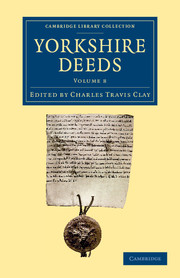
Published between 1909 and 1955, this ten-volume collection contains deeds relating to all of Yorkshire, from the twelfth to the seventeenth century. The deeds are of local historical interest, and provide topographical, philological and genealogical information, as well as insights into daily life. The majority of the records here are presented as abstracts, while documents in the vernacular that are of greater interest or importance are printed in full. Where possible, the documents are dated. Thorough background information and discussion of the deeds is included, as are notable physical descriptions, in particular of the seals. Each volume concludes with an index of people and places. Published in 1940, Volume 8 was edited by Charles Travis Clay (1885–1978). The majority of the deeds found here are from the collection of Lord Allendale. This volume also contains documents relating to the North and East Ridings from the collection of the Duke of Norfolk.
Edward Gibbon Wakefield (1796–1862) was a controversial colonial advocate and political theorist, who was the driving force behind the early colonization of New Zealand and South Australia. Barred from entering parliament after serving a three-year sentence in Newgate Prison, Wakefield read widely on contemporary economics and social questions, developing his influential theory of colonization. He formed the New Zealand Association in 1837 to create a new colony in that country, finally emigrating himself in 1852. This volume, first published in 1849, contains an explanation of Wakefield's philosophy of colonization. Writing in the form of letters to an anonymous statesman, Wakefield fully explores and discusses the social, political and economic aspects of his system of colonization, based on regulating emigration by fixing the price of land. Wakefield's ideas influenced early colonial economic policy in South Australia, and stimulated the development of later theories of colonization.
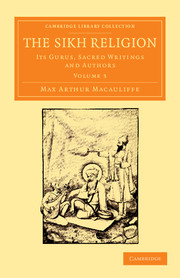
Born and educated in Ireland, Max Arthur Macauliffe (1841–1913) joined the Indian Civil Service in 1862. In 1882 he was promoted to the post of deputy commissioner of the Punjab. But it was after he retired from the civil service in 1893 that he gained public attention. Macauliffe developed a close affinity with Sikhism while in the Punjab, eventually converting to the religion. His translation into English of the Guru Granth Sahib, the holy book of Sikhism, is recognised as the most accurate to date. Following this project, he set to work on this six-volume set, covering the history and philosophy of Sikhism, first published in 1909 and still regarded as the definitive work on the subject. Volume 3 narrates the life of Arjun, the fifth guru, with translations of his compositions in the Sikh holy book.
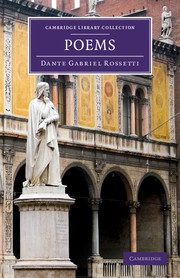
Few collections of verse have been associated with such drama as these poems by Dante Gabriel Rossetti (1828–82). Much of this work had disappeared in 1862 when it was buried with Rossetti's wife, Elizabeth Siddal, only to be brought back to the light of day in 1869. Rossetti added further poems and the work first appeared in 1870. The full impact of the sexually explicit material was soon felt. In his article 'The Fleshly School of Poetry', the writer Robert Williams Buchanan denounced Rossetti as corrupt and decadent. Others joined the chorus of disapproving voices. Steeped in remorse about his treatment of his wife, and riddled with guilt about his affair with Jane Morris, Rossetti broke down and attempted suicide. Behind all the sensation, however, lies Rossetti's subtle and complex literary intelligence attempting, many years before Freud, to find honest modes of expression for the central importance of the libido.
Very little is known about the life of the Attic orator Isaeus, who was active during the first half of the fourth century BCE, and many of his speeches have been lost to posterity. Published in 1904, these surviving speeches, presented in the original Greek with extensive commentary by the classical scholar William Wyse (1860–1929), are mostly concerned with the convoluted intrigue of inheritance disputes. Wyse regarded Isaeus as 'an unscrupulous falsifier of law and fact in the service of clients whose claims to the estates they contested were, without exception, fraudulent'. While modern scholars may not fully share this view, Wyse's monumental and learned edition is still a standard work in the study of ancient family law. In addition to a critical introduction, the texts of the speeches, and the detailed commentary, this work also includes family trees to aid understanding of the complex cases.
Gilbert White (1720–1793) published his Natural History and Antiquities as one volume in 1789. Both works consist of a series of letters written by White to the barrister Daines Barrington (1727–1800) and the zoologist Thomas Pennant (1726–1798). The letters in Natural History, White's best-known work, contain detailed information about his observations of local flora, fauna and wildlife. White was a pioneer of the study of birds and animals in their natural habitats, rather than as specimens removed from their environments. His methods of observation enabled him to identify and record many previously unknown species. (He was the first, for example, to distinguish the chiffchaff from the warbler by differences in song.) The letters in Antiquities are concerned with the topographical, social and ancient history of Selborne. They include details of important Roman coin finds and are an indispensable source for the history of local churches and buildings.
Published in 1803, this is the second part of a three-volume descriptive catalogue of the Hebrew codices in the personal library of Giovanni Bernardo De Rossi (1742–1831), professor of oriental languages at the University of Parma. Each codex is numbered and its contents briefly described in Latin. Volume 2 features descriptions of codices 347–858 from a total of 1,377. De Rossi was an important collector of manuscripts and incunabula, and an authority on Hebrew typography and textual variants. The Hebrew manuscripts described in this catalogue were obtained as a result of his exhaustive researches into variant readings of the Old Testament, the results of which he published as Variae lectiones veteris testamenti (1784–8). He also produced groundbreaking studies of printed Hebrew texts, and a catalogue of Jewish anti-Christian polemics, Bibliotheca judaica antichristiana (also reissued in this series).
Educated in Prague, Vienna and Leipzig, Moritz Steinschneider (1816–1907) was a Jewish Bohemian orientalist with a deep understanding of classical and Semitic languages and cultures, specialising in bibliography. He edited twenty-one volumes of the journal Hebräische Bibliographie from 1859 to 1882, and his 1878 catalogue of the Hebrew manuscripts held in the Hamburg State Library is also reissued in this series, along with his 1877 review of Arabic polemic and apologetic literature among Muslims, Christians and Jews. Published between 1878 and 1897, this two-volume work is a descriptive catalogue of the Hebrew manuscripts in what is now the Berlin State Library. Volume 2 is structured thematically, describing 135 manuscripts and focusing on the Hebrew Bible. It also addresses poetry as well as mathematics, medicine, magic and the Kabbalah.
The quintessential satire of life in early nineteenth-century Britain, Vanity Fair is a panoramic tour of English social strata, charting the rise and fall of the opportunistic Becky Sharp. Rejected by several publishers before finding a place with Bradbury and Evans, this 'novel without a hero' first appeared as a popular serial. The twenty parts were finally printed together in 1848, incorporating the author's own illustrations. Although William Makepeace Thackeray (1811–63) was not a debut author, this was the first of his works to bear his name on the title page; the vast scope of the novel gained him immediate critical acclaim, though reviewers often expressed misgivings about the dark portrayal of human nature. In response, Thackeray wrote that 'we are for the most part an abominably foolish and selfish people … I want to leave everybody dissatisfied and unhappy at the end of the story.'
A native of Baghdad, Abd-Allatif (1162–1231) was a versatile scholar and scientist of vast erudition. This prolific author travelled widely throughout the Muslim world and wrote an account of Egypt at a time when the country was rarely visited by Europeans. The book covers matters ranging from natural history and medicine to culture and domestic economy. It also includes a vivid description of the terrible famine that Abd-Allatif witnessed in 1200 and 1201 when the Nile failed to flood. The text was widely known in Europe at the end of the eighteenth century thanks to Latin and German translations. Orientalist Antoine Isaac Silvestre de Sacy (1758–1838) translated and edited this version, first published in French in 1810. Complementing this invaluable account are excerpts from several other Arab writers, a detailed biography of Abd-Allatif, and a general overview of the provinces and villages of Egypt in the fourteenth century.
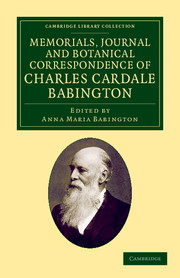
Collated by his widow and published in 1897, this collection of memorials, journal extracts and letters of Charles Cardale Babington (1808–95) demonstrates the esteem in which he was held by so many. An influential professor of botany at Cambridge, Babington left to the university a legacy that included the huge herbarium that he had partly funded himself, as well as some 1,600 volumes from his own library. His benevolence and generosity of knowledge, time and money endeared him to many departments and societies, while his works on local flora inspired others to produce many of the county floras that are still used today. His Manual of British Botany (also reissued in this series) first appeared in 1843 and made a huge impact on the study of the subject. These collected writings and tributes will offer students and scholars valuable insight into the breadth of his scientific interests and achievements.
The Nautical Magazine first appeared in 1832, and was published monthly well into the twenty-first century. It covers a wide range of subjects, including navigation, meteorology, technology and safety. An important resource for maritime historians, it also includes reports on military and scientific expeditions and on current affairs. The 1870 volume was the thirty-ninth and last to be edited by Rear-Admiral Becher, whose brief postscript highlights improvements in charts and the installation of lightning conductors as important achievements, and remarks that the magazine's 'efforts for the improvement of all that concerns the seaman's benefit' have been a labour of love. The volume devotes much space to the newly opened Suez Canal. Australia, Canada and the Mediterranean also feature, and there are ethnographic articles on the peoples of Polynesia and West Africa. The volume also contains an obituary of Charles Dickens and a lively article on the University Boat Race.
Published between 1909 and 1955, this ten-volume collection contains deeds relating to all of Yorkshire, from the twelfth to the seventeenth century. The deeds are of local historical interest, and provide topographical, philological and genealogical information, as well as insights into daily life. The majority of the records here are presented as abstracts, while documents in the vernacular that are of greater interest or importance are printed in full. Where possible, the documents are dated. Thorough background information and discussion of the deeds is included, as are notable physical descriptions, in particular of the seals. Each volume concludes with an index of people and places. Published in 1930, Volume 6 was edited by Charles Travis Clay (1885–1978). This volume largely relates to the West Riding. An appendix contains an index of deeds relating to Yorkshire found in the Descriptive Catalogue of Ancient Deeds in the Public Record Office (1890–1915).
A renowned Enlightenment polymath, Sir William Jones (1746–94) was a lawyer, translator and poet who wrote authoritatively on politics, comparative linguistics and oriental literature. Known initially for his Persian translations and political radicalism, Jones became further celebrated for his study and translation of ancient Sanskrit texts following his appointment to the supreme court in Calcutta in 1783. He spent the next eleven years introducing Europe to the mysticism and rationality of Hinduism through works such as his nine 'Hymns' to Hindu deities and his translation of the Sanskrit classic Sacontalá, influencing Romantic writers from William Blake to August Wilhelm Schlegel. Volume 4 of his thirteen-volume works, published in 1807, contains Jones' extensive Indic scholarship and translations published in British periodicals such as Asiatick Researches and The Asiatick Miscellany, and includes the unprecedented 'On the Musical Modes of the Hindus' (1792) and 'On the Mystical Poetry of the Persians and Hindus' (1791).
An accomplished biographer of figures ranging from Talleyrand to Cardinal Newman, Charlotte Blennerhassett (1843–1917) originally published this three-volume study in German. Reissued here is the English translation of 1889 by J. E. Gordon Cumming. Madame de Staël (1766–1817), an intellectual in Paris at the turn of the nineteenth century, was ranked by Auguste Comte as among the 'great men' of the era. A novelist, salonnière, literary and social critic, and follower of Rousseau, she became keenly involved in the opposition to Louis XVI. Volume 1 of Blennerhassett's authoritative study addresses Madame de Staël's life up to the Revolution, examining her ancestry, family and marriage to the Swedish ambassador to France. The volume also covers her views on marriage, slavery, the Rights of Man and the contemporary political turmoil.
The Mughal emperor Humayun (1508–56) ruled over parts of modern-day India, Afghanistan and Pakistan during his eventful reign. He came to the throne at the age of twenty-two in 1530 and thereafter faced a series of challenges to his control. Throughout this time he was served by his water-bearer, Jauhar, who later wrote these memoirs of his master and his campaigns. This translation from Persian to English was first published in 1832 by Charles Stewart (1764–1837), who had been a professor of oriental languages at the East India College, Haileybury. Jauhar gives a valuable eyewitness narrative of events during a fraught period of Indian history, also providing an insight into Humayun's character. The work begins with an account of his victory over Bahadur Shah and the conquest of Gujarat in the 1530s. It goes on to describe battles with Sher Shah Suri and other campaigns until his death.