A collection of out-of-copyright and rare books from the Cambridge University Library and other world-class institutions that have been digitally scanned, made available online, and reprinted in paperback.
To save content items to your account,
please confirm that you agree to abide by our usage policies.
If this is the first time you use this feature, you will be asked to authorise Cambridge Core to connect with your account.
Find out more about saving content to .
To save content items to your Kindle, first ensure no-reply@cambridge.org
is added to your Approved Personal Document E-mail List under your Personal Document Settings
on the Manage Your Content and Devices page of your Amazon account. Then enter the ‘name’ part
of your Kindle email address below.
Find out more about saving to your Kindle.
Note you can select to save to either the @free.kindle.com or @kindle.com variations.
‘@free.kindle.com’ emails are free but can only be saved to your device when it is connected to wi-fi.
‘@kindle.com’ emails can be delivered even when you are not connected to wi-fi, but note that service fees apply.
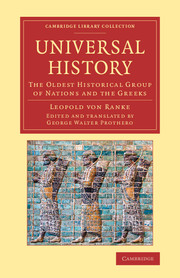
'No apology can be needed for introducing to English readers the latest work of Leopold von Ranke', states the editor's preface to this English translation, first published in 1884. Ranke (1795–1886) is well known for pioneering the modern historical method which advocates empiricism, rather than a focus on the philosophy of history. Emphasising the importance of presenting history exactly as the surviving evidence, both documentary and archaeological, reveals it to have happened, Ranke asserted that different eras need to be understood in their own contexts rather than in relation to each other. Though it is limited to the Mediterranean and the Middle East, this work takes a broad overview of 'the oldest historical group of nations and the Greeks', beginning with ancient Egypt and concluding with Alexander the Great and his immediate successors. Other works by Ranke in English translation are also reissued in the Cambridge Library Collection.
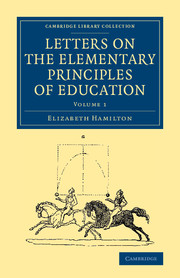
The novelist and essayist Elizabeth Hamilton (1756?–1816) received her education at a day school from the age of eight, and later recalled her childhood and schooldays fondly. However, intellectual girls in the period were regarded with some suspicion, and she remembered hiding from visitors those books that might be deemed inappropriate for a young woman. Later embarking on a literary career, she published in 1801 her Letters on Education, republished in this second edition of 1801–2. Owing much to the theories of John Locke as well as the period's standard conduct-book advice on the education of girls, Hamilton's work offers detailed theoretical explorations of how children learn. 'Be not afraid my good friend,' she writes, 'that I intend making speculative philosophers of your daughters.' Volume 1 includes comments on the 'pernicious effects of parental partiality', considering also 'contempt for the female character' and 'pride of station'.
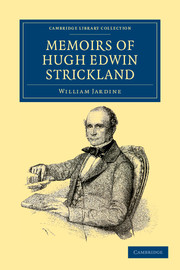
Published in 1858, this memoir recounts the life and work of the natural historian and geologist Hugh Edwin Strickland (1811–53). Written by his father-in-law, the Scottish naturalist Sir William Jardine (1800–74), the book covers Strickland's early childhood, his education at Oxford, his involvement in and influence upon the establishment of the Ray Society and his notable academic pursuits in natural history before his life was tragically cut short by a freak railway accident in 1853, when he was just forty-two. The reader will gain an insight into Strickland's character, his scientific acquaintances, including Henslow and Darwin, and his wide-ranging interests in the area of natural history, including geology, zoology, palaeontology and especially ornithology, demonstrated by his study The Dodo and its Kindred (1848). Drawing upon revealing and informative extracts from Strickland's journals throughout, the book also contains a wide selection of Strickland's shorter scientific writings.
Henry Pearson (1870–1916) was an English botanist specialising in research on the Gnetophyta division of woody plants. In 1903 he was elected to the Henry Bolus Professorship of Botany at the South African College, Cape Town (now known as the University of Cape Town), and he was elected a Fellow of the Royal Society in 1916 shortly before his death. In 1915 Pearson was commissioned to write this volume for the Cambridge Botanical Handbooks series. Published posthumously in 1929, it was the first extensive study on the Gnetales order and the only such study in English published during the twentieth century. In it, Pearson investigates the morphology and reproduction of the three Gnetophyta genera and examines their relation to the angiosperms (flowering plants). His research on Gnetophyta was later used together with genetic studies to provide theories explaining the evolution of seed plants.
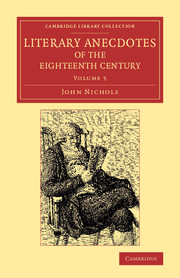
In this nine-volume work, published between 1812 and 1815, the author and publisher John Nichols (1745–1826) provides biographical notes on publishers, writers and artists of the eighteenth century, and also gives 'an incidental view of the progress and advancement of literature in this kingdom during the last century'. (A shorter version had been published in 1782.) His subjects range from the publisher William Bowyer to Henry Fielding and Horace Walpole, and also include histories of individual publishing houses and of genres such as lexicography. The work remains a useful source of biographical material on authors and publishers at a period when many of the literary genres we take for granted, such as the novel, the autobiography and the analytical history, were first being developed. Volume 5 includes memoirs of John and Charles Wesley, and of antiquaries such as William Stukeley, as well as an essay on lexicography.
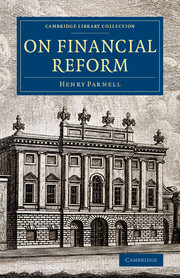
Prior to its publication in 1830, the draft of this work by Sir Henry Parnell, later Baron Congleton (1776–1842), was praised by John Stuart Mill, who said he could 'not see that it is possible to lay down the principles of political economy more broadly'. Chair of the select committee on public income and expenditure during the Duke of Wellington's first ministry, Parnell called for greater retrenchment and reduced taxation. He also argues here that 'the passage of merchandise from one state to another … ought to be as free as air and water', denouncing the supporters of protection as 'among the greatest enemies of mankind'. A later pamphlet by Parnell, A Plain Statement of the Power of the Bank of England (1832), highly critical of the Bank's monopoly, is included in this reissue. His Treatise on Roads (1833) is reissued separately in the Cambridge Library Collection.
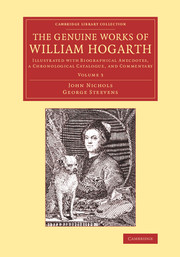
This illustrated three-volume catalogue of the works of painter and engraver William Hogarth (1697–1764) was the result of 'Hogarthomania', the enthusiasm for all his productions which arose soon after his death. The publisher and author John Nichols (1745–1826), assisted by the collector and literary critic George Steevens, published a life of Hogarth and a list of his works in 1781, and as disputes increasingly arose over the genuineness of some of the prints attributed to him, enlarged versions appeared in 1782 and 1785. This work, published between 1808 and 1817, is the last in the sequence of Nichols' works on Hogarth, and remains a useful source for art historians and anyone interested in the cultural life of the eighteenth century. Volume 3, published seven years after Volume 2, contains further plates, critical essays, and a 'key' to the scenes in Hogarth's prints allegedly derived from classical sources.
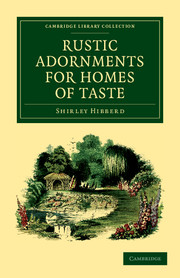
James Shirley Hibberd (1825–90) was a journalist and horticultural writer who worked as a bookseller before devoting his time to researching and lecturing and publishing on gardening. An active member of the Royal Horticultural Society, he edited several gardening magazines including Floral World, and his writing was widely enjoyed and respected. This book, first published in 1856, is Hibberd's carefully researched and practical guide to decorating the home and garden. Hibberd explains the practical aspects of garden design, the pleasures of bee-keeping, and how to construct a pond or aquarium. Full of useful advice on everything from preserving cut flowers to the ideal species of bird to keep in an aviary, this is a charming and enjoyable manual for the Victorian gardener which was very popular in its time, and remains a useful source for the cultural historian as well as an entertaining treat for the general reader.
In October 1854 the Taranaki Herald reported the return to New Zealand of Charles Hursthouse, who 'for years past has been in England the untiring advocate of New Zealand emigration, and by his writings and lectures has materially contributed to the colonization of the settlement'. In this updated 1861 version of his 1857 book, Hursthouse promises 'a fair and honest picture of New Zealand as she is today' and expresses his belief that thousands of struggling British people from all walks of life would be 'saved' by emigrating. He describes New Zealand's history, climate, natural history, population, government, exports and markets, agricultural pursuits and trades, and includes a revealing chapter on war and 'native policy'. Hursthouse explains his own reasons for emigrating, and provides practical advice on official regulations, travel insurance, choice of ship, the best times to sail and how to keep occupied during the voyage.
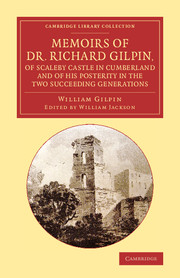
A physician and nonconformist minister who was active in the north of England, Richard Gilpin (1625–1700) was a popular preacher, leading large congregations, yet he faced opposition from Quakers and was ultimately unable to unite various dissenting factions. Including details about his descendants, the present work sets his story within the wider context of the Gilpin family history. First published in 1879, it was written in 1791 by fellow clergyman William Gilpin (1724–1804), an enlightened schoolmaster and writer on aesthetics. As well as covering his ancestors, William appends here his own life story, discussing his career as a teacher and his literary calling. He touches on his journeys during summer vacations when, with notebook and sketching materials, he would explore picturesque features of the British landscape. His volumes of Observations, based on these travels, are also reissued in the Cambridge Library Collection.
This world-famous work was begun by Sir William Jackson Hooker (1785–1865) in 1837, and the ten volumes reissued here were produced under his authorship until 1854, at which point his son, Joseph Dalton Hooker (1817–1911) continued the work of publication. Hooker's own herbarium, or collection of preserved plant specimens, was so extensive that at one point he stored it in one house and lived in another; it was left to the nation on his death. Each volume contains 100 line drawings of plants, and each is accompanied by a full Latin description, with notes in English on habitat and significant features. The order of the plants in each volume is not systematic, but two 'indexes' at the beginning provide plant lists, in alphabetical order and 'arranged according to the natural orders'.