A collection of out-of-copyright and rare books from the Cambridge University Library and other world-class institutions that have been digitally scanned, made available online, and reprinted in paperback.
To save content items to your account,
please confirm that you agree to abide by our usage policies.
If this is the first time you use this feature, you will be asked to authorise Cambridge Core to connect with your account.
Find out more about saving content to .
To save content items to your Kindle, first ensure no-reply@cambridge.org
is added to your Approved Personal Document E-mail List under your Personal Document Settings
on the Manage Your Content and Devices page of your Amazon account. Then enter the ‘name’ part
of your Kindle email address below.
Find out more about saving to your Kindle.
Note you can select to save to either the @free.kindle.com or @kindle.com variations.
‘@free.kindle.com’ emails are free but can only be saved to your device when it is connected to wi-fi.
‘@kindle.com’ emails can be delivered even when you are not connected to wi-fi, but note that service fees apply.
John Liddiard Nicholas (1784–1868), a London iron-founder, arrived in New South Wales in 1813 but rather than develop his business, he accompanied Samuel Marsden on a journey to New Zealand from November 1814 to March 1815 that established the first Christian mission to the Maoris. This two-volume book, first published in 1817 after Nicholas had returned to England, was widely successful, and was translated into Dutch and German in 1819. Based on Nicholas' journal, kept throughout his voyage, it tells the story of the missionaries' efforts but focuses particularly on Nicholas' observations of the Maoris and reflects his desire to share knowledge of a 'people so little known to Europeans, and at the same time so … interesting'. Nicholas pays careful attention to the customs, personalities, and relationships unique to different communities. Volume 2 includes the memoir of a Maori chief, and a Maori vocabulary.
This work on the theory of education was first published in 1839. The five writers had been chosen as the winners in a competition for an essay on the 'Expediency and Means of Elevating the Profession of the Educator in Society', organised by the Central Society of Education, founded in 1837 to promote state funding of education, at a time when the 'monitor' system, whereby older children taught younger ones, was seen as an effective (and money-saving) method. The journalist John Lalor (1814–56) won first prize with a wide-ranging consideration of all the aspects of education, comparing the status of teachers through history and across several countries, and championing their 'sacred mission'. The runners-up were the writer John A. Heraud, the Unitarian minister Edward Higginson, the lawyer and author James Simpson, and Mrs Sarah Porter, prolific writer on education and sister of the political economist David Ricardo.
Hermann Alfred Hirt (1865–1936) taught Greek, Latin and early Germanic languages at Leipzig University from 1892 to 1912 before moving to the chair of Sanskrit and comparative linguistics at Giessen. Born around the time when Bopp and Schleicher were publishing their ground-breaking work on Indo-European, and a young man when Brugmann published his monumental comparative grammar (all available in this series), Hirt began this seven-volume grammar in the 1920s soon after the exciting discovery of Tocharian and the decipherment of Hittite. The project arose out of his extensive research on the historical phonology of Indo-European vowels, which led him to consider much wider issues. Volume 2 (which appeared first, in 1921) revisits and updates Hirt's earlier work on the vowel system, and emphasises the value of comparative philology as opposed to single-language studies. It includes a full index of words.
Philip Luckombe (1730–1803), printer, author and shell-collector, published this work in 1771. (He had published a shorter version, A Concise History of the Origin and Progress of Printing, anonymously in the previous year.) Born in Exeter, he learned the printing trade there, and became a freeman of the city in 1776, but moved to London, where he wrote travelogues and several books on printing, edited dictionaries and encyclopaedias, and became an authority on shells. The first part of the book is concerned with the history of printing, including the various charters issued to the Stationers' Company, and the second with the practicalities of 'the art and mystery of printing' and 'the necessary materials used in a Printing House', including typefaces, presses and paper, and the duties of a warehouseman. This technical information continued to be used and quoted until the middle of the twentieth century.
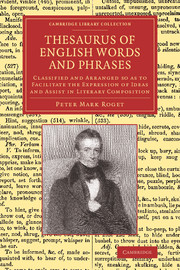
Peter Mark Roget (1779–1869), of Huguenot stock, trained as a physician in Edinburgh and London, yet he was increasingly drawn to the sciences, corresponding with Erasmus Darwin, Thomas Beddoes and Humphry Davy. He practised medicine (free of charge) in London at the Northern Dispensary, which he co-founded, and lectured on physiology and medical topics. His Bridgewater Treatise, on animal and vegetable physiology, is also reissued in the Cambridge Library Collection. Roget is remembered today for the present work, first published in 1852 following his retirement from professional duties. As the preface makes clear, he had contemplated such a work for nearly fifty years. It supplies a vocabulary of English words and idiomatic phrases 'arranged … according to the ideas which they express'. The thesaurus, continually expanded and updated, has always remained in print, but this reissued first edition shows the impressive breadth of Roget's own knowledge and interests.
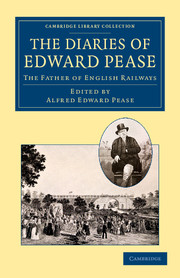
Edward Pease (1767–1858), who left behind extensive diaries for the years 1824–57, was dubbed the 'father of English railways' thanks to his backing of the Stockton and Darlington Railway, which began operating in 1825. A prominent Quaker and woollen manufacturer in Darlington, Pease famously recruited George Stephenson (1781–1848) as the line's engineer. His great-grandson Sir Alfred Pease (1857–1939) edited these diaries for private circulation only, but was persuaded to publish them in 1907. The work includes an introductory essay on Quakerism and biographical sketches of Pease and his wife Rachel. The diaries themselves reveal, as the editor mentions in his preface, a life devoted to public and private good works. The appendices include a variety of Quaker texts and other material relating to the Pease family and the founding of the railways.
William Emerton Heitland (1847–1935) was a Cambridge classicist, who was described as having 'a passionate desire to attain the truth'. His most distinguished work, Agricola, published in 1921, is a detailed study of agricultural labour in classical times. He makes use of a wide range of sources, from Homer in the eighth century BCE to Apollinaris Sidonius in the fifth century CE. In asking the question, by whom and under what conditions was the work done, he deals with land tenure, taxation, military service and political theory. He argues that changes in agricultural production were necessarily connected to changes in other areas of society. To a large extent, classical agriculture was based on slavery, and even those who were free tenants had limited legal rights. Roman poets such as Virgil idealised the pastoral life, but may not reflect reality. It is an important sourcebook for social and economic history.
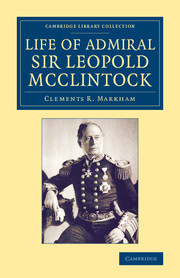
This biography of polar explorer Sir Leopold McClintock (his name is also spelled M'Clintock) was published in 1909 by his 'old messmate' Sir Clements Markham (1830–1916), later more famous as a historian. (Several works by both men have been reissued in the Cambridge Library Collection.) McClintock (1819–1907) gained experience of Arctic voyages on the expeditions of James Clark Ross and Edward Belcher, during which he undertook several arduous sledge journeys over the ice. In 1854, he took leave from the navy to command the Fox, a ship paid for by Lady Franklin to investigate the fate of her husband's expedition. He found the memorandum, written by his second-in-command, which confirmed Franklin's death in June 1847. McClintock was knighted for his services on his return, and he stayed in the navy, serving on different stations around the world, until his retirement with the rank of admiral in 1884.
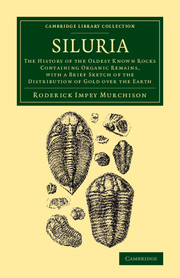
The Scottish geologist Sir Roderick Impey Murchison (1792–1871) first proposed the Silurian period after studying ancient rocks in Wales in the 1830s. Naming the sequence after the Silures, a Celtic tribe, he believed that the fossils representing the origins of life could be attributed to this period. This assertion sparked a heated dispute with his contemporary Adam Sedgwick, ultimately ruining their friendship. First published in 1854, Siluria is a significant reworking of Murchison's earlier book, The Silurian System, which had appeared in 1839. Thorough in his approach, he combines his own findings with those of researchers around the world, touching also on the later Devonian, Carboniferous and Permian periods as well as questions of natural history. An important text in nineteenth-century geology and palaeontology, the work contains a valuable geological map of Wales along with detailed engravings of fossils, including crustaceans, cephalopods and fish.
The influence of John Ruskin (1819–1900), both on his own time and on artistic and social developments in the twentieth century, cannot be over-stated. He changed Victorian perceptions of art, and was the main influence behind 'Gothic revival' architecture. As a social critic, he argued for the improvement of the condition of the poor, and against the increasing mechanisation of work in factories, which he believed was dull and soul-destroying. The thirty-nine volumes of the Library Edition of his works, published between 1903 and 1912, are themselves a remarkable achievement, in which his books and essays - almost all highly illustrated - are given a biographical and critical context in extended introductory essays and in the 'Minor Ruskiniana' - extracts from letters, articles and reminiscences both by and about Ruskin. This fourteenth volume contains Ruskin's 'Academy Notes' and other writings on painting and painters.
Having urged political reforms in Britain, Richard Price (1723–91) turned to defending the cause of American independence. Born in Wales, Price became an influential moral philosopher, dissenting Protestant preacher, political pamphleteer, and economic theorist. Known for his trenchant defence of the freedom of the human will against philosophical sceptics, Price applied his justification of individual moral agency to political issues - particularly the American Revolution - during the latter part of his life. This tract on America first appeared in 1784. Defining the right of American colonists to oppose British corruption, it suggested that their independence would offer much 'benefit to the world'. But it also offered a relatively rare critique of the system of racial slavery that continued to develop in America. Reissued here is the 1785 publication that also contained translations from French of a letter to Price by the economist Turgot and a parody by Charles-Joseph Mathon de la Cour which had amused Benjamin Franklin.
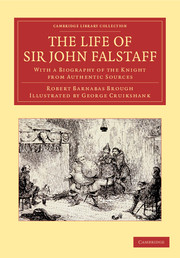
Remembered for both his satirical and serious work, Robert Barnabas Brough (1828–60) was a playwright, journalist, poet and founder member of the Savage Club. Built around a series of inspired etchings by the celebrated artist George Cruikshank (1792–1878), this is a delightful fictional biography, 'from authentic sources', of that most colourful of Shakespeare's characters. We hear how our hero was descended from the great Saxon leader Hundwulf Falstaff, how the name is a corruption of 'False-thief', of his adventures with his beloved Prince Hal, and of Christmas 1412 with the Whittington family. Henry V's terrible rejection of him - 'I know thee not, old man' - is touchingly depicted, as are the episode of the laundry basket and other misadventures at Windsor, along with his sad death at the Boar's Head in 1415. First published in 1858, this book is a must-read for every lover of this larger-than-life figure.
This authoritative biography of Ludwig van Beethoven (1770–1827) was a landmark in its meticulous research and use of source material. For the American author Alexander Wheelock Thayer (1817–97), it represented a lifelong labour of love, yet it remained unfinished at his death. His friend Hermann Deiters (1833–1907) edited and translated Thayer's work into German, publishing three volumes which covered Beethoven's life to 1816. Since Deiters also died before the biography could be completed, musicologist Hugo Riemann (1849–1919) was called upon to conclude the work. The final German volumes appeared in 1907 and 1908. It was the American critic Henry Edward Krehbiel (1854–1923) who prepared the present work, the first and considerably revised English version, published in three volumes in 1921. Volume 1 covers Beethoven's career through to 1802, the year of the Heiligenstadt Testament.
After a military career with the East India Company, Charles Stewart (1764–1837) focused his attention on the study of oriental languages. Following his return to England in 1806, he assumed the professorship of Arabic, Persian and Hindustani at the East India College in Hertfordshire. His scholarly achievements include an 1809 catalogue of the library of Tipu Sultan of Mysore, and this work, published in 1813, which formed the first serious study in English of the history of Bengal. The book is split into six sections. The first five cover the early Islamic conquests and dynasties from the ninth century onwards. The bulk of the book then covers the Mughal era and ensuing period of independent nawabs, providing also a detailed assessment of the events leading up to the Battle of Plassey in 1757 and the beginning of British dominance.
Lucretius' didactic poem On the Nature of Things is one of the great works of Latin literature, and Lachmann's edition of the work from 1850 is often considered the beginning of modern textual criticism. The poem is divided into six books and leans heavily on Epicurean philosophy. All that exists in the world, even the soul, is composed of atoms that unite and dissipate with time; Lucretius does not believe in an afterlife or in any of the Roman gods. Lachmann defines the editorial principle that agreement in error implies identity of origin, and on this basis he creates a stemma for the manuscripts of Lucretius, and demonstrates how the three main manuscripts all derive from one archetype. His commentary is divided into two parts: the recensio (creation of a family tree for the manuscripts of the work) and a lengthy emendatio (correction of the errors in the text).
An Irish-born gardener and writer, William Robinson (1838–1935) travelled widely to study gardens and gardening in Europe and America. He founded a weekly illustrated periodical, The Garden, in 1871, which he owned until 1919, and published numerous books on different aspects of horticulture. Topics included annuals, hardy perennials, alpines and subtropical plants, as well as accounts of his travels. This book, his most famous work, was first published in 1883, and fifteen editions were issued in his lifetime. It has been described as 'the most widely read and influential gardening book ever written'. Aimed at both amateurs and experienced gardeners, it sets out clearly the different types of plant suitable for each type of situation, and how to grow them. Robinson advocated a revolution in garden design, rejecting the more formal flower-beds which had long been popular in favour of a more natural and individual style.
In May 1851, the doors opened on the Great Exhibition, a celebration of British industry and international trade that spawned numerous imitations across the globe. The scale of the exhibition was immense and publishers responded quickly to the demand for catalogues, guidebooks and souvenir volumes. In a marketplace swamped with exhibition literature, Tallis' three-volume History and Description of the Crystal Palace, originally published in 1852 and reproduced here in the 1854 edition, quickly established itself as the definitive history for middle-class readers. Illustrated with high-quality steel-engraved plates of the most popular and eye-catching exhibits, Tallis' book provides a fascinating contemporary account of this cultural and commercial highlight of the Victorian age, and reveals the mind-set of a society at the peak of its imperial power. Volume 1 describes the preparations for the exhibition and focuses particularly on the 'foreign and colonial' departments and the decorative arts.
This two-volume natural history of volcanoes and volcanic phenomena was first published in Germany in 1855 by the chemist and mineralogist Georg Landgrebe (1802–1872) and was intended for scientifically literate enthusiasts rather than for specialists. The book begins with a review of contemporary work on volcanoes, explaining the theories of Leopold von Buch and the lively international debates they had generated among scholars including Charles Lyell, George Poulett Scrope and Charles Daubeny (also reissued in this series). Volume 1 lists the world's volcanoes by region, giving details of their altitude, mineralogy, and recent eruptions (including Etna in 1832 and Mount St Helens in September 1842). Landgrebe makes frequent reference to published work, summarising eyewitness accounts of vegetation, terrain and volcanic activity. He gives particular attention to Vesuvius and to the volcanoes of Iceland and Java, but there is also thorough coverage of the Americas, the Caribbean and the Pacific.
This four-volume edition of the Arabic text of the Journey of the Moroccan traveller Ibn Battuta (1304–68/9), with a French translation was published in 1853–8. In 1325, Ibn Battuta, who came from a family of jurists in Tangier, set out to make the pilgrimage to Mecca - the beginning of a journey that would last for twenty-four years and take him as far as China. In Volume 4, the sultan of Delhi asks Ibn Battuta to lead an embassy to China, during which he suffers difficulties, including attacks by Hindus, and shipwreck. He eventually reaches China via Sri Lanka, Vietnam and the Philippines; he then performs a fourth hajj before returning home, after twenty-four years' absence. He sets out again, to visit first Muslim Spain and then further regions of Africa, as far south as Timbuktu and down the river Niger, before returning home to dictate an account of his travels.
In 1887, when the first volume of this work was published, Greek epigraphy was not systematically studied or taught in English universities, and the book was specifically written to fulfil a need for 'a popular work, giving a classification of Greek inscriptions according to their age, country and subject, and a selection of texts by way of samples, under each class'. At a time when the value of some Greek letters (those peculiar to one city's version of the alphabet and so known rarely in surviving inscriptions) was not universally agreed, and when excavation was regularly providing new materials for study, the book was widely welcomed as a tool for research. The first volume contains a historical sketch of the Greek alphabet and a sequence of inscriptions showing its development across the Mediterranean area and Asia Minor until the end of the fifth century CE.