A collection of out-of-copyright and rare books from the Cambridge University Library and other world-class institutions that have been digitally scanned, made available online, and reprinted in paperback.
To save content items to your account,
please confirm that you agree to abide by our usage policies.
If this is the first time you use this feature, you will be asked to authorise Cambridge Core to connect with your account.
Find out more about saving content to .
To save content items to your Kindle, first ensure no-reply@cambridge.org
is added to your Approved Personal Document E-mail List under your Personal Document Settings
on the Manage Your Content and Devices page of your Amazon account. Then enter the ‘name’ part
of your Kindle email address below.
Find out more about saving to your Kindle.
Note you can select to save to either the @free.kindle.com or @kindle.com variations.
‘@free.kindle.com’ emails are free but can only be saved to your device when it is connected to wi-fi.
‘@kindle.com’ emails can be delivered even when you are not connected to wi-fi, but note that service fees apply.
A keen collector and sketcher of plant specimens from an early age, the author, educator and clergyman Charles Alexander Johns (1811–74) gained recognition for his popular books on British plants, trees, birds and countryside walks. Flowers of the Field (1851), one of several works originally published by the Society for Promoting Christian Knowledge, is also reissued in this series. First published by the Society between 1847 and 1849, this two-volume botanical guide for amateur enthusiasts focuses on the trees found in British woodland. Johns describes each species, noting also pests and diseases, uses for the wood, and associated myths and legends. The work is noteworthy for its meticulous engravings of leaves, seeds and blossom, and of the trees in natural settings. Volume 1 (1847) provides an introduction to the botanical terms used. The species covered in this volume include oak, ash, beech and poplar.
This short novel, published in 1886 by Robert Louis Stevenson (1850–94), may well be more familiar in its many stage, film and television adaptations than in its original form, while 'Jekyll and Hyde' has become the shorthand for a character who seems to have a 'split personality'. Stevenson claimed that the main features of the story came to him in a dream, and he wrote it very rapidly, though ill and bedridden at the time. Priced at one shilling (the genre of macabre and horror stories was known as the 'shilling shocker'), it was an immediate success. Though not the first of Stevenson's works to explore the notion of the divided self, in a period where increasing concern was felt about the possible negative sides of discoveries in both the physical and biological sciences, the story clearly struck a chord, and it has remained popular ever since.
In this nine-volume work, published between 1812 and 1815, the author and publisher John Nichols (1745–1826) provides biographical notes on publishers, writers and artists of the eighteenth century, and also gives 'an incidental view of the progress and advancement of literature in this kingdom during the last century'. (A shorter version had been published in 1782.) His subjects range from the publisher William Bowyer to Henry Fielding and Horace Walpole, and also include histories of individual publishing houses and of genres such as lexicography. The work remains a useful source of biographical material on authors and publishers at a period when many of the literary genres we take for granted, such as the novel, the autobiography and the analytical history, were first being developed. As well as memoirs of writers, Volume 4 also contains essays on the polyglot Bible, and on the rise of newspapers and periodicals.
Sourindro Mohan Tagore (1840–1914), musicologist, educationist and patron of Indian music, was a member of a highly influential family in nineteenth-century Calcutta that was renowned for its support of the arts. His work to generate understanding in the West of music's role in Indian culture and heritage was recognised worldwide and he is remembered today through his extensive writings, donations of musical instruments to leading institutions, and the Royal College of Music's prestigious Tagore gold medal. His valuable compilation of eighteenth- and nineteenth-century English writings on Indian music by learned Europeans was first printed for private circulation in 1875. It includes a catalogue of Indian musical instruments, illustrated notes by the orientalist William Ouseley (1767–1842), and a pioneering essay by Sir William Jones (1746–94), the Enlightenment polymath whose collected works are also reissued in this series.
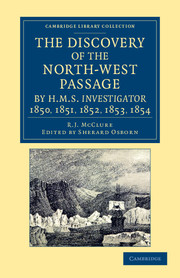
By the middle of the nineteenth century, the North-West Passage, a trade route from the Atlantic to the Pacific, had been sought for centuries without success. The Franklin expedition of 1845 became the latest victim, and Irish naval officer Sir Robert John Le Mesurier McClure (1807–73) took part in the attempts to ascertain its fate. His ship, H.M.S. Investigator, spent the years 1850–4 in the Arctic, and in the course of their search for the lost expedition, the crew discovered the North-West Passage. Upon his return to England, following the loss of the Investigator to pack ice, McClure handed over his journals to author and fellow officer Sherard Osborn (1822–75), who prepared this narrative of the pioneering expedition. First published in 1856, the work remains a compelling account of Arctic exploration, revealing how McClure and his men survived four forbidding winters.
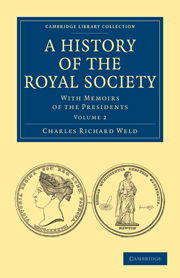
The Royal Society has been dedicated to scientific inquiry since the seventeenth century and has seen a long line of illustrious scientists and thinkers among its fellowship. The society's Assistant Secretary and Librarian, Charles Richard Weld (1813–1869), spent four years writing this two-volume History of the Royal Society, published in 1848, which also includes illustrations by his wife, Anne. Weld's aim was to document the 'rise, progress, and constitution' of the society. He charts how the informal meetings of like-minded men engaged in scientific pursuits in the mid-1600s developed into a prestigious society that by 1830 counted as one of the world's most influential scientific institutions. Volume 2 describes the governance, funding and organisation of the society from the 1770s to 1830, as well as key scientific concerns. It also contains biographies of notable presidents including James Burrow, Humphry Davy and Joseph Banks.
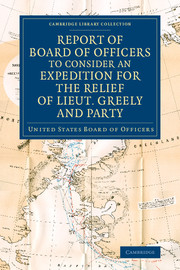
In 1881, Adolphus Greely led a US Arctic expedition to gather meteorological, astronomical and magnetic data. It was poorly supported by the US Army, neither Greely nor his men had experience of Arctic conditions, and their ship, the Proteus, sailed home once they had landed in Greenland. An inadequately planned relief mission failed to reach them in 1882, and a second expedition in 1883, including the Proteus (which was crushed by ice), also failed to locate the men or to land sufficient supplies. This official report was published in 1884, and proposes a further rescue mission, much more carefully planned and equipped. It includes, as an appendix, detailed information about Arctic conditions and means of survival from the British naval explorers George Nares and Albert H. Markham. When eventually found, only seven of Greely's original team of twenty-five were still alive. Other accounts of the expeditions are also reissued in this series.
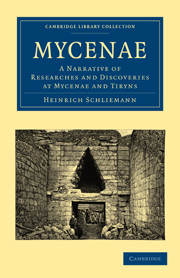
Heinrich Schliemann (1822–1890) published Mycenae, an account of his archaeological excavations of the ancient Greek cities of Mycenae and Tiryns, in 1878. Schliemann's astonishing finds revealed that the cities had a historical reality outside Homeric epic. His excavations uncovered many priceless treasures, most famously the 'death mask of Agamemnon' and the shaft graves, filled with pottery, carved stones, skeletons, gold, jewellery and weaponry. He also uncovered much about the layout and architecture of the two lost cities. The volume is generously illustrated with images of artefacts, maps and charts. It is introduced by W. E. Gladstone, who gave Schliemann the political assistance necessary for the excavations to take place. Schliemann's discoveries were met with wild enthusiasm, and while today his methods of excavation are deplored and many of his conclusions thought to be ill-founded, he is rightly credited with the discovery of the lost and ancient Mycenaean civilisation.
When George William Rusden (1819–1903) was fourteen, his family emigrated from England to Australia, where he later became a prominent educationalist and civil servant. Already an author of numerous books and pamphlets, he began work on his History of Australia after his retirement, and it was published in 1883 in three volumes. Although the work is considered sympathetic to the Aboriginal people of Australia, it is also infused with Rusden's Tory politics, infuriating his critics – one wrote that the volumes were 'as untrustworthy as a partisan pamphlet well can be without deliberate dishonesty'. Despite initial criticism, these wide-ranging volumes form an important early contribution to the writing of Australian history. Volume 1 begins with the arrival of Europeans in Australia, and then examines each colonial governor, starting with Arthur Philip (1738–1814), who was the first, and ending the volume with Thomas Brisbane (1773–1860) in 1821.
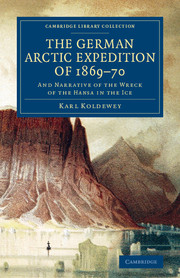
This heavily illustrated book is an account of a German Arctic expedition, published in 1873–4 by its commander Karl Koldewey (1837–1908) and in this English translation in 1874. The states of northern Germany had a long tradition of trade and exploration in northern waters. As the German empire came into being, two major expeditions were launched, both commanded by Koldewey. The second, of 1869–70, consisted of two vessels, the Germania and the Hansa, a supply ship. The Hansa became separated in fog, failed to reach the fallback rendezvous, was icebound, and finally sank, while the crew survived for nine months on a diminishing ice floe until they reached the coast of Greenland in their surviving small boats. The Germania reached the north of Greenland before encountering pack ice, and was successful in surveying the coast and collecting botanical specimens, before returning safely in 1870.
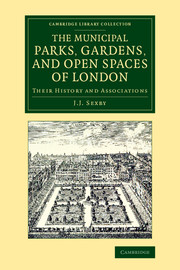
This survey, and fascinating history, of the public green spaces of London was published in 1898. Its author, John J. Sexby, the Chief Officer of Parks of the London County Council, is described as a lieutenant-colonel and a professional associate of the Surveyors' Institution, from which it can be deduced that he probably worked as a surveyor in the army. His skills as a horticulturalist and garden designer cannot be doubted, and he left his mark on many of the municipal parks and gardens about which he writes with such enthusiasm. Sexby focuses on the municipal parks (those maintained by local authorities) rather than the nationally managed parks in central London. He describes large open spaces such as Hampstead Heath as well as small, disused churchyards like that of St Dunstan's in Stepney, providing details of their former owners and use as well as their present condition.
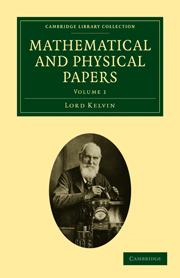
William Thomson, first Baron Kelvin (1824–1907), is best known for devising the Kelvin scale of absolute temperature and for his work on the first and second laws of thermodynamics, though throughout his 53-year career as a mathematical physicist and engineer at the University of Glasgow he investigated a wide range of scientific questions in areas ranging from geology to transatlantic telegraph cables. The extent of his work is revealed in the six volumes of his Mathematical and Physical Papers, published from 1882 until 1911, consisting of articles that appeared in scientific periodicals from 1841 onwards. Volume 1, published in 1882, includes articles from the period 1841–1853 and covers issues relating to heat, especially its linear motion and theories about it. Other topics include aspects of electricity, thermodynamics and research relating to magnetism.
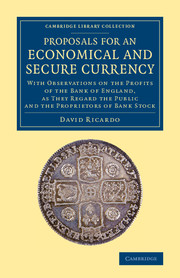
David Ricardo's work on currency was published in 1816, and this second edition appeared in the same year. Enormously successful as a stockbroker, Ricardo (1772–1823) was able to lead the life of a wealthy country squire, while his intellectual interests caused him to move in the circles of Thomas Malthus and James Mill. Written at the urging of the Cornish businessman Pascoe Grenfell, MP, who shared Ricardo's interest in financial matters, this work considers the problem of the national debt, in the context of paper money and whether it should in principle be exchanged at face value for gold bullion rather than for minted coins. Ricardo was very concerned at the large profits being made by the Bank of England in its dealings with the government, and suggests here the creation of an independent central bank, a proposal to which he later returned.
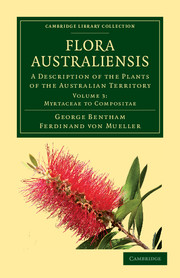
George Bentham (1800–84) was one of Britain's most influential botanists, whose own collection of plant specimens numbered more than 100,000. Although he donated his herbarium to the Royal Botanic Gardens, Kew in 1854, he continued to make significant contributions to the field, including this exhaustive, seven-volume work detailing the plant life of Australia, which was published from 1863 to 1878. It was part of a series of works commissioned by the British government to document the flora in its colonies. Using the extensive numbers of specimens at Kew - and with the help of Ferdinand Mueller (1825–96), a German botanist in Australia - Bentham was able to compile descriptions of more than 8,000 species of Australian plants, making these volumes the first completed compendium of the flora of any large continental area. Volume 3, published in 1866, describes 14 orders of dicotyledon flora in the subclasses polypetalae and monopetalae.
This work, originally published in 1817, is one of the founding texts of modern economics. Enormously successful as a stockbroker, David Ricardo (1772–1823) was able to lead the life of a wealthy country squire, while his intellectual interests caused him to move in the circles of Thomas Malthus and James Mill. It was at Mill's urging that Ricardo published this book, entered Parliament in 1819 (as an independent member for a rotten Irish borough) and worked for financial and parliamentary reform. Ricardo argues in this work that Adam Smith was mistaken in his understanding of the economic significance of rent, and also demonstrates the mutual benefit of free trade between countries, as against protectionism. The book's findings and conclusions have been controversial since its publication, but led John Stuart Mill to judge Ricardo 'the greatest political economist'.
The physician and author John Ayrton Paris (1785–1856), several of whose other medical and popular works have been reissued in the Cambridge Library Collection, published the first edition of this book in 1812. It was immediately successful, and went into eight further editions until 1843: this reissue is of the 1820 third edition. Many volumes on materia medica existed at the time, and Paris claims in his preface that he is not disparaging these competitor works, but that they presume too much prior knowledge on the part of the reader. His own work is designed to inform the student of the properties and effects of each medicinal substance, and how they function, both alone and in combinations. This will lead to greater understanding of the efficacy of medicines, and also help to prevent their adulteration. The qualities of each ingredient are discussed, and formulae and doses provided.
A Historical View of the Condition of the Greek Nation, from the Time of its Conquest by the Romans until the Extinction of the Roman Empire in the East
A philhellene who took part in the Greek war of independence alongside Lord Byron, George Finlay (1799–1875) later published this work on the country's ancient history in 1844. The text covers political, religious and social life in Greece from the Roman conquest of 146 BCE until 717 CE, the beginning of the Isaurian dynasty of the Byzantine Empire. By focusing on the many ways in which Greece differed from Rome, Finlay demonstrates that the Roman Empire was by no means homogenous in terms of culture or political organisation, and that these differences contributed to the more obvious divides between the eastern and western empires, not only in terms of social life and government but also in terms of their ultimate demise. Also reissued in this series are Finlay's History of the Greek Revolution (1861) and his seven-volume History of Greece (1877), covering the period from the Romans to 1864.
Although astronomical guides were available in the early nineteenth century, they tended to come from continental presses and were rarely in English. This two-volume work by the clergyman and astronomer William Pearson (1767–1847) aimed, with brilliant success, to compile data from extant sources into one of the first English practical guides to astronomy. Most of the tables were updated and improved versions, and some were wholly reconstructed to streamline the calculation processes. Sir John Herschel dubbed it 'one of the most important and extensive works on that subject which has ever issued from the press', and for his efforts Pearson was awarded the gold medal of the Astronomical Society. First published in 1829, Volume 2 provides full descriptions of a range of astronomical instruments, alongside instructions for their use and some pertinent equations and tables. In the history of science, Pearson's work reflects the contemporary challenges of celestial study.
Joseph-Louis Lagrange (1736–1813), one of the notable French mathematicians of the Revolutionary period, is remembered for his work in the fields of analysis, number theory and mechanics. Like Laplace and Legendre, Lagrange was assisted by d'Alembert, and it was on the recommendation of the latter and the urging of Frederick the Great himself that Lagrange succeeded Euler as the director of mathematics at the Prussian Academy of Sciences in Berlin. The two-volume Mécanique analytique was first published in 1788; the edition presented here is that of 1811–15, revised by the author before his death. In this work, claimed to be the most important on classical mechanics since Newton, Lagrange developed the law of virtual work, from which single principle the whole of solid and fluid mechanics can be derived.
Described by the London Chronicle as 'the genteelest thief ever remembered at the Old Bailey', during the 1770s the dandy, actor and pickpocket George Barrington acquired infamy throughout Great Britain. His prosecution and conviction in 1790 merely served to intensify popular interest and ensured that when in 1802 the account of his transportation to Australia was published, reading audiences responded with hearty enthusiasm. After prefacing his volume with a concise and useful history of New South Wales, the author regales readers with tales of murder, theft, punishment and retribution. These bloody episodes, combined with engaging, albeit prejudiced, notes on the indigenous population, found favour with European readers and twenty years of serialisations, new editions and translations followed. Punctuated by quirky vignettes and unusual coloured plates, Barrington's narrative continues to entertain and inform anyone with an interest in British colonial, maritime or criminal history.