A collection of out-of-copyright and rare books from the Cambridge University Library and other world-class institutions that have been digitally scanned, made available online, and reprinted in paperback.
To save content items to your account,
please confirm that you agree to abide by our usage policies.
If this is the first time you use this feature, you will be asked to authorise Cambridge Core to connect with your account.
Find out more about saving content to .
To save content items to your Kindle, first ensure no-reply@cambridge.org
is added to your Approved Personal Document E-mail List under your Personal Document Settings
on the Manage Your Content and Devices page of your Amazon account. Then enter the ‘name’ part
of your Kindle email address below.
Find out more about saving to your Kindle.
Note you can select to save to either the @free.kindle.com or @kindle.com variations.
‘@free.kindle.com’ emails are free but can only be saved to your device when it is connected to wi-fi.
‘@kindle.com’ emails can be delivered even when you are not connected to wi-fi, but note that service fees apply.
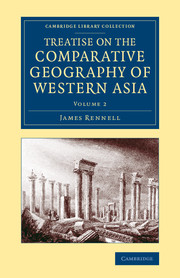
James Rennell (1742–1830) could be claimed as the father of historical geography. After a long career at sea and in India, during which he had learned surveying and cartography, he returned to England, and entered the circle of Sir Joseph Banks, who encouraged him to widen the his interests to include the geography of the ancient world. This two-volume work was published posthumously in 1831: Rennell had been working on the topic for many years, and had published a part of his findings in 1814, as Observations on the Topography of the Plain of Troy, also reissued in this series. The area covered in the treatise is a wide one, from Egypt to the Danube and from the Aegean to the Caspian Sea. In Volume 2, Rennell surveys the Greek and Roman territories of Asia Minor, and considers in detail the Roman road network of the area.
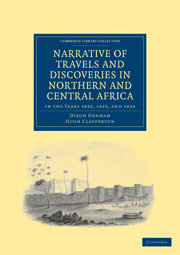
Major Dixon Denham (1786–1828) and Lieutenant Hugh Clapperton (1788–1827) were British explorers famous for their explorations in Africa. Between 1822 and 1825, they set out to investigate the lower course of the River Niger and the swamps and forests of the Guinea Coast, accompanied by the physician Dr Walter Oudney (1790–1824), who sadly died of a fever during the expedition. This important book, first published in 1826, brings together the memoirs of all three explorers to document their mission, which represented the first complete crossing of the Sahara by Europeans in recorded history. Diverse and insightful, it recounts phenomena such as the transportation of slaves from the Sudan, the salt industry in the heart of the desert, and encounters with native tribes. Providing unique insights into pre-colonial Africa, these vivid recollections remain of great interest to historians of Africa, cultural anthropologists and geographers alike.
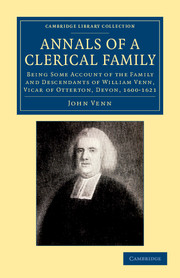
John Venn (1834–1923), a leading British logician, moral scientist and historian of Cambridge, came from a noted family of clerics, although he resigned from the clergy as his philosophical studies led him away from Anglican orthodoxy. This family memoir, published in 1904, covers the careers of three centuries of Venn clergy, together with an outline of the family origins and pedigrees. The family came from Devon, where William Venn was ordained in 1595, and two of his sons followed him. Richard Venn was displaced and jailed during the Commonwealth. The author's father, John, was the founder of an evangelical sect at Clapham (where his father Henry had also been curate), and of the Church Missionary Society, an organisation in which the author's brother, Henry, played a leading role. The study provides a microcosmic history of the Anglican Church from the Reformation to the end of the nineteenth century.
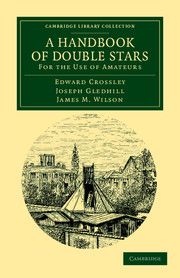
Used to describe both binary systems and optical doubles, the term 'double star' has been familiar to astronomers since the seventeenth century. This book, first published in 1879, outlines the history of their study, and describes the methods and equipment needed in order to observe the fascinating phenomenon. Written for non-specialists by Fellows of the Royal Society Edward Crossley (1841–1904), Joseph Gledhill (1837–1906) and James M. Wilson (1836–1931), the catalogue of over 1,200 double stars appears beside detailed notes and does not assume mathematical expertise. Also offered are a fully worked example of how to find the orbit of a binary star, and illustrations of telescopes, observatories, and even custom-made observation chairs. This reissue includes the supplement with corrections and notes published in 1880. A standard reference text in the late nineteenth century, the work remains a resources for students and scholars of the history of astronomy.
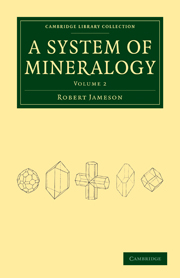
Robert Jameson (1774–1854) was a renowned geologist who held the chair of natural history at Edinburgh from 1804 until his death. A pupil of Gottlob Werner at Freiberg, he was in turn one of Charles Darwin's teachers. Originally a follower of Werner's influential theory of Neptunism to explain the formation of the earth's crust, and an opponent of Hutton and Playfair, he was later won over by the idea that the earth was formed by natural processes over geological time. He was a controversial writer, accused of bias towards those who shared his Wernerian sympathies such as Cuvier, while attacking Playfair, Hutton and Lyell. He built up an enormous collection of geological specimens, which provided the evidence for his System of Mineralogy, first published in 1808 and here reprinted from the second edition of 1816. Volume 2 continues 'earthy minerals' and covers saline and inflammable minerals, including coals.
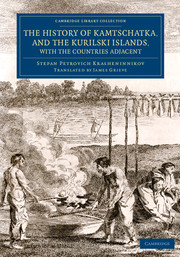
James Grieve (1703–63), physician to Catherine the Great of Russia, and translator of this book, published posthumously in English in 1764, apologises in his 'Advertisement' for the crudeness and rambling nature of Stepan Krasheninnikov's original work, which nevertheless contains 'many very useful remarks, greatly contributing to the improvement of the trade, geography, and natural history, of the country he describes'. In 1755, Krasheninnikov (1711–55) had published his account of an expedition to Kamchatka between 1733 and 1743, under Vitus Bering, to increase knowledge of regions to the east, in particular whether a sea route to North America could be established. Krasheninnikov was to serve as a naturalist on the expedition, but he also took a keen interest in the geography, history and people of the lands he passed through. His narrative is a fascinating and detailed account of a huge area virtually unknown to the western world.
Sir Charles Bruce (1836–1920) was a civil servant and colonial administrator who served for thirty-six years in various administrative and governing roles in Mauritius, Sri Lanka, the West Indies and Guyana. These volumes, first published in 1910, contain Bruce's discussions of the major problems of colonial administration. He provides a detailed survey of the development of national and colonial policy from 1815 to 1868 and imperial policy from 1868 to 1872, illustrating the historical context of late nineteenth-century colonial administration. Bruce then discusses in detail topics of importance to colonial administrators, including Crown law, labour and health, illustrating solutions to problems from his considerable experience. These volumes were intended as a reference work for students of colonial administration, and provide a wealth of information on the organisation and administration of British colonies in the nineteenth century. Volume 2 contains his discussion of education, communications, the fiscal system and commerce.
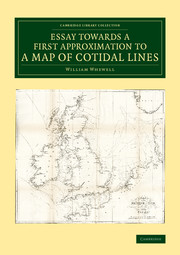
Cotidal lines are lines on a map which connect points at which the same tidal level occurs simultaneously. Isaac Newton had explained the movement of the tides by the action of the moon and sun, and Daniel Bernoulli had used Newton's findings to create tide tables for specific locations, but William Whewell wanted to take research further by gathering and analysing information which would link cotidal points or lines across the world. Fellow and eventually Master of Trinity College, Cambridge, Whewell (1794–1866) published this work in 1833. In it he proposes various observations that would need to be undertaken to produce a cotidal map, with detailed descriptions of the factors to be taken into account in computing the results. In 1837, Whewell, several of whose other works are also reissued in this series, was awarded a royal prize medal by the Royal Society for his work on 'tidology'.
Under the terms of the will of the Oxford scholar Francis Henry, Earl of Bridgewater (1756-1829), a series of works was commissioned, designed to contribute to an understanding of the world as created by God. In 1834 Peter Roget, who was at the time compiling his celebrated Thesaurus, contributed two volumes to that controversial series, of which this is the first. He described in a manner designed to appeal to a wide audience the variety and complexity of the mechanical processes of the plant and animal kingdoms. Particular attention is given to those areas where animal life reveals something about human life and the man-made world, emphasising the magnificence of the all-encompassing creative process behind it. The plant kingdom is examined with the goal of establishing the mechanics behind the beauty of plant life as created by God.
The influence of John Ruskin (1819–1900), both on his own time and on artistic and social developments in the twentieth century, cannot be over-stated. He changed Victorian perceptions of art, and was the main influence behind 'Gothic revival' architecture. As a social critic, he argued for the improvement of the condition of the poor, and against the increasing mechanisation of work in factories, which he believed was dull and soul-destroying. The thirty-nine volumes of the Library Edition of his works, published between 1903 and 1912, are themselves a remarkable achievement, in which his books and essays - almost all highly illustrated - are given a biographical and critical context in extended introductory essays and in the 'Minor Ruskiniana' - extracts from letters, articles and reminiscences both by and about Ruskin. This thirty-fourth volume contains essays and lectures including 'The Storm-Cloud of the Nineteenth Century'.
When this work first appeared in 1767, electricity was seen as such a minor aspect of natural philosophy that its investigation was not considered a priority for contemporary scientists. The polymath Joseph Priestley (1733–1804) was one of the few who devoted serious effort to advancing the field. Here he charts the history of electrical study from experiments with amber in ancient Greece to the most recent discoveries. The book comprises explanations of the principal theories of electricity - both historical and contemporary - in addition to a selection of well-known experiments carried out by previous researchers. Priestley also details his own experiments, covering such topics as the colour of electric light, the effects of temperature, and even the musical tone of electrical discharges. One of his most successful works, testifying to the clarity of his explanations, the book remains an important text in the history of science.
Dr Elisha Kane (1820–57), the most famous of American Arctic explorers before Peary, published this work in 1853. Having graduated from medical school, Kane joined the US Navy in 1843, and in 1850 was appointed senior medical officer on the expedition financed by the philanthropist Henry Grinnell to search for Sir John Franklin. Kane had departed on a second expedition while this book was in press, and he continued his Arctic travels, to the detriment of his health, until the year before his early death. In this work, Kane describes the origins of the expedition in the worldwide appeal by Lady Franklin, and, using his own journals, gives a vivid account of a winter spent icebound in the Arctic. Among the appendices is the official report of the expedition's commander, Lieutenant De Haven. Though Franklin's first winter camp was found, there were no further traces of his crew.
Joseph Spence (1699–1768) was ordained after graduating from Oxford, and having made the acquaintance of Alexander Pope, was helped by him to the professorship of poetry at Oxford, which he held for ten years from 1728. At the same time (and while holding the living of Birchanger in Essex) he began the first of several extended European journeys, accompanying nobility on the Grand Tour. He had published various literary works before his death in 1768, but left a number of manuscripts to be published at the discretion of his executors. They decided to take no action, but these anecdotes of Alexander Pope and his contemporaries came into the possession of a bookseller called Carpenter, who had them edited, and published them, prefaced with a life of Spence, in 1820. This is a fascinating compilation of anecdotes, aphorisms and biographical details about the most famous poet of his age.
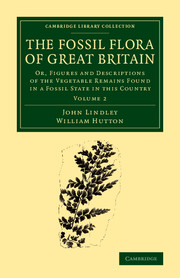
Employed early on in his career by Sir Joseph Banks, the botanist John Lindley (1799–1865) went on to conduct important research on the orchid family and also recommended that Kew Gardens should become a national botanical institution. This pioneering three-volume work of palaeobotany, first published between 1831 and 1837, catalogues almost 300 species of fossil plants from the Pleistocene to the Carboniferous period. The geologist and palaeontologist William Hutton (1797–1860), with whom Lindley collaborated, was responsible for collecting the fossil specimens from which the 230 plates were drawn. The first serious attempt at organising and interpreting the evidence of Britain's primeval plant life, this resource is notable also for its prefatory discussion of topics such as coal seams and prehistoric climate. Volume 2 opens with a preface on coal, followed by descriptions of some of the fossil plants found therein (plates 80-156).
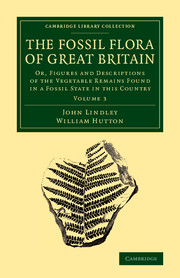
Employed early on in his career by Sir Joseph Banks, the botanist John Lindley (1799–1865) went on to conduct important research on the orchid family and also recommended that Kew Gardens should become a national botanical institution. This pioneering three-volume work of palaeobotany, first published between 1831 and 1837, catalogues almost 300 species of fossil plants from the Pleistocene to the Carboniferous period. The geologist and palaeontologist William Hutton (1797–1860), with whom Lindley collaborated, was responsible for collecting the fossil specimens from which the 230 plates were drawn. The first serious attempt at organising and interpreting the evidence of Britain's primeval plant life, this resource is notable also for its prefatory discussion of topics such as coal seams and prehistoric climate. Volume 3 includes a note on the action of water on plants. This is followed by the descriptions of plates 157–230.
Although a well-connected music teacher by profession, Charles Burney (1726–1814) gained greatest recognition for his writings on music. First published in 1771, this work recounts the 1770 journey that Burney undertook as one of two research trips for his General History of Music (1776–89). Eager to meet key composers of the day and to hear the latest music, Burney arrived in Paris in mid-June, soon moving on to Italy, where he spent the majority of his time. Naples, long a centre of musical excellence and then the focus of the new galant style, received particular attention. The whole account provides an invaluable first-hand insight into European musical life in the eighteenth century. Burney's General History and the record of his second tour, The Present State of Music in Germany, the Netherlands, and United Provinces, 2nd edition (1775), are also reissued in this series.
John Ross had disappeared while exploring the Northwest Passage in 1829. A lieutenant in the Royal Navy, George Back (1796–1878) had already served with John Franklin on two Arctic expeditions in 1819–22 and 1824–26. He volunteered to lead an expedition to find Ross, setting out in 1833. When Ross returned safely in 1834, Back continued his explorations down the unknown Great Fish River and mapped the Arctic coast westwards, travelling some 7,500 miles in total. Valuable observations on weather, geology, entomology, magnetics and aurora are included as appendices in this 1836 publication. Engravings of Back's own illustrations further enhance the narrative. Although described by some as an opportunist and a weak leader, Back was greeted as a hero on his return and awarded the gold medal of the Royal Geographical Society. The success of this expedition enabled him to head back to the Arctic in 1836.
In this 1922 book, the first of four on the history of Cambridge in the eighteenth and nineteenth centuries, D.A. Winstanley, a Fellow of Trinity College and leading historiographer, explored the close ties between the academic and political worlds in the mid-eighteenth century. The book focuses on the role and achievements of the Duke of Newcastle, a Whig politician, as Chancellor of the University during the period 1748 to 1768. It makes extensive use of primary sources including the Duke's own records, which provide valuable documentation not only about his own activities but also about wider issues. Winstanley gives a detailed account of the inner working structures of the university and the colleges, introduces some of the most significant Cambridge personalities, and assesses the Duke's contribution to the university's development. His book remains of lasting interest to historians of education and the university.
When George William Rusden (1819–1903) was fourteen, his family emigrated from England to Australia, where he later became a prominent educationalist and civil servant. Already an author of numerous books and pamphlets, he began work on his History of Australia after his retirement, and it was published in 1883 in three volumes. Although the work is considered sympathetic to the Aboriginal people of Australia, it is also infused with Rusden's Tory politics, infuriating his critics – one wrote that the volumes were 'as untrustworthy as a partisan pamphlet well can be without deliberate dishonesty'. Despite initial criticism, these wide-ranging volumes form an important early contribution to the writing of Australian history. Volume 2 continues Rusden's examination of earlier governors, starting with Ralph Darling (1772–1858) and ending with George Gipps (1791–1847), before discussing immigration, the end of the practice of transporting prisoners, and the discovery of gold.
James Rennell (1742–1830) could be claimed as the father of historical geography. After a long career at sea and in India, during which he had learned surveying and cartography, he returned to England, and entered the circle of Sir Joseph Banks, who encouraged him to widen the his interests to include the geography of the ancient world. This two-volume work was published posthumously in 1831: Rennell had been working on the topic for many years, and had published a part of his findings in 1814, as Observations on the Topography of the Plain of Troy, also reissued in this series. The area covered in the treatise is a wide one, from Egypt to the Danube and from the Aegean to the Caspian Sea. In Volume 1, Rennell lays out his geographical findings, and begins to discuss the relations of the modern to the ancient world.